Europe Interventional Oncology Market Size & Forecast:
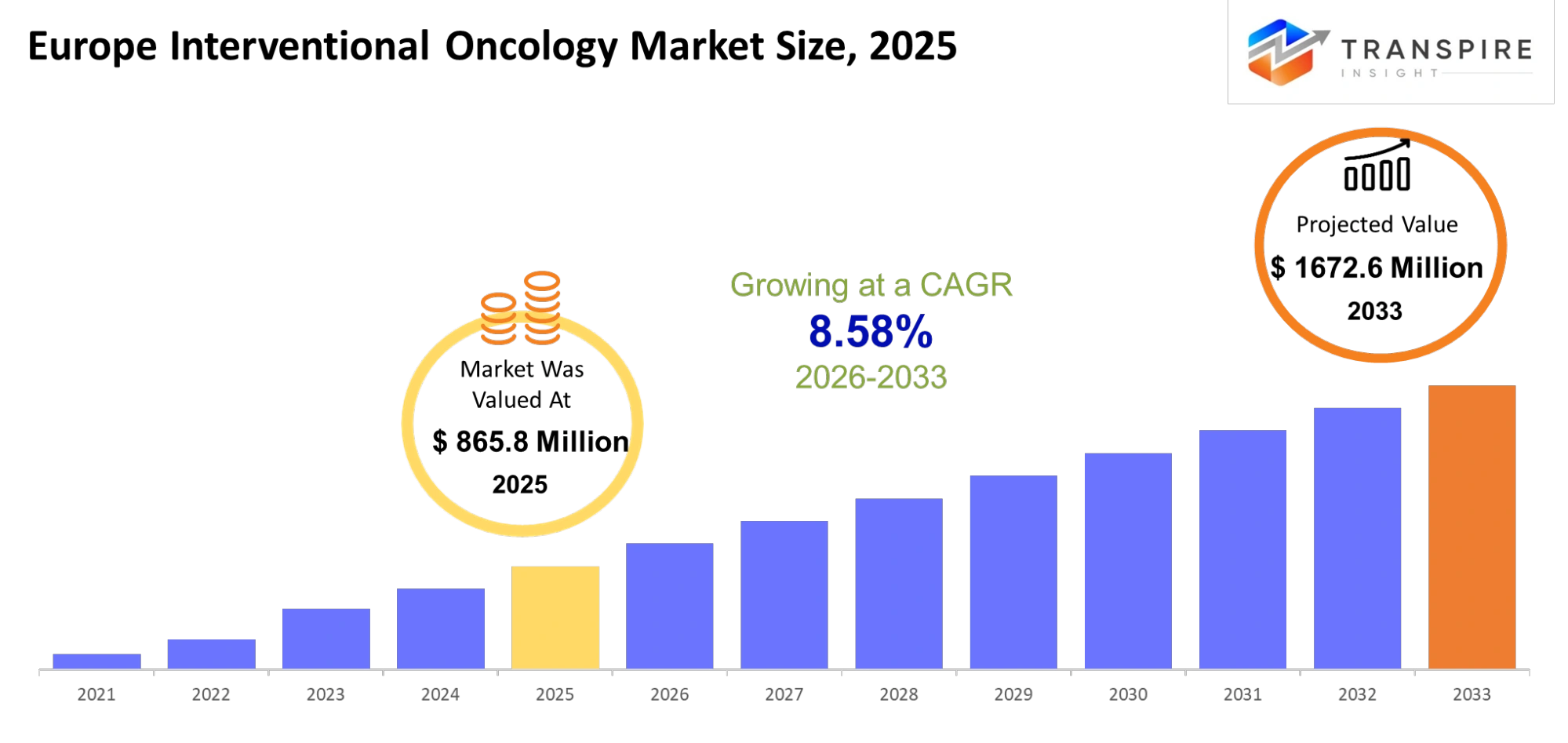
- Europe Interventional Oncology Market Size 2025: USD 865.8 Million
- Europe Interventional Oncology Market Size 2033: USD 1672.6 Million
- Europe Interventional Oncology Market CAGR: 8.58%
- Europe Interventional Oncology Market Segments: By Type (Embolization Devices, Ablation Devices, Radiotherapy Systems, Navigation Systems, Others); By Application (Liver Cancer, Lung Cancer, Kidney Cancer, Prostate Cancer, Bone Metastasis, Others); By End-User (Hospitals, Cancer Centers, Specialty Clinics, Research Institutes, Ambulatory Surgical Centers, Others); By Technology (Image-guided Therapy, Microwave Ablation, Radiofrequency Ablation, Cryoablation, Others)
To learn more about this report,  Download Free Sample Report
Europe Interventional Oncology Market Summary:
The Europe Interventional Oncology Market size is estimated at USD 865.8 Million in 2025 and is anticipated to reach USD 1672.6 Million by 2033, growing at a CAGR of 8.58% from 2026 to 2033.
The European interventional oncology sector for healthcare and medical device markets will operate between two medical sectors: precision medicine and minimally invasive treatment. European patients and clinicians will receive new methods to treat cancer through a treatment system which uses targeted therapies delivered by doctors through imaging techniques. The demand for medical services will shift towards treatment options that require less time in hospitals while delivering customized results, which will drive healthcare providers to implement new ablation and embolization treatment systems. The European safety regulations and clinical evidence requirements will become stricter, which will determine how products enter the market.
What Has the Impact of Artificial Intelligence Been on the Europe Interventional Oncology Market?
Artificial intelligence technology has become the main factor determining how the European interventional oncology market develops, as it delivers substantial benefits through enhanced accuracy, increased operational capacity, and improved system performance. The European interventional oncology market now uses artificial intelligence to conduct advanced imaging analysis which helps doctors identify tumors at earlier stages and plan their less invasive medical procedures with improved precision.
The European interventional oncology market benefits from smart automation and machine learning technologies because they develop operational workflows that extend beyond their clinical advantages. The hospitals and device manufacturers are implementing AI-powered systems to improve their operational efficiency while decreasing their operational inconsistencies and enhancing their supply chain management systems.
The result of this process has been decreased operational expenditures together with enhanced access to essential medical equipment. Artificial intelligence drives European interventional oncology market strategies to develop new medical solutions through its ability to create customized treatment plans and support evidence-based medical choices. The organizations which use AI-based insights to drive their operations have gained a competitive edge which will help them expand throughout the European interventional oncology market through advanced technology and greater business adaptability.
Key Market Trends & Insights:
- Western Europe controls the Europe interventional oncology market because it possesses advanced healthcare infrastructure which enables it to maintain 45% of market share in 2024.
- Eastern Europe shows the highest growth rate among all regions because it will achieve more than 10%Compound Annual Growth Rate during the forecast period due to its expanding oncology care facilities.
- The Europe interventional oncology market is dominated by ablation devices which hold approximately 40% market share because more medical professionals are using minimally invasive tumor destruction methods.
- Embolization devices maintain their position as the second most popular treatment option because they receive increasing usage for liver cancer and targeted therapy treatments.
- The image-guided systems segment grows at the fastest rate because it will experience rapid growth until 2030 through its AI-based precision technology improvements.
- The Europe interventional oncology market shows its highest demand for liver cancer applications which account for more than 35% market share because of their high procedure volume and successful clinical outcomes.
- The European continent experiences its fastest growing application through lung cancer interventions which increase their presence because more people develop lung cancer and early detection programs advance.
- The hospital sector controls more than 60% of interventional radiology services in 2024 because hospitals have built advanced interventional radiology systems.
- Specialty cancer centers experience the fastest growth among end-user segments because they provide personalized treatments and develop specialized care delivery systems.
- Emerging European economies provide companies with regional expansion opportunities which enable them to reach new customers while increasing their market share.
Europe Interventional Oncology Market Segmentation
By Type:
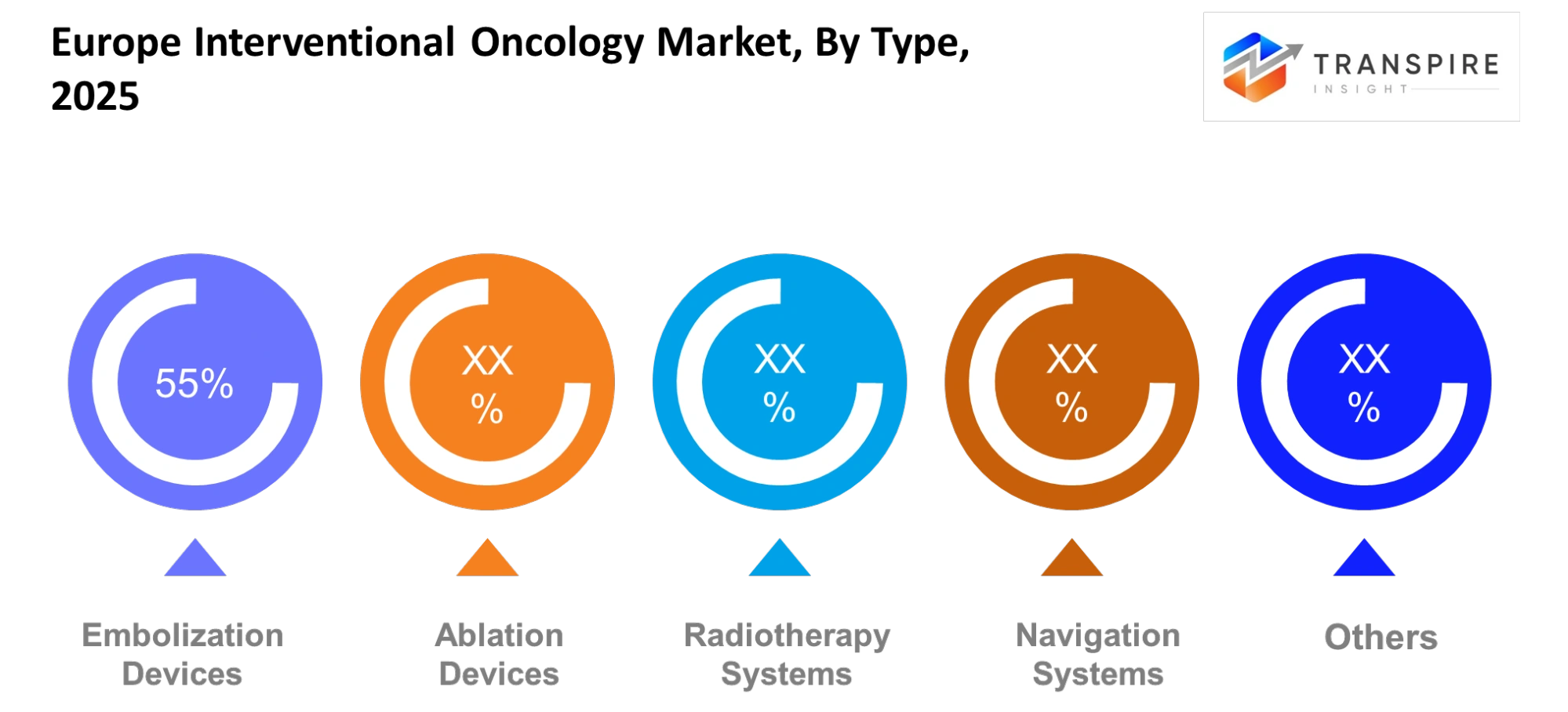
The Europe interventional oncology market depends mainly on embolization devices and ablation devices because these technologies enable doctors to target tumors with high accuracy while patients experience shorter recovery periods. The operational function of radiotherapy systems and navigation systems will validate complex case assessments whereas other device categories will maintain their capacity to meet specific clinical requirements across various treatment environments.
To learn more about this report, Download Free Sample Report
By Application:
The European interventional oncology market will experience a major increase in liver cancer treatment because hospitals perform numerous procedures with established medical techniques. The application of lung and kidney cancer treatments will grow at a steady pace while prostate cancer and bone metastasis treatments will become more popular because new detection methods and targeted treatment strategies emerged.
By End-User:
The European interventional oncology market will operate through hospitals which benefit from advanced imaging systems and highly trained medical staff. The demand for specialized treatment will drive the development of cancer centers and specialty clinics whereas research institutes and ambulatory surgical centers will enhance innovation and distribute outpatient medical services.
By Technology:
The European interventional oncology market will develop through image-guided therapy which enhances both treatment accuracy and treatment planning. Microwave and radiofrequency ablation will remain widely used, while cryoablation will gain traction for specific tumor types. The medical field will continue to develop new technologies which create safer and more effective medical procedures.
What are the Main Challenges for the Europe Interventional Oncology Market Growth?
The Europe interventional oncology market currently faces significant technical and operational challenges which prevent its full market entry. The procedures depend on exact imaging and equipment synchronization because any performance issue will result in negative effects on patient results. Healthcare facilities experience multiple challenges because their product performance standards differ from actual usage conditions and their treatment methods follow complicated processes. The European market for interventional oncology faces multiple supply chain issues. These supply chain issues include component shortages and imaging system delays. These issues combine to create supply chain problems which disrupt European market growth for interventional oncology.
The European interventional oncology market faces two major development obstacles which include manufacturing barriers and commercialization restrictions. The European Union enforcement of strict regulatory standards requires companies to validate their products through extensive clinical testing while maintaining quality control standards. Manufacturers experience financial challenges because the production expenses for advanced ablation systems and navigation systems exceed their production costs. The market restrictions create pricing problems which prevent smaller businesses from achieving competitive market presence through business expansion.
The healthcare infrastructure in several areas leads to major problems which prevent people from using healthcare. The European interventional oncology market needs qualified interventional radiologists and advanced medical facilities which have uneven geographical distribution. Public healthcare systems face budget limitations which restrict treatment access as innovation funding remains insufficient. The clinical advantages of the treatment fail to eliminate existing obstacles which block treatment development.
The European interventional oncology market experiences competitive threats from both traditional surgical methods and systematic treatment options.The future risks are charmed in ardent technological change and dynamic stakeholder demands for perpetual investments in innovation and compliance.
Regional Insights
The European interventional oncology market will primarily develop in Western Europe because the region has established healthcare systems and spends more on healthcare and uses advanced interventional procedures. Germany and France and the United Kingdom will create technology integration through their skilled professionals and their ongoing investments in oncology care infrastructure.
European development will demonstrate which populations have better access to different technologies than other groups. The southern and eastern regions of the country will experience steady development because healthcare policies will improve and modern treatment facilities will receive gradual funding increases. Training programs will expand and cross-border collaboration will enhance knowledge transfer and clinical results across different countries.
The healthcare modernization initiatives will determine how distribution systems will develop in the future. Healthcare systems will evolve because they will support funding for medical infrastructure and healthcare systems will implement less invasive treatment methods. The need for precise cancer treatment will drive the growth of different regions which will lead to equal development of established and developing medical systems.
Recent Development News
In April 2026, Boston Scientific reported earnings changes. The company lowered its 2026 profit and revenue growth forecast due to competitive pressure and weaker segment performance, reflecting shifting market conditions. https://www.reuters.com
In April 2026, Medtronic announced it was recognized as a LinkedIn Top Company 2026 across key European markets including the Netherlands, the United Kingdom, and Germany. The recognition highlights its strong workforce development and continued innovation presence in regional healthcare technology sectors. https://news.medtronic.com
|
Report Metrics |
Details |
|
Market size value in 2025 |
USD 865.8 Million |
|
Market size value in 2026 |
USD 865.8 Million |
|
Revenue forecast in 2033 |
USD 1672.6 Million |
|
Growth rate |
CAGR of 8.58% from 2026 to 2033 |
|
Base year |
2025 |
|
Historical data |
2021 - 2024 |
|
Forecast period |
2026 - 2033 |
|
Report coverage |
Revenue forecast, competitive landscape, growth factors, and trends |
|
Regional scope |
Europe (Germany, United Kingdom, France, Italy, Spain, Rest of Europe) |
|
Key company profiled |
Boston Scientific, Medtronic, Johnson & Johnson, Siemens Healthineers, GE Healthcare, Philips, AngioDynamics, Merit Medical, Cook Medical, Terumo, Stryker, Varian, Elekta, BD, Abbott |
|
Customization scope |
Free report customization (country, regional & segment scope). Avail customized purchase options to meet your exact research needs. |
|
Report Segmentation |
By Type (Embolization Devices, Ablation Devices, Radiotherapy Systems, Navigation Systems, Others); By Application (Liver Cancer, Lung Cancer, Kidney Cancer, Prostate Cancer, Bone Metastasis, Others); By End-User (Hospitals, Cancer Centers, Specialty Clinics, Research Institutes, Ambulatory Surgical Centers, Others); By Technology (Image-guided Therapy, Microwave Ablation, Radiofrequency Ablation, Cryoablation, Others) |
How Can New Companies Establish a Strong Foothold in the Europe Interventional Oncology Market?
New entrants aiming to gain traction in the europe interventional oncology market will need a focused and differentiated approach rather than broad competition with established players. Emerging companies will establish their initial credibility through their focus on specialized clinical requirements which include particular cancer types and medical facilities that lack basic services. The development of budget-friendly compact devices together with AI-powered imaging equipment will enable healthcare providers to deliver more affordable and precise medical solutions. The europe interventional oncology market maintains its requirement for medical solutions which enhance patient results through efficient procedure execution thus enabling flexible businesses to enter the market.
Strategic partnerships will play a critical role in overcoming entry barriers. Product validation and market access can be accelerated through collaborations with hospitals, research institutes, and local distributors. New companies entering the europe interventional oncology market will benefit from aligning with experienced clinical networks to strengthen trust and adoption. The development of training programs and user-friendly technologies will enable the company to penetrate the market because these initiatives will solve two main problems which include the shortage of qualified personnel and the existing infrastructure limitations.
The entry of new companies into the market demonstrates this method through their implementation. The company Quantum Surgical develops robotic surgical systems through its startup operations while Perfint Healthcare creates navigation systems which enhance targeting accuracy. Technology differentiation together with distinct value propositions serves as a foundation which enables businesses to achieve sustainable market expansion. The combination of ongoing innovation funding and location-specific business approaches will enable new businesses to establish permanent operations within the european interventional oncology sector.
Key Europe Interventional Oncology Market Company Insights
The European interventional oncology market will maintain intense competition because global medical device companies will establish their presence through advanced ablation and embolization and imaging technologies. The company will maintain its market leadership through ongoing product development and clinical proof of their products while their pricing choices and customer assistance systems will determine hospital and treatment facility purchasing behavior.
The European interventional oncology market will experience increased competition from mid-sized companies and emerging companies which deliver affordable technological solutions. The development of new navigation systems together with advanced image-guided therapy technologies will enable organizations to create unique products which their healthcare partners will use to distribute their products more effectively in industrialized and emerging markets.
The European interventional oncology market will experience transformation through strategic partnerships between organizations and their efforts to enter new markets and comply with regulatory requirements. Organizations will establish enduring relationships with healthcare professionals through their dedicated investment in research and development and educational initiatives. Organizations that prioritize efficiency and safety and user-friendly experiences will achieve market leadership in the competitive healthcare sector.
Company List
- Boston Scientific
- Medtronic
- Johnson & Johnson
- Siemens Healthineers
- GE Healthcare
- Philips
- AngioDynamics
- Merit Medical
- Cook Medical
- Terumo
- Stryker
- Varian
- Elekta
- BD
- Abbott
What are the Key Use-Cases Driving the Growth of the Europe Interventional Oncology Market?
The European interventional oncology market sees increased adoption because of its primary clinical applications which drive the development of minimally invasive tumor treatment. The medical field uses radiofrequency and microwave ablation procedures to treat liver and lung cancers because these techniques enable doctors to precisely target tumors while minimizing harm to healthy tissue. The applications of these technologies enable patients to recover faster from their medical procedures while hospitals achieve better operational results which helps to expand their market presence. The European interventional oncology market continues to grow because more people choose outpatient treatments that require less surgical intervention.
Transarterial embolization serves as a major use-case for the Europe interventional oncology market because it effectively treats liver tumors. The technique enables clinicians to stop blood flow to cancer cells while they give specific treatment which leads to better results. Advanced imaging systems are being incorporated into hospitals to improve their surgical procedures because these systems help doctors perform operations with better accuracy and higher success rates. Large hospitals and specialized cancer facilities are using the imaging and therapy combination as their standard treatment method.
Image-guided interventions have moved beyond their primary oncology functions to include palliative care and pain management applications. These use-cases address unmet needs in advanced cancer stages, offering symptom relief with fewer complications. The European interventional oncology market is experiencing innovative developments through AI-powered navigation systems and robotic assistance which will enhance operational efficiency in medical procedures. These technological advancements will create fresh possibilities which will help make medical treatments available to various types of healthcare facilities.
Europe Interventional Oncology Market Report Segmentation
By Type
- Embolization Devices
- Ablation Devices
- Radiotherapy Systems
- Navigation Systems
- Others
By Application
- Liver Cancer
- Lung Cancer
- Kidney Cancer
- Prostate Cancer
- Bone Metastasis
- Others
By End-User
- Hospitals
- Cancer Centers
- Specialty Clinics
- Research Institutes
- Ambulatory Surgical Centers
- Others
By Technology
- Image-guided Therapy
- Microwave Ablation
- Radiofrequency Ablation
- Cryoablation
- Others
Frequently Asked Questions
Find quick answers to common questions.
The approximate Europe Interventional Oncology Market size for the market will be USD 1672.6 Million in 2033.
Key segments for the Europe Interventional Oncology Market are By Type (Embolization Devices, Ablation Devices, Radiotherapy Systems, Navigation Systems, Others); By Application (Liver Cancer, Lung Cancer, Kidney Cancer, Prostate Cancer, Bone Metastasis, Others); By End-User (Hospitals, Cancer Centers, Specialty Clinics, Research Institutes, Ambulatory Surgical Centers, Others); By Technology (Image-guided Therapy, Microwave Ablation, Radiofrequency Ablation, Cryoablation, Others).
Major Europe Interventional Oncology Market players are Boston Scientific, Medtronic, Johnson & Johnson, Siemens Healthineers, GE Healthcare, Philips, AngioDynamics, Merit Medical, Cook Medical, Terumo, Stryker, Varian, Elekta, BD, Abbott.
The Europe Interventional Oncology Market size is USD 865.8 Million in 2025.
The Europe Interventional Oncology Market CAGR is 8.58%.
- Boston Scientific
- Medtronic
- Johnson & Johnson
- Siemens Healthineers
- GE Healthcare
- Philips
- AngioDynamics
- Merit Medical
- Cook Medical
- Terumo
- Stryker
- Varian
- Elekta
- BD
- Abbott
Recently Published Reports
-
Apr 2026
AI in Diabetic Retinopathy Market
AI in Diabetic Retinopathy Market Size, Share & Analysis Report By Type (Screening AI Systems, Diagnostic AI Systems, and Predictive AI Models), By Application Segment (Hospitals, Ophthalmology Clinics, Diagnostic Centers, and Research and Development), and Geography (North America, Europe, Asia-Pacific, Middle East and Africa, South and Central America), 2021 - 2031
-
Apr 2026
Psychometric Tests Market
Psychometric Tests Market Size, Share & Analysis Report By Type (Personality Tests, Ability/Aptitude Tests, Skill/Knowledge Tests, and Others), By Application (Talent Acquisition and Talent Management), and Geography (North America, Europe, Asia-Pacific, Middle East and Africa, South and Central America), 2021 – 2031
-
Apr 2026
Rare Biological Sample Collection Market
Rare Biological Sample Collection Market Size, Share & Analysis Report By Type (Isolation Kits & Reagent, Blood Collection Tubes, and Others), By Application (Oncology, Transcriptomics, Pharmacogenomics, and Others), and Geography (North America, Europe, Asia-Pacific, Middle East and Africa, South and Central America), 2021 – 2031
-
Apr 2026
Patient Lift Pendant Market
Patient Lift Pendant Market By Product Type (Wired Pendants, Wireless, Programmable), By Operation Type(Manual, Electric), By End-Users (Healthcare Professionals, Patients), By Application (Hospitals, Homecare, Rehabilitation Centers, Others), By Industry Analysis, Size, Share, Growth, Trends, and Forecasts 2021-2033
Our Clients
.jpg)