

North America Chronic Venous Occlusions Treatment Market Size & Forecast:
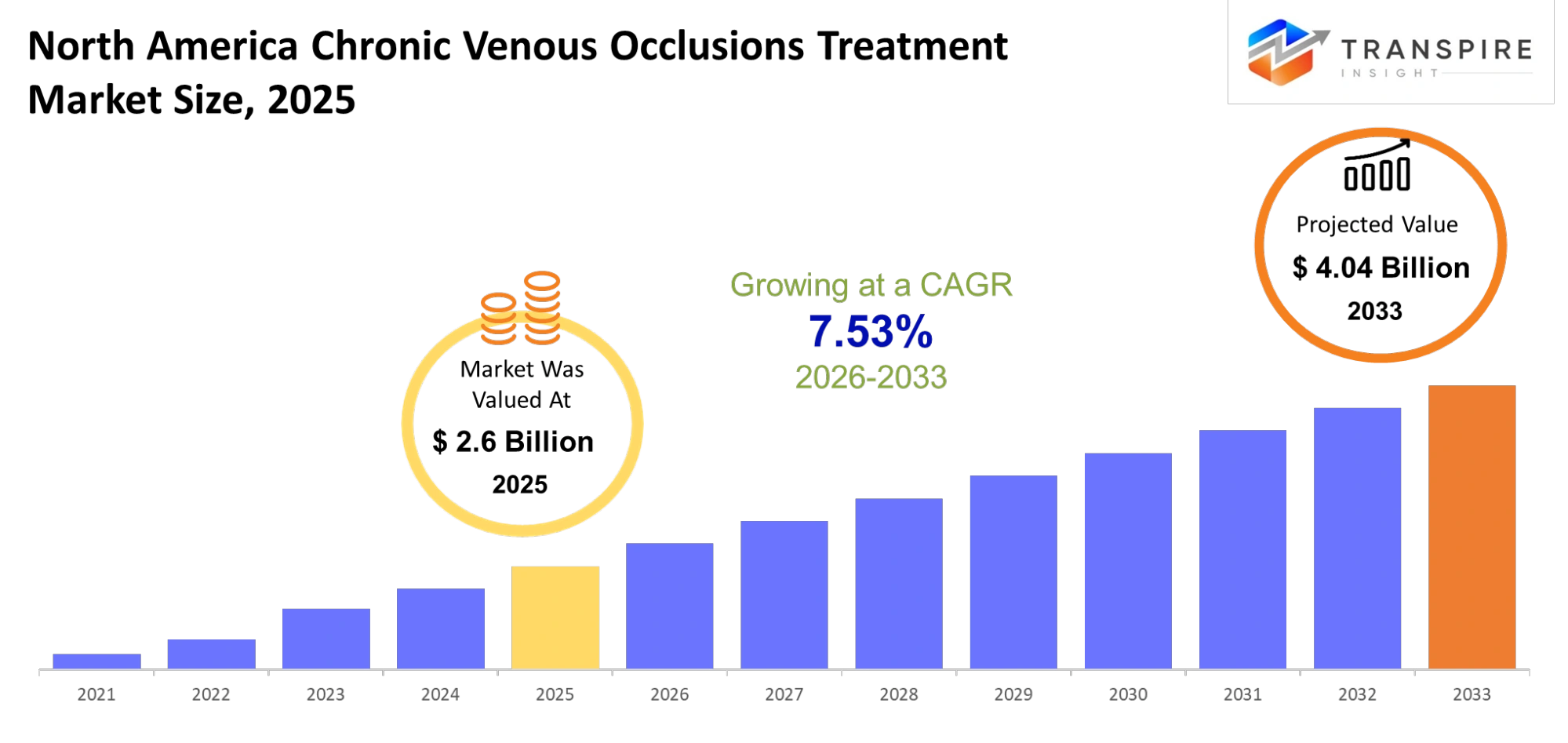
- North America Chronic Venous Occlusions Treatment Market Size 2025: USD 2.6 Billion
- North America Chronic Venous Occlusions Treatment Market Size 2033: USD 4.04 Billion
- North America Chronic Venous Occlusions Treatment Market CAGR: 7.53%
- North America Chronic Venous Occlusions Treatment Market Segments: By Type (Angioplasty, Stenting, Thrombolysis, Bypass Surgery, Others), By Application (Deep Vein Occlusion, Peripheral Veins, Dialysis Access, Others), By End-User (Hospitals, Clinics, Ambulatory Centers, Others), By Device (Catheters, Stents, Balloons, Guidewires, Others).
To learn more about this report,  Download Free Sample Report
North America Chronic Venous Occlusions Treatment Market Summary:
The North America Chronic Venous Occlusions Treatment Market size is estimated at USD 2.6 Billion in 2025 and is anticipated to reach USD 4.04 Billion by 2033, growing at a CAGR of 7.53% from 2026 to 2033. The North America Chronic Venous Occlusions Treatment Market experiences continuous expansion because more people develop venous disorders which affect aging individuals and those with deep vein thrombosis.
Patients achieve better treatment results because more people now understand how to recognize medical conditions early and access less invasive treatments which include endovascular recanalization and stenting. The development of imaging technologies together with catheter-based interventions enables healthcare facilities to implement more precise medical procedures which drive market growth.
The North America Chronic Venous Occlusions Treatment Market experiences another major shift because patients increasingly select outpatient treatments which require less time to recover. The medical device industry expands treatment options through its partnerships with healthcare facilities. The combination of positive regional reimbursement policies and active clinical studies leads to increased adoption of advanced medical treatments which will drive market growth over an extended period.
What Has the Impact of Artificial Intelligence Been on the North America Chronic Venous Occlusions Treatment Market?
The North America chronic venous occlusions treatment market receives new capabilities through fast-moving artificial intelligence development which enables improved clinical and commercial decision-making through data analysis. The northern american market for chronic venous occlusions treatment uses artificial intelligence to improve market research by analyzing large datasets which provide detailed information about patient demographics and treatment results and current market developments.
Stakeholders can use machine learning and predictive analytics to enhance their demand forecasting capabilities which enables them to identify fast-growing market segments and develop product development plans. The artificial intelligence system implementation into north american chronic venous occlusions treatment market ecosystems enables organizations to maintain their operational flexibility while competing effectively in their specialized medical sector.
Smart automation systems bring major benefits to operational efficiency which impacts all business processes in the north america chronic venous occlusions treatment market starting from production processes to supply chain operations. The AI-powered systems enhance production efficiency through streamlined operations which lead to decreased error rates and diminished operational expenses while their predictive analytics capabilities improve inventory management and distribution system performance.
AI contributes to treatment personalization by providing clinicians with real-time information and sophisticated imaging analysis tools which enhance patient treatment results. Artificial intelligence implementation in the north american chronic venous occlusions treatment market enables organizations to increase their operational efficiency while creating new business opportunities which result in sustainable competitive advantages.
Key Market Trends & Insights:
- The north america chronic venous occlusions treatment market is experiencing strong growth because post-thrombotic syndrome cases and chronic venous insufficiency cases continue to increase.
- The treatment landscape in hospitals and specialty clinics shows increased acceptance of endovascular stenting which represents a minimally invasive procedure.
- The market demand for medical products increases because technological developments in imaging and catheter-based systems improve procedural outcomes.
- The north america chronic venous occlusions treatment market demand arises from two main factors which include the increasing elderly population and the rising number of people who lead inactive lives.
- The market development across the region receives backing from two factors which include favorable reimbursement policies and healthcare infrastructure improvements.
- The United States dominates the north america chronic venous occlusions treatment market with over 80% share in 2025, driven by advanced healthcare systems.
- The region of Canada experiences its fastest growth because people become more aware of vascular treatments which now have better accessibility until 2030.
- Endovascular stents lead the market with approximately 45–50% share, reflecting high clinical effectiveness and increasing physician preference.
- The second-largest market share belongs to catheters and guidewires because they serve as vital components in performing minimally invasive medical interventions.
- The drug-coated balloon market segment will experience its fastest growth between 2025 and 2030 because of new clinical advantages that will develop during this period.
- Chronic venous insufficiency dominates with nearly 55% market share, driven by increasing diagnosis rates and treatment adoption.
- Post-thrombotic syndrome is the fastest-growing application, fueled by rising complications from untreated deep vein thrombosis cases.
North America Chronic Venous Occlusions Treatment Market Segmentation
By Type
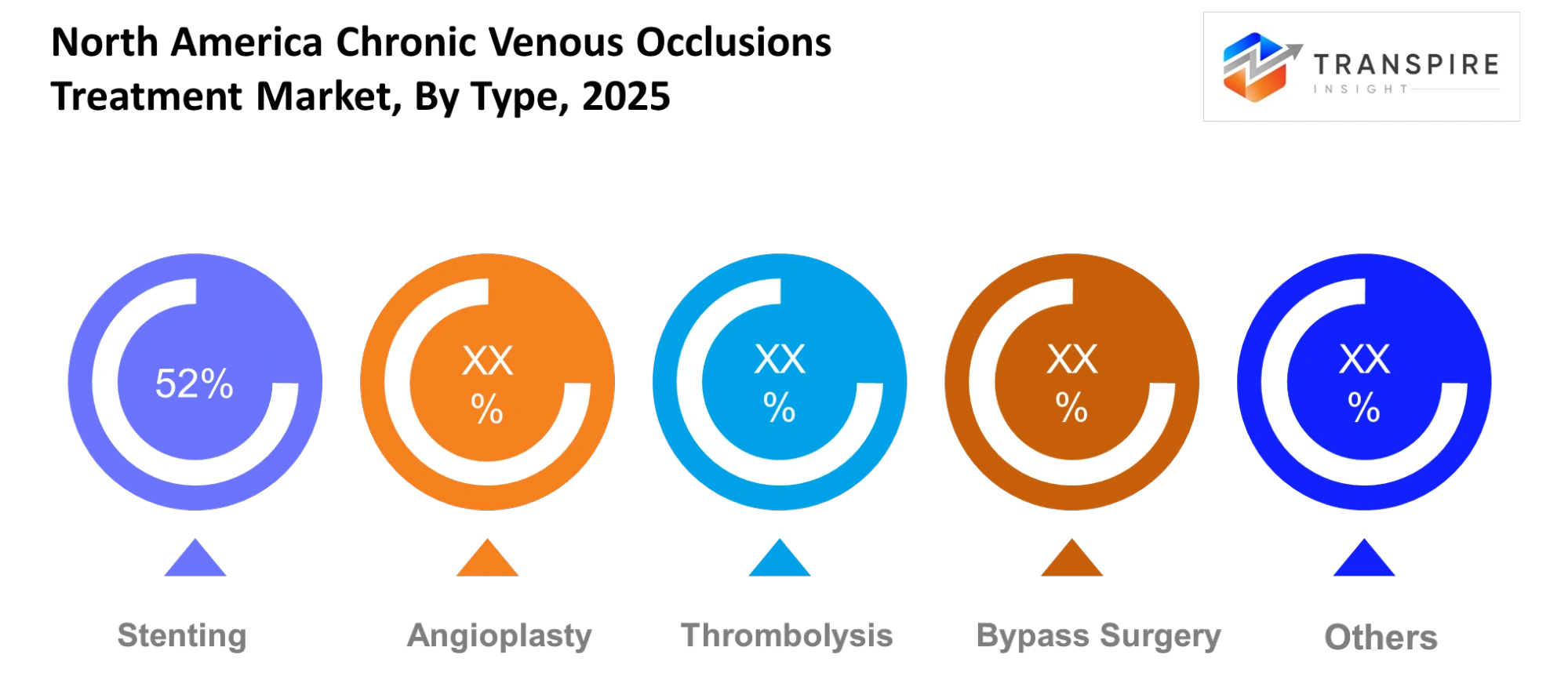
Doctors use angioplasty as a minimally invasive technique that uses balloons to open blocked veins and enhance blood circulation. Through stenting doctors use a small mesh tube to keep veins open which delivers long-term vascular support. Through thrombolysis doctors use special medications to dissolve blood clots which helps restore blood flow in affected areas.
Bypass surgery establishes an alternative blood circulation path which doctors use to move blood away from an arterial obstruction. Doctors will select their treatment methods according to the unique medical requirements of patients whose conditions they assess through their evaluation of patient severity and medical status. Physicians in the medical field will increasingly prefer minimally invasive techniques because angioplasty and stenting procedures allow patients to achieve faster recovery while experiencing reduced health issues.
Advanced medical conditions will require surgical methods to treat patients who do not respond to other treatment options. The ongoing development of treatment methods will lead to improved patient results and greater acceptance of medical procedures.
To learn more about this report, Download Free Sample Report
By Application
The main use of deep vein occlusion exists because lower limb vein blockages occur at a high rate. The treatment process for peripheral veins involves handling blockages that occur in their smaller veins which lead to circulation problems and physical discomfort. The purpose of dialysis access operations is to ensure patients receive correct blood flow throughout their extended dialysis sessions. The other applications address less common medical needs which still need prompt medical attention.
The need for treatment will rise across all areas because people become more aware of medical conditions and doctors obtain better diagnostic tools. The medical field considers deep vein conditions as highly important because untreated cases create dangerous health threats. The development of peripheral vein treatments will proceed at a steady rate because screening programs and early detection methods become more widely adopted. The number of dialysis procedures will increase because more patients need extended medical treatment.
By End-User
Doctors require hospitals as their main location to execute complex medical procedures which demand sophisticated tools and highly qualified personnel. Clinics deliver fundamental medical treatment together with ongoing medical support to treat patients with non-life-threatening medical conditions. Patients can receive same-day medical procedures at ambulatory centers which provide them better access to healthcare services while helping them save money.
The specialized care units which treat specific vascular conditions represent one of the additional user groups that will benefit from this service. Hospitals will continue their primary position because they possess the ability to treat dangerous patients and deliver complete medical services. Clinics will provide medical services which enable doctors to identify health problems early while patients receive their needed health services without needing to visit big healthcare centers.
The demand for outpatient services will increase because more people will need to undergo surgeries at ambulatory centers. The need for medical services which people can access and which provide efficient treatment will drive growth across all end-user segments.
By Device
Catheters function as common medical tools which enable direct administration of therapeutic materials and drugs into obstructed blood vessels. Stents play a key role in maintaining vessel patency during long-term blood circulation after doctors have completed their procedure to remove blockages. Balloons serve as devices which doctors use during angioplasty to treat patients by expanding their constricted veins and restoring normal blood flow. Guidewires assist medical professionals to control device movement through veins during surgical operations with accurate results.
The need for cutting-edge medical equipment will rise because hospitals are implementing less invasive treatment methods. Stents and balloons will experience significant market expansion because they help patients recover from medical procedures. Catheters and guidewires will remain essential components which medical procedures need to achieve successful outcomes. The ongoing development of new design solutions for medical devices will result in better safety performance together with increased operational efficiency and improved patient treatment results.
What are the Main Challenges for the North America Chronic Venous Occlusions Treatment Market Growth?
The north america chronic venous occlusions treatment market encounters major technical difficulties and operational problems that hinder its entire development process. The doctors who perform endovascular interventions must deliver exact results because the systems of their procedures require specific operational procedures to handle actual human attributes which create unpredictable results.
The extended success rates of medical devices experience negative effects from device performance problems which include restenosis risks and durability issues. The north america chronic venous occlusions treatment market sector faces operational challenges which arise from supply chain interruptions and the need for special parts. The north america chronic venous occlusions treatment market undergoes transformation because of two major obstacles which include manufacturing needs and commercialization requirements.
New product development processes experience delays because strict regulatory requirements demand businesses to meet both quality standards and clinical validation requirements. The advanced medical devices face production costs which prevent them from achieving widespread use and affordable pricing.The combination of market restrictions and reimbursement issues creates economic difficulties for manufacturers which results in decreased innovation progress throughout the healthcare sector.
The north america chronic venous occlusions treatment market faces major adoption challenges because of its existing insufficient infrastructure and its shortage of qualified personnel. The healthcare system requires both trained professionals and up-to-date medical facilities to execute advanced medical operations. Patient treatment development faces two main obstacles which include limited patient knowledge and the occurrence of delayed medical assessments. The combination of funding limitations with healthcare access disparities prevents organizations from adopting new technologies, which primarily affects remote underserved communities and creates ongoing obstacles to development.
Country Insights
The United States will hold the largest share because it maintains strong healthcare systems which enable early diagnosis and provide access to advanced treatment options. The industry will experience consistent demand because people know about vascular care and the field receives ongoing financial support. Major cities will experience better patient access and treatment outcomes because skilled specialists and modern hospitals will become available.
Canada will show stable growth supported by improving healthcare access and rising awareness of venous disorders. Government support and better screening programs will increase early detection and treatment rates. The expansion of outpatient care services will drive demand while the widespread adoption of minimally invasive procedures will enhance market growth throughout different regions.
Recent Development News
In April 2026, U.S. Regulators Fast-Track Coverage for Innovative Medical Devices: A new U.S. policy initiative will accelerate Medicare coverage for advanced medical devices, reducing approval timelines significantly. This move is expected to improve access to vascular and interventional treatments, supporting faster adoption of innovative therapies.
Source: https://www.reuters.com
In April 2026, Boston Scientific Revises 2026 Forecast Amid Competitive Pressure : Boston Scientific adjusted its 2026 revenue and profit outlook due to rising competition and weaker performance in key device segments. Despite the revision, quarterly earnings exceeded expectations, reflecting ongoing demand for cardiovascular technologies.
Source: https://www.reuters.com
|
Report Metrics |
Details |
|
Market size value in 2025 |
USD 2.6 Billion |
|
Market size value in 2026 |
USD 2.43 Billion |
|
Revenue forecast in 2033 |
USD 4.04 Billion |
|
Growth rate |
CAGR of 7.53% from 2026 to 2033 |
|
Base year |
2025 |
|
Historical data |
2021 – 2024 |
|
Forecast period |
2026 – 2033 |
|
Report coverage |
Revenue forecast, competitive landscape, growth factors, and trends |
|
Country scope |
North America (Canada, The United States, and Mexico) |
|
Key company profiled |
Medtronic, Boston Scientific, Abbott, Cook Medical, BD, Terumo, Cardinal Health, B. Braun, Merit Medical, AngioDynamics, Penumbra, Philips, GE Healthcare, Siemens Healthineers, Stryker |
|
Customization scope |
Free report customization (country, regional & segment scope). Avail customized purchase options to meet your exact research needs. |
|
Report Segmentation |
By Type (Angioplasty, Stenting, Thrombolysis, Bypass Surgery, Others), By Application (Deep Vein Occlusion, Peripheral Veins, Dialysis Access, Others), By End-User (Hospitals, Clinics, Ambulatory Centers, Others), By Device (Catheters, Stents, Balloons, Guidewires, Others). |
How Can New Companies Establish a Strong Foothold in the North America Chronic Venous Occlusions Treatment Market?
New entrants can establish strong market positions in the north american chronic venous occlusions treatment market by developing treatment solutions for patients who currently lack access to proper care and who need treatment for their medical conditions that remain unsatisfied. Companies that specialize in post-thrombotic syndrome and complex venous obstruction treatment will gain competitive advantage through their specialized expertise.
The adoption process will become easier when product designs match existing industry standards that require less invasive medical procedures. The emerging market players will build market trust through their value propositions which rely on clinical evidence. The chronic venous occlusions treatment market in North America will depend on innovation strategies to achieve market success. Advanced technologies which include AI-based imaging systems and smart catheters and upcoming stent models will enable companies to resolve present treatment challenges.
Startups like Vesper Medical have dedicated their efforts to creating venous stent systems which help patients achieve better long-term health results. The process of targeted innovation develops solutions which address critical problems that cause restenosis and operational delays, which helps businesses gain better market positioning. The north american chronic venous occlusions treatment market will experience accelerated growth through strategic partnerships and collaborations.
The validation process will proceed at a faster pace when hospitals and research organizations and established medical device manufacturers work together. LimFlow demonstrates how emerging companies can use technology-based solutions and partnerships to expand their operations in complex vascular treatment areas. The business relationships will create better distribution systems which will enable more people to reach trained experts.
Key North America Chronic Venous Occlusions Treatment Market Company Insights
The medical device industry will experience growth through two factors which include intense competition and the commitment of top companies to develop new products and maintain high product standards. Advanced stents and catheters and imaging tools will develop new treatment methods which will lead to better patient outcomes. Market leaders will invest in research and clinical trials to strengthen product portfolios and maintain position across major healthcare systems in the region.
Established companies and new market entrants will build competitive advantages through their partnership agreements and their efforts to enter new markets.Through hospital and research center collaborations products will achieve better clinical validation and adoption in medical settings. The business will determine its long-term success through its methods of setting prices and its distribution abilities and its ongoing development of new technologies. The smaller companies will compete in the market by focusing on specific areas and providing affordable products.
Company List
- Medtronic
- Boston Scientific
- Abbott
- Cook Medical
- BD
- Terumo
- Cardinal Health
- B. Braun
- Merit Medical
- AngioDynamics
- Penumbra
- Philips
- GE Healthcare
- Siemens Healthineers
- Stryker
What are the Key Use-Cases Driving the Growth of the North America Chronic Venous Occlusions Treatment Market?
North America chronic venous occlusions treatment market is growing because healthcare professionals use treatment methods for chronic venous insufficiency and post-thrombotic syndrome more frequently. Patients with these medical conditions need immediate treatment because they face risks of developing swelling and pain and forming ulcers. The use of angioplasty and venous stenting procedures which are less invasive has been shown to increase patient recovery results and decrease their time at medical facilities.
The strong clinical need for North America chronic venous occlusions treatment market products continues to drive market expansion. Dialysis access maintenance serves as another primary application that supports the North America chronic venous occlusions treatment market. Effective and long-lasting solutions are needed to treat vein blockages which develop in patients who require extended dialysis treatment.
Physicians can deliver accurate treatments through advanced catheter-based technologies which include imaging systems that create detailed vascular access management. This application functions to improve patient treatment results while enabling specialized treatment centers to sustain their market growth. The increasing popularity of outpatient services and ambulatory medical treatments is leading to new applications for North America chronic venous occlusions treatment market.
In favor of technology, a cost-effective and same-day treatment is being increasingly advocated by healthcare providers. The combination of AI-based imaging together with predictive analytics systems has enhanced both diagnostic capabilities and procedural execution precision. The innovative solutions create multiple pathways for expansion while raising the rate at which treatments receive implementation.
North America Chronic Venous Occlusions Treatment Market Report Segmentation
By Type
- Angioplasty
- Stenting
- Thrombolysis
- Bypass Surgery
- Others
By Application
- Deep Vein Occlusion
- Peripheral Veins
- Dialysis Access
- Others
By End-User
- Hospitals
- Clinics
- Ambulatory Centers
- Others
By Device
- Catheters
- Stents
- Balloons
- Guidewires
- Others
Frequently Asked Questions
Find quick answers to common questions.
The approximate North America Chronic Venous Occlusions Treatment Market size for the market will be USD 4.04 Billion in 2033.
The key segments of the North America Chronic Venous Occlusions Treatment Market are By Type (Angioplasty, Stenting, Thrombolysis, Bypass Surgery, Others), By Application (Deep Vein Occlusion, Peripheral Veins, Dialysis Access, Others), By End-User (Hospitals, Clinics, Ambulatory Centers, Others), By Device (Catheters, Stents, Balloons, Guidewires, Others).
Major players in the North America Chronic Venous Occlusions Treatment Market are Medtronic, Boston Scientific, Abbott, Cook Medical, BD, Terumo, Cardinal Health, B. Braun, Merit Medical, AngioDynamics, Penumbra, Philips, GE Healthcare, Siemens Healthineers, Stryker.
The current market size of the North America Chronic Venous Occlusions Treatment Market is USD 2.6 Billion in 2025.
The North America Chronic Venous Occlusions Treatment Market CAGR is 7.53%.
- Medtronic
- Boston Scientific
- Abbott
- Cook Medical
- BD
- Terumo
- Cardinal Health
- B. Braun
- Merit Medical
- AngioDynamics
- Penumbra
- Philips
- GE Healthcare
- Siemens Healthineers
- Stryker
Recently Published Reports
-
Apr 2026
Biosimilars Market
Biosimilars Market By Product Type (Monoclonal Antibodies, Recombinant Hormones, Erythropoietin, G-CSF, Others), By Indication (Oncology, Autoimmune Diseases, Blood Disorders, Diabetes, Others), By Manufacturing Type (In-House Manufacturing, Contract Manufacturing), By Distribution Channel (Hospital Pharmacies, Retail Pharmacies, Online Pharmacies), By Industry Analysis, Size, Share, Growth, Trends, and Forecasts 2021-2033
-
Apr 2026
Gastrointestinal Endoscopy Market
Gastrointestinal Endoscopy Market By Type (Rigid Gastrointestinal Endoscope, Flexible Gastrointestinal Endoscopes, Disposable Gastrointestinal Endoscope), By Procedure Type (Colonoscopy, Gastroscopy, Duodenoscopy, Enteroscopy, Flexible Sigmoidoscopy, Others), By Application (Diagnosis, Treatment), By End-Users (Hospitals, Ambulatory Surgical Centers, Specialty Clinics, Laboratories, Others), By Industry Analysis, Size, Share, Growth, Trends, and Forecasts 2021-2033
-
Apr 2026
Rare Inherited Metabolic Disorder Drug Market
Rare Inherited Metabolic Disorder Drug Market By Drug Class (Enzyme Replacement Drugs, Gene Therapy Drugs, Substrate Reduction Drugs, Small Module Drugs, Protein Drugs), By Route of Administration(Parenteral, Oral, Intrathecal), By Clinical Development (Marketed Drugs, Late Stage Clinical Phase III, Early Stage Clinical Phase I-II, Preclinical Candidates), By Indication (Lysosomal Storage Disorders, Urea Cycle Disorders, Amino Acid Metabolic Disorders, organic Acidemias, Peroximal Disorders), By Industry Analysis, Size, Share, Growth, Trends, and Forecasts 2021-2033
-
Jan 2026
Pharmaceutical Cleanroom Technology Market
Pharmaceutical Cleanroom Technology Market By Product (Equipment, Consumables, Services); By Cleanroom Type (Standard Cleanrooms, Modular Cleanrooms); By End Use (Pharmaceutical Companies, Biotechnology Companies), By Industry Analysis, Size, Share, Growth, Trends, and Forecasts 2021-2033