
Middle East and Africa AI In Neurology Market Size & Forecast:
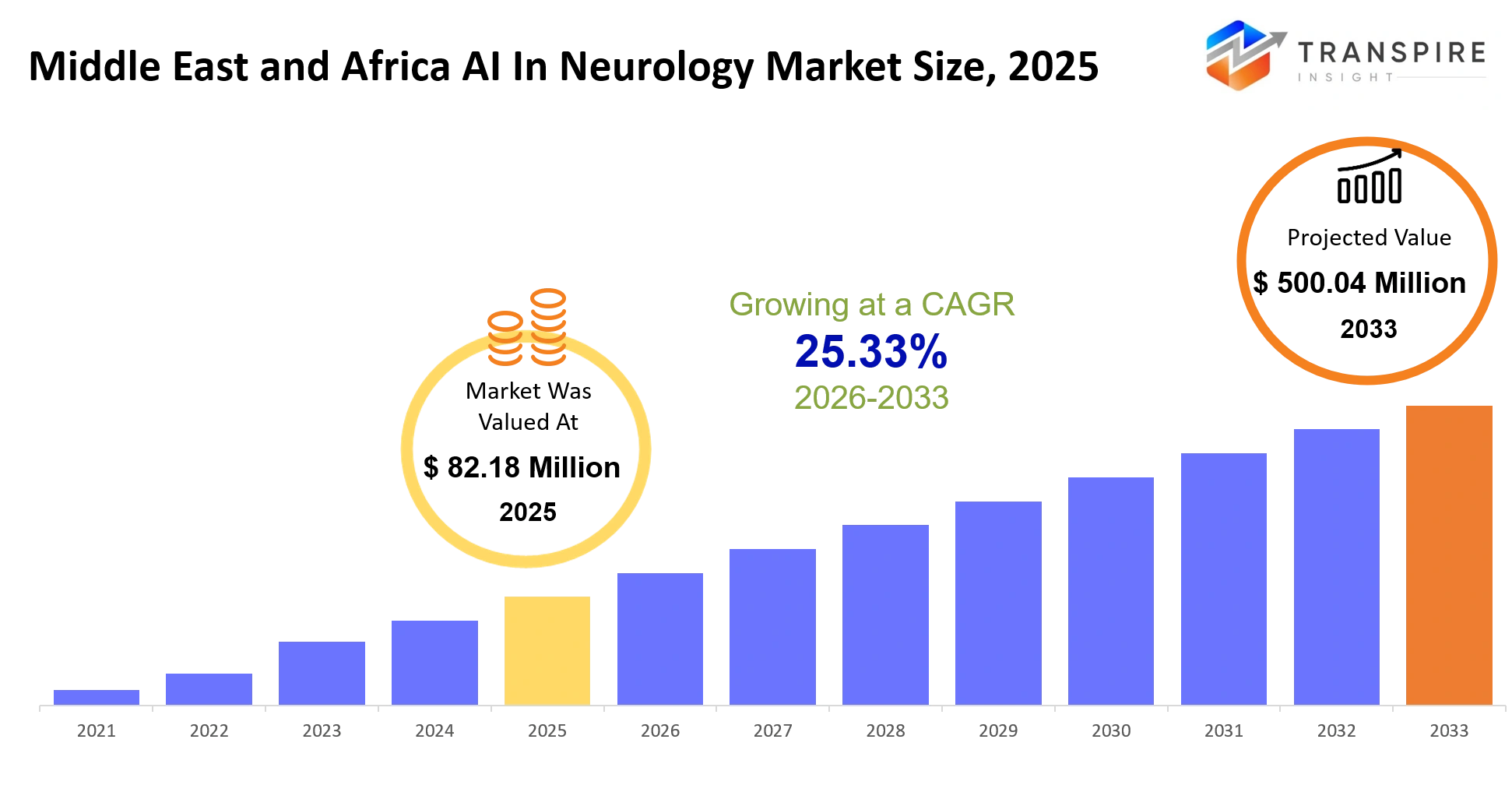
- Middle East and Africa AI In Neurology Market Size 2025: USD 82.18 Million
- Middle East and Africa AI In Neurology Market Size 2033: USD 500.04 Million
- Middle East and Africa AI In Neurology Market CAGR: 25.33%
- Middle East and Africa AI In Neurology Market Segments: By Technology (Machine Learning, Deep Learning, NLP, Computer Vision, Predictive Analytics, Others, Others, Others); By Application (Stroke Detection, Epilepsy Diagnosis, Brain Imaging, Neurodegenerative Diseases, Clinical Decision Support, Others, Others, Others); By Deployment (Cloud, On-Premise, Hybrid, Others, Others, Others, Others, Others); By End User (Hospitals, Neurology Clinics, Research Institutes, Diagnostic Centers, Others, Others, Others, Others).
Middle East and Africa AI In Neurology Market Summary
The Middle East and Africa AI In Neurology Market was valued at USD 82.18 Million in 2025. It is forecast to reach USD 500.04 Million by 2033. That is a CAGR of 25.33% over the period.
The Middle East and Africa AI in the Neurology Market is kind of shifting how healthcare providers detect, diagnose, and handle neurological disorders like stroke, epilepsy, Parkinson’s disease, and Alzheimer’s disease . Instead of only relying on standard routines, AI-powered tools look at medical imaging, clinical records, and other neuro data, sort of to help with quicker diagnosis and more precise treatment choices especially where there are not enough specialized neurologists. Over the last five years, the market moved from those early experimental AI try outs toward clinically validated platforms that actually fit inside hospital workflows. One big structural shift has been the rise of cloud-based diagnostic ecosystems, and AI-assisted neuroimaging solutions too.
Then, with digital health investments ramping up after healthcare modernization programs in Gulf countries and across Africa , adoption grew even more. Since a lot of systems are leaning toward earlier detection of nervous system issues and less time slipping away in diagnostic delays, these AI platforms are kinda streamlining the workflow efficiency and, eventually, clinical outcomes. So overall, this change is opening the door for wider adoption in hospitals, diagnostic centers, and research institutions, which helps create steady revenue potential across the broader regional healthcare ecosystem.
Key Market Insights
- Saudi Arabia and the UAE , taken together they make up an estimated 40%+ of the regional market share, largely because their healthcare digitization initiatives are pretty advanced, and honestly moving fast.
- Gulf Cooperation Council countries tend to dominate the revenue side , mainly through hefty investments in AI-enabled healthcare infrastructure and related digital frameworks.
- Machine Learning still leads the technology segment, with something like more than 30% of total market demand in 2025, at least by current projections.
- Deep Learning sits in the second place, mostly due to better results in neuroimaging interpretation, and that’s what many buyers care about.
- Computer Vision is projected to grow the fastest through 2033, pushed by AI-based brain scan analysis , across multiple care pathways.
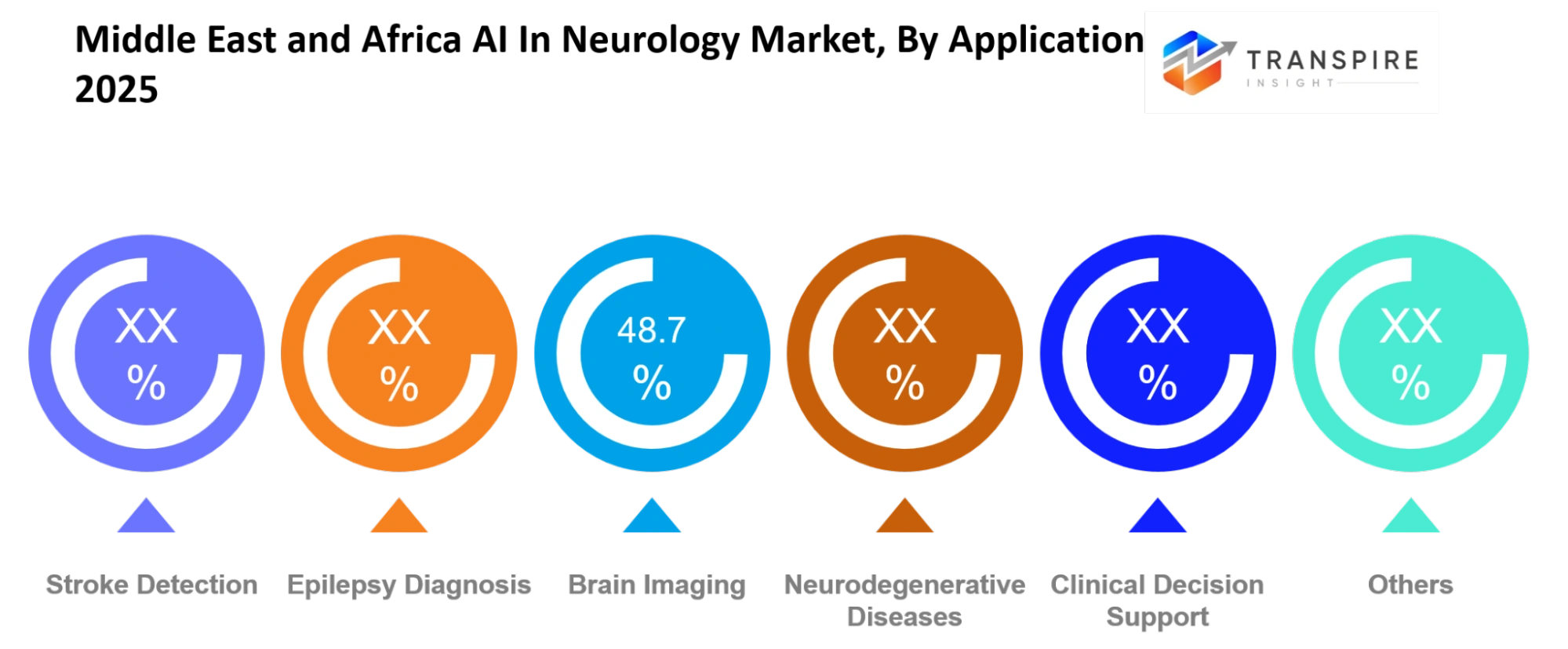
- For applications, Stroke Detection is the main one, with about 35% market share, because treatment outcomes really rely on quick diagnosis.
- Brain Imaging solutions are the second-largest application segment across hospitals and diagnostic centers.
- Clinical Decision Support platforms are among the fastest-growing applications, since healthcare systems are trying to optimize workflows, reduce delays, and smooth handoffs.
- Hospitals represent over 45% of regional spending, so they remain the biggest end user category.
- Neurology clinics are expected to expand the quickest through 2033, especially as specialized neurological care networks keep developing.
- Notable players like IBM, Microsoft, GE HealthCare, Siemens Healthineers, Philips, and Viz.ai mostly center on AI-enabled imaging, cloud integration, and strategic collaborations that lock in adoption.
- Overall, competitive advantage is increasingly tied to algorithm accuracy , interoperability, and real-time clinical workflow integration, all at once, not just one factor.
What are the Key Drivers, Restraints, and Opportunities in the Middle East and Africa AI In Neurology Market?
The main driver behind market growth is the growing burden of neurological disorders, teamed with healthcare workforce shortages, and honestly it feels like both are happening at once. In many nations across the Middle East and Africa, access to neurologists is limited, especially when you move away from the bigger urban centers. Meanwhile stroke, epilepsy, and neurodegenerative diseases keep piling pressure on healthcare systems. AI-enabled neuroimaging and diagnostic platforms let clinicians move through big patient data sets fast and spot abnormalities earlier. In practice this helps shorten diagnostic timelines, and it backs more thoughtful treatment planning, so healthcare providers are more likely to put money into AI-powered neurological solutions.
The most noticeable restraint is still the ongoing structural issue with healthcare infrastructure disparities across the region. Advanced AI systems really depend on digital imaging equipment, integrated electronic health records, dependable connectivity, and people who know how to run and interpret the workflow. A lot of healthcare facilities, particularly in several developing African markets, do not have these basic building blocks. Because of that, deployment tends to be slower, implementation costs can get higher, and the clinical or financial payoffs arrive later. So even with strong clinical interest, these constraints end up holding back adoption rates.
A clear opportunity is cloud-based neurological diagnostics and tele-neurology platforms. Investments by governments in smart healthcare ecosystems across Saudi Arabia, the UAE, and South Africa are setting up conditions that support scalable AI rollouts. AI-powered remote neurological assessments, along with imaging interpretation services, can extend specialist know-how into underserved areas where it would otherwise be hard to reach.
What Has the Impact of Artificial Intelligence Been on the Middle East and Africa AI In Neurology Market?
Artificial intelligence has basically become the bedrock of modern neurological diagnostics across a lot of healthcare institutions in the Middle East and Africa, kinda, at least in day to day practice. AI algorithms handle image analysis for CT and MRI scans, allowing clinicians to spot stroke lesions, brain hemorrhages, tumors and other neurological issues more quickly than the older manual review rhythm . Automated triage systems also help sort and push critical cases to the front, so treatment delays shrink and the whole clinical workflow feels more organized.
Then there’s machine learning, which is pushing predictive capabilities through neurological care pathways. Some advanced setups look at patient histories, imaging evidence, plus clinical indicators, to gauge risks of disease progression, support epilepsy monitoring, and detect early signals tied to neurodegenerative disorders. In that way these predictive tools can help healthcare providers place resources more effectively and adjust patient management strategies without guessing as much.
Operationally the gains show up as faster diagnosis turnaround times, less radiologist workload, better treatment prioritization, and stronger accuracy in clinical decision-making. AI enabled workflow platforms are increasingly helping multidisciplinary neurological teams too, because they bring imaging data, patient records, and decision-support recommendations together inside one shared environment, instead of scattered files.Still, adoption isn’t fully smooth. Implementation costs are high, and data availability can be rough. A number of healthcare systems don’t have adequately large and diverse neurological datasets needed to train and validate advanced AI models for local patient groups. As a result algorithm accuracy can get impacted, and deployment may move slower across emerging healthcare markets, even when there’s clear demand.
Key Market Trends
- Between 2021 and 2026, AI assisted stroke diagnosis adoption rose really fast , as hospitals kept pushing rapid treatment pathways, kind of quickly.
- Over 60% of the new neurological AI deployments now fold in cloud infrastructure for scalable data processing.
- Deep learning based brain imaging platforms found wider clinical acceptance because the diagnostic accuracy rates improved, noticeably.
- Healthcare systems in the Gulf boosted AI spending at double digit annual rates somewhere between 2023 and 2026.
- Strategic collaborations between technology vendors and hospitals helped commercialization of neurological AI applications move along faster.
- Computer vision adoption didn’t just stop at stroke detection , it also expanded into tumor identification and neurodegenerative disease assessment.
- Healthcare providers increasingly shifted away from stand alone software to integrated clinical workflow platforms.
- AI enabled tele neurology services started showing up as a practical option for underserved communities and remote populations.
- Vendors are increasingly prioritizing explainable AI capabilities , to meet regulatory expectations and clinical validation needs.
- Companies like IBM, Microsoft, Siemens Healthineers, Philips, Aidoc, and Viz.ai strengthened their offerings through partnerships and platform expansions.
Middle East and Africa AI In Neurology Market Segmentation
By Technology
Machine Learning is basically the base layer behind many neurological AI systems because algorithms can sniff out patterns in imaging collections, patient records, and past diagnostic notes, kind of. Deep Learning then makes it stronger for diagnosis, since it can work through complicated neurological imaging data and help catch abnormalities earlier, in a smoother way. NLP (Natural Language Processing) helps with the analysis of physician notes, medical reports, and patient histories, so healthcare teams can pull out clinically useful insights more quickly, without all the extra manual effort.
Computer Vision is a big deal for interpreting brain scans, especially in stroke detection and tumor assessment. Predictive Analytics supports forecasting disease progression and improves personalized treatment planning by using advanced modeling methods. Other approaches are also moving in—newer AI methods and more specialized analytical tools that target specific neurological needs, plus whatever clinical requirements are changing right now.
By Application
Stroke Detection is still a big deal application area, because fast diagnosis kinda affects patient outcomes, and how well the treatment works. For Epilepsy Diagnosis solutions, clinicians get help by looking at neurological signals and finding seizure related patterns, that are sometimes hard to catch by hand. In Brain Imaging applications, automated analysis supports the interpretation of MRI, CT and other neurological imaging procedures , so specialists don’t have to rely only on manual review.
When it comes to Neurodegenerative Diseases, the focus shifts toward spotting early clues for Alzheimer’s disease and Parkinson’s disease. Clinical Decision Support tools help physicians, with evidence based recommendations, plus workflow guidance, during patient evaluation. Other areas include neurological rehabilitation, research oriented tasks, and newer disease-specific analytical solutions.
By Deployment
Cloud deployment is still catching on because healthcare providers can scale computing power without having to think too much about infrastructure stuff, a kind of less heavy burden. Cloud based solutions also make remote access easier, help with shared diagnostic work, and keep data more centralized across different healthcare networks. Meanwhile On-Premise deployment stays a big deal for those institutions that want strict control over patient information, plus they prefer their own internal infrastructure.
Hybrid deployment, though, sort of blends cloud flexibility with local security needs, which makes it a go-to option for larger healthcare organizations. In practice it helps with workload distribution and it supports regulatory compliance while keeping day to day operations efficient. Then there are other approaches too, like customized deployment frameworks, they’re built for specialized institutional requirements and even for country specific healthcare regulations.
By End User
Hospitals are, kinda, the biggest end-user category because neurological diagnosis and treatment often get done in acute care settings. Large hospital networks are more and more rolling out AI platforms , so they can smooth the imaging workflow , cut down diagnostic delays and also back multidisciplinary neurological teams. Neurology clinics also matter quite a bit , mainly for specialized patient assessment and longer-range disease management.
Research institutes use neurological AI tools to push through clinical studies faster, speed up biomarker discovery and fuel neuroscience innovation in general. Diagnostic centers lean on advanced imaging analytics to improve how quickly they generate reports, while also raising diagnostic precision. Other players include academic medical institutions, telemedicine providers, and specialized healthcare organizations that focus on neurological care delivery.
What are the Key Use Cases Driving the Middle East and Africa AI In Neurology Market?
Stroke detection is still kind of the most crucial use case across the market, since the treatment results depend heavily on how fast diagnosis happens, and on intervention right after. AI based imaging platforms look through CT and MRI images in just a few minutes, so emergency rooms can sort the most urgent cases first, and then cut down the waiting time before clinicians decide what to do next.
There are also more extra uses, like epilepsy diagnosis, plus deeper brain imaging analysis. Neurology clinics, diagnostic centers are using AI systems more often, to spot seizure patterns, find those mild neurological issues that are easy to miss, and make the diagnostic results more consistent from one patient group to the next. Clinical decision support platforms are also picking up pace in hospitals, mostly to help streamline neurological care routes, and keep them more reliable in day to day practice.
More recently, people are talking about disease progression monitoring for Alzheimer’s disease and Parkinson’s disease, and also AI assisted tele neurology services. These ideas have real staying power in the long run, because they spread specialist know-how to places that have fewer resources, while at the same time helping with individualized neurological care strategies.
|
Report Metrics |
Details |
|
Market size value in 2025 |
USD 82.18 Million |
|
Market size value in 2026 |
USD 102.97 Million |
|
Revenue forecast in 2033 |
USD 500.04 Million |
|
Growth rate |
CAGR of 25.33% from 2026 to 2033 |
|
Base year |
2025 |
|
Historical data |
2021 - 2024 |
|
Forecast period |
2026 - 2033 |
|
Report coverage |
Revenue forecast, competitive landscape, growth factors, and trends |
|
Regional scope |
Middle East and Africa (Saudi Arabia, United Arab Emirates, South Africa, Rest of Middle East and Africa) |
|
Key company profiled |
IBM, Microsoft, GE HealthCare, Siemens Healthineers, Philips, Aidoc, Viz.ai, Qure.ai, NVIDIA, Oracle, Medtronic, Canon Medical, Roche, Tempus, Arterys. |
|
Customization scope |
Free report customization (country, regional & segment scope). Avail customized purchase options to meet your exact research needs. |
|
Report Segmentation |
By Technology (Machine Learning, Deep Learning, NLP, Computer Vision, Predictive Analytics, Others, Others, Others); By Application (Stroke Detection, Epilepsy Diagnosis, Brain Imaging, Neurodegenerative Diseases, Clinical Decision Support, Others, Others, Others); By Deployment (Cloud, On-Premise, Hybrid, Others, Others, Others, Others, Others); By End User (Hospitals, Neurology Clinics, Research Institutes, Diagnostic Centers, Others, Others, Others, Others). |
Which Regions are Driving the Middle East and Africa AI In Neurology Market Growth?
The Gulf region, with Saudi Arabia and the United Arab Emirates leading the way, stands out as the main market option across the Middle East and Africa. In practice, strong programs for healthcare modernization, national AI roadmaps, and a lot of money directed toward digital health infrastructure help drive broad adoption of neurological AI solutions. On top of that, well developed hospital networks and government-backed innovation efforts keep pushing the market forward. With smart medical technologies rolling out at scale, it also creates a kind of ready environment for clinical AI to land smoothly.
South Africa is the next big contributor, and it feels different from the Gulf because it puts more attention on healthcare accessibility, plus partnerships tied to digital transformation. Growth there is supported by partnerships between healthcare providers and technology vendors, in efforts meant to improve availability of specialist care. Public, as well as private healthcare organizations are still extending their investments into AI-powered imaging and diagnostic tools. Overall this steadier approach supports market stability and keeps revenue generation more consistent.
For the wider African region, the forecast points to the fastest growth. Newer investments in healthcare digitization, telemedicine systems, and cloud-based healthcare platforms have opened up fresh paths for AI deployment. As connectivity keeps improving, alongside modernization work in healthcare, more patients can reach advanced neurological diagnostic services. That ongoing push makes the region appealing for technology providers and investors looking for long-run growth in these emerging healthcare markets.
Who are the Key Players in the Middle East and Africa AI In Neurology Market and How Do They Compete?
Competition inside the market is a bit moderately fragmented, in the sense that global healthcare technology firms go head to head with more specialized neurological AI developers. Technology innovation is still the main competitive driver, especially when it comes to neuroimaging interpretation, clinical workflow streamlining, and cloud based healthcare linkage. Firms tend to separate themselves using a mix of algorithmic results, regulatory clearances, interoperability strengths, and the kinds of clinical validation outcomes that actually hold up.
GE HealthCare is leaning into putting AI straight within imaging workflows, so clinicians can examine neurological scans more quickly, and with less back and forth. Siemens Healthineers leans on advanced imaging hardware and broader digital health ecosystems to boost neurological diagnostic capacity. Philips, on the other hand, differentiates through connected care platforms that bundle imaging, monitoring, and clinical analytics into one unified healthcare setting.
There are also the more specialized players like Aidoc and Viz.ai, they concentrate on AI driven neurological workflow automation and fast disease recognition. Aidoc keeps stretching its offering via neuroscience collaborations and platform engineering, while Viz.ai focuses more on intelligent care coordination and real time clinical decision support. Together these targeted moves help the whole space push forward with quicker innovation and clearer differentiation across neurological care pathways.
Company List
- IBM
- Microsoft
- GE HealthCare
- Siemens Healthineers
- Philips
- Aidoc
- Viz.ai
- Qure.ai
- NVIDIA
- Oracle
- Medtronic
- Canon Medical
- Roche
- Tempus
- Arterys
Recent Development News
In April 2026, Aidoc entered a partnership with Cercare Medical and Circle CVI. The collaboration expands AI-powered neuroscience capabilities through MR Perfusion and automated ASPECTS scoring integration, strengthening stroke diagnosis and neuro-care workflows.
Source: https://www.aidoc.com
In April 2026, Aidoc secured funding of USD 150 million in a Series E round led by Goldman Sachs Alternatives. The investment supports expansion of clinical AI platforms, neurological imaging solutions, and enterprise healthcare AI deployment globally.
Source: https://www.prnewswire.com
In April 2026, Viz.ai entered a strategic collaboration with Johnson & Johnson. The partnership expands access to AI-powered subdural hemorrhage detection and coordinated neurological care solutions, supporting faster diagnosis and treatment pathways.
Source: https://www.viz.ai
What Strategic Insights Define the Future of the Middle East and Africa AI In Neurology Market?
The market seems to be drifting toward integrated neurological intelligence platforms that mix imaging analysis, predictive analytics, clinical decision support, and remote care delivery all within one healthcare ecosystem, not just a collection of tools. This shift is pushed by workforce shortages in healthcare, more and more neurological disease burdens, and government funding for digital health infrastructure. In the next five to seven years, what will work well, will likely lean on interoperability and real-time clinical integration more than on standalone diagnostic functionality, even if the pitch sounds simple.
There’s also a risk that’s a bit quieter but still real, like market concentration around a small set of AI platform providers and proprietary datasets. If healthcare providers end up locked into a narrow technology universe, the result can be pricing pressure, plus extra interoperability headaches that nobody wants to debug during a busy clinical day.
At the same time, there’s an emerging chance in AI-enabled tele-neurology networks across underserved African markets. As cloud infrastructure keeps expanding and digital healthcare platforms keep getting rolled out, remote neurological diagnostics could turn into a real growth lane. Market players should focus on partnerships with healthcare systems, and also put effort into localized AI model development to boost clinical accuracy, improve regulatory acceptance, and build a longer term competitive position.
Middle East and Africa AI In Neurology Market Report Segmentation
By Technology
- Machine Learning
- Deep Learning
- NLP
- Computer Vision
- Predictive Analytics
- Others
By Application
- Stroke Detection
- Epilepsy Diagnosis
- Brain Imaging
- Neurodegenerative Diseases
- Clinical Decision Support
- Others
By Deployment
- Cloud
- On-Premise
- Hybrid
- Others
By End User
- Hospitals
- Neurology Clinics
- Research Institutes
- Diagnostic Centers
- Others
Frequently Asked Questions
Find quick answers to common questions.
The expected Middle East and Africa AI In Neurology Market size for the market will be USD 500.04 Million in 2033.
Key segments for the Middle East and Africa AI In Neurology Market are By Technology (Machine Learning, Deep Learning, NLP, Computer Vision, Predictive Analytics, Others, Others, Others); By Application (Stroke Detection, Epilepsy Diagnosis, Brain Imaging, Neurodegenerative Diseases, Clinical Decision Support, Others, Others, Others); By Deployment (Cloud, On-Premise, Hybrid, Others, Others, Others, Others, Others); By End User (Hospitals, Neurology Clinics, Research Institutes, Diagnostic Centers, Others, Others, Others, Others).
Major Middle East and Africa AI In Neurology Market players are IBM, Microsoft, GE HealthCare, Siemens Healthineers, Philips, Aidoc, Viz.ai, Qure.ai, NVIDIA, Oracle, Medtronic, Canon Medical, Roche, Tempus, Arterys.
The Middle East and Africa AI In Neurology Market size is USD 82.18 Million in 2025.
The Middle East and Africa AI In Neurology Market CAGR is 25.33% from 2026 to 2033.
- IBM
- Microsoft
- GE HealthCare
- Siemens Healthineers
- Philips
- Aidoc
- Viz.ai
- Qure.ai
- NVIDIA
- Oracle
- Medtronic
- Canon Medical
- Roche
- Tempus
- Arterys
About the Authors

Pankaj Ghogare Patil
I am Pankaj Ghogare Patil, a Senior Research Analyst at Transpire Insight, specializing in the Pharmaceutical, Chemicals & Materials, Healthcare IT, and Biotechnology industry. My expertise lies in conducting comprehensive market research, analyzing industry trends, evaluating competitive landscapes, and translating complex data into actionable insights. At Transpire Insight, I closely follow emerging technologies, regulatory developments, and market innovations to create accurate, well-researched, and informative content that helps businesses and professionals make informed decisions. I am committed to producing credible, evidence-based articles that reflect industry best practices while making technical topics accessible and valuable for a broad audience.

Chakradhar Khansole
Chakradhar serves as the Research Director at Transpire Insight, bringing over 8 years of experience in technology, innovation, and strategic market intelligence. He specializes in transforming complex market data into actionable business insights that enable organizations to make informed, growth-oriented decisions. Recognized for his strategic vision and analytical expertise, Chakradhar leads high-impact research initiatives, delivering comprehensive market assessments, competitive intelligence, and forward-looking industry analysis.
Recently Published Reports
-
Apr 2026
AI in Diabetic Retinopathy Market
AI in Diabetic Retinopathy Market Size, Share & Analysis Report By Type (Screening AI Systems, Diagnostic AI Systems, and Predictive AI Models), By Application Segment (Hospitals, Ophthalmology Clinics, Diagnostic Centers, and Research and Development), and Geography (North America, Europe, Asia-Pacific, Middle East and Africa, South and Central America), 2021 - 2031
-
Apr 2026
Psychometric Tests Market
Psychometric Tests Market Size, Share & Analysis Report By Type (Personality Tests, Ability/Aptitude Tests, Skill/Knowledge Tests, and Others), By Application (Talent Acquisition and Talent Management), and Geography (North America, Europe, Asia-Pacific, Middle East and Africa, South and Central America), 2021 – 2031
-
Apr 2026
Rare Biological Sample Collection Market
Rare Biological Sample Collection Market Size, Share & Analysis Report By Type (Isolation Kits & Reagent, Blood Collection Tubes, and Others), By Application (Oncology, Transcriptomics, Pharmacogenomics, and Others), and Geography (North America, Europe, Asia-Pacific, Middle East and Africa, South and Central America), 2021 – 2031
-
Jul 2026
Diabetic Retinopathy Market
Diabetic Retinopathy Market Size, Share & Analysis Report By Type (Proliferative Diabetic Retinopathy, and Diabetic Macular Edema (DME)), By Treatment Type (Anti VEGF Drug, Steroid Implants, Laser Surgeries, and Vitrectomy), and Geography (North America, Europe, Asia-Pacific, Middle East and Africa, South and Central America), 2021 – 2031
Our Clients







