
France Predictive Analytics Market Size & Forecast:
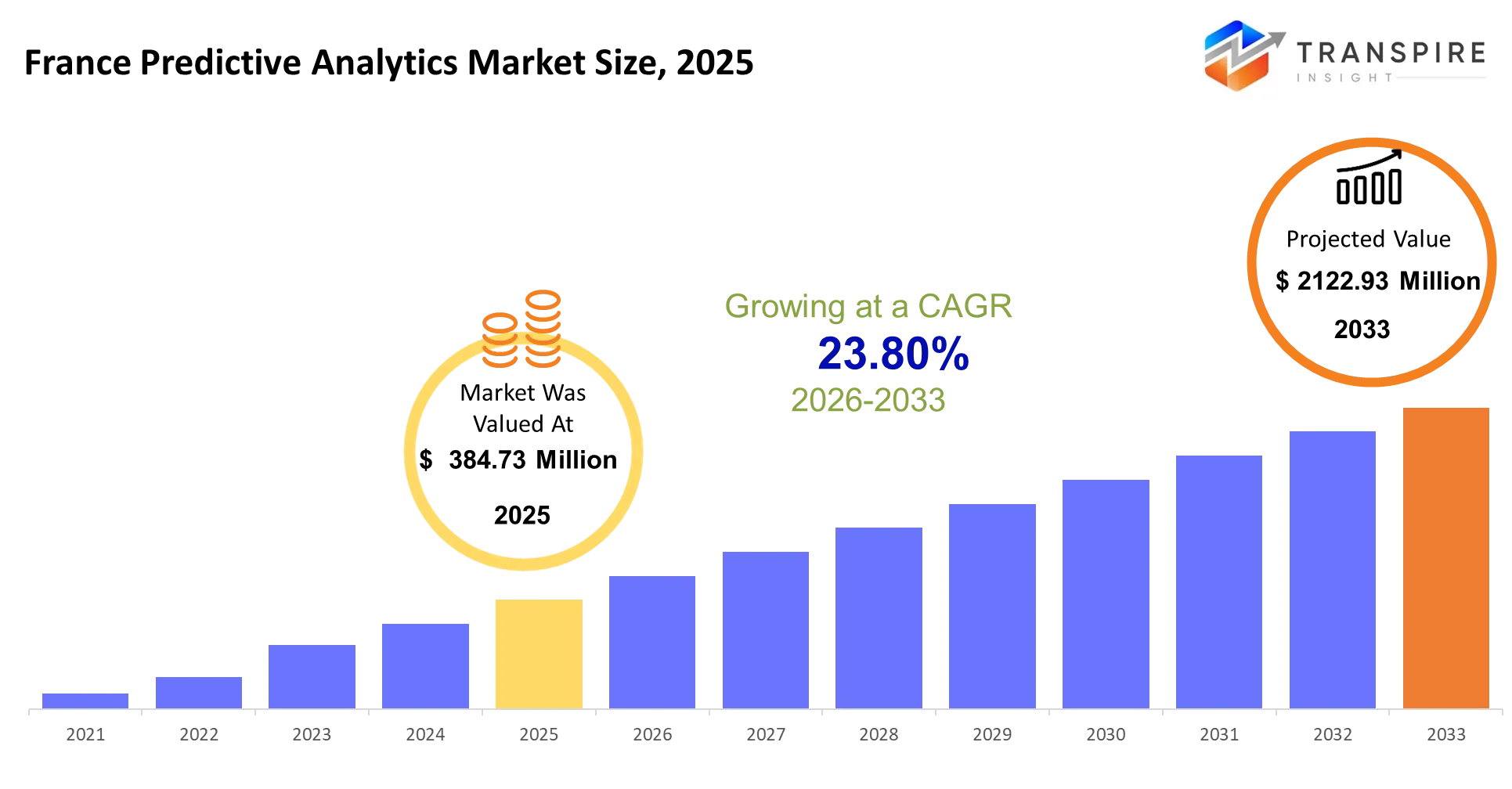
- France Predictive Analytics Market Size 2025: USD 384.73 Million
- France Predictive Analytics Market Size 2033: USD 2122.93 Million
- France Predictive Analytics Market CAGR: 23.80%
- France Predictive Analytics Market Segments: By Type (Software, Services, Platforms, Others); By Application (Fraud Detection, Risk Management, Marketing, Supply Chain, Healthcare Analytics, Others); By End-User (Enterprises, BFSI, Healthcare, Retail, IT & Telecom, Others); By Deployment (Cloud, On-premise, Hybrid, Others)
To learn more about this report,  Download Free Sample Report
France Predictive Analytics Market Summary
The France Predictive Analytics Market was valued at USD 384.73 Million in 2025. It is forecast to reach USD 2122.93 Million by 2033. That is a CAGR of 23.80% over the period.
The France Predictive Analytics Market enables organizations to transform operational customer and industrial data into future insights that organizations require for their decision-making process which includes demand forecasting and fraud detection and risk management and predictive maintenance across multiple sectors that include BFSI and retail and healthcare and manufacturing. Organizations have replaced traditional business intelligence dashboards with AI and machine learning powered real-time predictive platforms because organizations have started using these cloud-based systems during the last 3 to 5 years.
French organizations have had to allocate resources toward developing secure analytics systems which meet stricter GDPR data governance standards. European organizations faced two major challenges which required them to enhance their forecasting methods and scenario planning capabilities because COVID-19 disrupted supply chains and subsequent energy and geopolitical unrest. Enterprises have shifted their focus to predictive capabilities because they want to decrease operational uncertainty and decrease costs while becoming more flexible in managing demand changes which has resulted in faster enterprise adoption and vendor revenue growth.
Key Market Insights
- Île-de-France maintains its position as the leading region in the France Predictive Analytics Market because of its substantial enterprise and BFSI sector presence which accounts for 38% market share.
- The Auvergne-Rhône-Alpes region experiences rapid growth because its industrial sector embraces digital technologies and smart manufacturing systems until 2033.
- Southern France experiences increasing interest in predictive analytics which businesses use for logistics and tourism optimization and healthcare analytics development.
- The software segment leads the France Predictive Analytics Market with over 45% share which results from AI-powered forecasting systems.
- The services segment maintains the second-largest market share which consulting and integration and managed analytics deployment services support.
- The Platforms segment reaches its highest growth rate until 2033 because cloud-native predictive analytics environments and scalable data processing systems drive market development.
- The France Predictive Analytics Market for fraud detection reaches a market share exceeding 32% because of its use in banking and digital payment systems. Supply chain analytics has become the most important application because businesses need real-time forecasting accuracy to handle market changes.
- The use of predictive modeling for risk management has become a standard practice among enterprises which seek to decrease their financial and operational risks. The BFSI sector leads the France Predictive Analytics Market with nearly 35% share which results from its use of fraud prevention and credit scoring systems.
- The market penetration process accelerates through strategic partnerships which businesses form with French enterprises and government-backed digital initiatives. The predictive analytics industry gains competitive advantages through cloud migration and edge analytics integration which enhances vendor strengths.
- Vendors expand their market presence through the establishment of data centers in various locations which provide analytics solutions that comply with GDPR regulations.
What are the Key Drivers, Restraints, and Opportunities in the France Predictive Analytics Market?
The France Predictive Analytics Market experiences its main growth because businesses in the BFSI and retail and industrial sectors adopt AI-based decision intelligence systems at an increasing pace. The demand for real-time forecasting tools has grown because COVID-19 revealed weaknesses in traditional planning systems which organizations used before the pandemic. Organizations use predictive analytics today to minimize financial losses while enhancing their supply chain operations and improving their ability to identify fraudulent activities during the early stages of financial transactions. The combination of cloud computing with machine learning platforms has created an easier path to system setup which has allowed organizations to adopt those systems at faster rates in their mid-sized and large business environments.
The France Predictive Analytics Market faces major constraints because organizations need to manage complex data governance tasks while integrating their different legacy systems. Many enterprises still operate hybrid IT environments where data resides in silos, limiting model accuracy and slowing deployment cycles. Organizations must spend extra costs to meet rigorous GDPR requirements which also cause delays in their predictive model validation process. The need for complete system adoption causes organizations to postpone their implementation, which creates lower revenue growth for solution providers, although there exists strong market demand.
The development of edge AI-based predictive analytics systems in smart manufacturing clusters creates a significant business opportunity for companies operating in the Auvergne-Rhône-Alpes region. Industrial firms are increasingly investing in real-time predictive maintenance systems integrated with IoT sensors and 5G connectivity. For example, automotive and aerospace suppliers use localized analytics to forecast equipment failures that will lead to operational interruptions.
What Has the Impact of Artificial Intelligence Been on the France Predictive Analytics Market?
The implementation of artificial intelligence together with advanced digital technologies is currently transforming scrubber performance systems and all industrial and maritime operations in France that utilize predictive analytics. The field of emissions monitoring systems now employs AI-based automated systems which use real-time sensor data to control exhaust gas cleaning technology in order to achieve operational compliance with environmental regulations. The industrial asset managers and fleet operators of companies use AI-based control systems for automated compliance monitoring which decreases their need for manual inspections while enhancing their ability to generate precise reports for strict environmental regulations.
Machine learning models enable organizations to predict equipment failure through their ability to identify early signs of equipment decline and predict required maintenance activities. The models use vibration and temperature and fuel consumption data to analyze the operational efficiency of marine emission control systems and industrial facilities which results in a 15 to 25 percent reduction of unplanned downtime in digitally advanced facilities. The process of optimized combustion and load balancing generates fuel efficiency improvements which result in operational efficiency gains that range from 5 to 10 percent.
The implementation of maritime systems encounters obstacles because of insufficient training data which reflects actual maritime operations and because sensor performance declines in extreme environmental conditions. The implementation process faces obstacles because mid-sized operators must bear high expenses for integrating their old systems with new technology. AI technologies produce measurable gains in operational efficiency and regulatory compliance and expense reductions throughout the entire France Predictive Analytics Market ecosystem.
Key Market Trends
- Enterprises shifted from descriptive analytics to predictive AI platforms between 2020–2025, which enabled them to make decisions more quickly and to decrease their operational risks.
- Organizations that required scalable and low-latency analytics infrastructure through Cloud deployment expanded from below 40% in 2020 to more than 65% in 2025.
- French fintech companies saw increasing digital payment fraud, which led BFSI institutions to develop more advanced fraud detection systems after 2022.
- Machine learning adoption in supply chain forecasting improved inventory accuracy by nearly 20%, which resulted from COVID-era logistics disruptions.
- SAP and Microsoft introduced France-specific AI analytics solutions in 2023, which helped businesses improve their system integration and local regulatory compliance.
- Retailers shifted from using fixed reports to developing systems that forecast customer behavior in real time, which has led to increased revenue from customized products since 2021.
- The period from 2022 to 2025 saw organizations adopting explainable AI systems because GDPR regulations demanded deeper insights into their forecasting methods.
- Digital manufacturing plants used predictive maintenance systems more frequently, which led to 15–25% decreases in unexpected equipment breakdowns.
- Companies began implementing hybrid analytics systems after 2023, which enabled them to meet their on-premise security needs while they expanded their cloud-based forecasting capabilities.
France Predictive Analytics Market Segmentation
By Type
The France Predictive Analytics Market shows its software solutions as the dominant segment because enterprises use both AI-driven forecasting tools and integrated analytics suites throughout their operations. The demand for software products arises from customers who need scalable platforms that enable real-time decision-making for three applications: fraud detection and operational forecasting and customer analytics. Enterprises depend on consulting services and integration solutions and model training support to successfully implement predictive systems throughout their existing infrastructure.
The segment experiences growth because financial and industrial sectors are moving to cloud environments while adopting automated decision-making solutions. The platform market grows faster than standard software because platforms can combine all data processing together with machine learning development inside one system. The market for platform-based solutions will grow during the forecast period because companies will focus on creating complete analytics systems which will allow vendors to move from selling products to offering complete subscription-based predictive intelligence solutions.
By Application
The France Predictive Analytics Market shows its main application-based segmentation pattern through two sectors which include fraud detection and risk management. Digital transactions have increased while BFSI institutions now face stricter compliance requirements which drive their need for these solutions. The market position of fraud detection technologies currently stands at the highest point because online payment volumes keep growing and cyber threats develop new forms. Supply chain analysis has started to increase in use because actual disruptions displayed the problems that existed in logistics and inventory system forecasting abilities. Marketing analytics shows consistent growth because businesses now concentrate on predicting customer behavior and developing personalized marketing methods.
The digital transformation of hospital systems together with the need for strong logistics networks creates new business opportunities in healthcare analytics and supply chain applications. The segment experiences growth because it needs real-time decision making and operates in environments that require extensive data processing. The solution providers must create predictive models which will improve accuracy and decrease risk while building operational resilience according to the expected expansion of supply chain analytics and healthcare analytics during the upcoming forecast period.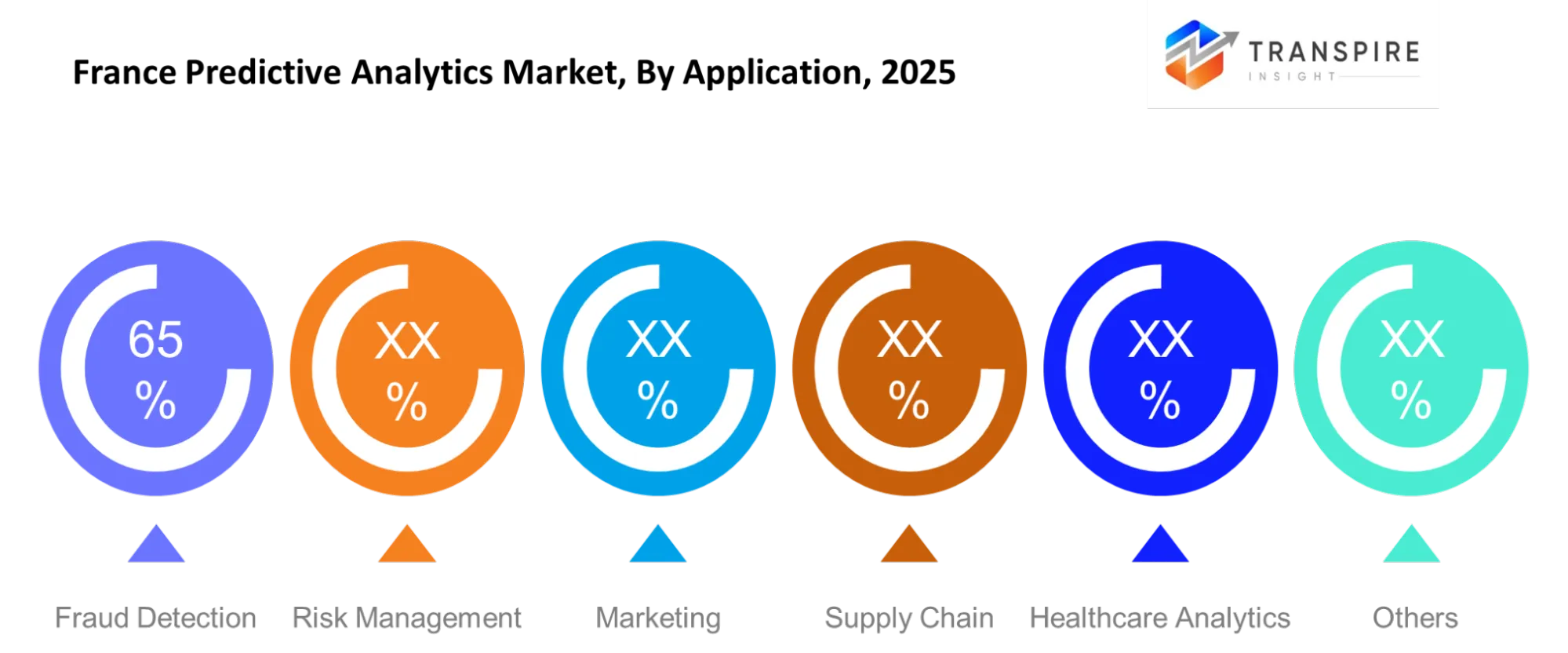
To learn more about this report, Download Free Sample Report
By End-User
BFSI institutions represent the main customer group for end-user segmentation in the France Predictive Analytics Market because they need fraud detection and credit risk modeling and regulatory compliance analytics. Enterprises across industries form a significant base as large organizations integrate predictive tools into core business functions such as demand forecasting and operational planning. Retail and IT & telecom sectors are expanding their usage of customer analytics and network optimization tools.
Business growth stems from digital transformation efforts and companies increasingly use data-based methods to make operational decisions. Healthcare is emerging as a strong adopter due to predictive diagnostics and resource optimization needs. The retail and healthcare sectors will experience faster adoption rates because organizations focus on developing customized experiences and operational efficiencies which will lead vendors to create specialized predictive models that meet industry-specific needs.
By Deployment
The France Predictive Analytics Market Deploys segmentation through cloud-based solutions, which provide superior scalability and quick implementation and reduced initial system expenses as their primary advantage. The BFSI and healthcare sectors continue to require on-premise systems because these industries need to protect data and meet strict security and compliance standards. Organizations now adopt hybrid deployment models to achieve their security objectives while maintaining access to cloud computing resources.
The growth of cloud deployment occurs because organizations increasingly adopt AI and machine learning systems that need both flexible computation and instant data processing. Organizations are adopting hybrid models to protect their sensitive information while they move away from outdated legacy systems. The forecast period will see cloud-first strategies become the leading approach which will drive vendors to develop predictive analytics solutions that meet security requirements and work across multiple environments while achieving compliance standards.
What are the Key Use Cases Driving the France Predictive Analytics Market?
The France Predictive Analytics Market dedicates its main resources to fraud detection, which banks and financial institutions use to manage their increasing digital payment transactions and advanced cyber fraud activities. Financial institutions utilize predictive modeling techniques to monitor real-time transaction patterns, which enables them to detect irregularities and minimize financial risk. The use case generates maximum demand because organizations need to spend on advanced risk management systems because of regulatory obligations and customer trust requirements.
Retail and manufacturing and logistics enterprises have started to adopt supply chain optimization and risk forecasting as their new operational methods. The sectors employ predictive analytics to forecast demand changes while they control their inventory and reduce supply chain disruptions that emerged from recent global supply chain challenges. Retail and e-commerce businesses increasingly utilize marketing analytics to analyze customer behavior, which helps them design targeted advertising campaigns that maximize their revenue.
The new applications of predictive maintenance emerge in industrial operations while the healthcare sector needs to forecast its resource requirements. Manufacturers adopt analytics tools to minimize their equipment downtime and maximize their asset performance, while hospitals use predictive models to forecast patient volume and determine their staffing requirements. The applications will experience continued expansion as organizations incorporate AI technologies into their operational frameworks throughout the France Predictive Analytics Market.
|
Report Metrics |
Details |
|
Market size value in 2025 |
USD 384.73 Million |
|
Market size value in 2026 |
USD 476.28 Million |
|
Revenue forecast in 2033 |
USD 2122.93 Million |
|
Growth rate |
CAGR of23.80% from 2026 to 2033 |
|
Base year |
2025 |
|
Historical data |
2021 - 2024 |
|
Forecast period |
2026 - 2033 |
|
Report coverage |
Revenue forecast, competitive landscape, growth factors, and trends |
|
Regional scope |
United States; Canada; Mexico; United Kingdom; Germany; France; Italy; Spain; Denmark; Sweden; Norway; China; Japan; India; Australia; South Korea; Thailand; Brazil; Argentina; South Africa; Saudi Arabia; United Arab Emirates |
|
Key company profiled |
IBM, SAS, Microsoft, SAP, Oracle, Google, Amazon, Salesforce, TIBCO, Alteryx, RapidMiner, Qlik, Teradata, H2O.ai, DataRobot . |
|
Customization scope |
Free report customization (country, regional & segment scope). Avail customized purchase options to meet your exact research needs. |
|
Report Segmentation |
By Type (Software, Services, Platforms, Others); By Application (Fraud Detection, Risk Management, Marketing, Supply Chain, Healthcare Analytics, Others); By End-User (Enterprises, BFSI, Healthcare, Retail, IT & Telecom, Others); By Deployment (Cloud, On-premise, Hybrid, Others) |
Which Regions are Driving the France Predictive Analytics Market Growth?
Île-de-France leads the France Predictive Analytics Market due to its concentration of large enterprises, BFSI headquarters, and advanced digital infrastructure. The region benefits from strong policy alignment with national AI strategies and early adoption of data-driven governance frameworks. The region has a dense ecosystem that includes technology providers and cloud service hubs and analytics consultancies which enables organizations to create new solutions and implement predictive technologies at a fast pace. Strong regulatory enforcement under GDPR has pushed companies to develop AI systems which meet compliance standards while providing explainable results thus companies establish their authority in analytics.
The industrial base of Auvergne-Rhône-Alpes and its manufacturing economy create stability which makes the region a second-tier contributor to economic development. The region needs to adopt predictive analytics technology which drives its operations in automotive and aerospace and energy sectors whereas Île-de-France depends on financial institutions for its growth. The companies in this region focus on improving their operational efficiency while maintaining their asset reliability instead of developing financial risk assessment models. The region has established itself as a steady revenue source for analytics vendors because businesses have begun making permanent investments in smart factories and Industry 4.0 system integration.
The Provence-Alpes-Côte d’Azur region experiences its fastest growth because of new investments which support logistics modernization and development of smart port facilities. The demand for digital port systems in Marseille has grown because of increased adoption of AI-based supply chain optimization tools. Tourism-driven enterprises and healthcare networks are also integrating predictive systems for demand forecasting and resource planning.
Who are the Key Players in the France Predictive Analytics Market and How Do They Compete?
The France Predictive Analytics Market shows a moderately consolidated competitive structure which enables global technology leaders to dominate enterprise contracts while specialized AI firms compete in niche analytics workloads. The competition in the market depends on two main factors which include technological capabilities and the ability of systems to deliver accurate models and to operate on cloud platforms and to work together with existing enterprise data systems. The large enterprises choose vendors who provide predictive analytics solutions that work with their cloud systems and meet their cybersecurity requirements, while the smaller companies use industry-focused solutions that enable quick implementation.
Businesses can use Azure-based predictive analytics services from Microsoft to enhance their operational efficiency because the platform offers machine learning solutions that work with their ERP and CRM systems. IBM develops hybrid cloud analytics together with AI governance solutions because these technologies provide businesses in BFSI and healthcare sectors with essential compliance and explainability requirements. SAP uses its ERP system to provide predictive analytics capabilities through its supply chain and financial planning modules which can be used by the entire organization.
Amazon Web Services promotes system implementation through its flexible cloud services and its sophisticated AI technologies such as SageMaker, which enables organizations to implement predictive models in real time while handling substantial data operations. Google uses its Vertex AI platform to showcase its AI developments because the platform helps businesses with heavy data needs to create custom machine learning solutions. SAS provides regulated industries with its high-precision statistical modeling solution, whereas DataRobot enables mid-sized businesses to develop models more quickly through its automated machine learning platform.
Company List
- IBM
- SAS
- Microsoft
- SAP
- Oracle
- Amazon Web Services (AWS)
- Salesforce
- TIBCO Software
- Alteryx
- RapidMiner
- Qlik
- Teradata
- H2O.ai
- DataRobot
Recent Development News
In March 2026, IBM completed its acquisition of Confluent to strengthen real-time data streaming capabilities for AI and predictive analytics. The integration improves enterprise decision-making by enabling continuous data processing for fraud detection, operational forecasting, and AI-driven automation systems.https://newsroom.ibm.com
What Strategic Insights Define the Future of the France Predictive Analytics Market?
The France Predictive Analytics Market is moving towards autonomous decision-making systems which use artificial intelligence to manage their operations and integrate predictive models into their business processes. The industry shift occurs because companies adopt cloud technology and need instant data access and their operational need for autonomous forecasting solutions which can automatically correct mistakes for their financial and retail and industrial operations. The next 5 to 7 years will see value creation emerge from platforms that merge predictive analytics with generative AI and automated decision workflows into complete system interfaces.
The growing dependence on worldwide hyperscaler providers creates a hidden danger because it limits mid-sized businesses' ability to negotiate prices while stifling their capacity to innovate. The model requires organizations to obtain direct access to high-quality real-time data which creates operational risks because many industries lack efficient data management systems that use standardized processes.
Predictive analytics can now be applied to edge computing systems which operate across manufacturing hubs and smart logistics corridors throughout the Auvergne-Rhône-Alpes region. This technology enables organizations to make immediate operational decisions at their operational locations instead of depending on centralized systems. Market participants must construct analytics systems which provide interoperability and low-latency performance through their ability to operate in hybrid and edge computing environments because this system design will facilitate enterprise usage.
France Predictive Analytics Market Report Segmentation
By Type
Software
Services
Platforms
Others
By Application
Fraud Detection
Risk Management
Marketing
Supply Chain
Healthcare Analytics
Others
By End-User
Enterprises
BFSI
Healthcare
Retail
IT & Telecom
Others
By Deployment
Cloud
On-premise
Hybrid
Others
Frequently Asked Questions
Find quick answers to common questions.
The Confirmed 2033 Market size figure is USD 2122.93 Million.
Key Segments for the France Predictive Analytics Market are By Type (Software, Services, Platforms, Others); By Application (Fraud Detection, Risk Management, Marketing, Supply Chain, Healthcare Analytics, Others); By End-User (Enterprises, BFSI, Healthcare, Retail, IT & Telecom, Others); By Deployment (Cloud, On-premise, Hybrid, Others).
Major France Predictive Analytics Market Players are IBM, SAS, Microsoft, SAP, Oracle, Google, Amazon, Salesforce, TIBCO, Alteryx, RapidMiner, Qlik, Teradata, H2O.ai, DataRobot
The France Predictive Analytics Market size is USD 384.73 Million in 2025.
The France Predictive Analytics Market CAGR is 23.80% from 2026 to 2033.
- IBM
- SAS
- Microsoft
- SAP
- Oracle
- Amazon Web Services (AWS)
- Salesforce
- TIBCO Software
- Alteryx
- RapidMiner
- Qlik
- Teradata
- H2O.ai
- DataRobot
Recently Published Reports
-
Apr 2026
3D Optical Profiler Market
3D Optical Profiler Market Size, Share & Analysis Report By Type (Desktop 3D Optical Profiler, and Portable 3D Optical Profiler), By Technology (Confocal Technology, and White Light Interference), By End-Use Industry (Manufacturing, Research Institutions, Automotive, Aerospace and Defense, Medical Devices, and Other), and Geography (North America, Europe, Asia-Pacific, Middle East and Africa, South and Central America), 2021 - 2031
-
Apr 2026
Depth Sensor Market
Depth Sensor Market Size, Share & Analysis Report By Type (Infrared Depth Sensors, Time-of-Flight (ToF) Sensors, Stereo Vision Sensors, Structured Light Sensors, Ultrasonic Depth Sensors), By Application (Automotive, Robotics, Gaming, Consumer Electronics, Industrial Automation, Healthcare, Security & Surveillance, Others), By End Users (Automotive Manufacturers, Consumer Electronics Companies, Healthcare Providers, Industrial Companies, Security Agencies, Gaming Companies, Robotics Companies, Others), and Geography (North America, Europe, Asia-Pacific, Middle East and Africa, South and Central America), 2021 – 2031
-
Apr 2026
Digital Manufacturing Market
Digital Manufacturing Market Size, Share & Analysis Report By Component (Hardware, Software, and Services), By Technology (Robotics, 3D Printing, Internet of Things (IoT), and Others), By Application (Automotive and Transportation, Aerospace and Defense, Consumer Electronics, Industrial Machinery, and Others), By Process Type (Computer-Based Designing, Computer-Based Simulation, Computer 3D Visualization, Analytics, and Others), and Geography (North America, Europe, Asia-Pacific, Middle East and Africa, South and Central America), 2021 – 2031
-
Apr 2026
Digital Visa Services Market
Digital Visa Services Market Size, Share & Analysis Report By Type (Individual Travelers, Group Travelers), By Application (Tourism, Business Travel, Others), and Geography (North America, Europe, Asia-Pacific, Middle East and Africa, South and Central America), 2021 – 2031