

Japan Video Management Software (VMS) Market Size & Forecast:
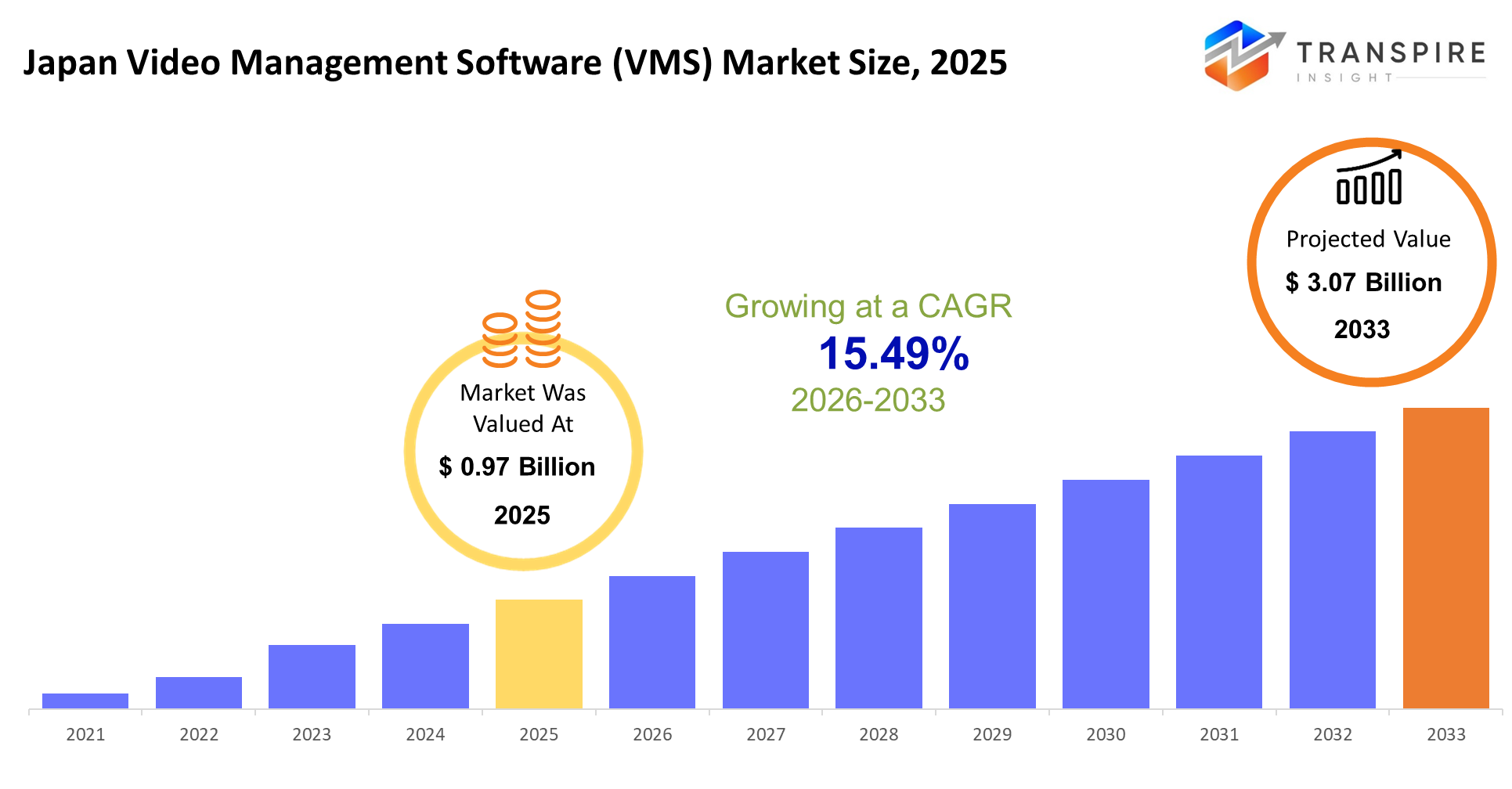
- Japan Video Management Software (VMS) Market Size 2025: USD 0.97 Billion
- Japan Video Management Software (VMS) Market Size 2033: USD 3.07 Billion
- Japan Video Management Software (VMS) Market CAGR: 15.49%
- Japan Video Management Software (VMS) Market Segments: By Type (Software, Hardware, Services, Cloud-based VMS, Others); By Application (Security & Surveillance, Traffic Monitoring, Retail Analytics, Smart Cities, Industrial Monitoring, Others); By End-User (Government, Enterprises, Retailers, Transportation Sector, Industrial Firms, Others); By Deployment (Cloud, On-premise, Hybrid, Others)
To learn more about this report,  Download Free Sample Report
Japan Video Management Software (VMS) Market Summary
The Japan Video Management Software (VMS) Market was valued at USD 0.97 Billion in 2025. It is forecast to reach USD 3.07 Billion by 2033. That is a CAGR of 15.49% over the period.
The Video Management Software (VMS) market in Japan operates as the essential component which enables modern surveillance systems to function because it provides businesses and transportation services and factories and public agencies with tools to control their live video streams and safekeeping of recorded footage and transformation of video data into useful information. The system enables operators to improve incident detection which allows them to handle multiple sites simultaneously while also eliminating security blind spots that occur in sensitive areas like rail stations and manufacturing facilities and logistics centers and advanced urban infrastructure.
The market has undergone a complete transformation during the past three to five years because businesses have moved away from using on-premise systems and now utilize hybrid and cloud-based systems which enable AI-powered analytics and remote monitoring capabilities. Organizations began to adopt this shift because COVID-19 pandemic restrictions prevented them from accessing physical locations and forced them to develop better systems for remote monitoring. Organizations need to comply with increased cybersecurity requirements which emerged after high-profile security breaches forced them to implement safer systems that support secure data sharing between different systems. Spending patterns have shifted from basic camera management expenses toward advanced intelligence systems which generate ongoing revenue through software analytics and their managed service offerings.
Key Market Insights
- Kanto controls the Japan Video Management Software (VMS) Market because it holds almost 41% of the market share in 2025 which results from its extensive business infrastructure and its smart city security systems.
- Kansai develops into the most rapidly expanding regional market because Osaka builds its public safety digital systems until 2030.
- Chubu shows excellent growth potential because manufacturing automation and industrial facility upgrades support its automotive and electronics production clusters.
- Cloud-based VMS solutions lead the market with about 46% of the total industry size in 2025 because they provide users with adjustable system capacity and their ability to monitor multiple locations from one central point.
- The on-premise VMS system stands as the second biggest market section which government agencies and critical infrastructure operators choose because they need to manage their data access.
- The fastest expanding market segment up to 2030 will be hybrid VMS platforms because businesses need to protect their systems while allowing remote worker access.
- Critical infrastructure surveillance leads with approximately 34% of the market share while rail transit and airports and utilities and urban monitoring requirements provide support.
- The retail and commercial analytics market grows fastest because businesses analyze customer behavior and implement fraud protection technologies.
- Factories need VMS systems to monitor their operations and detect potential incidents, which creates new demand for manufacturing facilities.
- Public sector organizations hold 37% of the market share because they implement citywide surveillance modernization initiatives.
What are the Key Drivers, Restraints, and Opportunities in the Japan Video Management Software (VMS) Market?
The Japan Video Management Software (VMS) Market experiences its primary growth because organizations adopt AI-powered surveillance systems together with cloud-based security solutions. The acceleration started when organizations began to replace their separate analog systems with integrated digital systems which provide instant data processing. The security operations market expanded because businesses started to use security systems for operational intelligence which generated additional software subscription income and extended their customer contracts.
A major restraint in the Japan Video Management Software (VMS) Market exists because organizations face ongoing problems with managing data and making their systems work together. The public institutions and industrial facilities that installed legacy surveillance systems face cloud integration challenges because their installations were not built for cloud use. The existing structure prevents organizations from modernizing their systems which hinders government agencies from completing digital transformation projects because they must follow lengthy procurement processes. The high market demand leads to revenue suppression for vendors during their initial sales period.
5G network expansion creates a significant opportunity for businesses to develop edge-based artificial intelligence video analytics solutions. The cities of Osaka and Fukuoka use telecom companies to test smart infrastructure systems which enable devices to process data in real time while decreasing latency and bandwidth expenses. The Japan Video Management Software (VMS) Market will experience its next period of growth through low-latency intelligent surveillance which will enable new operations to begin in logistics corridors and autonomous mobility zones.
What Has the Impact of Artificial Intelligence Been on the Japan Video Management Software (VMS) Market?
The Japanese Video Management Software market experiences continuous changes through artificial intelligence and advanced analytics because maritime and industrial operators use video monitoring systems for their compliance and asset management operations. AI-driven VMS systems now function in operational sites such as ports and vessel maintenance yards because they use live camera feeds to conduct automatic visual inspections of scrubber systems and exhaust gas cleaning equipment by detecting corrosion and leaks and identifying unusual emission patterns. The system enables maintenance teams to respond faster because it minimizes the need for manual inspections while enhancing their ability to monitor compliance across all their operational fleets.
Organizations use machine learning models to forecast equipment deterioration and determine optimal maintenance schedules. Operators can use historical video data together with sensor outputs to create maintenance forecasts for marine emission control systems which will help them avoid system failures and achieve 10 to 20 percent efficiency gains during planned downtimes in their digitally advanced systems. The systems enable fuel optimization because they detect engine and exhaust system inefficiencies which occur during various operational scenarios.
The Japan Video Management Software market encounters structural challenges which restrict AI usage within actual maritime operational settings. Real-time video processing capabilities face limitations due to restricted offshore connectivity and bandwidth which results in multiple analytics tasks needing to be handled through onboard systems that have limited computational capacity. The system has two problems which affect its performance because it loses accuracy during complicated sea operations and experiences delays in its complete deployment to shipping fleets especially on extended maritime routes.
Key Market Trends
- The Japan Video Management Software (VMS) market started to abandon its traditional on-premise DVR systems because the industry began to adopt cloud-native systems which now account for more than 40% of new system installations since 2023.
- The adoption of AI-based video analytics technology experienced rapid growth after 2024 because it introduced automated anomaly detection systems to transport hubs while decreasing the security team's need for manual monitoring tasks.
- The government surveillance modernization initiatives which began after 2022 created a need for smart city technologies in Tokyo, which resulted in increased demand for centralized video intelligence systems.
- Enterprises began to implement encrypted interoperable VMS systems which included sophisticated access control mechanisms after multiple infrastructure security breaches forced organizations to enhance their cybersecurity measures.
- Axis Communications and Genetec established their Japan expansion through partner networks during 2025, which enabled better system integration with local system integrators and telecom companies.
- The period from 2024 to 2026 saw rapid growth in edge computing adoption which enabled real-time processing capabilities at camera level while decreasing cloud bandwidth expenses for extensive system implementations.
- Japanese retailers developed multiple retail analytics use cases after they began using behavioral video insights to improve customer flow management and develop strategies for loss prevention.
- Industrial facilities raised their investments in video management systems after the 2023 supply chain interruptions revealed security vulnerabilities in their logistics and warehouse monitoring systems.
Japan Video Management Software (VMS) Market Segmentation
By Type :
The primary element of the Japan Video Management Software (VMS) Market will continue to be software because the need for video recording and storage and analytics tools keeps increasing. The system performance will be enhanced through hardware components which include cameras and storage systems. The company will provide services which include installation and maintenance and upgrades. The adoption of cloud-based VMS systems will increase because users appreciate the system's flexibility and ability to access data from remote locations.
Hardware and services will continue to hold value because organizations require dependable systems and technical assistance to achieve seamless video operations. Businesses are moving toward remote monitoring which enables them to decrease initial expenses thus cloud-based systems will continue to expand. The system will acquire additional components which address specific requirements while enhancing its efficiency and ability to work with different systems.
By Application :
The Japan Video Management Software (VMS) Market will experience growth through security and surveillance applications which fulfill the increasing demand for safety in public and private areas. Traffic monitoring will enable authorities to achieve better road management and accident control. Retail analytics enables businesses to analyze customer behavior through video insights which lead to improved store performance.
Smart city projects will increase usage of VMS for better urban management and public safety. Industrial monitoring enables factories to achieve better safety and productivity through real-time video tracking. The technology will find other uses in education and healthcare monitoring through video systems which create secure environments and enhance operational efficiency.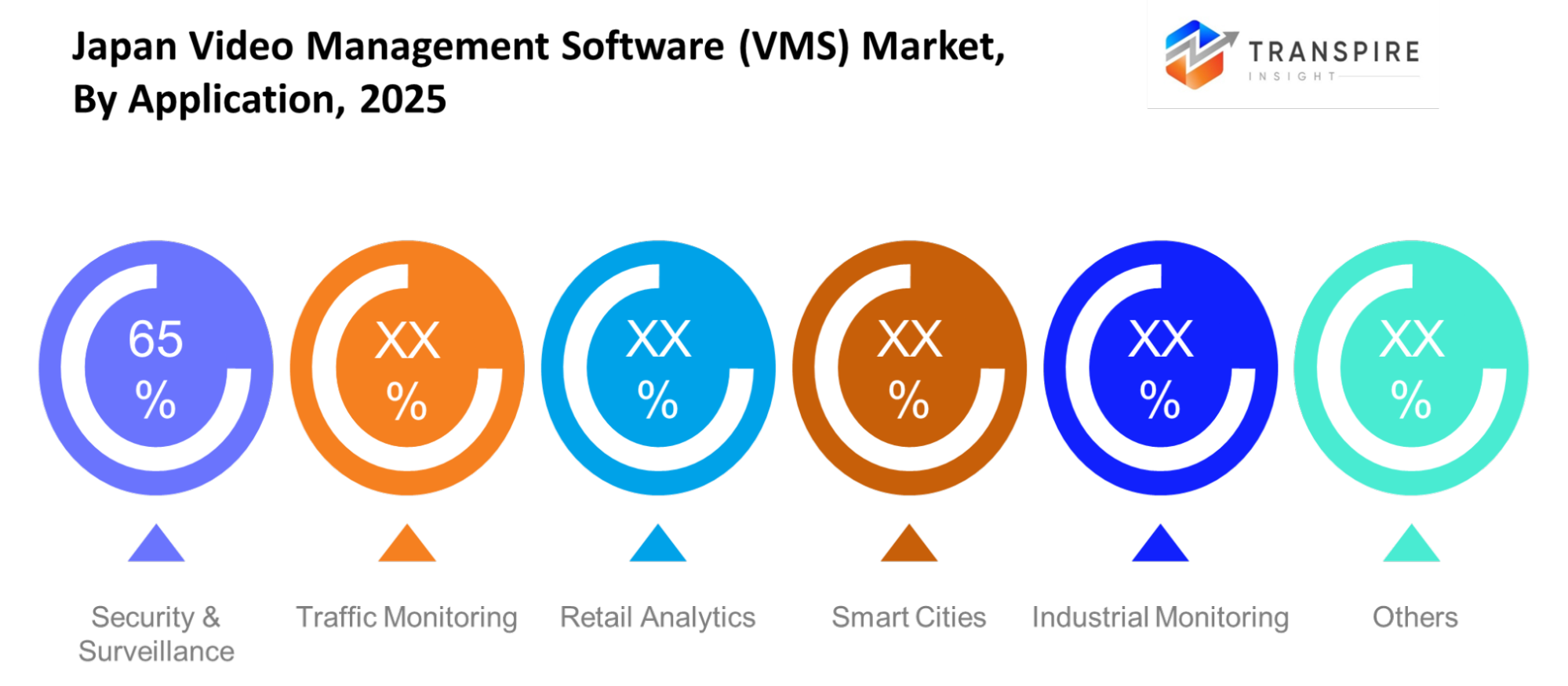
To learn more about this report, Download Free Sample Report
By End-User :
The Japanese Video Management Software VMS Market will experience steady government adoption because of its applications in public safety and law enforcement and smart city development projects. Enterprises will implement video systems to protect their offices and monitor their daily activities. Retailers will use VMS systems to prevent theft while analyzing customer behavior for their sales strategies improvement.
The transportation sector will expand its usage of video systems for traffic control and railway monitoring and airport security operations. Industrial firms will use video systems to secure their workplace environments and monitor their production processes. Educational institutions and healthcare facilities will need security and monitoring systems to maintain their essential operational functions.
By Deployment :
The Japan Video Management Software VMS Market will experience rapid growth in cloud deployment because of its ability to enable remote access and decrease maintenance requirements and provide flexible storage solutions. Organizations that require complete data and security control will maintain their on-premise systems. Hybrid models will combine both approaches for better balance and performance.
The cloud systems will enable multiple locations to achieve real-time monitoring capabilities while maintaining ability to scale their operations. The sectors with strict data policies will continue to prefer on-premise solutions. The hybrid deployment model will become more common as businesses seek to balance security needs with cloud-based advantages which will result in better system performance.
What are the Key Use Cases Driving the Japan Video Management Software (VMS) Market?
Core adoption in the Japan Video Management Software (VMS) Market is driven by critical infrastructure surveillance across rail networks, airports, and urban monitoring systems. The continuous production of high-volume video streams requires organizations to use centralized systems that enable them to detect threats in real time and handle emergency situations, which generates persistent demand from both enterprises and government agencies.
Retail analytics and industrial facility monitoring are developing new applications that people can use. Japanese retailers increasingly use VMS to track customer movement patterns and optimize store layouts, while manufacturers integrate video systems into production sites to enhance safety compliance and reduce operational disruptions, particularly in automotive and electronics plants.
VMS uses AI and IoT sensors to control container movement and vessel docking operations in autonomous port facilities and smart logistics corridors. Offshore energy installations now use video monitoring systems to verify maintenance work and identify hazards, which proves especially useful for inspecting remote marine sites that require expensive and rare manual checks.
|
Report Metrics |
Details |
|
Market size value in 2025 |
USD 0.97 Billion |
|
Market size value in 2026 |
USD 1.12 Billion |
|
Revenue forecast in 2033 |
USD 3.07 Billion |
|
Growth rate |
CAGR of 15.49% from 2026 to 2033 |
|
Base year |
2025 |
|
Historical data |
2021 - 2024 |
|
Forecast period |
2026 - 2033 |
|
Report coverage |
Revenue forecast, competitive landscape, growth factors, and trends |
|
Country scope |
Japan |
|
Key company profiled |
Genetec, Milestone Systems, Bosch, Honeywell, Axis Communications, Hikvision, Dahua, Avigilon, Pelco, Panasonic, NEC, Hanwha Vision, Cisco, IBM, Eagle Eye Networkse |
|
Customization scope |
Free report customization (country, regional & segment scope). Avail customized purchase options to meet your exact research needs. |
|
Report Segmentation |
By Type (Software, Hardware, Services, Cloud-based VMS, Others); By Application (Security & Surveillance, Traffic Monitoring, Retail Analytics, Smart Cities, Industrial Monitoring, Others); By End-User (Government, Enterprises, Retailers, Transportation Sector, Industrial Firms, Others); By Deployment (Cloud, On-premise, Hybrid, Others) |
Which Regions are Driving the Japan Video Management Software (VMS) Market Growth?
The Kanto region leads the Japan Video Management Software (VMS) Market because of its high concentration of government agencies and business centers and transportation networks which are centered around Tokyo. The authorities have enforced strong regulations to maintain urban safety standards and disaster readiness requirements which have resulted in continuous upgrades of surveillance systems throughout rail systems and public areas of the city. The area benefits from an advanced ecosystem which includes system integrators and telecom companies and security technology businesses that can handle extensive system implementation. Smart city projects require a high number of installed cameras which creates increased demand for systems that allow unified management of video surveillance operations.
The Kansai region maintains its constant presence through industrial variety which operates differently from administrative power distribution. Operational surveillance needs arise from the manufacturing and logistics and port activities that drive demand throughout Osaka and its adjacent prefectures. The long-term corporate investment patterns and digital modernization process which progresses through time define the growth path of Kansai because it does not follow Kanto's expansion through government policies. The stability of industrial and export-oriented infrastructure systems creates a pattern that leads to predictable implementation of video management systems.
The region of Kyushu experiences rapid growth because recent investments have improved both its port facilities and its cross-border logistics systems which support Southeast Asian trade routes. Fukuoka and Nagasaki have implemented new smart port projects which enable faster use of AI-based systems that track cargo and monitor ship operations. The security needs of industrial areas have increased because companies are now investing more into semiconductor production and advanced manufacturing facilities. For investors and market entrants the infrastructure development scheduled between 2026 and 2033 will create new business opportunities for Kyushu which serves as a high-growth entry market.
Who are the Key Players in the Japan Video Management Software (VMS) Market and How Do They Compete?
The market for video management software in Japan shows moderate consolidation because international security technology companies compete with local system integrators who have established themselves as major players. The existing vendors maintain their market positions through their extensive enterprise connections and their ongoing infrastructure agreements while new competitors who use AI and cloud technology solutions emerge in the market. Companies differentiate themselves through their technological capabilities instead of pricing their products, especially concerning AI analytics, cybersecurity compliance, and their ability to connect with smart city and industrial control systems. Organizations that meet Japan's strict guidelines on data management and system compatibility will establish themselves as preferred vendors for both business enterprises and government organizations.
Axis Communications uses an edge-first strategy which integrates AI analytics into cameras without depending on centralized processing. The system delivers benefits to Japanese smart city and industrial users by decreasing both latency and bandwidth expenditures. The company establishes its business presence through partnerships which involve local system integrators and telecom providers to develop transport and urban surveillance networks. Genetec distinguishes itself from competitors through its security platform which unifies video surveillance access control and license plate recognition functions while maintaining robust cybersecurity certifications that government clients find attractive. The company grows its operations through enterprise command center installations and its adoption of hybrid cloud technology.
Milestone Systems operates an open-platform system which enables comprehensive third-party system integration to draw in enterprise customers who require customized solutions for their logistics and manufacturing operations. Panasonic Connect uses its domestic advantages and expertise in hardware-software integration to obtain public infrastructure contracts throughout Japan. Hanwha Vision develops cost-effective AI-powered surveillance systems which it markets through partnerships with retail and logistics companies to expand its business reach into mid-sized enterprises.
Company List
- Genetec
- Milestone Systems
- Bosch
- Honeywell
- Axis Communications
- Hikvision
- Dahua
- Avigilon
- Pelco
- Panasonic
- NEC
- Hanwha Vision
- Cisco
- IBM
- Eagle Eye Networks
Recent Development News
In March 2026, Milestone Systems announced significant advancements to its XProtect VMS platform, introducing enhanced AI-driven analytics capabilities and improved integration with its BriefCam video analytics suite. The update strengthens enterprise video intelligence functions such as object recognition and real-time event analysis, reinforcing Milestone’s position in high-end security deployments across regulated and infrastructure-heavy markets like Japan.Source https://www.prnewswire.com/
In March 2026, Genetec Inc. expanded its Japan footprint through the same collaboration with Macnica, focusing on deploying its open-architecture Security Center platform, which functions as a leading enterprise-grade VMS and physical security software suite. The initiative supports centralized video management and multi-system integration across Japanese enterprises and critical infrastructure sites. Source https://www.macnica.co.jp/
What Strategic Insights Define the Future of the Japan Video Management Software (VMS) Market?
The Japan Video Management Software (VMS) Market is moving toward an intelligence-led architecture which will convert video systems into active monitoring systems that provide instant decision-making capabilities. The integration of AI analytics and edge computing together with cloud orchestration has established this new operational framework through its ongoing implementation across urban environments and industrial facilities. Security organizations will adopt unified security ecosystems which integrate video and IoT sensors and predictive analytics during the next 5 to 7 years instead of using individual surveillance systems.
A hidden threat emerges from the way technology companies select their cloud and AI infrastructure providers. A small set of global technology companies maintains control over essential processing and storage systems which creates a risk for users who depend on these systems because data sovereignty regulations in Japan become stricter. The situation will result in extended procurement times for government projects which require advanced security measures and critical infrastructure protection.
An emerging opportunity exists in the establishment of autonomous logistics corridors which will connect smart port development projects in Kyushu and coastal industrial areas. The current environment requires terminal operators to use VMS together with automated vessel handling and cargo tracking systems which will create a demand for ultra-low latency video intelligence. Market participants should focus on developing modular platforms which allow interoperability with transport automation systems and 5G infrastructure because their early entry into the market will establish their future control over Japanese surveillance contracts.
Japan Video Management Software (VMS) Market Report Segmentation
By Type
- Software
- Hardware
- Services
- Cloud-based VMS
By Application
- Security & Surveillance
- Traffic Monitoring
- Retail Analytics
- Smart Cities
- Industrial Monitoring
By End-User
- Government
- Enterprises
- Retailers
- Transportation Sector
- Industrial Firms
By Deployment
- Cloud
- On-premise
- Hybrid
Frequently Asked Questions
Find quick answers to common questions.
The Japan Video Management Software (VMS) Market size is USD 3.07 Billion in 2033.
Key Segments for the Japan Video Management Software (VMS) Market are By Type (Software, Hardware, Services, Cloud-based VMS, Others); By Application (Security & Surveillance, Traffic Monitoring, Retail Analytics, Smart Cities, Industrial Monitoring, Others); By End-User (Government, Enterprises, Retailers, Transportation Sector, Industrial Firms, Others); By Deployment (Cloud, On-premise, Hybrid, Others).
Major Japan Video Management Software (VMS) Market Players are Genetec, Milestone Systems, Bosch, Honeywell, Axis Communications, Hikvision, Dahua, Avigilon, Pelco, Panasonic, NEC, Hanwha Vision, Cisco, IBM, Eagle Eye Networkse.
The Current Japan Video Management Software (VMS) Market size is USD 0.97 Billion in 2025.
The Japan Video Management Software (VMS) Market CAGR is 15.49% from 2026 to 2033.
- Genetec
- Milestone Systems
- Bosch
- Honeywell
- Axis Communications
- Hikvision
- Dahua
- Avigilon
- Pelco
- Panasonic
- NEC
- Hanwha Vision
- Cisco
- IBM
- Eagle Eye Networks
Recently Published Reports
-
Apr 2026
3D Optical Profiler Market
3D Optical Profiler Market Size, Share & Analysis Report By Type (Desktop 3D Optical Profiler, and Portable 3D Optical Profiler), By Technology (Confocal Technology, and White Light Interference), By End-Use Industry (Manufacturing, Research Institutions, Automotive, Aerospace and Defense, Medical Devices, and Other), and Geography (North America, Europe, Asia-Pacific, Middle East and Africa, South and Central America), 2021 - 2031
-
Apr 2026
Depth Sensor Market
Depth Sensor Market Size, Share & Analysis Report By Type (Infrared Depth Sensors, Time-of-Flight (ToF) Sensors, Stereo Vision Sensors, Structured Light Sensors, Ultrasonic Depth Sensors), By Application (Automotive, Robotics, Gaming, Consumer Electronics, Industrial Automation, Healthcare, Security & Surveillance, Others), By End Users (Automotive Manufacturers, Consumer Electronics Companies, Healthcare Providers, Industrial Companies, Security Agencies, Gaming Companies, Robotics Companies, Others), and Geography (North America, Europe, Asia-Pacific, Middle East and Africa, South and Central America), 2021 – 2031
-
Apr 2026
Digital Manufacturing Market
Digital Manufacturing Market Size, Share & Analysis Report By Component (Hardware, Software, and Services), By Technology (Robotics, 3D Printing, Internet of Things (IoT), and Others), By Application (Automotive and Transportation, Aerospace and Defense, Consumer Electronics, Industrial Machinery, and Others), By Process Type (Computer-Based Designing, Computer-Based Simulation, Computer 3D Visualization, Analytics, and Others), and Geography (North America, Europe, Asia-Pacific, Middle East and Africa, South and Central America), 2021 – 2031
-
Apr 2026
Digital Visa Services Market
Digital Visa Services Market Size, Share & Analysis Report By Type (Individual Travelers, Group Travelers), By Application (Tourism, Business Travel, Others), and Geography (North America, Europe, Asia-Pacific, Middle East and Africa, South and Central America), 2021 – 2031