
Europe Language Translation Software Market Size & Forecast:
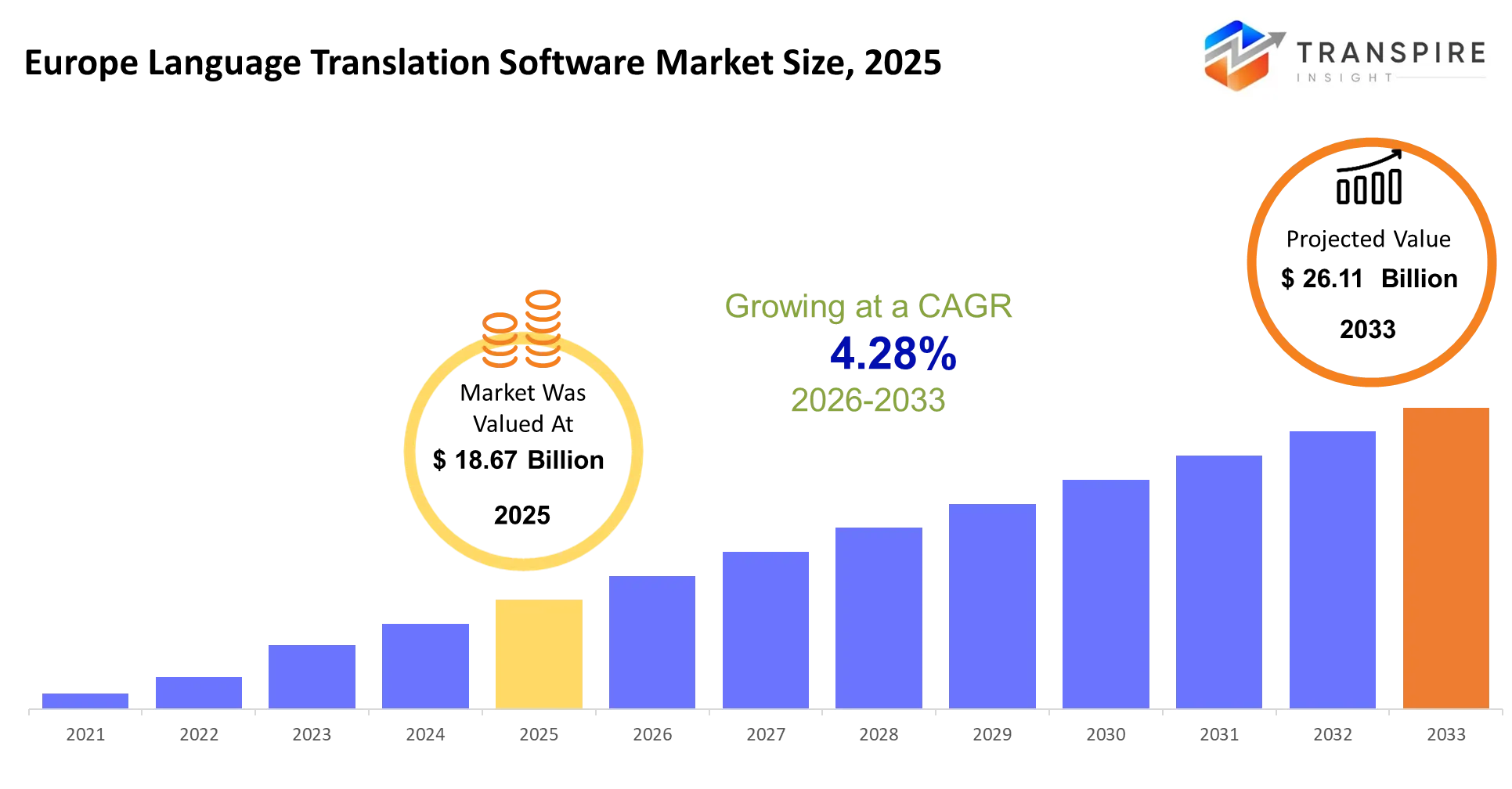
- Europe Language Translation Software Market Size 2025: USD 18.67 Billion
- Europe Language Translation Software Market Size 2033: USD 26.11 Billion
- Europe Language Translation Software Market CAGR: 4.28%
- Europe Language Translation Software Market Segments: By Type (Rule-based, Statistical, Neural Machine Translation, Others); By Application (E-commerce, Healthcare, Legal, IT & Telecom, Travel & Tourism, Others); By End-User (Enterprises, SMEs, Government, Content Creators, IT Companies, Others); By Deployment (Cloud-based, On-premise, Hybrid, Others)
To learn more about this report,  Download Free Sample Report
Europe Language Translation Software Market Summary
The Europe Language Translation Software Market was valued at USD 18.67 Billion in 2025. It is forecast to reach USD 26.11 Billion by 2033. That is a CAGR of 4.28% over the period.
The European Union uses language translation software to translate multilingual documents and technical manuals and customer communications and operational data which enables companies to operate their logistics and manufacturing and maritime trade and public services across different language regions. The software now exists as an integrated component of enterprise platforms instead of existing as an independent application.
The market has transitioned during the past three to five years from using rule-based and static translation systems toward adopting neural machine translation systems and large language model-based cloud solutions which organizations incorporate into their ERP and CRM and shipping documentation processes. The Eastern Europe geopolitical crisis which started in 2022 has created urgent requirements for public agencies and supply chains to enhance their cross-border coordination efforts. The combination of hybrid work systems with this need created increased requirements for organizations to establish instant and secure systems which enable multilingual communication.The accuracy improvements together with API-based deployment system enabled organizations to use translation services across all business functions which created additional revenue streams through subscription-based services.
Key Market Insights
- The Europe Language Translation Software Market which Western Europe controls as its main market region has strong enterprise digitization needs which require multilingual workforce support to achieve its 45% market share.
- The Eastern European region will experience its strongest growth period between 2024 and 2030 because of its developing outsourcing centers and increasing international trade activities.
- Germany and France lead adoption due to high industrial automation and regulatory multilingual compliance requirements.
- The market leader for Cloud-based translation software controls 55% of the market because its customers benefit from its ability to expand and its application programming interface integration capabilities.
- The government and defense sectors use on-premise solutions as their second most popular security solution because these systems offer superior data protection.
- The AI-powered neural translation systems represent the industrys most rapidly expanding sector which will experience growth until 2030 through its upcoming adoption phases.
- The Europe Language Translation Software Market shows document translation as its most important segment which controls 40% of the market because legal and technical and corporate entities require this service.
- The demand for real-time communication tools has increased because hybrid work environments and international collaboration have become more common.
- Large enterprises control about 50% of the market share because they use translation software to support their international business activities and regulatory compliance requirements.
- The entry barriers decrease for SMEs because SaaS-based translation tools become more affordable while operational expenses decrease.
What are the Key Drivers, Restraints, and Opportunities in the Europe Language Translation Software Market?
The European Language Translation Software Market develops through established structural elements which determine enterprise decisions regarding multilingual technology implementation across different business sectors.
Enterprises today experience fast growth because they now integrate AI-powered neural machine translation systems into their software solutions. European companies started to implement real-time translation services into their operational processes. The supply chain and remote work systems created cross-border operational challenges which made their international operations more difficult after 2022. The logistics and legal and e-commerce sectors experience faster business expansion because translation speed and accuracy directly affect their operational performance and revenue generation.
The main obstacle to progress exists because organizations must handle ongoing data protection needs and data protection regulations which emerge from GDPR and national security legislation. Organizations in various sectors still refrain from using complete cloud-based translation systems because they worry about their confidential documents getting exposed and their inability to send data across international borders. The government and financial services sectors experience a structural bottleneck because their extended procurement processes and ongoing use of hybrid on-premise systems restrict market earning capacity.
Regulated industries now possess a major opportunity through the development of domain-specific generative AI translation models which create industry-specific translation solutions. European companies and DeepL are investing in the development of specialized language models which will serve legal and technical applications. The growth of these systems will create new business opportunities for Eastern Europe when BPO and outsourcing centers start to use them.
What Has the Impact of Artificial Intelligence Been on the Europe Language Translation Software Market?
The European Language Translation Software Market experiences fundamental transformation through artificial intelligence which introduces automated processes and predictive tools and optimization features into business communication systems. Modern AI translation engines now automate large-scale document processing, allowing enterprises to convert technical manuals, legal contracts, and customer communications into multiple languages with minimal human intervention. This process helps organizations complete tasks more quickly while maintaining established operational standards throughout international teams.
Machine learning methods now provide predictive capabilities to help improve translation quality control processes. The models project contextual accuracy, identify terminology discrepancies, and provide correction recommendations which need to undergo testing before they can be used in operational environments. The enterprise domain has achieved better translation accuracy through this system which operates in logistics platforms and industrial compliance systems because it decreases required rework time by 20 to 30 percent across various documentation types.
AI implementation results in operational benefits because it boosts productivity through three main improvements which include faster localization and better customer service and reduced need for human translators. Organizations that implement advanced neural translation systems experience 40 percent faster content delivery across multiple languages which boosts their e-commerce revenue and service development.
The limited availability of domain-specific training data for specialized sectors which include legal and engineering and maritime compliance documentation remains the main barrier that prevents organizations from achieving full adoption. The need for precise terminology creates accuracy problems in actual cases where automated systems require human intervention to translate high-risk content.
Key Market Trends
- The period from 2018 to 2020 saw enterprises transition from using rule-based translation systems to adopting neural machine translation systems, which enhanced their ability to maintain contextual accuracy during multilingual operations in Europe.
- European authorities began to enforce stricter GDPR regulations from 2022, which led businesses to adopt hybrid translation systems that combine both professional and automated translation systems instead of using complete cloud-based language processing solutions.
- Between 2021 and 2025, Microsoft and Google developed their AI translation application programming interfaces by introducing real-time multilingual capabilities, which they integrated into their enterprise productivity software for European markets.
- After 2023, DeepL obtained a major portion of the European enterprise market because it developed precise legal and technical translation services that meet the needs of regulated industries.
- The move to cloud-based translation systems began in 2025 when more than 55% of enterprises started to use cloud services, which simplified their integration process with customer relationship management and enterprise resource planning software.
- The period following 2022 supply chain disruptions created a greater need for real-time translation in logistics operations, which helped European trade networks establish better operational efficiency through improved cross-border coordination.
- Small and medium-sized enterprises started using software as a service translation platforms from 2023 because subscription-based pricing made it easier for them to enter the market while decreasing their translation costs.
- The process of fine-tuning AI models with industry-specific vocabulary resulted in a 25 to 30 percent increase in translation precision for legal and engineering translations throughout Europe.
Europe Language Translation Software Market Segmentation
By Type:
The Europe Language Translation Software Market shows its largest market share which belongs to Neural Machine Translation because of its advanced capacity to understand multiple languages andits ability to deliver accurate translations. Enterprises shifted toward AI models for real-time translation and domain adaptation after 2020 because these systems showed better performance than rule-based and statistical systems. Rule-based systems continue to decline, mainly retained in legacy government or compliance-heavy environments where predictability still matters more than flexibility.
European language datasets provide continuous model training, which leads to the development of neural systems that operate within cloud enterprise platforms. Statistical models are gradually losing relevance as they struggle with nuanced grammar and industry-specific terminology. The upcoming period will see neural architectures becoming the primary force behind technological advancements because hybrid AI systems will enhance precision in legal, technical and customer service uses. Developers will focus on building domain-adaptive training layers which will enhance enterprise reliability and decrease costs associated with post-editing work.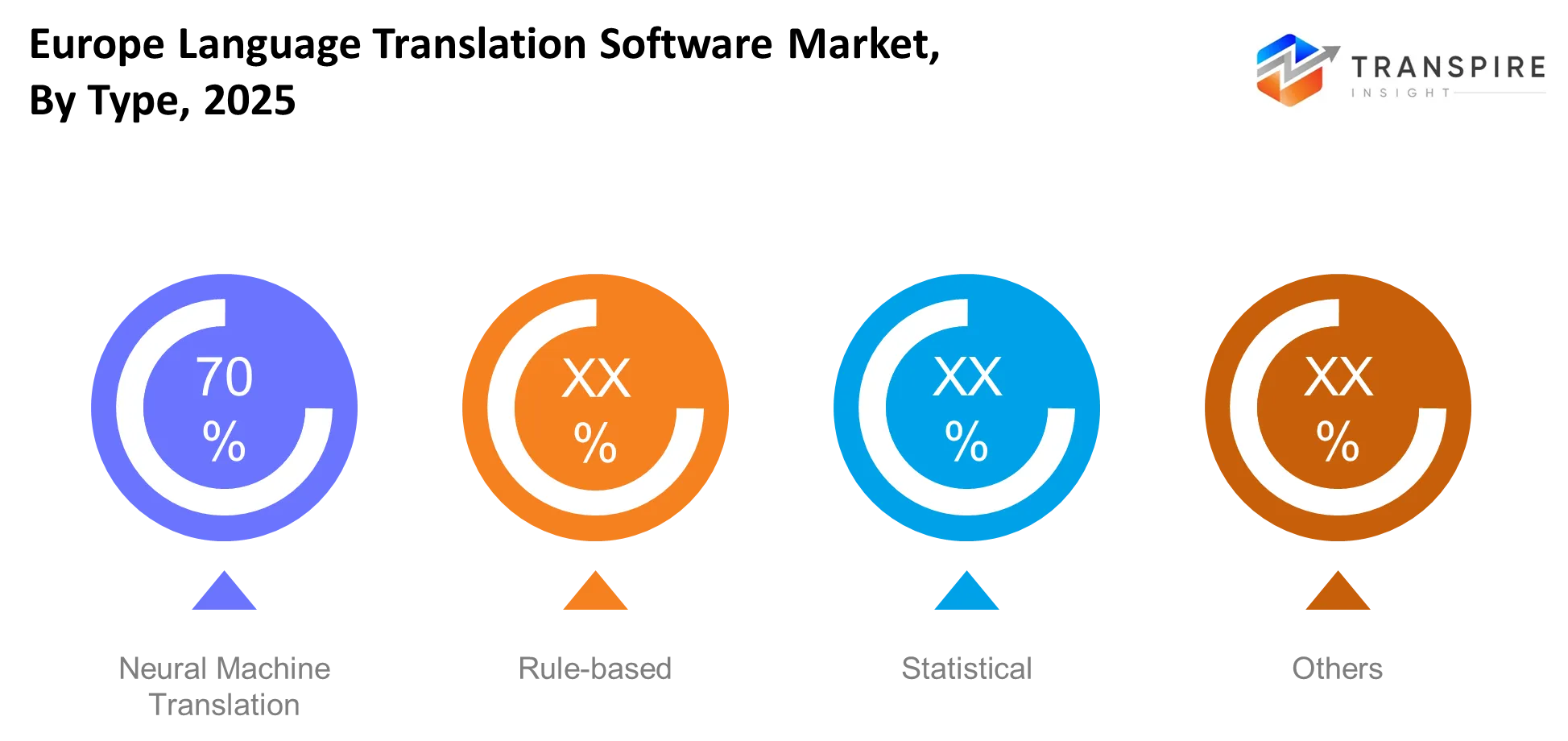
To learn more about this report, Download Free Sample Report
By Application:
E-commerce establishes itself as the main application area because European digital markets experience high-volume multilingual product listings and cross-border sales growth. The IT and telecom sectors require enterprise communication systems which need real-time translation capabilities to support their distributed teams. Legal and healthcare applications maintain strong but regulated adoption due to strict accuracy and compliance requirements.
The growth of digital commerce leads to higher customer needs for instant localization solutions which businesses use to establish contact with their clients. The travel and tourism sector experienced strong recovery after 2022 which created additional translation needs during peak times for booking and customer service interactions. The company will develop AI-powered localization solutions for digital storefronts which will help developers achieve faster processing times and better understanding of their website content that leads to successful customer conversions.
By End-User:
The Europe Language Translation Software Market enables enterprises to maintain their leading market position because they need to conduct multilingual operations throughout their supply chains and customer service activities and regulatory reporting. The adoption of SaaS-based translation solutions by SMEs creates a new business opportunity because these tools make it easier for them to enter international markets without needing extensive translation staff. Government agencies proceed with their technology implementation process at a slower pace because they need to comply with strict data governance requirements and they have to follow procurement cycles.
SMEs experience growth because subscription-based pricing systems work together with cloud productivity tools for their business operations. The IT industry and content creators use translation APIs to create digital content that can reach both European and international users. The forecast period will see enterprises transition to automated translation systems that prioritize AI-based solutions while SMEs will create growth through their simple translation tools which work with online commerce systems.
By Deployment:
The Europe Language Translation Software Market experiences its greatest market share through cloud-based deployment because this deployment method provides businesses with scalability and real-time processing and works seamlessly with their enterprise software systems. The banking and defense and government sectors maintain their on-premise systems because these regulated industries need to comply with strict data sovereignty laws. Organizations are now implementing hybrid models because they want to protect their systems while maintaining operational flexibility.
The need for cloud acceleration increases because people want APIs and they require ongoing translation updates without needing infrastructure resources. High-security environments that need complete data protection still use on-premise systems even though they are becoming less common. Vendors will focus their future growth efforts on hybrid and cloud-native solutions by establishing encryption systems and edge processing capabilities and compliance-ready architectures which will meet European regulatory requirements while delivering operational performance.
What are the Key Use Cases Driving the Europe Language Translation Software Market?
The primary application of European language translation software in e-commerce enables businesses to transform their product catalogs and customer support materials and checkout processes into multiple languages. The demand for this service exists at its highest level because European digital sales across borders require businesses to use accurate language conversion that happens instantaneously to achieve sales results and decrease customer drop-off rates.
The existing applications now include legal document translation together with IT support localization. Organizations of all sizes together with government bodies now employ translation software to translate their compliance documents and contracts and technical manuals into different legal systems. Multilingual support systems serve as essential tools for IT and telecom companies which operate their customer service and distributed workforce functions.
The use cases that are developing today feature real-time multilingual communication between industrial IoT systems and AI-powered translation systems which support healthcare diagnostic processes. Hospitals together with engineering companies start evaluating systems which enable instant translation of operational data streams together with patient records to enhance their ability to work internationally. The current applications exist at an initial development stage yet they demonstrate significant potential because AI technology continues to advance.
|
Report Metrics |
Details |
|
Market size value in 2025 |
USD 18.67 Billion |
|
Market size value in 2026 |
USD 19.47 Billion |
|
Revenue forecast in 2033 |
USD 26.11 Billion |
|
Growth rate |
CAGR of 4.28% from 2026 to 2033 |
|
Base year |
2025 |
|
Historical data |
2021 - 2024 |
|
Forecast period |
2026 - 2033 |
|
Report coverage |
Revenue forecast, competitive landscape, growth factors, and trends |
|
Regional scope |
Europe (Germany, United Kingdom, France, Italy, Spain, Rest of Europe) |
|
Key company profiled |
Google, Microsoft, Amazon, IBM, SDL, Lionbridge, RWS, Systran, DeepL, Smartling, TransPerfect, Memsource, Phrase, KantanAI, AppTek |
|
Customization scope |
Free report customization (country, regional & segment scope). Avail customized purchase options to meet your exact research needs. |
|
Report Segmentation |
By Type (Rule-based, Statistical, Neural Machine Translation, Others); By Application (E-commerce, Healthcare, Legal, IT & Telecom, Travel & Tourism, Others); By End-User (Enterprises, SMEs, Government, Content Creators, IT Companies, Others); By Deployment (Cloud-based, On-premise, Hybrid, Others) |
Which Regions are Driving the Europe Language Translation Software Market Growth?
The Western European market dominates the European Language Translation Software Market because it has many multinational companies and requires multiple languages to be used and its digital systems operate at a high level. The European Union's language and data privacy rules force businesses in Germany France and the Netherlands to use certified translation services because these regulations require them to follow strict compliance requirements. The area operates cloud infrastructure which supports advanced artificial intelligence systems that work with enterprise resource planning and customer relationship management software. The ongoing movement of goods through important port facilities and distribution centers drives the need for instant translation serviceswhich support both supply chain operations and document management processes. The existing system enables businesses to use the software at all timeswhile they receive software updates.
The Nordic countries of Northern Europe provide a reliable second-tier market because their digital governance systems and public sector digital services have reached advanced development stages. The region depends on government operations and educational institutions together with public works development because it does not have the same enterprise demand that Western European countries experience. Sweden and Finland establish digital communication standards for all public service operations which leads to constant use of translation software. Strong cybersecurity frameworks also support secure deployment of cloud-based translation systems. The system creates a steady demand for products which business expansion creates while government digital policies remain unchanged and avoid major shifts.
The fastest-growing area in Eastern Europe experiences growth because of two factors which are rapid IT outsourcing expansion and accelerated enterprise digital transformation after increased nearshoring activity since 2022. Western European clients receive support from multilingual service hubs which Poland Romania and Hungary built through their substantial investments in these facilities. The demand for real-time translation tools in customer support and software development services has increased because of new EU-funded infrastructure programs and rising BPO activity. The shift receives additional support through workforce scalability and reduced operational expenses which companies experience in comparison to Western Europe. From 2026 until 2033 time period this area presents high-volume growth opportunities for market entrants and investors through cloud-native solutions and API-based translation platforms which provide scalable translation services.
Who are the Key Players in the Europe Language Translation Software Market and How Do They Compete?
The Europe Language Translation Software Market displays moderate consolidation across its platform layer while maintaining its unbroken state throughout its various localization and specialized enterprise market segments. Global cloud providers establish direct competition with AI translation firms that operate exclusively within their specialized domain and with enterprise software companies. Current market competition exists between companies that develop neural models which use natural language processing and those who build API systems that comply with European Union data protection standards. Companies that provide translation services now achieve success through their ability to integrate translation into business processes which creates value through their control over ecosystems and their system compatibility with other platforms.
Google Cloud Translation APIs enable Google to maintain cost leadership through its Google Cloud Translation APIs which power real-time translation across multiple platforms including Android Search and Workspace to achieve extensive market presence in Europe. Microsoft creates customer loyalty by integrating translation features into its Teams and Azure AI products which enable businesses to communicate in different languages without difficulties during their operations. DeepL provides a unique advantage by offering precise neural translation systems that focus on European languages which makes it attractive to industries that require legal and technical translation services.
IBM applies its artificial intelligence consulting approach to deliver Watson-based language services which handle secure multilingual data processing needs of companies that operate within regulated industries. SAP uses its ERP system to create native connections which enable translation capabilities throughout supply chain and finance processes thus minimizing operational interruptions for business users. RWS Holdings operates as a localization expert which provides certified linguist-backed AI solutions to support legal life sciences and intellectual property translation needs. These companies grow their business through enterprise contract agreements which they establish with compliance partners and through their implementation of European Union regulatory-compliant systems.
Company List
- Microsoft
- Amazon
- IBM
- SDL
- Lionbridge
- RWS
- Systran
- DeepL
- Smartling
- TransPerfect
- Memsource
- Phrase
- KantanAI
- AppTek
Recent Development News
In July 2025, DeepL entered a strategic distribution partnership with Bechtle to expand AI translation solutions across 14 European countries. The collaboration enables DeepL’s tools to be embedded into enterprise IT infrastructure across finance, healthcare, and manufacturing sectors, significantly expanding its enterprise reach. This move strengthens DeepL’s enterprise penetration through channel-based distribution rather than direct sales. https://www.deepl-bridges.com
In August 2025, TransPerfect acquired Unbabel to expand its AI-powered language technology portfolio, integrating TowerLLM into its GlobalLink platform. The acquisition enhances automated customer service translation and strengthens TransPerfect’s hybrid AI-human localization capabilities across global enterprise clients. https://www.transperfect.com
What Strategic Insights Define the Future of the Europe Language Translation Software Market?
The Europe Language Translation Software Market is moving toward deeply embedded, AI-native language infrastructure which enables translation to function as an invisible system within enterprise operations. The advancement of neural and generative AI models together with enterprise needs for instant multilingual decision abilities across different locations has driven this transformation. The upcoming 5 to 7 years will see value development in platforms which provide direct translation capabilities within ERP systems, CRM software, and industrial communication networks instead of using traditional localization methods.
The market faces a hidden danger because more companies now depend on major AI and cloud providers. The bundled translation API system which enterprises use will create challenges for smaller specialist vendors because it will reduce their profit margins while making their services less distinct. The overall demand for innovation will increase, but the industry will experience slower progress due to this development.
The European Union has established an emerging opportunity for sovereign AI translation through its implementation of strict data localization requirements and its public sector digital transformation initiatives. The organization will establish space for compliant language models which use EU language databases to create their training material. Market participants should prioritize verticalized, compliance-first AI translation solutions and form partnerships with regulated industries early, rather than competing solely on general-purpose accuracy or cost efficiency.
Europe Language Translation Software Market Report Segmentation
By Type
- Rule-based
- Statistical
- Neural Machine Translation
- Others
By Application
- E-commerce
- Healthcare
- Legal
- IT & Telecom
- Travel & Tourism
- Others
By End-User
- Enterprises
- SMEs
- Government
- Content Creators
- IT Companies
- Others
By Deployment
- Cloud-based
- On-premise
- Hybrid
- Others
Frequently Asked Questions
Find quick answers to common questions.
The Europe Language Translation Software Market size is USD 26.11 Billion in 2033.
Key Segments for the Europe Language Translation Software Market are By Type (Rule-based, Statistical, Neural Machine Translation, Others); By Application (E-commerce, Healthcare, Legal, IT & Telecom, Travel & Tourism, Others); By End-User (Enterprises, SMEs, Government, Content Creators, IT Companies, Others); By Deployment (Cloud-based, On-premise, Hybrid, Others).
Major Europe Language Translation Software Market Players are Google, Microsoft, Amazon, IBM, SDL, Lionbridge, RWS, Systran, DeepL, Smartling, TransPerfect, Memsource, Phrase, KantanAI, AppTek.
The Current Europe Language Translation Software Market size is USD 18.67 Billion in 2025.
The Europe Language Translation Software Market CAGR is 4.28% from 2026 to 2033.
- Microsoft
- Amazon
- IBM
- SDL
- Lionbridge
- RWS
- Systran
- DeepL
- Smartling
- TransPerfect
- Memsource
- Phrase
- KantanAI
- AppTek
Recently Published Reports
-
Apr 2026
3D Optical Profiler Market
3D Optical Profiler Market Size, Share & Analysis Report By Type (Desktop 3D Optical Profiler, and Portable 3D Optical Profiler), By Technology (Confocal Technology, and White Light Interference), By End-Use Industry (Manufacturing, Research Institutions, Automotive, Aerospace and Defense, Medical Devices, and Other), and Geography (North America, Europe, Asia-Pacific, Middle East and Africa, South and Central America), 2021 - 2031
-
Apr 2026
Depth Sensor Market
Depth Sensor Market Size, Share & Analysis Report By Type (Infrared Depth Sensors, Time-of-Flight (ToF) Sensors, Stereo Vision Sensors, Structured Light Sensors, Ultrasonic Depth Sensors), By Application (Automotive, Robotics, Gaming, Consumer Electronics, Industrial Automation, Healthcare, Security & Surveillance, Others), By End Users (Automotive Manufacturers, Consumer Electronics Companies, Healthcare Providers, Industrial Companies, Security Agencies, Gaming Companies, Robotics Companies, Others), and Geography (North America, Europe, Asia-Pacific, Middle East and Africa, South and Central America), 2021 – 2031
-
Apr 2026
Digital Manufacturing Market
Digital Manufacturing Market Size, Share & Analysis Report By Component (Hardware, Software, and Services), By Technology (Robotics, 3D Printing, Internet of Things (IoT), and Others), By Application (Automotive and Transportation, Aerospace and Defense, Consumer Electronics, Industrial Machinery, and Others), By Process Type (Computer-Based Designing, Computer-Based Simulation, Computer 3D Visualization, Analytics, and Others), and Geography (North America, Europe, Asia-Pacific, Middle East and Africa, South and Central America), 2021 – 2031
-
Apr 2026
Digital Visa Services Market
Digital Visa Services Market Size, Share & Analysis Report By Type (Individual Travelers, Group Travelers), By Application (Tourism, Business Travel, Others), and Geography (North America, Europe, Asia-Pacific, Middle East and Africa, South and Central America), 2021 – 2031