
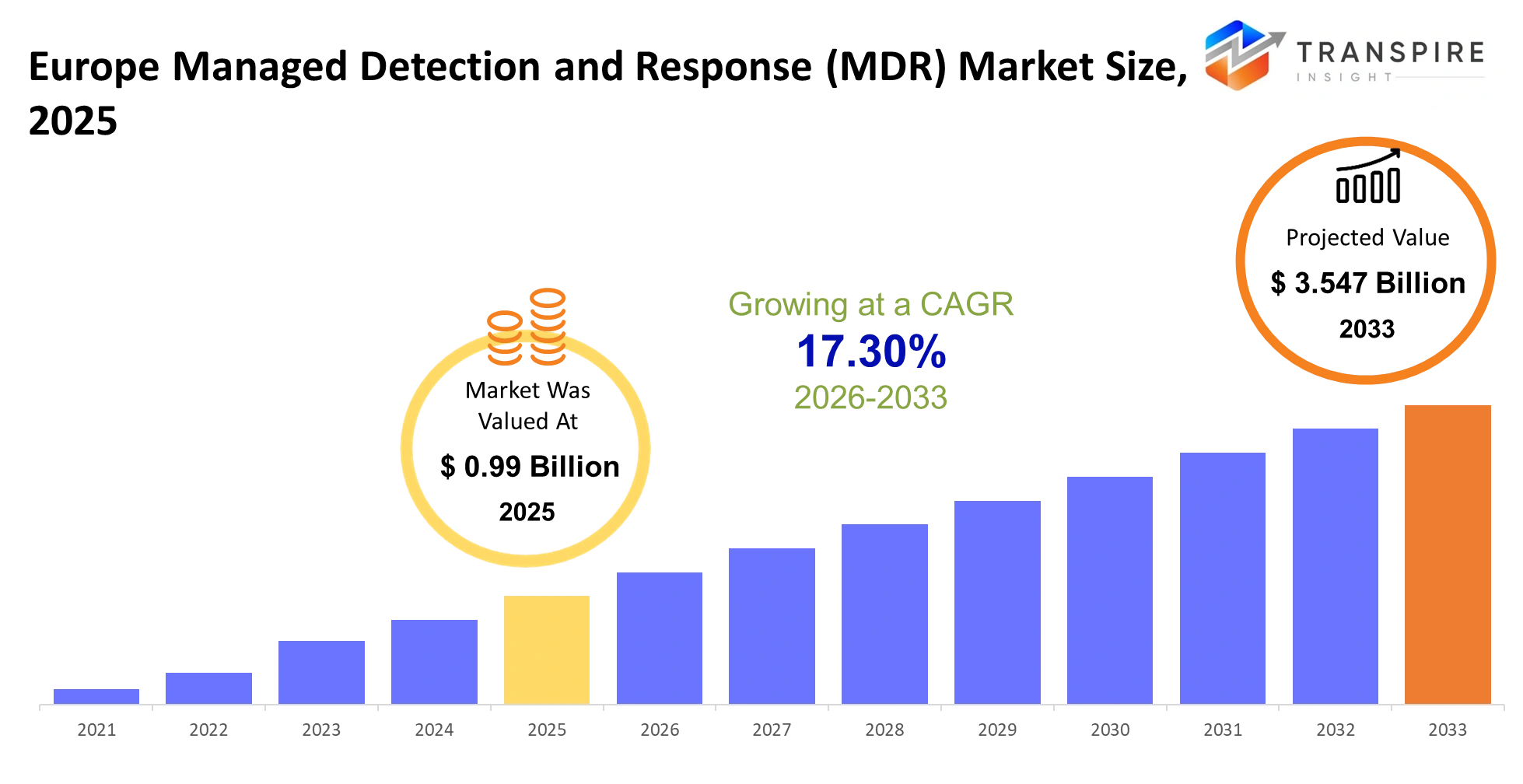
Europe Managed Detection and Response (MDR) Market Size & Forecast:
- Europe Managed Detection and Response (MDR) Market Size 2025: USD 0.99 Billion
- Europe Managed Detection and Response (MDR) Market Size 2033: USD 3.547 Billion
- Europe Managed Detection and Response (MDR) Market CAGR: 17.30%
- Europe Managed Detection and Response (MDR) Market Segments: By Type (Endpoint Detection, Network Detection, Cloud Detection, Others); By Application (Threat Detection, Incident Response, Security Monitoring, Risk Management, Others); By End-User (Enterprises, SMEs, BFSI, Healthcare, IT & Telecom, Government, Others); By Deployment (Cloud-based, On-premise, Hybrid, Others).
To learn more about this report,  Download Free Sample Report
Europe Managed Detection and Response (MDR) Market Summary
The Europe Managed Detection and Response (MDR) Market was valued at USD 0.99 Billion in 2025. It is forecast to reach USD 3.547 Billion by 2033. That is a CAGR of 17.30% over the period.
The MDR services which European countries provide work as security operations centers that monitor endpoints and cloud workloads and enterprise networks to detect cyber attacks which they will stop before the attacks disrupt business operations. Organizations use MDR providers to deliver all three services of threat detection and forensic analysis and rapid incident response because their internal IT teams do not have enough resources to handle these threats.
The market has moved away from on-premise SIEM-driven systems toward cloud-native AI-powered platforms which provide real-time monitoring for multiple environments during the last five years. The EU NIS2 Directive requires organizations to implement 24/7 security monitoring because ransomware attacks increased after the Russia-Ukraine conflict began and the NIS2 Directive went into effect. The cybersecurity talent shortage drives organizations to outsource their security operations which makes MDR an essential component of their security systems instead of a secondary solution.
Key Market Insights
- Western Europe dominates the Europe Managed Detection and Response (MDR) Market with nearly 48% share in 2025 because businesses spend heavily on security.
- The period from 2025 to 2030 will see Northern Europe become the fastest-growing region because businesses undergo digital transformation and cloud migration.
- The Europe Managed Detection and Response (MDR) Market shows increasing adoption in Southern and Eastern Europe because organizations face more cyberattack threats.
- The Europe Managed Detection and Response (MDR) Market identifies managed detection services as its leading solution which will capture about 52% of market share in 2025.
- Hybrid workforce environments make endpoint security solutions the second-largest market solution.
- Cloud-native MDR platforms will become the fastest-growing market segment until 2030 because enterprises adopt multi-cloud solutions.
- The Europe Managed Detection and Response (MDR) Market consists of threat monitoring and incident response services which hold a market share of approximately 45%.
- The Europe Managed Detection and Response (MDR) Market shows its largest share held by big enterprises because they operate complex IT systems.
- The end-user segment for SMEs grows fastest because managed security services help them cut internal cybersecurity expenses and solve skill shortage issues.
- The ongoing product innovation and SOC improvement process create essential competitive advantages for businesses that operate in the developing cybersecurity environment.
What are the Key Drivers, Restraints, and Opportunities in the Europe Managed Detection and Response (MDR) Market?
The cybersecurity priorities of enterprises in Europe are being redirected because of regulatory requirements and threats which drive security needs in their operations.
The enforcement of the EU NIS2 Directive together with rising ransomware-as-a-service attacks on critical infrastructure serves as the main force which drives growth for this market. Organizations in finance and healthcare and energy industries have started using continuous threat detection together with security services because of these security pressures. The demand for subscription-based MDR platforms has grown because organizations need permanent security solutions which lead to providers increasing their recurring revenues and businesses spending more on managed services instead of growing their SOC capabilities.
The cybersecurity industry faces a fundamental barrier because there is not enough qualified analysts who can operate advanced threat detection systems. The talent gap in Europe remains unsolved because European training programs cannot keep up with current security threat developments. The majority of organizations spend more time on partial MDR system implementation which results inMA development of mid-sized companies who choose hybrid solution delivery methods that restrict their contract growth potential.
The Southern and Eastern European markets present a significant business opportunity through AI-native MDR platforms which use cloud workload protection solutions. The growing use of Microsoft Sentinel-based MDR ecosystems together with cloud-first security architectures allows organizations to achieve quicker security operations while building their threat defense capabilities. The Europe Managed Detection and Response (MDR) Market will enter its next growth stage after organizations implement automated solutions which decrease their dependency on rare human resources.
What Has the Impact of Artificial Intelligence Been on the Europe Managed Detection and Response (MDR) Market?
The Europe Managed Detection and Response (MDR) Market experiences significant transformations through artificial intelligence which alters how security operations centers perform detection and analysis procedures while handling cyber threats. Organizations use AI-powered automation systems to enhance their alert triage processes while they track log data from various endpoints and cloud systems and use their SOAR platforms to run automated response procedures. The system enhances detection speed through automatic detection processes which reduce the need for human work resulting in faster incident detection and resolution times and better overall performance of security operations centers.
Security systems use machine learning models to create predictive cybersecurity functions which identify network activity that deviates from normal patterns and determine which vulnerabilities present the greatest risk while they identify initial signs of phishing or lateral movement attacks. The systems enable companies to adopt proactive defense measures which decrease their operational downtime and enhance their compliance with regulations from NIS2 and other governing bodies. Organizations experience better operational performance and decreased alert fatigue in most implementations, which leads to both cost savings and faster times to solve incidents.
Organizations experience challenges with adoption because the security infrastructure requires high integration costs and the organization does not possess enough labeled threat intelligence data to build their training models. The presence of encrypted traffic visibility gaps along with model drift from rapidly changing attack patterns causes real-world environment accuracy problems, which hampers the complete implementation of AI-powered MDR systems in certain European companies.
Key Market Trends
- Enterprises shifted from in-house SOCs to MDR subscriptions after 2022 ransomware spikes increased incident response costs across Europe.
- The EU's NIS2 Directive required organizations to implement continuous monitoring methods which replaced their existing periodic cybersecurity audits for compliance purposes because of its enforcement start date in 2024.
- AI-based threat detection systems replaced rule-based SIEM systems which enhanced real-time anomaly detection accuracy throughout hybrid cloud environments since 2023.
- Microsoft expanded Sentinel integrations in 2025 which helped enterprise cloud security buyers to consolidate their MDR platforms more quickly.
- European mid-sized companies adopted MDR solutions more frequently after 2023 because managed services allowed them to minimize their need for expensive cybersecurity specialists.
- Ransomware attacks against critical infrastructure systems increased dramatically after 2022 which compelled both utilities and healthcare organizations to establish ongoing managed detection operations for their systems.
- Security vendors shifted their operations from alerting users about security threats to implementing proactive threat detection systems which utilize machine learning technology and behavioral analytics methods.
- CrowdStrike and Palo Alto Networks expanded AI-native MDR offerings which made their automated incident response platforms more competitive in the market.
- European enterprises increased their demand for MDR solutions which provide security visibility across hybrid and multi-cloud environments because of the accelerated cloud migration that started in 2023.
Europe Managed Detection and Response (MDR) Market Segmentation
By Type:
The European Managed Detection and Response market shows Endpoint Detection as its most important segment because hybrid work environments and personal devices that access enterprise systems without control lead to high endpoint exposure. Organizations need to monitor endpoints because user devices serve as the starting point for most ransomware and phishing attacks, which makes endpoint monitoring essential as their primary protective measure. The enterprise security market segment derives advantages from established deployment methods and simple integration capabilities with current security systems which businesses already use.
Network Detection experiences constant growth because businesses increase their cloud operations while needing to analyze data traffic in their dispersed environments. The market expands because cloud infrastructure now experiences more east-west traffic, which traditional endpoint monitoring systems fail to track completely. The Cloud Detection market segment grows at its fastest rate because financial and retail companies rapidly adopt multi-cloud systems. The market will develop unified detection platforms which combine endpoint network and cloud telemetry to create consolidated security systems that vendors will need to create.
By Application:
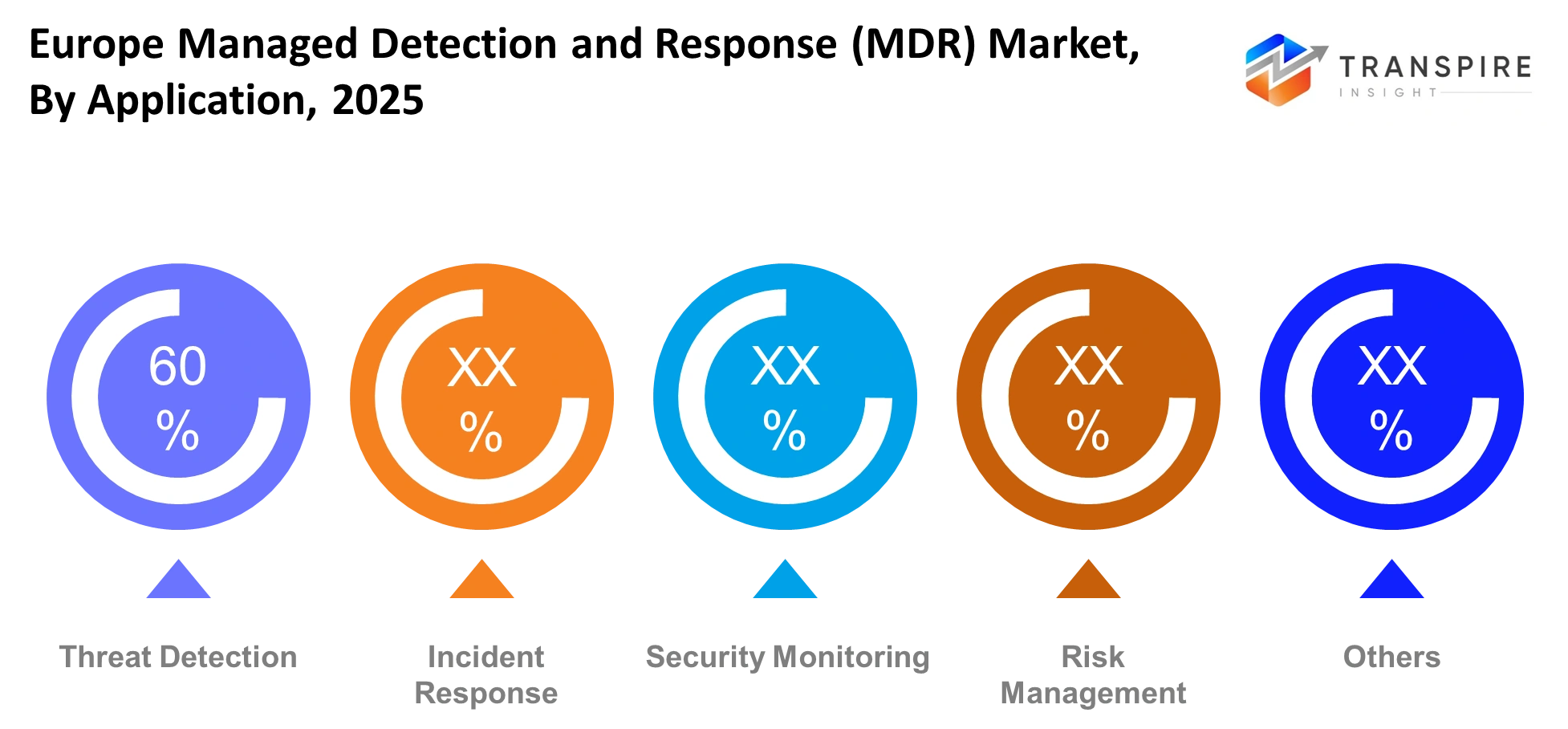
The Europe Managed Detection and Response (MDR) Market shows Threat Detection as its leading application because enterprises need to detect advanced persistent threats and ransomware attacks at the earliest stage. Businesses now adopt solutions because European Union cybersecurity regulations demand organizations to maintain constant threat monitoring capabilities. Organizations now use Incident Response as their main method because they need integrated response automation to minimize damage from security breaches.
Security Monitoring becomes more important for businesses because they now need to monitor their hybrid IT systems through continuous surveillance instead of conducting only occasional log checks. The growth of Risk Management occurs at a slow pace because organizations now require board members to take responsibility for cybersecurity matters and because insurance policies link cyber risk scoring to coverage requirements. The market will grow through platforms which combine detection and response with risk analytics into one operating system that will end tool duplication while enhancing decision-making efficiency.
To learn more about this report, Download Free Sample Report
By End-User:
The European Managed Detection and Response (MDR) Market sees enterprises maintaining their market leadership because their advanced infrastructure requires protection against more security threats which they can finance with their greater cybersecurity expenditures. Financial institutions and industrial operators invest heavily in outsourced detection services to maintain 24/7 monitoring capabilities. Their need for systems which provide ongoing threat intelligence at any time of the day shows their market dominance in the industry.
The cybersecurity talent shortage together with increasing operational costs drives SMEs to become their fastest developing sector. The BFSI sector requires the most security resources because it needs to meet strict compliance standards and protect its valuable data. The healthcare industry increases its adoption rates following multiple ransomware attacks against hospital systems, while the IT and telecom industries expand their operations to protect distributed cloud networks. Government agencies increasingly adopt MDR solutions to strengthen national cyber resilience frameworks. Future demand will shift toward packaged MDR services tailored to sector-specific compliance needs.
By Deployment:
The Europe Managed Detection and Response (MDR) market identifies cloud-based deployment as its leading solution because this deployment method provides better scalability and faster onboarding and it integrates easily with current business software. Organizations prioritize cloud-native security platforms because hybrid work arrangements and SaaS solutions become more widespread. The segment enjoys advantages from lower initial equipment expenses and its ability to receive ongoing system enhancements.
Organizations in highly regulated sectors such as defense and critical infrastructure need on-premise deployment because their data sovereignty rules prevent them from using cloud services. Enterprises need hybrid models which enable them to satisfy their regulatory requirements while enjoying cloud resources. This framework supports businesses to move some of their workloads to external sources while their sensitive information stays within their internal systems. Vendors will use hybrid architectures for their upcoming deployment patterns because these systems will enable them to provide complete visibility across their cloud and on-premise systems while they comply with various European Union regulatory requirements.
What are the Key Use Cases Driving the Europe Managed Detection and Response (MDR) Market?
The Europe Managed Detection and Response (MDR) Market experiences core adoption through its capacity to deliver continuous threat detection and incident response services to enterprise IT environments. Financial institutions and critical infrastructure operators depend on MDR services to detect ransomware and phishing and lateral movement attacks in real time. The most significant demand exists because organizations must maintain continuous monitoring and fast breach response according to NIS2 regulatory requirements which apply to their distributed networks.
The BFSI and healthcare sectors now implement security monitoring for hybrid cloud environments together with risk-based vulnerability assessment. The telecom and IT industries increasingly utilize MDR to handle their intensive network traffic while protecting their multi-cloud environments that support digital services. Organizations now require continuous security monitoring because they have transitioned from conducting security audits at fixed intervals.
AI-powered threat detection for industrial IoT environments and automated compliance reporting for government agencies represent new application areas. Manufacturers of smart systems that connect devices to create new monitoring needs show early adoption.
|
Report Metrics |
Details |
|
Market size value in 2025 |
USD 0.99 Billion |
|
Market size value in 2026 |
USD 1.161 Billion |
|
Revenue forecast in 2033 |
USD 3.547 Billion |
|
Growth rate |
CAGR of 17.30% from 2026 to 2033 |
|
Base year |
2025 |
|
Historical data |
2021 - 2024 |
|
Forecast period |
2026 - 2033 |
|
Report coverage |
Revenue forecast, competitive landscape, growth factors, and trends |
|
Regional scope |
Europe (Germany, United Kingdom, France, Italy, Spain, Rest of Europe) |
|
Key company profiled |
CrowdStrike, Palo Alto Networks, Microsoft, IBM, Cisco, FireEye, Rapid7, Secureworks, Sophos, SentinelOne, Trend Micro, Fortinet, Check Point, Arctic Wolf, eSentire. |
|
Customization scope |
Free report customization (country, regional & segment scope). Avail customized purchase options to meet your exact research needs. |
|
Report Segmentation |
By Type (Endpoint Detection, Network Detection, Cloud Detection, Others); By Application (Threat Detection, Incident Response, Security Monitoring, Risk Management, Others); By End-User (Enterprises, SMEs, BFSI, Healthcare, IT & Telecom, Government, Others); By Deployment (Cloud-based, On-premise, Hybrid, Others). |
Which Regions are Driving the Europe Managed Detection and Response (MDR) Market Growth?
The Europe Managed Detection and Response (MDR) Market operates under Western European control because the region enforces cybersecurity regulations and its businesses demonstrate advanced digital capabilities. The United Kingdom and Germany and France establish strict compliance requirements through their implementation of GDPR and NIS2 which mandates ongoing threat assessment for essential industries. The cloud provider ecosystem together with security vendors and managed service companies enables organizations to implement MDR solutions at high speed. Companies with large operations in finance and energy and manufacturing sectors demonstrate ongoing needs for advanced detection and response capabilities.
Northern Europe provides a reliable source of market revenue which grows at different rates than Western Europe. Nordic countries develop their cybersecurity framework through digital trust initiatives and government-sponsored security programs instead of relying solely on regulatory requirements. The enterprises in Sweden and Denmark and Finland focus on building long-term organizational strength through their commitment to cloud-native security solution adoption. The technology-driven industries maintain consistent funding while public and private entities work together which results in regular MDR adoption cycles that make this region more stable yet continuous growth.
Eastern and Southern Europe experience their strongest development period because of new cybersecurity modernization efforts and the European Union's increased support for digital infrastructure development. Poland and Italy and Spain are developing national cybersecurity defense systems because of increasing cross-border ransomware attacks. The expansion of cloud infrastructure together with the rise in SME digitalization activities drives MDR solution adoption. The market shift between 2026 and 2033 will create significant entry points for vendors who want to reach underserved markets through their scalable cloud-based security solutions.
Who are the Key Players in the Europe Managed Detection and Response (MDR) Market and How Do They Compete?
The Europe Managed Detection and Response (MDR) Market operates with a moderately consolidated top structure while its regional managed security providers maintain a fragmented market presence. Current market competition has shifted toward AI-based threat detection systems and cloud service capabilities and automated incident response systems instead of price competition. The large market players maintain their existing market positions through ecosystem lock-in strategies and their ability to meet EU regulatory standards which include NIS2 and GDPR requirements. The smaller market players establish their competitive advantage by serving specialized market segments through customized solutions that meet the particular needs of healthcare and manufacturing industries.
Microsoft enhances its market position through its complete integration of Sentinel MDR into Azure which provides businesses with comprehensive identity protection and compliance management solutions. Microsoft ecosystem expansion throughout Europe accelerates through its cloud partnerships and enterprise customers who migrate to Microsoft platforms. Palo Alto Networks establishes competitive advantage through its security system which combines Cortex XDR and Prisma Cloud into a single platform that protects both cloud services and network environments through security system acquisitions. CrowdStrike establishes its unique market position through its Falcon platform which operates in the cloud and provides precise endpoint data while enabling European businesses to expand through their managed SOC collaborations.
IBM unifies its QRadar analytics system with its consulting-based MDR solutions to create customized security operations for clients in the BFSI sector and public sector who require protection from security threats. Secureworks uses its Taegis platform together with its MSSP partnerships to target mid-market companies which lack their own security operations center capabilities. Rapid7 promotes the user-friendly nature and quick implementation of InsightIDR while it expands its operations through MSSP partnerships that provide cloud-based threat detection services to small and medium enterprises.
Company List
- CrowdStrike
- Palo Alto Networks
- Microsoft
- IBM
- Cisco
- FireEye
- Rapid7
- Secureworks
- Sophos
- SentinelOne
- Trend Micro
- Fortinet
- Check Point
- Arctic Wolf
- eSentire
Recent Development News
In March 2025, CrowdStrike announced enhanced MDR capabilities within its Falcon platform across Europe. The upgrade expanded AI-driven threat hunting and automated response workflows for enterprise SOC environments, reducing detection time and improving ransomware containment efficiency across hybrid infrastructures.
Source: https://www.crowdstrike.com
In November 2025, Palo Alto Networks announced agreement to acquire Chronosphere. The acquisition strengthens AI-driven MDR and SecOps capabilities by integrating real-time observability with Cortex AgentiX for autonomous threat detection and response.
Source: https://www.reuters.com
What Strategic Insights Define the Future of the Europe Managed Detection and Response (MDR) Market?
The Europe Managed Detection and Response (MDR) Market is completely changing its structure to establish security operations which will operate independently through artificial intelligence within cloud-based enterprise systems. The market has transitioned from basic threat monitoring outsourcing to new growth markets which combine identity security endpoint telemetry and predictive analytics into their unified systems. Organizations now need to use machine-based security systems because ransomware threats continue to develop and European Union cybersecurity regulations become more strict.
The risk which organizations need to watch at present has developed into two main threats which arise from current cybersecurity practices. The process of security operations center software development has created operational dependencies which organizations need to manage through multiple software tools.
Sovereign cloud-based MDR deployments within the EU public sector and critical infrastructure networks create emerging business opportunities. The regulatory requirement for data to stay within specific territories has resulted in increased need for security systems which organizations can control from their operating regions. Organizations in the market now need to develop security monitoring systems which can work together and meet regulatory standards to protect national cloud services while sharing information about potential threats.
Europe Managed Detection and Response (MDR) Market Report Segmentation
By Type
- Endpoint Detection
- Network Detection
- Cloud Detection
- Others
By Application
- Threat Detection
- Incident Response
- Security Monitoring
- Risk Management
- Others
By End-User
- Enterprises
- SMEs
- BFSI
- Healthcare
- IT & Telecom
- Government
- Others
By Deployment
- Cloud-based
- On-premise
- Hybrid
- Others
Frequently Asked Questions
Find quick answers to common questions.
The Europe Managed Detection and Response (MDR) Market size is USD 3.547 Billion in 2033.
Key segments for the Europe Managed Detection and Response (MDR) Market are By Type (Endpoint Detection, Network Detection, Cloud Detection, Others); By Application (Threat Detection, Incident Response, Security Monitoring, Risk Management, Others); By End-User (Enterprises, SMEs, BFSI, Healthcare, IT & Telecom, Government, Others); By Deployment (Cloud-based, On-premise, Hybrid, Others).
Major Europe Managed Detection and Response (MDR) Market players are CrowdStrike, Palo Alto Networks, Microsoft, IBM, Cisco, FireEye, Rapid7, Secureworks, Sophos, SentinelOne, Trend Micro, Fortinet, Check Point, Arctic Wolf, eSentire.
The Europe Managed Detection and Response (MDR) Market size is USD 0.99 Billion in 2025.
The Europe Managed Detection and Response (MDR) Market CAGR is 17.30% from 2026 to 2033.
- CrowdStrike
- Palo Alto Networks
- Microsoft
- IBM
- Cisco
- FireEye
- Rapid7
- Secureworks
- Sophos
- SentinelOne
- Trend Micro
- Fortinet
- Check Point
- Arctic Wolf
- eSentire
Recently Published Reports
-
Apr 2026
3D Optical Profiler Market
3D Optical Profiler Market Size, Share & Analysis Report By Type (Desktop 3D Optical Profiler, and Portable 3D Optical Profiler), By Technology (Confocal Technology, and White Light Interference), By End-Use Industry (Manufacturing, Research Institutions, Automotive, Aerospace and Defense, Medical Devices, and Other), and Geography (North America, Europe, Asia-Pacific, Middle East and Africa, South and Central America), 2021 - 2031
-
Apr 2026
Depth Sensor Market
Depth Sensor Market Size, Share & Analysis Report By Type (Infrared Depth Sensors, Time-of-Flight (ToF) Sensors, Stereo Vision Sensors, Structured Light Sensors, Ultrasonic Depth Sensors), By Application (Automotive, Robotics, Gaming, Consumer Electronics, Industrial Automation, Healthcare, Security & Surveillance, Others), By End Users (Automotive Manufacturers, Consumer Electronics Companies, Healthcare Providers, Industrial Companies, Security Agencies, Gaming Companies, Robotics Companies, Others), and Geography (North America, Europe, Asia-Pacific, Middle East and Africa, South and Central America), 2021 – 2031
-
Apr 2026
Digital Manufacturing Market
Digital Manufacturing Market Size, Share & Analysis Report By Component (Hardware, Software, and Services), By Technology (Robotics, 3D Printing, Internet of Things (IoT), and Others), By Application (Automotive and Transportation, Aerospace and Defense, Consumer Electronics, Industrial Machinery, and Others), By Process Type (Computer-Based Designing, Computer-Based Simulation, Computer 3D Visualization, Analytics, and Others), and Geography (North America, Europe, Asia-Pacific, Middle East and Africa, South and Central America), 2021 – 2031
-
Apr 2026
Digital Visa Services Market
Digital Visa Services Market Size, Share & Analysis Report By Type (Individual Travelers, Group Travelers), By Application (Tourism, Business Travel, Others), and Geography (North America, Europe, Asia-Pacific, Middle East and Africa, South and Central America), 2021 – 2031