Europe Functional Brain Imaging Systems Market Size & Forecast:
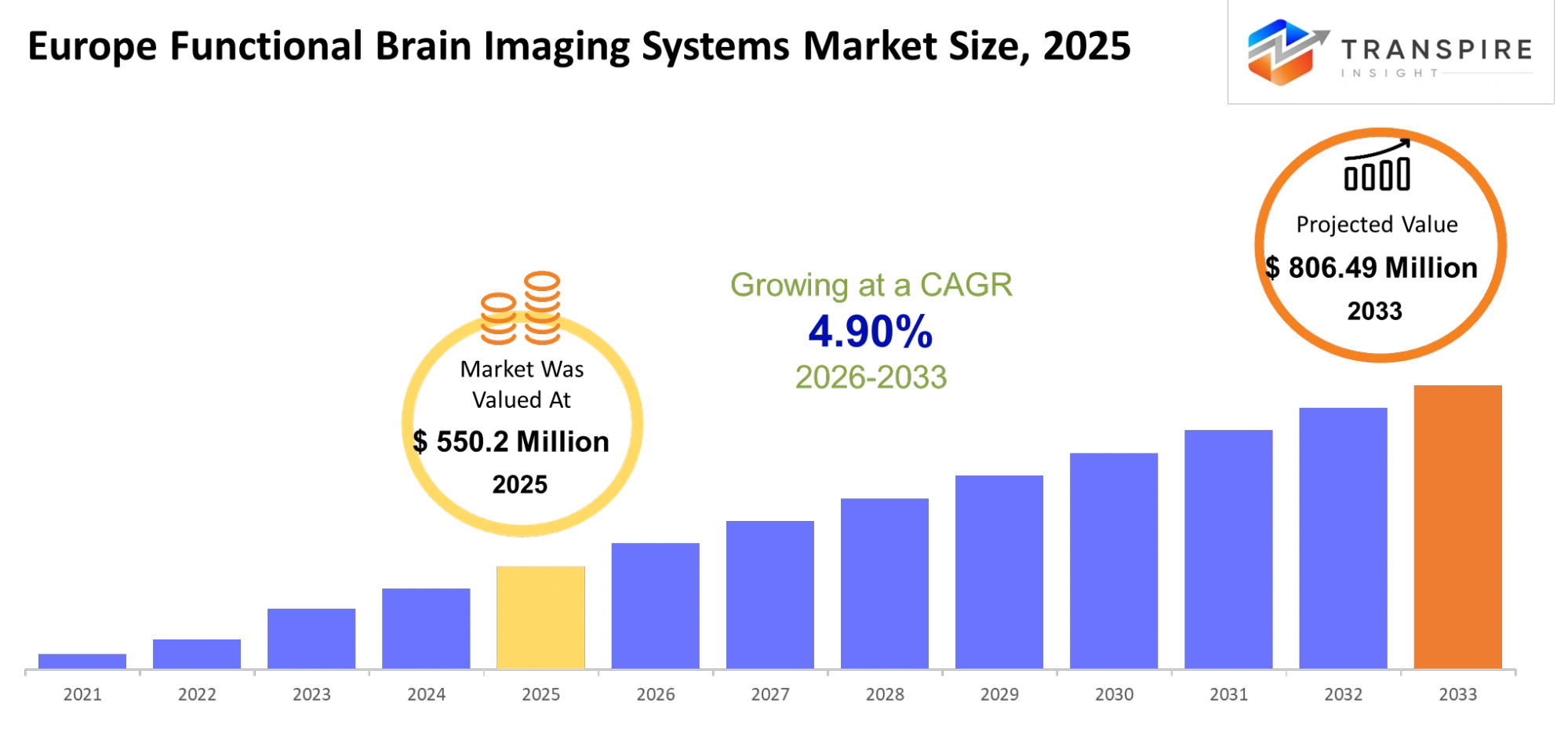
- Europe Functional Brain Imaging Systems Market Size 2025: USD 550.2 Million
- Europe Functional Brain Imaging Systems Market Size 2033: USD 806.49 Million
- Europe Functional Brain Imaging Systems Market CAGR: 4.90%
- Europe Functional Brain Imaging Systems Market Segments: By Type (fMRI, PET, SPECT, EEG, MEG, Others); By Application (Neurology, Psychiatry, Research, Oncology, Cognitive Studies, Others); By End-User (Hospitals, Clinics, Research Institutes, Universities, Diagnostic Centers, Others); By Technology (Imaging Systems, Software, AI Analysis, Hybrid Systems, Digital Imaging, Others)
To learn more about this report,  Download Free Sample Report
Europe Functional Brain Imaging Systems Market Summary:
The Europe Functional Brain Imaging Systems Market size is estimated at USD 550.2 Million in 2025 and is anticipated to reach USD 806.49 Million by 2033, growing at a CAGR of 4.90% from 2026 to 2033. Functional Brain Imaging Systems in Europe will be a niche area dedicated to visualizing neural activity in patients using medical imaging systems. The trend will be characterized by a gradual movement towards precise neurology where physicians will utilize dynamic information rather than fixed imagery. Changes in demand trends can be expected due to the desire for early diagnosis of disorders and personalized care. Stringent regulation policies governing the accuracy of imaging results will ensure that manufacturers improve the reliability of imaging systems. Developments in imaging technology such as hybrid imaging will provide a new perspective into neurological disorders.
What Has the Impact of Artificial Intelligence Been on the Europe Functional Brain Imaging Systems Market?
AI technology is quickly revolutionizing the europe functional brain imaging systems market by changing the way data collection, analysis, and interpretation takes place throughout the medical imaging field. The application of AI technology to europe functional brain imaging systems market dynamics will make data research more accurate by facilitating analysis and recognizing patterns that cannot be seen using conventional methods. Predictive analytics will be made possible using machine learning algorithms that will help predict shifts in demand, neurological trends, and specific requirements for individual patients.
Moreover, AI technology within the europe functional brain imaging systems market setting will revolutionize manufacturing processes through the use of automation techniques that will ensure accurate calibration, image reconstruction, and quality assurance. Operational costs will therefore be kept low without compromising on accuracy. AI technology will also optimize supply chains to ensure effective management and delivery of imaging equipment throughout healthcare institutions.
In addition to efficiency, the incorporation of AI technology will drive innovation in the europe functional brain imaging systems market through personalization of imaging techniques based on brain activities. With the help of advanced algorithms, it will become easier for doctors to detect diseases at an early stage and plan treatment, giving businesses incorporating such technologies a competitive edge.
Key Market Trends & Insights:
- Machine Learning is boosting the accuracy of the AI in europe functional brain imaging systems market, where the efficiency of interpreting images through this method is improving by over 30%.
- Predictive Analytics and Smart Automation are changing the face of work practices, cutting scanning times by nearly 20% while maximizing patient turnover in Europe.
- Growing demands for early detection of neurologic diseases are prompting growth, with the usage of functional imaging technology increasing exponentially among the elderly population.
- The integration of hybrid imaging systems like PET-MRI is becoming the key trend in providing excellent functionality and structural analysis.
- Germany is leading with ~28% market share in 2025 because of its strong healthcare infrastructure and research programs.
- France is leading as the fastest-growing region, growing at a compound annual growth rate of over 7.5% because of increasing adoption of AI-powered imaging systems.
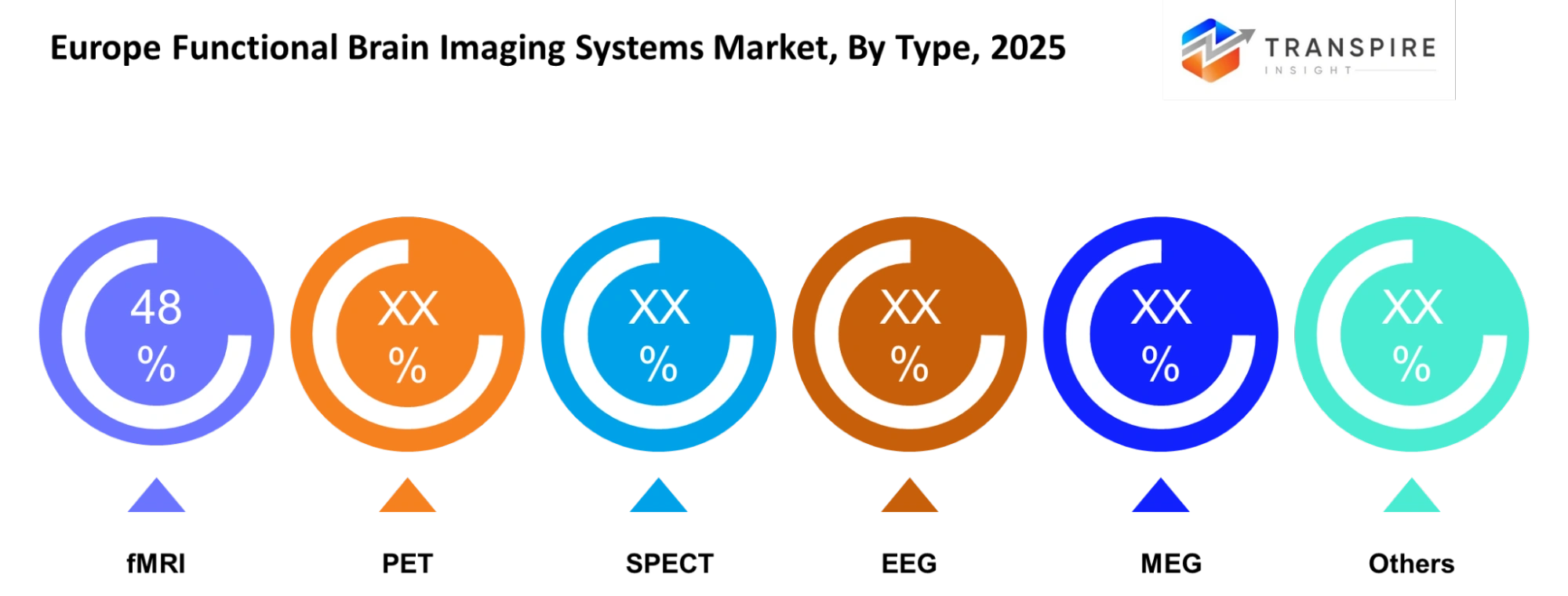
- fMRI technology leads with ~42% market share due to its non-invasive nature and high-resolution images.
- Hybrid imaging system will grow as the fastest-growing segment, predicted to increase by up to 2025-2030 with increased demand for multimodal imaging.
- Neurology holds ~55% market share because of the increasing number of Alzheimer’s and Parkinson’s diseases.
- Hospitals dominate the market with ~60% market
- Approximately 60% of the market is owned by hospitals who benefit from the great number of patients and sophisticated infrastructures.
Europe Functional Brain Imaging Systems Market Segmentation
By Type
The different categories of functional imaging will influence diagnostic depth through their diverse imaging capabilities, as such, fMRI will be used to monitor the changes in blood flow and map the brain's functioning during cognitive tasks without invasive methods. PET imaging will be used to detect the brain's metabolism and diagnose diseases when they first emerge. SPECT will be affordable for imaging, while EEG and MEG will track electrical and magnetic brain impulses.
The use patterns of imaging will vary across different countries in Europe depending on the clinical requirements and costs. fMRI and PET will be preferred in hospitals due to their sophisticated imaging capability, while EEG will still be widely used for neurological studies. MEG will receive growing attention because of its ability to detect small brain impulses reliably.
To learn more about this report, Download Free Sample Report
By Application
An increase in demand is expected as the medical industry becomes more focused on the brain disease. Neurology will take center stage as there will be more individuals suffering from various neurological disorders, including Alzheimer’s, epilepsia, and stroke. In these cases, the technology will have much importance in both diagnosis and monitoring of these diseases.
Additionally, more research and cognitive studies will play an essential part in promoting the demand. Universities and research centers will use imaging technology to study how the brain behaves in learning. There will be more interests in studying memory, decision making, and the process of aging.
By End-User
The end-user population will depend on service capability and availability of sophisticated equipment. Hospitals will be the major users owing to their well-developed facilities and large populations that require complex imaging studies. Diagnostic centers will boom rapidly through providing imaging services at reduced prices. Innovation centers or universities will remain the backbone of new innovation and adaption starts.
Clinical studies and experiments involving complex imaging tools will be conducted here. Academic demand will drive the progress in imaging technologies. The expansion of private diagnostic centers will make it possible for more people in urban and semi-urban areas to access these services.
By Technology
The performance and precision in the field of imaging technology will be driven by technology. Imaging technology will still be the pillar as it provides high-resolution images useful in clinical practice. Software will be used for data analysis and presentation purposes so as to make interpretation of results more understandable.
Hybrid technologies and digital imaging will transform efficiency and integration in the medical field. Technologies like hybrid will bring about more detailed analysis on the functioning of brain cells through using various imaging techniques together. Digital imaging will facilitate data storage and distribution. Future developments in software and AI will lead to better diagnostics and lower workloads.
What are the Main Challenges for the Europe Functional Brain Imaging Systems Market Growth?
The market for brain imaging systems operating in European territories encounters substantial technical and operational difficulties which will determine system capabilities and expansion possibilities. The system's high complexity will create difficulties for users especially those who need to operate multiple imaging systems which must undergo accurate calibration and integration processes. The diagnostic process will experience reduced accuracy because of three performance limitations which include signal noise and motion artifacts and the extended duration of scans. The European market for functional brain imaging systems will face expansion obstacles because supply chain problems will cause delays in obtaining essential components which include detectors and semiconductors.
The European market for functional brain imaging systems will experience slow development because of manufacturing and commercialization challenges. The production process will maintain its requirement for high financial investment because companies need to follow European regulatory requirements which include CE marking and quality compliance standards. The development process incurs high expenses while the approval process takes extended time which prevents smaller companies from entering the market. Companies will experience cost challenges which decrease their ability to set prices, thus creating difficulties in maintaining product innovation and market competitiveness.
The adoption process will encounter difficulties because of two main factors, which include insufficient infrastructure and insufficient workforce capacity. Most healthcare facilities in smaller areas will not possess the necessary advanced equipment needed to operate high-end imaging systems. The medical field will face limitations because there exists a lack of trained personnel who can operate advanced imaging technology and analyze its results. The European market for functional brain imaging systems will encounter growth obstacles because of funding constraints and unequal healthcare investment, which will impede the widespread use of this technology.
The constraints within the market will also come about through competition and changing threats. Competing diagnostic tools and cheaper imaging techniques will bring about price pressures within the europe functional brain imaging systems market. Changes within technology will mean that constant updating is required, which means higher costs within the industry.
Country Insights
There will be marked differences within the Europe functional brain imaging systems market on account of different levels of healthcare financing, technological infrastructure, and focus on research. Western Europe will dominate because of their advanced hospitals and early adoption of imaging techniques. Nations like Germany, France, and UK will be highly focused on precise diagnostics and AI-based imaging systems. Awareness about neurological conditions will drive stable demand from the region.
The healthcare system of Eastern Europe will experience continuous development through its ongoing process of modernizing healthcare facilities. The government and private sectors will make substantial investments to develop diagnostic centers and implement public healthcare programs that improve patient access to medical imaging technologies. The development of areas with insufficient infrastructure will progress at a slow pace whereas government support and private sector investment will create opportunities for future growth. Enhanced training programs and digital health policies will ensure sustained regional balance in the Europe functional brain imaging systems market.
Recent Development News
In April 2026, Siemens AG announced stake spin-off. The company confirmed plans to transfer around 30% of its holding in Siemens Healthineers to shareholders, effectively reducing majority ownership as part of a strategic restructuring move.https://www.reuters.com
In November 2025, GE HealthCare announced acquisition. The company agreed to acquire Intelerad Medical Systems for approximately $2.3 billion to strengthen imaging software capabilities and expand digital healthcare solutions portfolio.https://en.wikipedia.org
|
Report Metrics |
Details |
|
Market size value in 2025 |
USD 550.2 Million |
|
Market size value in 2026 |
USD 577.14 Million |
|
Revenue forecast in 2033 |
USD 806.49 Million |
|
Growth rate |
CAGR of 4.90% from 2026 to 2033 |
|
Base year |
2025 |
|
Historical data |
2021 - 2024 |
|
Forecast period |
2026 - 2033 |
|
Report coverage |
Revenue forecast, competitive landscape, growth factors, and trends |
|
Regional scope |
Europe (Germany, United Kingdom, France, Italy, Spain, Rest of Europe) |
|
Key company profiled |
Siemens Healthineers, GE Healthcare, Philips, Canon Medical, Hitachi, Shimadzu, Agfa-Gevaert, Hologic, Esaote, Fujifilm, Brain Products, Compumedics, Elekta, Natus Medical, Nihon Kohden |
|
Customization scope |
Free report customization (country, regional & segment scope). Avail customized purchase options to meet your exact research needs. |
|
Report Segmentation |
By Type (fMRI, PET, SPECT, EEG, MEG, Others); By Application (Neurology, Psychiatry, Research, Oncology, Cognitive Studies, Others); By End-User (Hospitals, Clinics, Research Institutes, Universities, Diagnostic Centers, Others); By Technology (Imaging Systems, Software, AI Analysis, Hybrid Systems, Digital Imaging, Others) |
How Can New Companies Establish a Strong Foothold in the Europe Functional Brain Imaging Systems Market?
New entrants can build a strong position in the europe functional brain imaging systems market by targeting unmet clinical needs and focusing on specialized use cases rather than broad competition. Niche businesses that operate in early-stage neurological detection or portable imaging solutions will achieve market differentiation. The europe functional brain imaging systems market experiences growth because medical professionals require faster and more accurate diagnostic solutions which create opportunities for innovative solutions that address actual medical problems.
The europe functional brain imaging systems market will depend on technology differentiation as essential factor for market development. Startups that integrate artificial intelligence cloud-based imaging software and predictive analytics into imaging workflows will deliver measurable value to healthcare providers. The AI-driven platforms developed by Quibim and Brainomix demonstrate how their technology can improve diagnostic processes through faster and more accurate results. The new market entrants demonstrate that innovation processes can create solutions which solve problems related to patient management and data interpretation.
The market entry process will become more efficient through strategic partnerships which enable business expansion efforts. The organization will establish research relationships with hospitals and research institutes and academic centers which will enable them to gather clinical validation and actual market data. The alliances will facilitate regulatory approvals while enhancing the organization's market reputation. The europe functional brain imaging systems market will experience faster system integration through partnerships which established imaging providers and software companies.
The organization requires cost-effective solutions that can grow with its needs to achieve long-term success. The new business must develop methods which enable them to operate at minimal expenses while achieving their desired performance outcomes. The subscription software which provides image processing capabilities will attract more clients by solving existing infrastructure limitations.
Key Europe Functional Brain Imaging Systems Market Company Insights
The Europe functional brain imaging systems market will exhibit fierce competition amongst existing players as well as newer entrants with emphasis on diagnostic advancements. The main companies in the market which include Siemens Healthineers, GE HealthCare, and Philips Healthcare will maintain their market leadership through continuous improvements in imaging technologies and artificial intelligence. Companies will compete through product innovations and precise execution of their business operations.
Small-sized enterprises and startups will strengthen their market presence through affordable customized products. The rapid validation and acceptance of technological innovations will result from partnerships between the organization and hospitals and research facilities. The company will enhance its competitive position through entering new markets and implementing software upgrades for its imaging systems. The future competitive landscape of the Europe functional brain imaging systems market will depend on research and development investments that focus on digital imaging technology.
Company List
- Siemens Healthineers
- GE Healthcare
- Philips
- Canon Medical
- Hitachi
- Shimadzu
- Agfa-Gevaert
- Hologic
- Esaote
- Fujifilm
- Brain Products
- Compumedics
- Elekta
- Natus Medical
- Nihon Kohden
What are the Key Use-Cases Driving the Growth of the Europe Functional Brain Imaging Systems Market?
The market for functional brain imaging systems in Europe is expanding because of essential healthcare applications which focus on detecting medical conditions and assessing patient health. The primary market driver for this technology exists in neurology because healthcare professionals use imaging systems to identify Alzheimer's disease and epilepsy and stroke symptoms at their initial stages. Hospitals are introducing functional imaging as a standard diagnostic tool which enables better clinical judgment and enhances patient results. The current need for accurate brain mapping technologies drives hospitals to implement these systems in their advanced medical operations.
Psychiatric evaluation and mental health assessment represent another essential application that drives demand for functional brain imaging systems in Europe. Researchers use functional imaging to study how depression and schizophrenia and anxiety disorders affect brain activity. This method develops treatment methods which better suit individual patients while allowing therapists to monitor their progress. The rising mental health awareness throughout Europe has led to an increasing need for advanced diagnostic equipment.
The market growth of research and academic applications has become a major force in driving market development. Research centers and universities utilize imaging systems to conduct research about cognitive behavior and memory formation and brain development processes. The generated knowledge drives neuroscience progress while it establishes pathways for pharmaceutical research and clinical study advancement. The European market for functional brain imaging systems will keep growing because research funds permanently support research activities.
Potential growth drivers have been identified with the increasing adoption of such technology in the field of oncology and rehabilitation. This technology aids in detecting tumors, planning for treatments, and post-neurological injury recovery. In addition, integration with AI will help enhance scale and efficiency of this technology. The diversity in applications is creating a strong foundation for future success in this market segment.
Europe Functional Brain Imaging Systems Market Report Segmentation
By Type
- fMRI
- PET
- SPECT
- EEG
- MEG
- Others
By Application
- Neurology
- Psychiatry
- Research
- Oncology
- Cognitive Studies
- Others
By End-User
- Hospitals
- Clinics
- Research Institutes
- Universities
- Diagnostic Centers
- Others
By Technology
- Imaging Systems
- Software
- AI Analysis
- Hybrid Systems
- Digital Imaging
- Others
Frequently Asked Questions
Find quick answers to common questions.
The approximate Europe Functional Brain Imaging Systems Market size for the market will be USD 806.49 Million in 2033.
Key segments for the Europe Functional Brain Imaging Systems Market are By Type (fMRI, PET, SPECT, EEG, MEG, Others); By Application (Neurology, Psychiatry, Research, Oncology, Cognitive Studies, Others); By End-User (Hospitals, Clinics, Research Institutes, Universities, Diagnostic Centers, Others); By Technology (Imaging Systems, Software, AI Analysis, Hybrid Systems, Digital Imaging, Others).
Major Europe Functional Brain Imaging Systems Market players are Siemens Healthineers, GE Healthcare, Philips, Canon Medical, Hitachi, Shimadzu, Agfa-Gevaert, Hologic, Esaote, Fujifilm, Brain Products, Compumedics, Elekta, Natus Medical, Nihon Kohden.
The Europe Functional Brain Imaging Systems Market size is USD 550.2 Million in 2025.
The Europe Functional Brain Imaging Systems Market CAGR is 4.90%.
- Siemens Healthineers
- GE Healthcare
- Philips
- Canon Medical
- Hitachi
- Shimadzu
- Agfa-Gevaert
- Hologic
- Esaote
- Fujifilm
- Brain Products
- Compumedics
- Elekta
- Natus Medical
- Nihon Kohden
Recently Published Reports
-
Apr 2026
AI in Diabetic Retinopathy Market
AI in Diabetic Retinopathy Market Size, Share & Analysis Report By Type (Screening AI Systems, Diagnostic AI Systems, and Predictive AI Models), By Application Segment (Hospitals, Ophthalmology Clinics, Diagnostic Centers, and Research and Development), and Geography (North America, Europe, Asia-Pacific, Middle East and Africa, South and Central America), 2021 - 2031
-
Apr 2026
Psychometric Tests Market
Psychometric Tests Market Size, Share & Analysis Report By Type (Personality Tests, Ability/Aptitude Tests, Skill/Knowledge Tests, and Others), By Application (Talent Acquisition and Talent Management), and Geography (North America, Europe, Asia-Pacific, Middle East and Africa, South and Central America), 2021 – 2031
-
Apr 2026
Rare Biological Sample Collection Market
Rare Biological Sample Collection Market Size, Share & Analysis Report By Type (Isolation Kits & Reagent, Blood Collection Tubes, and Others), By Application (Oncology, Transcriptomics, Pharmacogenomics, and Others), and Geography (North America, Europe, Asia-Pacific, Middle East and Africa, South and Central America), 2021 – 2031
-
Apr 2026
Patient Lift Pendant Market
Patient Lift Pendant Market By Product Type (Wired Pendants, Wireless, Programmable), By Operation Type(Manual, Electric), By End-Users (Healthcare Professionals, Patients), By Application (Hospitals, Homecare, Rehabilitation Centers, Others), By Industry Analysis, Size, Share, Growth, Trends, and Forecasts 2021-2033
Our Clients
.jpg)