Israel Medical Imaging Market Size & Forecast:
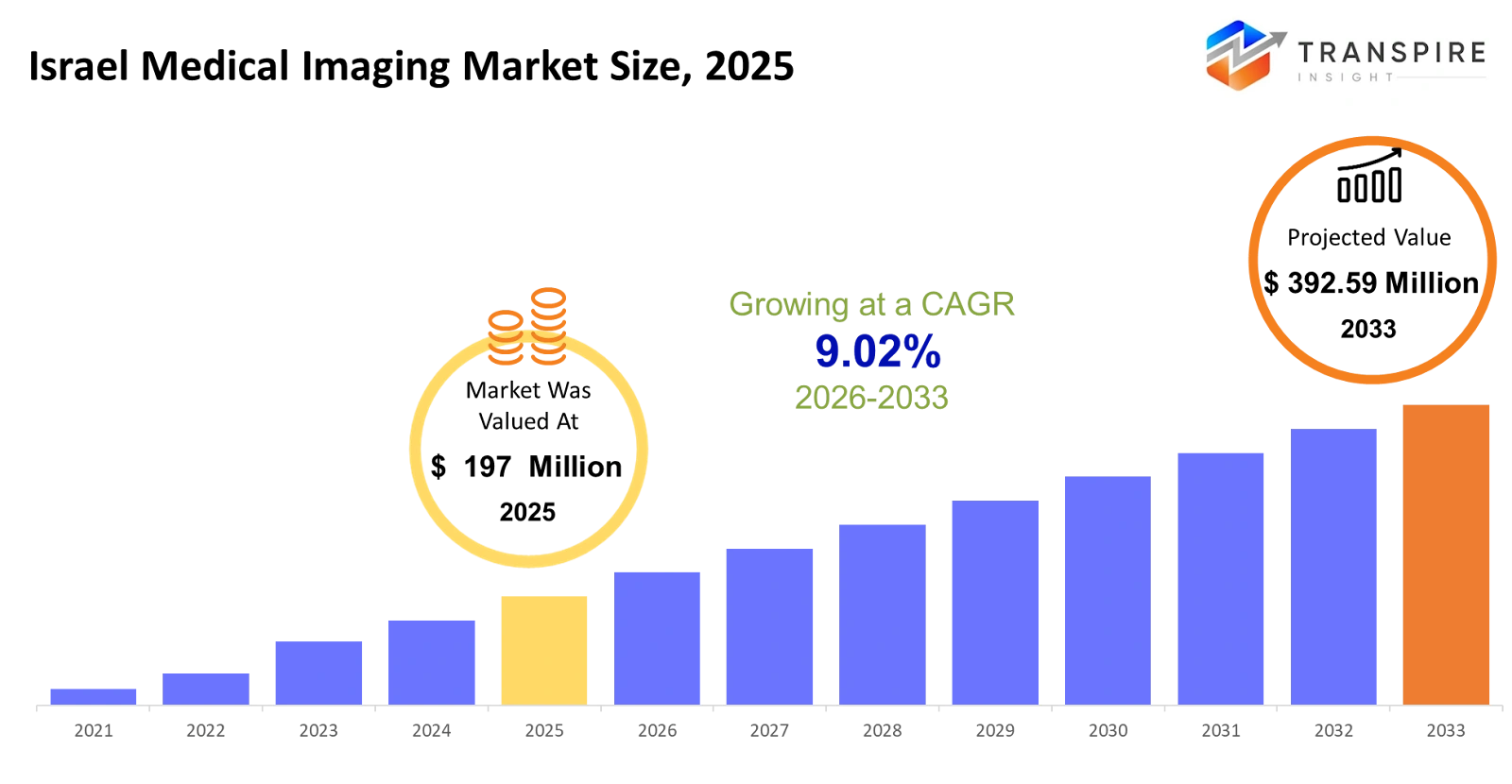
- Israel Medical Imaging Market Size 2025: USD 197 Million
- Israel Medical Imaging Market Size 2033: USD 392.59 Million
- Israel Medical Imaging Market CAGR: 9.02%
- Israel Medical Imaging Market Segments: By Imaging Modality (X-ray, Computed Tomography, Magnetic Resonance Imaging, Ultrasound, Nuclear Imaging), By Application (Cardiology, Oncology, Neurology, Orthopedics), By End-User (Hospitals, Diagnostic Imaging Centers, Research Institutes).
To learn more about this report,  Download Free Sample Report
Israel Medical Imaging Market Summary:
The Israel Medical Imaging Market size is estimated at USD 197 Million in 2025 and is anticipated to reach USD 392.59 Million by 2033, growing at a CAGR of 9.02% from 2026 to 2033. The healthcare technology industry controls the Israel medical imaging market which will enhance diagnostic performance throughout medical facilities. Patients who want faster tests that use less invasive methods must be treated with advanced imaging technologies which medical providers will need to implement. AI-based diagnostic systems and cloud-based medical facilities will increase diagnostic speed and availability in remote treatment environments. The regulatory authorities will implement stricter rules for data security and clinical testing procedures which will require medical facilities to update their outdated systems. As digital health integration develops medical imaging systems will become more compatible with electronic health records which will help doctors work together to treat patients while making their work easier.
Key Market Trends & Insights:
The israel medical imaging market will witness a steady shift toward AI-supported diagnostics, where algorithms will assist radiologists in identifying patterns with greater precision. The transition will decrease reporting time while producing standardized results. The healthcare industry will adopt these solutions because they help healthcare workers handle growing imaging work demands without requiring additional staff across both urban and rural medical centers.
The market for portable and point-of-care imaging devices will experience growth because outpatient services are expanding. Clinics will prefer compact systems that deliver reliable results without requiring large infrastructure investments. Emergency and rural medical facilities will benefit from faster diagnosis because this trend enables medical professionals to use their imaging equipment in areas outside of conventional hospital environments.
The digital health ecosystems will become more popular because they provide a system which links imaging data with electronic medical records and telemedicine platforms. This alignment will enable more coordinated treatment planning. Physicians will access imaging insights remotely, which enables better collaboration between specialists and improved patient management for chronic conditions that need ongoing tracking and medical evaluation.
Purchasing choices will change because regulatory bodies will start prioritizing customer data protection and product performance requirements. Providers will choose solutions that maintain compliance standards but also allow their business operations to expand. Patients will learn about medical procedures which will increase their demand for safer imaging methods that decrease radiation exposure while providing better comfort during diagnostic tests which different population groups will use.
Israel Medical Imaging Market Segmentation
By Imaging Modality
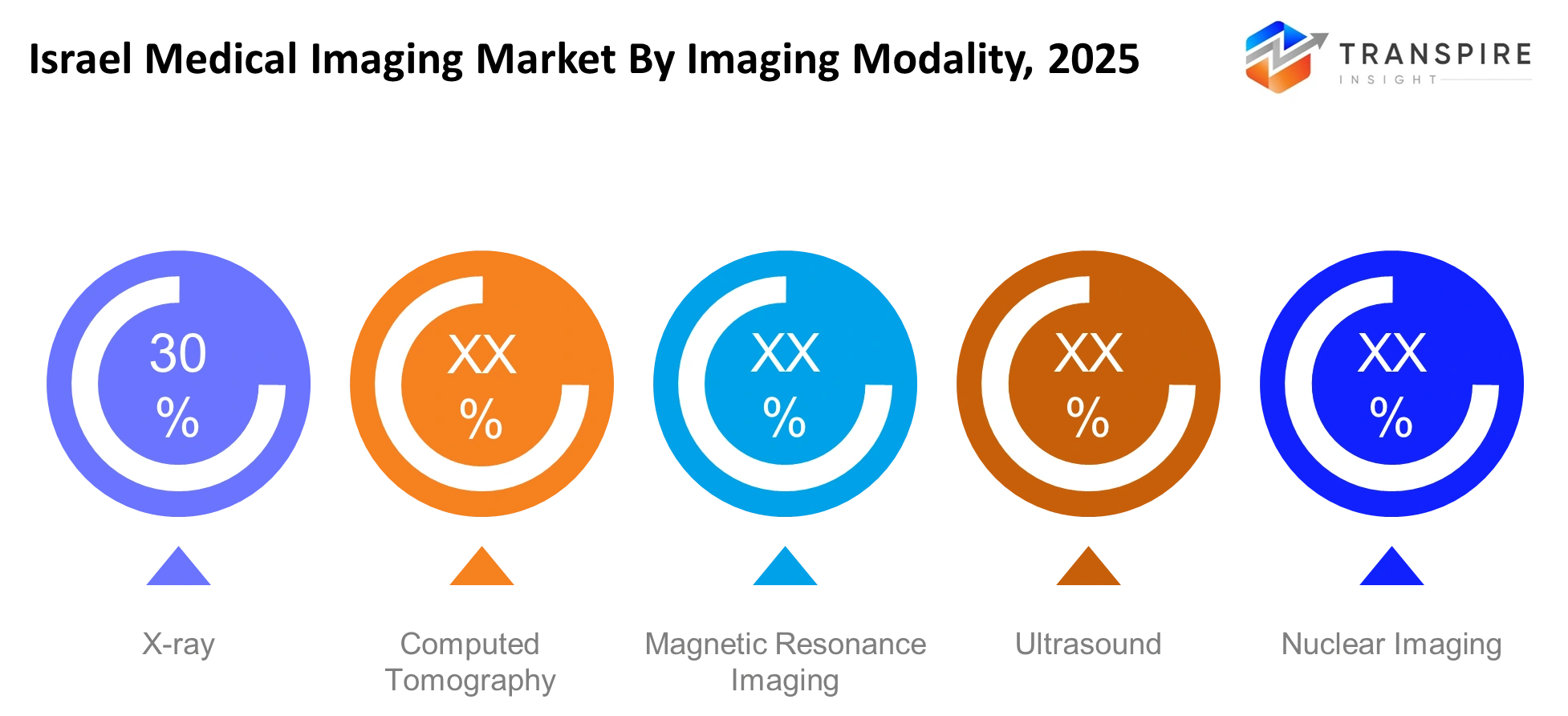
X-ray- X-ray imaging will serve as the main diagnostic method because it provides rapid results and costs less and is available at all medical facilities. The technology will be used extensively to identify broken bones and infections and conditions that affect the chest. Digital radiography systems will achieve better image quality through technological advancements while they decrease radiation exposure for patients.
Computed Tomography- Computed tomography will achieve high market growth because it provides detailed three-dimensional images which doctors use to diagnose medical emergencies and difficult-to-detect health conditions. Doctors will use CT scanning technology to achieve fast results which help them make precise medical evaluations. The development of low-dose CT technology will enable safer medical imaging procedures which maintain accurate diagnostic results.
Magnetic Resonance Imaging- Medical professionals will choose magnetic resonance imaging because it provides better soft tissue imaging capabilities which enables them to assess neurological and musculoskeletal conditions. The system will assist in identifying medical conditions which need advanced imaging techniques. Healthcare facilities will adopt the new scanning technologies which improve patient comfort and medical imaging systems at higher rates.
Ultrasound- The use of ultrasound imaging will grow quickly because the technology allows for easy use and does not expose patients to dangerous radiation. The technology will see growing use during pregnancy assessments and abdominal medical evaluations and immediate medical testing. Handheld ultrasound devices will empower doctors to conduct patient assessments at hospital bedsides which enhances medical imaging access in outlying areas and emergency situations.
Nuclear Imaging- Nuclear Imaging Nuclear imaging functions as essential tool for functional diagnostics because it enables doctors to observe organ activity through its imaging capabilities. The system will find extensive application in oncology and cardiology to identify early-stage medical abnormalities. The development of advanced tracers will enhance accuracy and support more personalized treatment planning.
To learn more about this report, Download Free Sample Report
By Application
Cardiology- The field of cardiology imaging will develop methods to use advanced imaging technologies for detecting and monitoring heart diseases at their initial stage. Medical imaging techniques such as CT and MRI and nuclear scanning will deliver precise information about how the heart functions. As people learn more about heart health requirements they will need advanced imaging systems which provide accurate results to help doctors deliver immediate treatment and develop plans for patient treatment over time.
Oncology- Oncology applications will rely heavily on imaging for cancer detection, staging, and treatment monitoring. The technologies of MRI and CT and nuclear imaging will allow doctors to see tumors with better accuracy. The healthcare industry will implement high-resolution imaging systems to achieve better patient outcomes because it needs to provide specialized medical services with early stage diagnostic methods.
Neurology- Doctors will require neurological imaging to identify brain and nervous system disorders. Medical professionals will use MRI and CT scans to find instances of stroke and tumor development. The development of imaging technology will enable doctors to discover medical conditions at earlier stages which will help them to develop treatment strategies that enhance patient recovery outcomes.
Orthopedics- Orthopedic imaging will focus on diagnosing bone and joint conditions which include fractures and arthritis and sports injuries. Radiologists will use X-rays and MRI as their primary imaging methods for precise diagnosis. The combination of more people engaging in physical activities and the increasing number of elderly citizens will create a need for dependable imaging systems which assist doctors with both medical assessments and rehabilitation program development.
By End-User
Hospitals- The hospitals will maintain their dominant position in medical imaging because their complete diagnostic systems enable them to manage their most difficult medical situations. The hospitals will purchase advanced imaging technology which they will use to improve their emergency medical treatment and special treatment services. The integration of hospital information systems will create more efficient workflows which will enable better medical team communication.
Diagnostic Imaging Centers- Diagnostic imaging centers will grow as convenient and cost-effective alternatives for routine scans. The centers offer patients rapid appointment scheduling together with their unique medical services. The facilities will implement modern imaging technologies to achieve high-quality results while they continue to operate efficiently and meet increasing patient demands.
Research Institutes- Research institutes will utilize imaging technologies for clinical studies and medical innovation. The team will concentrate on creating fresh imaging methods while they work to enhance current imaging systems. The collaboration between healthcare providers and technology developers will result in new imaging advancements which will improve diagnostic accuracy and lead to upcoming medical advancements in imaging technology.
Country Insights
The healthcare system of Israel will achieve strong acceptance of advanced imaging technologies through its existing network of public and private medical facilities which already established operational capabilities. The implementation of digital infrastructure will lead to improved seamless imaging data transfer into medical operational procedures. The system will enable medical professionals to diagnose patients more rapidly while they maintain uniform quality treatment standards throughout urban medical centers and remote healthcare facilities.
The urban areas of Tel Aviv and Jerusalem will maintain their position as the primary providers of advanced imaging technology which will draw patients who need specialized medical tests. Remote areas will expand their medical services through the establishment of mobile imaging facilities and telehealth services. The new system will bridge regional disparities by providing essential diagnostic resources to remote populations who need medical testing without facing extended waiting times.
The nation's dedication to research and development will drive changes in imaging methods because healthcare organizations will work with technology companies to develop advanced diagnostic systems. Medical professionals will use artificial intelligence along with data analytics to help them analyze intricate imaging results. The method will enhance operational performance while enabling healthcare professionals to make better and faster medical choices throughout various healthcare fields.
The system will maintain its rigorous regulatory control which focuses on safeguarding patient well-being through secure data handling and maintaining high medical equipment standards. Healthcare organizations must adopt new compliance requirements which will drive them to update their imaging technologies on a regular basis. The general public will become more informed about medical procedures while they demand safer and quicker and more pleasant imaging methods which have become standard in contemporary healthcare.
Recent Development News
Expansion of Cloud-Based Imaging Solutions- The acquisition of Intelerad by GE HealthCare will demonstrate the increasing trend which healthcare facilities adopt to utilize cloud-based imaging systems for their outpatient services. The connected imaging systems which allow remote access will drive faster diagnostics while enabling organizations to manage their images at scale.
Rising Global Attention on Israeli MedTech Innovations- International visibility will increase for Israeli medical technology companies through their participation in MEDICA 2025 which will feature multiple companies displaying their latest imaging and diagnostic technologies. This exposure will attract investors and healthcare providers worldwide which will strengthen Israel's reputation as an innovative center for imaging technologies and digital health development.
Integration of Enterprise Imaging and Digital Pathology- Israeli healthcare providers will start using unified imaging systems which integrate radiology with digital pathology. Enterprise imaging systems will provide organizations with centralized data access which will streamline their operational processes. The industry transition will lead to organizations implementing integrated imaging systems which promote teamwork while simplifying their daily operations.
|
Report Metrics |
Details |
|
Market size value in 2025 |
USD 197 Million |
|
Market size value in 2026 |
USD 214.54 Million |
|
Revenue forecast in 2033 |
USD 392.59 Million |
|
Growth rate |
CAGR of 9.02% from 2026 to 2033 |
|
Base year |
2025 |
|
Historical data |
2021 – 2024 |
|
Forecast period |
2026 – 2033 |
|
Report coverage |
Revenue forecast, competitive landscape, growth factors, and trends |
|
Country scope |
Israel |
|
Key company profiled |
Siemens Healthineers AG, GE HealthCare Technologies Inc., Philips Healthcare, Canon Medical Systems Corporation, Fujifilm Holdings Corporation, Hitachi Medical Systems, Samsung Medison Co. Ltd., Hologic Inc., Carestream Health Inc., Esaote S.p.A., Shimadzu Corporation, Agfa-Gevaert Group, Konica Minolta Inc., Mindray Medical International Ltd., Neusoft Medical Systems Co. Ltd. |
|
Customization scope |
Free report customization (country, regional & segment scope). Avail customized purchase options to meet your exact research needs. |
|
Report Segmentation |
By Imaging Modality (X-ray, Computed Tomography, Magnetic Resonance Imaging, Ultrasound, Nuclear Imaging), By Application (Cardiology, Oncology, Neurology, Orthopedics), By End-User (Hospitals, Diagnostic Imaging Centers, Research Institutes). |
Key Israel Medical Imaging Market Company Insights
Key entities within the Israeli medical imaging industry will develop their diagnostic capabilities through advanced technology which combines superior hardware components with intelligent software solutions. The companies Siemens Healthineers GE HealthCare Philips and local innovators will develop artificial intelligence-based imaging systems which function through cloud-based systems. The combination of hospital partnerships and startup collaborations will drive innovation while the ongoing system upgrades will assist providers in maintaining compliance with changing clinical and regulatory requirements.
Company List
- Siemens Healthineers AG
- GE HealthCare Technologies Inc.
- Philips Healthcare
- Canon Medical Systems Corporation
- Fujifilm Holdings Corporation
- Hitachi Medical Systems
- Samsung Medison Co. Ltd.
- Hologic Inc.
- Carestream Health Inc.
- Esaote S.p.A.
- Shimadzu Corporation
- Agfa-Gevaert Group
- Konica Minolta Inc.
- Mindray Medical International Ltd.
- Neusoft Medical Systems Co. Ltd.
Israel Medical Imaging Market Report Segmentation
By Imaging Modality
- X-ray
- Computed Tomography
- Magnetic Resonance Imaging
- Ultrasound
- Nuclear Imaging
By Application
- Cardiology
- Oncology
- Neurology
- Orthopedics
By End-User
- Hospitals
- Diagnostic Imaging Centers
- Research Institutes
Frequently Asked Questions
Find quick answers to common questions.
The approximate Israel Medical Imaging Market size for the market will be USD 392.59 Million in 2033.
Key segments for the Israel Medical Imaging Market By Imaging Modality (X-ray, Computed Tomography, Magnetic Resonance Imaging, Ultrasound, Nuclear Imaging), By Application (Cardiology, Oncology, Neurology, Orthopedics), By End-User (Hospitals, Diagnostic Imaging Centers, Research Institutes).
Major players in the Israel Medical Imaging Market are Siemens Healthineers AG, GE HealthCare Technologies Inc., Philips Healthcare, Canon Medical Systems Corporation, Fujifilm Holdings Corporation, Hitachi Medical Systems, Samsung Medison Co. Ltd., Hologic Inc., Carestream Health Inc., Esaote S.p.A., Shimadzu Corporation, Agfa-Gevaert Group, Konica Minolta Inc., Mindray Medical International Ltd., Neusoft Medical Systems Co. Ltd.
The Israel Medical Imaging Market size is USD 197 Million in 2025.
The Israel Medical Imaging Market CAGR is 9.02%.
- Siemens Healthineers AG
- GE HealthCare Technologies Inc.
- Philips Healthcare
- Canon Medical Systems Corporation
- Fujifilm Holdings Corporation
- Hitachi Medical Systems
- Samsung Medison Co. Ltd.
- Hologic Inc.
- Carestream Health Inc.
- Esaote S.p.A.
- Shimadzu Corporation
- Agfa-Gevaert Group
- Konica Minolta Inc.
- Mindray Medical International Ltd.
- Neusoft Medical Systems Co. Ltd.
Recently Published Reports
-
Apr 2026
AI in Diabetic Retinopathy Market
AI in Diabetic Retinopathy Market Size, Share & Analysis Report By Type (Screening AI Systems, Diagnostic AI Systems, and Predictive AI Models), By Application Segment (Hospitals, Ophthalmology Clinics, Diagnostic Centers, and Research and Development), and Geography (North America, Europe, Asia-Pacific, Middle East and Africa, South and Central America), 2021 - 2031
-
Apr 2026
Psychometric Tests Market
Psychometric Tests Market Size, Share & Analysis Report By Type (Personality Tests, Ability/Aptitude Tests, Skill/Knowledge Tests, and Others), By Application (Talent Acquisition and Talent Management), and Geography (North America, Europe, Asia-Pacific, Middle East and Africa, South and Central America), 2021 – 2031
-
Apr 2026
Rare Biological Sample Collection Market
Rare Biological Sample Collection Market Size, Share & Analysis Report By Type (Isolation Kits & Reagent, Blood Collection Tubes, and Others), By Application (Oncology, Transcriptomics, Pharmacogenomics, and Others), and Geography (North America, Europe, Asia-Pacific, Middle East and Africa, South and Central America), 2021 – 2031
-
May 2026
Patient Lift Pendant Market
Patient Lift Pendant Market By Product Type (Wired Pendants, Wireless, Programmable), By Operation Type(Manual, Electric), By End-Users (Healthcare Professionals, Patients), By Application (Hospitals, Homecare, Rehabilitation Centers, Others), By Industry Analysis, Size, Share, Growth, Trends, and Forecasts 2021-2033
Our Clients
.jpg)