
Asia Pacific Maritime Information Market Size & Forecast:
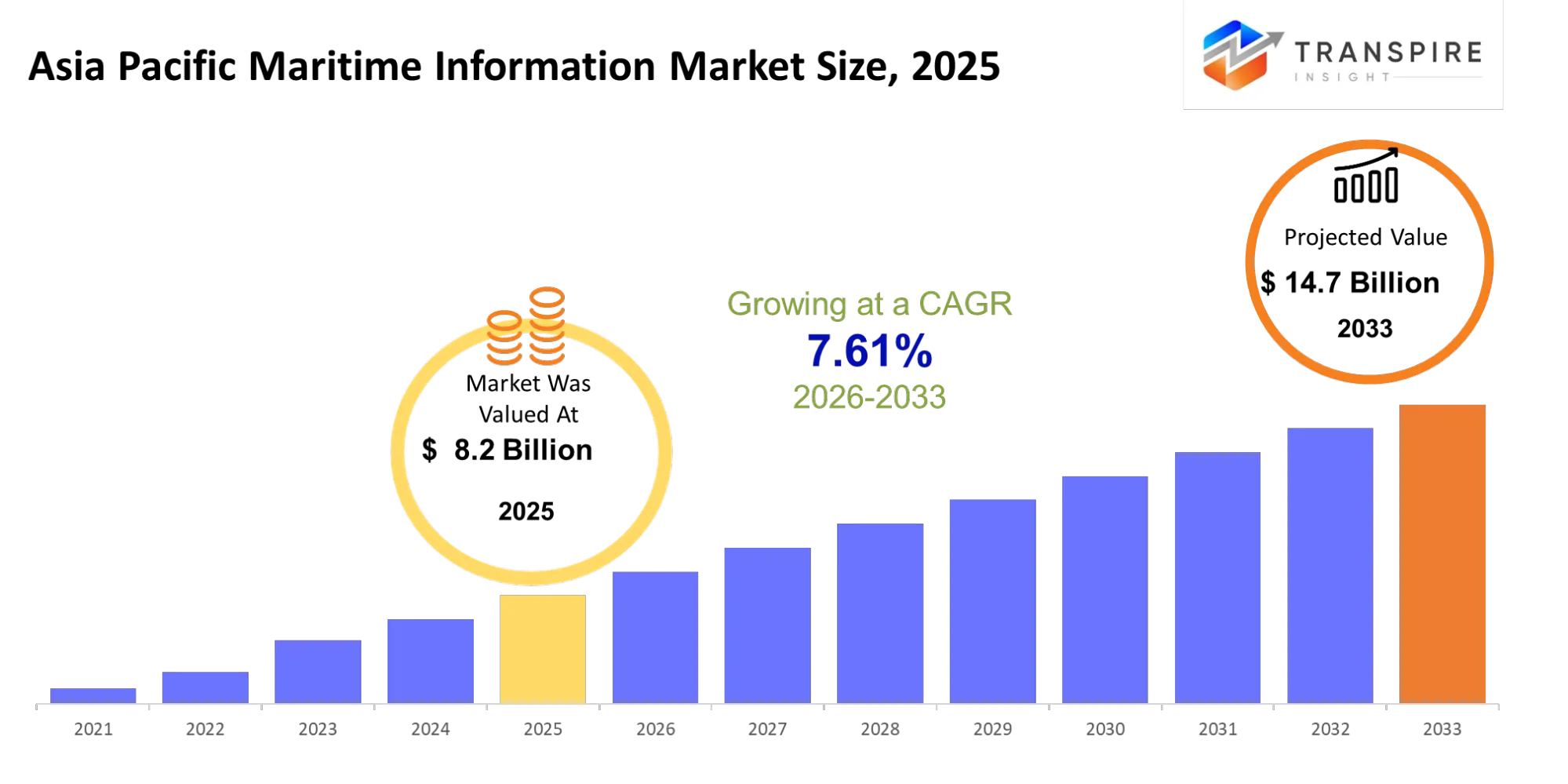
- Asia Pacific Maritime Information Market Size 2025: USD 8.2 Billion
- Asia Pacific Maritime Information Market Size 2033: USD 14.7 Billion
- Asia Pacific Maritime Information Market CAGR: 7.61%
- Asia Pacific Maritime Information Market Segments: By Type (Navigation Systems, Communication Systems, Data Analytics, Others); By Application (Fleet Management, Navigation, Safety & Security, Traffic Monitoring, Others); By End-User (Shipping Companies, Port Authorities, Government Agencies, Logistics Providers, Defense, Others); By Technology (AIS, GPS, Satellite Communication, IoT, Others)
To learn more about this report,  Download Free Sample Report
Asia Pacific Maritime Information Market Summary
The Asia Pacific Maritime Information Market was valued at USD 8.2 Billion in 2025. It is forecast to reach USD 14.7 Billion by 2033. That is a CAGR of 7.61% over the period.
The Asia Pacific maritime information market provides essential support for digital decision-making systems used by regional shipping operations. The system enables port authorities and fleet operators and coast guards and logistics planners to monitor vessels and control traffic and create travel plans and check rule adherence and handle operational hazards throughout major international shipping routes. The system evolved through three to five years into its current state which enables users to track vessels through a complete intelligence system that integrates satellite information with artificial intelligence analytics and operational forecasts.
The International Maritime Organization approved a global maritime digitalization strategy in 2026 which led to a fundamental reorganization of maritime systems through their development of interoperable digital maritime ecosystems. The main cause of industry changes happened because the pandemic created supply chain problems which resulted in cargo delays and shipping route conflicts that showed businesses how fragmented shipping information increased their costs.
Companies started investing in unified information systems after they realized that insufficient visibility resulted in delays for their cargo deliveries and increased expenses for cargo redirection. The transition process now transforms current operational requirements into ongoing platform income because customers use digital intelligence for their daily work in maritime operations.
Key Market Insights
- China controls the Asia Pacific Maritime Information Market because it has approximately 32% market share in 2026 which it achieves through its wide-ranging smart port digital transformation programs.
- Singapore functions as a valuable maritime intelligence center because it uses its advanced vessel traffic systems together with its digital twin-based port management system.
- The Indian market will experience its fastest growth rate because it will expand at more than 11% until 2032 through investment in digital maritime infrastructure which connects to the Sagarmala project.
- The maritime traffic management software market leads the industry with a 38% market share because ports have implemented automated systems throughout their operations.
- The predictive maritime analytics market will experience its fastest growth rate because artificial intelligence adoption will drive expansion until 2032.
- The maritime industry is adopting cloud-based information platforms because these systems provide cost-effective deployment solutions and enable organizations to expand their operational activities.
- The application demand for port operations management systems reaches 41% market share because of their ability to provide cargo visibility and improve berth allocation efficiency.
- The commercial shipping sector shows the greatest demand for maritime information services because it will generate 46% of the Asia Pacific Maritime Information Market revenue in 2026.
- Digital transformation expenditures at major container hubs make port authorities the second largest user group of port management systems.
- Offshore energy operators represent the fastest-growing end-user category through the forecast period, adopting advanced situational intelligence systems.
What are the Key Drivers, Restraints, and Opportunities in the Asia Pacific Maritime Information Market?
The strongest force accelerating the Asia Pacific maritime information market is the region-wide push toward port digitalization and integrated vessel traffic intelligence. The shift received increased momentum after major shipping delays during the pandemic years showed the financial impact of broken maritime data systems in essential trade routes. Governments and port authorities responded by investing in smart port infrastructure, automated traffic coordination platforms, and predictive analytics systems to improve cargo flow efficiency. The direct commercial impact is clear because ports that decrease vessel waiting times and achieve optimal berth allocation will increase throughput which results in ongoing software licensing revenues and system integration contracts and extended data service payments for their solution providers.
The market’s most significant structural barrier is the uneven digital maturity across Asia Pacific maritime ecosystems. Advanced hubs such as Singapore and South Korea implemented digital frameworks but developing ports continue using outdated systems that lack proper interoperability. The challenge exists as a structural problem because maritime communication networks require extensive financial investment and regulatory collaboration and extended periods to implement their upgrades. The result is slower technology adoption, fragmented regional data visibility, and delayed monetization opportunities for maritime information platform providers.
The upcoming trade hubs in South and Southeast Asia present a significant growth potential through the implementation of AI-based predictive maritime intelligence systems. The smart port modernization initiatives in India together with Indonesia's development of coastal logistics systems create advantageous conditions for the implementation of cloud-based maritime analysis solutions. The combination of satellite vessel tracking systems with predictive congestion modeling systems will enable operators to forecast disruptions which will help them maintain their cargo operations.
What Has the Impact of Artificial Intelligence Been on the Asia Pacific Maritime Information Market?
Artificial intelligence and advanced digital systems are changing how maritime information platforms operate across Asia Pacific because they enable shipping companies to control their vessels through automated predictive systems instead of using traditional methods of monitoring. Shipping operators are increasingly deploying AI-enabled scrubber performance systems which automatically monitor exhaust gas cleaning efficiency and detect anomalies in sulfur oxide removal rates while triggering control adjustments without manual intervention. These systems help crews maintain continuous compliance with IMO emissions standards while reducing inspection-related downtime. Fleet compliance tracking platforms now use sensor data integration with automated reporting engines which decrease manual documentation requirements while enhancing regulatory response efficiency.
Machine learning models are also improving predictive capabilities across vessel operations. Operators use them to forecast scrubber maintenance needs and identify corrosion risks and optimize washwater treatment performance based on operating conditions. The use of predictive maintenance applications in practical settings has decreased unexpected equipment downtime through enhanced fault detection systems which identify problems before they result in failures. AI-driven route and fuel optimization tools help vessels reduce fuel consumption through speed profile and engine load adjustments which use weather and traffic information.
The primary problem which prevents progress remains in the area of inconsistent data patterns that exist between different ships and their respective travel paths. Marine emission control systems depend on outdated onboard systems which have various problems related to sensor calibration across the board. The process decreases model accuracy during actual marine operations because it raises costs for system integration which prevents adoption by most medium-sized regional shipping organizations.
Key Market Trends
- The major ports in China and Singapore have transformed their operational systems since 2022 by adopting unified digital command platforms which merge their vessel and cargo and berth intelligence systems.
- The shipping industry began using automated fleet reporting systems after they implemented IMO carbon-intensity requirements which resulted in a 30% decrease of manual emissions reporting responsibilities.
- Since 2021 customers have stopped using on-premise maritime software because they now prefer cloud-native solutions that enable faster shipping network compatibility across multiple regions.
- Kongsberg Maritime and Wärtsilä expanded their AI-based predictive maintenance solutions after operators demonstrated their ability to decrease unplanned equipment failures.
- The Red Sea route disruptions in 2024 led regional carriers to boost their investment in dynamic rerouting systems which help them reduce delays that result from congestion and excessive fuel consumption.
- Indian and Indonesian port authorities now allocate their capital resources to digital maritime visibility systems which they see as essential for operational resilience instead of funding traditional port development projects.
- The shipping industry has adopted machine learning-based vessel performance optimization since 2023 with operators achieving fuel efficiency improvements between 5% and 8% through their use of adaptive routing models.
- The new surveillance regulations require real-time monitoring systems which has led to increased funding for systems that integrate AIS with satellite tracking and automated detection of security threats.
- Technology vendors now established competitive practices which drive them to seek partnerships with regional ports while choosing to avoid direct software sales because it limits their chances of obtaining ongoing service contracts.
Asia Pacific Maritime Information Market Segmentation
By Type:
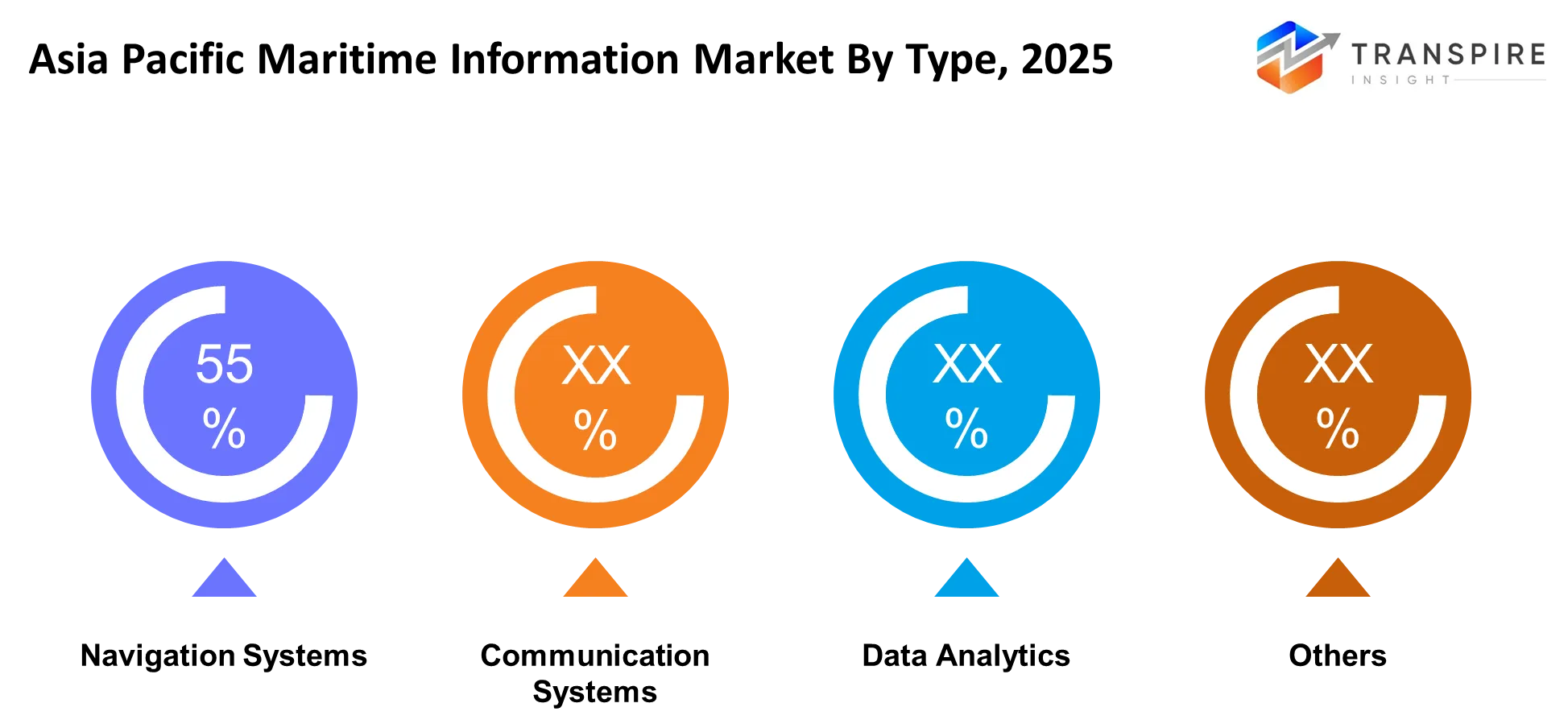
The Asia Pacific Maritime Information Market depends on the navigation systems segment because shipping operations require accurate route planning and real-time positioning support. The systems enable organizations to enhance their operational control by minimizing route deviations and assisting vessels in navigating through crowded waterways with improved accuracy. The increased maritime traffic throughout regional trade routes will create continuous demand for enhanced navigation technologies.
Communication systems maintain critical value because vessels and ports and monitoring centers require continuous communication to operate. The market for data analytics solutions is expanding because companies want to analyze their operational processes in order to achieve better fuel efficiency and improved scheduling outcomes. The other category includes software support platforms and integrated information tools that enhance maritime operations and enable decision-making throughout various operational processes.
To learn more about this report, Download Free Sample Report
By Application:
Operators now use fleet management as their primary market application because they need to track vessel networks with improved accuracy. Maritime information systems enable organizations to track their performance metrics and fuel consumption and maintenance activities and route operational efficiency which results in cost management and decreased operational delays. The shipping industry requires stronger digital controls for fleet management because regional shipping competition continues to grow.
The growth of navigation applications stems from the necessity to track routes precisely in busy maritime areas. The implementation of safety and security systems has increased because governments and private entities work to decrease accidents and stop unauthorized activities. The demand for traffic monitoring systems is increasing because ports need improved capacity to track their vehicle movements. Maritime businesses achieve operational efficiency through various applications which provide support for reporting tasks and compliance management and operational planning activities.
By End-User:
The shipping industry generates significant demand for market services because companies require maritime information systems to achieve better operational management and minimize transportation risks. The organizations are developing digital solutions which will deliver real-time information and enhance their route optimization capabilities. Organizations will continue to adopt new technologies because they need to reduce operational costs while delivering better customer service.
Port authorities also represent a major user group because they require improved vessel coordination and better control of port traffic. Government agencies use these systems for monitoring and regulatory enforcement while logistics providers need accurate maritime data to schedule their operations and plan cargo movements. The defense sector needs to expand its applications because regional maritime surveillance demands continue to grow while research and monitoring institutions also require access to this capability.
By Technology:
The advanced AIS technology maintains its popularity among users because it enables ships to transmit their positions and identification details which creates better maritime route visibility. The GPS system maintains its crucial role in route management and operational planning because it delivers exact navigation and positioning capabilities. The two technologies operate together to enhance system dependability which enables safer vessel operations through high-traffic maritime areas.
Satellite communication has become a vital technology for shipping operators who require better connectivity to remote ocean regions. IoT-based systems are experiencing increased adoption because their connected sensors enable real-time tracking of equipment status and operational performance. The implementation of these technologies will enable maritime stakeholders to achieve quicker decision-making processes and better maintenance planning which will lead to more effective risk management and enhanced operational results throughout the Asia Pacific region.
What are the Key Use Cases Driving the Asia Pacific Maritime Information Market?
The main application of the system involves managing port operations together with tracking ship movements throughout busy commercial shipping routes. The systems enable container terminals together with major port authorities to control berth assignments while they decrease ship turnaround times and they sustain complete operational awareness which results in their platform usage becoming the primary source of ongoing demand.
Fleet compliance monitoring and route optimization adoption is growing among bulk cargo operators and tanker fleets who must comply with new regional emissions standards. Offshore energy operators use maritime intelligence tools to control vessel movement while they track weather-related interruptions and enhance their logistical operations for offshore installations.
New applications will use AI systems to predict traffic congestion together with building systems that support independent ship operations. These systems currently gain initial acceptance in advanced shipping centers located in Singapore and South Korea because their regulators evaluate digital navigation systems together with predictive maritime safety technologies that will transform future ship traffic control operations.
|
Report Metrics |
Details |
|
Market size value in 2025 |
USD 8.2 Billion |
|
Market size value in 2026 |
USD 8.8 Billion |
|
Revenue forecast in 2033 |
USD 14.7 Billion |
|
Growth rate |
CAGR of 7.61% from 2026 to 2033 |
|
Base year |
2025 |
|
Historical data |
2021 - 2024 |
|
Forecast period |
2026 - 2033 |
|
Report coverage |
Revenue forecast, competitive landscape, growth factors, and trends |
|
Regional scope |
Asia Pacific (China, India, Japan, South Korea, Australia, Rest of Asia Pacific) |
|
Key company profiled |
Kongsberg, Wärtsilä, Navico, Furuno, Garmin, Raymarine, Thales, Saab, Honeywell, Northrop Grumman, Lockheed Martin, Spire Global, Orbcomm, Inmarsat, Iridium |
|
Customization scope |
Free report customization (country, regional & segment scope). Avail customized purchase options to meet your exact research needs. |
|
Report Segmentation |
By Type (Navigation Systems, Communication Systems, Data Analytics, Others); By Application (Fleet Management, Navigation, Safety & Security, Traffic Monitoring, Others); By End-User (Shipping Companies, Port Authorities, Government Agencies, Logistics Providers, Defense, Others); By Technology (AIS, GPS, Satellite Communication, IoT, Others) |
Which Regions are Driving the Asia Pacific Maritime Information Market Growth?
The maritime information market within the Asia Pacific region The most operationally effective area of the region functions through the combined efforts of China, Japan, and South Korea. The industry achieves its market leadership through its extensive port facilities and its implementation of strict digital navigation requirements and its possession of the largest commercial shipping fleets found anywhere in the world. The governments operating in these markets have integrated maritime digitalization into their complete logistics modernization initiatives which has resulted in increased funding for vessel traffic intelligence systems and monitoring systems that connect different aspects of operations. The ecosystem of shipbuilders and marine electronics manufacturers together with software developers and advanced port operators maintains this market position which speeds up the implementation of next-generation maritime data platforms.
Southeast Asia ranks as the second most important regional contributor because its network stability contributes to its operational power without needing extensive physical resources. The region achieves its technological superiority through its geographical position near vital international shipping routes which receive continuous funding from international port operators. The regional market depends on Singapore to provide highly developed maritime intelligence systems while Malaysia, Thailand and Vietnam support the industry through their ongoing port development programs and their gradual approach to implementing regulations. The balanced growth profile of Southeast Asia results in a reliable pattern of technology implementation which generates ongoing revenue from services that last for extended periods.
South Asia remains the quickest expanding region because India operates its port modernization program together with its maritime logistics development initiatives. The national infrastructure programs have expanded their smart port initiative; they now require digital vessel coordination solutions and predictive maritime analytics systems. The operators evaluate their fleet modernization programs together with their increasing coastal cargo operations to move toward complete information system integration. The period between 2026 and 2033 presents market entrants and investors with an excellent business growth opportunity through scalable cloud-native maritime intelligence solutions.
Who are the Key Players in the Asia Pacific Maritime Information Market and How Do They Compete?
The Asia Pacific maritime information market shows moderate competition because global marine technology groups control valuable contracts while specialized software companies and local system integrators fight for port development contracts. The market remains stable because maritime information systems need lengthy certification periods and dependable performance and complete integration with ships and port systems. Organizations compete based on their technology capabilities which include predictive analytics and real-time interoperability and cybersecurity resilience. Existing companies protect their market share by integrating AI-powered systems into their complete maritime automation platforms instead of competing through software price reductions.
Kongsberg Maritime uses digital platforms with high integration capabilities to link its systems for vessel automation and navigation intelligence and port coordination. The company provides its strength through operational architecture, which enables shipowners and port operators to operate their systems together without facing integration difficulties. The company maintains its Asia expansion through partnerships that support smart port development and autonomous ship testing programs. Wärtsilä differentiates itself through predictive fleet optimization tools that combine voyage analytics with emissions compliance monitoring, giving operators measurable efficiency gains across mixed vessel fleets.
The company uses its strong market presence in Asia's coastal and commercial shipping sectors and its dependable radar and navigation sensor systems to gain competitive strength. The company uses its existing onboard hardware to create new digital intelligence systems which attract operators who want to make gradual upgrades. Thales Group focuses on maritime surveillance and secure information exchange, positioning itself strongly in coast guard and naval-adjacent deployments across the region. The company achieves access to valuable contracts which require data protection and precise operations because of its specialized niche expertise.
Company List
- Kongsberg
- Wärtsilä
- Navico
- Furuno
- Garmin
- Raymarine
- Thales
- Saab
- Honeywell
- Northrop Grumman
- Lockheed Martin
- Spire Global
- Orbcomm
- Inmarsat
- Iridium
Recent Development News
In March 2026, Siemens Energy entered a partnership with Marco Polo Shipyard. The collaboration will deploy hybrid-electric propulsion technology for offshore wind support vessels, improving fuel efficiency by 20–30% and accelerating low-emission vessel development across the Asia Pacific maritime information and smart-vessel ecosystem.
Source https://www.apmaritime.com/
In March 2026, Bureau Veritas entered a strategic partnership with Beng Hui Marine Electrical and Penguin International. The agreement launched Bureau Veritas’ Type-Approved PWR+ Power Management and Digital Monitoring System on next-generation compact crewboats, strengthening digital vessel monitoring capabilities and operational intelligence in Asia Pacific shipping. Source https://www.bhglobal.com
What Strategic Insights Define the Future of the Asia Pacific Maritime Information Market?
The Asia Pacific maritime information market is heading toward its final destination which includes complete implementation of connected maritime intelligence systems between 2023 and 2027. The market requires control systems which connect two critical operational parts through their digital platforms instead of using separate operating systems. The market experiences dual pressures because companies face increasing emissions requirements while their trade routes become less predictable and they need to maximize port operations without expanding their physical space. The market’s hidden risk arises from the existing problem of system interoperability between different platforms which creates digital silos that prevent data sharing between systems used by fleet operators and ports to vendor-specific systems which decrease operational efficiency because they create separate digital environments.
AI-enabled digital twin infrastructures present a major emerging opportunity through their installation across rapidly developing ports throughout South Asia especially in India which currently invests heavily in smart port technology. The systems enable maritime intelligence to advance from basic operational surveillance toward real-time operational projection and synchronized operational forecasting. The most effective strategic approach for market participants involves creating open systems through development work combined with establishing integration partnerships based on industry standards. Companies that achieve system compatibility between their various fleet operations and regional port facilities will establish themselves as major beneficiaries in the maritime digital market because they will create sustainable income streams.
Asia Pacific Maritime Information Market Report Segmentation
By Type
- Navigation Systems
- Communication Systems
- Data Analytics
By Application
- Fleet Management
- Navigation
- Safety & Security
- Traffic Monitoring
By End-User
- Shipping Companies
- Port Authorities
- Government Agencies
- Logistics Providers
- Defense
By Technology
- AIS
- GPS
- Satellite Communication
- IoT
Frequently Asked Questions
Find quick answers to common questions.
The Asia Pacific Maritime Information Market size is USD 14.7 Billion in 2033.
Key segments for the Asia Pacific Maritime Information Market are By Type (Navigation Systems, Communication Systems, Data Analytics, Others); By Application (Fleet Management, Navigation, Safety & Security, Traffic Monitoring, Others); By End-User (Shipping Companies, Port Authorities, Government Agencies, Logistics Providers, Defense, Others); By Technology (AIS, GPS, Satellite Communication, IoT, Others).
Major Asia Pacific Maritime Information Market players are Kongsberg, Wärtsilä, Navico, Furuno, Garmin, Raymarine, Thales, Saab, Honeywell, Northrop Grumman, Lockheed Martin, Spire Global, Orbcomm, Inmarsat, Iridium.
The Asia Pacific Maritime Information Market size is USD 8.2 Billion in 2025.
The Asia Pacific Maritime Information Market CAGR is 7.61% from 2026 to 2033.
- Kongsberg
- Wärtsilä
- Navico
- Furuno
- Garmin
- Raymarine
- Thales
- Saab
- Honeywell
- Northrop Grumman
- Lockheed Martin
- Spire Global
- Orbcomm
- Inmarsat
- Iridium
Recently Published Reports
-
Apr 2026
Biosimilars Market
Biosimilars Market By Product Type (Monoclonal Antibodies, Recombinant Hormones, Erythropoietin, G-CSF, Others), By Indication (Oncology, Autoimmune Diseases, Blood Disorders, Diabetes, Others), By Manufacturing Type (In-House Manufacturing, Contract Manufacturing), By Distribution Channel (Hospital Pharmacies, Retail Pharmacies, Online Pharmacies), By Industry Analysis, Size, Share, Growth, Trends, and Forecasts 2021-2033
-
Apr 2026
Gastrointestinal Endoscopy Market
Gastrointestinal Endoscopy Market By Type (Rigid Gastrointestinal Endoscope, Flexible Gastrointestinal Endoscopes, Disposable Gastrointestinal Endoscope), By Procedure Type (Colonoscopy, Gastroscopy, Duodenoscopy, Enteroscopy, Flexible Sigmoidoscopy, Others), By Application (Diagnosis, Treatment), By End-Users (Hospitals, Ambulatory Surgical Centers, Specialty Clinics, Laboratories, Others), By Industry Analysis, Size, Share, Growth, Trends, and Forecasts 2021-2033
-
Apr 2026
Rare Inherited Metabolic Disorder Drug Market
Rare Inherited Metabolic Disorder Drug Market By Drug Class (Enzyme Replacement Drugs, Gene Therapy Drugs, Substrate Reduction Drugs, Small Module Drugs, Protein Drugs), By Route of Administration(Parenteral, Oral, Intrathecal), By Clinical Development (Marketed Drugs, Late Stage Clinical Phase III, Early Stage Clinical Phase I-II, Preclinical Candidates), By Indication (Lysosomal Storage Disorders, Urea Cycle Disorders, Amino Acid Metabolic Disorders, organic Acidemias, Peroximal Disorders), By Industry Analysis, Size, Share, Growth, Trends, and Forecasts 2021-2033
-
Jan 2026
Pharmaceutical Cleanroom Technology Market
Pharmaceutical Cleanroom Technology Market By Product (Equipment, Consumables, Services); By Cleanroom Type (Standard Cleanrooms, Modular Cleanrooms); By End Use (Pharmaceutical Companies, Biotechnology Companies), By Industry Analysis, Size, Share, Growth, Trends, and Forecasts 2021-2033