

Japan Digital Camera Market Size & Forecast:
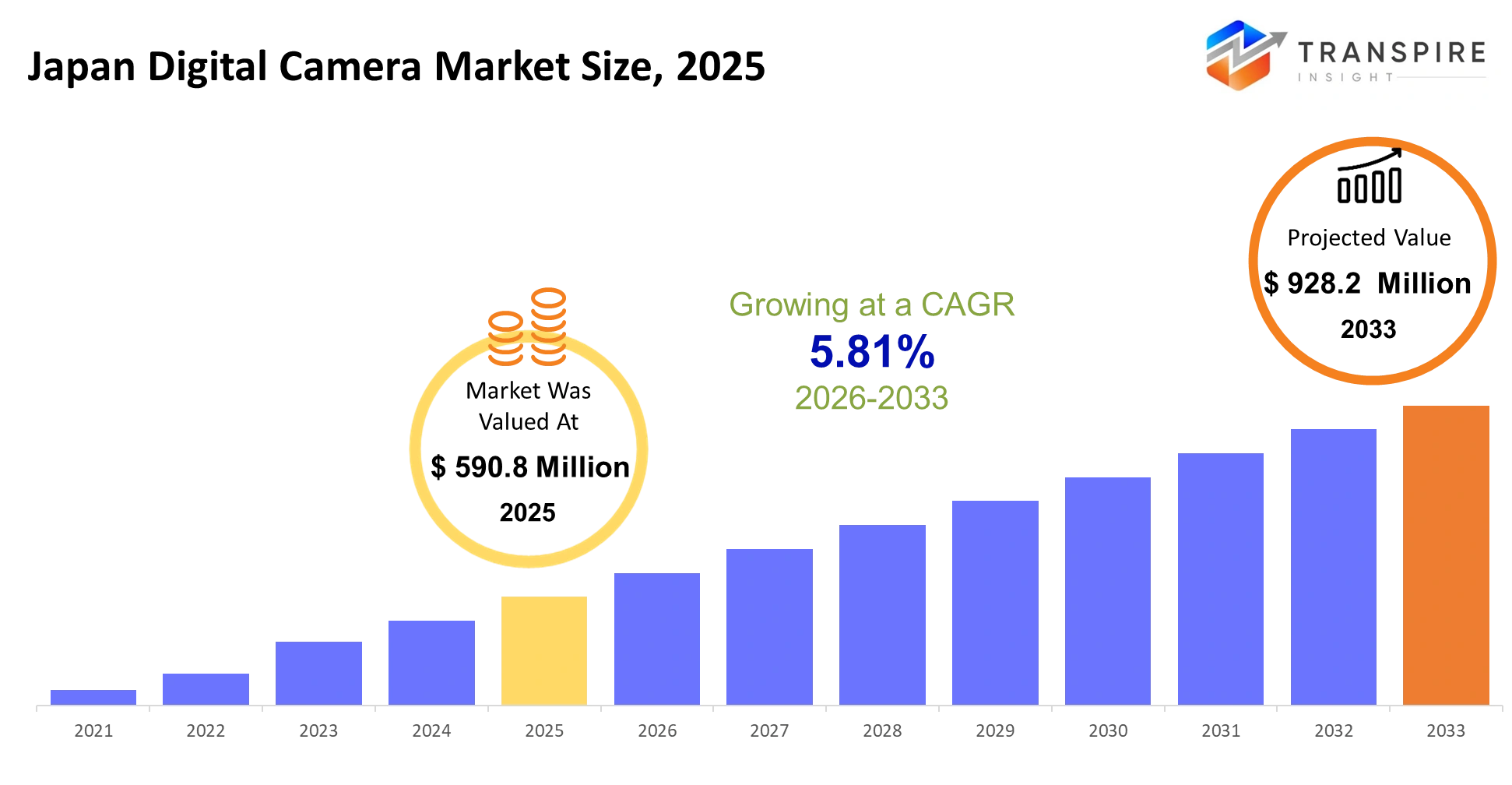
- Japan Digital Camera Market Size 2025: USD 590.8 Million
- Japan Digital Camera Market Size 2033: USD 928.2 Million
- Japan Digital Camera Market CAGR: 5.81%
- Japan Digital Camera Market Segments: By Type (DSLR, Mirrorless, Compact Cameras, Action Cameras, Others); By Application (Photography, Videography, Surveillance, Content Creation, Others); By End-User (Consumers, Professionals, Media Industry, Enterprises, Others); By Distribution (Online, Retail Stores, Specialty Stores, Others)
To learn more about this report,  Download Free Sample Report
Japan Digital Camera Market Summary
The Japan Digital Camera Market was valued at USD 590.8 Million in 2025. It is forecast to reach USD 928.2 Million by 2033. That is a CAGR of 5.81% over the period.
The Japan digital camera market serves a practical role that goes well beyond consumer photography. The system enables precise imaging work which supports professional media production and industrial inspection work and medical documentation and surveillance operations and content creation systems that depend on image quality and operational velocity and operational reliability. For manufacturers and service providers, these devices solve the need for high-resolution visual capture in environments where smartphone cameras still fall short on optics, sensor performance, and workflow integration.
The market experienced its major shift during the last three to five years when consumers stopped buying compact cameras and started purchasing premium mirrorless cameras and professional imaging equipment that requires specialized knowledge. After semiconductor shortages disrupted global supply chains during the pandemic manufacturers chose to focus their resources on profitable product lines instead of entry-level products. Japan's creator economy growth combined with the increasing use of digital communication in hybrid working environments has created a rising need for high-quality imaging equipment. The companies have directed their development efforts toward AI-powered autofocus systems and video-focused functionalities and compatibility between different systems which results in improved revenue from each product and higher usage rates among professional users and dedicated enthusiasts.
Key Market Insights
- The Japan Digital Camera Market in 2025 saw the Kanto region secure 38% of market share because Tokyo hosted most media and advertising and professional imaging studios.
- The Kansai region will experience its fastest market growth until 2030 because Osaka functions as a content production hub and advanced manufacturing hubs adopt industrial imaging technology.
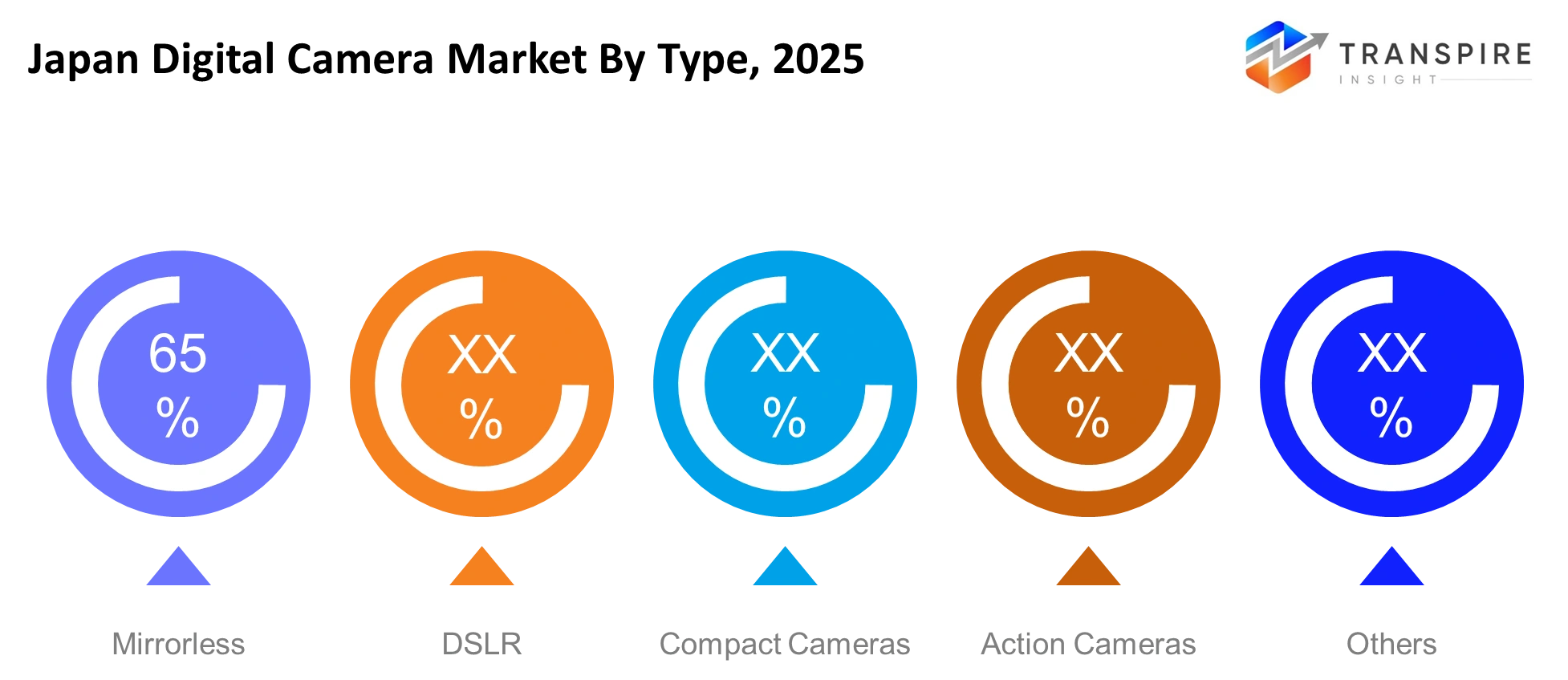
The demand for Hokkaido and Kyushu products will increase at an annual rate exceeding 6% because tourism drives equipment sales and local artist communities develop. - The Japan Digital Camera Market in 2025 shows mirrorless cameras leading the market with above 58% share because users prefer lightweight systems that offer professional-grade performance.
- The DSLR camera segment maintains its position as the second largest market segment with approximately 24% market share which exists because professional users from previous generations and institutions use these cameras for their photography work.
- The most rapidly expanding market segment of compact premium digital cameras will continue until 2029 because international travel has recovered and high-end cameras attract dedicated users.
- The Japanese digital camera market of 2025 saw professional photography and videography make up 41% of total demand which existed because of growing commercial media production and digital advertising industries.
- The 2025 market distribution showed professional creators and media production houses as the largest end-user group which controlled 46% of market share.
- The fastest expanding end-user group consists of independent digital creators who experience growth because of monetized online video platforms and investments in equipment designed for content creators.
- The corporate enterprise sector has started to adopt hybrid communication solutions together with internal media production and product visualization processes.
What are the Key Drivers, Restraints, and Opportunities in the Japan Digital Camera Market?
The Japanese digital camera market experiences its strongest expansion because professional-grade mirrorless systems have become widely adopted through recent sensor miniaturization and AI autofocus development and real-time video processing technology improvements which occurred during the last five years. The broadcasters and commercial studios and creators all adopted 4K and 8K production workflows which made older DSLR platforms less efficient for hybrid photo-video usage. The technology shift requires both consumers and enterprises to make faster upgrades which enables manufacturers to achieve higher sales through their premium product offerings and interchangeable lens systems and subscription software solutions for editing and cloud-based workflows.
The most significant barrier results from entry-level camera segment structural contraction which continues because smartphone imaging technology keeps advancing. The computational photography capabilities of flagship mobile devices have created a permanent change in casual photography that leads to decreased first-time digital camera purchases. The challenge exists as a structural problem because camera manufacturers need to create products that offer better portability and connectivity and mass-market pricing. The business operation creates a more restricted customer pathway which prevents businesses from achieving direct sales growth while limiting their ability to replace products through time which used to provide regular market income.
The upcoming industrial growth potential will emerge through industrial applications and machine-vision imaging systems. Japan’s manufacturing sector expansion for factory automation and semiconductor inspection systems has created high demand for advanced high-resolution imaging equipment. The adoption of digital camera technology in robotics and precision manufacturing systems will generate substantial revenue for companies when they expand their operations throughout the Kansai and Chubu industrial areas.
What Has the Impact of Artificial Intelligence Been on the Japan Digital Camera Market?
The digital imaging industry in Japan undergoes transformation through artificial intelligence which establishes automated systems for camera operation and production processes. Current manufacturers implement AI-powered systems which recognize scenes and detect subjects while providing precise autofocus tracking for human eyes and vehicles and animals and fast-moving objects. The capabilities of this system enable photographers to spend less time on manual adjustments while they achieve better results when capturing sports events and live shows and commercial video projects. Advanced digital imaging systems in manufacturing enable factories to achieve automated quality control through sensor alignment and lens assembly optimization which improves their operational efficiency.
Machine learning models enhance predictive accuracy for interconnected imaging systems through their development. Camera firmware increasingly analyzes user shooting patterns to optimize exposure settings, battery consumption, and thermal management during extended 4K and 8K recording sessions. The system has achieved operational improvements which include extended recording periods without interruptions and decreased processing requirements that enhance user reliability for professional users. Cloud-linked software platforms utilize predictive analytics to monitor component degradation which enables service centers to schedule maintenance for shutters and sensors before breakdowns happen.
The main limitation of advanced AI processing hardware arises from its expensive integration requirements. The need for real-time inference demands advanced chipsets and thermal management systems, which increase product costs and restrict usage to high-end camera models. AI systems still experience accuracy problems because they struggle to handle extremely low-light conditions and highly obstructed shooting environments, which traditional manual controls do better than automated systems.
Key Market Trends
- Since 2021 the mirrorless camera market grew from 55 percent to over 70 percent of total interchangeable-lens shipments because Sony Group Corporation and Canon Inc. launched their primary products.
- The introduction of computational imaging technology on smartphones led to a major decrease in entry-level compact camera production after 2022 because Japanese consumers stopped purchasing these cameras through retail stores.
- AI-based autofocus systems achieved their first major improvement in subject tracking accuracy during 2025 when compared to 2020 models, which resulted in buyers favoring intelligent capture platforms.
- Japanese creators during the years 2022 to 2025 moved away from their traditional usage of still-photography equipment to embrace hybrid video systems because 4K streaming monetization became more profitable through its increased adoption.
- The period from 2021 to 2023 experienced semiconductor shortages which forced manufacturers to concentrate on producing high-end products that resulted in higher profits from professional imaging equipment.
- FUJIFILM Holdings Corporation and Nikon Corporation expanded their lens ecosystem investments after 2023 to establish proprietary systems which help them retain customers for the long haul.
- 8K recording limitations exposed performance gaps in early next-generation camera releases which made battery efficiency and thermal control become major factors that customers used to decide which products to buy.
- Japanese automation manufacturers started using advanced camera modules for their semiconductor inspection systems and robotics systems. The year 2024 brought industrial imaging applications because of this development.
- The market share of direct-to-consumer online sales channels increased after 2020 which resulted in reduced demand for traditional electronics retailers while transforming product launch methods.
- The emergence of subscription-based firmware upgrades and cloud workflow services after 2023 demonstrates how hardware-only competition has transformed into software-enabled imaging ecosystems.
Japan Digital Camera Market Segmentation
By Type:
The DSLR segment maintains its market presence in the Japan Digital Camera Market because professional photographers and users who prefer traditional camera handling with optical viewfinders continue to show strong demand for the product. The combination of high image quality and interchangeable lens support together with extended battery life enables DSLR cameras to perform effectively in studio environments and wildlife photography and commercial projects. The segment has reached a growth plateau because new product categories have emerged but dedicated users continue to support this product segment.
Mirrorless cameras are experiencing higher growth rates because of their small size and cutting-edge autofocus capabilities and rapid shooting capabilities. The number of creators who want lightweight equipment that delivers professional-quality results is rising. People continue to use compact cameras for casual situations and travel purposes because of their ability to be easily carried and simple to use. Adventure users and sports recording professionals are driving demand for action cameras while the digital camera market in Japan includes specialized industrial cameras and instant hybrid devices which fulfill specific niche needs.
To learn more about this report, Download Free Sample Report
By Application :
The main use of digital cameras in Japan remains photography because both consumers and professionals need high-resolution images for their personal and business needs and their artistic work. The purchase of cameras remains active through landscape photography and portrait sessions and event coverage and product imaging. The segment maintains its demand through ongoing developments in sensor technology and image stabilization systems.
Cinematic-quality video recording has created strong demand between independent production and commercial media which has resulted in rapid growth for videography. Digital platforms that support video publishing and visual storytelling have created a fast expansion of content creation activities. Security requirements and monitoring needs are fulfilled by specialized camera systems which support surveillance applications. Advanced digital imaging tools have become essential for accuracy and efficiency in education and scientific imaging and industrial documentation.
By End-User :
The consumer segment accounts for a significant share of the Japan Digital Camera Market because photography enthusiasts and people who want better image quality than smartphones deliver make up this segment. The ongoing interest in travel photography and family documentation and hobby-based content recording continues to drive consumer purchases. The various price points of digital cameras enable customers from different income levels to purchase these products.
Photography studios and freelance projects require advanced imaging tools which make professional users an essential market segment. The media industry requires high-performance cameras to support its journalism and broadcasting and production work. Organizations are implementing digital cameras to fulfill their needs for inspection and documentation and corporate media purposes. Educational institutions and research organizations use specialized devices for training and technical applications as their primary devices.
By Distribution :
The Japan Digital Camera Market will continue to grow because online product distribution has become the main shopping method for consumers who want to compare items and access special deals. E-commerce platforms allow buyers to access detailed specifications, reviews, and bundled offers before making purchasing decisions. The combination of advanced digital payment solutions with swift delivery systems allows online businesses to reach more customers.
Retail stores still serve as vital distribution points because they enable customers to test products directly before making buying decisions. Buyers use physical encounters with camera models to evaluate how well they can control the devices and which functions the devices provide. Professional users find specialty stores to be valuable resources because these stores offer expert assistance, technological backing, and personalized product suggestions. Serious camera buyers trust these stores as reliable shopping locations because they provide after-sales support and guidance on lens compatibility and accessory selection.
What are the Key Use Cases Driving the Japan Digital Camera Market?
Digital cameras in Japan get their main practical application through the needs of professional media production work. All commercial studios and broadcasters with advertising agencies and independent production houses depend on high-performance imaging systems to capture 4K and 8K video content while they cover live events and create premium commercial photography. The highest demand exists for this segment because image precision and autofocus reliability and lens flexibility determine both production quality and operational efficiency.
Corporate communication needs and industrial inspection requirements both drive adoption growth. Large enterprises increasingly use advanced imaging systems for hybrid events, product visualization, and branded digital content, while manufacturers deploy specialized cameras for precision inspection across semiconductor fabrication and automotive component production.
Robotics together with healthcare imaging documentation and immersive virtual production develop their new applications. Japanese research institutions and technology developers are testing advanced camera integration for machine vision, AI-assisted diagnostics, and volumetric capture environments. These applications remain niche at present but they show potential to become vital growth pathways as both imaging intelligence and sensor capabilities continue to progress.
|
Report Metrics |
Details |
|
Market size value in 2025 |
USD 590.8 Million |
|
Market size value in 2026 |
USD 625.1 Million |
|
Revenue forecast in 2033 |
USD 928.2 Million |
|
Growth rate |
CAGR of 5.81% from 2026 to 2033 |
|
Base year |
2025 |
|
Historical data |
2021 - 2024 |
|
Forecast period |
2026 - 2033 |
|
Report coverage |
Revenue forecast, competitive landscape, growth factors, and trends |
|
Country scope |
Japan |
|
Key company profiled |
Canon, Nikon, Sony, Panasonic, Fujifilm, Olympus, Leica, GoPro, Ricoh, Kodak, Samsung, Hasselblad, Sigma, Tamron, Zeiss |
|
Customization scope |
Free report customization (country, regional & segment scope). Avail customized purchase options to meet your exact research needs. |
|
Report Segmentation |
By Type (DSLR, Mirrorless, Compact Cameras, Action Cameras, Others); By Application (Photography, Videography, Surveillance, Content Creation, Others); By End-User (Consumers, Professionals, Media Industry, Enterprises, Others); By Distribution (Online, Retail Stores, Specialty Stores, Others) |
Which Regions are Driving the Japan Digital Camera Market Growth?
The Kanto region operates as the leading force in Japan's digital camera industry because Tokyo hosts numerous media organizations together with commercial production facilities and technology-based imaging companies. The area establishes its leadership position through its concentration of professional resources which includes advertising agencies and broadcast networks and content production companies and major retail outlets that use advanced cameras. The region gains product launch control through its concentration of major manufacturing companies which operate their headquarters and research and development facilities throughout Tokyo and its surrounding areas. The interconnected business network creates product demand through its system that combines product development with distribution channels and professional education and customer service within a unified business center.
Kansai holds the second-largest share, but its market dynamics differ notably from Kanto's media-centric structure. The region maintains its growth because of its stable industrial base which includes manufacturing facilities that operate throughout Osaka and Kyoto and Kobe to support digital imaging systems used in inspection and engineering documentation and corporate communication. Regional purchasing behavior leads to consumers choosing products which require extended replacement periods and slow capital spending instead of quickly buying new high-end products. The constant revenue stream from Kansai depends on industrial demand which remains strong together with continuous investment from precision manufacturing industries.
Chubu has become the fastest-growing regional market because advanced manufacturing modernization develops throughout Aichi and its neighboring prefectures. The market now requires high-resolution industrial imaging platforms because businesses have increased their spending on robotics and semiconductor manufacturing and factory automation since 2024. Local businesses use camera systems to develop machine vision systems which they use for their quality-control procedures in their digital transformation projects. The period until 2033 presents excellent business prospects for new market participants and investors who want to enter the market especially through specialized imaging solutions which industrial automation and intelligent manufacturing systems need.
Who are the Key Players in the Japan Digital Camera Market and How Do They Compete?
The Japanese digital camera market displays high market control through its competition which exists between domestic manufacturing companies that operate in the premium imaging sector. The market remains stable because new companies cannot enter the industry due to the need for companies to possess optical engineering expertise and sensor development capabilities and research their lens ecosystem solutions. Companies compete through technological advancements which develop superior imaging software features while creating systems that make it hard for customers to switch to different products. Companies that already exist in the market use faster product development cycles together with advanced computational technologies to maintain market presence while their proprietary lens systems and workflow software create customer loyalty.
Through its sensor technology Sony Group Corporation maintains market presence while developing AI-based autofocus systems and stacked CMOS technology and systems that combine video and photography. The Alpha ecosystem from Sony attracts commercial creators who need fast performance and low-light abilities and advanced video functions. The company develops its business operations through software integration and partnership development in professional content production networks. Canon Inc. uses its color science and user-friendly design and strong loyalty from professional broadcasters and event photographers to create a unique market position. The company establishes a competitive advantage in high-end system upgrades through its RF lens ecosystem development.
FUJIFILM Holdings Corporation has established its competitive advantage through its retro design approach combined with its film simulation technology and its ability to attract creative professionals who want unique visual results. Nikon Corporation is increasing its market presence through the introduction of advanced mirrorless systems and its development of precise optical equipment which caters to both athletic and nature photography experts. Panasonic Holdings Corporation maintains its growth strategy by developing Lumix video production systems which filmmakers can use, while its niche market presence is strengthened through its codec compatibility and its professional stabilization capabilities.
Company List
- Canon
- Nikon
- Sony
- Panasonic
- Fujifilm
- Olympus
- Leica
- GoPro
- Ricoh
- Kodak
- Samsung
- Hasselblad
- Sigma
- Tamron
- Zeiss
Recent Development News
In April 2026, The Sony Alpha 7 V received its major technology certification from Sony Group Corporation after the camera won the "Best Full Frame Expert Camera" award at the 2026 TIPA World Awards. The recognition strengthened Sony's premium mirrorless positioning in Japan's digital camera market and reinforced the Alpha 7 V's strong commercial momentum across Japanese retail channels. Source https://www.digitalcameraworld.com/
In March 2025, The product served as Fujifilm's initial fixed-lens GFX-series digital camera which utilized a 102MP large-format sensor and expanded the company's premium digital camera range while establishing Japan as the leading nation in high-end compact medium-format camera development. Source https://www.fujifilm.com/
What Strategic Insights Define the Future of the Japan Digital Camera Market?
The Japan digital camera market will evolve into a system that produces fewer products which generate greater value through premium imaging technology during the next five to seven years. The primary element which drives this transition forward stems from the combined development of AI-powered recording systems together with professional video production processes and enhanced software integration features, which will make cameras function more like intelligent imaging systems than traditional optical instruments. The organization will achieve revenue growth through ecosystem monetization resulting from product updates and internet-based services and dedicated industrial software solutions.
A less visible risk exists because market concentration occurs when a few manufacturers dominate the entire industry. Extended replacement cycles will occur when product innovation decreases and lens systems become too essential to encourage new testing. An emerging opportunity is taking shape in Chubu's industrial automation corridor machine vision systems for semiconductor and robotics manufacturing currently remain underdeveloped yet have become essential for strategic operations. Market participants should invest beyond consumer-facing hardware. The companies that develop imaging software which works with different systems and AI processing components and industrial-grade imaging alliances will emerge as market leaders in Japan's digital imaging industry.
Japan Digital Camera Market Report Segmentation
By Type
- DSLR
- Mirrorless
- Compact Cameras
- Action Cameras
By Application
- Photography
- Videography
- Surveillance
- Content Creation
By End-User
- Consumers
- Professionals
- Media Industry
- Enterprises
By Distribution
- Online
- Retail Stores
- Specialty Stores
Frequently Asked Questions
Find quick answers to common questions.
The Japan Digital Camera Market size is USD 928.2 Million in 2033.
Key segments for the Japan Digital Camera Market are By Type (DSLR, Mirrorless, Compact Cameras, Action Cameras, Others); By Application (Photography, Videography, Surveillance, Content Creation, Others); By End-User (Consumers, Professionals, Media Industry, Enterprises, Others); By Distribution (Online, Retail Stores, Specialty Stores, Others).
Major Japan Digital Camera Market players are Canon, Nikon, Sony, Panasonic, Fujifilm, Olympus, Leica, GoPro, Ricoh, Kodak, Samsung, Hasselblad, Sigma, Tamron, Zeiss.
The Japan Digital Camera Market size is USD 590.8 Million in 2025.
The Japan Digital Camera Market CAGR is 5.81% from 2026 to 2033.
- Canon
- Nikon
- Sony
- Panasonic
- Fujifilm
- Olympus
- Leica
- GoPro
- Ricoh
- Kodak
- Samsung
- Hasselblad
- Sigma
- Tamron
- Zeiss
Recently Published Reports
-
Apr 2026
Fiber Optic Faceplates Market
Fiber Optic Faceplates Market Size, Share & Analysis Report By Type (< 300 mm2, 300-350 mm2, and > 350 mm2, By Application (Night Vision, Holographic Imaging, Medical, and Others), and Geography (North America, Europe, Asia-Pacific, Middle East and Africa, South and Central America), 2021 - 2031
-
Apr 2026
High Temperature Superconductors Market
High Temperature Superconductors Market Size, Share & Analysis Report By Type (1G HTS, and 2G HTS), By Application (Power Cable, Fault Current Limiter, and Transformer), and Geography (North America, Europe, Asia-Pacific, Middle East and Africa, South and Central America), 2021 - 2031
-
Apr 2026
Industrial Plugs and Socket Market
Industrial Plugs and Socket Market Size, Share & Analysis Report By Type (Industrial Plugs, Industrial Sockets), By Current (Up to 32 A, 32 to 125 A, Above 125 A), By Protection (Dustproof and Splash Proof, Waterproof, Explosion Proof), By End User (Heavy Industries, Oil and Gas, Chemicals and Pharmaceuticals, Power Generation, Others), and Geography (North America, Europe, Asia-Pacific, Middle East and Africa, South and Central America), 2021 - 2031
-
Apr 2026
InGaAs Avalanche Photodiodes Market
InGaAs Avalanche Photodiodes Market Size, Share & Analysis Report By Type (1100 - 1700 nm, and 1000 - 1600 nm), By Application (Missile Warning System, Muzzle Flash Detection, Wafer Defect Inspection, Laser Rangefinders, and Others), and Geography (North America, Europe, Asia-Pacific, Middle East and Africa, South and Central America), 2021 - 2031