
Europe Digital Subscriber Line (DSL) Network Equipment Market Size & Forecast:
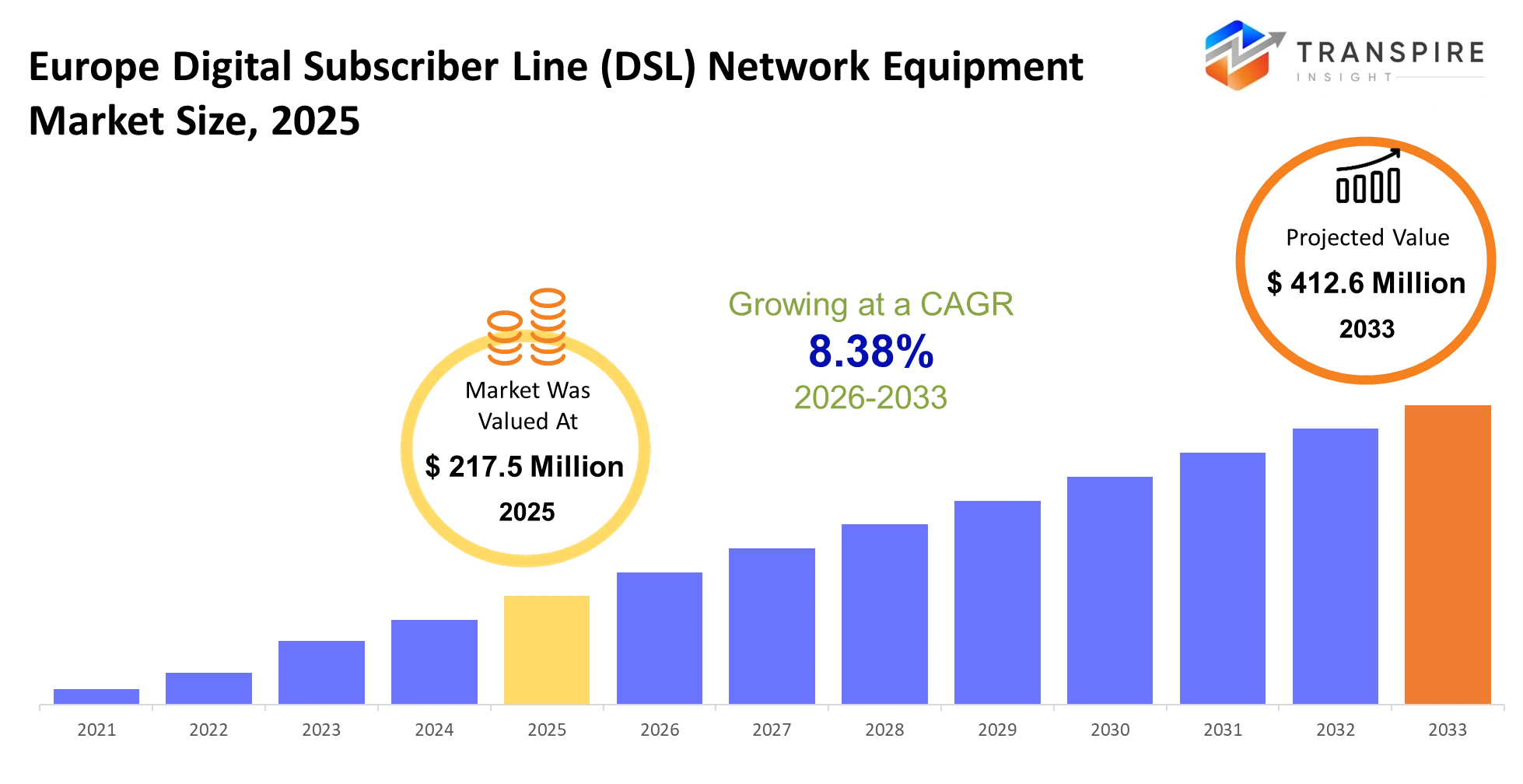
- Europe Digital Subscriber Line (DSL) Network Equipment Market Size 2025: USD 217.5 Million
- Europe Digital Subscriber Line (DSL) Network Equipment Market Size 2033: USD 412.6 Million
- Europe Digital Subscriber Line (DSL) Network Equipment Market CAGR: 8.38%
- Europe Digital Subscriber Line (DSL) Network Equipment Market Segments: By Type (ADSL Equipment, VDSL Equipment, G.fast Equipment, Others), By Application (Residential Broadband, Enterprise Networking, Telecom Infrastructure, Smart Homes, Others), By End-User (Telecom Operators, ISPs, Enterprises, Government, Residential Users, Others), By Technology (Copper-based DSL, Hybrid Fiber DSL, Vectoring Technology, Others).
To learn more about this report,  Download Free Sample Report
Europe Digital Subscriber Line (DSL) Network Equipment Market Summary:
The Europe Digital Subscriber Line (DSL) Network Equipment Market size is estimated at USD 217.5 Million in 2025 and is anticipated to reach USD 412.6 Million by 2033, growing at a CAGR of 8.38% from 2026 to 2033. The Europe Digital Subscriber Line (DSL) Network Equipment Market enables telecom operators to maintain internet service through existing copper networks which create broadband access in areas where double fiber installation remains too costly or difficult. The actual function of DSL equipment provides a connection between outdated last-mile networks and current bandwidth needs which require its use in both semi-urban and rural areas.
The period between 2018 and 2023 has seen fundamental changes through the development of hybrid access systems which combine DSL technology with fiber backhaul to enhance performance and extend system operational time. The need for this change became more important when remote work needs during the pandemic created problems with internet access in non-urban areas. The current approach of operators focuses on upgrading existing systems through vectoring and G.fast implementation instead of replacing entire networks.
The current situation maintains ongoing market significance. Vendors achieve financial benefits through their solutions which enable operators to increase bandwidth without incurring expensive capital costs while still achieving regulatory standards and customer performance requirements.
Key Market Insights
- The Europe Digital Subscriber Line (DSL) Network Equipment Market of 2024 shows Western Europe as its leading region because it possesses 55% of the market share which results from its extensive existing copper infrastructure.
- Eastern Europe will experience the fastest growth until 2030 because EU-funded broadband projects support the necessary improvements to affordable infrastructure.
- DSL access multiplexers (DSLAMs) hold the largest market share of more than 45% because service providers update their central office systems to support greater bandwidth transmission.
- The second largest market segment consists of customer premises equipment (CPE), which businesses need to replace their existing equipment while also upgrading their systems to current standards.
- G.fast technology serves as the fastest expanding market sector between 2023 and 2030 because it delivers gigabit internet through short copper wires.
- People use residential broadband for internet access purposes because it provides 65% of total usage in 2024, which businesses need to support remote work and home internet connection needs.
- The most rapidly expanding application segment within the market provides internet services to small and medium enterprises, which need dependable and affordable internet service for their operations in developing urban business areas.
- The Europe Digital Subscriber Line (DSL) Network Equipment Market remains under the control of telecom operators, who possess more than 70% market share because they hold ownership of the networks and must manage their system enhancements.
- Internet service providers (ISPs) represent the fastest-growing end-user category, leveraging DSL to expand last-mile coverage quickly.
What are the Key Drivers, Restraints, and Opportunities in the Europe Digital Subscriber Line (DSL) Network Equipment Market?
The Europe Digital Subscriber Line (DSL) Network Equipment Market experiences growth because the industry shifts to hybrid fiber-copper systems. The telecom operators established this movement because fiber deployment costs in low-density areas became unprofitable after 2020. They developed a new method to bring fiber to cabinets while applying vectoring and G.fast technology to upgrade their copper loop system. The system enables operators to boost their existing infrastructure revenue through direct bandwidth enhancements which require no major financial investments. Equipment vendors benefit from regular DSLAM upgrade orders which include advanced line technologies because these services create stable revenue streams that support ongoing network upgrades.
The most significant barrier is the structural decline of copper-based infrastructure. Many European countries have already committed to long-term fiber transition roadmaps which limits the lifespan of DSL investments. The issue requires extensive time to resolve because national broadband strategies and regulatory frameworks support fiber-first objectives. Operators who shut down their copper networks need to purchase less DSL equipment because they will stop using it. The situation prevents businesses from making major financial commitments while restricting market development because DSL services still function in specific areas.
The opportunity to grow exists through expanding rural broadband access in Eastern and Southern Europe. The combination of state-sponsored funding programs with government-supported connectivity goals establishes an environment where DSL upgrades become the most sensible temporary answer. Operators can achieve their speed objectives through the combination of fiber backhaul and G.fast technology which they implement in village clusters.
What Has the Impact of Artificial Intelligence Been on the Europe Digital Subscriber Line (DSL) Network Equipment Market?
The deployment and operation of DSL network equipment throughout Europe is undergoing continuous improvement through the combined efforts of artificial intelligence and advanced digital technologies. The operators use AI-driven automation solutions for their access networks to handle automatic line performance monitoring, automatic signal adjustment, and automatic traffic management without using manual procedures. The system performs continuous analysis of noise levels and interference patterns and bandwidth demand to enable real-time optimization of copper lines while decreasing service degradation in hybrid fiber-copper systems.
The DSL infrastructure uses machine learning models to create predictive maintenance capabilities. The models use historical fault data analysis together with live network conditions to predict equipment failures that will affect DSLAMs and customer premises devices before they cause service interruptions. The predictive capability enables operators to decrease system interruptions while preventing expensive emergency maintenance work. Telecom providers achieve better network uptime results and decreased operational costs because their optimized maintenance procedures require fewer field visits.
The AI-driven analytics system improves energy efficiency and capacity planning capabilities through its ability to predict usage patterns while controlling power consumption. The presentation of adoption challenges results from the complex nature of system integration requirements. The outdated DSL systems from the past do not work with current AI systems, which requires companies to spend large amounts of money on system upgrades that create implementation delays despite obvious advantages for their operations.
Key Market Trends
- Telecom operators have shifted their network construction methods from building complete fiber networks to using hybrid fiber-DSL systems which help them reduce their spending in areas with low population density.
- After 2022, G.fast technology became popular because operators could achieve nearly gigabit internet speeds through short copper connections which allowed them to extend their existing systems without needing complete system upgrades.
- Western Europe reduced its large-scale DSL investments by almost 20% since 2020 because of strong fiber deployment initiatives and regulatory requirements.
- Between 2021 and 2024 Eastern Europe increased its DSL upgrade budget by more than 25% because of EU broadband funding and rural connectivity requirements.
- Since 2022 vendors such as Nokia and Adtran have shifted their focus to software-defined access solutions which increase DSL network flexibility while decreasing operational expenses.
- After 2023, AI-based line optimization tools became available which helped operators decrease network faults by 30% through their capacity to manage real-time interference.
- Telecom operators have consolidated supplier bases since 2021, favoring end-to-end DSL solution providers to streamline deployment and maintenance.
- The equipment replacement cycle for customer premises equipment decreased from its previous period of 5 to 7 years to a new period of 3 to 5 years because companies needed to update their equipment to work with faster DSL technologies.
- The regulatory frameworks of Germany, France, and Italy have started to give more importance to fiber targets, which results in indirect restrictions on DSL equipment purchasing decisions.
Europe Digital Subscriber Line (DSL) Network Equipment Market Segmentation
By Type
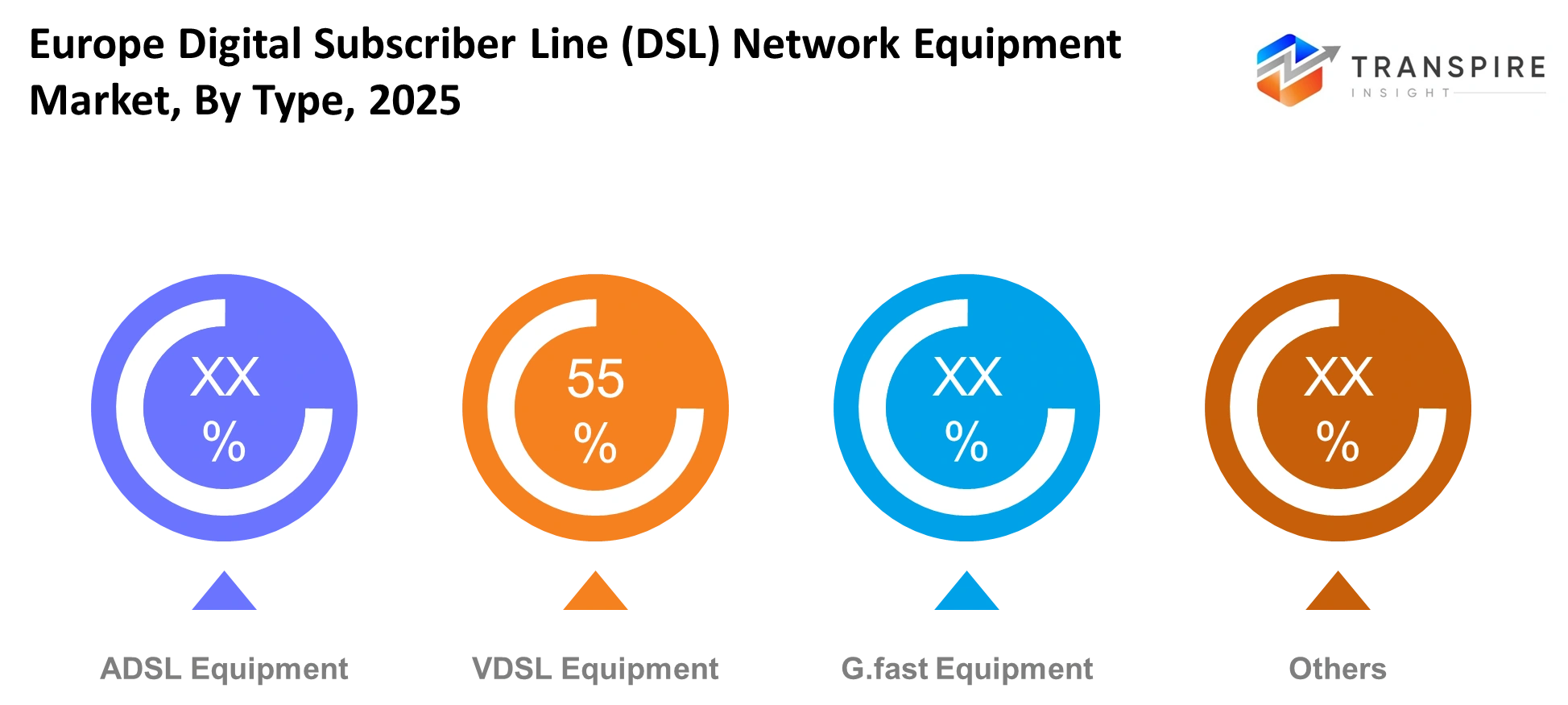
VDSL equipment currently dominates the market because it enables higher data transmission speeds through existing copper networks when compared to ADSL technology. Telecom operators prefer VDSL as their upgrade solution because it delivers better performance while staying within their budget constraints. ADSL equipment keeps losing market share in Western Europe because consumers demand more bandwidth and regulators introduce tighter requirements.
G.fast equipment is becoming more popular in urban areas that use short copper loops to deliver internet speeds that approach fiber-optic performance especially in multi-dwelling units. The organization implements this transition to improve equipment longevity while ensuring that equipment meets customer demands. Equipment vendors are aligning their product lines with high-speed variants which indicates that upcoming growth will focus on advanced DSL technologies instead of traditional systems.
To learn more about this report, Download Free Sample Report
By Application
The primary market for residential broadband services exists between urban and rural areas because people need stable home internet access. The pandemic of 2020 established remote work as a permanent practice, which created a need for DSL upgrades that deliver better last-mile performance without the need to rebuild entire networks. Small and medium enterprises use cost-efficient connectivity solutions to run their business operations, making enterprise networking the second-largest market segment.
The market for smart home applications will grow because connected devices require consistent internet bandwidth to function effectively. The usage patterns of applications will show that DSL provides essential practical connectivity functions, which customers use for their basic internet needs. The segment functions as an intermediate solution because dedicated system enhancements enable organizations to adapt their digital services, which digital consumption patterns require, without needing complete network system changes.
By End-User
Telecom operators maintain market dominance because they directly control access networks and must perform infrastructure improvements. The operators control procurement cycles while they select solutions which will enhance network durability and preserve operational performance. Internet service providers are growing their market power by using wholesale access systems to supply broadband internet service to areas with limited connectivity.
The dedicated fiber network in dedicated regions shows steady growth among enterprises and government users despite their smaller usage share. Users from residential areas create demand through their network usage which leads operators to enhance their network capabilities. The end-user landscape shows that major operators will keep control over decision-making while minor companies concentrate on specialized market deployment. The market operates with stable investment patterns which occur in specific areas throughout the entire market.
By Technology
The technology of hybrid fiber DSL establishes itself as the leading solution because it enables operators to create affordable high-speed Internet connections by using fiber backhaul and existing copper loops. The segment requires vectoring technology because it improves line performance through its capability to decrease interference. People abandon traditional copper-based DSL systems because they no longer meet current Internet usage demands. G.fast and enhanced vectoring serve as crucial elements for developing advanced technology solutions which will transform high-density use environments through their deployment. The current technological shift shows clear progress toward using complete existing systems before implementing fiber technology across the network. The market demands manufacturers to develop solutions which work with multiple systems through software-based functionality while investors consider hybrid models as temporary growth paths which will end at a specific point.
What are the Key Use Cases Driving the Europe Digital Subscriber Line (DSL) Network Equipment Market?
The primary application of residential broadband services exists in rural areas of France and Germany and Italy because their last-mile connectivity services depend on copper access technology. Telecom operators use DSL upgrades to achieve EU Digital Agenda speed requirements because they do not need to install complete fiber networks which allows them to maintain service operations at reduced expenses.
Small businesses and retail chains and public offices that function outside of fiber-rich areas are experiencing growth in enterprise connectivity services. Internet service providers employ DSL systems to provide dependable internet access which supports point-of-sale operations and cloud services and municipal functions throughout secondary cities and semi-urban areas.
The development of smart grid communication and connected home ecosystems represents a new emerging use case. Utilities are using DSL networks to test remote meter data transmission while smart home device integration is driving demand for continuous stable connections in regions with low fiber coverage.
|
Report Metrics |
Details |
|
Market size value in 2025 |
USD 217.5 Million |
|
Market size value in 2026 |
USD 234.9 Million |
|
Revenue forecast in 2033 |
USD 412.6 Million |
|
Growth rate |
CAGR of 8.38% from 2026 to 2033 |
|
Base year |
2025 |
|
Historical data |
2021 - 2024 |
|
Forecast period |
2026 - 2033 |
|
Report coverage |
Revenue forecast, competitive landscape, growth factors, and trends |
|
Regional scope |
Europe (Germany, United Kingdom, France, Italy, Spain and Rest of Europe) |
|
Key company profiled |
Huawei, Nokia, Ericsson, ZTE, Cisco, Juniper Networks, ADTRAN, Calix, Broadcom, Intel, Alcatel-Lucent, NEC, Fujitsu, D-Link, TP-Link. |
|
Customization scope |
Free report customization (country, regional & segment scope). Avail customized purchase options to meet your exact research needs. |
|
Report Segmentation |
By Type (ADSL Equipment, VDSL Equipment, G.fast Equipment, Others), By Application (Residential Broadband, Enterprise Networking, Telecom Infrastructure, Smart Homes, Others), By End-User (Telecom Operators, ISPs, Enterprises, Government, Residential Users, Others), By Technology (Copper-based DSL, Hybrid Fiber DSL, Vectoring Technology, Others). |
Which Regions are Driving the Europe Digital Subscriber Line (DSL) Network Equipment Market Growth?
The telecom infrastructure of Western Europe which has reached maturity along with its regulatory compliance for EU broadband standards results in Western Europe maintaining its top position. The governments of Germany and France together with the United Kingdom government have established minimum speed standards which require telecom operators to enhance their current copper infrastructure. The presence of extensive old network systems results in telecommunications companies needing to improve their DSL services instead of building entirely new systems. The region maintains its leadership position because existing companies provide advanced technology and there is a trained workforce and the government maintains steady industry regulations.
Southern Europe maintains its role as a reliable base which operates through equal funding methods and slow improvements of its network systems. Spain and Italy develop their service areas while they handle their restricted telecommunications financial resources. The region's operators choose to minimize expenses which makes DSL upgrades both functional and dependable for their systems. The digitalization process continues to advance in the economy which results in stable business growth that generates revenue for the entire market.
Eastern Europe experiences its most rapid development because of two factors which include new EU financial support programs and national initiatives to improve broadband access. Poland and Romania accelerated their infrastructure advancements after 2021 to establish internet connectivity in their rural regions. The new distribution system created strong demand for hybrid fiber DSL solutions which enable rapid and cost-effective installation. The region's current growth creates valuable business possibilities for vendors and investors who want to enter markets that majorly need development until the period of 2026 to 2033.
Who are the Key Players in the Europe Digital Subscriber Line (DSL) Network Equipment Market and How Do They Compete?
The European Digital Subscriber Line market for DSL network equipment has an intermediate level of competition because its major contracts are mainly held by a few large telecom companies. The existing companies use performance enhancements to maintain their market share because they need to demonstrate the continuing value of copper networks instead of using price competition as their main strategy. Companies compete in the market based on their technology abilities and how well their systems work with current operator networks. Buyers prefer vendors who provide hybrid fiber solutions because these vendors enable their customers to upgrade systems without creating additional operational challenges.
Nokia develops software-defined access technology together with advanced vectoring solutions which enhance line capacity for crowded network environments. The system enables service providers to achieve better performance through existing infrastructure while avoiding the need for complete hardware upgrades. Adtran offers cost-effective solutions to smaller telecommunications providers through its modular DSL systems which enable regional networks to function effectively. The company accelerates its market growth by forming alliances with local service providers which helps them reach unserved markets more efficiently.
Huawei and ZTE compete through cost-performance balance and strong presence in Eastern and Southern Europe. Both companies use their combined DSL and fiber and IP networking solutions to create integrated product packages which reduce procurement challenges for operators. Ericsson chooses its projects according to their business value because it prefers to work on IP network convergence and network transformation initiatives instead of only DSL equipment projects. The company uses its selected projects to support its access modernization objectives.
Company List
- Huawei
- Nokia
- Ericsson
- ZTE
- Cisco
- Juniper Networks
- ADTRAN
- Calix
- Broadcom
- Intel
- Alcatel-Lucent
- NEC
- Fujitsu
- D-Link
- TP-Link
Recent Development News
In April 2026, Openreach deploys recycled broadband equipment for fibre rollout: Openreach expanded its fibre rollout strategy using newly engineered optical network terminals made with recycled materials. The move reflects ongoing European operator efforts to retire DSL/copper infrastructure and modernize fixed broadband access networks.
Source: https://www.telecoms.com
In March 2026, Nokia launches next-generation optical networking products for AI: AI traffic and data centre interconnect (DCI) requirements are accelerating, exceeding the practical limits of approaches based solely on incremental improvements over previous generations, says Nokia.
Source: https://www.telecoms.com
What Strategic Insights Define the Future of the Europe Digital Subscriber Line (DSL) Network Equipment Market?
The Europe Digital Subscriber Line (DSL) Network Equipment Market is undergoing changes to its fundamental structure which results in its new function as a transitional component of hybrid access systems that use both fiber and selective copper improvement methods. Operators base their decisions on network lifespan maintenance because they want to achieve better capital efficiency in low-return areas instead of investing in complete fiber network expansions. The next five to seven years will see DSL used as a bridging technology which connects current systems with upcoming systems.
The enforcement of fiber policies will create less visible dangers for the system. When governments impose stricter deadlines for removing copper networks operators will begin their investments at faster rates which will result in an unexpected drop in demand for DSL equipment. The policy-driven shift will proceed faster than vendors can adjust which will result in unused inventory for their products.
The integration of software-defined access with DSL platforms presents a new business opportunity which Eastern Europe requires because network flexibility has become essential. Vendors that provide remote provisioning capabilities together with dynamic bandwidth allocation solutions will generate additional business benefits. Market participants should invest in interoperable software-centric solutions which enable DSL to connect with upcoming fiber migration routes instead of approaching it as an independent technology.
Europe Digital Subscriber Line (DSL) Network Equipment Market Report Segmentation
By Type
- ADSL Equipment
- VDSL Equipment
- G.fast Equipment
- Others
By Application
- Residential Broadband
- Enterprise Networking
- Telecom Infrastructure
- Smart Homes
- Others
By End-User
- Telecom Operators
- ISPs
- Enterprises
- Government
- Residential Users
- Others
By Technology
- Copper-based DSL
- Hybrid Fiber DSL
- Vectoring Technology
- Others
Frequently Asked Questions
Find quick answers to common questions.
The approximate Europe Digital Subscriber Line (DSL) Network Equipment Market size for the market will be USD 412.6 Million in 2033.
The key segments of the Europe Digital Subscriber Line (DSL) Network Equipment Market are By Type (ADSL Equipment, VDSL Equipment, G.fast Equipment, Others), By Application (Residential Broadband, Enterprise Networking, Telecom Infrastructure, Smart Homes, Others), By End-User (Telecom Operators, ISPs, Enterprises, Government, Residential Users, Others), By Technology (Copper-based DSL, Hybrid Fiber DSL, Vectoring Technology, Others).
Major players in the Europe Digital Subscriber Line (DSL) Network Equipment Market are Huawei, Nokia, Ericsson, ZTE, Cisco, Juniper Networks, ADTRAN, Calix, Broadcom, Intel, Alcatel-Lucent, NEC, Fujitsu, D-Link, TP-Link.
The current market size of the Europe Digital Subscriber Line (DSL) Network Equipment Market is USD 217.5 Million in 2025.
The Europe Digital Subscriber Line (DSL) Network Equipment Market CAGR is 8.38%.
- Huawei
- Nokia
- Ericsson
- ZTE
- Cisco
- Juniper Networks
- ADTRAN
- Calix
- Broadcom
- Intel
- Alcatel-Lucent
- NEC
- Fujitsu
- D-Link
- TP-Link
Recently Published Reports
-
Apr 2026
3D Optical Profiler Market
3D Optical Profiler Market Size, Share & Analysis Report By Type (Desktop 3D Optical Profiler, and Portable 3D Optical Profiler), By Technology (Confocal Technology, and White Light Interference), By End-Use Industry (Manufacturing, Research Institutions, Automotive, Aerospace and Defense, Medical Devices, and Other), and Geography (North America, Europe, Asia-Pacific, Middle East and Africa, South and Central America), 2021 - 2031
-
Apr 2026
Depth Sensor Market
Depth Sensor Market Size, Share & Analysis Report By Type (Infrared Depth Sensors, Time-of-Flight (ToF) Sensors, Stereo Vision Sensors, Structured Light Sensors, Ultrasonic Depth Sensors), By Application (Automotive, Robotics, Gaming, Consumer Electronics, Industrial Automation, Healthcare, Security & Surveillance, Others), By End Users (Automotive Manufacturers, Consumer Electronics Companies, Healthcare Providers, Industrial Companies, Security Agencies, Gaming Companies, Robotics Companies, Others), and Geography (North America, Europe, Asia-Pacific, Middle East and Africa, South and Central America), 2021 – 2031
-
Apr 2026
Digital Manufacturing Market
Digital Manufacturing Market Size, Share & Analysis Report By Component (Hardware, Software, and Services), By Technology (Robotics, 3D Printing, Internet of Things (IoT), and Others), By Application (Automotive and Transportation, Aerospace and Defense, Consumer Electronics, Industrial Machinery, and Others), By Process Type (Computer-Based Designing, Computer-Based Simulation, Computer 3D Visualization, Analytics, and Others), and Geography (North America, Europe, Asia-Pacific, Middle East and Africa, South and Central America), 2021 – 2031
-
Apr 2026
Digital Visa Services Market
Digital Visa Services Market Size, Share & Analysis Report By Type (Individual Travelers, Group Travelers), By Application (Tourism, Business Travel, Others), and Geography (North America, Europe, Asia-Pacific, Middle East and Africa, South and Central America), 2021 – 2031