
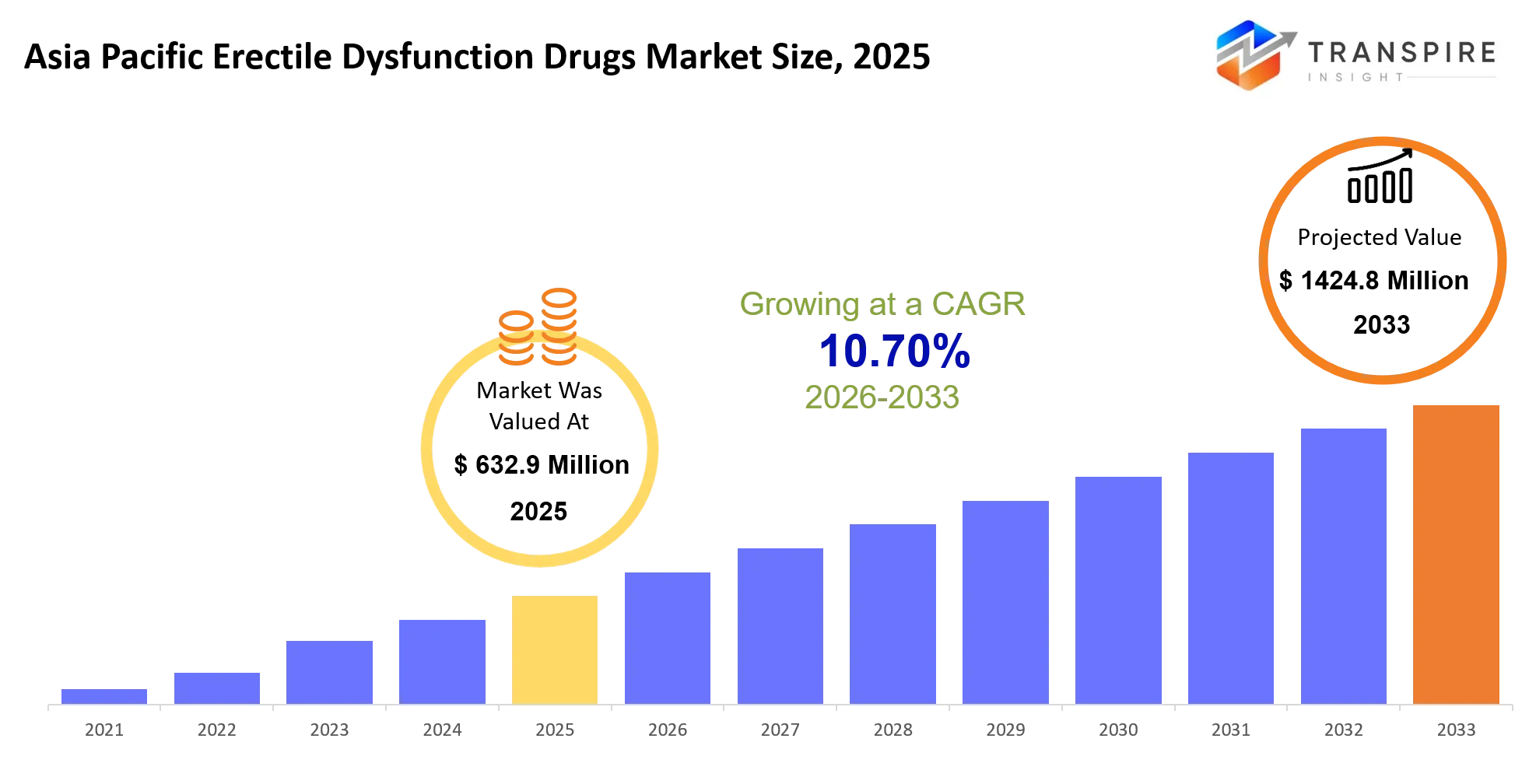
Asia Pacific Erectile Dysfunction Drugs Market Size & Forecast:
- Asia Pacific Erectile Dysfunction Drugs Market Size 2025: USD 632.9 Million
- Asia Pacific Erectile Dysfunction Drugs Market Size 2033: USD 1424.8 Million
- Asia Pacific Erectile Dysfunction Drugs Market CAGR: 10.70%
- Asia Pacific Erectile Dysfunction Drugs Market Segments: By Drug Type (Sildenafil, Tadalafil, Vardenafil, Avanafil, Others); By Distribution Channel (Hospital Pharmacies, Retail Pharmacies, Online Pharmacies, Others); By Application (Erectile Dysfunction Treatment, Pulmonary Arterial Hypertension, Others); By End User (Hospitals, Clinics, Homecare Patients, Others)
To learn more about this report,  Download Free Sample Report
Asia Pacific Erectile Dysfunction Drugs Market Summary
The Asia Pacific Erectile Dysfunction Drugs Market was valued at USD 632.9 Million in 2025. It is forecast to reach USD 1424.8 Million by 2033. That is a CAGR of 10.70% over the period.
The Asia Pacific erectile dysfunction drugs market , kind of tackles a very real health issue, by helping men cope with erectile dysfunction, a condition that can quietly disturb quality of life, mental balance and even intimate bonds. In day to day terms, these therapies back better sexual function and now they’re more and more blended into wider men’s wellness plans, not only in hospitals or specialty clinics, but also through telehealth channels, plus retail pharmacy networks.
In the past three to five years, the market has been shifting in a noticeable way from more “just treat it” prescribing, toward longer term sexual wellness and digital care delivery. Online consultations, e-pharmacies, and discreet care routes have widened access, especially across major cities. One big reason that really sped this up was the COVID-19 pandemic , which basically made telemedicine and remote prescriptions feel normal across multiple Asia Pacific countries. Because of that, the usual hurdles tied to stigma and limited specialist reach got smaller.
Now, as health systems keep digitizing, and populations age, more patients are getting into the treatment group earlier, then staying engaged with therapy for longer. That trend is showing up as stronger prescription volumes, deeper product reach across different channels, and better revenue openings for pharmaceutical companies working in the region.
Key Market Insights
- China is basically calling the shots in the Asia Pacific Erectile Dysfunction Drugs Market, sitting on roughly 35% of the regional revenue, mainly because there is a huge patient pool and the healthcare infrastructure is pretty well developed.
- In 2025, PDE5 inhibitors kinda dominate the picture , with over 70% share, and that is backed by solid clinical results plus a physician preference that stays strong.
- Then there are Sildenafil-based products, they take the second spot, mostly thanks to broad availability and the fact that cost-effective generic alternatives are easy to find.
- Meanwhile Tadalafil-based therapies are showing the fastest momentum all the way through 2032, helped by their longer duration of action and an increasing patient inclination toward them, more and more.
- Generic erectile dysfunction drugs are still gaining ground too, as patent expirations keep improving affordability across Asia Pacific markets.
- When it comes to applications, erectile dysfunction treatment takes up more than 80% of market revenue, so in 2025 it’s clearly the most dominant application segment.
- Also, age-related erectile dysfunction treatment is still a big revenue driver because demographics are shifting across the more developed Asian economies.
- For the fastest-growing application angle, lifestyle-related erectile dysfunction management is rising quicker, mainly because obesity and diabetes prevalence keep moving upward.
- At the same time, digital consultation-linked prescriptions are opening up fresh growth avenues in urban and semi-urban settings.
- Finally, retail pharmacies lead the Asia Pacific Erectile Dysfunction Drugs Market with about 45% market share, and that is supported by extensive distribution networks, which is kind of the whole point.
What are the Key Drivers, Restraints, and Opportunities in the Asia Pacific Erectile Dysfunction Drugs Market?
The strongest force driving the Asia Pacific Erectile Dysfunction Drugs Market is, kind of oddly enough, the rapid expansion of digital healthcare infrastructure. A lot of people have taken to telemedicine and e-pharmacy platforms, especially after the COVID-19 pandemic, and that seems to have knocked down one of the biggest hurdles to getting treated: the need for face to face consultations for something sensitive. In China, India, and Australia, governments alongside healthcare providers expanded these digital health services, so diagnosis happens faster, and prescriptions get filled more quickly. With all that, patient involvement went up, the continuity of therapy improved, and prescription volumes rose , which supports market revenue growth in a pretty direct way.
That said, social stigma around sexual health is still the most stubborn structural barrier to market expansion. In many Asia Pacific countries, cultural expectations don’t really encourage open talk about erectile dysfunction, so a lot of men tend to delay, or just quietly skip, medical care. And unlike issues such as pricing or distribution bottlenecks, these cultural views don’t change overnight; they need a longer runway, usually through better health messaging and gradual shifts in patient behavior. So even though the demand might be there, a noticeable slice of the addressable patient population stays untreated, and that drags down diagnosis rates while also restraining potential pharmaceutical sales.
The next stage of growth is probably going to come from integrated men's health platforms that blend erectile dysfunction care with ongoing disease tracking. Erectile dysfunction is often connected with diabetes, heart disease, and obesity, and these things seem to be showing up more often across Asia Pacific lately. Doctors, and clinics in India and some parts of Southeast Asia are now putting more and more budget into digital platforms that basically run screening, consultation, and medication delivery all through one single channel, you know. On paper this model may catch patients who were never treated before, and it can also expand reach beyond only the largest city areas, so over time it may support a more sustainable treatment market.
What Has the Impact of Artificial Intelligence Been on the Asia Pacific Erectile Dysfunction Drugs Market?
Artificial intelligence plus newer digital tools are also slowly reshaping the Asia Pacific Erectile Dysfunction Drugs Market, mainly because they assist with patient identification, make the whole treatment experience feel more tailored, and then they help tune commercial operations too. A lot of pharmaceutical companies, as well as digital health providers, are now leaning on AI-enabled platforms that automate patient screening , prescription steps, and even telehealth consultations. For example, natural language processing can read patient-reported symptoms alongside medical histories, which in turn helps clinicians spot potential candidates for erectile dysfunction treatment more quickly, without as much manual effort.
On top of that, machine learning models are giving stronger predictive power across the whole value chain. In practice, healthcare organizations use predictive analytics to find groups that appear more likely to face erectile dysfunction, based on things like diabetes, cardiovascular disease, obesity, and age. Those insights, in general, enable earlier intervention and can also boost how consistently patients follow through with treatment. Meanwhile, drug manufacturers are applying AI in order to forecast prescription demand, adjust inventory planning more accurately, and cut down supply chain friction across the many Asia Pacific markets where conditions, channels, and demand patterns can vary.
The operational advantages are getting easier to measure. AI-driven patient engagement platforms can lift follow-up rates, reinforce medication adherence, and lower the chances of prescription abandonment. At the same time, digital prescribing systems improve regulatory alignment and streamline pharmacy fulfillment, which often leads to reduced paperwork overhead. As a result, patient access tends to improve, at least in many of these deployments.
Key Market Trends
- Since 2020, telemedicine platforms across India, China, and Australia have been expanding erectile dysfunction consultations, which has helped reduce the usual treatment barriers and somehow boosted prescription conversion rates a lot.
- After patent expirations, generic sildenafil uptake seemed to speed up fast , and competition then tilted away from brand differentiation and more toward pricing, practical accessibility, and pharmacy distribution strength.
- Between 2021 and 2025, online pharmacy channels picked up even more share. Consumers basically started valuing privacy , convenience, and those home delivery services more than before, so the shift was pretty clear.
- Pharmaceutical firms also moved beyond “standalone” erectile dysfunction therapies, now linking treatment pathways with diabetes and cardiovascular disease management programs, not just pitching one isolated product.
- Over the past five years, tadalafil prescriptions kept climbing steadily. A big reason is that physicians seem to prefer longer-duration options, because they give patients more flexibility during real life routines and schedules.
- Meanwhile, regional manufacturers strengthened local production capabilities after pandemic related supply problems. Those disruptions made the dependence on imported active pharmaceutical ingredients feel pretty obvious.
- Digital health providers are increasingly rolling out AI driven patient screening tools, this shortens consultation time, and it also improves the way eligible treatment candidates get identified.
- Since 2022, companies like Pfizer, Viatris, and Sun Pharmaceutical have broadened digital engagement strategies too, focusing on patient retention and adherence, even when the customer journey spans months.
- Regulatory authorities in several Asia Pacific countries have increased oversight of online medicine sales, and that has lowered counterfeit circulation within licensed channels.
- Urban markets are maturing , at the same time Southeast Asian countries have started showing up as major expansion targets. The reason is improving healthcare access alongside better digital infrastructure, which makes adoption easier.
Asia Pacific Erectile Dysfunction Drugs Market Segmentation
By Drug Type :
Sildenafil is still one of the most broadly prescribed drug types in the Asia Pacific Erectile Dysfunction Drugs Market, mainly because it has an established clinical track record and a lot of physician comfort with it. There’s also a big layer of generic availability, so overall market take up stays pretty strong, especially since cheaper substitutes have widened access across both high income and fast growing healthcare environments, kind of all at once.
Tadalafil keeps getting more attention too, because it tends to last longer with therapeutic effects, which basically gives patients more flexibility about when they take it. Vardenafil and Avanafil sort of slot into more specific needs, where the way someone responds, how quickly it starts working, or how well it’s tolerated can be different. The other category is more of a mix, covering alternative formulations and some niche therapies that are aimed at specialized treatment situations in the market.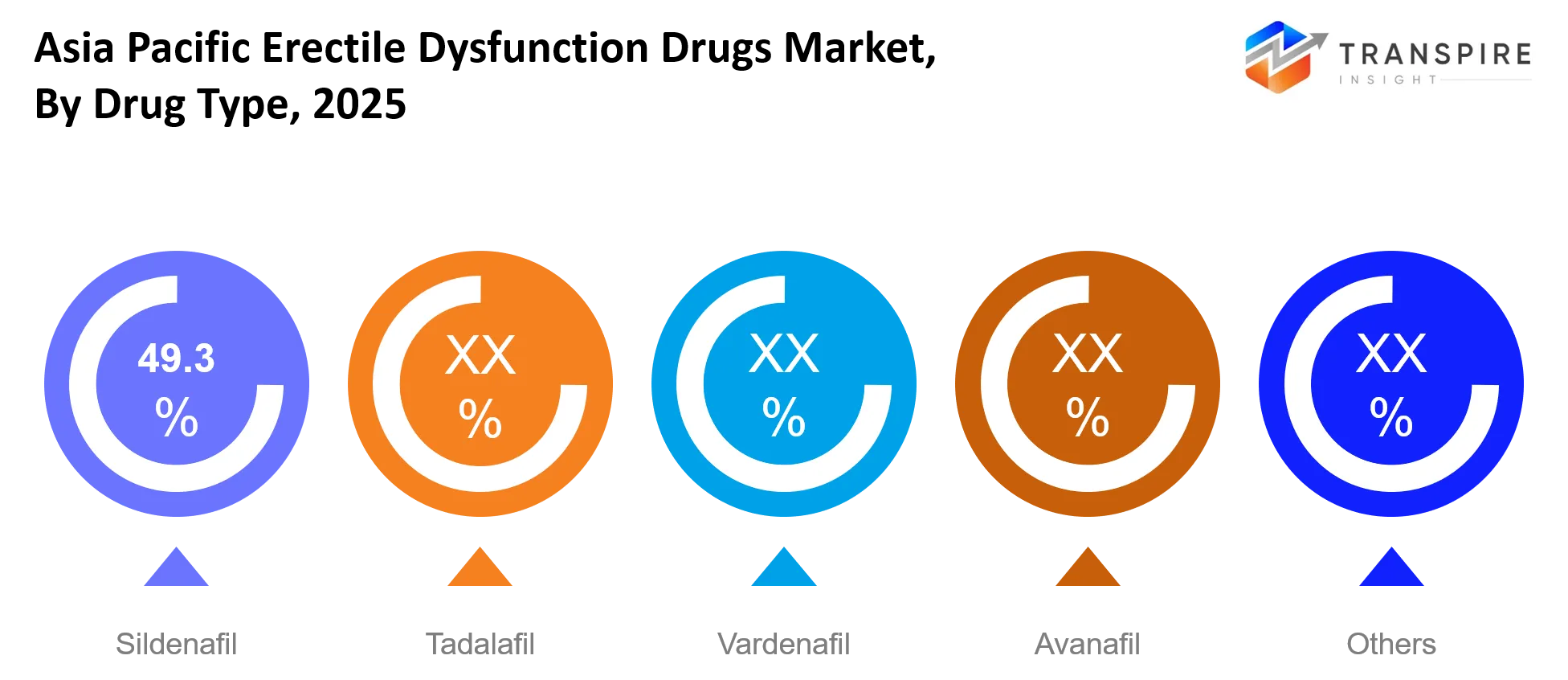
To learn more about this report, Download Free Sample Report
By Distribution Channel :
Hospital pharmacies matter a lot for supplying prescription erectile dysfunction medications, especially around specialist consultations and when treatment is first started. With strong physician supervision and better access to broader healthcare services, this channel stays important in many large facilities.
Retail pharmacies hold a strong position as well, mainly due to wide geographic coverage and easy medication pickup. Online pharmacies are also still growing across the region, since digital healthcare adoption keeps increasing. And the other segment includes other distribution pathways plus specialty healthcare providers, that help keep medication availability consistent in specific markets where access may be more uneven.
By Application :
Erectile dysfunction treatment still seems like the main application segment, it takes up most of the prescriptions too, and it brings in the majority of the revenue. What also matters is that sexual health management is getting bundled more often into broader healthcare services, so the app’s role feels stronger across the Asia Pacific region.
Pulmonary arterial hypertension shows up as another therapeutic application for some drugs in this category. This one opens up chances that go beyond sexual health treatment, and it gives the whole space some extra reach. Then there’s the other segment which covers approved and still-emerging uses where similar pharmacological mechanisms can offer clinical benefits in particular medical conditions, or in specific care settings.
By End User :
Hospitals remain a major end user segment because they usually have the diagnostic tools, the specialists, and the more structured pathways for treatment , all of which makes patient management easier. Big healthcare institutions often become the first destination for diagnosis and prescription ,especially for people who are looking for help.
Clinics help a lot as well, mainly through outpatient consultations and ongoing monitoring. Homecare patients are also becoming more visible , largely because telemedicine keeps expanding. Add digital prescriptions and online pharmacy access into the mix and you get a steady growth trend. The other category includes specialty care centers and other alternative care environments, they support treatment delivery across different groups of patients.
What are the Key Use Cases Driving the Asia Pacific Erectile Dysfunction Drugs Market?
The main reason behind adoption in the Asia Pacific Erectile Dysfunction Drugs Market is pretty much the treatment of erectile dysfunction among grown up ,and aging male groups. This kind of application creates the most pull in the market because it tackles a frequent medical issue that tends to show up alongside diabetes, cardiovascular disorders, obesity, and general age related health changes. Ongoing prescribing coming from hospitals, clinics, and retail pharmacies keeps feeding the market growth, even when demand shifts a bit.
There are also secondary applications that are starting to gain momentum in pulmonary arterial hypertension care, where certain drugs are used to support blood flow and lower the pressure inside pulmonary arteries. Specialist hospitals and cardiovascular treatment centers are gradually folding these therapies into wider care plans, so prescription demand doesn’t just rely on erectile dysfunction alone.
Meanwhile, emerging use cases are taking shape through integrated men’s health platforms. These platforms kinda bundle erectile dysfunction treatment together with metabolic and cardiovascular risk evaluations. At the same time digital healthcare providers are experimenting with tailored treatment routes, backed by telemedicine along with remote monitoring instruments. This is still early, but it looks promising since healthcare systems across Asia Pacific are moving toward connected care models, at a faster pace than before.
|
Report Metrics |
Details |
|
Market size value in 2025 |
USD 632.9 Million |
|
Market size value in 2026 |
USD 699.4 Million |
|
Revenue forecast in 2033 |
USD 1424.8 Million |
|
Growth rate |
CAGR of 10.70% from 2026 to 2033 |
|
Base year |
2025 |
|
Historical data |
2021 - 2024 |
|
Forecast period |
2026 - 2033 |
|
Report coverage |
Revenue forecast, competitive landscape, growth factors, and trends |
|
Regional scope |
Asia Pacific (India, China, Japan, Australia,South Korea, Rest of Asia Pacific) |
|
Key company profiled |
Pfizer, Eli Lilly, Bayer, Sanofi, Teva Pharmaceutical, Cipla, Sun Pharma, Dr. Reddy’s, Lupin, Viatris, Glenmark, Zydus Lifesciences, Johnson & Johnson, Abbott, GSK |
|
Customization scope |
Free report customization (country, regional & segment scope). Avail customized purchase options to meet your exact research needs. |
|
Report Segmentation |
By Drug Type (Sildenafil, Tadalafil, Vardenafil, Avanafil, Others); By Distribution Channel (Hospital Pharmacies, Retail Pharmacies, Online Pharmacies, Others); By Application (Erectile Dysfunction Treatment, Pulmonary Arterial Hypertension, Others); By End User (Hospitals, Clinics, Homecare Patients, Others) |
Which Regions are Driving the Asia Pacific Erectile Dysfunction Drugs Market Growth?
China kind of represents the leading market across the Asia Pacific Erectile Dysfunction Drugs Market. The leadership comes from a big patient base, expanding healthcare coverage, and the strong availability of branded and generic therapies at the same time. Also, digital health policies have helped telemedicine really take off, so men can get treated in more places, including not only major cities but also secondary ones. Plus there’s a solid pharmaceutical manufacturing base, wide pharmacy networks, and steady investment into men’s health services, which all keeps reinforcing that market dominance, in a very direct way.
Japan sits as the second-largest regional market, yet the drivers are a bit different compared with China. The healthcare system is already quite mature, and treatment adherence tends to stay high, while physicians remain consistently engaged, which makes the prescription drug environment more stable overall. There’s also an aging population, giving a sort of predictable patient flow. On top of that, strict regulatory standards help keep confidence strong in the therapies that are approved. With long-term healthcare spending and well established reimbursement structures, Japan keeps acting as a dependable contributor to regional revenue.
India, meanwhile, is emerging as the fastest-growing market in the region. Telehealth services are expanding quickly, online pharmacies are getting deeper market penetration, and overall access to care is improving, so treatment patterns have shifted in recent years. More affordable generic medications are becoming available, and that has widened access beyond just major metropolitan areas, encouraging earlier treatment seeking as well. From 2026 to 2033, this momentum should generate substantial opportunities for pharmaceutical manufacturers, digital healthcare providers, and investors who are specifically looking for high-growth markets.
Who are the Key Players in the Asia Pacific Erectile Dysfunction Drugs Market and How Do They Compete?
Competition in the Asia Pacific Erectile Dysfunction Drugs Market is sort of moderately fragmented, with multinational pharma firms going head to head alongside regional generic drug manufacturers. Market share seems to depend not so much on fancy technology differentiation but more on pricing strategy, product availability, distribution reach, and how well companies tap into digital healthcare channels. The established brands still defend their place using physician trust and clinical recognition, while generic suppliers push back with lower-cost alternatives. And as telemedicine as well as e-pharmacy platforms keep expanding, service accessibility and day to day patient convenience are turning into more and more important competitive factors.
Pfizer stands out based on long-standing market recognition of sildenafil-based therapies, plus a large body of clinical evidence that backs product use. It keeps competitive strength through brand credibility, physician engagement programs, and partnerships that help boost treatment access through digital healthcare ecosystems. Eli Lilly leans on tadalafil-based products, and that longer-duration treatment effect appeals to a lot of patients who want more flexibility. Ongoing growth of men’s health initiatives and broader patient support efforts also helps keep the company visible across key Asia Pacific countries.
Viatris kind of competes using big generic manufacturing capabilities plus those broad distribution networks, that help maintain affordable treatment access. Because of cost efficiency, they can push further into price-sensitive areas where generic adoption keeps rising. Sun Pharmaceutical Industries then leans on solid regional manufacturing infrastructure and really deep penetration across India and nearby markets. Dr. Reddy's Laboratories emphasizes expanding the generic portfolio and also tightening up pharmacy partnerships, which gives them wider reach, while still covering the need for accessible therapies that are competitively priced.
Company List
- Pfize
- Eli Lilly
- Bayer
- Sanofi
- Teva Pharmaceutical
- Cipla
- Sun Pharma
- Dr. Reddy’s
- Lupin
- Viatris
- Glenmark
- Zydus Lifesciences
- Johnson & Johnson
- Abbott
- GSK
Recent Development News
In March 2026, Zuellig Pharma announced the acquisition of Cialis® (tadalafil) rights from Eli Lilly and Company in Hong Kong, Macau, and South Korea. The deal expanded Zuellig Pharma’s ownership of the erectile dysfunction brand to 11 Asian markets, strengthening regional access to a leading ED therapy and reinforcing its men's health portfolio.
Source https://www.media-outreach.vn/
In July 2025, Dalian Sky Pharma received approval for Taituotuo® (tunodafil hydrochloride tablets), a Class 1 innovative anti-erectile dysfunction drug in China. The approval added another novel PDE5 inhibitor to the Chinese ED treatment market, broadening therapeutic choices and supporting continued innovation in erectile dysfunction care across Asia Pacific.
Source https://www.dlskypharma.com/
What Strategic Insights Define the Future of the Asia Pacific Erectile Dysfunction Drugs Market?
The Asia Pacific Erectile Dysfunction Drugs Market seems to be shifting toward a more connected men’s health ecosystem, instead of staying as just a standalone pharmaceutical segment. Over the next five to seven years, growth is probably going to be steered more and more by the overlap of digital healthcare, long term chronic disease support, and personalized treatment routes. As clinicians start linking erectile dysfunction screening with diabetes programs, cardiovascular initiatives, and metabolic health follow ups, the rate of identifying patients, plus their long term participation in therapy, is likely to rise quite noticeably
There is also a quieter kind of risk, which is the tightening of competition around low-cost generic products. Even though generics do expand access, the continuing price pressure may end up shrinking margins, weakening the will to distinguish products, and cutting back on investment in new formulations or patient-support services. This effect could get stronger in fiercely competitive places like India and China.
On the flip side, there’s an emerging chance tied to AI-enabled digital men’s health platforms across Southeast Asia. Better telehealth rules, and higher smartphone usage, are making it easier to roll out scalable, data driven care approaches. Market players should focus on collaborations with telemedicine providers and digital pharmacy networks, because the control over how patients get to care channels, may end up mattering just as much as product ownership in determining future market share.
Asia Pacific Erectile Dysfunction Drugs Market Report Segmentation
By Drug Type
- Sildenafil
- Tadalafil
- Vardenafil
- Avanafil
By Distribution Channel
- Hospital Pharmacies
- Retail Pharmacies
- Online Pharmacies
By Application
- Erectile Dysfunction Treatment
- Pulmonary Arterial Hypertension
By End User
- Hospitals
- Clinics
- Homecare Patients
Frequently Asked Questions
Find quick answers to common questions.
The Asia Pacific Erectile Dysfunction Drugs Market size is USD 1424.8 Million in 2033.
Key Segments for the Asia Pacific Erectile Dysfunction Drugs Market are By Drug Type (Sildenafil, Tadalafil, Vardenafil, Avanafil, Others); By Distribution Channel (Hospital Pharmacies, Retail Pharmacies, Online Pharmacies, Others); By Application (Erectile Dysfunction Treatment, Pulmonary Arterial Hypertension, Others); By End User (Hospitals, Clinics, Homecare Patients, Others).
Major Asia Pacific Erectile Dysfunction Drugs Market Players are Pfizer, Eli Lilly, Bayer, Sanofi, Teva Pharmaceutical, Cipla, Sun Pharma, Dr. Reddy’s, Lupin, Viatris, Glenmark, Zydus Lifesciences, Johnson & Johnson, Abbott, GSK.
The Asia Pacific Erectile Dysfunction Drugs Market size is USD 632.9 Million in 2025.
The Asia Pacific Erectile Dysfunction Drugs Market CAGR is 10.70% from 2026 to 2033.
- Pfize
- Eli Lilly
- Bayer
- Sanofi
- Teva Pharmaceutical
- Cipla
- Sun Pharma
- Dr. Reddy’s
- Lupin
- Viatris
- Glenmark
- Zydus Lifesciences
- Johnson & Johnson
- Abbott
- GSK
About the Authors

Pankaj Ghogare Patil
I am Pankaj Ghogare Patil, a Senior Research Analyst at Transpire Insight, specializing in the Pharmaceutical, Chemicals & Materials, Healthcare IT, and Biotechnology industry. My expertise lies in conducting comprehensive market research, analyzing industry trends, evaluating competitive landscapes, and translating complex data into actionable insights. At Transpire Insight, I closely follow emerging technologies, regulatory developments, and market innovations to create accurate, well-researched, and informative content that helps businesses and professionals make informed decisions. I am committed to producing credible, evidence-based articles that reflect industry best practices while making technical topics accessible and valuable for a broad audience.

Chakradhar Khansole
Chakradhar serves as the Research Director at Transpire Insight, bringing over 8 years of experience in technology, innovation, and strategic market intelligence. He specializes in transforming complex market data into actionable business insights that enable organizations to make informed, growth-oriented decisions. Recognized for his strategic vision and analytical expertise, Chakradhar leads high-impact research initiatives, delivering comprehensive market assessments, competitive intelligence, and forward-looking industry analysis.
Recently Published Reports
-
Jul 2026
Alopecia Treatment Market
Alopecia Treatment Market Size, Share & Analysis Report By Disease Type (Alopecia Areata, Cicatricial Alopecia, Traction Alopecia, Alopecia Totalis, Androgenetic Alopecia, Alopecia Universalis, and Other Disease Types), By Treatment Type (Topical Treatments, Oral Medications, Injectable Therapies, and Hair Transplantation), By Gender (Male, and Female), By Distribution Channel (Hospitals and Clinics, Retail Pharmacies, and Online Retailers), and Geography (North America, Europe, Asia-Pacific, Middle East and Africa, South and Central America), 2021 - 2031
-
Jul 2026
Medical Ultrasound Probe Market
Medical Ultrasound Probe Market Size, Share & Analysis Report By Type (Linear Type, Convex Type, Endocavitary Probe, Phased Array/Cardiac Probe, Transesophageal (TEE) Probe, and Others), By Application (Ophthalmology, Cardiology, Musculoskeletal, Oncology, Obstetrics & Gynecology, General Imaging, and Others), By End User (Hospitals & Clinics, Diagnostic Centers, Ambulatory Surgical Centers, and Others), and Geography (North America, Europe, Asia-Pacific, Middle East and Africa, South and Central America), 2021 – 2031
-
May 2026
Biosimilars Market
Biosimilars Market By Product Type (Monoclonal Antibodies, Recombinant Hormones, Erythropoietin, G-CSF, Others), By Indication (Oncology, Autoimmune Diseases, Blood Disorders, Diabetes, Others), By Manufacturing Type (In-House Manufacturing, Contract Manufacturing), By Distribution Channel (Hospital Pharmacies, Retail Pharmacies, Online Pharmacies), By Industry Analysis, Size, Share, Growth, Trends, and Forecasts 2021-2033
-
Apr 2026
Gastrointestinal Endoscopy Market
Gastrointestinal Endoscopy Market By Type (Rigid Gastrointestinal Endoscope, Flexible Gastrointestinal Endoscopes, Disposable Gastrointestinal Endoscope), By Procedure Type (Colonoscopy, Gastroscopy, Duodenoscopy, Enteroscopy, Flexible Sigmoidoscopy, Others), By Application (Diagnosis, Treatment), By End-Users (Hospitals, Ambulatory Surgical Centers, Specialty Clinics, Laboratories, Others), By Industry Analysis, Size, Share, Growth, Trends, and Forecasts 2021-2033