
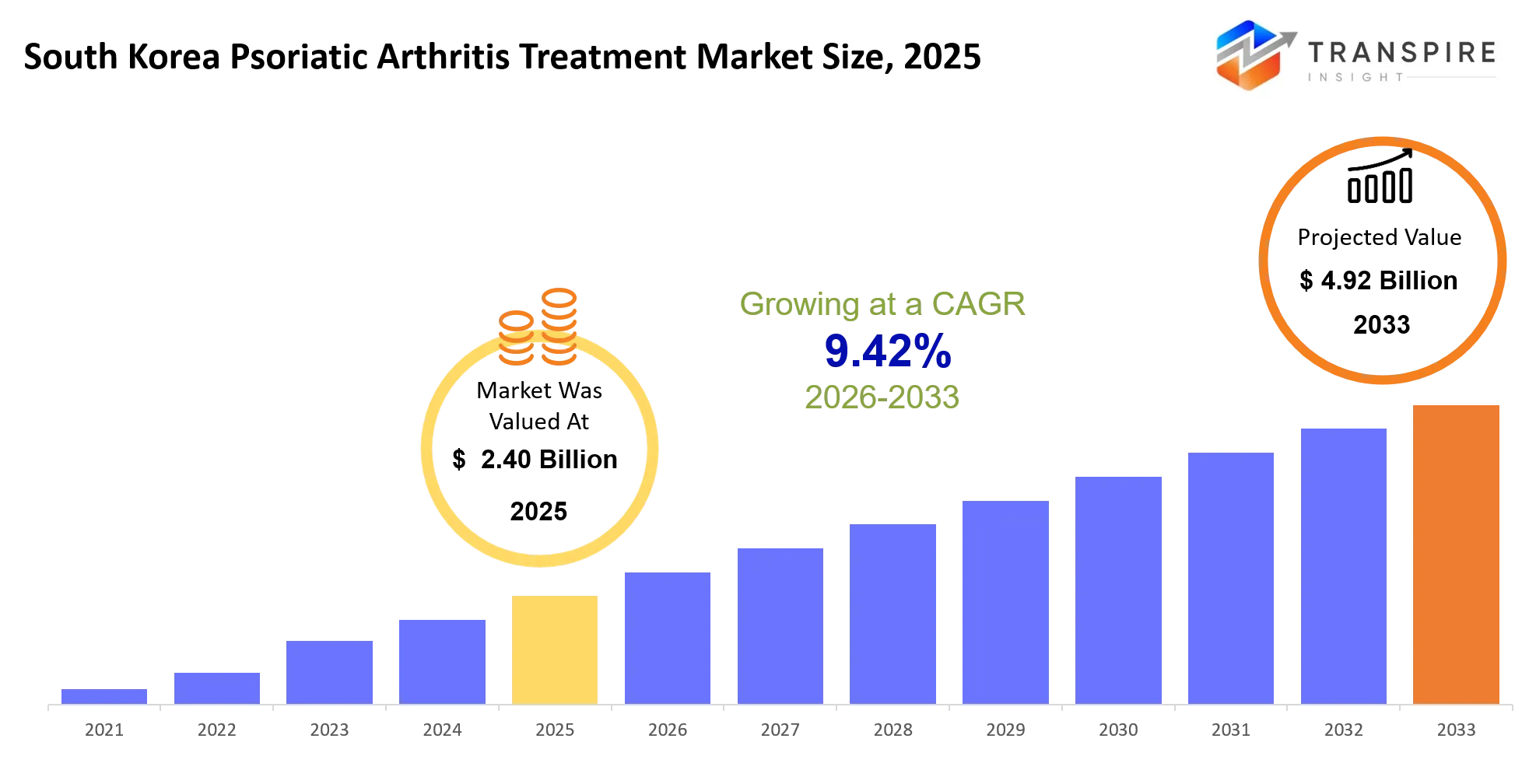
South Korea Psoriatic Arthritis Treatment Market Size & Forecast:
- South Korea Psoriatic Arthritis Treatment Market Size 2025: USD 2.40 Billion
- South Korea Psoriatic Arthritis Treatment Market Size 2033: USD 4.92 Billion
- South Korea Psoriatic Arthritis Treatment Market CAGR: 9.42%
- South Korea Psoriatic Arthritis Treatment Market Segments: By Treatment Type (Biologic Drugs, Nonsteroidal Anti-inflammatory Drugs, DMARDs, Corticosteroids, Others); By Drug Class (TNF Inhibitors, IL-17 Inhibitors, JAK Inhibitors, PDE4 Inhibitors, Others); By Application (Mild Psoriatic Arthritis, Moderate Psoriatic Arthritis, Severe Psoriatic Arthritis, Others); By Distribution Channel (Hospital Pharmacies, Retail Pharmacies, Online Pharmacies, Others); By End User (Hospitals, Specialty Clinics, Home Care Settings, Others)
To learn more about this report,  Download Free Sample Report
South Korea Psoriatic Arthritis Treatment Market Summary
The South Korea Psoriatic Arthritis Treatment Market was valued at USD 2.40 Billion in 2025. It is forecast to reach USD 4.92 Billion by 2033. That is a CAGR of 9.42% over the period.
The South Korea Psoriatic Arthritis Treatment Market works a bit like a specialized healthcare ecosystem that deals with chronic autoimmune joint inflammation, helping people lower pain, stop irreversible joint damage from stacking up , and stay mobile over the long run via biologics, targeted synthetic drugs, and advanced specialty care pathways. In day to day practice, it links rheumatology clinics , hospital infusion centers, and specialty pharmacies together so patients can get ongoing, long-duration therapy, not just a one-time course.
Over the last 3–5 years, the whole market has been shifting in a more structural way toward biologic-first treatment protocols, and it’s slowly replacing conventional systemic therapies. The reason people point to is higher clinical efficacy and symptom relief that happens faster. A big nudge behind this shift has been the post pandemic surge in hospital based specialty care capacity , plus quicker regulatory green lights for biosimilars , which then made affordability and access feel more workable. In parallel, when global pharmaceutical supply chains got disrupted , South Korea leaned more into its stronger domestic biologics manufacturing know how, so treatment stayed on schedule . All together, this mash up of clinical novelty and supply resilience has broadened patient uptake and it also fortified recurring pharmaceutical revenue across the whole healthcare system .
Key Market Insights
- South Korea Psoriatic Arthritis treatment market is kind of led by biologics, taking around 55% share in 2025 , mainly because outcomes look better in efficacy terms.
- On top of that, immunology drug advancements and IL inhibitors are speeding up adoption throughout hospital rheumatology units across the country, so it feels pretty fast right now.
- The fastest growing slice seems to be JAK inhibitors , they’re growing quickly through an oral therapy preference and the whole outpatient convenience angle.
- Meanwhile hospital pharmacies stay the biggest end users, roughly 60% share because infusion based biologic administration models are still the usual thing.
- Retail specialty pharmacies are also gaining momentum pretty strongly, supported by longer prescription refill cycles and patient self management programs.
- For geography, the Seoul–Gyeonggi region is dominant, nearing 45% share , largely tied to stronger hospital infrastructure.
- The Busan–Ulsan area is the fastest growing, helped by expanding tertiary care networks and healthcare investment programs.
- Key players mentioned are AbbVie, Novartis, Johnson & Johnson, Pfizer, Amgen, and Celltrion. Their strategic expansion is leaning into biosimilar launches, which are lowering treatment cost barriers by about 20–30% in some drug classes.
- Digital rheumatology platforms are improving adherence tracking for patients, and they also reduce therapy discontinuation rates in a noticeable way.
- Overall competitive advantage comes from pipeline innovation in IL-17 and IL-23 inhibitors, especially for moderate-to-severe cases that need stronger control.
What are the Key Drivers, Restraints, and Opportunities in the South Korea Psoriatic Arthritis Treatment Market?
The main push behind the South Korea Psoriatic Arthritis Treatment Market is largely the swift clinical movement toward biologic and more targeted immunotherapies, it’s kinda like everyone is switching faster than before, even when it’s not fully obvious why. This change is backed by quicker regulatory processing for advanced biologics and biosimilars so the products can land in the market earlier and the reimbursement coverage is getting stronger in day to day practice. Also, as hospitals start using more precision based rheumatology protocols , patient staying rates on long-term therapy tend to improve, which then helps the whole recurring pharmaceutical revenue picture. At the same time it widens treatment penetration in a lot of urban healthcare centers, not just a few big ones.
The biggest restraint still feels like the high total cost across a lifetime of treatment when biologics are involved. Even if biosimilars enter sooner, long term dependency tends to build financial pressure on patients and public insurers, which can mean advanced therapy is started later, especially for people with less severe disease. And this “cost structure” is not easy to undo quickly, because biologic manufacturing is complicated and cold chain logistics needs stay tight, keeping the starting price relatively high. So adoption ends up uneven, with income groups seeing different access levels and smaller regional hospitals lagging behind.
A key opportunity is the expansion of local biopharmaceutical manufacturing, plus more biosimilar exports. Firms like Celltrion are ramping up next generation antibody production, and that could lower the dependence on imported biologics , quite a bit. On top of that, more investment in digital rheumatology platforms can help improve affordability and also support earlier diagnosis rates. If both things move together, South Korea looks set for the next growth phase of the market.
What Has the Impact of Artificial Intelligence Been on the South Korea Psoriatic Arthritis Treatment Market?
Artificial intelligence is kinda reshaping the South Korea Psoriatic Arthritis Treatment Market a bit, mainly by boosting diagnostic accuracy , making the treatment option easier, and aiding with long period patient follow up. In other words, it’s like helping clinicians spot patterns faster, coordinate care more smoothly, and keep track of the patient course with less friction too.In real clinical practice, AI based imaging tools are showing up more often to spot early joint inflammation signals that can be hard to see with standard radiology. Because of that, clinicians can start earlier treatment and, in turn lower the risk of faster disease progression. At the same time, some hospitals are dropping machine learning models into electronic health records, so they can match patients with the most suitable biologic or JAK inhibitor option, using past response patterns as a kind of reference.
Predictive analytics is also being used to anticipate flare ups, by looking at mobility information, inflammatory markers, and whether patients are sticking to medication routines. This approach has supported better treatment fine tuning and it also cuts down on unnecessary therapy switching, which improves overall care efficiency. A few hospital networks even report tangible improvements in outpatient follow up speed, plus fewer hospital stays, largely because early warning alerts trigger intervention sooner.
Still, AI adoption has a big constraint, namely fragmented and relatively small clinical datasets for psoriatic arthritis across South Korea. Limited interoperability between hospital systems can reduce training accuracy, and real-world differences in how patients respond make the predictions less dependable. On top of that, the cost of integrating AI enabled rheumatology platforms is high, so mid-tier hospitals move slower. That limits nationwide rollout, even though the underlying technology seems ready and promising.
Key Market Trends
- Biologic adoption really surged after 2022, kind of replacing the conventional DMARDs across major rheumatology centers nationwide.
- Biosimilar penetration went up, cost efficiency climbed by nearly 25% , and this helped access in secondary healthcare facilities a lot.
- JAK inhibitor usage expanded after 2023, mostly because oral administration felt smoother, and patients liked the convenience more than injections.
- In the South Korea Psoriatic Arthritis Treatment Market, the whole shift moved toward hospital-specialty pharmacy integration for longer term therapy delivery, sort of a more coordinated approach.
- IL-17 and IL-23 inhibitors also gained momentum , they improved clinical remission rates especially for severe patient cohorts.
- Digital rheumatology tools expanded after 2024, which improved adherence tracking and helped reduce missed treatment cycles.
- AbbVie and Novartis intensified biologic pipeline competition across Asia-Pacific markets, it felt like a faster race there.
- In South Korea, Psoriatic Arthritis Treatment Market, Seoul-based hospitals captured nearly 45% of treatment volume share, so the balance tilted.
- Clinical trial activity increased by over 30% between 2023–2025, and that strengthened pipeline innovation, overall.
- Domestic production by Celltrion helped reduce biologic import dependency, and it stabilized the supply chains, too.
South Korea Psoriatic Arthritis Treatment Market Segmentation
By Treatment Type
Biologic Drugs keep the dominant position in the South Korea Psoriatic Arthritis Treatment Market. This is mainly because results in moderate to severe patients tend to be strong and there’s also widespread adoption across tertiary hospitals, so even the prescribing habits feel pretty confident. Rheumatologists prescribe with high confidence and reimbursement backing for advanced immune based therapies really helps, and that kind of support keeps their leading share in place. NSAIDs stay relatively stable but they sit in a more secondary lane, mostly for short term relief of pain and inflammation in earlier stage patients. DMARDs are still important as foundation, especially when used together in combination regimens to manage disease control before biologic escalation. Corticosteroids get used in limited cycles, since long term safety concerns show up, while other options take a more niche supportive role for stubborn or refractory situations.
Biologic Drugs also grow faster over time because there’s a rising preference for targeted immune modulation and patients often report better quality of life, which makes clinicians lean in. NSAIDs face slower momentum since they don’t change how the disease progresses and they stay mostly symptom-focused, which is kind of a ceiling. DMARDs hold steady demand in the step-up therapy pathways that many hospitals follow as protocol. Corticosteroids decline gradually too, driven by safety limitations and guideline restrictions. Through the forecast window biologics are expected to strengthen further and keep shifting the treatment economics toward high value specialty pharmaceuticals, plus that will likely encourage new innovation in next generation immunotherapies.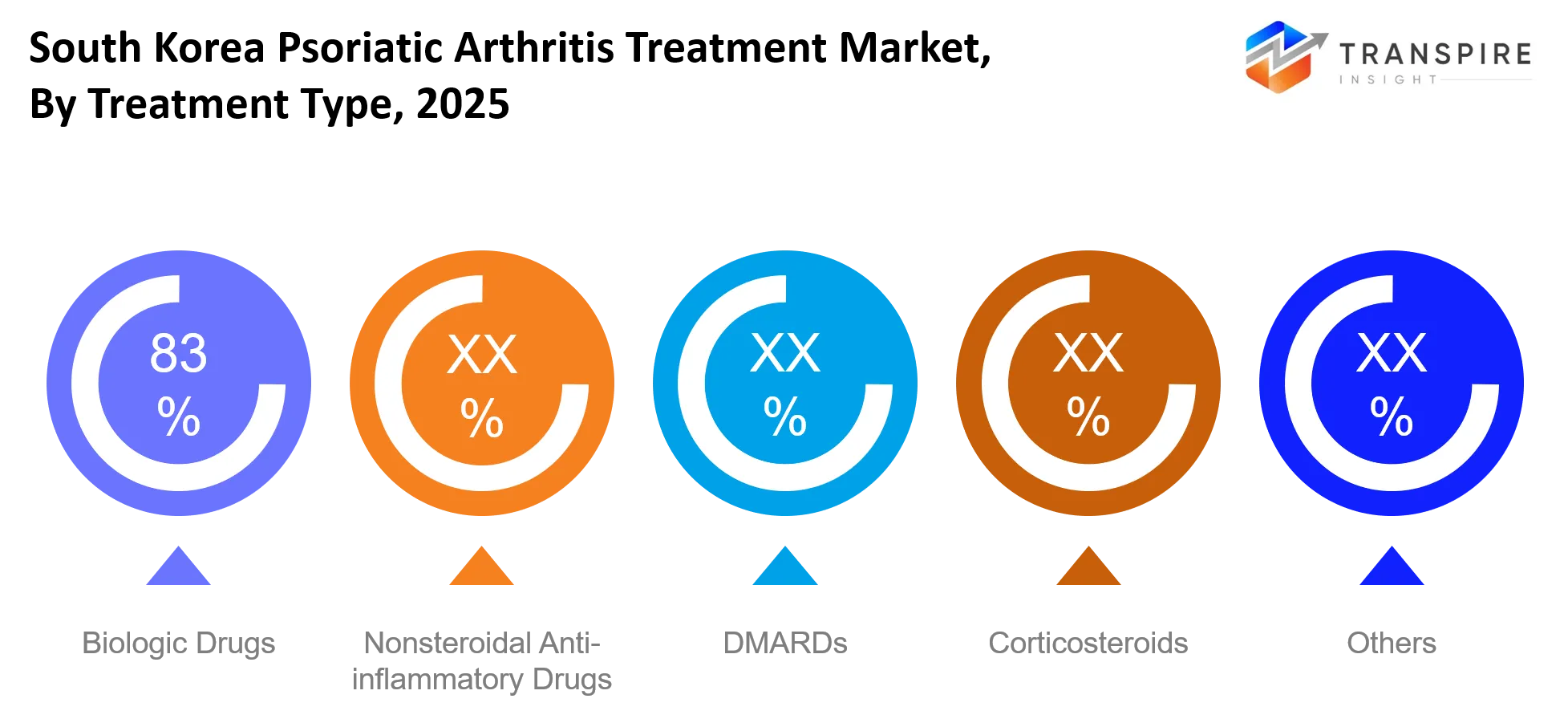
To learn more about this report, Download Free Sample Report
By Drug Class
TNF Inhibitors keep a pretty strong spot as the most established biologic group, backed by years of clinical know-how and pretty wide uptake by doctors across South Korea. People keep using them a lot in both moderate and severe disease too, mainly because the benefits feel reliable and there is a lot of real-world data to lean on. IL-17 Inhibitors are moving up fast now as newer options, showing quicker symptom settling and a nicer profile for skin and joint improvement. IL-23 Inhibitors are also taking up more room in advanced immunology pipelines, especially for patients who do not respond well. Then there are JAK Inhibitors, they’re getting more attention partly because oral administration is convenient, while PDE4 Inhibitors stay in limited but steady use for mild-to-moderate situations.
In terms of momentum, IL-17 Inhibitors are growing faster, largely because response rates look better in patients with both skin and joint involvement, which is very often seen in psoriatic arthritis cases. TNF Inhibitors are holding steady though, even if there is slow, gradual substitution pressure from the newer biologics coming in. IL-23 Inhibitors are expanding as clinical evidence keeps indicating longer remission cycles and fewer dosing touches. JAK Inhibitors also benefit from the outpatient preference angle and less need for infusions, which helps them spread faster in urban clinics. Through the forecast window, class evolution should drift toward more precisely targeted immune pathways, so competition for precision immunology treatments should increase, kind of steadily.
By Application
Moderate Psoriatic Arthritis holds the lead most of the time because many patients get diagnosed and treated before they really march toward severe joint damage, particularly via hospital based rheumatology screening. Early intervention protocols in South Korea also seem to help kick off consistent treatment in this group. Severe Psoriatic Arthritis is a high value slice, mainly since the care plan is biologic intensive and usually stretches across long term therapy cycles. Mild cases stay important too, but they often depend on NSAIDs plus DMARDs before anything escalates. There are also other uses, like atypical presentations or treatment resistant scenarios, handled through specialized care pathways.
Moderate Psoriatic Arthritis keeps growing steadily since diagnostic rates get better, and referrals happen earlier in the bigger urban healthcare centers. Severe cases tend to grow faster in revenue terms, mainly because biologic dependence is stronger and the treatment window stays long. Mild cases show slower pharmaceutical revenue movement, because a lot of people remain in symptom based management for longer periods. Other categories also expand, especially when hospitals run programs aimed at rare immune patterns or drug resistant autoimmune profiles. Over time, the application structure may bend toward earlier biologic intervention, which should raise lifetime treatment value per patient.
By Distribution Channel
Hospital Pharmacies have the lead position mostly because they handle biologics directly, and they also tie in tightly with rheumatology departments. Infusion based treatments plus specialist prescriptions make the distribution system stay under hospital control. Specialty Pharmacies are moving up quite fast, mainly since long term biologic prescriptions need structured follow up, and real adherence programs. Retail Pharmacies stay in the mid range, usually centered on NSAIDs, DMARDs, and various supportive meds. Online Pharmacies are still limited, partly because the prescriptions are complex and because clinical monitoring can’t be skipped
Hospital Pharmacies keep growing, at a steady pace, because biologic protocols still get anchored in clinical settings where monitoring is expected. Specialty Pharmacies increase more quickly, driven by the demand for chronic therapy oversight and for home administration biologics. Retail Pharmacies basically stay the same, but they don’t really grab the high value biologic share. Online Pharmacies edge forward slowly , due to regulatory constraints and patient safety worries. During the forecast period, distribution will likely drift toward mixed hybrid models where hospitals initiate treatment while specialty pharmacy teams manage the ongoing continuity care
By End User
Hospitals keep the dominant position because they handle diagnosis, biologic administration, and the long term management aspect of psoriatic arthritis for patients. Advanced rheumatology departments plus infusion facilities end up reinforcing this central role in treatment delivery, even when it feels a bit crowded. Specialty Clinics are increasing steadily too, they provide more focused immunology support and often shorter waiting cycles, though not always uniformly. Rheumatology Centers act like high specialization hubs for difficult cases, especially when advanced biologic sequencing becomes necessary. Home Care Settings are still limited, yet they are starting to show up more often for maintenance phase therapy and related follow ups.
Hospitals stay on an upward path, largely thanks to structured reimbursement systems and solid clinical infrastructure that supports biologic therapies without much friction. Specialty Clinics tend to grow at a quicker pace, because patients want faster access and a more personalized treatment pathway setup. Rheumatology Centers expand in urban clusters, where advanced immunology knowledge is concentrated and referrals are dense. Home Care Settings expand slowly, driven by greater adoption of self-administered biologics and digital monitoring tools, and this feels like it is happening in waves. Through the forecast period, end user dynamics should shift toward decentralized care models, but still supported by hospital led initiation of treatment and outpatient continuity systems that keep patients connected.
What are the Key Use Cases Driving the South Korea Psoriatic Arthritis Treatment Market?
The core use case in the South Korea Psoriatic Arthritis Treatment Market is basically long-term biologic therapy, given through hospital rheumatology departments , and somehow that keeps showing up as the main thing. It drives most of the demand because it directly helps manage disease progression and wards off irreversible joint damage, especially in moderate-to-severe patients.
Then you start seeing expansion , like outpatient oral JAK inhibitor therapies and combination immunomodulator treatments. These show up in specialty clinics and tertiary hospitals, and they're building momentum with working age patients who kind of want care that doesn't rely on infusion, plus they look for quicker symptom relief too.
More emerging use cases are also popping up such as AI-enabled treatment personalization and home-based remote monitoring systems that connect to digital health platforms. This is still early in the process, but it is gradually getting more support from hospital networks and biopharma collaborations. The idea is improving adherence, and lowering relapse rates, throughout the forecast period.
|
Report Metrics |
Details |
|
Market size value in 2025 |
USD 2.40 Billion |
|
Market size value in 2026 |
USD 2.62 Billion |
|
Revenue forecast in 2033 |
USD 4.92 Billion |
|
Growth rate |
CAGR of 9.42% from 2026 to 2033 |
|
Base year |
2025 |
|
Historical data |
2021 - 2024 |
|
Forecast period |
2026 - 2033 |
|
Report coverage |
Revenue forecast, competitive landscape, growth factors, and trends |
|
Regional scope |
South Korea |
|
Key company profiled |
AbbVie, Amgen, Novartis, Pfizer, Johnson & Johnson, Eli Lilly, Bristol Myers Squibb, UCB Pharma, GSK, Sun Pharmaceutical, Biogen, Roche, Merck & Co., Samsung Bioepis, Celltrion |
|
Customization scope |
Free report customization (country, regional & segment scope). Avail customized purchase options to meet your exact research needs. |
|
Report Segmentation |
By Treatment Type (Biologic Drugs, Nonsteroidal Anti-inflammatory Drugs, DMARDs, Corticosteroids, Others); By Drug Class (TNF Inhibitors, IL-17 Inhibitors, JAK Inhibitors, PDE4 Inhibitors, Others); By Application (Mild Psoriatic Arthritis, Moderate Psoriatic Arthritis, Severe Psoriatic Arthritis, Others); By Distribution Channel (Hospital Pharmacies, Retail Pharmacies, Online Pharmacies, Others); By End User (Hospitals, Specialty Clinics, Home Care Settings, Others) |
Which Regions are Driving the South Korea Psoriatic Arthritis Treatment Market Growth?
The Seoul–Gyeonggi corridor is still, kind of the most dominant area in the South Korea Psoriatic Arthritis Treatment Market because it has lots of tertiary hospitals, more advanced rheumatology centers ,and very specialized immunology departments. This part also lines up well with national reimbursement rules ,so patients can reach biologic therapies quicker across large patient pools. On top of that, dense patient numbers plus early diagnostic uptake help treatment start faster than in other regions. And because leading pharmaceutical distributors are nearby, cold-chain delivery for biologics stays uninterrupted which basically strengthens the regions lead position.
The Busan–Ulsan region keeps adding momentum in a steadier way, mainly because its healthcare demand leans more industrial, workforce-driven, rather than being centered around academic hospitals. Compared with Seoul, growth here is supported by steady corporate health coverage from shipbuilding, logistics, and manufacturing employers, who tend to put chronic disease upkeep high on the list. Hospitals in this area often focus on standardized care pathways, rather than chasing cutting edge innovation, so adoption tends to be stable but slower. That means the region acts as a reliable revenue contributor with less ups and downs, even if it doesn’t have the advanced clinical study ecosystem you see in the capital area.
The fastest-growing region is the Chungcheong and southern inland belt. This is being pushed by the recent expansion of regional medical hubs and by government funded hospital modernization initiatives. A big change is the decentralization of specialty care, which improves access to biologics beyond the metropolitan centers. New infusion facilities and better insurance claim processing systems have cut treatment delays quite noticeably since 2024.
Who are the Key Players in the South Korea Psoriatic Arthritis Treatment Market and How Do They Compete?
The South Korea Psoriatic Arthritis treatment market is kinda moderately consolidated, with big global biopharmaceutical players going head to head with strong local biosimilar manufacturers. The competition mostly comes down to clinical efficacy, pricing pressure thanks to biosimilars, and this fast immunology pipeline expansion that never really stops. The incumbents try to hold their share by pushing next generation biologics, while newcomers often lean on cost effective biosimilar alternatives, which in turn expands patient access. Also, hospital procurement agreements really matter here, so clinical results plus reimbursement alignment end up being key levers for winning.
AbbVie, it competes using high-efficacy IL inhibitor therapies, and keeps an edge by relying on solid clinical trial evidence along with physician confidence especially in refractory cases. Novartis tends to build from immunology pipeline diversification, using IL-17 and IL-23 platforms to spread coverage across multiple autoimmune conditions. Johnson & Johnson strengthens its stance via integrated rheumatology solutions and hospital partnerships, basically helping to smooth out biologic administration routes.
Celltrion and Samsung Bioepis compete very aggressively in biosimilars, and they use cost leadership tactics to cut treatment expenses by large margins versus originator biologics. Their growth is pushed by global biosimilar exports, plus deeper penetration inside South Korean hospital procurement systems. Together, these players are shifting the competitive balance by expanding access, and also basically forcing originators to speed up their innovation cycles, even when it gets a little uncomfortable for them.
Company List
- AbbVie
- Amgen
- Novartis
- Pfizer
- Johnson & Johnson
- Eli Lilly
- Bristol Myers Squibb
- UCB Pharma
- GSK
- Sun Pharmaceutical
- Biogen
- Roche
- Merck & Co.
- Samsung Bioepis
- Celltrion
Recent Development News
In May 2026, Samsung Bioepis announced the launch of its ustekinumab biosimilar SB17 through partner NIPRO for plaque psoriasis and psoriatic arthritis treatment, expanding biosimilar access across Asia and strengthening cost-efficient immunology treatment adoption in South Korea-linked markets.https://firstwordpharma.com
In December 2025, Samsung Bioepis received regulatory approval in Japan for its ustekinumab biosimilar used in plaque psoriasis and psoriatic arthritis, marking a key milestone in cross-border commercialization of advanced immunology therapies developed in South Korea.https://www.pearceip.law
In May 2025, Celltrion and Samsung Bioepis were reported to be expanding divergent biosimilar commercialization strategies, with Celltrion strengthening direct sales control while Bioepis advanced partner-led distribution models impacting autoimmune therapy access including psoriatic arthritis treatments.https://www.koreabiomed.com
What Strategic Insights Define the Future of the South Korea Psoriatic Arthritis Treatment Market?
South Korea Psoriatic Arthritis treatment market is kinda moving, structurally speaking toward a biologics-led, precision oriented ecosystem supported by earlier diagnosis and broader specialty care access . Over the next 5–7 years, growth will be pulled by biosimilar penetration plus next generation immunology therapies, that sort of shift treatment from symptom coping to long-run disease suppression. There’s also a quieter hazard, like payer concentration pressure creeping up, where national insurance systems may end up tightening reimbursement ceilings as biologic use grows, which could slow premium drug adoption a bit.
A new opening is showing up too: AI assisted rheumatology decision systems being rolled into hospital networks, they can help refine drug choice and reduce the therapy switching costs. Market players should focus on localized real world evidence work in South Korea, to lock in reimbursement advantage and push stronger hospital level adoption, especially since competition keeps heating up between originator biologics and biosimilar manufacturers.
South Korea Psoriatic Arthritis Treatment Market Report Segmentation
By Treatment Type
- Biologic Drugs
- NSAIDs
- DMARDs
- Corticosteroids
- Others
By Drug Class
- TNF Inhibitors
- IL-17 Inhibitors
- IL-23 Inhibitors
- JAK Inhibitors
- PDE4 Inhibitors
- Others
By Application
- Mild Psoriatic Arthritis
- Moderate Psoriatic Arthritis
- Severe Psoriatic Arthritis
- Others
By Distribution Channel
- Hospital Pharmacies
- Retail Pharmacies
- Online Pharmacies
- Specialty Pharmacies
- Others
By End User
- Hospitals
- Specialty Clinics
- Home Care Settings
- Rheumatology Centers
- Others
Frequently Asked Questions
Find quick answers to common questions.
The Estimated South Korea Psoriatic Arthritis Treatment Market size for the Market will be USD 66.8 Billion in 2033.
Key Segments for the South Korea Psoriatic Arthritis Treatment Market are By Treatment Type (Biologic Drugs, Nonsteroidal Anti-inflammatory Drugs, DMARDs, Corticosteroids, Others); By Drug Class (TNF Inhibitors, IL-17 Inhibitors, JAK Inhibitors, PDE4 Inhibitors, Others); By Application (Mild Psoriatic Arthritis, Moderate Psoriatic Arthritis, Severe Psoriatic Arthritis, Others); By Distribution Channel (Hospital Pharmacies, Retail Pharmacies, Online Pharmacies, Others); By End User (Hospitals, Specialty Clinics, Home Care Settings, Others.
Major South Korea Psoriatic Arthritis Treatment Market Players are AbbVie, Amgen, Novartis, Pfizer, Johnson & Johnson, Eli Lilly, Bristol Myers Squibb, UCB Pharma, GSK, Sun Pharmaceutical, Biogen, Roche, Merck & Co., Samsung Bioepis, Celltrion
The Current South Korea Psoriatic Arthritis Treatment Market size is USD 2.40 Billion in 2025.
The South Korea Psoriatic Arthritis Treatment Market CAGR is 9.42% from 2026 to 2033.
- AbbVie
- Amgen
- Novartis
- Pfizer
- Johnson & Johnson
- Eli Lilly
- Bristol Myers Squibb
- UCB Pharma
- GSK
- Sun Pharmaceutical
- Biogen
- Roche
- Merck & Co.
- Samsung Bioepis
- Celltrion
About the Authors

Pankaj Ghogare Patil
I am Pankaj Ghogare Patil, a Senior Research Analyst at Transpire Insight, specializing in the Pharmaceutical, Chemicals & Materials, Healthcare IT, and Biotechnology industry. My expertise lies in conducting comprehensive market research, analyzing industry trends, evaluating competitive landscapes, and translating complex data into actionable insights. At Transpire Insight, I closely follow emerging technologies, regulatory developments, and market innovations to create accurate, well-researched, and informative content that helps businesses and professionals make informed decisions. I am committed to producing credible, evidence-based articles that reflect industry best practices while making technical topics accessible and valuable for a broad audience.

Chakradhar Khansole
Chakradhar serves as the Research Director at Transpire Insight, bringing over 8 years of experience in technology, innovation, and strategic market intelligence. He specializes in transforming complex market data into actionable business insights that enable organizations to make informed, growth-oriented decisions. Recognized for his strategic vision and analytical expertise, Chakradhar leads high-impact research initiatives, delivering comprehensive market assessments, competitive intelligence, and forward-looking industry analysis.
Recently Published Reports
-
Jul 2026
Alopecia Treatment Market
Alopecia Treatment Market Size, Share & Analysis Report By Disease Type (Alopecia Areata, Cicatricial Alopecia, Traction Alopecia, Alopecia Totalis, Androgenetic Alopecia, Alopecia Universalis, and Other Disease Types), By Treatment Type (Topical Treatments, Oral Medications, Injectable Therapies, and Hair Transplantation), By Gender (Male, and Female), By Distribution Channel (Hospitals and Clinics, Retail Pharmacies, and Online Retailers), and Geography (North America, Europe, Asia-Pacific, Middle East and Africa, South and Central America), 2021 - 2031
-
Jul 2026
Medical Ultrasound Probe Market
Medical Ultrasound Probe Market Size, Share & Analysis Report By Type (Linear Type, Convex Type, Endocavitary Probe, Phased Array/Cardiac Probe, Transesophageal (TEE) Probe, and Others), By Application (Ophthalmology, Cardiology, Musculoskeletal, Oncology, Obstetrics & Gynecology, General Imaging, and Others), By End User (Hospitals & Clinics, Diagnostic Centers, Ambulatory Surgical Centers, and Others), and Geography (North America, Europe, Asia-Pacific, Middle East and Africa, South and Central America), 2021 – 2031
-
May 2026
Biosimilars Market
Biosimilars Market By Product Type (Monoclonal Antibodies, Recombinant Hormones, Erythropoietin, G-CSF, Others), By Indication (Oncology, Autoimmune Diseases, Blood Disorders, Diabetes, Others), By Manufacturing Type (In-House Manufacturing, Contract Manufacturing), By Distribution Channel (Hospital Pharmacies, Retail Pharmacies, Online Pharmacies), By Industry Analysis, Size, Share, Growth, Trends, and Forecasts 2021-2033
-
Apr 2026
Gastrointestinal Endoscopy Market
Gastrointestinal Endoscopy Market By Type (Rigid Gastrointestinal Endoscope, Flexible Gastrointestinal Endoscopes, Disposable Gastrointestinal Endoscope), By Procedure Type (Colonoscopy, Gastroscopy, Duodenoscopy, Enteroscopy, Flexible Sigmoidoscopy, Others), By Application (Diagnosis, Treatment), By End-Users (Hospitals, Ambulatory Surgical Centers, Specialty Clinics, Laboratories, Others), By Industry Analysis, Size, Share, Growth, Trends, and Forecasts 2021-2033