

North America Gastrointestinal Bleeding Treatment Market Size & Forecast:
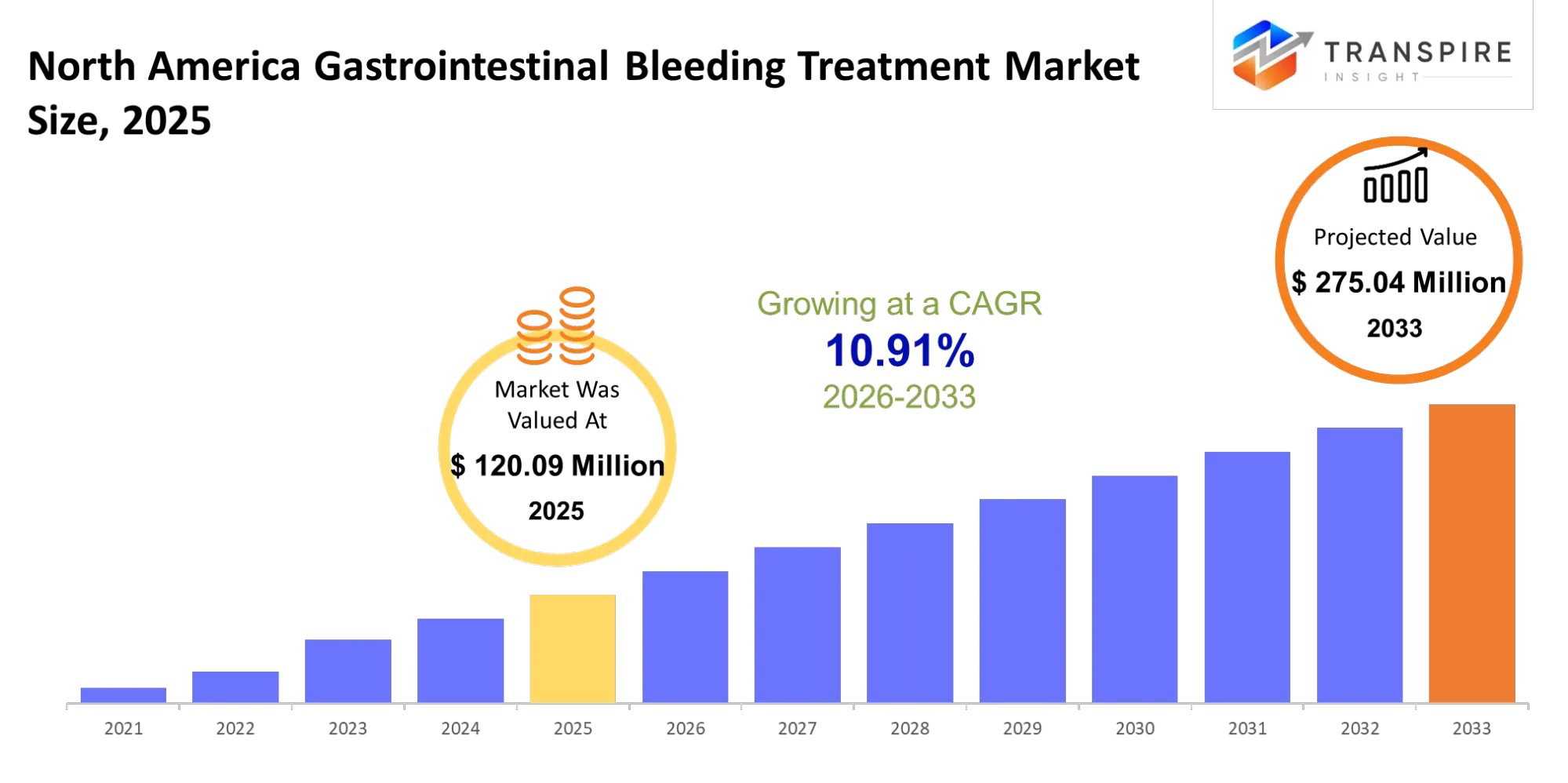
- North America Gastrointestinal Bleeding Treatment Market Size 2025: USD 120.09 Million
- North America Gastrointestinal Bleeding Treatment Market Size 2033: USD 275.04 Million
- North America Gastrointestinal Bleeding Treatment Market CAGR: 10.91%
- North America Gastrointestinal Bleeding Treatment Market Segments: By Treatment Type (Endoscopic Therapy, Drug Therapy, Surgery, Angiographic Embolization, Thermal Therapy, Others), By Disease Type (Upper GI Bleeding, Lower GI Bleeding, Peptic Ulcers, Variceal Bleeding, Others), By End User (Hospitals, Specialty Clinics, Ambulatory Surgical Centers, Others), By Drug Type (Proton Pump Inhibitors, Antibiotics, Hemostatic Agents, Others).
To learn more about this report,  Download Free Sample Report
North America Gastrointestinal Bleeding Treatment Market Summary:
The North America Gastrointestinal Bleeding Treatment Market size is estimated at USD 120.09 Million in 2025 and is anticipated to reach USD 275.04 Million by 2033, growing at a CAGR of 10.91% from 2026 to 2033. The North America Gastrointestinal Bleeding Treatment Market supports hospitals, emergency departments and certain gastroenterology clinics, helping them control internal bleeding throughout the digestive tract before it spirals into shock, organ failure, or longer run complications. In day to day practice, the whole process tends to hover around fast diagnosis, endoscopic intervention, hemostatic tools, embolization procedures , and medication paths that try to reduce mortality, while also cutting down the length of stay in hospital and the level of intensive care patients actually end up requiring.
Over the last five years, this market kind of moved away from mainly surgical management and started leaning more into minimally invasive endoscopic options and image guided treatments. That change picked up steam when health systems tried to cut down recovery time for procedures and also reduce inpatient expenses. Then the COVID-19 pandemic, added extra pressure by showing how operationally heavy it becomes when gastrointestinal procedures get delayed. In response, many organizations put money into more rapid diagnostic workflows, plus upgraded therapeutic endoscopy platforms. With North America’s aging population, there are more anticoagulant related bleeding situations, alongside ongoing chronic gastrointestinal disorders, so clinicians are beginning to use more precise bleeding control technologies earlier in the care pathway. This is not only raising procedural volumes, it’s also pushing up device utilization rates, and it’s helping treatment plus monitoring solution providers build more consistent recurring revenue streams.
Key Market Insights
- The United States pretty much ruled the North America Gastrointestinal Bleeding Treatment Market , taking nearly 78% market share in 2025, largely because hospitals there have advanced infrastructure already in place.
- Canada looks like the fastest mover through 2032, driven by expanding gastroenterology care networks and more funding for endoscopic treatment technologies, you could say.
- In North America, solid reimbursement rules are still pushing the take up of gastrointestinal bleeding management devices, along with hemostatic treatment solutions that clinicians can rely on.
- And regional growth also benefits from a steady rise in emergency admissions tied to anticoagulant-related gastrointestinal bleeding , especially for people above 65 years.
- Within this market, endoscopic treatment devices held the dominant position with about 46% of revenue share in 2025 . Hemostatic clips and thermal coagulation systems then grabbed the second-largest slice, largely due to strong physician preference in acute bleeding management.
- Meanwhile hemostatic powders and advanced sealants are emerging as the fastest-growing segment across the 2026–2032 forecast window .
- Demand for minimally invasive gastrointestinal bleeding therapies keeps climbing, mainly because hospitals want shorter recovery time , and fewer complication rates too.
- Overall , the gastrointestinal bleeding treatment industry is growing as healthcare providers shift away from older surgical routes and instead use advanced therapeutic endoscopy platforms.
- When it comes to disease area, upper gastrointestinal bleeding treatment accounted for nearly 58% market share in 2025 , mostly due to higher occurrence of peptic ulcer complications.
- Lower gastrointestinal bleeding management is projected as the fastest-growing application segment through 2032, supported by broader colonoscopy screening adoption.
What are the Key Drivers, Restraints, and Opportunities in the North America Gastrointestinal Bleeding Treatment Market?
The most powerful force pushing the North America Gastrointestinal Bleeding Treatment Market is this quick turn toward minimally invasive endoscopic action, aided by hospital cost optimization plans. In the past five years, health systems across the United States and Canada have been under rising pressure to cut down on intensive care stays, prevent surgical complications, and shorten inpatient recovery periods. And yeah that, kind of set off bigger investments in advanced hemostatic clips, thermal coagulation setups, and AI-supported endoscopy platforms. So now, physicians tend to address gastrointestinal bleeding earlier and with more efficiency, which boosts procedural volumes and keeps device repeat use high. The financial effect is noticeable too, since minimally invasive pathways can reduce overall hospitalization expenses, while also letting providers manage more patients within each operating cycle.
Meanwhile, the market’s main structural obstacle is still the shortage of highly trained therapeutic endoscopists , plus the uneven availability of advanced GI care outside large metropolitan regions. Teaching doctors the finer points of complex bleeding management can take years of hands on procedural time, and also needs serious investment in specialized infrastructure. Smaller hospitals often can’t quite justify the expense of keeping advanced endoscopy units running, so adoption of next generation bleeding control technologies gets delayed , and that in turn limits revenue growth across secondary healthcare networks.
AI integrated endoscopy systems feel like the most obvious long term growth runway. The firms pushing real time bleeding detection, predictive imaging analytics, and robotic aided therapeutic navigation are basically shaping quicker, more exact intervention pathways. In particular, big university hospitals across the United States are already trialing “smart” endoscopic platforms, that cut down diagnostic variability and help procedure success rates, which then turns into a scalable playbook for wider commercial take up by 2032, generally speaking.
What Has the Impact of Artificial Intelligence Been on the North America Gastrointestinal Bleeding Treatment Market?
Artificial intelligence, along with advanced digital technologies, is kinda reshaping the North America Gastrointestinal Bleeding Treatment Market by making diagnostic speed faster, procedures more precise, and overall hospital workflow more efficient, day to day. Hospitals and gastroenterology centers are increasingly leaning on AI-enabled endoscopy platforms, to automate lesion identification, spot active bleeding sources right away, and also to sort and prioritize high-risk cases during urgent emergency evaluations. In practice these systems cut down on how long physicians need to recheck images, and they also support more steady procedural consistency, especially across big hospital networks handling very high patient volumes.
At the same time, machine learning is reinforcing predictive capabilities across the gastrointestinal care pathway. Providers are now looking at patient history, anticoagulant use, hemoglobin movement over time, plus imaging inputs, to anticipate the risk of rebleeding and to fine-tune treatment choices before complications get out of hand. A few North American hospitals have already embedded predictive analytics inside electronic health records, so they can flag which patients may need early therapeutic action or closer intensive monitoring. This method helps reduce repeat admissions, and it can also limit unnecessary surgical escalation.
Operationally, AI-assisted endoscopy systems improve diagnostic reliability, reduce procedure duration, and enable a faster patient turnover in emergency departments. Some newer imaging platforms have shown measurable gains in adenoma detection rates and bleeding-source detection, and those outcomes feed directly into treatment efficiency and also reimbursement performance. Still, AI adoption is not completely smooth, because integrating these “smart imaging” tools into existing hospital infrastructure takes substantial capital investment, plus access to high-quality clinical datasets, and physicians need training. So adoption can end up being slower, among.
Key Market Trends
- Since 2021 , U.S. hospitals have been gradually swapping surgical bleeding interventions for therapeutic endoscopy, partly to trim inpatient recovery time and also cut down ICU use and… well, overall utilization.
- AI-assisted endoscopy platforms started seeing wider adoption after 2022, because many providers leaned harder on quicker bleeding-source identification and tighter procedural consistency across big hospital networks, you know, the standardized accuracy part.
- Boston Scientific and Olympus Corporation both expanded hemostatic device portfolios between 2021 and 2025. The goal was basically to reinforce hospital partnerships and keep pace with what endoscopists were asking for.
- Ambulatory surgical centers ended up handling a bigger chunk of gastrointestinal bleeding procedures once reimbursement rules started nudging clinicians toward cheaper outpatient intervention tracks, a bit like “go less costly first” so it kind of reshaped everything.
- Hospitals also adjusted their procurement methods after COVID-19, because the pandemic laid bare delays in emergency GI care , and it also showed there were shortages of specialized endoscopy capacity when it counted most.
- Since 2023, demand for hemostatic powders and those advanced clipping systems has risen pretty noticeably, as physicians wanted faster hemostasis during more involved endoscopic work, not just the routine stuff.
- In Canada, investment in regional gastroenterology networks picked up speed after rural healthcare systems reported longer delays for GI bleeding treatment during the pandemic recovery period, which wasn’t exactly surprising but still.
- Machine learning tools are now being used more and more to map anticoagulant use, hemoglobin trends, and patient history , with the idea of forecasting rebleeding risk before escalation becomes a full-blown emergency.
- And lastly, device manufacturers strengthened their competitive positioning by building integrated imaging ecosystems, mixing AI visualization with therapeutic endoscopy, plus digital workflow management platform sort of all in one, streamlined, connected, you know.
North America Gastrointestinal Bleeding Treatment Market Segmentation
By Treatment Type
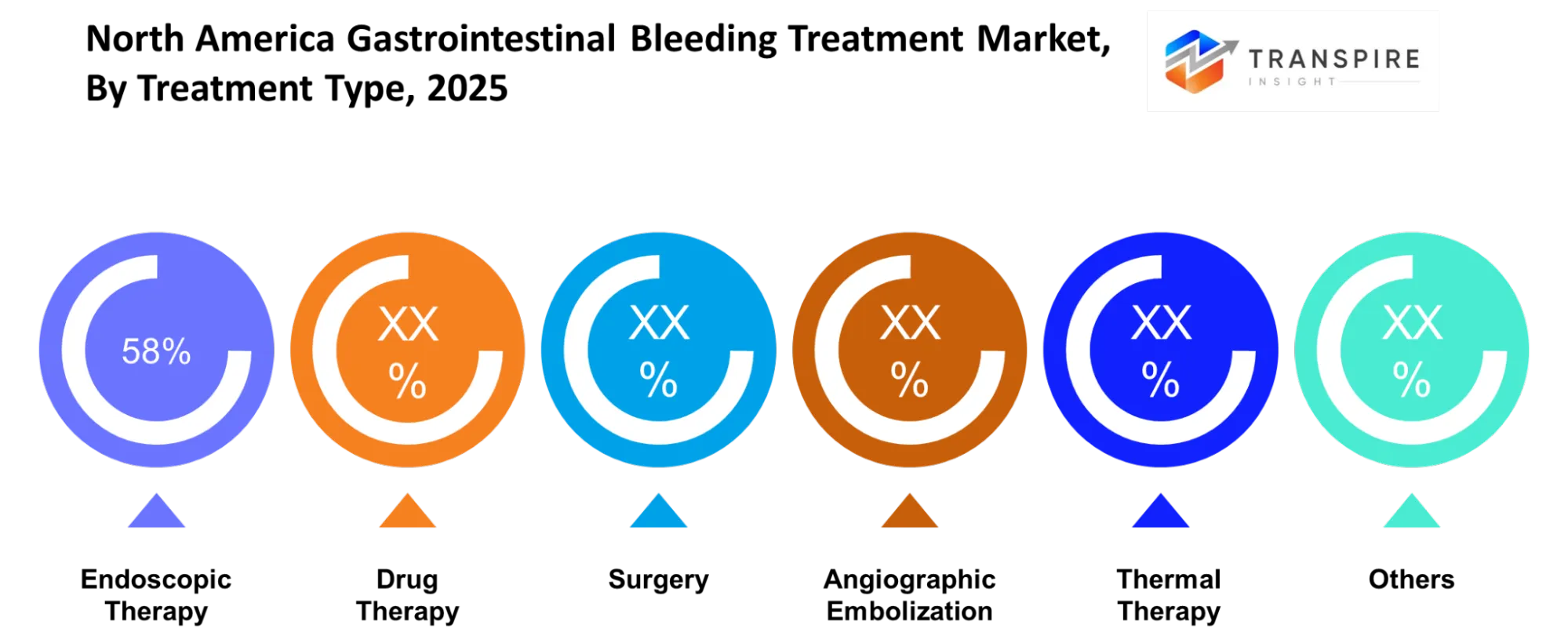
Endoscopic therapy still sort of takes the lead in this treatment type segment, mainly because more hospitals now favor minimally invasive procedures, which seem to both shorten recovery periods and lower surgical complications. Hemostatic clipping , thermal therapy, and advanced coagulation systems keep gradually replacing what used to be conventional surgical intervention across emergency gastrointestinal care settings. Drug therapy also keeps strong traction, because proton pump inhibitors and supportive medications are still basically required for acute bleeding stabilization and also for post-procedure follow-up. Surgery and angiographic embolization, meanwhile, still seem pretty important when bleeding is extremely severe or basically won't stop, and especially if the endoscopic route doesn’t really pan out.
But the real bottlenecks feel like those high procedural costs , plus specialist shortages too, which in turn end up restricting access to advanced therapeutic endoscopy in smaller healthcare facilities, more or less. Manufacturers are trying to respond to that gap, with portable visualization systems, AI assisted endoscopy platforms, and integrated bleeding management technologies, kind of bundled all together in one package.Looking ahead, growth in this area will probably hinge on precision-guided therapeutic tools, aiming to boost procedural accuracy, while also trimming how many hospital resources get used, and that should open up more solid opportunities for device makers and outpatient care providers.
To learn more about this report, Download Free Sample Report
By Disease Type
Upper gastrointestinal bleeding pretty much leads the disease type segment, mainly because the prevalence of peptic ulcers, gastritis, and anticoagulant related complications is high among aging populations across North America. The bleeding tied to peptic ulcer issues keeps producing major treatment demand, mostly because long term nonsteroidal anti inflammatory drug use is still pretty widespread in elderly patient groups. Variceal bleeding is another serious clinical category, since liver disease and alcohol connected complications seem to keep rising and driving more hospital admissions.
Lower gastrointestinal bleeding is getting more attention too, as colonoscopy screening programs roll out more broadly and healthcare systems improve in early diagnostic capability. The treatment pathways for upper versus lower gastrointestinal conditions are clearly not the same, so demand keeps building for specialized endoscopic devices, embolization methods , and focused pharmaceutical options. Overall, the disease profile seems to move toward chronic condition management, more than an isolated emergency response. This shift should push manufacturers to create condition specific treatment systems while investors start putting more emphasis on technologies that help with earlier diagnosis and long term bleeding prevention strategies.
By End-User
Hospitals are still the main end user segment, because acute gastrointestinal bleeding patients really do need emergency infrastructure, close range intensive monitoring ability and fast access to specialized therapeutic endoscopy teams. So yeah, large hospital networks keep pushing investments into integrated imaging systems and upgraded hemostatic technologies, partly to speed up patient flow and partly to lower the need for intensive care dependency. Specialty clinics are rising too, though a bit more slowly and steady, as healthcare providers decentralize noncritical gastrointestinal procedures and move follow up care away from classic inpatient settings.
Ambulatory surgical centers are gaining traction as well, since reimbursement models are starting to favor lower cost outpatient interventions for stable bleeding cases.That said, access gaps to well trained therapeutic specialists are still a thing, and it keeps smaller regional facilities from expanding procedures as much. Healthcare systems are answering with centralized referral pathways and co working gastroenterology networks, which help improve procedural efficiency. In the future, competition inside the end user segment will probably hinge more on operational speed, AI enabled workflow integration, and the capability to handle complicated bleeding situations using fewer inpatient resources.
By Drug Type
Proton pump inhibitors basically dominate that drug segment, since physicians routinely prescribe these kinds of therapies during acute bleeding from ulcers, along with the after- endoscopy stabilization protocols , you know, where things settle down. Strong clinical evidence for acid suppression treatment keeps pushing consistent use across hospitals and outpatient clinics. Hemostatic agents are also grabbing a bigger slice of gastrointestinal bleeding care because rapid clot formation and extra procedural backing matter more now during minimally invasive interventions. Antibiotics stay steady too, especially in treatment pathways for variceal bleeding, where infection prevention really affects patient outcomes. Other supportive medications, like vasoconstrictors and adjunctive treatments, keep getting used for specialized clinical scenarios, even if they do not show up everywhere.
There’s also growing pressure to cut hospital readmission rates , so healthcare providers are leaning into more targeted pharmaceutical approaches, ones that support faster recovery and reduce the chance of complications. Looking ahead, expansion in this drug segment will probably revolve around combination therapies, more personalized dosing protocols , and newer biologic formulations that improve treatment precision while still helping with long-term gastrointestinal disease management.
What are the Key Use Cases Driving the North America Gastrointestinal Bleeding Treatment Market?
Emergency endoscopic management for upper GI bleeding is still the main reason hospitals in North America actually adopt these systems. There is a lot of patient inflow tied to peptic ulcer problems, anticoagulant complications, and basically age related gastrointestinal disorders so demand stays high for quick hemostasis plus enhanced visualization setups.
Meanwhile, other uses are growing too, especially in ambulatory surgical centers and specialty gastroenterology clinics. People are looking more into lower gastrointestinal bleeding management and then also into post procedure monitoring. Outpatient therapeutic endoscopy is picking up momentum, since many healthcare systems are steering stable cases away from expensive inpatient wards to boost procedural throughput and also ease pressure on bed occupancy, a bit.
Newer directions are showing up as well, like AI supported bleeding detection plus predictive rebleeding risk analysis built into digital endoscopy platforms. At the same time, big academic medical centers are experimenting with robotic aided therapeutic navigation, which aims to tighten precision during complicated gastrointestinal interventions and helps clinicians move to decisions faster when it is emergency time.
|
Report Metrics |
Details |
|
Market size value in 2025 |
USD 120.09 Million |
|
Market size value in 2026 |
USD 133.19 Million |
|
Revenue forecast in 2033 |
USD 275.04 Million |
|
Growth rate |
CAGR of 10.91% from 2026 to 2033 |
|
Base year |
2025 |
|
Historical data |
2021 - 2024 |
|
Forecast period |
2026 - 2033 |
|
Report coverage |
Revenue forecast, competitive landscape, growth factors, and trends |
|
Country scope |
North America (Canada, The United States, and Mexico) |
|
Key company profiled |
Boston Scientific, Olympus Corporation, Medtronic, Cook Medical, Abbott, Johnson & Johnson, Baxter International, Pfizer, Fujifilm Holdings, CONMED, Stryker, Erbe Elektromedizin, Karl Storz, Teleflex, B. Braun |
|
Customization scope |
Free report customization (country, regional & segment scope). Avail customized purchase options to meet your exact research needs. |
|
Report Segmentation |
By Treatment Type (Endoscopic Therapy, Drug Therapy, Surgery, Angiographic Embolization, Thermal Therapy, Others), By Disease Type (Upper GI Bleeding, Lower GI Bleeding, Peptic Ulcers, Variceal Bleeding, Others), By End User (Hospitals, Specialty Clinics, Ambulatory Surgical Centers, Others), By Drug Type (Proton Pump Inhibitors, Antibiotics, Hemostatic Agents, Others) |
Which Regions are Driving the North America Gastrointestinal Bleeding Treatment Market Growth?
The United States stays ahead in the North America Gastrointestinal Bleeding Treatment Market, mostly because big hospital networks keep putting money in advanced therapeutic endoscopy plus emergency GI care infrastructure. There’s also strong reimbursement backing for minimally invasive procedures, that nudges quicker uptake of AI supported imaging platforms, hemostatic devices, and even outpatient bleeding management routes. On top of that, the high incidence of anticoagulant related bleeding, peptic ulcer disease, and age linked gastrointestinal complications, means clinicians see a steadier flow of cases across both metro and more regional health systems. And with major firms like Boston Scientific and Medtronic around, clinical training, tech rollouts and ongoing product development get a further lift, inside the U.S. healthcare ecosystem.
Canada brings a smaller but still very reliable slice of regional revenue, since healthcare expansion tends to be more centralized and policy driven than what you typically see in the United States. Provincial services keep leaning into long term investment for gastroenterology capacity, especially around diagnostic imaging and therapeutic endoscopy. Patient demand stays rather consistent too, because Canada runs strong chronic disease programs and organized colorectal screening efforts, which helps catch bleeding earlier. Canadian hospitals also put serious emphasis on operational efficiency and connected referral pathways, so the need for advanced bleeding control tools remains steady, without as much of the quick buying swings that can happen in more private or fragmented healthcare setups.
Mexico is showing the fastest expanding regional market, partly because healthcare modernization initiatives and the private hospital build out are speeding up access to specialized gastrointestinal services. In the last few years, investment into urban multispecialty hospitals and less invasive surgical infrastructure has been climbing quite a bit across most major cities. At the same time, more medical tourism activity, plus better availability of advanced endoscopic treatment systems, is helping adoption of modern approaches for gastrointestinal bleeding control. Basically, this current momentum is generating promising opportunities for manufacturers, distributors, and investors between 2026 and 2033, since a lot of secondary care facilities are still in the middle of switching away from conventional surgical methods toward advanced therapeutic endoscopy platforms.
Who are the Key Players in the North America Gastrointestinal Bleeding Treatment Market and How Do They Compete?
The competitive landscape of the North America Gastrointestinal Bleeding Treatment Market keeps looking moderately consolidated, mostly because a short list of multinational medical technology companies controls a big chunk of the more advanced endoscopic and hemostatic treatment systems. What we see now, is that rivals are less focused on simple device pricing, and more on procedural velocity, imaging precision, and how well their tools get along with hospital digital workflows. Meanwhile the already established manufacturers keep defending their share by rolling out constant product upgrades, funding physician training, and signing longer term hospital procurement agreements. At the same time, smaller specialized firms are sliding into specific therapeutic segments like hemostatic powders, AI-enabled imaging, and minimally invasive bleeding control technologies, which causes a kind of selective disruption in those higher-growth clinical corners.
Boston Scientific basically competes via aggressive innovation in therapeutic endoscopy, and hemostatic intervention systems too. The company sets itself apart with integrated bleeding management platforms, where clipping devices visualization tools and advanced catheter technologies are bundled into one procedural ecosystem. Plus, strategic partnerships with major hospital systems, along with physician education initiatives, help lock in longer term adoption, and sustain recurring procedural revenue. Olympus Corporation leans hard on high-definition imaging plus AI-assisted endoscopy platforms, aiming to improve bleeding-source detection during urgent procedures. Its strong presence in large academic medical centers gives Olympus a technology edge in advanced gastrointestinal diagnostics, and it also supports workflow integration for therapy execution.
Medtronic kind of leans into minimally invasive procedures and digital surgery integration, to push for better process efficiency across those really complex GI cases. They also keep expanding via software driven imaging tools, and by doing cross specialty surgical collaborations that help hospitals adopt the tech more readily, even when it gets a bit complicated. Cook Medical seems to focus more on a narrower lane , like interventional radiology and embolization products. Those are used when endoscopic therapy doesn’t quite do the job, or when it just is insufficient. They maintain strong ties with tertiary hospitals and trauma centers too, which helps keep demand steady for advanced vascular intervention platforms. Fujifilm Holdings Corporation is expanding pretty aggressively as well, using AI enhanced visualization platforms and smaller endoscopy systems meant for outpatient , ambulatory surgical spaces. This gives Fujifilm a solid position in decentralized gastrointestinal care models.
Company List
- Boston Scientific
- Olympus Corporation
- Medtronic
- Cook Medical
- Abbott
- Johnson & Johnson
- Baxter International
- Pfizer
- Fujifilm Holdings
- CONMED
- Stryker
- Erbe Elektromedizin
- Karl Storz
- Teleflex
- B. Braun
Recent Development News
In April 2026, Boston Scientific Highlights Growth in Interventional and Minimally Invasive Device Portfolio: Boston Scientific continued expanding its minimally invasive treatment technologies portfolio in 2026, reinforcing its position in GI intervention and bleeding management markets. The company’s broader device innovation strategy supports increasing adoption of endoscopic and embolization procedures across North American hospitals.
Source: https://www.reuters.com
In April 2026, Johnson & Johnson Reports Strong Uptake of Ictocyde and Growth in GI-Focused Immunology Portfolio : Johnson & Johnson announced better-than-expected quarterly earnings despite biosimilar pressure on Stelara. The company highlighted rapid adoption of Icotyde and continued expansion of Tremfya, both of which are increasingly relevant for inflammatory bowel disease management tied to gastrointestinal bleeding complications. Executives emphasized strong physician uptake across North America.
Source: https://www.reuters.com
What Strategic Insights Define the Future of the North America Gastrointestinal Bleeding Treatment Market?
The North America Gastrointestinal Bleeding Treatment Market is, sort of, getting pulled into more integrated data driven intervention schemes that blend AI assisted diagnostics , minimally invasive therapeutics, and decentralized outpatient care delivery. The push behind this shift is mostly the increasing pressure on healthcare systems to trim emergency care costs while also dealing with a growing share of elderly patients who have anticoagulant exposure and ongoing gastrointestinal disorders. Over the next five to seven years, treatment pathways are likely to slide more and more away from purely reactive hospital actions , and toward predictive risk management plus earlier therapeutic escalation.
A not so obvious risk is that the market may be concentrating around a small group of endoscopy platform manufacturers. When hospitals go all in on proprietary imaging ecosystems, they can start running into upgrade costs that climb, interoperability constraints, and procurement flexibility that feels slower or harder later. Meanwhile, AI enabled capsule endoscopy , along with remote gastrointestinal monitoring technologies, is showing up as a real emerging opening, especially for underserved regional healthcare networks that want earlier bleeding detection without depending on tertiary hospitals all the time.
Market participants should aim to build interoperable digital platforms and scalable outpatient treatment approaches, instead of leaning only on premium inpatient procedural systems. This is because healthcare purchasing models keep moving toward efficiency focused care delivery, and the gap between “nice on paper” and “workable day to day” gets wider as budgets tighten .
North America Gastrointestinal Bleeding Treatment Market Report Segmentation
By Treatment Type
- Endoscopic Therapy
- Drug Therapy
- Surgery
- Angiographic Embolization
- Thermal Therapy
- Others
By Disease Type
- Upper GI Bleeding
- Lower GI Bleeding
- Peptic Ulcers
- Variceal Bleeding
- Others
By End User
- Hospitals
- Specialty Clinics
- Ambulatory Surgical Centers
- Others
By Drug Type
- Proton Pump Inhibitors
- Antibiotics
- Hemostatic Agents
- Others
Frequently Asked Questions
Find quick answers to common questions.
The approximate North America Gastrointestinal Bleeding Treatment Market size for the market will be USD 275.04 Million in 2033.
The key segments of the North America Gastrointestinal Bleeding Treatment Market are By Treatment Type (Endoscopic Therapy, Drug Therapy, Surgery, Angiographic Embolization, Thermal Therapy, Others), By Disease Type (Upper GI Bleeding, Lower GI Bleeding, Peptic Ulcers, Variceal Bleeding, Others), By End User (Hospitals, Specialty Clinics, Ambulatory Surgical Centers, Others), By Drug Type (Proton Pump Inhibitors, Antibiotics, Hemostatic Agents, Others).
Major players in the North America Gastrointestinal Bleeding Treatment Market are Boston Scientific, Olympus Corporation, Medtronic, Cook Medical, Abbott, Johnson & Johnson, Baxter International, Pfizer, Fujifilm Holdings, CONMED, Stryker, Erbe Elektromedizin, Karl Storz, Teleflex, B. Braun.
The current market size of the North America Gastrointestinal Bleeding Treatment Market is USD 120.09 Million in 2025.
The North America Gastrointestinal Bleeding Treatment Market CAGR is 10.91%.
- Boston Scientific
- Olympus Corporation
- Medtronic
- Cook Medical
- Abbott
- Johnson & Johnson
- Baxter International
- Pfizer
- Fujifilm Holdings
- CONMED
- Stryker
- Erbe Elektromedizin
- Karl Storz
- Teleflex
- B. Braun
About the Authors

Pankaj Ghogare Patil
I am Pankaj Ghogare Patil, a Senior Research Analyst at Transpire Insight, specializing in the Pharmaceutical, Chemicals & Materials, Healthcare IT, and Biotechnology industry. My expertise lies in conducting comprehensive market research, analyzing industry trends, evaluating competitive landscapes, and translating complex data into actionable insights. At Transpire Insight, I closely follow emerging technologies, regulatory developments, and market innovations to create accurate, well-researched, and informative content that helps businesses and professionals make informed decisions. I am committed to producing credible, evidence-based articles that reflect industry best practices while making technical topics accessible and valuable for a broad audience.

Chakradhar Khansole
Chakradhar serves as the Research Director at Transpire Insight, bringing over 8 years of experience in technology, innovation, and strategic market intelligence. He specializes in transforming complex market data into actionable business insights that enable organizations to make informed, growth-oriented decisions. Recognized for his strategic vision and analytical expertise, Chakradhar leads high-impact research initiatives, delivering comprehensive market assessments, competitive intelligence, and forward-looking industry analysis.
Recently Published Reports
-
Apr 2026
AI in Diabetic Retinopathy Market
AI in Diabetic Retinopathy Market Size, Share & Analysis Report By Type (Screening AI Systems, Diagnostic AI Systems, and Predictive AI Models), By Application Segment (Hospitals, Ophthalmology Clinics, Diagnostic Centers, and Research and Development), and Geography (North America, Europe, Asia-Pacific, Middle East and Africa, South and Central America), 2021 - 2031
-
Apr 2026
Psychometric Tests Market
Psychometric Tests Market Size, Share & Analysis Report By Type (Personality Tests, Ability/Aptitude Tests, Skill/Knowledge Tests, and Others), By Application (Talent Acquisition and Talent Management), and Geography (North America, Europe, Asia-Pacific, Middle East and Africa, South and Central America), 2021 – 2031
-
Apr 2026
Rare Biological Sample Collection Market
Rare Biological Sample Collection Market Size, Share & Analysis Report By Type (Isolation Kits & Reagent, Blood Collection Tubes, and Others), By Application (Oncology, Transcriptomics, Pharmacogenomics, and Others), and Geography (North America, Europe, Asia-Pacific, Middle East and Africa, South and Central America), 2021 – 2031
-
Jul 2026
Diabetic Retinopathy Market
Diabetic Retinopathy Market Size, Share & Analysis Report By Type (Proliferative Diabetic Retinopathy, and Diabetic Macular Edema (DME)), By Treatment Type (Anti VEGF Drug, Steroid Implants, Laser Surgeries, and Vitrectomy), and Geography (North America, Europe, Asia-Pacific, Middle East and Africa, South and Central America), 2021 – 2031
Our Clients







