
Asia Pacific Clinical Laboratory Tests Market Size & Forecast:
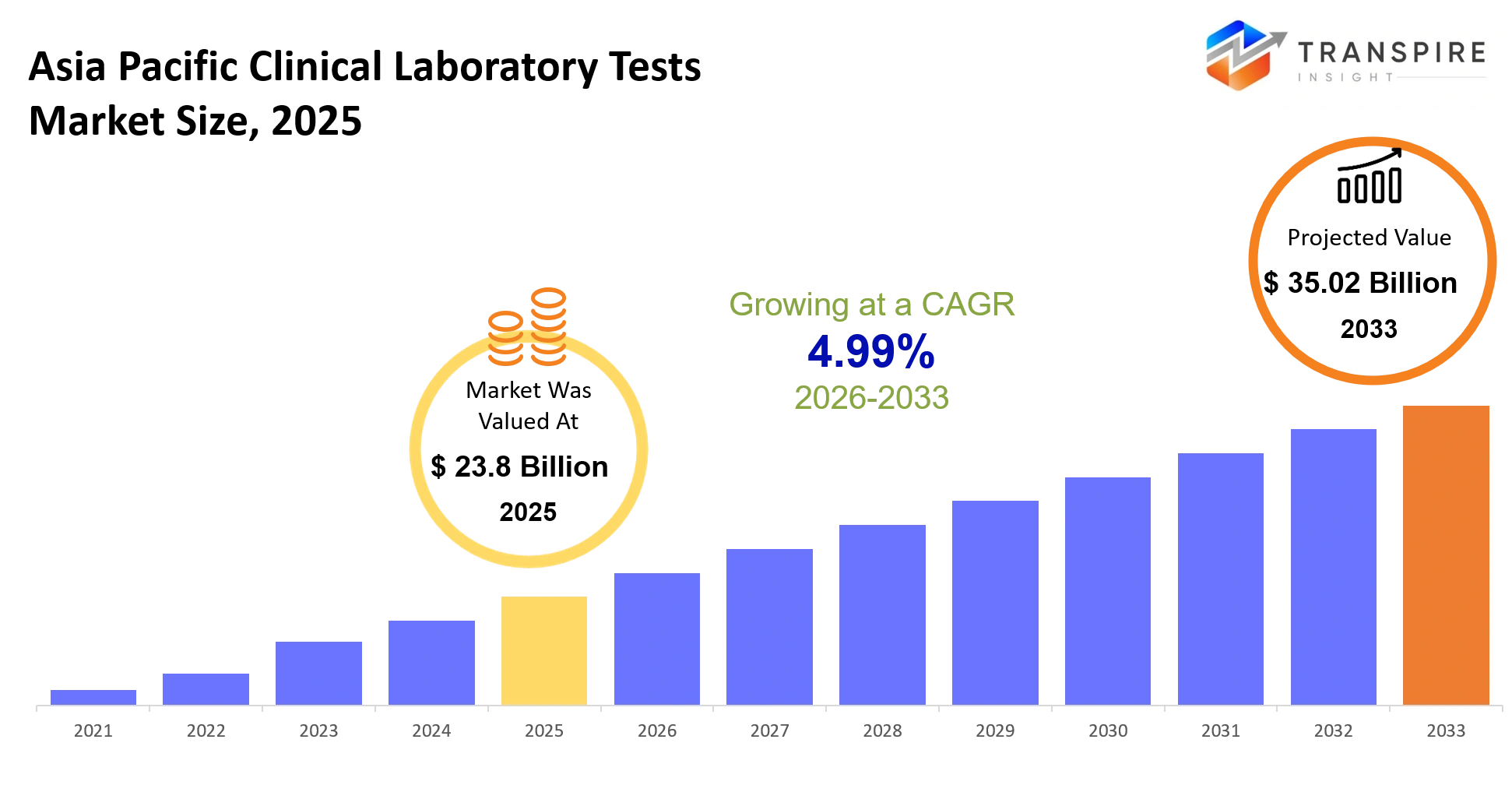
- Asia Pacific Clinical Laboratory Tests Market Size 2025: USD 23.8 Billion
- Asia Pacific Clinical Laboratory Tests Market Size 2033: USD 35.02 Billion
- Asia Pacific Clinical Laboratory Tests Market CAGR: 4.99%
- Asia Pacific Clinical Laboratory Tests Market Segments: By Test Type (Blood Tests, Urine Tests, Molecular Diagnostics, Microbiology Tests, Immunology Tests, Genetic Tests, Others); By End User (Hospitals, Diagnostic Laboratories, Clinics, Academic Institutes, Others); By Technology (Clinical Chemistry, Hematology, PCR, Immunoassays, Sequencing, Others); By Application (Infectious Diseases, Oncology, Cardiology, Diabetes, Others)
Asia Pacific Clinical Laboratory Tests Market Summary
The Asia Pacific Clinical Laboratory Tests Market was valued at USD 23.8 billion in 2025. It is forecast to reach USD 35.02 billion by 2033. That is a CAGR of 4.99% over the period.
The Asia Pacific clinical laboratory tests market is really important for hospitals and research institutions. It helps them use samples to make decisions about medical treatment. This market is useful for finding diseases and keeping an eye on them. It also helps doctors choose the therapy for patients.
The Asia Pacific clinical laboratory tests market makes things easier for doctors by reducing the time it takes to get test results. This means doctors can start treating patients. The market is used in cities and in smaller towns.Over the five years the Asia Pacific clinical laboratory tests market has changed a lot. Now it uses machines and computers to do tests of people doing them by hand. This is faster and more efficient. The COVID-19 pandemic was a reason for this change. It showed that the old way of doing things was not working. So laboratories started using machines and computers to do tests.
The Asia Pacific clinical laboratory tests market uses things like PCR and immunoassay automation. These are words that mean using machines to do tests. The market also uses data-integrated reporting systems. This means that all the test results are stored in a computer system.All these changes have been good, for the Asia Pacific clinical laboratory tests market. Now it can do tests faster and more accurately. More people can get tested, in smaller towns. This means that hospitals and research institutions can do tests and get more money. The Asia Pacific clinical laboratory tests market is really helping people get medical care.
Key Market Insights
- The Asia Pacific Clinical Laboratory Tests Market is led by China with 35 percent of the market and India and Southeast Asia are growing really fast and will keep doing so until 2030.
- The Asia Pacific Clinical Laboratory Tests Market is changing in a way because of automation and laboratories that use artificial intelligence, which helps get more work done and gives people their test results faster. The Asia Pacific Clinical Laboratory Tests Market is getting better because of this change.
- Immunoassay testing is still the popular way to test and it has about 30 percent of the Asia Pacific Clinical Laboratory Tests Market because doctors use it a lot to check for and keep an eye on chronic diseases. The Asia Pacific Clinical Laboratory Tests Market has a lot of immunoassay testing.
- From 2024 to 2030 molecular diagnostics will be the growing part of the Asia Pacific Clinical Laboratory Tests Market because precision medicine is getting more popular and more people want to get tested for genetic diseases. This will help the Asia Pacific Clinical Laboratory Tests Market grow.
- Testing for diseases is the most common use, with about 40 percent of the market because we need to keep an eye on diseases after a pandemic and make sure we can respond to outbreaks. The Asia Pacific Clinical Laboratory Tests Market is important for disease testing.
- Cancer testing is becoming more popular fast because more people are getting cancer and doctors are using targeted therapy diagnostics more often in the Asia Pacific region. The Asia Pacific Clinical Laboratory Tests Market will grow because of cancer testing.
- Hospitals are still the users of the Asia Pacific Clinical Laboratory Tests Market with about 55 percent of the market because they see a lot of patients and have systems that work well together. Hospitals use the Asia Pacific Clinical Laboratory Tests Market a lot.
- Diagnostic chains and reference laboratories are growing fast which makes it easier for people to get tested and helps make sure the quality of tests is the same everywhere even in smaller cities and towns. This helps the Asia Pacific Clinical Laboratory Tests Market.
- Big companies like Roche Diagnostics, Abbott, Siemens Healthineers, Thermo Fisher Scientific and Danaher Corporation are getting stronger by using automation and expanding into regions. These companies are important, to the Asia Pacific Clinical Laboratory Tests Market.
- The Asia Pacific Clinical Laboratory Tests Market is growing in a way because of digital laboratory platforms, laboratory information system integration and analytics that use artificial intelligence, which helps make more money and improves the accuracy of tests. The Asia Pacific Clinical Laboratory Tests Market is growing because of these technologies.
What are the Key Drivers, Restraints, and Opportunities in the Asia Pacific Clinical Laboratory Tests Market?
Driver
The main thing that is making this market grow is that automated and molecular diagnostic testing is becoming more popular in hospitals and laboratories. This happened because of the changes that occurred in the healthcare system after COVID, which showed that manual testing was not enough and that governments and private companies needed to invest in technology like high-throughput PCR and laboratory information systems. As a result the number of tests being done has increased a lot. The time it takes to get results has decreased which is making hospitals more efficient and increasing the money they make from diagnostic tests.
Restraint
The biggest problem is that laboratories in some countries do not have the level of equipment and funding. In smaller towns and rural areas the laboratories are not well equipped and do not have access to the latest technology. This is an issue because it will take a long time to fix and it will require a lot of money training for the workers and changes in policies. Because of this the use of testing is mostly limited to big cities, which is slowing down the growth of the market and the money being made from diagnostic tests.
Opportunity
There is a chance for growth in the market for molecular testing that can be done outside of central laboratories especially in countries like India and Indonesia. Portable PCR and other diagnostic systems are becoming more popular in clinics, which allows for diagnosis. This is attracting the attention of companies like Thermo Fisher Scientific. It could lead to a big expansion of the market. The Driver of this growth is the expansion of point-of-care molecular testing and the Driver of this trend is the need, for faster and more convenient diagnostic tests.
What Has the Impact of Artificial Intelligence Been on the Asia Pacific Clinical Laboratory Tests Market?
The Asia Pacific Clinical Laboratory Tests Market is changing because of intelligence and new digital technologies. These things are making laboratory work more accurate, faster and better. In laboratories people are using intelligence to automate certain tasks. This includes sorting samples tracking them with barcodes and using computer systems to manage laboratory information. This reduces mistakes that people make and makes the whole testing process smoother.
Artificial intelligence is also helping with looking at slides and pictures. This means that laboratories can standardize how they look at these things and do not have to do it all by hand. This is especially helpful when they have to do a lot of tests.Now people are using computer models to predict when equipment will be busy how much of certain supplies they will need and when equipment needs to be fixed. This helps prevent equipment from breaking down. These systems look at how equipment has worked in the past and how it is working now to figure out when something might go wrong.
Because of all these changes laboratories are seeing results. They are getting tests done faster spending money and getting more accurate results. This is especially true for laboratories in cities.There is still a problem. It is very expensive to connect intelligence systems to old laboratory equipment. Many laboratories, in some parts of Asia still have equipment that does not work well with new artificial intelligence systems. This makes it hard for them to share data and use intelligence in a standardized way. This slows down the process of adopting intelligence even though it can make things more efficient. The Asia Pacific Clinical Laboratory Tests Market is still working on this issue.
Key Market Trends
- Between 2020 and 2025 around sixty percent of labs in cities started using automated analyzers of doing things by hand. This change made the Asia Pacific Clinical Laboratory Tests Market work a lot faster.
- Molecular diagnostics became really popular after 2021. Before that it was mainly used for cancer testing. After 2021 it started being used for regular checks for infectious diseases in big hospitals.
- After COVID the governments of India and China decided to spend money on special machines called high-throughput PCR infrastructure. They did this between 2022 and 2024.
- A new way of testing started to be used, where tests could be done at the point of care and people did not have to go to a lab. This was especially helpful in areas of Southeast Asia.
- Artificial intelligence started being used in labs in 2023. It really helped with getting the right results and reducing mistakes in big labs.
- Companies like Roche Diagnostics started to focus on making platforms for labs and they spent a lot of money on cloud-connected laboratory platforms.
- There were some problems with getting the supplies between 2021 and 2022 so labs had to find new ways to get what they needed and they started working with local manufacturers.
- The rules for testing got stricter after the pandemic because there were some problems with tests not being consistent. So national health agencies started to make sure that all tests were done in the way.
- More people started getting tested for cancer from 2022 because there were programs to detect cancer earlier and more people were using precision medicine.
- Labs in countries started working together which helped big diagnostic companies make sure that their tests were of the same quality everywhere, in the Asia Pacific healthcare markets.
Asia Pacific Clinical Laboratory Tests Market Segmentation
By Test Type
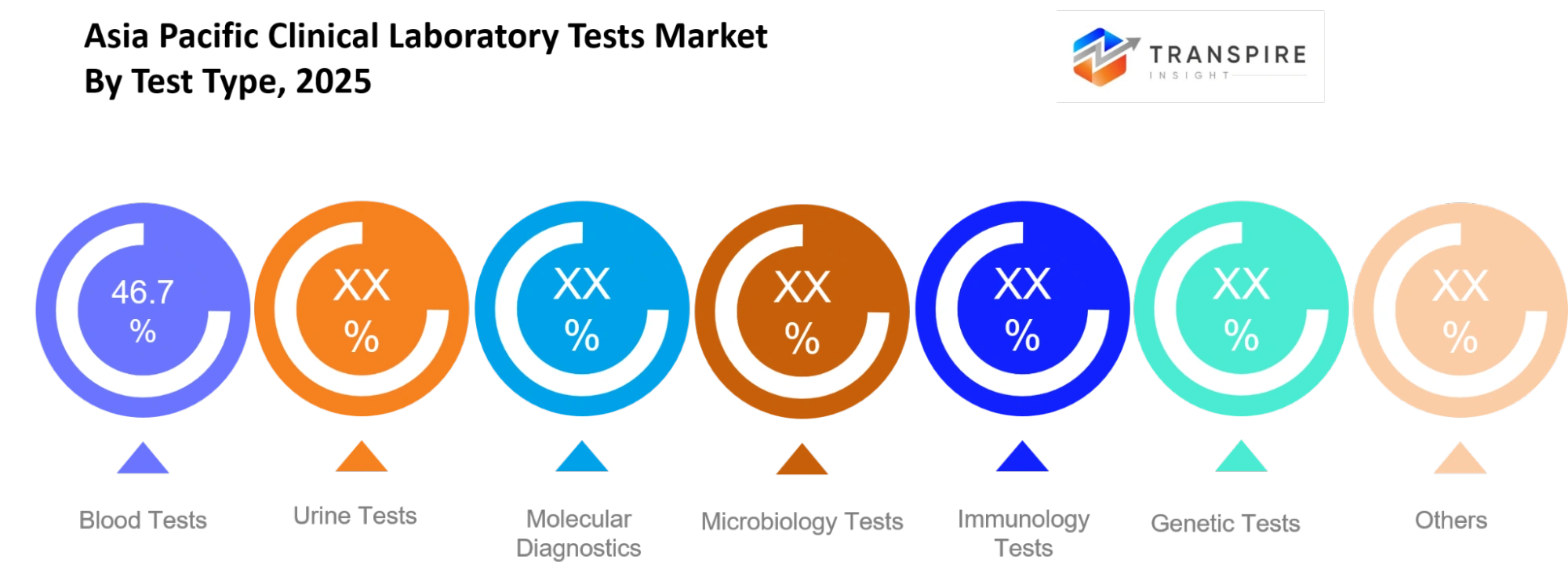
Blood tests are the common type of test done in Asia Pacific clinical diagnostics. This is because people get these tests done regularly to check for anemia, metabolic conditions and infections. Urine tests are also done regularly to check how well the kidneys are working and to check for pregnancy. Molecular diagnostics is a type of test that is becoming more popular because it helps doctors find out exactly what is wrong with a person. This type of test is used to check for infections and cancer. Microbiology tests help doctors find out what kind of germ is making a person sick. Immunology and genetic tests are also becoming more popular because they help doctors make a treatment plan for each person. The Asia Pacific Clinical Laboratory Tests Market is moving towards using precise tests in hospitals and laboratories.
The use of automated machines is increasing in laboratories, which means they can do blood and molecular tests. Many people have diseases so they need to get tested regularly. Genetic tests are becoming more popular in cancer screening programs. Microbiology tests are also becoming more popular because laboratories are getting better at keeping people safe from germs. Doctors are trying to find out if a person is sick early as possible so they are using tests that can check for many things at once. Laboratories are investing in automated machines, which means they can do tests without having to do everything by hand.
By End User
Hospitals are the places where most tests are done because they have patients and a system in place for diagnosing people. Diagnostic laboratories are also doing tests and are setting up centers where they can do many tests at once. Clinics are doing tests to help people who are not very sick. Academic institutes are doing research. Testing new diagnostic technologies. The Asia Pacific Clinical Laboratory Tests Market relies heavily on hospitals to do tests.
Many hospitals are opening branches, which means they can do more tests for people with chronic diseases and infections. Diagnostic laboratories are working together to make sure they can do tests in places and give people their results quickly. Clinics are helping to find out if people are sick on which means they do not have to go to the hospital. Academic institutes are getting funding to do research and find biomarkers and testing methods. Hospitals and diagnostic laboratories are working together to make sure they can do tests quickly and get the results to people fast.
By Technology
chemistry is a type of test that is used to check how well a persons organs are working. Hematology is a type of test that is used to check for blood disorders. PCR technology is a type of test that is used to check for infections and genetic diseases. Immunoassays are a type of test that is used to check for hormones and disease markers. Sequencing technology is a type of test that is used to check for cancer and rare diseases. The Asia Pacific Clinical Laboratory Tests Market is moving towards using precise diagnostic platforms.
Automated machines are being used more in chemistry, which means tests can be done faster and with less waste. PCR technology is being used more because it can help doctors find out quickly if someone has an infection. Immunoassay platforms are being used with automated machines to make sure tests are consistent and accurate. Sequencing technology is being used more because it is becoming cheaper and computers can help with the results. Laboratories are. Moving away from doing things by hand which means they can do more tests and get the results faster.
By Application
disease testing is the most common type of test done because doctors need to check for infections all the time. Oncology testing is becoming more popular because cancer is becoming more common and people are getting tested earlier. Cardiology diagnostics are used to check for heart disease by using biomarkers. Diabetes testing is steady because people need to check their glucose levels all the time. The Asia Pacific Clinical Laboratory Tests Market is strong in the areas of chronic and diseases.
After the pandemic doctors are doing tests to check for infections. Oncology screening programs are expanding to cities and more people have insurance to cover the tests. Cardiology testing is becoming more popular because people are trying to stay healthy and prevent lifestyle diseases. Diabetes testing is becoming more popular because many people have metabolic disorders as they get older. Doctors are working together to make sure they can diagnose diseases, at once.
What are the Key Use Cases Driving the Asia Pacific Clinical Laboratory Tests Market?
The Asia Pacific Clinical Laboratory Tests Market is really about infectious disease diagnostics. This is the thing that hospitals and big laboratories in the area focus on. They get a lot of patients so they need to do a lot of tests to see if people have fevers and to check on them after an outbreak. This means they are always doing blood tests and molecular infection tests.Hospitals need to get the results of these tests so they can decide what to do to help the patients right away and stop the infection from spreading. They use machines that can do PCR and immunoassay tests fast.
There are some things that laboratories and clinics are starting to do more of. For example they are doing tests for cancer and diabetes. Some cities have programs to screen for cancer and doctors are keeping an eye on people with diabetes to make sure they are okay. They use machines that can do the tests automatically which helps get the results to the doctorsSome new things that are starting to happen include doing tests in emergency rooms and checking for genetic problems in special clinics. Some people are also using computers to help figure out what is wrong with patients and using kits that can do tests outside of the laboratory. This is helping doctors make decisions faster even when they are not, in a hospital.
|
Report Metrics |
Details |
|
Market size value in 2025 |
USD 23.8 Billion |
|
Market size value in 2026 |
USD 24.9 Billion |
|
Revenue forecast in 2033 |
USD 35.02 Billion |
|
Growth rate |
CAGR of 4.99% from 2026 to 2033 |
|
Base year |
2025 |
|
Historical data |
2021 - 2024 |
|
Forecast period |
2026 - 2033 |
|
Report coverage |
Revenue forecast, competitive landscape, growth factors, and trends |
|
Regional scope |
Asia Pacific |
|
Key company profiled |
Quest Diagnostics, Labcorp, Sonic Healthcare, SRL Diagnostics, Metropolis, Dr Lal PathLabs, Roche Diagnostics, Abbott, Siemens Healthineers, Bio-Rad, Thermo Fisher, Sysmex, Danaher, Qiagen, Agilent |
|
Customization scope |
Free report customization (country, regional & segment scope). Avail customized purchase options to meet your exact research needs. |
|
Report Segmentation |
By Test Type (Blood Tests, Urine Tests, Molecular Diagnostics, Microbiology Tests, Immunology Tests, Genetic Tests, Others); By End User (Hospitals, Diagnostic Laboratories, Clinics, Academic Institutes, Others); By Technology (Clinical Chemistry, Hematology, PCR, Immunoassays, Sequencing, Others); By Application (Infectious Diseases, Oncology, Cardiology, Diabetes, Others) |
Which Regions are Driving the Asia Pacific Clinical Laboratory Tests Market Growth?
East Asia represents the largest share of the Asia Pacific Clinical Laboratory Tests Market due to its advanced healthcare infrastructure, high diagnostic testing volumes, and strong adoption of laboratory automation. Public health programs and widespread screening initiatives continue to support demand for routine and specialized laboratory tests. The region also benefits from a dense network of hospitals, reference laboratories, diagnostic manufacturers, and research institutions that strengthen testing capacity. This integrated ecosystem enables rapid adoption of new diagnostic technologies and sustains its leadership position.
Oceania contributes a smaller but highly stable portion of market revenue, supported by mature healthcare systems and consistent investment in diagnostic quality standards. Unlike East Asia, growth is driven less by scale and more by demand for high-value testing services and precision diagnostics. Laboratories in the region maintain strong operational standards and regularly upgrade testing platforms to improve efficiency and accuracy. These factors create a reliable market environment that supports steady long-term demand for clinical laboratory services.
South Asia is emerging as the fastest-growing region as healthcare access expands and diagnostic awareness increases across urban and semi-urban populations. Recent investments in laboratory networks, digital health infrastructure, and molecular testing capabilities have accelerated market development. Growing emphasis on early disease detection and preventive healthcare is creating new opportunities for both public and private diagnostic providers. Over the 2026–2033 period, this growth trajectory is expected to attract investment in laboratory expansion, advanced testing technologies, and integrated diagnostic service models.
Who are the Key Players in the Asia Pacific Clinical Laboratory Tests Market and How Do They Compete?
The Asia Pacific Clinical Laboratory Tests Market exhibits a moderately consolidated competitive structure, with multinational diagnostics companies competing alongside regional laboratory networks and specialized testing providers. Competition is driven primarily by technology innovation, test accuracy, turnaround time, and laboratory automation capabilities rather than price alone. Established participants are strengthening their positions through advanced molecular diagnostics, digital laboratory platforms, and expanded test portfolios, while emerging companies focus on niche applications such as genetic testing and precision medicine. The ability to deliver high-throughput testing and integrate data analytics into laboratory workflows has become a key differentiator across the market.
Roche Diagnostics pursues a technology-led strategy centered on molecular diagnostics, immunoassays, and automated laboratory systems. Its cobas platform provides integrated workflow solutions that improve efficiency and scalability for large testing volumes. Abbott Laboratories differentiates itself through a broad diagnostics portfolio that spans clinical chemistry, immunoassays, and rapid molecular testing, enabling laboratories to consolidate multiple testing functions on connected platforms. Siemens Healthineers focuses on automation and digitalization, offering laboratory solutions that combine diagnostic instruments with software-driven workflow optimization to reduce operational complexity.
Thermo Fisher Scientific emphasizes specialized molecular and genetic testing technologies, particularly in sequencing and precision medicine applications. The company expands its presence through strategic collaborations and continuous enhancement of its life science and diagnostic testing portfolio. Danaher Corporation, through its diagnostics businesses, competes by delivering integrated laboratory solutions that combine instruments, reagents, and data management capabilities, allowing laboratories to improve productivity while expanding access to advanced diagnostic testing services.
Company List
- Quest Diagnostics
- Labcorp
- Sonic Healthcare
- SRL Diagnostics
- Metropolis Healthcare
- Dr Lal PathLabs
- Roche Diagnostics
- Abbott
- Siemens Healthineers
- Bio-Rad Laboratories
- Thermo Fisher Scientific
- Sysmex Corporation
- Danaher Corporation
- QIAGEN
- Agilent Technologies
Recent Development News
"In May 2026, CellCarta entered a strategic partnership with Sonic Healthcare USA. The collaboration aims to commercialize companion diagnostics through Sonic’s laboratory network, accelerating access to precision medicine testing and strengthening advanced clinical laboratory services globally, including Asia-Pacific markets.https://cellcarta.com
"In March 2026, Roche Diagnostics announced the expansion of its Ionify® mass spectrometry assay portfolio for the cobas® i 601 analyzer after receiving CLIA moderate-complexity designation for its steroid assays. The development broadens access to automated high-precision laboratory testing and supports wider adoption of advanced clinical laboratory diagnostics.https://diagnostics.roche.com
"In April 2026, Roche Diagnostics highlighted launch updates for its mass spectrometry platform, including the cobas® i 601 analyzer, during Roche Diagnostics Day 2026. The continued commercialization and menu expansion of the platform are expected to enhance laboratory automation, workflow efficiency, and specialized clinical testing capabilities.https://www.roche.com
What Strategic Insights Define the Future of the Asia Pacific Clinical Laboratory Tests Market?
The Asia Pacific Clinical Laboratory Tests Market is moving toward a more decentralized, data-driven diagnostic ecosystem over the next five to seven years. Growth will increasingly be shaped by the integration of automation, artificial intelligence-enabled interpretation, and high-throughput molecular testing rather than simple expansion in testing volumes. Rising demand for preventive healthcare, precision medicine, and population-scale disease surveillance is expected to accelerate this structural shift.
A less visible risk lies in the growing concentration of advanced testing technologies among a limited number of global diagnostics suppliers. Dependence on a narrow supplier base could expose laboratories to pricing pressure, reagent shortages, and technology-access constraints during periods of supply disruption. At the same time, multi-omics testing platforms that combine genomics, proteomics, and metabolomics represent an emerging opportunity that remains underpenetrated but is gaining relevance for personalized treatment pathways.
Market participants should prioritize investments in scalable digital laboratory infrastructure and strategic partnerships that expand access to advanced testing capabilities while reducing dependence on single-source technology providers.
Asia Pacific Clinical Laboratory Tests Market Report Segmentation
By Test Type
- Blood Tests
- Urine Tests
- Molecular Diagnostics
- Microbiology Tests
- Immunology Tests
- Genetic Tests
- Others
By End User
- Hospitals
- Diagnostic Laboratories
- Clinics
- Academic Institutes
- Others
By Technology
- Clinical Chemistry
- Hematology
- PCR
- Immunoassays
- Sequencing
- Others
By Application
- Infectious Diseases
- Oncology
- Cardiology
- Diabetes
- Others
Frequently Asked Questions
Find quick answers to common questions.
The expected Asia Pacific Clinical Laboratory Tests Market size for the market will be USD 35.02 Billion in 2033.
Key segments for the Asia Pacific Clinical Laboratory Tests Market are By Test Type (Blood Tests, Urine Tests, Molecular Diagnostics, Microbiology Tests, Immunology Tests, Genetic Tests, Others); By End User (Hospitals, Diagnostic Laboratories, Clinics, Academic Institutes, Others); By Technology (Clinical Chemistry, Hematology, PCR, Immunoassays, Sequencing, Others); By Application (Infectious Diseases, Oncology, Cardiology, Diabetes, Others) .
Major Asia Pacific Clinical Laboratory Tests Market players are Quest Diagnostics, Labcorp, Sonic Healthcare, SRL Diagnostics, Metropolis, Dr Lal PathLabs, Roche Diagnostics, Abbott, Siemens Healthineers, Bio-Rad, Thermo Fisher, Sysmex, Danaher, Qiagen, Agilent .
The Asia Pacific Clinical Laboratory Tests Market size is USD 23.8 Billion in 2025.
The Asia Pacific Clinical Laboratory Tests Market CAGR is 4.99% from 2026 to 2033.
- Quest Diagnostics
- Labcorp
- Sonic Healthcare
- SRL Diagnostics
- Metropolis Healthcare
- Dr Lal PathLabs
- Roche Diagnostics
- Abbott
- Siemens Healthineers
- Bio-Rad Laboratories
- Thermo Fisher Scientific
- Sysmex Corporation
- Danaher Corporation
- QIAGEN
- Agilent Technologies
About the Authors

Pankaj Ghogare Patil
I am Pankaj Ghogare Patil, a Senior Research Analyst at Transpire Insight, specializing in the Pharmaceutical, Chemicals & Materials, Healthcare IT, and Biotechnology industry. My expertise lies in conducting comprehensive market research, analyzing industry trends, evaluating competitive landscapes, and translating complex data into actionable insights. At Transpire Insight, I closely follow emerging technologies, regulatory developments, and market innovations to create accurate, well-researched, and informative content that helps businesses and professionals make informed decisions. I am committed to producing credible, evidence-based articles that reflect industry best practices while making technical topics accessible and valuable for a broad audience.

Chakradhar Khansole
Chakradhar serves as the Research Director at Transpire Insight, bringing over 8 years of experience in technology, innovation, and strategic market intelligence. He specializes in transforming complex market data into actionable business insights that enable organizations to make informed, growth-oriented decisions. Recognized for his strategic vision and analytical expertise, Chakradhar leads high-impact research initiatives, delivering comprehensive market assessments, competitive intelligence, and forward-looking industry analysis.
Recently Published Reports
-
Jul 2026
Alopecia Treatment Market
Alopecia Treatment Market Size, Share & Analysis Report By Disease Type (Alopecia Areata, Cicatricial Alopecia, Traction Alopecia, Alopecia Totalis, Androgenetic Alopecia, Alopecia Universalis, and Other Disease Types), By Treatment Type (Topical Treatments, Oral Medications, Injectable Therapies, and Hair Transplantation), By Gender (Male, and Female), By Distribution Channel (Hospitals and Clinics, Retail Pharmacies, and Online Retailers), and Geography (North America, Europe, Asia-Pacific, Middle East and Africa, South and Central America), 2021 - 2031
-
Jul 2026
Medical Ultrasound Probe Market
Medical Ultrasound Probe Market Size, Share & Analysis Report By Type (Linear Type, Convex Type, Endocavitary Probe, Phased Array/Cardiac Probe, Transesophageal (TEE) Probe, and Others), By Application (Ophthalmology, Cardiology, Musculoskeletal, Oncology, Obstetrics & Gynecology, General Imaging, and Others), By End User (Hospitals & Clinics, Diagnostic Centers, Ambulatory Surgical Centers, and Others), and Geography (North America, Europe, Asia-Pacific, Middle East and Africa, South and Central America), 2021 – 2031
-
May 2026
Biosimilars Market
Biosimilars Market By Product Type (Monoclonal Antibodies, Recombinant Hormones, Erythropoietin, G-CSF, Others), By Indication (Oncology, Autoimmune Diseases, Blood Disorders, Diabetes, Others), By Manufacturing Type (In-House Manufacturing, Contract Manufacturing), By Distribution Channel (Hospital Pharmacies, Retail Pharmacies, Online Pharmacies), By Industry Analysis, Size, Share, Growth, Trends, and Forecasts 2021-2033
-
Apr 2026
Gastrointestinal Endoscopy Market
Gastrointestinal Endoscopy Market By Type (Rigid Gastrointestinal Endoscope, Flexible Gastrointestinal Endoscopes, Disposable Gastrointestinal Endoscope), By Procedure Type (Colonoscopy, Gastroscopy, Duodenoscopy, Enteroscopy, Flexible Sigmoidoscopy, Others), By Application (Diagnosis, Treatment), By End-Users (Hospitals, Ambulatory Surgical Centers, Specialty Clinics, Laboratories, Others), By Industry Analysis, Size, Share, Growth, Trends, and Forecasts 2021-2033