
Market Summary
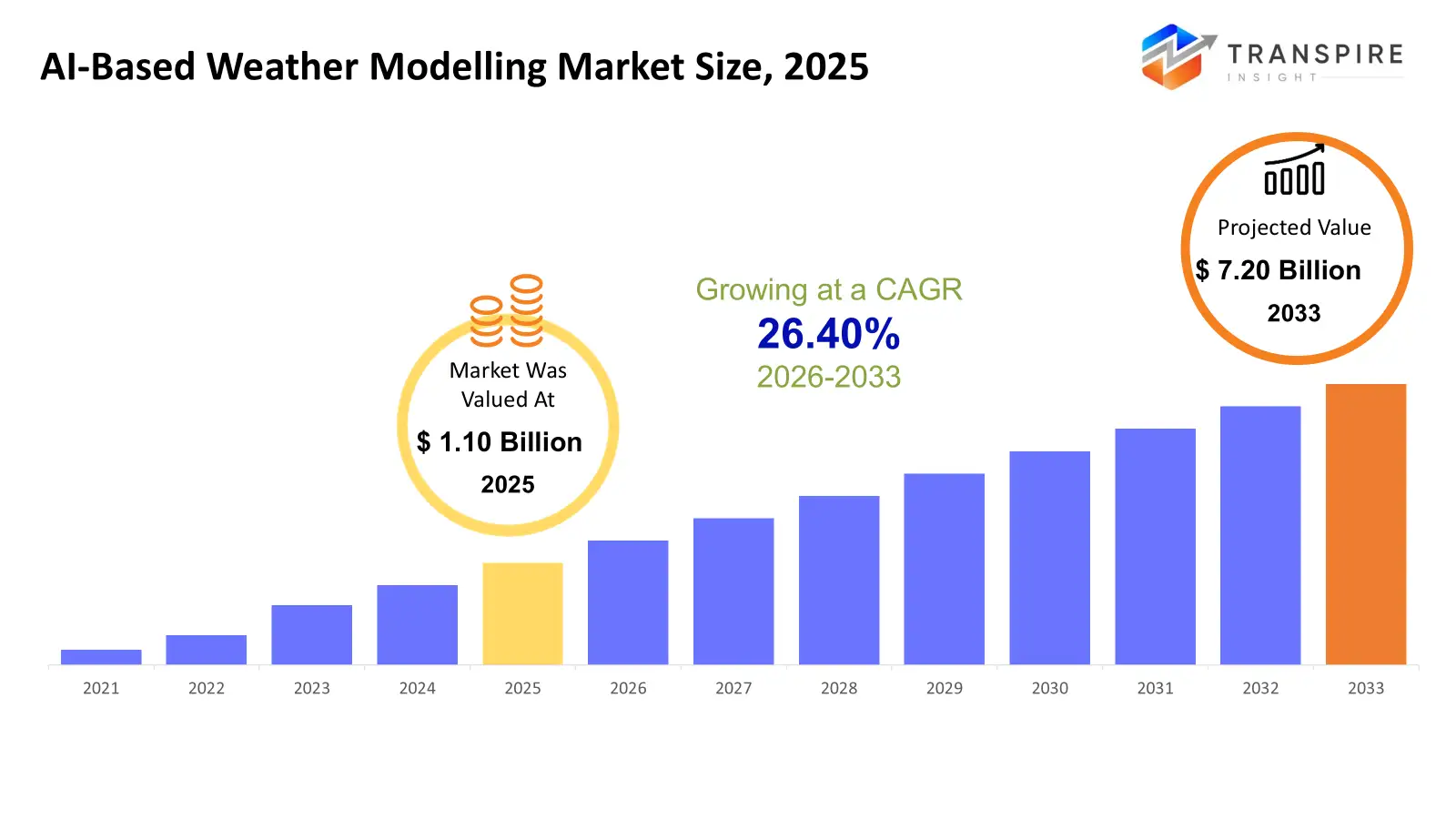
The global AI-Based Weather Modelling market size was valued at USD 1.10 billion in 2025 and is projected to reach USD 7.20 billion by 2033, growing at a CAGR of 26.40% from 2026 to 2033. The market for AI-based weather modeling is increasing because of the rising demand for accurate and real-time weather forecasts in critical sectors such as agriculture, energy, and transportation. Cloud-based AI solutions and hybrid models of weather forecasting improve the efficiency of weather forecasting and minimize computational expenses. The increasing number of extreme weather occurrences is fueling the demand for AI-based weather modeling solutions among governments and private organizations for disaster management and risk reduction.
Market Size & Forecast
- 2025 Market Size: USD 1.10 Billion
- 2033 Projected Market Size: USD 7.20 Billion
- CAGR (2026-2033): 26.40%
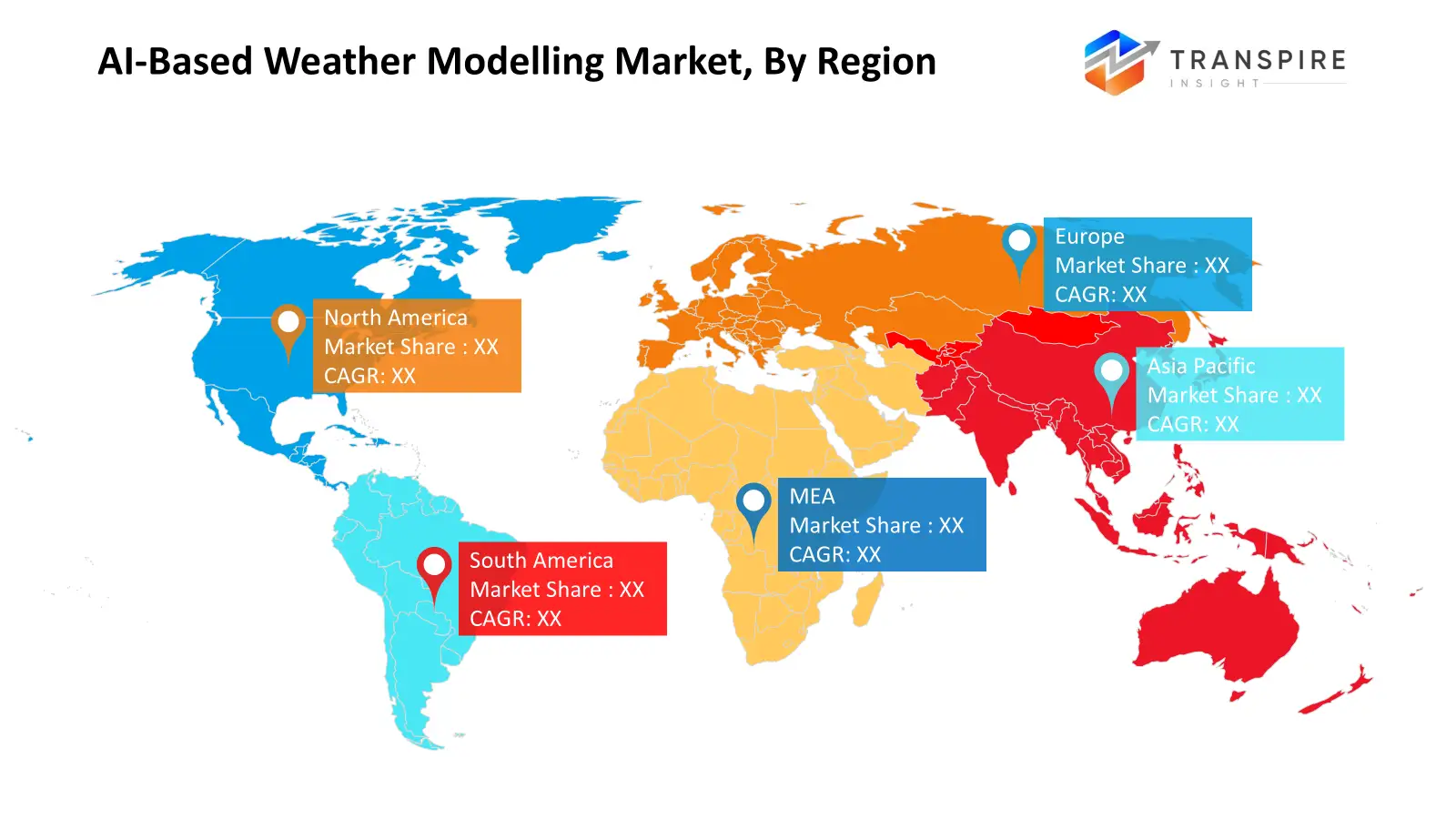
- North America: Largest Market in 2026
- Asia Pacific: Fastest Growing Market
To learn more about this report,  Download Free Sample Report
Key Market Trends Analysis
- North America shows high adoption rates for AI-based weather forecasting solutions due to the region’s advanced computing infrastructure, high investment in climate analysis, and abundant data, which enables the swift implementation of hybrid forecasting solutions in the energy, transport, and disaster response sectors, which demand high accuracy and reliability in forecasting.
- The United States continues to be at the forefront of technological innovation with high investments in artificial intelligence, cloud computing, and meteorology, which enables the widespread use of AI-based forecasting solutions for renewable energy resource optimization, aviation safety, climate analysis, and enterprise risk management in various sectors.
- The Asia-Pacific region is experiencing a rapid adoption rate due to climate change, agricultural reliance, and rising disaster risks, which are pushing governments and businesses to adopt AI-based forecasting solutions that can facilitate localized forecasting, infrastructure development, and energy management in the rapidly digitalizing economies of the region.
- Software components are the most popular trend in component choices, as organizations are focusing on developing scalable AI solutions that can combine real-time data inputs, while cloud deployment is making these solutions more accessible, easier to operate, and more efficient for forecasting purposes.
- Hybrid models are now being recognized as the preferred choice in modeling due to their ability to leverage physics-based modeling and machine learning capabilities, which will enable enhanced accuracy and processing capabilities for complex applications such as extreme weather modeling, climate analysis, and renewable energy forecasting.
- Short-term weather forecasting is still the most prominent application in terms of adoption, as various industries are now increasingly demanding real-time and highly localized weather forecasts to minimize disruptions in operations and optimize logistics planning, and AI is now enabling faster data processing and enhanced responsiveness to rapidly changing atmospheric conditions.
- Government and meteorological organizations are still the most prominent end-users, as there is an increasing focus on disaster preparedness, climate monitoring, and public safety, as AI-based systems are now enabling efficient processing of large observational datasets and enhancing early warning systems for extreme weather events and long-term climate risks.
So, The AI-based weather modeling market is primarily concerned with the application of artificial intelligence to improve the accuracy of weather forecasts and climate modeling. The market combines machine learning algorithms with conventional numerical models to offer real-time weather forecasts, long-term climate projections, and disaster management information. The increasing need for accurate weather information in agriculture, energy, transportation, and insurance has driven the demand for AI-based solutions.
Cloud-based implementation, hybrid modeling, and analytics are transforming the way organizations handle historical and real-time weather information. Governments and weather departments employ AI-based models to forecast severe weather events, manage energy resources, and make policy-related decisions. Businesses apply these models to optimize efficiency, mitigate risks, and make proactive logistics decisions. The increasing availability of computing power and data further fuels the adoption of AI-based weather modeling solutions worldwide.
AI-Based Weather Modelling Market Segmentation
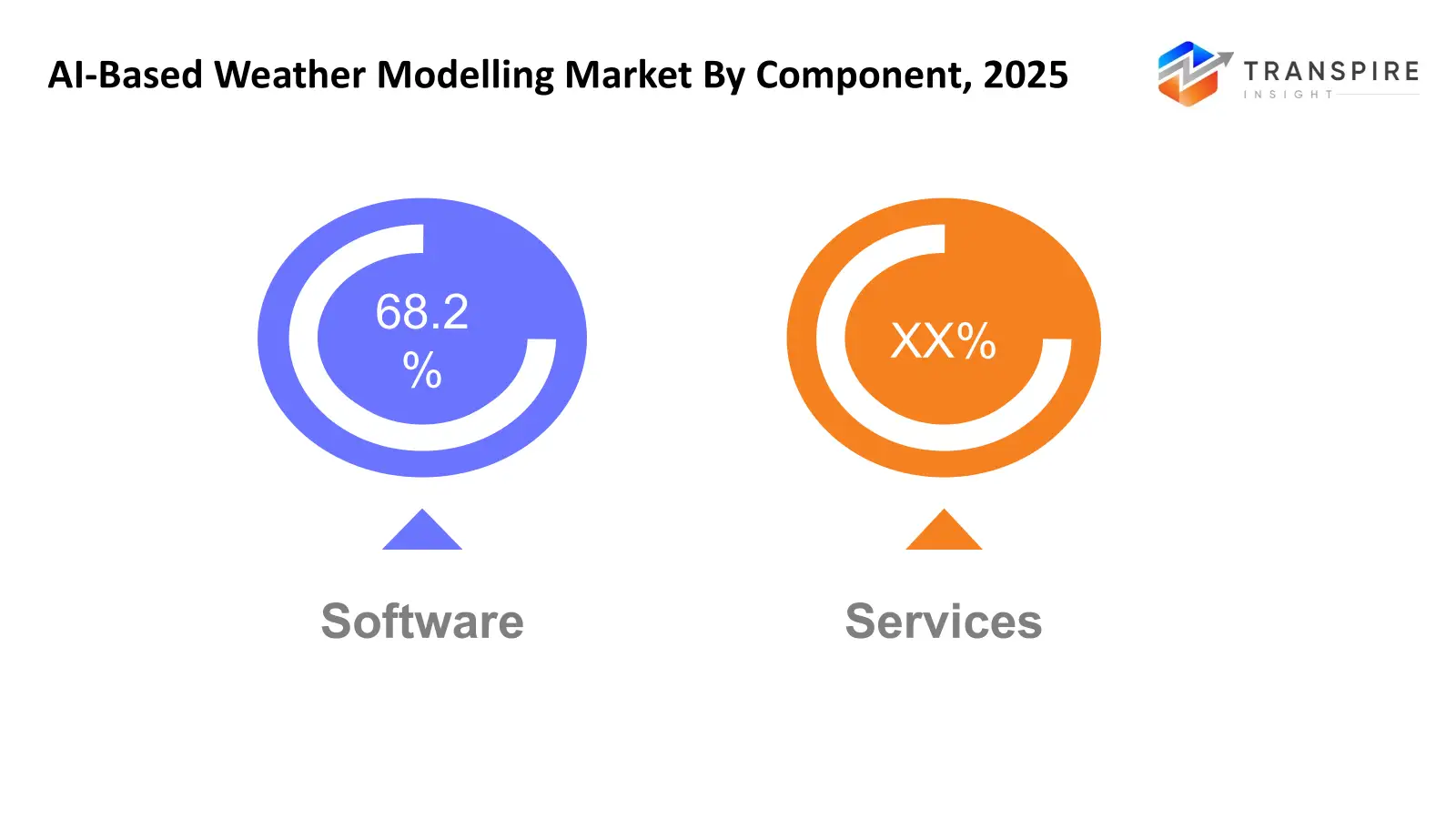
By Component
- Software
The AI-based weather modeling software combines machine learning algorithms with conventional weather forecasting models. The software is widely adopted by weather departments and corporate organizations, especially in North America and Europe, owing to their sophisticated IT infrastructure. Cloud-based solutions are increasingly being adopted to enable real-time updates and scalability for regional and global weather forecasting.
- Services
Weather modeling services comprise consulting, implementation, and predictive analytics services. These services help organizations in the agriculture, energy, and insurance sectors adopt AI models without requiring in-house expertise. The demand for these services is increasing in the Asia Pacific and Middle East & Africa regions, driven by the need for localized weather information and disaster management solutions.
To learn more about this report, Download Free Sample Report
By Model Type
- Numerical Weather Prediction (NWP) Models
NWP models employ physics-based algorithms to predict atmospheric phenomena and are essential for precise short- and medium-term forecasting. They are extensively used in government weather centers across North America and Europe, thanks to the availability of strong computing infrastructure. AI integration improves the accuracy of extreme weather forecasting.
- Machine Learning (ML) Models
ML models are based on past weather data to identify trends and make predictions. ML models are gaining popularity in the Asia Pacific and South America regions, thanks to the accelerated digitalization process that enables the collection of large weather datasets. They offer faster agricultural, energy, and insurance industry forecasts with less computational complexity compared to NWP models.
- Hybrid Models
Hybrid models incorporate both NWP and ML models to enhance forecast accuracy by utilizing the strengths of both physics-based and data-driven models. Hybrid models are gaining popularity in Europe and North America for high-risk applications like disaster prediction and climate modeling.
By Application
- Short-Term Weather Forecasting
Short-term weather forecasts are used for forecasting conditions from hours to days. They are crucial for flight planning, transportation, and organizing events. The use of short-term forecasts is most prevalent in North America and Europe, where there is a need for precise and up-to-date information. The addition of AI improves the ability to react to sudden changes in the weather.
- Medium-Term Weather Forecasting
Medium-term weather forecasts range from days to weeks. They are useful for agricultural planning, energy load forecasting, and water resource management. The Asia Pacific region witnesses a rise in the use of medium-term weather forecasts, where AI-based models are used to counteract crop damage and optimize the functioning of renewable energy sources.
- Long-Term Climate Modelling
Long-term models forecast seasonal and annual climate patterns. Europe and North America are prominent users of long-term models because of their established climate observation systems. AI enhances the analysis of scenarios and minimizes computation time for multi-year forecasting.
- Disaster Prediction & Management
AI models for disaster prediction concentrate on cyclones, floods, and weather-related disasters. These models are essential in the Asia Pacific, South America, and Middle East & Africa regions because of the regular occurrence of climate-related disasters.
By End User
- Government & Meteorological Organizations
These organizations apply AI models for precise national weather forecasts, disaster response, and climate studies. North America and Europe are the primary investors in AI technology, thanks to their developed infrastructure and emphasis on public safety and government regulations. The application of AI technology improves the accuracy of weather forecasts and efficiency.
- Agriculture & Farming
Farmers and agricultural businesses apply AI weather models for irrigation, crop, and yield optimization. The Asia Pacific and South America regions are prominent markets, as agriculture in these regions is largely influenced by seasonal weather conditions. ML models provide predictive analytics to reduce losses from unpredictable weather occurrences.
- Energy & Utilities
AI models for weather forecasts help in the generation of renewable energy, grid management, and demand response. Europe and North America are the major adopters of AI technology, thanks to the integration of wind and solar power into their national energy grids. Predictive models improve efficiency and reduce weather-related downtime.
- Transportation & Logistics
Air transport, maritime, and land transport rely on weather models for route optimization, minimizing delays, and improving safety. North America and Europe are leaders because of their high-value logistics infrastructure. AI-powered real-time weather forecasts enable dynamic planning to counteract weather-related disruptions.
- Research & Academia
Research and academic organizations apply AI-powered weather models for climate research, environmental studies, and predictive analysis. Europe, North America, and Japan are major centers because of their superior research facilities. AI boosts the speed of simulations and offers in-depth analysis of long-term climate patterns.
- Insurance & Risk Management
Insurance firms apply AI-powered weather modeling for risk analysis, catastrophe modeling, and claims processing. The Asia Pacific and Middle East & Africa regions are witnessing an increase in adoption because of their susceptibility to climate change. AI enhances the accuracy of predictions, enabling insurers to minimize risks of weather-related financial losses.
Regional Insights
North America, comprising the US, Canada, and Mexico, is a mature market because of the sophisticated computing infrastructure, availability of data, and government-driven weather forecasting programs. Europe, including Germany, the UK, France, Spain, Italy, and RoE, is marked by a high level of adoption in climate studies, renewable energy resource optimization, and disaster response, with robust public-private partnerships. The Asia Pacific market, including Japan, China, Australia & New Zealand, South Korea, India, and RoAPAC, is experiencing a rapid adoption rate in agriculture, energy resource planning, and disaster-susceptible areas. The region is engaged in the development of ML and hybrid models for optimizing agricultural production, energy resources, and disaster response systems. The South America market, including Brazil, Argentina, and RoSA, is a growth market where AI services and predictive software solutions are applied to agriculture, risk management, and climate observation. Middle East & Africa, including Saudi Arabia, the United Arab Emirates, South Africa, and the Rest of the region, is expanding steadily with investments in infrastructure, optimizing the energy sector, and disaster preparedness. The market focuses on cloud-based and service-oriented AI solutions to address resource limitations and improve predictive capabilities. Hybrid modeling and AI software adoption are the leading trends in all regions, indicating a transition towards scalable, accurate, and real-time weather forecasting solutions.
To learn more about this report, Download Free Sample Report
Recent Development News
- January 2026, NVIDIA has announced the Earth-2 family of open AI weather models and tools, which is the first open, accelerated software stack for AI weather and climate modeling. The software stack includes all aspects of weather forecasting, ranging from the processing of observation data to the generation of global and local forecasts.
(Source: https://blogs.nvidia.com/blog/nvidia-earth-2-open-models)
- In December 2025, The National Oceanic and Atmospheric Administration (NOAA) has announced the operational use of a new set of global weather prediction models that utilize AI, which is a significant improvement in the country’s weather forecasting systems.
(Source: https://www.noaa.gov/news-release/noaa-deploys-new-generation-of-ai-driven-global-weather-models)
|
Report Metrics |
Details |
|
Market size value in 2025 |
USD 1.10 Billion |
|
Market size value in 2026 |
USD 1.40 Billion |
|
Revenue forecast in 2033 |
USD 7.20 Billion |
|
Growth rate |
CAGR of 26.40% from 2026 to 2033 |
|
Base year |
2025 |
|
Historical data |
2021 – 2024 |
|
Forecast period |
2026 – 2033 |
|
Report coverage |
Revenue forecast, competitive landscape, growth factors, and trends |
|
Regional scope |
North America; Europe; Asia Pacific; Latin America; Middle East & Africa |
|
Country scope |
United States; Canada; Mexico; United Kingdom; Germany; France; Italy; Spain; Denmark; Sweden; Norway; China; Japan; India; Australia; South Korea; Thailand; Brazil; Argentina; South Africa; Saudi Arabia; United Arab Emirates |
|
Key company profiled |
Google LLC, Microsoft, IBM Corporation, NVIDIA Corporation, AccuWeather, Inc., ClimateAi, The Tomorrow Companies Inc., Jupiter (Jupiter Intelligence), Atmos Climate, Open Climate Fix, Meteomatics AG, AWS (Amazon Web Services), Skymet Weather Services, DTN, LLC and Spire Global, Inc. |
|
Customization scope |
Free report customization (country, regional & segment scope). Avail customized purchase options to meet your exact research needs. |
|
Report Segmentation |
By Component (Software, Services), By Model Type (Numerical Weather Prediction (NWP) Models, Machine Learning (ML) Models, Hybrid Models), By Application (Short-Term Weather Forecasting, Medium-Term Weather Forecasting, Long-Term Climate Modelling, Disaster Prediction & Management) and By End User (Government & Meteorological Agencies, Agriculture & Farming, Energy & Utilities, Transportation & Logistics, Research & Academia, Insurance & Risk Management) |
Key AI-Based Weather Modelling Company Insights
Google LLC has created a strong market position in the AI-driven weather modeling market through its extensive technical know-how in AI, data analysis, and cloud infrastructure to create scalable forecasting solutions. The recent launch of AI-driven weather forecasting models tailored for enterprise use cases reflects the shift from laboratory to application phases for energy, logistics, and retail industries. With the immense processing power of Google Cloud and the advanced research capabilities of DeepMind, the company’s offerings facilitate the integration of large data sets, real-time analysis, and flexible forecasting outputs. Collaborations with government bodies and innovations in AI model development further strengthen its market positioning for precise weather analysis.
Key AI-Based Weather Modelling Companies:
- Google LLC
- Microsoft
- IBM Corporation
- NVIDIA Corporation
- AccuWeather, Inc.
- ClimateAi
- The Tomorrow Companies Inc.
- Jupiter (Jupiter Intelligence)
- Atmos Climate
- Open Climate Fix
- Meteomatics AG
- AWS (Amazon Web Services)
- Skymet Weather Services
- DTN, LLC
- Spire Global, Inc.
Global AI-Based Weather Modelling Market Report Segmentation
By Component
- Software
- Services
By Model Type
- Numerical Weather Prediction (NWP) Models
- Machine Learning (ML) Models
- Hybrid Models
By Application
- Short-Term Weather Forecasting
- Medium-Term Weather Forecasting
- Long-Term Climate Modelling
- Disaster Prediction & Management
By End User
- Government & Meteorological Agencies
- Agriculture & Farming
- Energy & Utilities
- Transportation & Logistics
- Research & Academia
- Insurance & Risk Management
Regional Outlook
- North America
- United States
- Canada
- Mexico
- Europe
- Germany
- United Kingdom
- France
- Spain
- Italy
- Rest of Europe
- Asia Pacific
- Japan
- China
- Australia & New Zealand
- South Korea
- India
- Rest of Asia Pacific
- South America
- Brazil
- Argentina
- Rest of South America
- Middle East & Africa
- Saudi Arabia
- United Arab Emirates
- South Africa
- Rest of the Middle East & Africa
Frequently Asked Questions
Find quick answers to common questions.
The approximate AI-Based Weather Modelling Market size for the market will be USD 7.20 billion in 2033.
Key segments for the AI-Based Weather Modelling Market By Component (Software, Services), By Model Type (Numerical Weather Prediction (NWP) Models, Machine Learning (ML) Models, Hybrid Models), By Application (Short-Term Weather Forecasting, Medium-Term Weather Forecasting, Long-Term Climate Modelling, Disaster Prediction & Management) and By End User (Government & Meteorological Agencies, Agriculture & Farming, Energy & Utilities, Transportation & Logistics, Research & Academia, Insurance & Risk Management).
Major AI-Based Weather Modelling Market players are Google LLC, Microsoft, IBM Corporation, NVIDIA Corporation, AccuWeather, Inc.
The North America region is leading the AI-Based Weather Modelling Market.
The CAGR of the AI-Based Weather Modelling Market is 26.40%.
- Google LLC
- Microsoft
- IBM Corporation
- NVIDIA Corporation
- AccuWeather, Inc.
- ClimateAi
- The Tomorrow Companies Inc.
- Jupiter (Jupiter Intelligence)
- Atmos Climate
- Open Climate Fix
- Meteomatics AG
- AWS (Amazon Web Services)
- Skymet Weather Services
- DTN, LLC
- Spire Global, Inc.
Recently Published Reports
-
Apr 2026
3D Optical Profiler Market
3D Optical Profiler Market Size, Share & Analysis Report By Type (Desktop 3D Optical Profiler, and Portable 3D Optical Profiler), By Technology (Confocal Technology, and White Light Interference), By End-Use Industry (Manufacturing, Research Institutions, Automotive, Aerospace and Defense, Medical Devices, and Other), and Geography (North America, Europe, Asia-Pacific, Middle East and Africa, South and Central America), 2021 - 2031
-
Apr 2026
Depth Sensor Market
Depth Sensor Market Size, Share & Analysis Report By Type (Infrared Depth Sensors, Time-of-Flight (ToF) Sensors, Stereo Vision Sensors, Structured Light Sensors, Ultrasonic Depth Sensors), By Application (Automotive, Robotics, Gaming, Consumer Electronics, Industrial Automation, Healthcare, Security & Surveillance, Others), By End Users (Automotive Manufacturers, Consumer Electronics Companies, Healthcare Providers, Industrial Companies, Security Agencies, Gaming Companies, Robotics Companies, Others), and Geography (North America, Europe, Asia-Pacific, Middle East and Africa, South and Central America), 2021 – 2031
-
Apr 2026
Digital Manufacturing Market
Digital Manufacturing Market Size, Share & Analysis Report By Component (Hardware, Software, and Services), By Technology (Robotics, 3D Printing, Internet of Things (IoT), and Others), By Application (Automotive and Transportation, Aerospace and Defense, Consumer Electronics, Industrial Machinery, and Others), By Process Type (Computer-Based Designing, Computer-Based Simulation, Computer 3D Visualization, Analytics, and Others), and Geography (North America, Europe, Asia-Pacific, Middle East and Africa, South and Central America), 2021 – 2031
-
Apr 2026
Digital Visa Services Market
Digital Visa Services Market Size, Share & Analysis Report By Type (Individual Travelers, Group Travelers), By Application (Tourism, Business Travel, Others), and Geography (North America, Europe, Asia-Pacific, Middle East and Africa, South and Central America), 2021 – 2031