
Feb 17, 2026
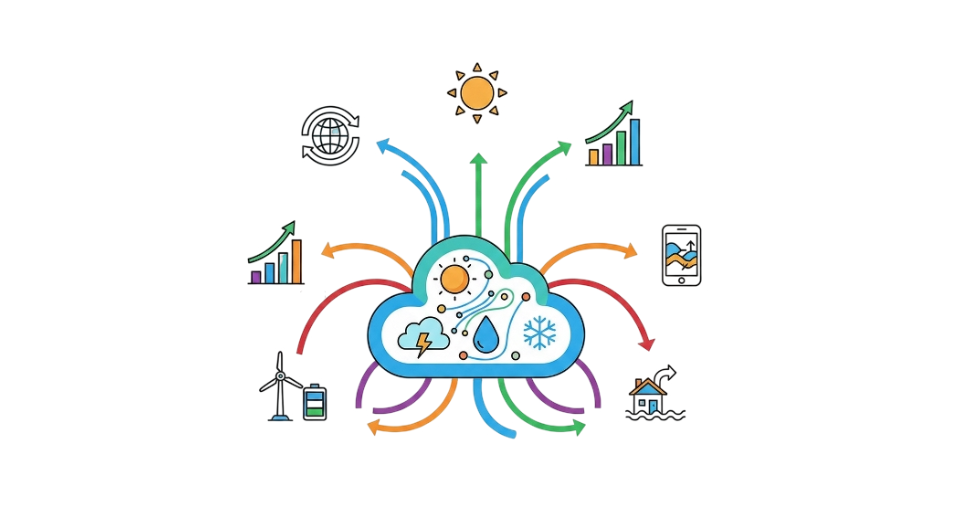
The report “AI-Based Weather Modelling Market By Component (Software, Services), By Model Type (Numerical Weather Prediction (NWP) Models, Machine Learning (ML) Models, Hybrid Models), By Application (Short-Term Weather Forecasting, Medium-Term Weather Forecasting, Long-Term Climate Modelling, Disaster Prediction & Management) and By End User (Government & Meteorological Agencies, Agriculture & Farming, Energy & Utilities, Transportation & Logistics, Research & Academia, Insurance & Risk Management)” is expected to reach USD 7.20 billion by 2033, registering a CAGR of 26.40% from 2026 to 2033, according to a new report by Transpire Insight.
The international AI-Based Weather Modelling Market is growing at a fast pace due to the increasing adoption of artificial intelligence technology to improve the accuracy, speed, and resolution of weather and climate forecasting. These models combine machine learning techniques with conventional numerical weather forecasting models to produce real-time forecasts, medium- and long-term climate projections, and disaster warnings. Rising adoption in the agriculture, energy, transportation, and insurance industries is driving the market, as companies are looking to reduce the risks associated with unpredictable weather patterns and optimize resource allocation. Cloud computing of AI weather models is revolutionizing the market with scalable, affordable, and easily maintainable solutions. Companies can now obtain highly localized forecasts without requiring large-scale computational resources. Hybrid models that integrate physics models with AI insights are improving the accuracy of weather forecasts and enabling informed decision-making for disaster response, renewable energy resource planning, and climate change impact analysis.
The government and meteorological departments continue to be key adopters, utilizing AI-driven platforms for national weather forecasting, climate analysis, and early warning systems for severe weather events. The adoption of AI-driven weather solutions is also gaining momentum in the private sector, with energy companies, logistics firms, and insurers using predictive analytics to mitigate losses and improve planning. The Asia-Pacific, South America, and Middle East & Africa regions, which are emerging markets, are also adopting AI-driven weather solutions to enhance agricultural productivity, energy grid management, and disaster readiness. Innovation driven by technology, government emphasis on climate resilience, and rising instances of severe weather events are expected to fuel the market's steady growth in the coming years.
The Software segment is projected to witness the highest CAGR in the AI-Based Weather Modelling during the forecast period.
According to Transpire Insight, Software solutions lead the market for AI-based weather modeling due to their scalability, customizability, and real-time predictive analysis capabilities. Cloud-based AI platforms enable organizations to leverage sophisticated weather forecasting models with minimal infrastructure investment, ensuring smooth integration with current business processes. Software solutions are most beneficial for businesses and organizations that need frequent updates, data analysis, and scenario simulation. With the increasing need for accurate weather intelligence across industries such as energy, agriculture, and transportation, software solutions continue to develop with improved machine learning algorithms, hybrid models, and automation tools that minimize margins of error and ensure the reliability of forecasts.
Software solutions also help optimize business operations by enabling applications across industries, making predictive planning easier. AI-based software solutions provide comprehensive tools for long-term climate modeling, short-term forecasting, and disaster risk management. Integration with big data analytics enables organizations to work with past and current data to produce highly accurate forecasts. Software development with continuous innovation, cloud scalability, and ease of deployment makes this market segment the key driver for market growth, attracting investment from both public and private sources worldwide.
The Hybrid Models segment is projected to witness the highest CAGR in the AI-Based Weather Modelling during the forecast period.
Hybrid models, which integrate traditional numerical weather forecasting with machine learning models, are also gaining immense popularity because of their accuracy and adaptability. Hybrid models have the ability to leverage both physics-based simulations and AI-driven insights, making them highly suitable for applications like disaster response, energy resource planning, and agricultural weather forecasting. Hybrid models are also known to minimize prediction errors and provide faster results than traditional numerical models, making them highly useful for decision-making in the public and private sectors.
The use of hybrid models is also being driven by the availability of large weather datasets and advancements in computational infrastructure. Organizations in North America, Europe, and Asia Pacific are increasingly adopting hybrid models to predict extreme weather events, optimize renewable energy resources, and support insurance and risk management activities. The ability to set customized parameters for a particular region or application makes hybrid models highly versatile and appealing for use in the public and private sectors. Hybrid models are poised to be a major growth driver in the AI-based weather modeling market.
The Short-Term Weather Forecasting segment is projected to witness the highest CAGR in the AI-Based Weather Modelling during the forecast period.
According to Transpire Insight, Short-term weather forecasting, which spans a few hours to a few days, is still the most popular use case in the market. Reliable short-term weather forecasts are critical for transportation, aviation, logistics, and energy load management, enabling businesses to minimize operational risks and maximize efficiency. AI-powered models improve the accuracy and speed of forecasting, enabling decision-making and reacting to abrupt weather changes in real-time, especially in high-risk areas.
The rise in the number of extreme weather events around the world has increased the demand for short-term weather forecasting solutions. AI-powered solutions enable the combination of multiple data sources, such as satellite images, sensors, and past weather data, to provide hyper-localized forecasts. This market is aided by cloud infrastructure and hybrid modeling techniques, which provide actionable and highly accurate predictive forecasts. As industries like logistics and energy continue to focus on operational resilience, short-term weather forecasting is expected to be a leading use case in the market.
The Government & Meteorological Agencies segment is projected to witness the highest CAGR in the AI-Based Weather Modelling during the forecast period.
The government and meteorological departments are the largest end-users, as they use AI-powered weather models for national forecasting, climate studies, and disaster risk management. Organizations in North America and Europe, in particular, use AI-powered solutions to enhance accuracy, cut computation time, and develop sophisticated early warning systems for natural disasters. These organizations also use a combination of hybrid and machine learning models to improve both short-term and long-term forecasts. The use of AI-powered solutions by government agencies is fueled by the need to protect citizens, manage infrastructure, and facilitate emergency response activities. AI helps meteorological departments analyze large amounts of observational and historical data efficiently, leading to improved predictive accuracy. Joint efforts between government agencies and private AI and cloud companies further fuel technological advancements, allowing organizations to develop solutions that are scalable and adaptable to region-specific climate and weather patterns.
The North America region is projected to witness the highest CAGR in the AI-Based Weather Modelling during the forecast period.
North America is one of the most prominent regions for AI-based weather modeling, thanks to the presence of sophisticated IT infrastructure, a comprehensive network of meteorological stations, and substantial investment in AI research and cloud computing. The United States of America, Canada, and Mexico are the major contributors to AI-based weather modeling, with government bodies, energy corporations, and transportation networks embracing AI models to improve the accuracy of weather forecasts. Hybrid models and ML models are increasingly being used for the prediction of extreme weather, renewable energy optimization, and disaster readiness, providing faster and more accurate results compared to traditional models.
The availability of prominent AI technology companies and advanced computing infrastructure enables high adoption rates in North America. Government-initiated projects, joint ventures between the public and private sectors, and innovation through research initiatives ensure that both software and service components continue to grow. North America also has a high density of real-time weather observation systems, satellite systems, and historical data archives, making it possible to train AI models more effectively.
Key Players
The top 15 players in the AI-Based Weather Modelling market include Google LLC, Microsoft, IBM Corporation, NVIDIA Corporation, AccuWeather, Inc., ClimateAi, The Tomorrow Companies Inc., Jupiter (Jupiter Intelligence), Atmos Climate, Open Climate Fix, Meteomatics AG, AWS (Amazon Web Services), Skymet Weather Services, DTN, LLC, and Spire Global, Inc.
Drop us an email at:
Call us on:
+91 7666513636

 inquiry@transpireinsight.com
 APAC:+91 7666513636
 Address





