
Feb 05, 2026
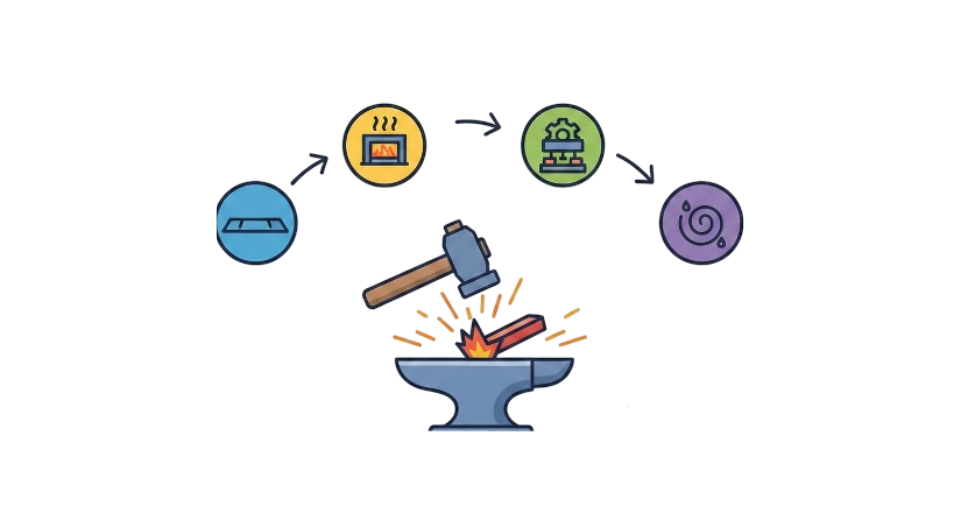
The report “Metal Forging Market By Forging Process (Open-Die Forging, Closed-Die Forging, Rolled Ring / Seamless Forging, Hammer Forging, Cold Forging, Others), By Material (Carbon Steel, Alloy Steel, Aluminum & Aluminum Alloys, Stainless Steel, Titanium & Superalloy, Magnesium & Other Specialty Materials), By Technology (Precision Forging, Automated & Robotic Forging Systems) and By End-Use Industry (Automotive & Commercial Vehicles, Aerospace & Defense, Industrial Machinery, Railway / Transportation, Oil & Gas / Energy & Power Generation, Construction & Heavy Equipment, Others)” is expected to reach USD 126.00 billion by 2033, registering a CAGR of 6.60% from 2026 to 2033, according to a new report by Transpire Insight.
The metal forging market represents a critical segment of the global manufacturing ecosystem, supplying high-strength, fatigue-resistant components across automotive, aerospace, industrial machinery, energy, and construction industries. Forged parts are crucial for load-bearing and safety-critical applications because forging methods improve mechanical integrity by fine-tuning grain structure. Forged components continue to outperform cast or manufactured counterparts as industries place a greater emphasis on longevity, performance, and lifecycle efficiency. Trends in automobile manufacturing, infrastructural development, industrial output, and energy investments all have a significant impact on market demand. Engine, gearbox, and chassis applications continue to be the key drivers of demand in the automotive and commercial vehicle industries. The utilization of precision forgings and high-value alloys is also growing as a result of defense modernization initiatives, aerospace recovery, and renewable energy installations. Consistent production quantities across areas are supported by these demand forces taken together.
The market for metal forging is becoming more competitive due to technological developments. Automation, robotics, and precision forging are being used more and more to increase operating efficiency, decrease material waste, and improve dimensional accuracy. To achieve strict OEM requirements while reducing production costs and enhancing sustainability performance, manufacturers are investing in digital process controls and sophisticated shaping techniques. The market forecast is still favorable for the future thanks to measures to lighten vehicles, the growing popularity of electric vehicles, and the growing usage of aluminum and specialized alloy forgings. Ongoing innovation and growing end-use applications are anticipated to support stable expansion during the projection period, despite limitations posed by capital-intensive equipment needs and raw material price instability.
The Closed-Die Forging segment is projected to witness the highest CAGR in the Metal Forging during the forecast period.
According to Transpire Insight, Closed-die forging represents the leading forging process segment due to its ability to produce complex, high-precision components at scale. The technique is especially well-suited for high-volume manufacturing situations because it provides greater dimensional precision, repeatability, and material utilization. For vital drivetrain, structural, and engine components where mechanical strength and uniformity are crucial, automotive and aerospace OEMs are depending more and more on closed-die forging.
From a commercial standpoint, closed-die forging's dominance is strengthened by its compatibility with performance standards and cost optimization. Long-term advantages like less machining, lower scrap rates, and increased productivity outweigh the higher initial tooling costs when compared to open-die methods. Closed-die forging is anticipated to maintain its dominant position in the forging process landscape as OEMs continue to consolidate suppliers and seek finer tolerances.
The Carbon Steel segment is projected to witness the highest CAGR in the Metal Forging during the forecast period.
Carbon steel remains the most widely used material in the metal forging market, supported by its favorable balance of strength, ductility, availability, and cost efficiency. It is widely used in applications requiring strong load-bearing capacity and durability, such as automotive, construction, industrial machinery, and transportation. The material's versatility in a variety of forging techniques further solidifies its leading position.
Large-scale infrastructure projects and consistent vehicle production volumes, especially in emerging markets, favor carbon steel forgings from the perspective of demand. Carbon steel is still an affordable option for mass-market applications, even though lightweight alternatives are becoming more popular. Long-term demand stability is further supported by its well-established supply chain and recyclability, guaranteeing its sustained significance in spite of tendencies toward material diversity.
The Precision Forging segment is projected to witness the highest CAGR in the Metal Forging during the forecast period.
According to Transpire Insight, With manufacturers concentrating on increasing productivity, accuracy, and sustainability, precision forging is becoming the most popular technology area. Near-net-shape production is made possible by this technology, which drastically lowers secondary machining and material waste. Precision forging is becoming more and more popular in sectors like automotive and aerospace to satisfy stringent performance requirements and dimensional tolerances.
Analytically, precision forging aligns closely with OEM requirements for cost control and quality consistency. Shorter production cycles and increased throughput result from fewer processing steps, which boosts supplier competitiveness. Precision forging is anticipated to be adopted more quickly as automation and digital monitoring proliferate, especially in high-value component manufacturing where performance reliability is crucial.
The Automotive & Commercial Vehicles segment is projected to witness the highest CAGR in the Metal Forging during the forecast period.
Due to the widespread usage of forged parts in engines, transmissions, axles, suspension systems, and safety-critical structures, the automotive and commercial vehicle industries continues to be the largest end-use market for metal forgings. Superior strength and fatigue resistance are provided by forged parts, which are crucial for vehicle longevity and legal compliance.
According to market dynamics, moves toward electrification and lightweighting are changing the demand for forging rather than decreasing it. Commercial vehicles continue to heavily rely on heavy-duty steel forgings, while electric vehicles still need forged parts for their drivetrains, chassis, and thermal systems. Automotive applications are anticipated to continue to be the main demand pillar for the metal forging market as global vehicle manufacturing steadily increases.
The North America region is projected to witness the highest CAGR in the Metal Forging during the forecast period.
North America's robust presence in the production of industrial machinery, automobiles, aircraft, and defense makes it a strategically important region in the global metal forging market. Due to sophisticated OEM ecosystems and stable demands for high-strength, safety-critical forged components, the US leads the region in demand. Carbon steel, alloy steel, and precision forgings are in steady demand across a variety of end-use industries due to ongoing infrastructure investments, commercial vehicle production, and defense modernization initiatives.
North America gains from the widespread use of automated and precision forging technologies, which allow producers to satisfy strict performance, quality, and traceability requirements. Supply chain resilience and governmental assistance are driving increased reshoring and localization of manufacturing in the region, strengthening domestic forging capability. Strong technological capabilities, high-value applications, and long-term OEM contracts place North America as a high-margin, innovation-driven market within the global metal forging environment, despite the fact that labor costs and capital intensity continue to be obstacles.
Key Players
The top 15 players in the Metal Forging market include Precision Castparts Corp., Howmet Aerospace Inc., Allegheny Technologies Incorporated, Thyssenkrupp AG, Nippon Steel Corporation, VSMPO-AVISMA Corporation, KOBELCO (Kobe Steel), Aichi Steel Corporation, Aubert & Duval, Bharat Forge Limited, American Axle & Manufacturing Holdings, AVIC Heavy Machinery, Wanxiang Qianchao Co. Ltd., FRISA Forjados S.A. de C.V., and Pacific Precision Forging.
Drop us an email at:
Call us on:
+91 7666513636

 inquiry@transpireinsight.com
 APAC:+91 7666513636
 Address





