
Sep 30, 2026
By Transpire Insight
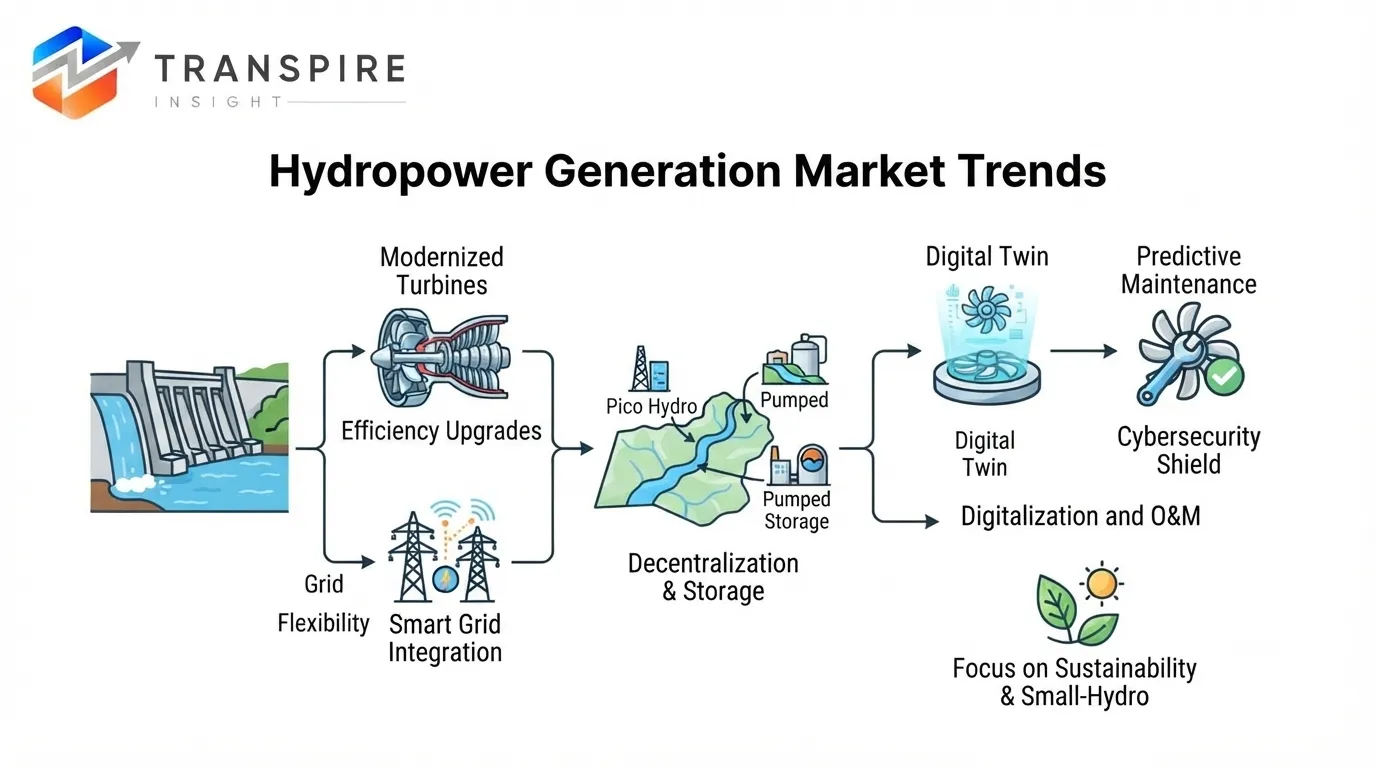
Description
According to a research report published by Transpire Insight, the hydropower generation market size is projected to grow from USD 316.77 billion in 2026 to USD 473.25 billion by 2035, at a CAGR of 4.5% during the forecast period 2027-2035. Rapid growth in the hydropower market is being propelled by growing demand for baseload clean energy, government decarbonization targets, rising integration of pumped storage for grid stabilisation, and the adoption and expansion of rural electrification projects worldwide.
Introduction
Hydro is still one of the mainstays for the world's renewable energy transition. New facilities have been built to generate electricity using kinetic water energy and have proven to be reliable, large-scale, and flexible in the grid due to advanced pumped storage. Hydropower is now an important tool to harmonize ephemeral solar and wind grid input in urban and industrial areas around the world as nations ramp up decarbonization efforts, upgrade old facilities, add more run-of-river projects, and incorporate digital management systems.
Recent Development News
March 2026: India's Expert Appraisal Committee (EAC) approved NHPC's 1,720MW Kamala Hydroelectric Project in Arunachal Pradesh after conducting hearings. The Expert Appraisal Committee (EAC) of India granted environmental clearance to NHPC's Kamala Hydroelectric Project in Arunachal Pradesh.
June 2026: IHA publishes its 2026 Outlook, with China leading the way with over 300 GW in the works.
Stay Ahead of Emerging Opportunities with Expert Market Insights by Transpire Insight
Transpire Insight provides comprehensive, data-driven market intelligence to support smarter business decisions. Our research is rooted in comprehensive analysis, authoritative predictions, and industry expertise, enabling organizations to make informed decisions in rapidly evolving markets. We provide in-depth analysis of market segmentation, competitive positioning, regional trends, and emerging investment opportunities in high-growth areas. We blend accuracy with actionable intelligence, helping companies uncover new growth avenues, strengthen strategic decision-making, and stay ahead in a dynamic market.
Hydropower Generation Market Size & Statistics
The Market Size for Hydropower Generation Was Estimated to be Worth USD 316.77 Billion in 2026.
The Market Size is Going to Expand at a CAGR of 4.5% between 2026 and 2035.
The Hydropower Generation Market Size is anticipated to reach USD 473.25 Billion by 2035.
Asia-Pacific is projected to drive the highest demand during the forecast period, accounting for 43.5% of the Hydropower Generation market.
Europe is projected to grow the fastest during the forecast period at a CAGR of 4.14% in the Hydropower Generation market.
Regional Growth and Demand Analysis by Transpire Insight
Asia Pacific is all set for leadership with the sustained investment in massive hydropower schemes and grid modernization in the region by China, while India focuses on the development of run-of-river projects in areas with water sources. GE Renewable Energy's deployment of Francis 117, a turbine designed to deliver the highest efficiency and reduce environmental footprint, also comes at a time when the region is simultaneously undergoing a technological transformation as new capacity continues to be installed throughout the major river basins of Asia, particularly in China, India and Southeast Asia. The region continues to have a strong role due to abundant water resources, the increasing demand for electricity due to industrialisation, and government support for renewable infrastructure, with large hydropower plants (over 10MW) still the main source of output.
Europe's growth is being shaped less by greenfield dam construction and more by modernization and flexibility upgrades. The European Investment Bank's (EIB) approval of financing for Energie AG Oberösterreich for expanding hydropower capacity in Austria shows the EIB's focus on replacing old assets and identifying pumped storage hydropower (PSH) potential in the region to mitigate intermittency caused by increasing solar and wind deployment. The EU renewable energy directive, which aims to hit higher targets for renewable energy, and the growth of Spain's hydropower base are just two factors that are further compelling investments in efficiency gains, digital monitoring, and grid balancing capacity in both Western and Nordic markets.
Top 15 Trends in the Hydropower Generation Market
Pumped Storage Hydropower (PSH) Adoption
Pumped storage hydropower is gaining traction as grids add more solar and wind, since it stores excess renewable electricity and delivers rapid balancing power.
Modernization and Refurbishment of Aging Plants
Utilities worldwide are refurbishing aging hydropower plants, upgrading turbines and control systems to boost efficiency, extend operational life, and improve grid reliability significantly each year.
Small and Micro Hydropower Expansion
Small and micro hydropower projects are expanding rapidly, supporting decentralized renewable generation in areas with suitable local water resources and limited existing grid access nationwide.
AI-Based Predictive Maintenance and Turbine Optimization
Artificial intelligence is optimizing turbine performance and predicting equipment failures, analyzing sensor data to reduce downtime, cut costs, and maximize overall plant energy output efficiently.
Retrofitting Dams with Reversible Pump-Turbines
Conventional dams are being retrofitted with reversible pump-turbines, cutting capital costs sharply compared with greenfield storage projects while doubling grid-balancing response speeds for utility operators.
Hybrid Hydropower-Solar-Wind Integration
Hydropower is increasingly paired with solar and wind assets, using reservoir storage to balance intermittent renewable output and strengthen overall power system resilience across national networks.
List of Top 25 Companies Leading the Hydropower Generation Market
leader operating the world's largest hydroelectric plant on the Yangtze River.
Founded: 1993 | HQ: Wuhan, China.
Why It Ranks: World's largest hydropower developer by capacity and total operational output footprint.
Regional Dominance: Dominates East Asia while expanding across Latin America and Southern Europe.
Product Line: Mega-scale hydroelectric dams, pumped-storage facilities, and offshore wind power developments.
Major European energy utility with immense pumped-storage and conventional hydro assets.
Founded: 1946 | HQ: Paris, France.
Why It Ranks: Operates Europe's largest fleet of flexible hydroelectric and pumped-storage power plants.
Regional Dominance: Strong presence across Western Europe, South America, and West Africa projects.
Product Line: Run-of-river installations, flexible pumped storage, high-head hydro, and grid integration.
Leading European producer of renewable energy with massive Scandinavian hydro portfolio assets.
Founded: 1895 | HQ: Oslo, Norway.
Why It Ranks: Europe's top producer of renewable power driven by extensive Norwegian reservoirs.
Regional Dominance: Dominates Northern Europe while scaling assets in South America and South Asia.
Product Line: Large hydro reservoirs, run-of-river plants, pumped storage, and green power trading.
Engineering powerhouse providing heavy equipment, turbines, and digital systems for hydro plants.
Founded: 2024 | HQ: Cambridge, Massachusetts, USA.
Why It Ranks: Supplies major electromechanical turbine systems for landmark hydroelectric dams globally.
Regional Dominance: Strong market footprint across North America, Europe, Asia-Pacific, and Latin America.
Product Line: Hydro turbines, generators, control systems, and plant digital automation solutions.
Premier technology supplier specializing in advanced hydraulic machines, automation, and plant services.
Founded: 1867 | HQ: Heidenheim, Germany.
Why It Ranks: Globally recognized OEM equipping a massive share of operating hydro capacity.
Regional Dominance: Leading market presence across Europe, North America, South America, and Asia.
Product Line: Francis, Kaplan, and Pelton turbines, generators, automation, and modernization services.
technology provider offering complete electro-mechanical equipment suites for hydroelectric power plants.
Founded: 1852 | HQ: Vienna, Austria.
Why It Ranks: World-leading supplier of electro-mechanical systems for large and small hydro projects.
Regional Dominance: Broad operational reach spanning Europe, North America, Latin America, and Asia.
Product Line: Water-to-wire equipment, bulb turbines, pumped storage technology, and plant rehabilitation.
Engineering giant providing grid interconnections, generators, and digital control solutions to developers.
Founded: 2020 | HQ: Munich, Germany.
Why It Ranks: Key technology partner supplying electrical equipment and grid integration for plants globally.
Regional Dominance: Dominant footprint across Europe, North America, the Middle East, and Asia-Pacific regions.
Product Line: High-voltage switchgear, transformers, generators, digital controls, and automation software solutions.
India's flagship public sector utility focused entirely on developing mega-scale hydroelectric projects.
Founded: 1975 | HQ: Faridabad, India.
Why It Ranks: Premier developer driving South Asia's major conventional and pumped-storage project pipelines.
Regional Dominance: Unrivaled leader across India, Bhutan, Nepal, and the wider South Asian region.
Product Line: High-head dams, underground powerhouses, run-of-river systems, and pumped storage facilities.
Renewable energy pioneer heavily invested in pumped-storage hydroelectric plants across Southwestern Europe.
Founded: 1992 | HQ: Bilbao, Spain.
Why It Ranks: Pioneering gigawatt-scale pumped-storage installations to act as massive clean energy batteries.
Regional Dominance: Dominates Southwestern Europe, the United Kingdom, and expands across Latin America.
Product Line: Pumped storage hydroelectricity, river hydro plants, and hybrid clean energy systems.
Latin America's largest electric power utility, controlling vast hydroelectric generation capacity and reservoirs.
Founded: 1962 | HQ: Rio de Janeiro, Brazil.
Why It Ranks: Controls the vast majority of Brazil's high-capacity hydroelectric plants and transmission networks.
Regional Dominance: Complete market dominance in Brazil and a prominent player across South America.
Product Line: High-capacity dams, run-of-river facilities, transmission infrastructure, and clean energy generation.
Conclusion
The hydropower market is entering an important modernization period due to grid decarbonisation needs. With wind and solar increasing in popularity, industry leaders are finding ways to transform dated infrastructure into critical flex storage resources through pumped-storage and advanced turbine automation. With wind and solar growing in popularity, top industry leaders are using pumped-storage and advanced turbine automation to transform dated infrastructure into critical flex storage resources. In combination with cross-border investments in infrastructure, sustainable technological innovation further reinforces the irreplaceable role of hydropower in the carbon-neutral and sustainable energy transition.


Send us a brief description of your challenge and we'll get back to you within 24 hours.

 [email protected]
 APAC:+91 7666513636
 Address


