
Nov 21, 2026
By Transpire Insight
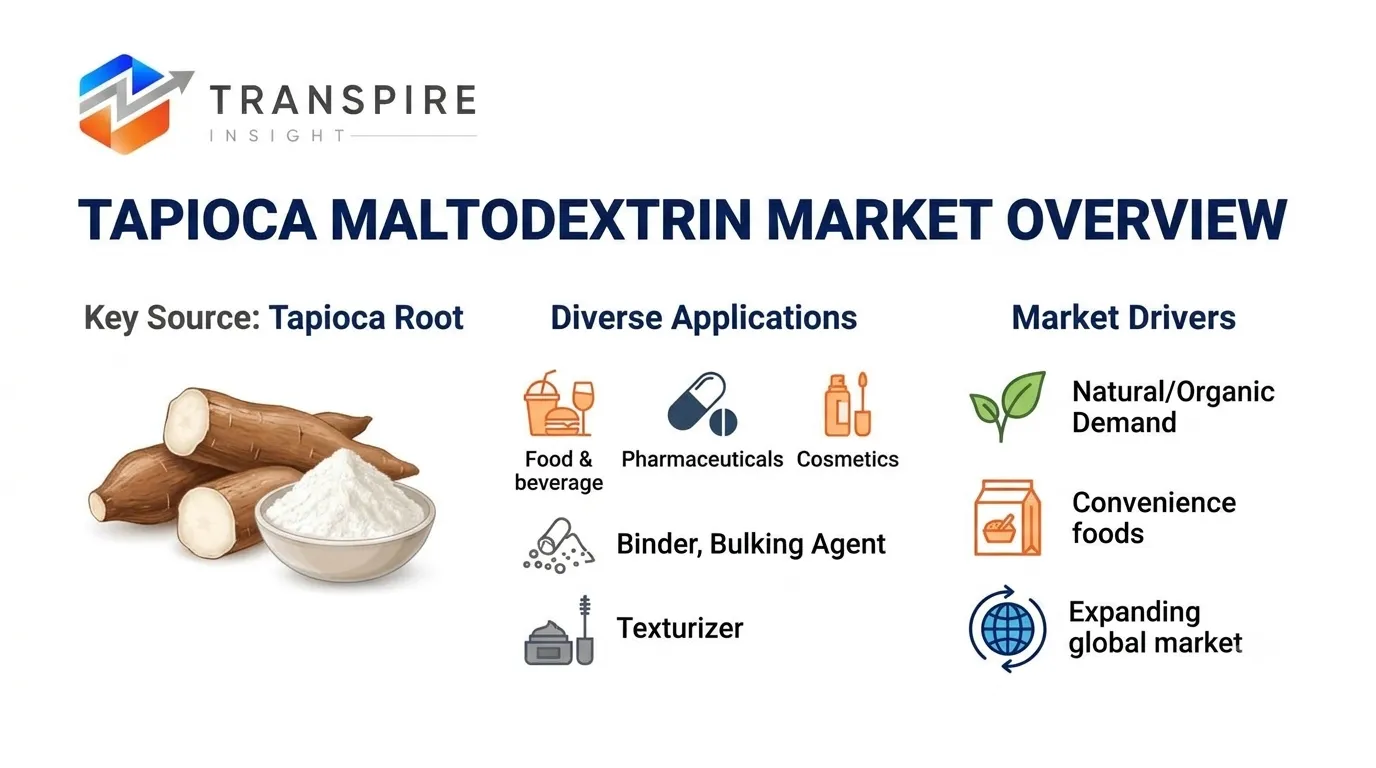
Description
According to a research report published by Transpire Insight, the global Tapioca Maltodextrin Market size was valued at USD 543.7 million in 2026 and is projected to reach approximately USD 579.64 million in 2027. The market is expected to grow at a CAGR of 6.61% during the 2027–2035 forecast period, reaching approximately USD 967.25 million by 2035. Increasing demand for plant-based food ingredients, clean-label formulations, gluten-free products, sports nutrition, pharmaceutical excipients, and functional food applications is supporting industry expansion. Manufacturers are focusing on improved ingredient functionality, non-GMO sourcing, consistent quality, neutral flavor profiles, and specialized tapioca-based carbohydrate ingredients to meet changing requirements across food, beverage, nutraceutical, and pharmaceutical industries.
Introduction
Tapioca maltodextrin occupies an interesting position in the food ingredient industry. Produced from cassava-derived tapioca starch, it offers manufacturers a functional carbohydrate ingredient for applications where texture, bulk, mouthfeel, and formulation stability matter.
Unlike conventional maltodextrin sourced from corn, tapioca maltodextrin provides an alternative for manufacturers seeking different starch sources, including non-GMO and plant-based ingredient options.
Its applications extend well beyond food processing. Food manufacturers use it in seasoning blends, beverages, bakery products, confectionery, dairy preparations, powdered mixes, and nutritional supplements. Pharmaceutical manufacturers also use specialized grades in selected formulations.
The commercial opportunity is tied to formulation requirements rather than simply the replacement of one carbohydrate with another. A beverage manufacturer looking for improved mouthfeel has different requirements from a supplement company seeking a carrier for spray-dried ingredients.
Competition includes specialist tapioca processors, international starch manufacturers, and diversified food ingredient suppliers. Companies such as SMS Corporation, Grain Processing Corporation, Ingredion, ADM, Banpong Tapioca Solution, and Vedan participate in different parts of this supply chain.
Recent Development News
March 2026: SMS Corporation participated in Food Ingredients China 2026, held from March 17–19 at the National Exhibition and Convention Center in Shanghai. The company presented its waxy tapioca starch and modified tapioca starch solutions for applications including bakery products, dairy, desserts, snacks, sauces, frozen foods, and noodles. The development reflects continued investment in tapioca-derived functional ingredients for food manufacturers.
June 2026: SMS Corporation announced a groundbreaking ceremony for a new production facility intended to strengthen its tapioca starch manufacturing and innovation capabilities. The planned facility is designed to support food and non-food applications, including pharmaceutical, personal care, and industrial uses.
October 2026: SMS Group announced the opening of a new factory at Siam Quality Starch Co., Ltd. in Chaiyaphum, Thailand. The expansion strengthens its manufacturing capabilities and supply capacity for tapioca starch solutions across international markets.
October 2026: Samyang Corporation introduced a tapioca-based resistant dextrin to the North American market at SupplySide Global 2026. Although resistant dextrin is a different ingredient category from conventional tapioca maltodextrin, this development highlights growing commercial interest in tapioca-derived functional carbohydrates and alternatives to corn-based ingredients.
Stay Ahead of Emerging Opportunities with Expert Market Insights by Transpire Insight
Transpire Insight provides comprehensive, data-driven market intelligence to support informed business decisions. Our research combines market sizing, competitive benchmarking, regional analysis, industry trends, and growth forecasting to help businesses understand changing market conditions.
We provide detailed assessments of market segmentation, leading manufacturers, ingredient innovation, distribution strategies, and emerging investment opportunities. Our research helps manufacturers, investors, suppliers, food processing companies, and industry professionals evaluate market developments and identify opportunities for business expansion.
Tapioca Maltodextrin Market Size & Statistics
Regional Growth and Demand Analysis by Transpire Insight
Asia-Pacific
Asia-Pacific represents the leading regional market for tapioca maltodextrin, supported by its established cassava cultivation, tapioca starch processing industry, and food ingredient manufacturing capabilities.
Thailand, China, India, Vietnam, and Indonesia are important markets within the regional supply chain. Thailand has an established tapioca processing industry, while Indonesia and Vietnam contribute to regional cassava-based ingredient production.
Companies such as SMS Corporation, Thai Wah, Banpong Tapioca Solution, Vedan, and other regional processors participate in the production and supply of tapioca-derived ingredients.
Demand comes from food processing, beverage manufacturing, confectionery, seasoning production, and nutritional formulations. The availability of cassava as a raw material also supports the development of specialized starch derivatives.
North America
North America is the second-largest regional market, supported by established food processing industries and demand for specialized functional ingredients.
The United States and Canada have significant food, beverage, dietary supplement, and pharmaceutical manufacturing operations. Tapioca maltodextrin serves as an alternative carbohydrate ingredient in applications where manufacturers require specific texture, dispersibility, carrier, or bulking properties.
Companies such as Grain Processing Corporation, Cargill, Ingredion, ADM, and American Key Food Products participate in the wider starch and specialty ingredient supply chain.
Demand is supported by product reformulation, non-GMO ingredient sourcing, specialty nutrition, and the development of powdered food and beverage products.
Europe
Europe is identified as the fastest-growing regional market for tapioca maltodextrin. Demand is supported by interest in alternative starch sources, plant-based formulations, specialty food ingredients, and functional carbohydrate applications.
Germany, France, the United Kingdom, Italy, and the Netherlands represent important markets for food ingredient suppliers and manufacturers.
Ingredient companies such as Roquette, Tereos, Ingredion, Tate & Lyle, and other European suppliers participate in the broader maltodextrin and starch ingredient industry.
Manufacturers are paying closer attention to ingredient origin, processing characteristics, product specifications, and application performance. These requirements create opportunities for tapioca-derived ingredients in selected food, beverage, and nutrition formulations.
Top 15 Trends in the Tapioca Maltodextrin Market
Increasing Demand for Plant-Based and Non-GMO Ingredients
Ingredient sourcing is becoming an important consideration for food manufacturers. Tapioca maltodextrin offers a cassava-derived alternative to maltodextrin produced from other starch sources.
This is particularly relevant for manufacturers developing plant-based, non-GMO, and specialty food formulations. Ingredient suppliers with traceable cassava sourcing and consistent production specifications have an opportunity to serve these requirements.
Growing Application in Sports Nutrition and Dietary Supplements
Sports nutrition manufacturers use carbohydrate ingredients in energy powders, recovery products, and powdered nutritional formulations. Tapioca maltodextrin offers formulation functionality, including carbohydrate delivery, bulk, and carrier properties.
Its use in dry blends also makes ingredient handling and processing characteristics important purchasing considerations. Suppliers offering consistent dextrose equivalent specifications and product quality have an advantage when serving supplement manufacturers.
Rising Use in Flavor Encapsulation and Powdered Ingredients
Flavor manufacturers require carrier ingredients that help distribute flavor components throughout powdered products. Tapioca maltodextrin is used in selected spray-drying and encapsulation formulations.
Seasoning manufacturers, beverage producers, and food ingredient companies are among the potential customers for these applications. Product performance depends on the formulation, carrier concentration, processing conditions, and required powder characteristics.
Increasing Adoption in Gluten-Free Food Products
Tapioca-derived ingredients are relevant to gluten-free food manufacturing because cassava is naturally gluten-free. Manufacturers use tapioca-based ingredients in selected bakery, snack, dessert, and powdered food formulations.
However, gluten-free claims depend on the finished product, manufacturing controls, and applicable certification requirements rather than the raw material alone.
Growing Demand for Pharmaceutical-Grade Tapioca Ingredients
Pharmaceutical and nutraceutical manufacturers require ingredients that meet defined purity, safety, and consistency specifications. Specialized tapioca-derived carbohydrates are used in selected pharmaceutical formulations.
The opportunity for suppliers lies in providing reliable quality documentation, appropriate manufacturing standards, and application-specific ingredient grades. Food-grade and pharmaceutical-grade products should not be treated as interchangeable.
Increasing Use in Beverage and Dairy Formulations
Tapioca maltodextrin is used in selected beverage and dairy formulations to support body, mouthfeel, solids replacement, and formulation consistency.
For example, lower-DE tapioca maltodextrin grades can contribute to a fuller texture in certain beverage applications. Higher-DE grades serve different formulation requirements. Manufacturers therefore select products according to the intended application rather than relying on a single standard grade.
Expansion of Cassava Processing Infrastructure
Production capacity and raw material availability influence the competitive position of tapioca ingredient manufacturers. Companies operating close to cassava-growing regions can benefit from established agricultural sourcing networks and processing infrastructure.
Investment in new facilities, improved processing technology, and supplier relationships supports the development of a more dependable tapioca ingredient supply chain.
List of Top 25 Companies Leading the Tapioca Maltodextrin Market
The following companies represent manufacturers, ingredient suppliers, and competing participants in the global tapioca maltodextrin and related starch ingredient industry as of 2026. The selection considers relevant product portfolios, tapioca or maltodextrin participation, manufacturing capabilities, and geographic presence. It is an indicative competitive shortlist, not an audited ranking by market share.
SMS Corporation is a Thailand-based manufacturer specializing in tapioca starch and modified starch solutions. Its ingredient portfolio includes D-PERSE® tapioca maltodextrin, developed for food and beverage applications.
The company offers different dextrose equivalent grades for specific formulation requirements, including fat replacement, solids replacement, and mouthfeel enhancement.
Headquarters: Pathum Thani, Thailand.
Why It Ranks: Direct participation in tapioca maltodextrin manufacturing, specialized product grades, and an established tapioca processing business.
Product Line: Tapioca maltodextrin, native tapioca starch, modified tapioca starch, and pharmaceutical starch ingredients.
Grain Processing Corporation (GPC) is a US-based ingredient manufacturer with a portfolio of maltodextrin products. Its MALTRIN® T-Series includes tapioca maltodextrins and tapioca syrup solids produced from tapioca sources.
These products serve food, beverage, and nutritional applications requiring bulking, mouthfeel, and carrier functionality.
Headquarters: Muscatine, Iowa, USA.
Why It Ranks: Dedicated tapioca maltodextrin products and an established maltodextrin ingredient business.
Product Line: Tapioca maltodextrin, tapioca syrup solids, conventional maltodextrin, and specialty carbohydrate ingredients.
Ingredion is a global ingredient solutions company serving food, beverage, pharmaceutical, and industrial customers. Its business includes starches, sweeteners, texturizers, and specialty ingredients.
The company's competitive relevance comes from its broad starch processing capabilities, international customer relationships, and experience in tapioca-derived ingredient applications.
Headquarters: Westchester, Illinois, USA.
Why It Ranks: Global ingredient manufacturing capabilities, starch expertise, and established food industry relationships.
Product Line: Specialty starches, maltodextrins, sweeteners, tapioca-derived ingredients, and texturizing solutions.
ADM operates across agricultural processing, food ingredients, nutrition, and specialty ingredient manufacturing. Its carbohydrate ingredient portfolio includes maltodextrins and other functional ingredients used by food and beverage producers.
Its international sourcing and processing network supports its participation in the broader maltodextrin market.
Headquarters: Chicago, Illinois, USA.
Why It Ranks: Large-scale agricultural processing, international distribution, and diversified carbohydrate ingredient capabilities.
Product Line: Maltodextrins, starches, sweeteners, nutrition ingredients, and food processing solutions.
Cargill is a major global supplier of agricultural commodities, food ingredients, and industrial products. Its starches and sweeteners business serves food and beverage manufacturers across multiple regions.
The company competes in the wider carbohydrate ingredient sector through manufacturing scale, ingredient development, and established supply relationships.
Headquarters: Wayzata, Minnesota, USA.
Why It Ranks: International food ingredient operations, starch processing expertise, and extensive customer reach.
Product Line: Starches, maltodextrins, sweeteners, texturizers, and specialty food ingredients.
Banpong Tapioca Solution operates in Thailand's tapioca ingredient industry, supplying tapioca-based ingredients for industrial and food applications.
Its market relevance is associated with regional cassava processing capabilities and participation in the supply chain for tapioca-derived products.
Headquarters: Thailand.
Why It Ranks: Specialization in tapioca-based ingredients and participation in the Asian tapioca processing industry.
Product Line: Tapioca starch and related tapioca-derived ingredients.
WGC is identified among the companies participating in the tapioca maltodextrin supply chain. Its competitive relevance comes from its involvement in tapioca-related ingredient manufacturing and supply.
The company's position is linked to regional sourcing and the wider market for starch-based food ingredients.
Headquarters: Thailand.
Why It Ranks: Participation in the specialist tapioca ingredient supplier group.
Product Line: Tapioca-derived starch ingredients and related food processing ingredients.
Vedan is an established Vietnamese food ingredient and starch processing company. Its business includes starch-related ingredients, sweeteners, and products serving food manufacturers.
Its regional manufacturing presence provides exposure to the growing demand for tapioca-derived food ingredients across Asia.
Headquarters: Dong Nai, Vietnam.
Why It Ranks: Established Asian ingredient manufacturing operations and participation in starch-based food ingredient markets.
Product Line: Starch, modified starch, sweeteners, and related food ingredients.
Shandong Bailong Chuangyuan operates in the functional carbohydrate and food ingredient industry. Its business includes specialty carbohydrates, dietary fibers, and other functional ingredients.
Its relevance to the wider tapioca maltodextrin competitive environment comes from its position in functional carbohydrate manufacturing rather than an exclusive focus on conventional tapioca maltodextrin.
Headquarters: Shandong, China.
Why It Ranks: Specialty carbohydrate manufacturing and participation in functional ingredient markets.
Product Line: Resistant dextrin, dietary fibers, functional carbohydrates, and related food ingredients.
Briess is a US ingredient manufacturer serving food, beverage, and specialty ingredient markets. Its product portfolio includes maltodextrin and other carbohydrate ingredients.
The company participates in the broader market through ingredient manufacturing and established relationships with food processors.
Headquarters: Chilton, Wisconsin, USA.
Why It Ranks: Established specialty ingredient manufacturing and participation in the maltodextrin category.
Product Line: Maltodextrin, malt ingredients, specialty starch products, and food ingredients.
Thai Wah is a major Southeast Asian agribusiness company with operations in tapioca starch, starch-related products, food products, and biodegradable materials.
Its tapioca processing network includes manufacturing facilities in Thailand and other Southeast Asian markets. This provides an established position in the regional cassava-derived ingredient industry.
Headquarters: Bangkok, Thailand.
Why It Ranks: Strong regional tapioca processing presence and diversified starch-related operations.
Product Line: Tapioca starch, modified starch, glucose syrup, tapioca flour, and related food ingredients.
Conclusion
The global tapioca maltodextrin market is positioned for continued growth as food, beverage, nutrition, and pharmaceutical manufacturers seek functional carbohydrate ingredients with specific formulation characteristics. Cassava-based sourcing, non-GMO options, powdered product development, and specialty nutrition applications are creating opportunities for ingredient manufacturers.
Asia-Pacific holds an established position because of its cassava production and tapioca processing infrastructure. North America remains an important market for specialty food ingredients, while Europe's projected growth reflects increasing demand for alternative carbohydrate sources and functional formulations.
For manufacturers and investors, the next step should be to assess the market by application and ingredient specification. Comparing food-grade and pharmaceutical-grade requirements, DE ranges, raw material sourcing, production capacity, and regional distribution networks will help identify commercially attractive opportunities in the tapioca maltodextrin industry.


Send us a brief description of your challenge and we'll get back to you within 24 hours.

 [email protected]
 APAC:+91 7666513636
 Address


