
Nov 21, 2026
By Transpire Insight
Description
According to a research report published by Transpire Insight, the global Compost Turning Machine Market size was valued at USD 172.5 million in 2026 and is projected to grow at a CAGR of 6.50% during the 2027–2035 forecast period. Based on this growth rate, the market is expected to reach approximately USD 183.71 million in 2027 and USD 304.04 million by 2035. Increasing organic waste generation, government initiatives supporting waste recycling, rising demand for organic fertilizers, and expansion of commercial composting facilities are supporting industry growth. Manufacturers are focusing on high-capacity windrow turners, automated operating systems, fuel-efficient engines, electric turning equipment, and improved material-handling capabilities to serve agricultural, municipal, and industrial composting facilities.
Introduction
Turning compost is a mechanical operation, but the equipment behind it has a direct effect on processing capacity, aeration, moisture distribution, and the quality of the finished compost.
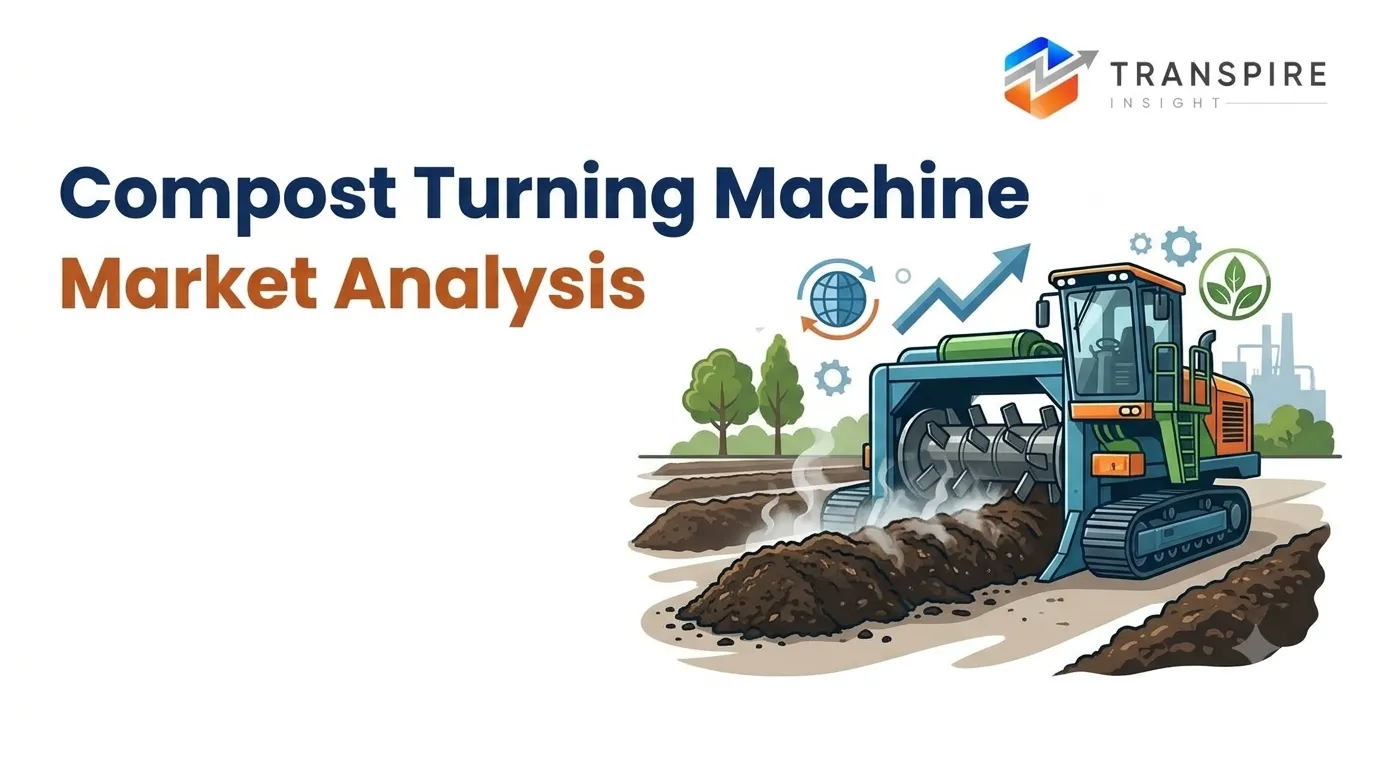
A compost turning machine mixes and aerates decomposing organic materials by moving them through windrows or compost piles. Regular turning introduces oxygen, redistributes moisture, and helps maintain more consistent decomposition conditions. Equipment configurations include self-propelled windrow turners, tractor-pulled turners, straddle-type machines, tow-behind systems, and compact turning attachments.
The market serves several customer groups. Municipal waste management departments process household organic waste and green waste, agricultural operators manage manure and crop residues, and commercial composting facilities handle food waste, yard waste, and other biodegradable materials.
Machine selection is closely connected to the size of the composting operation. A small agricultural facility does not require the same throughput as a municipal composting plant processing thousands of cubic metres of organic material. This difference creates opportunities for manufacturers offering machines across multiple capacity categories.
Competition includes specialist equipment manufacturers such as Komptech, Eggersmann, SCARAB, Brown Bear, and Compost Systems. Other manufacturers, including MENART, JT RecTec, EZ Machinery, and Midwest Bio-Systems, serve particular regional and operational requirements.
Recent Development News
May 2026: Eggersmann introduced the BACKHUS ALPHA 55, a fully automated and electrically powered windrow turner ahead of IFAT Munich 2026. The machine incorporates automated windrow recognition, turning, and repositioning functions. Its development reflects growing interest in reducing manual intervention and introducing electric powertrains into industrial composting operations.
2026: Neuson Ecotec compost-turner product specifications included the ECO 5003, ECO 4003, TEC 30, TEC 25, and SF 420 models. The range demonstrates the continued availability of different machine configurations for composting operations with varying equipment and capacity requirements.
Stay Ahead of Emerging Opportunities with Expert Market Insights by Transpire Insight
Transpire Insight provides market intelligence covering industry size, competitive positioning, regional demand, technology developments, and long-term growth opportunities. Our research evaluates the commercial factors influencing equipment manufacturers, waste management operators, agricultural businesses, and investors.
For the Compost Turning Machine Market, competitive analysis covers machine configurations, equipment capacity, automation, power systems, geographic presence, and manufacturer positioning. These factors help businesses assess the changing requirements of composting facilities and identify potential areas for product development and investment.
Compost Turning Machine Market Size & Statistics
Regional Growth and Demand Analysis by Transpire Insight
North America
North America represented the leading regional market for compost turning machines in 2025. The region benefits from established commercial composting facilities, municipal organic waste management programs, agricultural operations, and a developed market for specialized waste-processing equipment.
The United States has a particularly established equipment supplier base. Companies such as SCARAB International, Brown Bear Corporation, Vermeer Corporation, HCL Machine Works, and Midwest Bio-Systems serve different requirements across commercial composting, agricultural waste treatment, and municipal organic waste processing.
Equipment purchasing decisions in North America are closely connected to windrow dimensions, processing capacity, engine power, machine maintenance, and operating costs. Large composting facilities require machines capable of handling substantial material volumes, while agricultural customers frequently prioritize tractor compatibility and equipment acquisition costs.
Canada also provides opportunities for composting equipment suppliers through municipal waste diversion programs, agricultural operations, and organic material recovery facilities. Equipment manufacturers offering dealer support and replacement parts have an advantage in serving geographically dispersed customers.
Europe
Europe represented the second-largest regional market in 2025. The region has an established environmental equipment manufacturing industry and a developed market for organic waste processing machinery.
Germany, Austria, Belgium, Italy, and other European countries host manufacturers specializing in composting, recycling, and agricultural machinery. Eggersmann's BACKHUS brand, Komptech, MENART, Compost Systems, JT RecTec, and other European manufacturers participate in the regional competitive environment.
European composting operators increasingly evaluate equipment according to automation, energy consumption, emissions, operational reliability, and maintenance requirements. Electrification is also gaining attention, particularly for facilities seeking alternatives to conventional diesel-powered machinery.
The introduction of the BACKHUS ALPHA 55 in 2026 provides an example of how manufacturers are developing electric and automated compost-turning systems for larger operations.
Asia Pacific
Asia Pacific is projected to register the fastest growth in the Compost Turning Machine Market. Urban population growth, increasing organic waste generation, agricultural activity, and expansion of waste management infrastructure are supporting equipment demand.
China has an established manufacturing base for composting and organic fertilizer machinery. Domestic suppliers offer windrow turners, crawler-type machines, tractor-operated equipment, and integrated organic fertilizer production systems.
India represents another developing opportunity. Municipal waste management initiatives, agricultural residue utilization, organic fertilizer production, and the expansion of decentralized composting facilities are creating requirements for different equipment capacities.
Manufacturers and suppliers such as TAGRM, ShunXin Fertilizer Machinery, Ecostan, and other regional equipment companies participate in this market. International manufacturers also serve Asian customers through regional distributors and project-based equipment supply.
Price competitiveness, machine durability, availability of spare parts, and suitability for local feedstocks will remain important purchasing considerations across the region.
Top 15 Trends in the Compost Turning Machine Market
Automation and Electrification Reshaping Compost Turning Equipment
Automation is becoming a significant product development area. Large composting facilities handle repetitive windrow operations across extensive processing areas, making automated machine movement and turning attractive to operators.
The BACKHUS ALPHA 55 introduced in 2026 illustrates this direction. Its automated operating functions and electric power system demonstrate how equipment manufacturers are addressing operator requirements, machine control, and energy consumption.
Electric turners also provide an alternative to conventional diesel-powered equipment. Their commercial suitability depends on operating duration, charging infrastructure, battery capacity, machine size, and the working conditions of individual composting facilities.
Growing Demand for High-Capacity Windrow Turners
Large commercial composting facilities require equipment capable of turning substantial quantities of organic material. High-capacity machines are designed for larger windrow dimensions and demanding operating schedules.
Manufacturers such as SCARAB, Komptech, Eggersmann, and Terex Ecotec participate in this equipment category. Machine specifications, including rotor dimensions, engine power, working width, throughput, and maintenance access, influence purchasing decisions.
Higher-capacity machines are particularly relevant to municipal and industrial facilities where daily processing volumes justify specialized equipment investment.
Increasing Adoption of Tractor-Pulled Compost Turners
Tractor-pulled machines serve agricultural operators and smaller composting facilities that already own compatible tractors. This configuration reduces the need to purchase a separate self-propelled machine.
Companies such as Brown Bear, Midwest Bio-Systems, Compost Systems, and other equipment manufacturers supply machinery for tractor-operated composting applications.
The segment attracts buyers who prioritize affordability, compatibility with existing farm equipment, straightforward maintenance, and flexibility across different composting operations.
Expansion of Municipal Organic Waste Processing
Municipalities are increasing their focus on the collection, separation, and processing of biodegradable waste. Food scraps, garden waste, leaves, and other organic materials require appropriate treatment infrastructure.
Compost turning machines support aerobic composting by mixing material and maintaining airflow through windrows. Their adoption is connected to the development of centralized composting plants, municipal waste recovery facilities, and organic fertilizer production projects.
Improved Material Handling and Rotor Technology
Rotor design influences how organic material is lifted, mixed, and redistributed during turning. Manufacturers are working on machine configurations that provide consistent material movement while maintaining suitable windrow dimensions.
Machine design must also account for different feedstocks. Green waste, manure, food waste, and mixed organic materials have different moisture levels, densities, and handling characteristics.
Equipment buyers therefore compare rotor configuration, turning depth, material discharge, and machine compatibility with their processing requirements.
List of Top 35 Companies Leading the Compost Turning Machine Market
The following companies represent established manufacturers and suppliers active in the global compost turning machine and composting equipment industry as of 2026. The selection considers dedicated compost-turner portfolios, equipment manufacturing capabilities, product availability, and regional industry participation. It is not a definitive ranking based on audited market shares.
Komptech is an Austrian environmental technology manufacturer specializing in machinery for organic waste processing, composting, and recycling. Its equipment portfolio includes dedicated compost turners designed for commercial composting operations.
Headquarters: Frohnleiten, Austria.
Why It Ranks: Established composting equipment portfolio, international market presence, and specialized windrow-turning technology.
Product Line: Topturn compost turners, organic waste processing machinery, shredders, and screening equipment.
Eggersmann operates through several environmental technology businesses, including the BACKHUS brand, which specializes in compost windrow turners. The company serves industrial composting facilities requiring equipment for large-scale organic material processing.
Headquarters: Wardenburg, Germany.
Why It Ranks: Established windrow-turning expertise, international equipment presence, and investment in automated and electric machinery.
Product Line: BACKHUS A, X, and L series windrow turners and ALPHA 55 electric automated turner.
SCARAB specializes in self-propelled compost windrow turning machines for commercial and municipal composting facilities. Its machines are designed for different windrow dimensions and processing capacities.
Headquarters: White Deer, Texas, USA.
Why It Ranks: Dedicated compost-turner manufacturing expertise and a broad range of industrial windrow configurations.
Product Line: Self-propelled compost windrow turners, including small-, medium-, and large-capacity models.
Vermeer is an established manufacturer of industrial and agricultural equipment. Its environmental equipment portfolio includes compost turners and machinery used in organic material processing.
Headquarters: Pella, Iowa, USA.
Why It Ranks: Established equipment manufacturing capabilities, international distribution, and participation in the organic waste processing industry.
Product Line: Compost turners, horizontal grinders, trommel screens, and environmental processing equipment.
Brown Bear manufactures agricultural and composting equipment, including machines designed to turn and aerate organic material. Its equipment serves agricultural, commercial, and municipal composting requirements.
Headquarters: Iowa, USA.
Why It Ranks: Established compost-turner specialization and equipment configurations for different composting applications.
Product Line: Tractor-pulled compost turners, windrow turners, and agricultural composting machinery.
Compost Systems specializes in composting technology and equipment for organic waste treatment. Its machinery is designed to support aerobic composting processes and commercial windrow operations.
Headquarters: Austria.
Why It Ranks: Specialist composting knowledge and equipment designed for professional organic waste processing facilities.
Product Line: ST series compost turners, composting equipment, and organic waste treatment systems.
MENART is a Belgian manufacturer of equipment for composting, recycling, and organic waste processing. Its machinery serves agricultural, municipal, and industrial customers.
Headquarters: Belgium.
Why It Ranks: Established composting equipment portfolio and experience in professional organic waste treatment.
Product Line: Compost turners, windrow turners, shredders, and screening equipment.
Terex Ecotec manufactures environmental processing machinery for recycling, biomass, and waste management applications. Its windrow-turner range includes equipment designed for high-volume composting facilities.
Headquarters: Omagh, Northern Ireland, UK.
Why It Ranks: International equipment distribution and dedicated windrow-turning products.
Product Line: TCT 580 and TCT 630 windrow turners, shredders, and recycling equipment.
Midwest Bio-Systems specializes in aerobic composting equipment and related systems. Its Aeromaster equipment is designed for agricultural and commercial composting operations.
Headquarters: Tampico, Illinois, USA.
Why It Ranks: Dedicated composting machinery portfolio and experience serving agricultural compost producers.
Product Line: Aeromaster compost turners and aerobic composting equipment.
HCL Machine Works manufactures composting equipment for agricultural, municipal, and commercial operations. Its product portfolio includes tractor-powered and other compost-turning configurations.
Headquarters: California, USA.
Why It Ranks: Specialist equipment manufacturing and participation in the North American composting machinery market.
Product Line: Compost windrow turners, tractor-powered turners, and composting equipment.
Eagle Bridge manufactures compost turning equipment, with a focus on straddle-type machines for agricultural and commercial composting operations.
Headquarters: Eagle Bridge, New York, USA.
Why It Ranks: Specialized windrow-turning equipment and experience with agricultural composting applications.
Product Line: Self-propelled and tractor-operated compost turners.
JT RecTec specializes in self-propelled compost turners and equipment for biological waste treatment. Its machinery serves composting, biological drying, and microbial soil treatment operations.
Headquarters: Germany.
Why It Ranks: Dedicated turning equipment portfolio and development of electric compost-turning technology.
Product Line: JT580, JT630, eTurner E380, and eTurner E530.
EZ Machinery is an Australian equipment manufacturer supplying machinery for composting and organic material processing. Its products address commercial and agricultural requirements.
Headquarters: Australia.
Why It Ranks: Regional manufacturing presence and participation in composting and material-handling equipment markets.
Product Line: Compost windrow turners and horizontal compost mixing equipment.
Doppstadt is a German environmental technology manufacturer specializing in machinery for waste processing and recycling. Its equipment portfolio serves organic waste preparation and treatment applications.
Headquarters: Velbert, Germany.
Why It Ranks: Established environmental machinery manufacturing and participation in compost processing systems.
Product Line: Organic waste processing machinery, shredders, screening equipment, and composting equipment.
Pronar is a Polish machinery manufacturer with a broad portfolio covering agricultural, municipal, and recycling equipment. Its environmental machinery activities serve customers involved in waste processing and organic material management.
Headquarters: Narew, Poland.
Why It Ranks: Established machinery manufacturing operations and international distribution.
Product Line: Recycling machinery, material-handling equipment, agricultural machinery, and compost-processing equipment.
Conclusion
The global Compost Turning Machine Market is projected to expand from USD 172.5 million in 2026 to approximately USD 304.04 million by 2035, based on the supplied 6.50% annual growth assumption. Increasing organic waste processing, agricultural compost production, and investment in municipal waste management infrastructure are supporting demand for specialized turning machinery.
Competition is moving toward equipment that combines higher processing capacity with lower operating requirements. Electric powertrains and automated windrow operations, demonstrated by the BACKHUS ALPHA 55 introduced in 2026, provide a clear example of product development priorities.
For manufacturers and investors, the strongest starting point is to compare self-propelled, tractor-pulled, and electric compost turners separately. Their customer requirements, purchase economics, and operating environments differ considerably. A product strategy built around a clearly defined facility size and feedstock requirement will provide a more practical route to market than competing across every machine category at once.


Send us a brief description of your challenge and we'll get back to you within 24 hours.

 [email protected]
 APAC:+91 7666513636
 Address


