
Nov 21, 2026
By Transpire Insight
Description
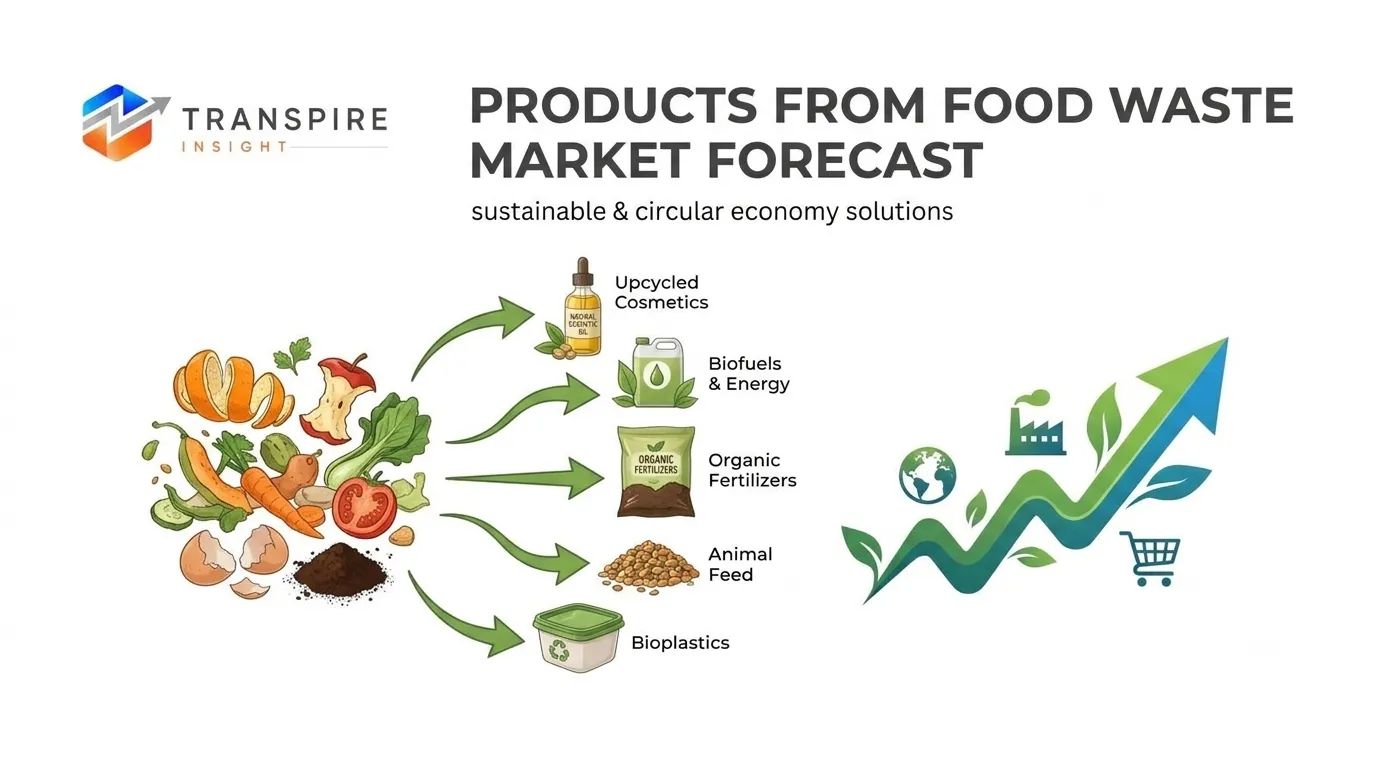
According to a research report published by Transpire Insight, the global Products from Food Waste Market size was valued at USD 66.5 billion in 2026 and is projected to grow at a CAGR of 6.63% during the 2027–2035 forecast period. Based on this growth rate, the market is expected to reach approximately USD 70.91 billion in 2027 and USD 118.50 billion by 2035. The market was estimated to reach USD 104.2 billion in 2033. Increasing food processing waste, rising demand for sustainable food ingredients, growing interest in circular economy practices, and advancements in food waste conversion technologies are supporting industry expansion. Manufacturers are focusing on transforming fruit and vegetable residues, agricultural by-products, spent grains, surplus food, and other organic materials into functional food ingredients, animal feed, biofertilizers, biofuels, and value-added consumer products.
Introduction
Food waste is becoming a valuable industrial resource rather than simply a disposal problem. Food manufacturers, agricultural processors, retailers, and technology companies are finding commercial applications for materials that previously had little economic value.
Products from Food Waste include a wide range of materials and finished goods manufactured by recovering useful components from discarded or underutilized food resources. These products include upcycled snacks, fruit powders, vegetable flours, plant-based proteins, food-grade fibers, animal feed ingredients, organic fertilizers, biogas, biofuels, and bio-based materials.
Consider the by-products generated during food manufacturing. Breweries produce spent grain, fruit processors generate peels and pulp, and soy milk manufacturers produce okara. These materials retain useful nutrients and functional properties that can be recovered through drying, milling, fermentation, extraction, and other processing techniques.
The commercial opportunity extends beyond food manufacturing. Companies specializing in biotechnology, enzyme processing, waste recovery, and industrial equipment are developing technologies that help convert organic residues into marketable products.
Competition includes specialist upcycling companies such as Renewal Mill, Upcycled Foods, Inc., EverGrain, Kern Tec, and Matriark Foods, alongside established ingredient suppliers and industrial processing companies. Their business models differ considerably, but they share an interest in extracting greater commercial value from food production resources.
Recent Development News
February 2026: 2nd Nature highlighted its AgWaste Portal, an AI-based platform designed to identify functional ingredients from agricultural processing by-products. The technology examines food processing side streams and identifies potential applications, including non-caloric sweeteners and sodium-reduction ingredients.
July 2026: Austrian food technology company Kern Tec received attention for its approach to converting discarded stone fruit pits, including apricot, plum, cherry, and peach pits, into valuable food ingredients. Its processing approach recovers kernels containing oils, proteins, and other functional components for food applications.
August 2026: Hungarian startup Secon Taste attracted industry attention for its upcycled food products made from surplus food materials. Its portfolio includes fiber-rich granola, instant porridge, and other retail-oriented products, demonstrating how surplus ingredients can become consumer food products.
November 2026: UK food technology startup UPP received attention for its patented Harvesta technology, which collects broccoli stems and stalks left behind during harvesting. The company processes this material into upcycled fiber and binding ingredients for food manufacturers.
November 2026: MeNow highlighted its data-driven approach to identifying functional compounds from natural sources and food industry waste streams. The approach is intended to help ingredient companies identify potential applications for recovered food-processing materials.
Stay Ahead of Emerging Opportunities with Expert Market Insights by Transpire Insight
Transpire Insight provides comprehensive, data-driven market intelligence to support informed business decisions. Our research combines market sizing, competitive benchmarking, regional analysis, industry trends, and growth forecasting to help businesses understand changing market conditions.
We provide detailed assessments of product segmentation, food waste processing technologies, ingredient recovery, manufacturing strategies, distribution channels, and emerging investment opportunities. Our research helps food manufacturers, ingredient suppliers, investors, technology developers, and industry professionals evaluate market developments and identify potential areas for business expansion.
Products from Food Waste Market Size & Statistics
Regional Growth and Demand Analysis by Transpire Insight
Asia Pacific
Asia Pacific held the leading regional position in the Products from Food Waste Market in 2025. The region benefits from its extensive agricultural production, large food processing industry, and established manufacturing networks.
China, India, Japan, South Korea, and Southeast Asian countries generate substantial quantities of agricultural residues and food processing by-products. These materials provide feedstock for manufacturing animal feed, organic fertilizers, bioenergy, food ingredients, and other value-added products.
China has a substantial food processing industry, creating opportunities for companies involved in ingredient recovery, fermentation, and organic waste conversion. India's growing packaged food industry, agricultural processing activities, and interest in organic fertilizer production are supporting the development of food waste utilization technologies.
Companies operating across the region are focusing on improving processing efficiency and developing commercially viable products from fruit peels, vegetable residues, grain by-products, and surplus food.
Europe
Europe represented the second-largest regional market in 2025. The region has an established food processing industry, developed recycling infrastructure, and increasing commercial interest in resource recovery.
Germany, France, the United Kingdom, Italy, the Netherlands, and Austria are important markets for food waste processing and upcycled products. Companies such as Kern Tec, Agrain, Döhler, Kerry Group, and Novonesis participate in different parts of the value chain.
European manufacturers are investing in ingredient recovery, food by-product processing, fermentation, and sustainable packaging applications. The presence of specialist upcycling businesses also supports the development of products using fruit stones, vegetable residues, cereal by-products, and spent grains.
North America
North America is projected to register the fastest growth during the forecast period. Increasing interest in upcycled ingredients, investment in food processing technologies, and demand for sustainable packaged food products are creating commercial opportunities.
The United States and Canada have an established ecosystem of food ingredient manufacturers, biotechnology companies, and specialist upcycling businesses.
Companies such as Renewal Mill, Upcycled Foods, Inc., EverGrain, Matriark Foods, Pulp Pantry, and Barnana are developing products from food processing residues and surplus agricultural materials. Their offerings range from protein and fiber ingredients to packaged snacks, baking ingredients, sauces, and other consumer products.
The expansion of food waste recovery infrastructure and growing interest in alternative proteins are also creating opportunities for industrial processing companies.
Top 15 Trends in the Products from Food Waste Market
Upcycled Food Ingredients Creating New Commercial Opportunities
Food processing companies generate substantial quantities of by-products during manufacturing. Fruit pulp, vegetable residues, cereal fractions, and spent grains frequently retain useful nutritional and functional components.
Specialist companies are recovering these materials to manufacture ingredients for food and beverage applications. Renewal Mill, EverGrain, and Upcycled Foods, Inc. are examples of businesses developing commercial products from food processing side streams.
These ingredients can be incorporated into bakery products, cereals, snack bars, beverages, and other formulations. Their commercial value depends on nutritional composition, processing costs, food safety, and the ability to maintain consistent quality.
Growing Demand for Fruit and Vegetable Waste Processing
Fruit and vegetable processing generates peels, seeds, pulp, stems, and other residual materials. Instead of sending these materials for disposal, processors are developing methods to recover dietary fiber, oils, powders, natural colors, and functional ingredients.
Kern Tec is working with discarded stone fruit pits, while UPP is recovering broccoli stems and stalks for food ingredient applications. These approaches demonstrate the potential to develop specialized ingredient businesses around individual agricultural waste streams.
Increasing Use of Spent Grain in Food Manufacturing
Brewer's spent grain is one of the recognizable food industry by-products being converted into commercial ingredients. It contains protein and dietary fiber, making it suitable for further processing.
EverGrain and Upcycled Foods, Inc. are associated with the development of ingredients from spent grain. These ingredients provide opportunities in bakery products, breakfast cereals, snack bars, and plant-based food formulations.
The main commercial challenge is processing the material efficiently while maintaining consistent nutritional characteristics and shelf stability.
Development of Alternative Proteins from Food Waste
Alternative protein production is creating another area of opportunity. Food processing residues and other organic by-products can serve as inputs for insect farming, fermentation, and other biological conversion processes.
Companies involved in insect protein production are developing protein ingredients and oils for animal nutrition and related applications. Protix and Innovafeed are examples of companies operating in the insect ingredient industry, although their feedstock and production models should be evaluated separately from conventional edible food upcycling.
Demand from aquaculture, poultry, and pet food manufacturers is supporting interest in alternative feed ingredients.
Growing Application of Food Waste in Organic Fertilizer Production
Food waste contains organic matter and nutrients that can be recovered through composting, anaerobic digestion, and other biological treatment methods.
The resulting products include compost, digestate-based soil amendments, and organic fertilizers. Agricultural producers use these materials to improve soil management and recycle nutrients within farming systems.
Industrial waste recovery companies are developing processing facilities that combine organic waste treatment with energy and nutrient recovery.
AI and Enzyme Technologies Improving Food Waste Conversion
Technology development is changing how companies identify and process underutilized food materials.
AI-based ingredient discovery platforms are helping researchers identify potential functional compounds from agricultural side streams. Enzyme technologies also support the breakdown of complex materials into useful components.
These approaches are relevant to food manufacturers looking to recover ingredients from materials that are difficult to process using conventional techniques. Their commercial success depends on extraction yields, processing economics, regulatory approval, and the performance of the resulting ingredients.
Expansion of Food Waste Biorefineries
Food waste biorefineries are designed to recover several valuable outputs from organic feedstock. Depending on the processing method, a facility can produce biogas, biofertilizers, recovered nutrients, organic acids, and other industrial materials.
This model creates opportunities for companies specializing in anaerobic digestion, fermentation, separation equipment, and industrial process engineering.
The economics of these facilities depend heavily on feedstock availability, transportation distance, plant utilization, energy prices, and the market value of recovered products.
Internal link placement: Products from Food Waste Market report purchase page.
List of Top 30 Companies Leading the Products from Food Waste Market
The following companies are active participants in the food waste upcycling, food by-product processing, ingredient recovery, and value-added product industries as of 2026. The shortlist considers commercial product portfolios, industry participation, technology capabilities, and geographic presence.
It includes specialist upcycling brands as well as established ingredient and processing businesses. It is not an audited ranking by revenue or market share, and the companies do not all operate in identical product categories.
Upcycled Foods, Inc. develops ingredients using food manufacturing by-products, particularly brewer's spent grain. Its SuperGrain+ ingredient is designed for use in different food applications, including snacks, bakery products, cereals, and other formulations.
The company represents the commercial ingredient side of food waste utilization, where recovered grain materials are processed into ingredients for food manufacturers.
Headquarters: United States.
Why It Ranks: Specialist experience in spent grain upcycling and commercial ingredient development.
Product Line: SuperGrain+ ingredients, upcycled grain flour, protein-rich ingredients, and food applications.
Renewal Mill specializes in converting food manufacturing by-products into functional ingredients. Its processing model uses materials such as okara, the pulp remaining after soy milk and tofu production.
The company develops ingredients for food manufacturers and consumer products, including baking applications. Its approach gives food processors another route to commercialize materials generated during plant-based food production.
Headquarters: Oakland, California, USA.
Why It Ranks: Established specialization in upcycled flours, fibers, and food ingredients.
Product Line: Organic okara flour, baking mixes, oat-derived ingredients, and upcycled food ingredients.
EverGrain, associated with Anheuser-Busch InBev, develops ingredients from brewer's spent grain. The company recovers valuable components from this brewing by-product and converts them into protein and fiber ingredients.
Its business model connects the brewing industry with food ingredient manufacturing. The resulting materials are suitable for applications in nutrition products, bakery goods, cereals, and plant-based formulations.
Headquarters: St. Louis, Missouri, USA.
Why It Ranks: Industrial brewing by-product access and specialization in recovered protein and fiber ingredients.
Product Line: Upcycled barley protein, dietary fiber ingredients, and food ingredient solutions.
Matriark Foods develops food products using surplus vegetables and food processing by-products. Its approach focuses on converting underutilized agricultural materials into commercially usable food products.
The company's portfolio includes sauces, soups, broths, and culinary bases. It also serves institutional and foodservice customers, providing an outlet for ingredients that might otherwise be discarded.
Headquarters: New York, USA.
Why It Ranks: Commercial food product development using surplus vegetables and processing remnants.
Product Line: Vegetable-based broths, soups, sauces, and culinary bases.
Kern Tec is an Austrian food technology company that converts discarded stone fruit pits into valuable food ingredients. Its approach focuses on recovering kernels from apricot, cherry, plum, and peach processing residues.
The recovered kernels contain oils, proteins, and other useful components that can be processed for food applications. This provides a specialized route for commercializing materials generated by fruit processing operations.
Headquarters: Austria.
Why It Ranks: Specialized stone fruit by-product processing and ingredient recovery technology.
Product Line: Upcycled stone fruit kernel ingredients, oils, and food ingredient solutions.
Döhler is a global producer of natural ingredients and integrated food and beverage solutions. Its activities cover fruit and vegetable ingredients, flavors, colors, and other functional components.
The company's ingredient processing capabilities are relevant to the recovery and utilization of agricultural and food processing side streams. Its established relationships with food and beverage manufacturers provide opportunities for incorporating recovered materials into commercial formulations.
Headquarters: Darmstadt, Germany.
Why It Ranks: Broad food ingredient expertise and international food processing relationships.
Product Line: Fruit and vegetable ingredients, natural flavors, colors, concentrates, and functional food ingredients.
Kerry Group supplies ingredients, taste solutions, and nutritional technologies to food and beverage manufacturers. Its research and processing capabilities are relevant to the development of more efficient ingredient utilization.
The company participates in the wider food ingredient value chain, where recovered plant materials and processing by-products can support new formulations and resource-efficient manufacturing.
Headquarters: Tralee, Ireland.
Why It Ranks: International ingredient supply capabilities and established food manufacturing relationships.
Product Line: Food ingredients, taste solutions, nutritional ingredients, flavors, and functional systems.
ADM is a major agricultural processing and ingredient company with activities spanning oilseeds, grains, plant proteins, and food ingredients.
Its processing infrastructure provides experience in converting agricultural raw materials into food, feed, and industrial products. By-product recovery and efficient utilization of agricultural processing streams are relevant to its wider operations.
Headquarters: Chicago, Illinois, USA.
Why It Ranks: Large-scale agricultural processing, ingredient manufacturing, and established global distribution.
Product Line: Plant proteins, specialty ingredients, food ingredients, animal nutrition products, and agricultural processing outputs.
Cargill operates across agricultural supply chains, food ingredients, animal nutrition, and industrial processing. Its broad manufacturing network creates opportunities to improve the utilization of agricultural and food processing materials.
The company supplies ingredients to food manufacturers and develops solutions across several product categories. Its relevance to this market comes from its ingredient processing and resource utilization capabilities rather than a single dedicated upcycled food brand.
Headquarters: Wayzata, Minnesota, USA.
Why It Ranks: Extensive agricultural supply chain operations and international food ingredient manufacturing.
Product Line: Plant-based ingredients, proteins, starches, sweeteners, oils, and animal nutrition products.
Ingredion develops specialty ingredients from agricultural raw materials, including starches, sweeteners, fibers, and plant proteins.
Its ingredient processing expertise is relevant to the conversion of underutilized plant materials into functional food components. The company also participates in the development of sustainable ingredient solutions for food and beverage manufacturers.
Headquarters: Westchester, Illinois, USA.
Why It Ranks: Strong specialty ingredient portfolio and food processing expertise.
Product Line: Starches, plant proteins, dietary fibers, sweeteners, and specialty food ingredients.
Novonesis develops biosolutions, including enzymes and microbial technologies for industrial and food applications. Enzyme processing is relevant to the recovery of functional components from food manufacturing residues.
Its technology portfolio supports processes such as fiber modification, fermentation, and ingredient production. These capabilities are applicable to the development of higher-value outputs from agricultural and food processing materials.
Headquarters: Bagsværd, Denmark.
Why It Ranks: Established biotechnology and enzyme development capabilities.
Product Line: Industrial enzymes, food enzymes, microbial biosolutions, and fermentation technologies.
dsm-firmenich supplies nutrition, health, taste, and fragrance ingredients to manufacturers across multiple industries.
Its ingredient science and biotechnology expertise are relevant to the development of functional compounds and resource-efficient food manufacturing. The company participates in the wider ingredient ecosystem supporting product formulation and sustainable ingredient innovation.
Headquarters: Kaiseraugst, Switzerland, and Maastricht, Netherlands.
Why It Ranks: Global ingredient science capabilities and extensive food and nutrition industry relationships.
Product Line: Nutritional ingredients, food flavors, specialty ingredients, and biotechnology-based solutions.
Conclusion
The global Products from Food Waste Market is developing into an important part of the food ingredient, agricultural processing, and circular manufacturing industries. Rising interest in resource recovery, sustainable food production, and alternative ingredients is encouraging companies to commercialize materials that were previously discarded.
The competitive environment includes specialist businesses such as Renewal Mill, Upcycled Foods, Inc., EverGrain, Kern Tec, and Matriark Foods, alongside established companies such as ADM, Cargill, Kerry Group, Novonesis, Veolia, and SUEZ.
Different product categories offer different commercial opportunities. Upcycled food ingredients and consumer snacks depend on nutritional quality, product acceptance, and retail distribution. Animal feed, fertilizers, and bioenergy depend more heavily on feedstock availability, processing efficiency, and industrial economics.
For manufacturers and investors, the next step should be to compare individual food waste streams by recovery cost, usable material yield, regulatory requirements, and potential selling price. This assessment will help identify which recovered ingredients and products offer the strongest commercial opportunities during the 2027–2035 forecast period.


Send us a brief description of your challenge and we'll get back to you within 24 hours.

 [email protected]
 APAC:+91 7666513636
 Address


