

Global Compost Turning Machine Market Summary:
According to Transpire Insights, a detailed research report on the market reflects that the agriculture and organic waste management application segment dominates the Global Compost Turning Machine Market, accounting for approximately 65% of the total share worldwide. Vermeer Corporation leads the market with approximately (around USD 1.0 billion) in annual revenue and a significant global market presence, making it one of the leading contributors to global market development, innovation, advanced compost turning machine production, expanding manufacturing capabilities, and growth dynamics.
Market Snapshot
- Global Market Value (2025): USD 162 Million.
- Expected Market Value (2026): USD 172.5 Million.
- Estimated Market Value (2033): USD 268.1 Million.
- Forecast CAGR (2026–2033): 6.50%.
- Leading Region in 2025: North America
- Second-largest Region: Europe
- Fastest Growing Region: Asia Pacific
Introduction
The production, distribution, and sales of commercial and industrial equipment intended to mix, aerate, and hasten the breakdown of organic waste into nutrient-rich compost are all included in the Compost Turning Machine Market. A compost turning machine, also known as a compost turner, is a piece of machinery that mixes, aerates, and speeds up the biological breakdown of organic waste into compost. These devices provide even oxygen distribution, steady moisture spread, and appropriate temperature control by rotating large rows of compost, or windrows. This method can provide a higher-quality, nutrient-rich soil amendment while cutting the composting time by 40% to 60%. Optimized efficiency & speed frequent rotating ensures the best possible dispersion of moisture and oxygen by preventing pile compaction. This significantly shortens composting cycles and speeds up the aerobic breakdown process. Superior compost quality large materials are broken down uniformly by regular mechanical mixing. This results in a stable, consistent, and nutrient-rich final product by preventing anaerobic zones, which emit offensive aromas and hazardous gasses. Enhanced environmental sustainability composting greatly reduces methane emissions and carbon footprints by diverting large amounts of organic waste such as urban trash, agricultural residues, and livestock manure away from landfills. Resource recovery the resulting compost increases soil moisture retention, microbial activity, and soil structure. Farmers are directly assisted in lowering their dependency on costly synthetic chemical fertilizers. Operational scalability facilities can process enormous, industrial-scale amounts of garbage that manual labor could never handle thanks to modern turners (such as self-propelled, tow-behind, or electric motor-driven systems).
- For instance:- Depending on the extent of mechanized organic waste systems assessed, the global market for compost turning machines is estimated to be worth between $130 million and $360 million. Due to stringent municipal trash diversion regulations and corporate sustainability investments, North America dominates the world market with about 35% of the total.

Market Highlights: -
- North America is expected to grow at a rapid CAGR in the Global Compost Turning Machine Market by holding around 35% of the share during the forecast period.
- Europe is anticipated to hold almost29% share of the Global Compost Turning Machine Market over the predicted timeframe.
- Asia Pacific is anticipated to hold around25% share of the Global Compost Turning Machine Market over the predicted timeframe.
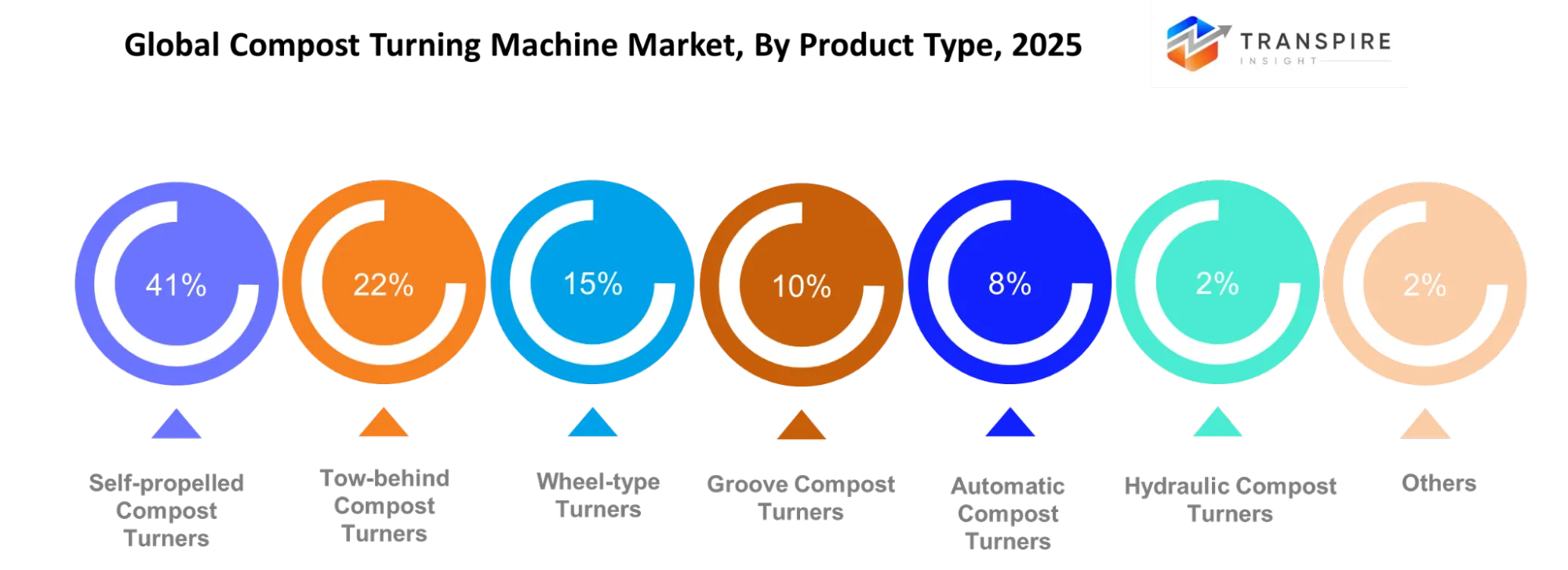
- By product type, the Self-propelled Compost Turner segment dominated the market and holds nearly 30% share in 2025 and is projected to grow at a substantial CAGR during the forecast period.
- By application, the agricultural composting segment dominated the market and holds roughly 40% share in 2025 and is projected to grow at a substantial CAGR during the forecast period.
- By end user, the Farms segment dominated the market and holds nearly 42% share in 2025 and is projected to grow at a substantial CAGR during the forecast period.
- India: The central government offers subsidies up to 50% (e.g., ₹25,000 limits) under the Organic Fertilizer Scheme to support the setup of vermicompost and commercial composting units. Composting machines also benefit from a concessional 12% GST rate
How is Technology Driving Growth in the Global Compost Turning Machine Market?
Through IoT-enabled monitoring, artificial intelligence, automated control systems, remote management platforms, and energy-efficient technologies, technological developments are revolutionizing the operation of industrial equipment. While AI-driven modifications optimize procedures and minimize manual involvement, real-time data tracking of operational circumstances enhances accuracy, efficiency, and productivity. Predictive maintenance is made possible via cloud-based monitoring, which reduces maintenance expenses and downtime. Additionally, by lowering emissions and enhancing adherence to international environmental regulations, the development of electric and fuel-efficient machinery helps sustainability objectives. Operations are becoming more intelligent, dependable, and ecologically conscious thanks to these technologies.
Market Drivers
Stricter waste management regulations to reduce methane emissions, governments around the world are imposing stringent prohibitions on organic waste being dumped in landfills. Municipalities must use mechanical composting methods in order to comply with mandates requiring the diversion of organic waste from homes and businesses. Growing interest in organic farming and the need for premium, nutrient-rich fertilizers is rising as farming becomes more sustainable and organic food is produced. By converting organic waste into useful biofertilizers, composting promotes acceptance in the manufacturing and agricultural industries. Massive organic garbage generation manual turning techniques are ineffective given the world's organic garbage volumes, which surpass 2 billion tons per year. To effectively aerate, control moisture, and handle massive amounts of trash, commercial-scale compost turners are necessary. Technological development real-time monitoring of temperature, moisture, and airflow is made possible by the combination of automation and IoT-enabled monitoring systems. These developments enhance the final compost's overall quality while reducing operating expenses. Circular economy initiatives by forming strategic alliances with compost manufacturers, waste management companies hope to turn urban food waste into goods that improve soil, supporting sustainable practices and circular farming. Accelerated Decomposition: Turning machines can reduce composting time by 40% to 60% by guaranteeing ideal aeration and moisture control. Superior compost quality organic waste is fully mixed by regular mechanical rotation, resulting in a uniform, nutrient-rich fertilizer. Odor and pest control frequent turning maintains piles hygienic, discouraging scavengers and rodents, and prevents anaerobic zones, which emit offensive odors.
- For Instance: - The market for compost turning machines is estimated to be worth between USD 134 and USD 360 million, and it is expected to expand gradually at a CAGR of 3% to 5.8%. Organic farming and zero-waste regulations are major drivers of investment. Targeted investment opportunities are created in Russia by localized agricultural expansion and municipal waste reforms, despite obstacles from trade prohibitions and capital expenses.
Restrain
Market expansion is hampered by high capital costs, maintenance costs, a lack of technological know-how, infrastructure difficulties, different regulations, and competition from low-cost alternatives. Furthermore, the biological and environmental hazards connected to composting operations pose operational difficulties that call for enhanced safety protocols and sophisticated management techniques.
Analysis of Prices and Consumer Behaviour
Self-propelled compost turners dominate the rest of the market, accounting for almost 30% of the entire market total by 2025 due to their efficiency, fast composting times, low labor requirements, and suitability for large composting projects. Self-propelled compost turners are expected to be more expensive than other types of composting equipment due to being fitted with a more advanced automation system, having more capacity, being more fuel-efficient and mixing better. Almost 40% of total market demand comes from agriculture composting applications owing to the growing adoption of organic farming, sustainable waste management, and high-quality compost production practices. About 42% of the demand comes from farms, helped by a growing awareness of the importance of soil health and declining demand for chemical-based fertilizers. Consumer behavior indicates that purchasers prefer machines based on their efficiency, durability, processing capacity, and maintenance costs. Another large part of buyers prefers to do business with their suppliers in the long term, while switching to a dealer system of procurement to make sure that they receive satisfactory after-sales service, replacement parts, and consistent work of equipment all the time.
Top Companies in the Global Compost Turning Machine Market
- Komptech
- BACKHUS
- SCARAB International
- Vermeer
- EYS Metal
- Brown Bear Corporation
- Eggersmann Group
- Menart
- Kollvik Recycling
- ALLU
- Terra Select
- Sittler Machine Company
- Frontier Industrial
- JT Rec Tec
- Green Mountain Technologies
Market Segmentation
The Global Compost Turning Machine Market share is divided into five categories: By product type, application, end user, distribution channel and capacity.
The Self-propelled Compost Turner dominated the market, accounting for nearly 30% in 2025 and is expected to rise at a significant CAGR during the forecast period.
The Global Compost Turning Machine Market is segmented by product type into Self-propelled Compost Turners, Tow-behind Compost Turners, Wheel-type Turners, Groove Compost Turners, Crawler Compost Turners, Automatic Compost Turners, Hydraulic Compost Turners, Others. Among these, the Self-propelled Compost Turner segment dominated the market, accounting for nearly 30% in 2025 and expected to increase at a significant CAGR during the forecast period. Because of its great efficiency, quicker composting cycles, lower labor costs, and capacity for large-scale operations, the Self-propelled Compost Turner dominates the market. Its popularity and future expansion are being driven by rising need for mechanized waste management, sustainability initiatives, and agricultural productivity.
The agricultural composting segment dominated the market, accounting for roughly 40% in 2025, and is expected to rise at a significant CAGR during the forecast period.
The Global Compost Turning Machine Market is segmented by application into Municipal Composting, Agricultural Composting, Organic Waste Recycling, Food Waste Processing, Livestock Waste Management, Industrial Composting, Others. Among these, the agricultural composting segment dominated the market, accounting for roughly 40% in 2025 and expected to increase at a significant CAGR during the forecast period. Due to improving soil health, sustainable farming methods, and growing demand for organic fertilizers, the agricultural composting market dominates. Composting solutions are being used by farmers to effectively manage agricultural waste, lessen reliance on chemical fertilizers, and increase crop yield, all of which are contributing to the market's notable expansion.
The Farms dominated the market, accounting for nearly 42% in 2025 and is expected to rise at a significant CAGR during the forecast period.
The Global Compost Turning Machine Market is segmented by end user into Municipal Authorities, Farms, Waste Management Companies, Compost Producers, Agricultural Cooperatives, Industrial Facilities, Others. Among these, the Farms segment dominated the market, accounting for nearly 42% in 2025 and expected to increase at a significant CAGR during the forecast period. Due to increased soil fertility, effective farm waste management, and the increasing use of composting for sustainable agriculture, farms dominate the market. The segment's notable growth is being driven by rising awareness of organic farming, decreased use of chemical fertilizers, and demand for eco-friendly techniques.
Regional Segment Analysis of the Global Compost Turning Machine Market:
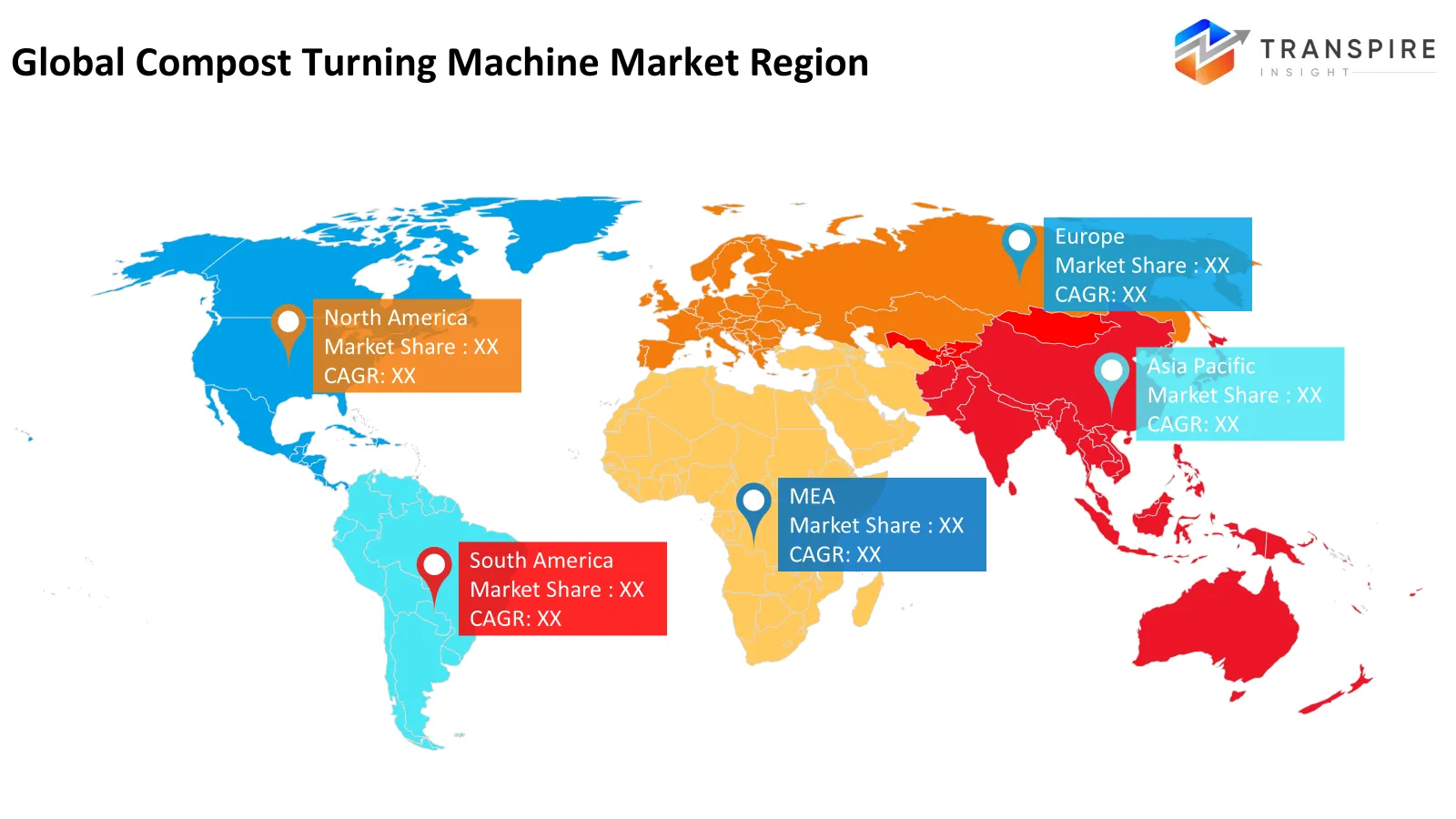
- North America (U.S., Canada, Mexico)
- Europe (Germany, France, U.K., Italy, Spain, Rest of Europe)
- Asia-Pacific (China, Japan, India, Rest of APAC)
- South America (Brazil and the Rest of South America)
- The Middle East and Africa (UAE, South Africa, Rest of MEA)
North America is the fastest-growing region in the Global Compost Turning Machine Market during the period, holding around 35% share.
North America is expected to grow at a rapid CAGR in the Global Compost Turning Machine Market holding around 35% share during the forecast period. The global market for compost turning machines is expanding at the fastest rate in North America because of the region's increased use of sustainable waste management techniques, growing composting activities, sophisticated agricultural infrastructure, government support for recycling programs, and rising demand for effective mechanized solutions to enhance organic waste processing and lessen environmental impact.
Europe is expected to grow at a rapid CAGR in the Global Compost Turning Machine Market, holding almost 29% of the share during the forecast period
Europe is expected to grow at a rapid CAGR in the Global Compost Turning Machine Market holding almost 29% share during the forecast period. Due to stringent waste management laws, growing adoption of circular economy practices, growing composting initiatives, government sustainability programs, and rising demand for effective machinery to process organic waste and produce high-quality compost, Europe is anticipated to grow at a rapid compound annual growth rate (CAGR) in the global compost turning machine market.
Asia Pacific is the fastest-growing region in the Global Compost Turning Machine Market during the period, holding around 25% share.
Asia Pacific is the fastest-growing region in the Global Compost Turning Machine Market during the forecast period, holding around 25% share during the forecast period. The global market for compost turning machines is expanding at the fastest rate in Asia Pacific due to a number of factors, including growing agricultural activity, increased organic waste generation, expanding composting initiatives, government support for sustainable waste management, and growing adoption of mechanized equipment to increase compost production efficiency across developing economies.
Strategies for Market Growth in Non-Leading Regions:
Efficient and scalable compost turning machine production and deployment technologies can pave the way for small and medium waste disposal firms, farms, and composting providers to benefit from regional development. The local manufacture and assembly of compost turning devices, as well as the creation of regional maintenance offices, can reduce the reliance on imports and lower expenses related to operations. Building strategic alliances with local agricultural firms, organic waste disposers, composting companies, and machinery distributors can ensure better market penetration for compost turning machine manufacturers. To raise the level of knowledge about composting activities, machinery operation and upkeep, and optimization of this process, it is necessary to conduct training programs and improve technical skills of the workers involved. Moreover, it is possible to ensure the affordability of compost turning devices for users and motivate their use by means of flexible financing, leasing schemes, long-term maintenance contracts, and contract production.
Future Market Trends for the Global Compost Turning Machine Market: -
- IoT and Smart Monitoring: To track temperature, moisture, and oxygen levels in real time, advanced turners are utilizing IoT and smart sensors. This maximizes microbial activity and permits predictive maintenance.
- Electrification and Hybrid Systems: To reduce the carbon footprint, manufacturers are switching from diesel-only engines to electric motor-driven and hybrid machines in response to strict pollution regulations and growing fuel prices.
- Elevating Face & Drum Turners: Due to their excellent aeration efficiency, elevating face turners currently hold a 50% market share, but drum turners are still quite popular for heavy-duty industrial and municipal composting.
- Adoption in Construction and Agriculture: The largest end-user segment is still organic farming. These turners are also being used more frequently in the construction sector for on-site organic waste processing, soil preparation, and land reclamation.
- Modular and Scalable Designs: Equipment manufacturers are creating modular machines with a variety of capacities and easy transportation to suit both large municipal garbage facilities and small-scale farmers.
Recent Development
- In March 2026: Eggersmann Group advanced its industrial composting and recycling solutions by focusing on improving processing efficiency, increasing throughput capacity, and integrating intelligent control technologies. These developments aim to optimize operational performance, reduce processing costs, enhance automation, and support sustainable waste management practices, contributing to the continued growth and innovation of the Global Compost Turning Machine Market.
- In March 2026: Future Market Insights (FMI) highlighted the growth potential of the global compost turning machine industry, driven by increasing adoption across municipal, institutional, agricultural, and commercial composting facilities. The market expansion is supported by rising organic waste management requirements, sustainability initiatives, and growing demand for efficient mechanized composting technologies that enhance processing capacity and operational efficiency.
This study forecasts revenue at global, regional and country levels from 2020 to 2033. Transpire Insights has segmented the Global Compost Turning Machine Market based on the below-mentioned segments:
Global Compost Turning Machine Market, By Product Type
- Self-propelled Compost Turners
- Tow-behind Compost Turners
- Wheel-type Turners
- Groove Compost Turners
- Crawler Compost Turners
- Automatic Compost Turners
- Hydraulic Compost Turners
- Others
Global Compost Turning Machine Market, By Application
- Municipal Composting
- Agricultural Composting
- Organic Waste Recycling
- Food Waste Processing
- Livestock Waste Management
- Industrial Composting
- Others
Global Compost Turning Machine Market, By End User
- Municipal Authorities
- Farms
- Waste Management Companies
- Compost Producers
- Agricultural Cooperatives
- Industrial Facilities
- Others
Global Compost Turning Machine Market, By Distribution Channel
- Direct Sales
- Agricultural Equipment Dealers
- OEM Suppliers
- Exporters
- Others
Global Compost Turning Machine Market, By Capacity
- Small Scale
- Medium Scale
- Large Scale
- Industrial Scale
- Others
Global Compost Turning Machine Market, By Regional Analysis
North America
- United States
- Canada
- Mexico
Europe
- Germany
- United Kingdom
- France
- Italy
- Spain
- Russia
- Rest of Europe
Asia Pacific
- China
- Japan
- India
- South Korea
- Australia
- Rest of Asia Pacific
South America
- Brazil
- Argentina
- Rest of South America
Middle East & Africa
- Saudi Arabia
- United Arab Emirates
- Qatar
- South Africa
- Rest of the Middle East & Africa
Frequently Asked Questions
Find quick answers to common questions.
The market will grow at 6.50% CAGR from 2026–2033, reaching USD 268.1 Million by 2033 due to sustainable waste management adoption.
Self-propelled Compost Turners dominate with nearly 30% share in 2025 due to efficiency, faster processing, and reduced labor requirements.
Agricultural Composting leads with around 40% share in 2025, driven by organic farming, soil improvement, and increasing compost demand.
North America dominates with around 35% share, supported by waste regulations, advanced infrastructure, and sustainable composting initiatives.
IoT, AI automation, and smart monitoring improve efficiency, reduce costs, enable predictive maintenance, and enhance composting quality.
- Komptech
- BACKHUS
- SCARAB International
- Vermeer
- EYS Metal
- Brown Bear Corporation
- Eggersmann Group
- Menart
- Kollvik Recycling
- ALLU
- Terra Select
- Sittler Machine Company
- Frontier Industrial
- JT Rec Tec
- Green Mountain Technologies
About the Authors

Avinash Kumar
I’m Avinash Kumar, a Senior Research Analyst at Transpire Insight, with expertise in the Electronics and Semiconductor and Energy & Power industry. My work focuses on analyzing emerging technologies, market trends, industry developments, and innovation across these sectors. I specialize in transforming complex technical and market insights into clear, research-backed content that helps professionals, businesses, and decision-makers stay informed. Through continuous industry research and data-driven analysis, I strive to deliver accurate, reliable, and practical perspectives on the latest advancements shaping the semiconductor and energy landscape.

Chakradhar Khansole
Chakradhar serves as the Research Director at Transpire Insight, bringing over 8 years of experience in technology, innovation, and strategic market intelligence. He specializes in transforming complex market data into actionable business insights that enable organizations to make informed, growth-oriented decisions. Recognized for his strategic vision and analytical expertise, Chakradhar leads high-impact research initiatives, delivering comprehensive market assessments, competitive intelligence, and forward-looking industry analysis.
Recently Published Reports
-
Apr 2026
Fiber Optic Faceplates Market
Fiber Optic Faceplates Market Size, Share & Analysis Report By Type (< 300 mm2, 300-350 mm2, and > 350 mm2, By Application (Night Vision, Holographic Imaging, Medical, and Others), and Geography (North America, Europe, Asia-Pacific, Middle East and Africa, South and Central America), 2021 - 2031
-
Apr 2026
High Temperature Superconductors Market
High Temperature Superconductors Market Size, Share & Analysis Report By Type (1G HTS, and 2G HTS), By Application (Power Cable, Fault Current Limiter, and Transformer), and Geography (North America, Europe, Asia-Pacific, Middle East and Africa, South and Central America), 2021 - 2031
-
Apr 2026
Industrial Plugs and Socket Market
Industrial Plugs and Socket Market Size, Share & Analysis Report By Type (Industrial Plugs, Industrial Sockets), By Current (Up to 32 A, 32 to 125 A, Above 125 A), By Protection (Dustproof and Splash Proof, Waterproof, Explosion Proof), By End User (Heavy Industries, Oil and Gas, Chemicals and Pharmaceuticals, Power Generation, Others), and Geography (North America, Europe, Asia-Pacific, Middle East and Africa, South and Central America), 2021 - 2031
-
Apr 2026
InGaAs Avalanche Photodiodes Market
InGaAs Avalanche Photodiodes Market Size, Share & Analysis Report By Type (1100 - 1700 nm, and 1000 - 1600 nm), By Application (Missile Warning System, Muzzle Flash Detection, Wafer Defect Inspection, Laser Rangefinders, and Others), and Geography (North America, Europe, Asia-Pacific, Middle East and Africa, South and Central America), 2021 - 2031