
Europe Waste Management Market Size & Forecast:
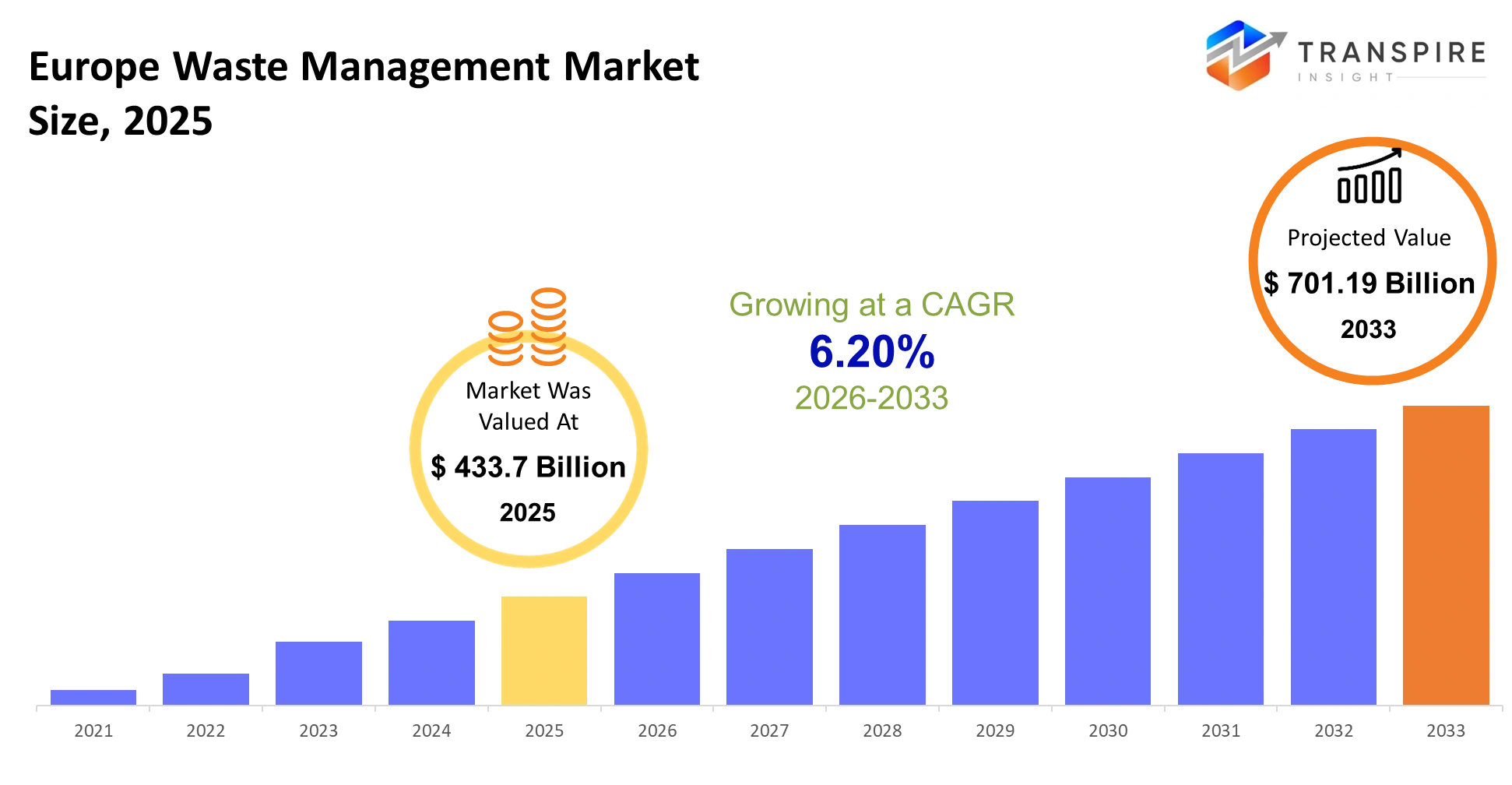
- Europe Waste Management Market Size 2025: USD 433.7 Billion
- Europe Waste Management Market Size 2033: USD 701.19 Billion
- Europe Waste Management Market CAGR: 6.20%
- Europe Waste Management Market Segments: By Type (Solid Waste, Liquid Waste, Hazardous Waste, Others); By Application (Collection, Recycling, Disposal, Energy Recovery, Others); By End-User (Municipal, Industrial, Commercial, Residential, Others); By Service (Public, Private, PPP, Others)
To learn more about this report,  Download Free Sample Report
Europe Waste Management Market Summary
The Europe Waste Management Market was valued at USD 433.7 Billion in 2025. It is forecast to reach USD 701.19 Billion by 2033. That is a CAGR of 6.20% over the period.
The waste management market in Europe tracks waste from municipal and industrial sources through collection and sorting and treatment processes while recovering materials for recycling and energy production and safe disposal. The system allows cities and manufacturers to fulfill their strict environmental requirements while they extract reusable materials from waste that includes packaging and plastics and metals and organic matter.
The sector has transformed its operations from linear disposal methods to circular resource recovery processes during the past 3 to 5 years because of funding initiatives that developed automated sorting technology and digital waste tracking systems and producer responsibility policies. The European Union tightened landfill diversion regulations through its Green Deal framework which created a major trigger for the current situation because the energy crisis of 2022 increased the need for waste-to-energy operations. The existing industry pressures require operators to enhance their processing capabilities through infrastructure upgrades and efficiency improvements. The company achieves revenue growth through two main sources which include technology-enabled recovery services and long-term compliance contracts as opposed to basic waste collection services.
Key Market Insights
- Western Europe holds the majority of the Europe Waste Management Market with a 40% market share because of its established recycling systems and its enforcement of waste disposal regulations.
- The Nordic countries experience their most rapid growth because they implement carbon-neutral goals and their waste-to-energy systems reach full deployment by 2030.
- European Union modernization programs which receive funding from the EU boost waste collection systems and waste diversion from landfills in Eastern Europe.
- The Europe Waste Management Market Distribution reaches its highest point through collection and sorting services which receive support from municipal waste contracts and industrial waste operations.
- Recycling services represent the second-largest segment which receives support from EU circular economy regulations and material recovery funding initiatives.
- Waste-to-energy systems represent the fastest-expanding sector because energy security requirements and landfill reduction regulations have increased since 2022.
- The municipal waste stream represents the largest waste category because urban population growth and city-sanctioned waste collection procedures operate throughout Europe.
- The industrial sector shows its most rapid growth through its need to manage waste produced during manufacturing operations and its requirement to treat hazardous materials.
- Municipal authorities remain the leading end-user segment, relying heavily on long-term public-private waste contracts.
- The manufacturing and industrial sectors expand their user base because environmental regulations and ESG reporting requirements become more stringent.
What are the Key Drivers, Restraints, and Opportunities in the Europe Waste Management Market?
The Europe Waste Management Market is being reshaped by a clear set of structural forces that are redefining how waste is collected, processed, and monetized across the region. The European Union has implemented its Circular Economy Action Plan which creates stricter regulations that require municipalities and industrial operators to stop using landfills and start using advanced recycling and recovery methods. The policy pressure has resulted in increased revenue for waste operators through contracts which specifically benefit the sorting and recycling and waste-to-energy operations. The company has increased its investments in automated material recovery facilities which will boost its operational efficiency and capacity to generate profits from its entire production process.
The most significant restraint is fragmented infrastructure across Eastern and Southern Europe, where collection systems remain inconsistent and underfunded. The operational framework creates organizational barriers which prevent large companies from expanding their operations while simultaneously raising their operational costs and showing no progress toward developing waste treatment systems that can operate across national boundaries. A portion of recycled materials continues to escape designated recycling channels which results in lost revenue opportunities throughout the European Waste Management Market.
The rapid adoption of AI-enabled waste sorting systems and digital waste tracking technology presents a valuable opportunity for operators because Germany and the Netherlands have started pilot programs which boost material recovery efficiency. The operational capacity of organizations expands through these technologies which attract institutional backing to transform low-value waste materials into profitable business assets.
What Has the Impact of Artificial Intelligence Been on the Europe Waste Management Market?
AI and advanced digital systems are transforming waste management and marine emission control operations throughout Europe because they enable digital monitoring of all aspects of their operations. AI-powered sensors in scrubber performance systems and exhaust gas cleaning technology maintain continuous monitoring of sulfur levels and pressure differentials and wash water quality while their automatic control system adjusts equipment settings to comply with EU MRV and IMO regulations without requiring human input. Fleet operators use AI-based compliance tracking tools to automate their reporting process which results in shorter inspection times for their European coastal vessels.
The use of machine learning models for predictive maintenance has increased because they enable the detection of early pump degradation and fouling and corrosion signs which helps organizations prevent unexpected equipment failures while extending machine operational life. Emissions forecasting algorithms enhance fuel efficiency and route optimization by providing measurable reductions in fuel use and operational improvements across both fleet operations and waste processing logistics systems.
The implementation of these technologies has increased system uptime while decreasing costs associated compliance management and improving both reporting precision and operational transparency. The implementation process faces challenges because high integration expenses combined with unstable offshore network access create barriers to real-time data flow which decreases model effectiveness in difficult maritime environments that lack extensive training data.
Key Market Trends
- The European Union has mandated all operators to implement advanced recycling and material recovery systems as their primary waste management method since 2020.
- The implementation of waste-to-energy solutions has increased after the 2022 energy crisis because it helps to decrease landfill usage while it boosts regional energy security improvements.
- The tracking platforms which launched after 2023 have enhanced compliance visibility for municipal waste networks while they decreased the number of reporting mistakes which occurred in those networks.
- All major facilities in Germany and France have switched to using automated sorting systems which operate through AI vision technology as their primary method of waste separation since 2021.
- Digital was The waste collection vehicle industry has moved towards electric vehicle adoption for its waste collection operations since 2022 because European urban centers enacted new emissions control regulations.
- The waste management company Veolia and SUEZ have been making more acquisitions since 2021 to establish dominance over existing waste collection services in various geographic areas.
- The demand for industrial waste recycling services increased after 2022 because manufacturing companies started to implement ESG reporting requirements and new disposal tracking measures.
- The implementation of IoT sensor-based smart landfill monitoring systems has decreased methane gas emissions from landfills while increasing their capacity to meet environmental regulations since 2020.
- The regulations for waste shipment between countries became more stringent in 2023, which required waste management companies to develop processing facilities that operate within their specific regions.
- The funding for facilities which recover circular materials has increased substantially since 2021 because their business operations now focus on resource recovery instead of traditional waste collection.
Europe Waste Management Market Segmentation
By Type:
The European Waste Management Market shows its highest market share through solid waste because urban areas produce continuous municipal waste while regulations require waste to be diverted from landfills. The city infrastructure of municipal solid waste systems generates permanent income streams which benefit operators through established agreements. Liquid waste and hazardous waste exist as minor segments in the market because their treatment value exceeds waste material volume through their industry-specific handling rules and compliance standards which apply to chemical and healthcare and manufacturing industries.
The European Union circular economy laws drive solid waste growth because they require waste materials to be recycled and separated from their origin points. The pharmaceutical and chemical industries face industrial compliance pressure which leads to hazardous waste expansion because disposal costs have increased. The growing need for advanced treatment technologies to meet wastewater discharge regulations has made basic disposal methods obsolete in liquid waste processing.
The Europe Waste Management Market will depend on solid waste throughout the forecast period yet hazardous waste and liquid waste will create greater value growth. Investors show increasing interest in facilities that provide high-profit waste treatment services while technology companies develop advanced filtration methods and secure waste disposal solutions to comply with regulatory standards.
By Application:
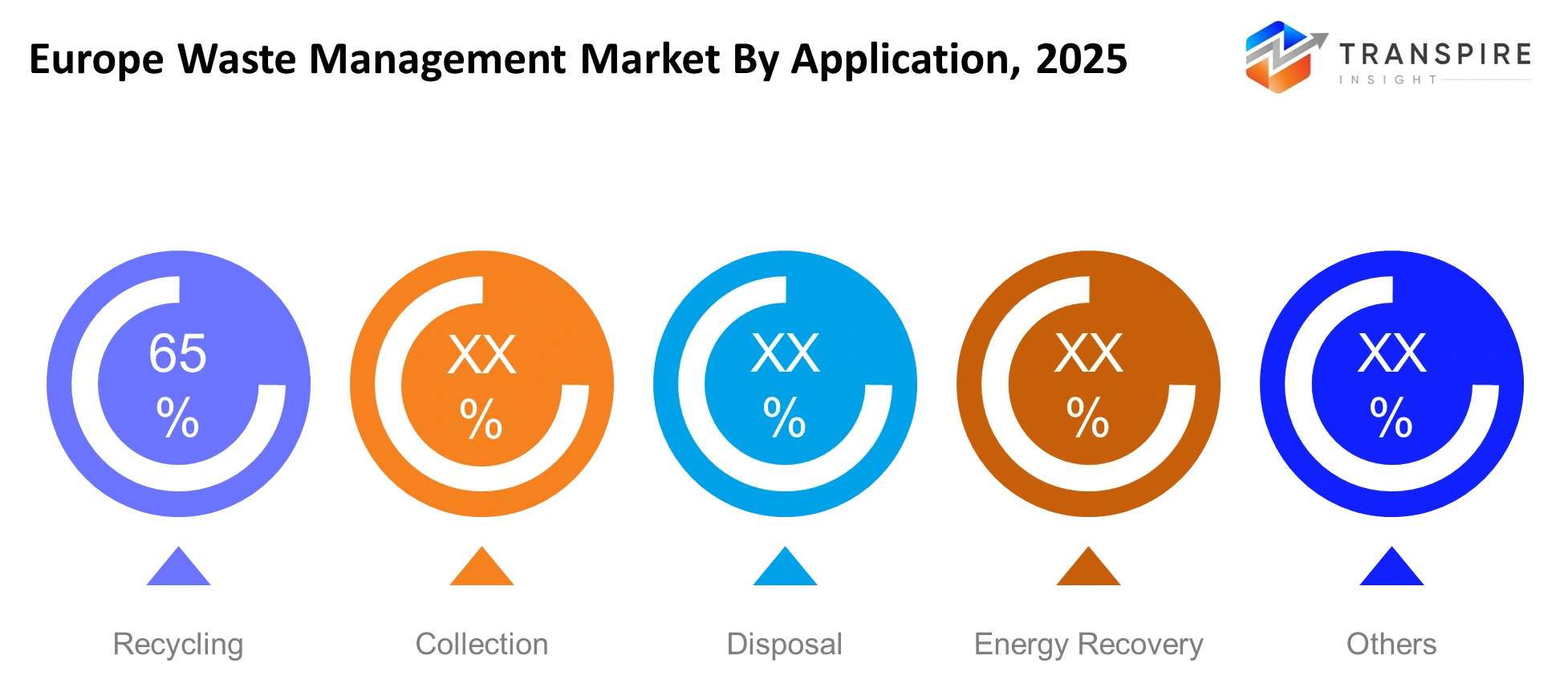
The market for waste management in Europe currently distributes its strongest market share to collection services because municipalities continue to hire private companies for their large-scale logistics requirements. The existing transport networks together with municipal contracts that operate for extended periods of time create returns which businesses can expect to receive. Recycling operations receive support through legal requirements which demand businesses to recover materials from their packaging and plastic and industrial waste operations.
The implementation of extended producer responsibility laws makes manufacturers financially responsible for their product waste which drives recycling operations to grow. After the 2022 energy crisis energy recovery operations received increased interest because waste-to-energy facilities became essential power generation facilities for both electricity and heat production. The importance of traditional disposal services has decreased because of increasing environmental fines and restrictions on landfill usage.
The Europe Waste Management Market will grow through energy recovery and recycling activities whereas collection activities will remain constant as a developed service category. Technology providers are focusing on automation in sorting facilities and efficiency upgrades in incineration plants, signaling a shift from logistics-heavy models toward resource recovery-driven revenue structures.
To learn more about this report, Download Free Sample Report
By End-User:
The European Waste Management Market is primarily controlled by municipal end-users who handle waste collection in cities and maintain public sanitation systems and ensure regulatory standards are fulfilled. The Western European cities with their developed infrastructure receive stable revenue streams through long-term contracts which bind private operators to deliver waste management services.
The increase in industrial users occurs because all manufacturing sectors need to meet their compliance obligations which apply to chemical and automotive and pharmaceutical products. Industrial growth occurs because companies must now follow stricter environmental reporting standards while they face increasing costs for disposing hazardous by-products.
The demand from industrial end-users will experience rapid growth throughout the future forecast duration because action on ESG regulations becomes more strict which affects supply chain operations in the European Waste Management Market. Investors are increasingly prioritizing industrial waste solutions with higher margins while municipal contracts provide long-term stability that limits growth opportunities.
By Service:
The European Waste Management Market depends on Public service provision because it remains essential for areas where municipalities operate their waste collection and disposal operations. The need for better operational results together with budget constraints has driven businesses to depend more on private companies which deliver better operational results and wider business growth. The private sector now controls the development of new technologies and their implementation throughout the industry.
The private sector has been growing quickly because of two main factors which include the relaxation of regulations and the decision of municipalities to contract their services to private companies. Public-private partnerships have emerged as the dominant approach for handling extensive infrastructure initiatives because they unite public sector control with private sector funding and operational skills. The framework enables recycling facilities and energy recovery operations to upgrade their systems
The European Waste Management Market will experience increased adoption of PPP models because governments aim to expand their infrastructure without requiring additional funding costs. Private companies will take the lead in both technology development and operational efficiency improvements while public organizations maintain their authority over regulations and responsibility for providing services.
What are the Key Use Cases Driving the Europe Waste Management Market?
The Europe Waste Management Market uses municipal collection and processing for its primary operation because cities continuously produce waste and public sanitation systems receive legal requirements. EU landfill diversion targets require cities to establish formal collection systems This system creates the most reliable operational needs for service providers who operate in the area.
The industrial waste treatment and recycling market experiences rapid growth through its application in manufacturing, automotive, and chemical industries. The need for better ESG reporting and hazardous waste management controls has forced factories to implement specialized waste treatment methods and certified recycling systems. The retail and hospitality industries show steady growth through their commercial waste services which private operators handle using outsourced contract arrangements.
Northern Europe now uses AI-powered smart sorting facilities and advanced waste-to-energy systems integrated into district heating networks as new operational applications. Shipping companies now require maritime waste management services because new regulations force ships to separate their waste and use digital waste tracking systems.
|
Report Metrics |
Details |
|
Market size value in 2025 |
USD 433.7 Billion |
|
Market size value in 2026 |
USD 460.15 Billion |
|
Revenue forecast in 2033 |
USD 701.19 Billion |
|
Growth rate |
CAGR of 6.20% from 2026 to 2033 |
|
Base year |
2025 |
|
Historical data |
2021 - 2024 |
|
Forecast period |
2026 - 2033 |
|
Report coverage |
Revenue forecast, competitive landscape, growth factors, and trends |
|
Regional scope |
Europe (Germany, United Kingdom, France, Italy, Spain, Rest of Europe) |
|
Key company profiled |
Veolia, Suez, Remondis, Biffa, Renewi, FCC Environment, Clean Harbors, Covanta, Urbaser, Averda, Hitachi Zosen, Republic Services, Waste Management Inc, Stericycle, Casella |
|
Customization scope |
Free report customization (country, regional & segment scope). Avail customized purchase options to meet your exact research needs. |
|
Report Segmentation |
By Type (Solid Waste, Liquid Waste, Hazardous Waste, Others); By Application (Collection, Recycling, Disposal, Energy Recovery, Others); By End-User (Municipal, Industrial, Commercial, Residential, Others); By Service (Public, Private, PPP, Others) |
Which Regions are Driving the Europe Waste Management Market Growth?
The Europe Waste Management Market shows Western Europe as its leading region because Western European countries maintain established waste management regulations which their advanced waste processing systems. The European Union circular economy directives require Germany France and the Netherlands to implement strict recycling rules which lead to high collection and recovery rates. Integrated waste services require continuous operational demand from cities with dense populations and advanced waste management systems. The ecosystem of private operators who collaborate with technology providers and municipal partnerships enables organizations to develop new solutions for sorting and energy recovery and recycling.
Southern Europe functions as a stable yet fundamentally distinct element of the Europe Waste Management Market. The countries of Italy Spain and Portugal use gradual regulatory implementation as their primary approach to compliance instead of following early compliance leadership. The local economy gains support from two main sources which include waste produced by tourists and manufacturing operations that run throughout the year. The infrastructure modernization process maintains its steady development which generates extended service agreements between private operators and the company. The region maintains its defensive capacity because of two factors which include its predictable demand patterns and the ongoing European Union funding for environmental improvements.
Eastern Europe represents the fastest expanding area because of its quick infrastructure upgrades and successful EU environmental standard implementation. The landfill systems in Poland Romania and Hungary received major improvements through recent investments which established better recycling facilities since 2022. The waste collection networks operational modernization process has received funding through strong EU structural fund inflows combined with growing involvement from the private sector. The region presents investors with high growth opportunities between 2026 and 2033 because of its digital tracking system and recycling facility and integrated operation development possibilities.
Who are the Key Players in the Europe Waste Management Market and How Do They Compete?
The Waste Management Market in Europe operates through a system of regional competitions which creates a consolidated market in Western Europe while Eastern European markets maintain their divided state through multiple local waste management companies. The battle for contract retention exists between large companies which hold municipal contracts and their competitors who want to take those contracts. Companies compete with each other through their ability to meet compliance standards and their efficiency in managing logistics and their use of advanced recycling systems which extend beyond basic pricing competition.
Veolia provides complete circular economy solutions by delivering water waste and energy services which help municipalities throughout France and Europe. SUEZ establishes its unique market position through digital waste tracking systems and intelligent recycling centers which help industrial customers increase their waste management traceability. The company REMONDIS establishes its operations in Germany and Eastern Europe through the development of local business centers which grow its logistics network by acquiring new assets.
Biffa operates in the UK market by developing landfill diversion systems and recycling programs which achieve higher operational efficiency through new sorting technology and commercial waste partnerships. FCC Environment operates its business in Spain and Portugal by obtaining municipal contracts which allow it to transform landfills into recycling operations. The two companies create stronger market positions through infrastructure upgrades and public-private partnership agreements which help them meet operational demands and regulatory requirements.
Company List
- Veolia
- Suez
- Remondis
- Biffa
- Renewi
- FCC Environment
- Clean Harbors
- Covanta
- Urbaser
- Averda
- Hitachi Zosen
- Republic Services
- Waste Management Inc
- Stericycle
- Casella
Recent Development News
In November 2025, Veolia announced acquisition of Enviri’s Clean Earth business for approximately $3 billion. The transaction strengthens Veolia’s hazardous waste capabilities in the United States and expands its exposure to high-growth industrial and healthcare waste streams. The deal also enhances its European operational model by integrating advanced treatment and compliance technologies across cross-border networks.https://www.reuters.com
In May 2024, Biffa acquired Renewi’s UK municipal waste division, expanding its long-term public sector contracts across England and Scotland. The move strengthens Biffa’s collection footprint and increases integration of recycling and residual waste treatment operations.https://www.renewi.com
What Strategic Insights Define the Future of the Europe Waste Management Market?
The Europe Waste Management Market is developing into a resource recovery model which requires compliance with multiple regulations, as companies will generate more revenue from material recovery than from their basic waste collection operations. The European Union has introduced stricter circular economy regulations, while industrial sectors now require secondary raw materials, which together establish waste materials as usable resources instead of discardable garbage. Digital traceability together with automation will determine which companies succeed in their competitive markets during the upcoming five to seven years through their ability to operate beyond their physical locations.
Market concentration presents an undiscovered danger because major companies keep buying regional businesses which will restrict their ability to set prices while creating antitrust concerns about their control over city contracts. The process will lead to delays in deal approval, which will affect the companys ability to grow in the future.
Advanced chemical recycling of plastics presents a new business opportunity in Germany and the Netherlands, where pilot plants are advancing toward their first commercial operations. The sector remains in its early stages of development, yet it meets EU packaging waste objectives. The market stakeholders need to make early chemical recycling infrastructure investments together with digital waste tracking platform development to achieve compliance with regulations and establish control over feedstock materials for their operations.
Europe Waste Management Market Report Segmentation
By Type
- Solid Waste
- Liquid Waste
- Hazardous Waste
- Others
By Application
- Collection
- Recycling
- Disposal
- Energy Recovery
- Others
By End-User
- Municipal
- Industrial
- Commercial
- Residential
- Others
By Service
- Public
- Private
- PPP
- Others
Frequently Asked Questions
Find quick answers to common questions.
The Europe Waste Management Market size is USD 701.19 Billion in 2033.
Key segments for the Europe Waste Management Market are By Type (Solid Waste, Liquid Waste, Hazardous Waste, Others); By Application (Collection, Recycling, Disposal, Energy Recovery, Others); By End-User (Municipal, Industrial, Commercial, Residential, Others); By Service (Public, Private, PPP, Others).
Major Europe Waste Management Market players are Veolia, Suez, Remondis, Biffa, Renewi, FCC Environment, Clean Harbors, Covanta, Urbaser, Averda, Hitachi Zosen, Republic Services, Waste Management Inc, Stericycle, Casella.
The Europe Waste Management Market size is USD 433.7 Billion in 2025.
The Europe Waste Management Market CAGR is 6.20% from 2026 to 2033.
- Veolia
- Suez
- Remondis
- Biffa
- Renewi
- FCC Environment
- Clean Harbors
- Covanta
- Urbaser
- Averda
- Hitachi Zosen
- Republic Services
- Waste Management Inc
- Stericycle
- Casella
Recently Published Reports
-
Apr 2026
Active Power Filter Market
Active Power Filter Market Size, Share & Analysis Report By Type (Shunt Active Power Filters, Series Active Power Filter, Hybrid Active Power Filter), By Application (Harmonics Mitigation, Reactive Power Compensation, Voltage Regulation, Power Factor Correction), By Phase (Single Phase, Three Phase), By End-User Industry (Manufacturing, Healthcare, Commercial, Automotive, Oil and Gas, Others), and Geography (North America, Europe, Asia-Pacific, Middle East and Africa, South and Central America), 2021 - 2031
-
Apr 2026
Electrical Transformer Market
Electrical Transformer Market Size, Share & Analysis Report By Core (Closed, Shell, and Berry), By Insulation (Gas, Oil, Solid, Air, and Other), By Phase (Single, and Three), By Rating (100 MVA to 500 MVA, 501 MVA to 800 MVA, and 801 MVA to 1200 MVA), and Geography (North America, Europe, Asia-Pacific, Middle East and Africa, South and Central America), 2021 – 2031
-
Apr 2026
Hydraulic Piston Pumps Market
Hydraulic Piston Pumps Market Size, Share & Analysis Report By Type (Axial Piston Pumps, Radial Piston Pumps), By Operating Pressure (Low Pressure, Medium Pressure, High Pressure), By Application (Construction, Mining, Agriculture, Automotive, Oil & Gas, Industrial Machinery, Others), By End-User (OEMs, Aftermarket), and Geography (North America, Europe, Asia-Pacific, Middle East and Africa, South and Central America), 2021 – 2031
-
Apr 2026
Laboratory Gas Generators Market
Laboratory Gas Generators Market Size, Share & Analysis Report By Product (Nitrogen Gas Generator, Hydrogen Gas Generator, Zero Air Gas Generator, Purge Gas Generator, TOC Gas Generators, Others), By Application (Gas Chromatography, Liquid Chromatography-mass Spectrometry (LC-MS), Gas Analyzers, Others), By End-user (Life Science, Chemical & Petrochemical, Food & Beverage, Others), and Geography (North America, Europe, Asia-Pacific, Middle East and Africa, South and Central America), 2021 – 2031