
France IT Services Outsourcing Market Size & Forecast:
- France IT Services Outsourcing Market Size 2025: USD 37090.8 Million
- France IT Services Outsourcing Market Size 2033: USD 71174.9 Million
- France IT Services Outsourcing Market CAGR: 8.51%
- France IT Services Outsourcing Market Segments: By Type (Application Outsourcing, Infrastructure Outsourcing, BPO, KPO, Others); By Application (IT Services, Finance & Accounting, HR Services, Customer Support, Data Analytics, Others); By End-User (Enterprises, SMEs, BFSI, Healthcare, IT & Telecom, Government, Others); By Deployment (Onshore, Offshore, Nearshore, Hybrid, Others)
To learn more about this report,  Download Free Sample Report
France IT Services Outsourcing Market Summary
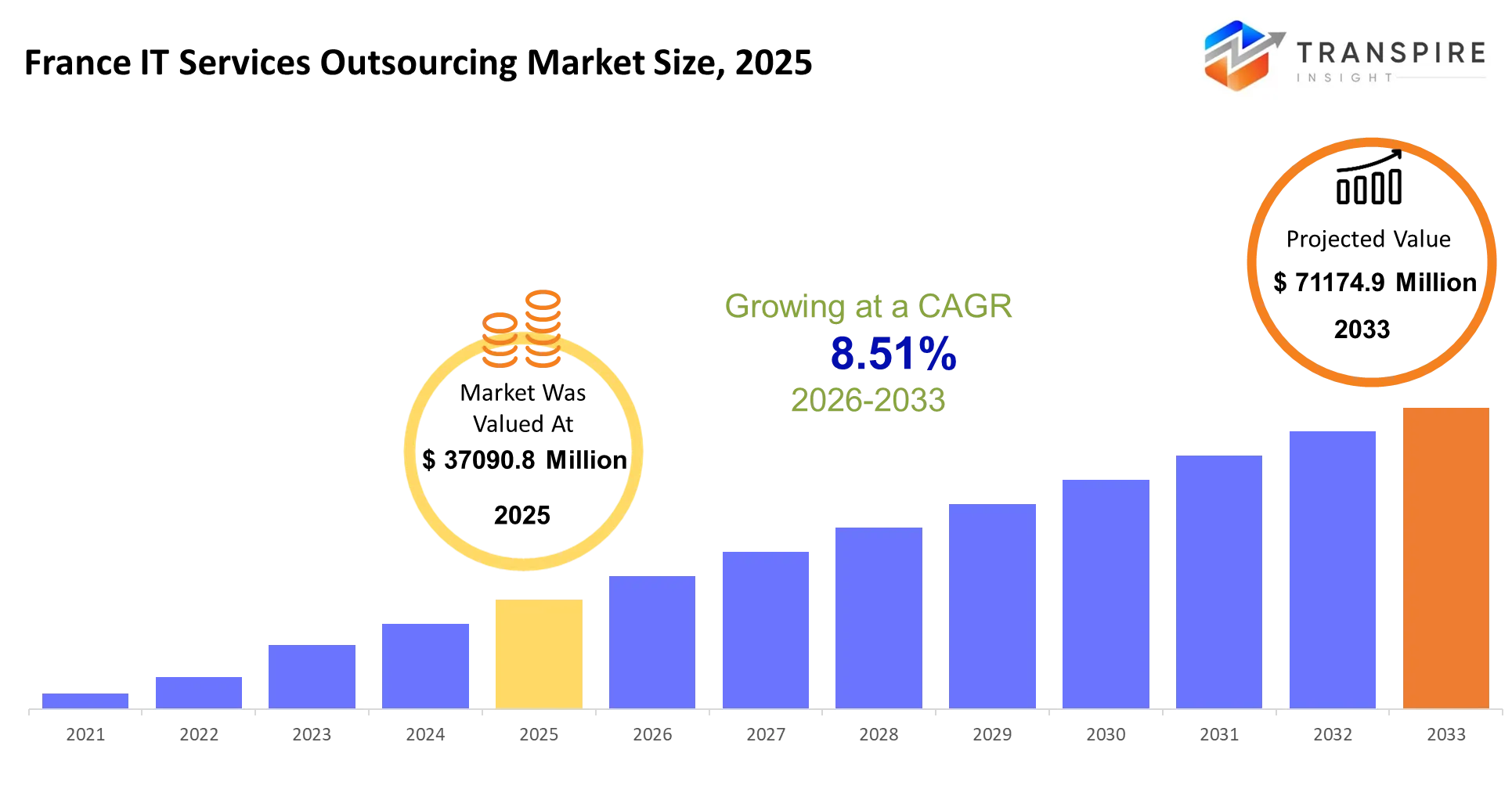
The France IT Services Outsourcing Market was valued at USD 37090.8 Million in 2025. It is forecast to reach USD 71174.9 Million by 2033. That is a CAGR of 8.51% over the period.
The France IT Services Outsourcing Market helps businesses transfer their non-essential IT functions which include infrastructure management and application development and support services to dedicated external service providers. This enables organizations in banking and healthcare and manufacturing sectors to decrease their operational difficulties while enhancing service delivery and directing their staff members to work on important strategic objectives. The outsourcing vendors provide businesses with scalable digital solutions and cybersecurity services and cloud integration which their internal teams cannot effectively develop.
The market has shifted during the last three to five years toward cloud-based outsourcing and platform-driven service delivery methods. Businesses now seek to implement outsourcing solutions because they require access to advanced capabilities which include AI technology and DevOps development acceleration. The COVID-19 pandemic created operational disruptions which required organizations to establish remote work capabilities while their existing IT systems demonstrated significant deficiencies. Organizations started to increase their outsourcing partnerships because they needed to maintain business operations which resulted in higher revenue growth and stronger relationships with their service providers.
Key Market Insights
- The Île-de-France region holds 40 percent of the French IT Services Outsourcing Market because the area contains many businesses and advanced technology systems.
- The southern part of France will experience its fastest growth between now and 2033 because government-supported digital centers and small and medium-sized enterprises will begin using outsourcing services.
- Application outsourcing leads the market with 35 percent market share because enterprises need custom software and modernization services.
- Infrastructure outsourcing accounts for the second most market share because organizations require cloud migration services and hybrid IT environment management solutions.
- The KPO segment experiences the fastest growth rate because businesses need analytics and AI and high-value knowledge services.
- The IT services field leads the application market with more than 30 percent market share because organizations keep advancing their digital transformation efforts.
- The data analytics outsourcing market experiences its fastest growth because companies implement real-time decision-making systems that use predictive insights.
- The BFSI sector dominates the French IT Services Outsourcing Market because financial institutions must follow complex regulations while maintaining secure IT systems.
- The healthcare industry is expanding quickly because medical providers need IT support for their telemedicine services and patient information management systems.
- Businesses invest in artificial intelligence service platforms and cloud-native products and cybersecurity improvements to enhance their competitive advantage.
- The company accelerates its market growth through strategic alliances with hyperscalers and by establishing operations in European technology centers.
- Companies are using their budget resources to create automation systems and analytics tools because they want to better serve their customers and keep existing customers.
What are the Key Drivers, Restraints, and Opportunities in the France IT Services Outsourcing Market?
The enterprise shift toward cloud-based infrastructure and digital-first operating models drives the entire France IT Services Outsourcing Market. The organization found its internal IT systems to be ineffective because it needed to spend more money on old system upkeep while facing greater security threats. The company decided to use outsourcing solutions which provide cloud resources and security management and system updates throughout the day. The volume and length of outsourcing contracts at companies that move their operations to hybrid and multi-cloud systems create higher income for vendors who provide extended service contracts.
The United States and European Union countries face their biggest barrier from France's data sovereignty laws and regulatory requirements which create obstacles to their business operations. The General Data Protection Regulation establishes strict rules which limit how organizations handle data and transfer data between countries and hold vendors responsible for their data handling practices. The requirements for compliance increase operational expenses while the extended contract negotiation process results in delayed outsourcing decisions which require more time to complete. The smaller companies in the market face adoption obstacles because they need to address both legal risks and integration difficulties which results in lost revenue opportunities despite strong market demand.
European businesses now have an opportunity to expand their AI-driven outsourcing services together with their nearshore delivery operations. Companies are increasing their investments in both advanced analytics and automation platforms and industry-specific AI tools to establish their market position. French clients now receive affordable high-skilled services because Eastern European outsourcing providers have established AI operations centers. The new business operation generates revenue streams which enable vendors to obtain valuable contracts in data analytics and intelligent automation projects.
What Has the Impact of Artificial Intelligence Been on the France IT Services Outsourcing Market?
The entire process of IT outsourcing throughout France has undergone a fundamental transformation because of artificial intelligence. Service providers now use AI-based automation solutions to handle all aspects of IT operations which include system monitoring and incident detection as well as help desk support services. The system automatically handles common technical problems to reduce the need for human staff which results in faster operations and lower expenses. The critical industries of banking and telecommunications benefit from improved service reliability which drives down operational interruptions.
The use of machine learning models has expanded to support predictive maintenance and performance enhancement tasks for outsourced IT operations. System providers study past system performance to predict when hardware will fail and when network issues and application problems will arise. The system's predictive abilities enable better equipment performance through improved uptime and better resource management which results in higher business productivity. Organizations use AI-based analytics systems to analyze extensive data to extract practical business knowledge which assists them in making better strategic decisions.
AI integration has produced multiple benefits for operational processes which include quicker ticket resolution and lower infrastructure expenses and better detection of cybersecurity threats. The implementation process encounters its main obstacle because organizations need to spend large amounts of money for system connection and they require secure access to data. The training process for AI models needs organized data which most legacy systems cannot provide, so this problem hinders deployment and decreases effectiveness during complex IT tasks in real-world business situations.
Key Market Trends
- Companies adopted cloud-native service models from 2020 until 2025 because they needed services that could grow and deploy new features without interruption.
- After 2021, organizations began to implement AI-based automation systems which reduced their need for manual IT support while delivering better service results throughout their outsourcing agreements.
- BFSI companies increased their outsourcing relationships after 2022 to protect their digital banking operations from cybersecurity threats and to meet regulatory standards.
- By 2024, vendors switched to platform-based delivery systems which allowed them to replace traditional labor contracts with subscription-based service delivery methods.
- European countries experienced increased adoption of nearshore outsourcing after 2022 because geopolitical events made offshore delivery services less dependable.
- After 2023, enterprises began to outsource data analytics because they needed tools that would provide them with immediate insights and make future operational decisions more precise.
- French businesses accelerated their hybrid cloud implementation through partnerships between service providers and cloud platforms such as AWS and Microsoft Azure.
- Mid-sized enterprises increased outsourcing adoption after 2021 as cost pressures and talent shortages limited in-house IT expansion.
- The cybersecurity outsourcing market expanded quickly because ransomware attacks increased and EU compliance standards became more demanding.
- Providers expanded AI and automation technology investments to create unique service offerings which would help them win high-value contracts with enterprise customers.
France IT Services Outsourcing Market Segmentation
By Type
The outsourcing market uses service type segmentation as its main method to determine outsourcing needs, while application and infrastructure services together account for most enterprise software modernization needs and cloud infrastructure requirements. Organizations adopt this solution because it enables them to handle complex IT systems while decreasing their need to maintain internal operations. Business process outsourcing and knowledge process outsourcing contribute a smaller but steadily expanding portion, driven by demand for specialized and process-driven external capabilities. The market structure shows a gradual transition from cost-based outsourcing toward value-based expertise-driven service delivery.
Enterprise adoption of cloud-native architectures together with rising demands for distributed systems management creates growth within this market segment. Organizations want vendors who deliver complete packages that include development tools, infrastructure components, and analytics solutions because this approach helps them establish enduring agreements which create consistent revenue. The higher-value segments of knowledge-based services will see faster growth during the forecast period, which will lead providers to spend resources on developing advanced AI capabilities along with specialized knowledge. Vendors who move beyond basic outsourcing to develop strategic digital partnerships will find better business opportunities according to this trend.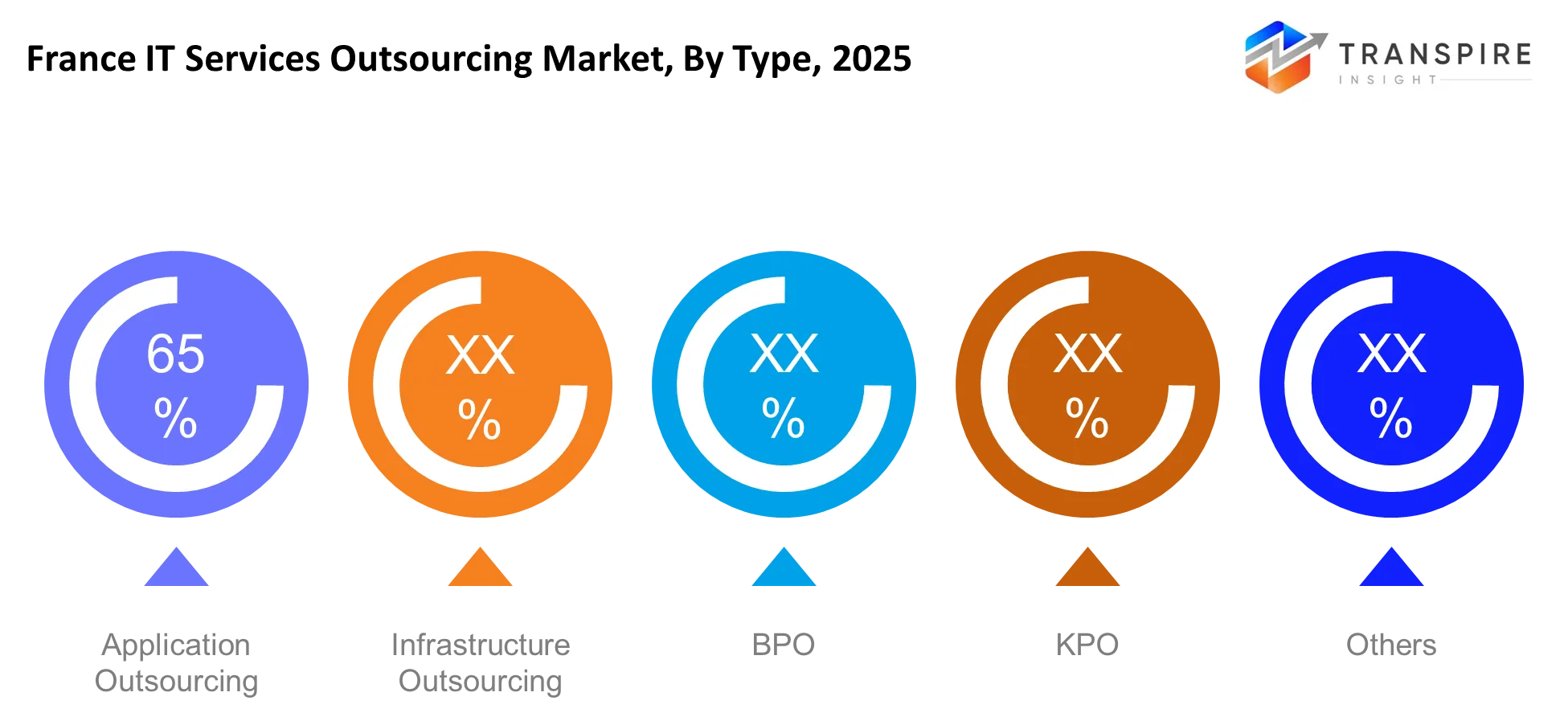
To learn more about this report, Download Free Sample Report
By Application
The IT services sector leads application-based segmentation because businesses maintain their highest spending levels on digital transformation services and system integration services. Organizations need to establish proper operational procedures which will help their various departments including finance and HR and customer support functions to operate their work processes more effectively. The rising demand for data-driven decision-making in multiple industries has made data analytics become an important application field. The market position shows a shift from transactional outsourcing to service delivery which uses data insights.
Different applications have different growth patterns which lead to analytics and IT services expansion because of the growing need for real-time data processing and digital platform implementation. The traditional support functions of organizations continue to hold value while their growth rate decreases because automation technology decreases the requirement for human work. The market for data-centric applications will continue to grow which will create pressure on service providers to develop better analytical skills and make investments in new technological solutions. The evolution creates new business possibilities for specialized vendors because it motivates buyers to select outsourcing partners who can demonstrate their ability to achieve specific business results.
By End-User
The end-user segmentation analysis demonstrates that large enterprises control most market share because they have extensive IT needs and spend more money on outsourcing than other companies do. The banking and telecommunications and healthcare sectors create demand because they need secure and scalable IT systems to meet their complex regulatory requirements. Small and medium enterprises represent a growing segment as digital tools become essential for competitiveness and operational efficiency. The market structure shows expanded client adoption of services which now includes companies that operate smaller than traditional large-scale clients.
This segment develops through two factors which include its specific industry needs and its existing digital development status. The regulated sectors use outsourcing for both compliance needs and infrastructure management while smaller companies use outsourcing to obtain essential capabilities without making substantial equipment investments. The upcoming trends will lead mid-sized companies and public sector organizations to participate more in digital programs while they aim to reduce expenses. The transition requires service providers to develop solutions which can adapt to different business sizes and industry requirements.
By Deployment
The current deployment segmentation process uses offshore models which dominate the market because they offer lower costs and access to international workforce resources. Onshore and nearshore models hold smaller shares but play a critical role in projects requiring regulatory compliance, data security, and proximity to clients. The adoption of hybrid deployment methods is increasing because organizations want to achieve both cost savings and operational control. Organizations use market positioning to achieve their goals of operational efficiency together with their risk assessment needs.
The growth patterns of the market depend on three main factors which include geopolitical developments and data protection laws and the demand for strong service delivery systems. Nearshore and hybrid approaches are expanding as enterprises seek to reduce dependency on distant outsourcing locations while maintaining flexibility. Hybrid deployment will experience the highest growth rate during the forecast period because it enables organizations to achieve cost savings and performance improvements and compliance requirements. Providers use this trend to develop distributed delivery networks while they build their regional delivery capabilities to maintain their market advantage.
What are the Key Use Cases Driving the France IT Services Outsourcing Market?
Core demand comes from application outsourcing for enterprise IT modernization, particularly in banking and telecommunications. Organizations depend on external providers to rebuild their legacy systems while they transition their workloads to cloud platforms and running-critical applications. The use case creates maximum demand because it enables revenue operations and digital customer interfaces and meets regulatory compliance requirements. The combination of software updates and system integration needs maintains the active status of outsourcing agreements which extend throughout their duration.
The industry expands its application range through finance and accounting outsourcing and customer support services which are especially important for retail and BFSI and e-commerce operations. Companies outsource transaction processing and payroll management and multilingual customer service to enhance their operational efficiency and service delivery standards. Healthcare providers also adopt outsourcing for patient data management and telehealth platforms. The applications show increased adoption because businesses need solutions that can manage their growing operational demands while providing efficient service to their customers.
The industry currently develops new use cases that involve outsourcing data analytics work and using AI technology to automate business processes. Enterprises increasingly use external partners to build predictive models, manage large datasets, and automate decision workflows. Manufacturing and logistics companies utilize these services to enhance their supply chain operations and demand prediction capabilities. The forecast period shows a rising trend towards outsourcing which delivers high-value insights to businesses.
|
Report Metrics |
Details |
|
Market size value in 2025 |
USD 37090.8 Million |
|
Market size value in 2026 |
USD 40170.2 Million |
|
Revenue forecast in 2033 |
USD 71174.9 Million |
|
Growth rate |
CAGR of 8.51% from 2026 to 2033 |
|
Base year |
2025 |
|
Historical data |
2021 - 2024 |
|
Forecast period |
2026 - 2033 |
|
Report coverage |
Revenue forecast, competitive landscape, growth factors, and trends |
|
Regional scope |
United States; Canada; Mexico; United Kingdom; Germany; France; Italy; Spain; Denmark; Sweden; Norway; China; Japan; India; Australia; South Korea; Thailand; Brazil; Argentina; South Africa; Saudi Arabia; United Arab Emirates |
|
Key company profiled |
Accenture, TCS, Infosys, Wipro, Cognizant, Capgemini, IBM, HCLTech, Tech Mahindra, DXC Technology, Atos, CGI, Sopra Steria, Fujitsu, NTT Data |
|
Customization scope |
Free report customization (country, regional & segment scope). Avail customized purchase options to meet your exact research needs. |
|
Report Segmentation |
By Type (Application Outsourcing, Infrastructure Outsourcing, BPO, KPO, Others); By Application (IT Services, Finance & Accounting, HR Services, Customer Support, Data Analytics, Others); By End-User (Enterprises, SMEs, BFSI, Healthcare, IT & Telecom, Government, Others); By Deployment (Onshore, Offshore, Nearshore, Hybrid, Others) ) |
Which Regions are Driving the France IT Services Outsourcing Market Growth?
The current deployment segmentation process uses offshore models which dominate the market because they offer lower costs and access to international workforce resources. Onshore and nearshore models hold smaller shares but play a critical role in projects requiring regulatory compliance, data security, and proximity to clients. The adoption of hybrid deployment methods is increasing because organizations want to achieve both cost savings and operational control. Organizations use market positioning to achieve their goals of operational efficiency together with their risk assessment needs.
The growth patterns of the market depend on three main factors which include geopolitical developments and data protection laws and the demand for strong service delivery systems. Nearshore and hybrid approaches are expanding as enterprises seek to reduce dependency on distant outsourcing locations while maintaining flexibility. Hybrid deployment will experience the highest growth rate during the forecast period because it enables organizations to achieve cost savings and performance improvements and compliance requirements. Providers use this trend to develop distributed delivery networks while they build their regional delivery capabilities to maintain their market advantage.
Who are the Key Players in the France IT Services Outsourcing Market and How Do They Compete?
The French IT services outsourcing market shows competitive activity because global companies and local experts compete against each other while top providers maintain their market power through moderate consolidation. Large firms compete primarily on three factors which are their technological expertise and their cloud integration abilities and their capacity to implement complete digital transformation solutions. The market has transitioned from a competition based on expenses to a competition that creates value through automation and analytics and service models which use platform technology. The existing providers maintain their market presence by developing new capabilities and building long-term business relationships.
Capgemini establishes its business through consulting-led outsourcing services and strong partnerships with European companies while using AI and cloud transformation services for its operational development. Accenture differentiates itself through its platform-driven delivery systems and its substantial investment in digital solutions tailored to specific industries which help companies achieve their transformation objectives. IBM uses its hybrid cloud system and artificial intelligence platforms to provide secure outsourcing solutions which meet the needs of highly regulated industries like banking and healthcare.
Tata Consultancy Services and Infosys compete through cost-efficient global delivery models combined with strong automation frameworks. These companies establish their presence in France by developing local talent and establishing partnerships to fulfill regulatory and cultural needs. The companies maintain their competitive edge through their continuous spending on digital engineering and cloud development which helps them acquire permanent outsourcing contracts.
Company List
- Accenture
- Tata Consultancy Services
- Infosys
- Wipro
- Cognizant
- Capgemini
- IBM
- HCLTech
- Tech Mahindra
- DXC Technology
- Atos
- CGI
- Sopra Steria
- Fujitsu
- NTT Data
Recent Development News
In July 2025, Capgemini announced acquisition of WNS for $3.3 billion. The deal strengthens Capgemini’s outsourcing and business process transformation capabilities, especially in generative AI and analytics services.https://www.reuters.com
What Strategic Insights Define the Future of the France IT Services Outsourcing Market?
The France IT Services Outsourcing Market is moving toward a platform-centric and AI-integrated structure, driven by enterprise demand for scalable and intelligent digital operations. Service providers are transforming from traditional outsourcing vendors into strategic partners who provide ongoing product development and assess business results. The current technological development is enabled through the combination of cloud technology, automated systems, and the industrial demand for immediate data analysis solutions.
European countries are implementing stricter data sovereignty regulations which create hidden dangers because these rules increase compliance costs and prevent companies from delivering services across international borders. The development of specialized outsourcing platforms for different industries creates new business opportunities especially in healthcare and financial services which require customized solutions to achieve better profitability. The market requires businesses to develop local delivery systems while establishing advanced AI systems because these capabilities will provide them with a competitive edge and enable them to achieve sustainable success in the upcoming specialized outsourcing environment.
France IT Services Outsourcing Market Report Segmentation
By Type
- Application Outsourcing
- Infrastructure Outsourcing
- BPO
- KPO
- Others
By Application
- IT Services
- Finance & Accounting
- HR Services
- Customer Support
- Data Analytics
- Others
By End-User
- Enterprises
- SMEs
- BFSI
- Healthcare
- IT & Telecom
- Government
- Others
By Deployment
- Onshore
- Offshore
- Nearshore
- Hybrid
- Others
Frequently Asked Questions
Find quick answers to common questions.
The confirmed 2033 market size figure is USD 71174.9 Million.
Key segments for the France IT Services Outsourcing Market are By Type (Application Outsourcing, Infrastructure Outsourcing, BPO, KPO, Others); By Application (IT Services, Finance & Accounting, HR Services, Customer Support, Data Analytics, Others); By End-User (Enterprises, SMEs, BFSI, Healthcare, IT & Telecom, Government, Others); By Deployment (Onshore, Offshore, Nearshore, Hybrid, Others).
Major France IT Services Outsourcing Market Players are Accenture, TCS, Infosys, Wipro, Cognizant, Capgemini, IBM, HCLTech, Tech Mahindra, DXC Technology, Atos, CGI, Sopra Steria, Fujitsu, NTT Data.
The France IT Services Outsourcing Market size is USD 37090.8 Million in 2025.
The France IT Services Outsourcing Market CAGR is 8.51% from 2026 to 2033.
- Accenture
- Tata Consultancy Services
- Infosys
- Wipro
- Cognizant
- Capgemini
- IBM
- HCLTech
- Tech Mahindra
- DXC Technology
- Atos
- CGI
- Sopra Steria
- Fujitsu
- NTT Data
Recently Published Reports
-
Apr 2026
3D Optical Profiler Market
3D Optical Profiler Market Size, Share & Analysis Report By Type (Desktop 3D Optical Profiler, and Portable 3D Optical Profiler), By Technology (Confocal Technology, and White Light Interference), By End-Use Industry (Manufacturing, Research Institutions, Automotive, Aerospace and Defense, Medical Devices, and Other), and Geography (North America, Europe, Asia-Pacific, Middle East and Africa, South and Central America), 2021 - 2031
-
Apr 2026
Depth Sensor Market
Depth Sensor Market Size, Share & Analysis Report By Type (Infrared Depth Sensors, Time-of-Flight (ToF) Sensors, Stereo Vision Sensors, Structured Light Sensors, Ultrasonic Depth Sensors), By Application (Automotive, Robotics, Gaming, Consumer Electronics, Industrial Automation, Healthcare, Security & Surveillance, Others), By End Users (Automotive Manufacturers, Consumer Electronics Companies, Healthcare Providers, Industrial Companies, Security Agencies, Gaming Companies, Robotics Companies, Others), and Geography (North America, Europe, Asia-Pacific, Middle East and Africa, South and Central America), 2021 – 2031
-
Apr 2026
Digital Manufacturing Market
Digital Manufacturing Market Size, Share & Analysis Report By Component (Hardware, Software, and Services), By Technology (Robotics, 3D Printing, Internet of Things (IoT), and Others), By Application (Automotive and Transportation, Aerospace and Defense, Consumer Electronics, Industrial Machinery, and Others), By Process Type (Computer-Based Designing, Computer-Based Simulation, Computer 3D Visualization, Analytics, and Others), and Geography (North America, Europe, Asia-Pacific, Middle East and Africa, South and Central America), 2021 – 2031
-
Apr 2026
Digital Visa Services Market
Digital Visa Services Market Size, Share & Analysis Report By Type (Individual Travelers, Group Travelers), By Application (Tourism, Business Travel, Others), and Geography (North America, Europe, Asia-Pacific, Middle East and Africa, South and Central America), 2021 – 2031