
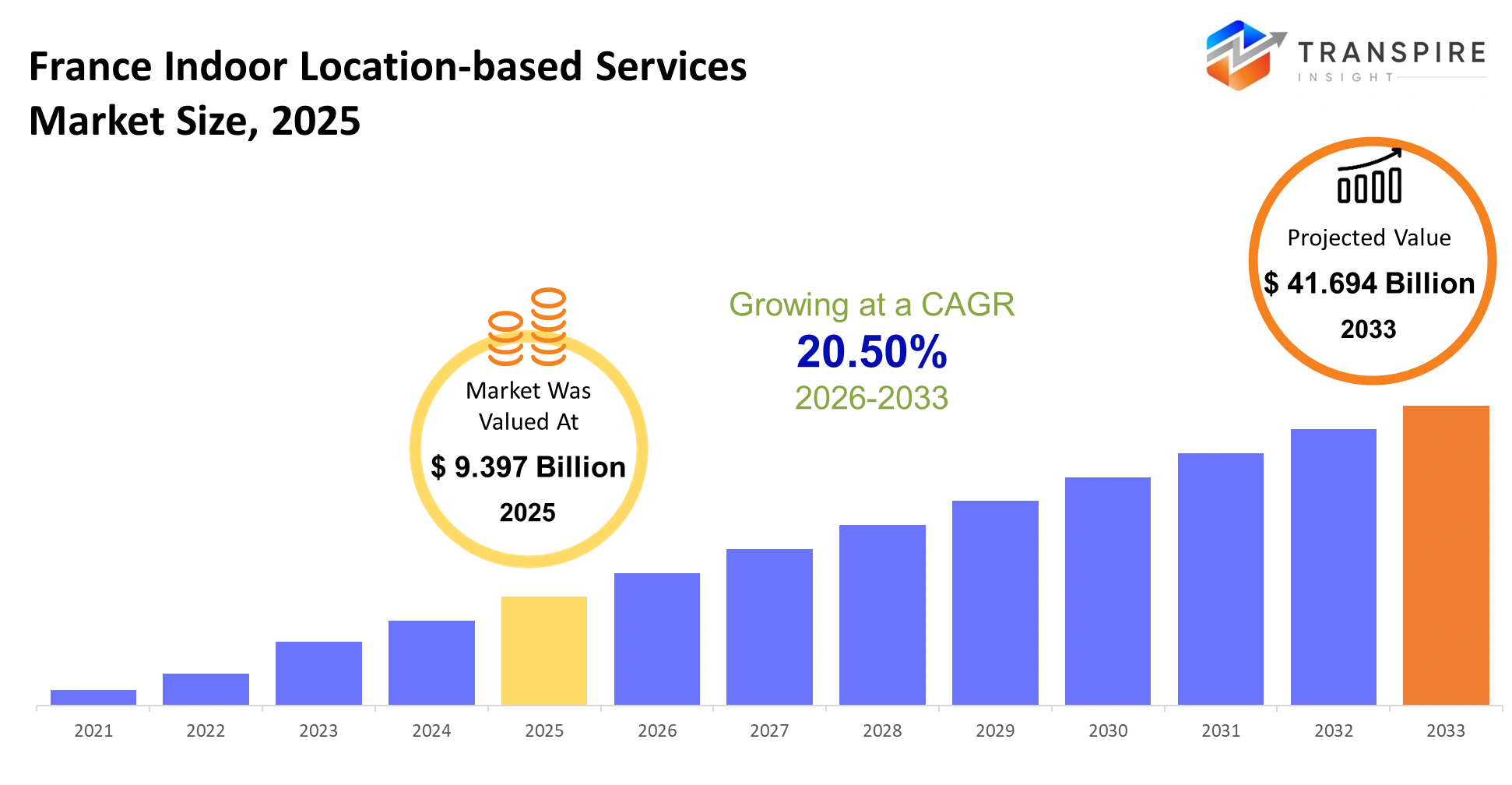
France Indoor Location-based Services Market Size & Forecast:
- France Indoor Location-based Services Market Size 2025: USD 9.397 Billion
- France Indoor Location-based Services Market Size 2033: USD 41.694 Billion
- France Indoor Location-based Services Market CAGR : 20.50%
- France Indoor Location-based Services Market Segments: By Type (Hardware, Software, Services, Others); By Application (Retail, Healthcare, Airports, Smart Buildings, Warehousing, Others); By End-User (Retailers, Enterprises, Hospitals, Airports, Logistics Companies, Others); By Technology (Wi-Fi, Bluetooth, UWB, RFID, Others)
To learn more about this report,  Download Free Sample Report
France Indoor Location-based Services Market Summary
The France Indoor Location-based Services Market was valued at USD 9.397 Billion in 2025. It is forecast to reach USD 41.694 Billion by 2033. That is a CAGR of 20.50% over the period.
The France Indoor Location-based Services market enables real-time tracking of people and assets and their workflows inside complex environments which include hospitals and airports and retail stores and warehouses where GPS tracking systems do not function. The system provides operators with precise indoor positioning which helps them decrease asset loss and enhance their navigation and staffing and customer experience abilities.
The market has shifted from using Wi-Fi-based positioning systems to adopting hybrid systems which combine Bluetooth Low Energy and Ultra-Wideband and RFID technology for improved accuracy and reliability since the last three to five years. The COVID-19 pandemic required hospitals and public facilities to track patient movement while they maintained social distance and monitored essential equipment throughout the entire facility.. This caused indoor tracking solutions to be adopted at a faster rate.
Enterprises now consider location data as an operational asset which results in deeper analytics platform integration that creates new use cases and increases deployment costs.
Key Market Insights
- The France Indoor Location-based Services Market will reach its largest market share of approximately 38% in 2025 because Northern France contains extensive retail and logistics networks.
- The fastest-growing region in Southern France will continue its growth until 2033 because of smart building developments and airport modernization projects.
- Enterprises will spend most of their budget on sensors, beacons and tracking devices which will make hardware the leading market segment with a 45% market share in 2025.
- The second largest market share belongs to software because more organizations implement analytics platforms and location intelligence systems.
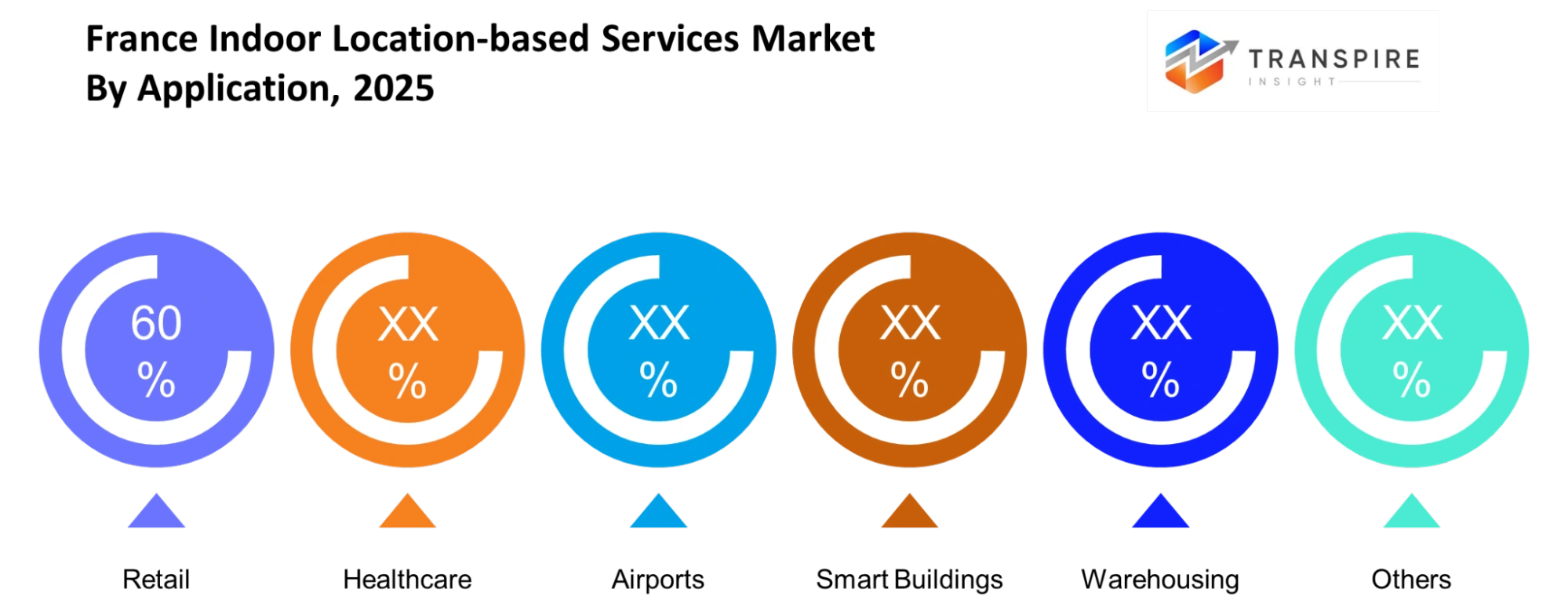
- Retail leads with ~30% market share, using indoor navigation, customer behavior tracking, and proximity marketing solutions.
- Real-time asset tracking and patient flow management in hospitals make healthcare the fastest-growing application.
- Enterprises use indoor positioning to enhance their workflow processes while achieving operational visibility which results in their 35% market share.
- The fastest-growing market segment consists of logistics companies which need warehouse automation and inventory tracking solutions.
- Companies drive product innovation through their development of UWB-based high-precision tracking solutions which meet industrial environment requirements.
- The deployment scale of airports, hospitals and retailers has expanded through strategic partnerships and collaborations.
- Companies are developing AI-driven analytics tools and cloud integration systems to improve their ability to make decisions in real time.
- The organization has developed regional expansion strategies which will improve its market position through smart infrastructure development projects.
What are the Key Drivers, Restraints, and Opportunities in the France Indoor Location-based Services Market?
The primary force accelerating the France Indoor Location-based Services Market is the shift toward real-time operational visibility across healthcare, retail, and logistics. The transition happened because Bluetooth Low Energy beacons became affordable and Ultra-Wideband systems achieved higher precision through their ability to track locations within one meter. Enterprises now see clear financial returns from tracking assets, staff movement, and customer behavior indoors. Hospitals achieve faster equipment searches, retailers boost in-store sales through specific customer interactions, and warehouses decrease order picking mistakes. The measurable advancements lead to higher rates of technology adoption and greater investments in complete hardware systems and analytical software solutions.
The most significant barrier is the high cost and complexity of infrastructure deployment, particularly in large or legacy buildings. Indoor positioning needs multiple sensors which require precise setup and ongoing upkeep that becomes difficult to achieve in all settings. The structural problem causes project delays while increasing initial investment requirements. The established technology results in market entry delays for small and mid-sized enterprises which slows down revenue generation because their use cases have been validated.
A major growth opportunity lies in the integration of indoor location data with AI-driven analytics in smart buildings and airports. France is investing in connected infrastructure, where combining IoT sensors with location intelligence can enable predictive maintenance and crowd flow optimization. For example, airports that implement UWB-based tracking and AI technologies can effectively control how passengers move through their facilities, which results in better passenger processing.
What Has the Impact of Artificial Intelligence Been on the France Indoor Location-based Services Market?
French indoor location-based services employ artificial intelligence to create automated operational systems from their basic position data. AI-powered control systems in hospitals and logistics centers track asset movements to initiate automatic workflows that include equipment distribution and personnel navigation and stock replenishment. Machine learning enables retail locations to modify their store navigation system together with their promotional activities according to customer traffic patterns, which results in better sales performance while decreasing the need for human work.
The value of deployment becomes dependent on predictive capabilities. Machine learning models use past location data to estimate future equipment requirements while they determine operational delays and create maintenance schedules for tracking instruments like sensors and beacons. Warehouses use this technology to create optimal delivery paths which decrease waiting periods while airports use predictive crowd flow models to handle traffic congestion and enhance customer movement efficiency.
The applications of these systems produce quantifiable benefits which include improved asset usage and decreased time spent searching for items and increased adherence to established operational standards. The process of adopting AI technology encounters one major obstacle which needs to be resolved. Organizations face practical challenges because the process of integrating their existing systems together with their various data sources needs to be done at a high cost, which results in decreased model performance and delays their ability to use advanced systems throughout their existing facilities.
Key Market Trends
- Since 2021, enterprises have shifted from Wi-Fi positioning to hybrid BLE and UWB systems, which now achieve accuracy levels below one meter, instead of a five to ten meter range.
- French hospitals have deployed complete asset tracking systems after running pilot programs, which showed that COVID-19 outbreaks created problems with equipment use and patient tracking.
- Retailers have shifted from basic proximity marketing methods to AI-powered in-store analytical systems, which use current customer traffic information to modify their marketing strategies and store design.
- Airports such as Paris Charles de Gaulle Airport have developed better indoor navigation systems and crowd management systems to manage new passenger traffic and their more complicated business operations.
- Logistics operators increasingly link indoor positioning systems with their warehouse management systems, which helps them decrease picking mistakes while they fulfill orders from their big distribution facilities.
- Technology providers including Cisco Systems and Zebra Technologies have shifted focus toward AI-powered location analytics platforms rather than standalone hardware sales.
- Smart building developers in France have begun embedding indoor positioning into new infrastructure projects, which connect occupancy information with both energy control systems and security protection systems.
- Between 2022 and 2025, UWB adoption has accelerated in industrial environments because hardware prices dropped while businesses needed equipment that could provide centimeter-level tracking accuracy.
- Enterprises are increasingly demanding interoperable platforms, which forces vendors to implement open standards while they connect indoor location information with their current enterprise software systems.
France Indoor Location-based Services Market Segmentation
By Type
The type-based segmentation indicates that hardware retains its biggest market share because hospitals and retail chains and warehouses continue to install beacons and sensors and tracking tags. High-value environments require physical infrastructure because accuracy requirements demand operational efficiency through asset tracking. Software functions as a vital element which supports analytics and visualization and system integration, while companies need deployment and calibration and lifecycle support, which drives demand for services. The segment experiences growth because buyers now prefer integrated solutions that provide complete system functionality instead of separate system components.
The software and services market will increase its market share during the forecast period because deployment processes reach maturity and businesses adopt subscription-based revenue models. Vendors are moving toward platform-based offerings that combine hardware with analytics and cloud integration which increases long-term customer value. The current trend allows developers to develop software systems which can grow their reach but investors should focus on companies which have strong service capabilities. Buyers will need systems which provide them with multiple compatible options that limit their need to use equipment from only one manufacturer.
By Application
The retail sector leads application-based segmentation because it uses indoor navigation and customer analytics and proximity-based engagement solutions at high rates. The warehousing and healthcare sectors use operational efficiency requirements to track inventory and equipment usage. Airports and smart buildings need exact indoor positioning systems to help manage passenger movement and control energy use. The growth of applications shows that organizations are moving from their experimental phase to using systems for their vital operations which generate measurable business results.
The healthcare sector and smart building development will drive future expansion because both sectors need real-time visibility and automation capabilities. Hospitals are investing in patient flow management systems, while smart infrastructure projects integrate location data with IoT platforms. This evolution creates opportunities for solution providers to tailor industry-specific applications rather than generic platforms. Buyers will increasingly select vendors based on domain expertise and the ability to deliver measurable efficiency improvements.
To learn more about this report, Download Free Sample Report
By End-User
The end-user segmentation shows enterprises as the dominant category, supported by large-scale adoption across retail chains, corporate campuses, and industrial facilities. The primary contributors to this market segment include logistics companies and hospitals which require real-time asset tracking together with workflow optimization capabilities. The airport segment generates substantial business because its facilities experience high passenger traffic while managing complex operational requirements.Indoor positioning systems provide immediate benefits to larger organizations, which establish their operational scales, thereby driving this market segment's development.
The operational efficiency requirement for competitive advantage will lead to logistics companies and hospitals becoming the fastest-growing end users throughout the upcoming years. The increasing automation of warehouses together with the growing number of patients in healthcare facilities will lead to wider use of location intelligence technologies. Vendors in this market trend will create targeted solutions which address critical needs within major market sectors. The sectors of these markets will focus their buying decisions on three main factors which are product precision design, system scalability, and ability to work with their current enterprise systems.
By Technology
The technology segmentation is currently dominated by Wi-Fi because of its widespread availability and lower deployment cost, which makes it the preferred choice for basic indoor positioning. Bluetooth Low Energy has gained strong momentum because it provides a budget-friendly solution that delivers better accuracy and uses less power. Ultra-Wideband is rapidly growing in environments that need extreme accuracy, while RFID technology maintains its presence in specialized applications for inventory management and access control. The three technologies present different options because they trade off between their respective costs and accuracy levels and their capacity to expand.
Businesses will embrace Ultra-Wideband and Bluetooth because these technologies will improve their ability to meet upcoming accuracy standards. The combination of decreasing hardware prices and growing understanding among enterprises, about high-precision systems, is driving market growth for these advanced technologies. Technology providers develop hybrid solutions, which merge several positioning techniques, to boost system dependability. The transition enables innovation through multi-technology platforms, which will drive customers to find solutions that deliver both effective results and budget-friendly options.
What are the Key Use Cases Driving the France Indoor Location-based Services Market?
The main purpose of indoor positioning technology exists in retail settings because it enables customers to navigate stores while businesses deliver specific advertisements and conduct their store behavior research. Through the use of location data, large retail chains track shopper movement patterns which enable them to design effective store layouts that increase customer purchases, thereby creating a direct link between store setup and business revenues.
The development of healthcare and logistics solutions has reached a rapid growth phase. Hospitals use indoor tracking to locate critical equipment, manage patient flow, and reduce delays in care delivery. Warehouses use these systems which logistics companies implement to create better picking routes and track inventory movement while achieving high accuracy in order fulfillment during urgent delivery periods.
Smart buildings and airports are now experiencing the development of new use cases. Facility operators are beginning to link occupancy data with energy systems to optimize power usage, while airports are testing predictive crowd management solutions to streamline passenger movement and enhance operational efficiency.
|
Report Metrics |
Details |
|
Market size value in 2025 |
USD 9.397 Billion |
|
Market size value in 2026 |
USD 11.305 Billion |
|
Revenue forecast in 2033 |
USD 41.694 Billion |
|
Growth rate |
CAGR of 20.50% from 2026 to 2033 |
|
Base year |
2025 |
|
Historical data |
2021 - 2024 |
|
Forecast period |
2026 - 2033 |
|
Report coverage |
Revenue forecast, competitive landscape, growth factors, and trends |
|
Regional scope |
France |
|
Key company profiled |
Google, Apple, Cisco, Microsoft, Zebra Technologies, HERE Technologies, IndoorAtlas, Qualcomm, Ericsson, IBM, STMicroelectronics, NXP, Samsung, Huawei, Aruba |
|
Customization scope |
Free report customization (country, regional & segment scope). Avail customized purchase options to meet your exact research needs. |
|
Report Segmentation |
By Type (Hardware, Software, Services, Others); By Application (Retail, Healthcare, Airports, Smart Buildings, Warehousing, Others); By End-User (Retailers, Enterprises, Hospitals, Airports, Logistics Companies, Others); By Technology (Wi-Fi, Bluetooth, UWB, RFID, Others) |
Which Regions are Driving the France Indoor Location-based Services Market Growth?
The northern French region experiences market expansion because of its extensive retail chain distribution combined with its logistics center establishment and its extensive healthcare system operations which utilize indoor location tracking technology. The region's digital infrastructure enables warehouse automation while its European trade routes enable businesses to track their assets. Smart infrastructure projects receive both public and private funding which increases their deployment throughout commercial facilities and transportation centers. The region maintains its leading status because of its complete technology provider system integrator and enterprise buyer ecosystem.
The Île-de-France region including Paris operates as a permanent contributor that brings about innovative development rather than an expansive entity. The area receives ongoing development through investments that fund airport construction, corporate campus development and high-end shopping areas which provide customers with accurate indoor navigation capabilities. Organizations based in this area which include major corporations and international companies use advanced analytics systems to create constant software and service requirements. The combination of regulatory frameworks with innovative business practices enables organizations to improve their operations through ongoing development work.
The southern part of France has developed into its most rapidly expanding area because investors have increased their funding for smart building projects and tourism-related facilities and airport upgrades. The cities of Nice and Marseille are developing connected systems to handle their seasonal population increases while creating more efficient operational capacity. The implementation of indoor positioning technology has received a boost from recent system upgrades and digital conversion activities. The period from 2026 to 2033 will create multiple opportunities for new businesses and investors who focus on developing greenfield sites and various urban areas that are modernizing at a rapid pace.
Who are the Key Players in the France Indoor Location-based Services Market and How Do They Compete?
The current state of competition shows moderate fragmentation which allows global technology companies to compete against specialized positioning companies. The existing market players use pricing to protect their market shares because customers consider both accuracy and scalability and enterprise system integration as key factors. Companies now compete through their technological capabilities and platform performance which includes their ability to deliver complete solutions through hardware and software and analytics. The established vendors face new competition from newcomers who introduce specialized technologies that include geomagnetic positioning and AI-based analytics platforms.
Cisco Systems concentrates on platform unification which allows businesses to use their indoor positioning system inside their already existing Wi-Fi networks. The solution enables organizations with extensive operations to execute their deployment process while securing customer loyalty for an extended period. Zebra Technologies establishes its distinct identity through its asset intelligence products which are specifically designed for healthcare and logistics operations that depend on strong equipment and immediate asset monitoring to achieve operational improvements. HERE Technologies uses its mapping knowledge to create accurate indoor mapping systems which come with analytics tools that assist users in navigating through complicated building systems.
Apple and Google compete through ecosystem control by combining indoor positioning technology with their mobile operating systems and development platforms. The strategy makes it easier for businesses to use location-based services because they can now access location services through multiple channels. STMicroelectronics develops UWB chipsets which achieve centimeter-level precision to support upcoming industrial applications. These companies expand their market presence through partnerships with device producers and infrastructure suppliers while maintaining their unique technological edge.
Company List
- Apple
- Cisco
- Microsoft
- Zebra Technologies
- HERE Technologies
- IndoorAtlas
- Qualcomm
- Ericsson
- IBM
- STMicroelectronics
- NXP
- Samsung
- Huawei
- Aruba Networks
Recent Development News
In March 2026, IndoorAtlas launched SDK 3.8, enhancing indoor positioning accuracy through improved sensor fusion and better indoor-outdoor transition detection. The upgrade strengthens enterprise deployment reliability across healthcare, retail, and transportation environments, enabling more stable real-time location tracking and analytics-driven operations.https://www.indooratlas.com
What Strategic Insights Define the Future of the France Indoor Location-based Services Market?
The France Indoor Location-based Services Market is moving toward AI-based spatial intelligence platforms which will replace existing standalone positioning systems. The upcoming five to seven years will experience growth through the combination of UWB technology Bluetooth technology and cloud analytics which enterprises need to make real-time operational decisions in their complex facilities that include hospitals and airports and logistics hubs. Indoor positioning has become a standard component of digital infrastructure which no longer exists as a separate technology element.
The ecosystem operates at risk because platform concentration enables a small number of ecosystem owners to manage all mobile operating systems and mapping layers and enterprise cloud integration systems. The system creates interoperability issues for small vendors while decreasing their ability to adjust prices as time progresses. The integration of indoor location data with digital twin infrastructure creates a major opportunity for smart city and transport modernization programs which French airports and urban redevelopment programs will use to advance their operations.
Market participants should prioritize their development of API-based platforms which enable seamless integration of their products with enterprise AI and IoT systems instead of focusing on equipment accuracy improvements.
France Indoor Location-based Services Market Report Segmentation
By Type
- Hardware
- Software
- Services
- Others
By Application
- Retail
- Healthcare
- Smart Buildings
- Warehousing
- Others
By End-User
- Retailers
- Enterprises
- Hospitals
- Airports
- Logistics Companies
- Others
By Technology
- Wi-Fi
- Bluetooth
- UWB
- RFID
- Others
Frequently Asked Questions
Find quick answers to common questions.
The confirmed 2033 market size figure is USD 41.694 Billion.
Key segments for the France Indoor Location-based Services Market are By Type (Hardware, Software, Services, Others); By Application (Retail, Healthcare, Airports, Smart Buildings, Warehousing, Others); By End-User (Retailers, Enterprises, Hospitals, Airports, Logistics Companies, Others); By Technology (Wi-Fi, Bluetooth, UWB, RFID, Others).
Major France Indoor Location-based Services Market players are Google, Apple, Cisco, Microsoft, Zebra Technologies, HERE Technologies, IndoorAtlas, Qualcomm, Ericsson, IBM, STMicroelectronics, NXP, Samsung, Huawei, Aruba.
The France Indoor Location-based Services Market size is USD 9.397 Billion in 2025.
The France Indoor Location-based Services Market CAGR is 20.50% from 2026 to 2033.
- Apple
- Cisco
- Microsoft
- Zebra Technologies
- HERE Technologies
- IndoorAtlas
- Qualcomm
- Ericsson
- IBM
- STMicroelectronics
- NXP
- Samsung
- Huawei
- Aruba Networks
Recently Published Reports
-
Apr 2026
3D Optical Profiler Market
3D Optical Profiler Market Size, Share & Analysis Report By Type (Desktop 3D Optical Profiler, and Portable 3D Optical Profiler), By Technology (Confocal Technology, and White Light Interference), By End-Use Industry (Manufacturing, Research Institutions, Automotive, Aerospace and Defense, Medical Devices, and Other), and Geography (North America, Europe, Asia-Pacific, Middle East and Africa, South and Central America), 2021 - 2031
-
Apr 2026
Depth Sensor Market
Depth Sensor Market Size, Share & Analysis Report By Type (Infrared Depth Sensors, Time-of-Flight (ToF) Sensors, Stereo Vision Sensors, Structured Light Sensors, Ultrasonic Depth Sensors), By Application (Automotive, Robotics, Gaming, Consumer Electronics, Industrial Automation, Healthcare, Security & Surveillance, Others), By End Users (Automotive Manufacturers, Consumer Electronics Companies, Healthcare Providers, Industrial Companies, Security Agencies, Gaming Companies, Robotics Companies, Others), and Geography (North America, Europe, Asia-Pacific, Middle East and Africa, South and Central America), 2021 – 2031
-
Apr 2026
Digital Manufacturing Market
Digital Manufacturing Market Size, Share & Analysis Report By Component (Hardware, Software, and Services), By Technology (Robotics, 3D Printing, Internet of Things (IoT), and Others), By Application (Automotive and Transportation, Aerospace and Defense, Consumer Electronics, Industrial Machinery, and Others), By Process Type (Computer-Based Designing, Computer-Based Simulation, Computer 3D Visualization, Analytics, and Others), and Geography (North America, Europe, Asia-Pacific, Middle East and Africa, South and Central America), 2021 – 2031
-
Apr 2026
Digital Visa Services Market
Digital Visa Services Market Size, Share & Analysis Report By Type (Individual Travelers, Group Travelers), By Application (Tourism, Business Travel, Others), and Geography (North America, Europe, Asia-Pacific, Middle East and Africa, South and Central America), 2021 – 2031