
Sep 28, 2026
By Transpire Insight
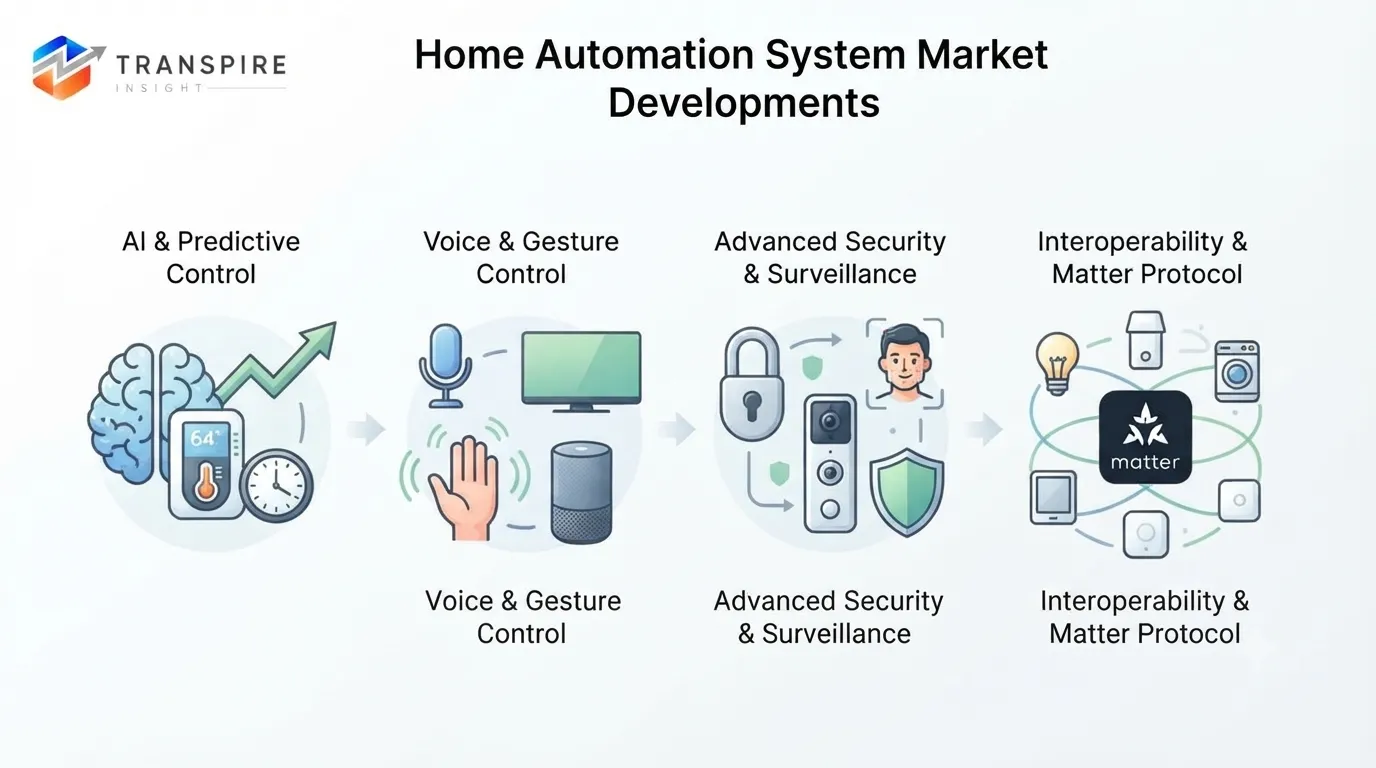
Description
According to a research report published by Transpire Insight, the home automation system market size is projected to grow from USD 76.965 billion in 2026 to USD 101.956 billion by 2035, at a CAGR of 4.35% during the forecast period 2027-2035. The market for smart technologies in the home is growing rapidly across the globe, fueled by the rise in IoT ecosystems, home energy efficiency demands, growing voice-controlled AI, and rising home security concerns.
Introduction
Home Automation System Market involves technologies that allow automated control of the climate, home entertainment systems, and home security systems in the home. This industry is being driven by a surge in wireless protocols, IoT connectivity, and artificial intelligence that all combine to create a convenient and sustainable solution. The market is still growing at an exponential rate, with operational efficiency, safety, and remote monitoring becoming standard features in the housing infrastructure of the world as homeowners more and more consider the benefits of these technologies.
Recent Development News
February 2026: The prominent smart home protocol consortiums introduced new interoperability specifications, aiming to improve the connectivity between different brands of devices and offline local processing.
August 2026: The major automation companies launched adaptive energy management platforms that automatically lower power consumption during peak periods, using AI.
Stay Ahead of Emerging Opportunities with Expert Market Insights by Transpire Insight
Transpire Insight provides comprehensive, data-driven market intelligence to support smarter business decisions. Our research is rooted in comprehensive analysis, authoritative predictions, and industry expertise, enabling organizations to make informed decisions in rapidly evolving markets. We provide in-depth analysis of market segmentation, competitive positioning, regional trends, and emerging investment opportunities in high-growth areas. We blend accuracy with actionable intelligence, helping companies uncover new growth avenues, strengthen strategic decision-making, and stay ahead in a dynamic market.
Home Automation System Market Size & Statistics
The Market Size for Home Automation System Was Estimated to be Worth USD 76.965 Billion in 2026.
The Market Size is Going to Expand at a CAGR of 4.35% between 2026 and 2035.
The Home Automation System Market Size is anticipated to reach USD 101.956 Billion by 2035.
North America is projected to drive the highest demand during the forecast period, accounting for 36% of the home automation system market.
Asia-Pacific is projected to grow the fastest during the forecast period at a CAGR of 7.4% in the home automation system market.
Regional Growth and Demand Analysis by Transpire Insight
North America continues to anchor demand, underpinned by dense smartphone and broadband penetration, an established base of security-and-safety installers, and aggressive product cycles from incumbent players. Recent moves illustrate this momentum: Johnson Controls rolled out its DSC PowerSeries Neo 5 and IQ Panel 5 lines, fusing residential security with native smart-home intelligence, while ADT's acquisition of Origin AI brought Wi-Fi-based ambient sensing into its portfolio, allowing occupancy and motion detection without added hardware. Apple has likewise deepened its ecosystem play by folding HomeKit Secure Video enhancements and smarter notification grouping into its Home app, reinforcing the region's pull toward tightly integrated, subscription-anchored automation platforms across single-family and increasingly multi-family housing stock.
Asia Pacific's acceleration is being driven by China's large-scale IoT rollouts, high-speed connectivity upgrades, and coordinated smart-city programs, alongside India's growing appetite for cost-effective, locally-tailored voice assistants. A pattern that is spreading globally across urbanizing APAC markets, regional developers are embedding automation into new-build multi-family projects, instead of relying on it as an add-on – such as ASSA ABLOY's DoorBird IP video intercom, which is now also supporting remote digital access management. Together with growing disposable income and government energy-efficiency regulations, this is narrowing the market adoption gap between Asia Pacific and the well-established North America and Europe markets.
Top 15 Trends in the Home Automation System Market
AI-Driven Predictive Automation
AI-driven systems learn household routines, predicting lighting, temperature, and security needs automatically, reducing manual input while boosting energy efficiency and personalized comfort for all residents.
Matter Protocol Interoperability
Matter, the unified smart-home standard backed by Apple, Google, and Amazon, is easing interoperability across brands, letting devices communicate seamlessly regardless of manufacturer or ecosystem.
Voice Assistant Integration
Voice assistants like Alexa and Siri now control lighting, locks, thermostats, and appliances hands-free, becoming the primary interface for many households managing connected devices daily.
Energy Management Systems
Rising utility costs and sustainability goals are pushing homeowners toward smart meters, solar integration, and automated energy monitoring tools that track and reduce household consumption.
Wi-Fi Sensing Technology
New Wi-Fi sensing technology detects motion and occupancy using existing router signals, eliminating extra hardware while enabling ambient, privacy-conscious monitoring for security and wellness applications.
Smart Security Convergence
Security and access control are merging into unified platforms, combining cameras, locks, and alarms with AI analytics for faster threat detection and remote household management.
List of Top 25 Companies Leading the Home Automation System Market
Schneider Electric
Pioneers digital transformation in energy management and residential automation solutions globally.
Founded: 1836 | HQ: Rueil-Malmaison, France.
Why It Ranks: Commands high market share through comprehensive, sustainable home energy solutions.
Regional Dominance: Strong presence across Europe, North America, and expanding Asia-Pacific regions.
Product Line: Smart panelboards, automated switches, energy monitors, and Wiser ecosystem.
Honeywell International Inc.
Delivers specialized sensor and environmental control technologies for smart connected homes.
Founded: 1906 | HQ: Charlotte, North Carolina, USA.
Why It Ranks: Industry benchmark for intelligent climate control and residential safety hardware.
Regional Dominance: Primary footprint in North America with extensive distribution networks.
Product Line: Smart thermostats, security alarms, environmental sensors, and HVAC controls.
Siemens AG
Integrates heavy industrial engineering expertise into intelligent residential building automation networks.
Founded: 1847 | HQ: Munich, Germany.
Why It Ranks: Exceptional engineering quality makes it a leader in high-end automation.
Regional Dominance: Dominates Western Europe with growing market penetration across Asian markets.
Product Line: Smart relays, building controllers, smart metering, and automated power distribution.
Johnson Controls
Focuses on intelligent building platforms, smart HVAC, and connected security systems.
Founded: 1885 | HQ: Cork, Ireland.
Why It Ranks: Superior capability in integrated climate control and smart safety solutions.
Regional Dominance: Widespread coverage across North America, Europe, and the Middle East.
Product Line: Smart thermostats, integrated security systems, and HVAC management software.
ABB Ltd.
Provides scalable home automation systems focusing on smart power and electrification.
Founded: 1988 | HQ: Zürich, Switzerland.
Why It Ranks: Leads in open-protocol KNX technology for premium luxury residential automation.
Regional Dominance: Highly dominant across Europe, Europe-adjacent regions, and Asia-Pacific territories.
Product Line: ABB-free@home systems, smart touch panels, and KNX home controllers.
Legrand
Offers extensive architectural electrical and smart connected lighting control systems worldwide.
Founded: 1860 | HQ: Limoges, France.
Why It Ranks: Unmatched variety in smart switches, wiring devices, and interior fixtures.
Regional Dominance: Strong market hold in Europe, South America, and North America.
Product Line: Smart switches, dimmers, visual intercoms, and connected wiring devices.
Crestron Electronics, Inc.
Engineers premium custom-installed luxury automation systems for high-end residential estates.
Founded: 1971 | HQ: Rockleigh, New Jersey, USA.
Why It Ranks: Gold standard for custom ultra-luxury smart home and audiovisual integration.
Regional Dominance: Dominates high-end luxury estate markets throughout North America and Europe.
Product Line: Custom control panels, smart lighting, automated shades, and enterprise AV.
Control4 (Snap One)
Delivers personalized, scalable smart home OS platforms uniting disparate hardware systems.
Founded: 2003 | HQ: Lehi, Utah, USA.
Why It Ranks: Widely adopted by professional installers for complete custom home integration.
Regional Dominance: Core market leadership in North America with strong European channels.
Product Line: Smart home OS, centralized lighting, multi-room audio, and controllers.
Lutron Electronics Co., Inc.
World leader in advanced architectural lighting controls and precision automated shades.
Founded: 1961 | HQ: Coopersburg, Pennsylvania, USA.
Why It Ranks: Unrivaled reputation and patents in smart dimming and shading technologies.
Regional Dominance: Dominant leadership across North American residential and commercial markets.
Product Line: Caséta, RadioRA, HomeWorks lighting systems, and motorized window shades.
Loxone Electronics GmbH
Specializes in centralized, miniserver-based total home and building automation logic engines.
Founded: 2009 | HQ: Kollerschlag, Austria.
Why It Ranks: Renowned for robust offline processing and high-reliability wired automation setups.
Regional Dominance: Massive footprint in Central Europe with expanding international installation networks.
Product Line: Loxone Miniserver, presence sensors, smart LED spots, and actuators.
Conclusion
AI and energy management are driving the home automation system market to become an integral part of the residence rather than a luxury novelty. Supported by establishing standards like Matter, interoperability barriers are steadily declining. Intelligent automation will remain a driver of increased energy efficiency, security, and personal comfort in the home throughout different markets, as legacy industrial giants and agile tech start-ups continue to broaden their product lines.


Send us a brief description of your challenge and we'll get back to you within 24 hours.

 [email protected]
 APAC:+91 7666513636
 Address


