
Global Home Automation System Market Size & Forecast:
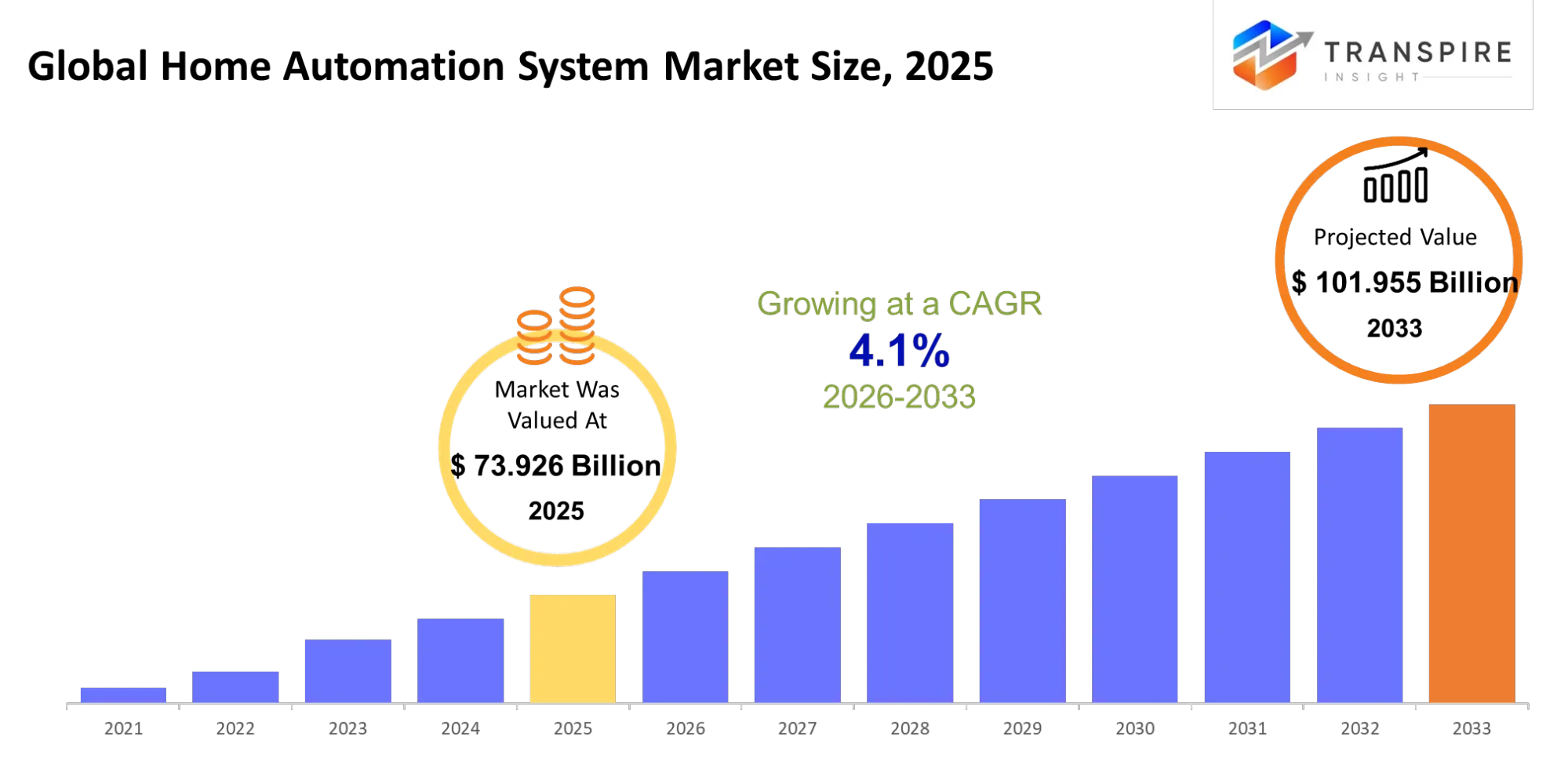
- Global Home Automation System Market Size 2025: USD 73.926 Billion
- Global Home Automation System Market Size 2033: USD 101.955 Billion
- Global Home Automation System Market CAGR: 4.1%
- Global Home Automation System Market Segments: By Type (Smart Lighting Systems, Smart Security Systems, Smart HVAC Control, Smart Entertainment Systems, Voice-controlled Automation, Energy Management Systems, Others); By Application (Residential Homes, Smart Apartments, Luxury Villas, Commercial Smart Buildings, Assisted Living Facilities, Others); By End-User (Homeowners, Property Developers, Enterprises, Hospitality Sector, Others); By Connectivity (Wi-Fi-enabled Systems, Zigbee Systems, Bluetooth Systems, AI-integrated Platforms, Others)
To learn more about this report,  Download Free Sample Report
Global Home Automation System Market Summary:
The Global Home Automation System Market size is estimated at USD 73.926 Billion in 2025 and is anticipated to reach USD 101.955 Billion by 2033, growing at a CAGR of 4.1% from 2026 to 2033.
This industry changes how modern living spaces operate by turning standard properties into self-managing environments that handle security monitoring, climate adjustments, and lighting without human intervention. Households recently abandoned isolated smart gadgets in favor of deeply interconnected hardware networks. This pivot gained serious traction as unifying industry communication standards wiped out the software boundaries that used to separate rival tech platforms. Specifically, embedding advanced AI voice models directly into home ecosystems acted as a massive practical accelerator, giving systems the power to act on complicated, conversational commands instantly. With cities slapping households with aggressive peak-hour utility rates, families are installing automated power managers to cut electricity consumption the moment tariffs spike, turning what was once a premium status symbol into an essential utility-saving strategy.
Key Market Insights:
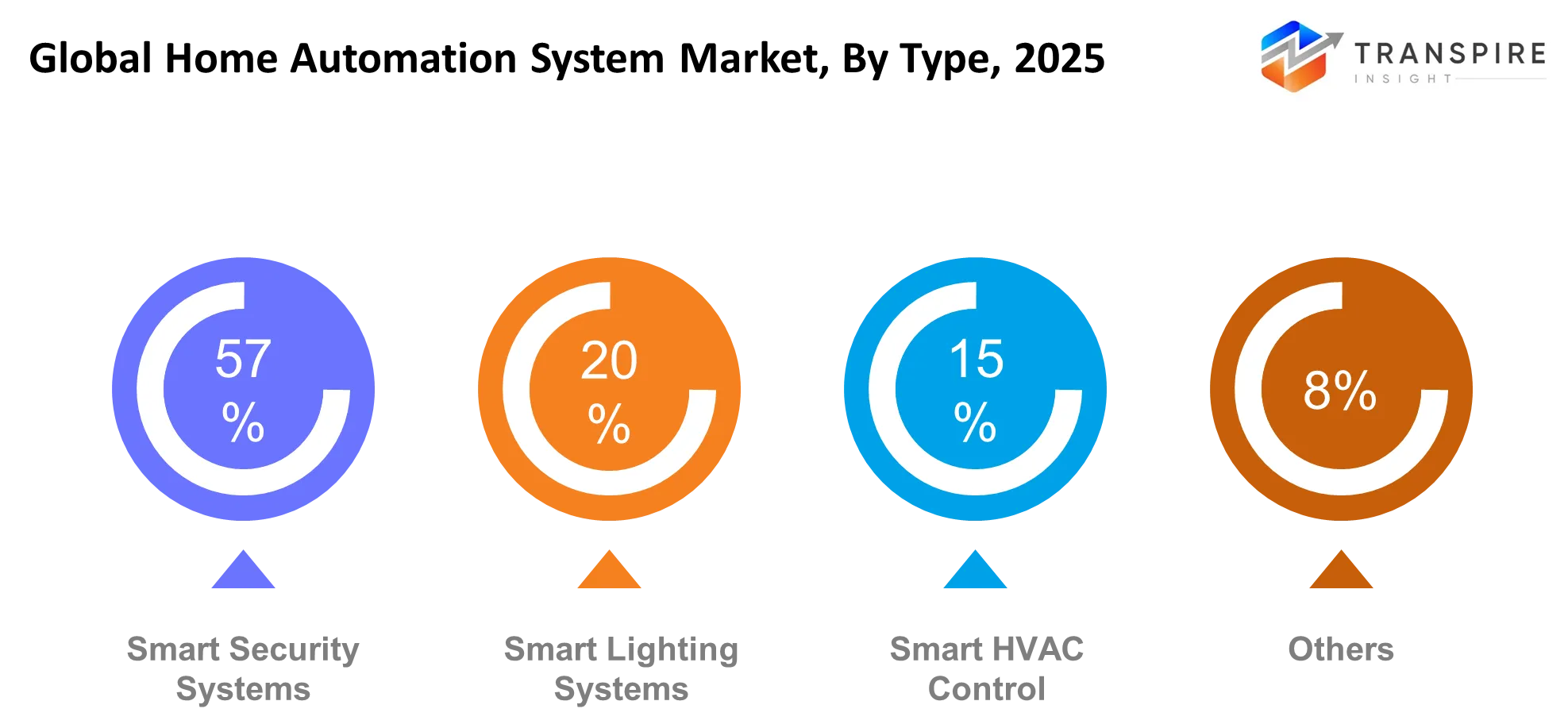
- Smart Security Systems dominate with a 57% share, driven by players like ADT embedding localized computer vision into hardware to instantly separate routine backyard movement from genuine trespassers.
- AI-integrated Platforms grow fastest at a 12.9% CAGR as tech giants like Google Nest and Amazon Alexa deploy generative voice models to execute complex household routines from single conversations.
- Smart Lighting Systems hold a solid 20% share, supported by pioneers like Philips Hue rolling out adaptive circadian fixtures that autonomously shift indoor color spectrums to match natural daylight.
- Smart HVAC Control secures a 15% footprint with engineering firms like Honeywell and Schneider Electric launching predictive thermostats that evaluate building insulation against live weather feeds to cut electricity waste.
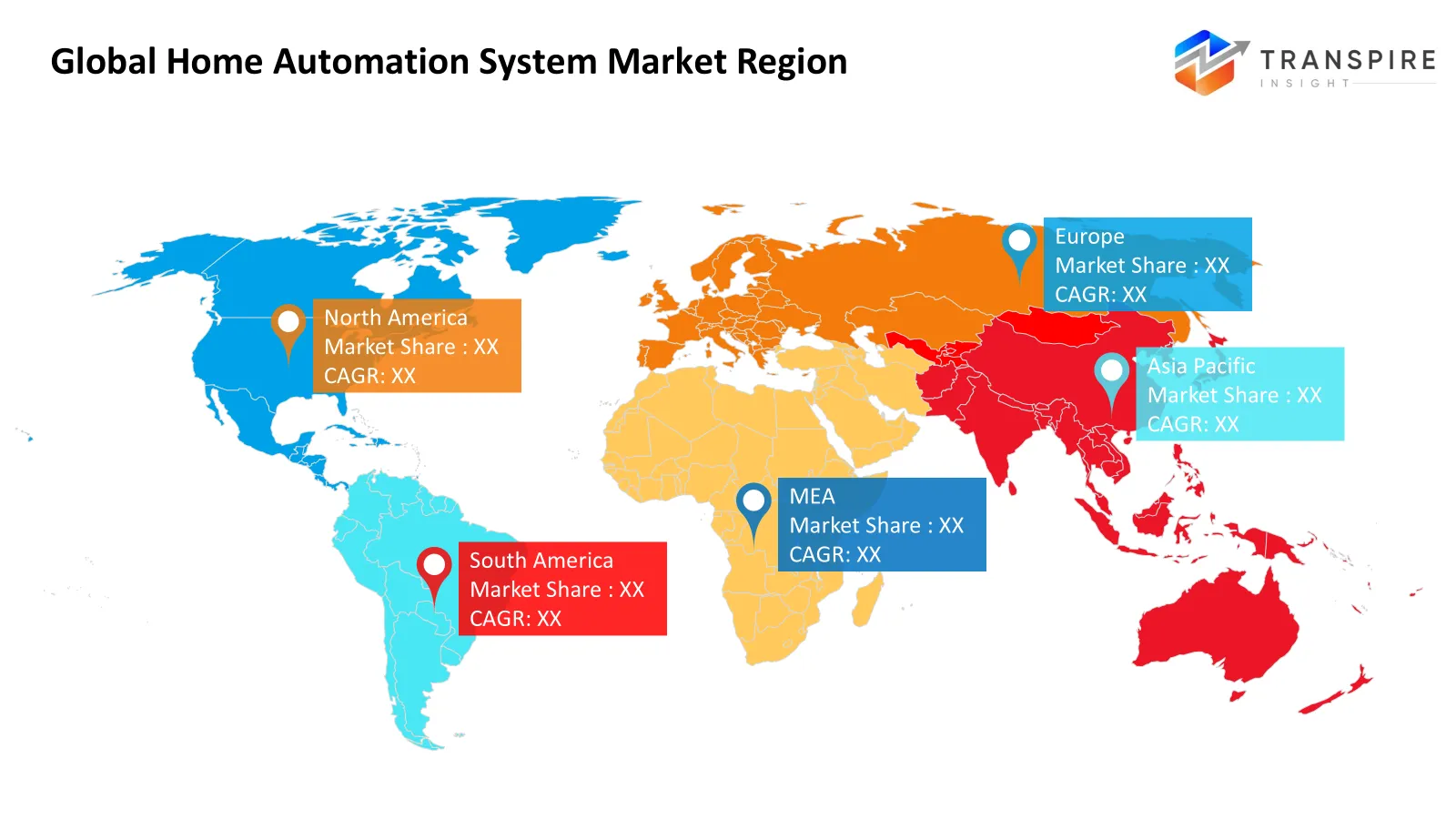
- North America controls 41% of global volume as developers integrate platforms like Apple HomeKit directly into luxury real estate projects to meet the local appetite for touchless property management.
- Europe maintains a 27% market stake, with regional brands like Bosch Smart Home and Siemens manufacturing decentralized control hubs to satisfy strict regional data privacy rules and consumer safety laws.
- Asia Pacific is surging at a 13.8% CAGR as electronics heavyweights like Samsung SmartThings and ABB ramp up factory outputs to supply automated systems for massive urban high-rises.
- Other Technologies capture the remaining 8% share, with elite providers like Crestron Electronics focusing exclusively on custom, high-margin automation architectures for premium luxury estates and high-end hospitality venues.
What are the Key Drivers, Restraints, and Opportunities in the Global Home Automation System Market?
Driver
The aggressive integration of generative AI into residential hardware ecosystems acts as the primary growth engine here. Users flatly rejected rigid, single-step voice triggers, pushing developers to engineer fluid, context-aware interactions. Embedding this conversational intelligence completely removes the technical learning curve for average families, accelerating mass hardware installation and unlocking continuous, high-margin subscription revenue through premium algorithmic tiers. In May 2026, Google deployed its "Gemini for Home" architecture. This structural software overhaul injected conversational, large-language-model assistance directly into localized Nest hubs, letting properties execute complex, multi-layered tasks simultaneously without ever demanding exact, robotic phrasing from the user.
Restraint
Industry expansion remains heavily bottlenecked by severe cybersecurity anxieties. Because automated living requires mapping intimate household habits—tracking everything from daily foot traffic to indoor audio—buyers fundamentally distrust cloud-dependent platforms. This roadblock persists structurally because leading tech conglomerates openly tie their broader corporate financial models to external data monetization, cementing a permanent consumer trust barrier.
Opportunity
Massive commercial potential lies in developing strictly offline, localized edge-computing hubs. Shifting the command processing away from remote corporate servers and directly onto the internal hardware completely neutralizes external hacking risks. Manufacturers investing in these decentralized, non-cloud architectures will immediately capture the lucrative, untapped demographic of privacy-first property owners who currently boycott internet-tethered living environments.
What Has the Impact of Artificial Intelligence Been on the Global Home Automation System Market?
AI changes the way smart homes function by turning basic, click-and-respond setups into environments that can think and act for themselves. Instead of just running pre-set timers, engineering teams now pack advanced machine learning models and edge-computing directly into central control modules. These hardware setups constantly monitor and learn from everyday household variables—like walking paths, vocal inflections, shifting utility prices, and incoming storm fronts—to handle complex, behind-the-scenes structural tweaks without requiring you to open an app.
This technical leap vastly improves daily resource efficiency. Instead of running the air conditioning at full blast on a dumb schedule, predictive engines dynamically tweak HVAC workflows by tracking real-time room occupancy alongside outdoor heatwaves, dropping power intake the moment peak rates spike. At the same time, security systems utilizing intelligent computer vision instantly tell the difference between a passing neighborhood pet and an actual intruder, completely eliminating the headache of endless false notifications.
However, older building infrastructure remains a massive bottleneck for market adoption. Sophisticated automation requires clean, uninterrupted data pipelines, but legacy homes simply lack the digital wiring, smart sensors, or robust local networks needed to run these algorithms without an incredibly expensive structural overhaul.
Key Market Trends:
- Households are actively ditching multiple proprietary apps, forcing competing brands to adopt the Matter connectivity standard so all household devices talk to each other out of the box.
- Buyers are shifting away from basic infrared motion sensors, increasingly demanding mmWave radar systems that can detect the microscopic chest movements of a person sitting completely still.
- Residential properties are quickly phasing out physical door keypads and instead installing ultra-wideband smart locks that automatically throw the deadbolt the second a owner's phone nears the door.
- Families are rejecting cloud-based home cameras due to data leaks, forcing security brands to build local edge-processing hard drives that keep video footage completely inside the house.
- Modern interiors are moving away from traditional static bulbs toward smart circadian setups that gradually shift light color and warmth to match the real solar cycle outside.
- Real estate developments are abandoning standard electrical panels for automated power managers that track real-time grid prices and cut power to heavy appliances when electricity costs spike.
- Homeowners are stepping away from traditional wall-mounted thermostats, preferring predictive climate networks that study local weather forecasts to cool rooms down before an afternoon heatwave starts.
- Users are completely ignoring rigid, robotic voice triggers, forcing manufacturers to embed conversational AI models that understand natural, multi-step instructions spoken casually.
Global Home Automation System Market Segmentation
By Type
Smart Security Systems easily hold the top market position, capturing a massive 57% share since they act as the absolute baseline protective measure for almost every modernized property today. Right behind them, Smart Lighting Systems and Smart HVAC Control maintain solid footprints at 20% and 15% respectively. The growth logic here is split: security components generate revenue through immediate consumer anxieties around physical safety, while climate and lighting networks are expanding rapidly because families are realizing they automatically slash utility bills during expensive peak-hour grid tariffs. Looking forward, the line between basic smart plugs, localized security cameras, and intelligent thermostats will completely blur. As properties transition into self-governing spaces, suppliers will be forced to engineer every single piece of hardware to function seamlessly inside a single, central AI brain rather than relying on fragmented, single-use mobile apps.
To learn more about this report, Download Free Sample Report
By Application
Residential Homes completely anchor this segment, processing the vast majority of volume alongside newly constructed Smart Apartments. The unique growth logic is tied strictly to the sudden shift in architectural standards; if a modern development is going up, builders are pre-wiring it for localized network control, creating an incredibly predictable, high-volume installation loop. On the flip side, Commercial Smart Buildings and Assisted Living Facilities represent a fast-growing, high-margin niche where predictive health monitoring and automated energy arbitrage matter far more than simple convenience. As older urban infrastructure gets retrofitted, property managers are utilizing these systems to actively manage building-wide power draws rather than just flicking switches. Ultimately, this means the application landscape will split. Standard households will continue demanding massive shipments of plug-and-play retail kits, while the commercial and medical sectors will force manufacturers to develop highly secure, closed-loop processing hubs built specifically to survive strict data privacy audits.
By End-User
Property Developers are quickly becoming the absolute heavyweight buyers here, essentially dictating the supply chain terms for everyone else. Individual Homeowners pull steady daily retail numbers, but massive residential construction firms actually drive the broader market structure. Their unique growth logic comes straight from the competitive real estate landscape; as developers abandon standard static wiring, they lock themselves into a permanent dependency on bulk-ordering smart hardware to justify premium, luxury property valuations. The Hospitality Sector acts more cyclically, executing massive, customized purchase orders to upgrade entire hotel chains in one sweep. The biggest future implication is how these networks are deployed. Instead of manual retail purchasing, massive real estate conglomerates will soon require suppliers to integrate their hardware directly into the architectural blueprints, triggering automated, pre-configured software setups the moment the physical drywall is finished.
By Connectivity
Wi-Fi-enabled Systems traditionally handle the baseline traffic, but AI-integrated Platforms are currently expanding the fastest at a 12.9% CAGR. The growth logic is completely tied to the end of consumer app fatigue; basic Bluetooth and standard Wi-Fi environments suffer from heavy network congestion and dropped signals, pushing users straight toward localized AI hubs that process complex commands instantly on the edge. While Zigbee Systems remain critical for running low-power battery sensors, the industry is aggressively pushing away from isolated communication silos. The biggest future implication is the total destruction of brand exclusivity. Because homeowners flatly refuse to buy into locked ecosystems anymore, manufacturers will soon be forced to completely abandon proprietary radio signals and fully adopt universal standards like Matter, ensuring that any sensor pulled out of a box instantly syncs with the home's primary intelligence network.
What are the Key Use Cases Driving the Global Home Automation System Market?
Proactive threat deterrence forms the foundational use case, heavily driving residential smart security installations. Homeowners deploy edge-AI cameras and touchless locks to verify familiar faces and secure perimeters instantly, eliminating false alarms while safely managing remote guest access.
Beyond safety, automated energy arbitration is rapidly expanding across commercial buildings and smart apartments. Facility managers utilize integrated climate networks that dynamically react to live room occupancy. These systems proactively kill power to empty zones and shift heavy appliance loads to off-peak hours, drastically cutting utility overhead.
A highly profitable use case is gaining traction around proactive damage control linked directly to property insurance policies. Instead of waiting for a disaster, smart setups track tiny changes in plumbing pressure - electrical wiring to spot hidden leaks and faults early. Insurance providers are responding by slashing premium costs for homes that can automatically cut off the main water line before a major flood happens.
|
Report Metrics |
Details |
|
Market size value in 2025 |
USD 73.926 Billion |
|
Market size value in 2026 |
USD 76.960 Billion |
|
Revenue forecast in 2033 |
USD 101.955 Billion |
|
Growth rate |
CAGR of 4.1% from 2026 to 2033 |
|
Base year |
2025 |
|
Historical data |
2021 - 2024 |
|
Forecast period |
2026 - 2033 |
|
Report coverage |
Revenue forecast, competitive landscape, growth factors, and trends |
|
Regional scope |
United States; Canada; Mexico; United Kingdom; Germany; France; Italy; Spain; Denmark; Sweden; Norway; China; Japan; India; Australia; South Korea; Thailand; Brazil; Argentina; South Africa; Saudi Arabia; United Arab Emirates |
|
Key company profiled |
Google Nest, Amazon Alexa, Samsung SmartThings, Apple HomeKit, Schneider Electric, Honeywell, Siemens, Control4, ABB, Crestron Electronics, Legrand, Philips Hue, Bosch Smart Home, ADT, Johnson Controls |
|
Customization scope |
Free report customization (country, regional & segment scope). Avail customized purchase options to meet your exact research needs. |
|
Report Segmentation |
By Type (Smart Lighting Systems, Smart Security Systems, Smart HVAC Control, Smart Entertainment Systems, Voice-controlled Automation, Energy Management Systems, Others); By Application (Residential Homes, Smart Apartments, Luxury Villas, Commercial Smart Buildings, Assisted Living Facilities, Others); By End-User (Homeowners, Property Developers, Enterprises, Hospitality Sector, Others); By Connectivity (Wi-Fi-enabled Systems, Zigbee Systems, Bluetooth Systems, AI-integrated Platforms, Others) |
Which Regions are Driving the Global Home Automation System Market Growth?
North America confidently leads the global home automation sector, commanding a massive (41%) market share through early tech adoption and a booming luxury real estate sector. The territory relies on an incredibly robust digital ecosystem, universal broadband access, and fierce competition among domestic hardware giants like Apple and Amazon to push continuous innovation. To satisfy the modern homebuyer's appetite for frictionless living, massive construction firms now treat integrated smart networks as standard utility infrastructure, pre-wiring entire suburban developments before the drywall even goes up. This permanent shift in building standards guarantees a relentless, high-volume installation pipeline for predictive climate hubs and biometric security arrays, effectively locking in North America's market dominance.
In January 2026, Johnson Controls broadened the reach of its OpenBlue smart building framework across several large North American commercial properties. This rollout used localized computing to instantly weigh real-time room occupancy against upcoming weather forecasts. By doing so, facility managers were able to hand over climate control to an automated routine, cutting down on daily power waste without needing a human to monitor the dials.
Europe holds the second-largest market footprint with a stable 27% share, but its core growth engine looks completely different from the American landscape. Instead of chasing luxury entertainment setups, European market stability is tightly bound to volatile winter energy costs and aggressive, continent-wide carbon reduction laws. Because local governments strictly penalize inefficient buildings, property managers have no choice but to install predictive HVAC controllers that actively shave down daily power draws to keep properties legally compliant. On top of that, strict consumer privacy laws like the GDPR heavily push buyers toward decentralized European brands such as Bosch and Siemens, ensuring that sensitive home surveillance data stays strictly on local hard drives rather than vulnerable cloud servers.
Asia Pacific ranks as the fastest-expanding global territory, accelerating at an aggressive 13.8% CAGR thanks to hyper-fast urbanization and a skyrocketing middle class. The landscape shifted dramatically over the past two years as national governments across India and China began pouring heavy subsidies into massive smart-city megaprojects, embedding digital infrastructure directly into new urban zoning laws. Because millions of residents are rapidly moving into dense metropolitan areas, the region completely skipped the era of clunky retail smart plugs and jumped straight into pre-installed, centralized apartment networks run by conglomerates like Samsung. Ultimately, this explosive vertical construction boom gives regional hardware manufacturers the perfect opportunity to ditch individual retail sales and lock down incredibly lucrative, multi-thousand-unit commercial contracts.
In April 2026, Samsung Electronics launched extensive AI enhancements for its SmartThings ecosystem, aiming directly at high-rise residential complexes sprouting up across Asia. Working hand-in-hand with prominent local construction firms, Samsung built its predictive software and "Home Insight" logic right into the building's physical backbone, giving thousands of new move-in-ready flats the ability to regulate electricity intake and monitor security on their own from day one.
To learn more about this report, Download Free Sample Report
Who are the Key Players in the Global Home Automation System Market and how do they Compete?
The battle for smart home supremacy is split between massive tech giants scrambling for app dominance and industrial engineering firms locking down physical building infrastructure. Today, winning the market has very little to do with selling single gadgets; instead, it is all about how well devices communicate locally and process data right at the edge. Companies get ahead by pulling users into smart, self-adjusting networks that handle heating, alarms, and electricity under one roof without constantly relying on sluggish, remote cloud servers.
Samsung SmartThings bets heavily on a volume-based growth plan, setting itself apart by making sure its tech works with almost anything. By jumping headfirst into the universal Matter standard, Samsung scales its business by landing major deals to act as the built-in operating system for massive new apartment complexes. On the other hand, Schneider Electric focuses entirely on power optimization. Its predictive EcoStruxure software moves completely away from basic retail store gadgets, aiming instead at reducing property overhead by working directly with city power grids to smartly manage heavy home electricity demands.
Apple HomeKit thrives on a premium, closed-loop strategy, putting a tight lock on its ecosystem to promise total data security. It stands out by keeping all automated thinking strictly inside the house, expanding its footprint through high-end real estate partnerships where wealthy buyers expect secure, hands-free living. At the very top of the ladder, elite brands like Crestron Electronics ignore the retail mass market completely, growing their business by designing custom, hardwired control systems tailored for luxury mega-mansions and high-end hotels.
Company List
- Google Nest
- Amazon Alexa
- Samsung SmartThings
- Apple HomeKit
- Schneider Electric
- Honeywell
- Siemens
- Control4
- ABB
- Crestron Electronics
- Legrand
- Philips Hue
- Bosch Smart Home
- ADT
- Johnson Controls
Recent Development News
In May 2026, Philips Hue (Signify) launched its "Sports Live" software update to completely change how fans experience game day at home. By hooking their smart bulbs directly into live broadcasting APIs, the system automatically flashes specific team colors the moment a goal is scored or a penalty happens, letting users completely skip the hassle of buying and wiring up extra HDMI sync boxes.
In April 2026, Honeywell agreed to sell off its Productivity Solutions and Services arm to the Brady Corporation for a massive $1.4 billion in cash. Shedding this logistics division was a highly calculated move, freeing up Honeywell to dump its engineering resources and cash flow entirely into building out its higher-margin smart building networks and predictive automation tech.
In March 2026, Siemens unveiled a major upgrade to its fire safety portfolio by launching the Sinteso Nova and Cerberus Nova cloud-connected detectors. Instead of waiting for a manual inspection, these IoT-enabled sensors constantly run automated self-checks and feed that data straight into a building's central control hub, effectively stopping annoying false alarms and pushing massive commercial facilities one step closer to running completely on their own.
What Strategic Insights Define the Future of the Global Home Automation System Market?
The home automation sector is leaving behind fragmented novelty gadgets to become the actual operating system of the modern house. Buyers now expect flawless teamwork between devices, pushing the industry toward self-governing setups that run climate and security protocols strictly on local hardware.
A major hidden threat stems from the massive wave of budget-grade, mass-produced IoT sensors hitting retail shelves. Because these cheap gadgets regularly cut corners on basic encryption, a single poorly secured smart bulb can give a hacker complete backdoor access to a homeowner's entire private network.
On the flip side, predictive energy arbitrage represents an explosive emerging opportunity. As local power grids face extreme strain, systems that automatically move heavy appliance usage into cheaper, off-peak hours will capture immense value.
Strategically, developers must stop building walled gardens. Brands should embrace universal protocols like Matter while aggressively marketing offline, hardwired data processing as their ultimate, non-negotiable selling point.
Global Home Automation System Market Segmentation
By Type
- Smart Lighting Systems
- Smart Security Systems
- Smart HVAC Control
- Smart Entertainment Systems
- Voice-controlled Automation
- Energy Management Systems
- Others
By Application
- Residential Homes
- Smart Apartments
- Luxury Villas
- Commercial Smart Buildings
- Assisted Living Facilities
- Others
By End-User
- Homeowners
- Property Developers
- Enterprises
- Hospitality Sector
- Others
By Connectivity
- Wi-Fi-enabled Systems
- Zigbee Systems
- Bluetooth Systems
- AI-integrated Platforms
- Others
Regional Outlook
North America
- United States
- Canada
- Mexico
Europe
- Germany
- United Kingdom
- France
- Spain
- Italy
- Rest of Europe
Asia Pacific
- Japan
- China
- Australia & New Zealand
- South Korea
- India
- Rest of Asia Pacific
South America
- Brazil
- Argentina
- Rest of South America
Middle East & Africa
- Saudi Arabia
- United Arab Emirates
- South Africa
- Rest of the Middle East & Africa
Frequently Asked Questions
Find quick answers to common questions.
The Global Home Automation System Market size was valued at USD 73.926 Billion in 2025 and is poised to reach USD 101.955 Billion by 2033, expanding at a 4.1% CAGR.
Key segments for the Global Home Automation System Market are Type (Smart Lighting Systems, Smart Security Systems, Smart HVAC Control, Smart Entertainment Systems, Voice-controlled Automation, Energy Management Systems, Others), Application (Residential Homes, Smart Apartments, Luxury Villas, Commercial Smart Buildings, Assisted Living Facilities, Others), End-User (Homeowners, Property Developers, Enterprises, Hospitality Sector, Others), Connectivity (Wi-Fi-enabled Systems, Zigbee Systems, Bluetooth Systems, AI-integrated Platforms, Others).
Growth is primarily driven by the aggressive integration of generative AI into residential hardware, which completely removes the technical learning curve for average families. Furthermore, the massive push from property owners for proactive threat deterrence and predictive energy management is forcing developers to engineer fluid, context-aware environments that automatically regulate power loads and security without relying on manual app commands.
The global market is led by major manufacturers including Google Nest, Amazon Alexa, Samsung SmartThings, Apple HomeKit, Schneider Electric, Honeywell, Siemens, Control4, ABB, Crestron Electronics, Legrand, Philips Hue, Bosch Smart Home, ADT, and Johnson Controls.
North America controls a massive 41% market share through early tech adoption and a booming luxury real estate sector. The territory dictates global market dynamics because massive domestic construction firms now treat integrated smart networks as standard utility infrastructure, pre-wiring entire suburban developments before the drywall goes up, which effectively guarantees a relentless, high-volume installation pipeline for hardware manufacturers.
Massive commercial potential lies in developing strictly offline, localized edge-computing hubs that process commands internally to completely neutralize external hacking risks. Additionally, predictive energy arbitrage—where AI hubs automatically move heavy appliance usage into cheaper, off-peak grid hours—and proactive damage prevention tied directly to premium property insurance discounts represent incredibly lucrative avenues for future expansion.
- Google Nest
- Amazon Alexa
- Samsung SmartThings
- Apple HomeKit
- Schneider Electric
- Honeywell
- Siemens
- Control4
- ABB
- Crestron Electronics
- Legrand
- Philips Hue
- Bosch Smart Home
- ADT
- Johnson Controls
About the Authors

Mayur Shinde
I am Mayur Shinde, a Senior Research Analyst at Transpire Insight, specializing in the Automotive & Transportation and Information & Communication Technology (ICT) Industry. My work focuses on analyzing emerging market trends, technological advancements, competitive landscapes, and industry developments to deliver accurate, data-driven insights. I am passionate about transforming complex market information into clear, actionable content that helps businesses, professionals, and decision-makers stay informed and make confident strategic decisions.

Chakradhar Khansole
Chakradhar serves as the Research Director at Transpire Insight, bringing over 8 years of experience in technology, innovation, and strategic market intelligence. He specializes in transforming complex market data into actionable business insights that enable organizations to make informed, growth-oriented decisions. Recognized for his strategic vision and analytical expertise, Chakradhar leads high-impact research initiatives, delivering comprehensive market assessments, competitive intelligence, and forward-looking industry analysis.
Recently Published Reports
-
Apr 2026
3D Optical Profiler Market
3D Optical Profiler Market Size, Share & Analysis Report By Type (Desktop 3D Optical Profiler, and Portable 3D Optical Profiler), By Technology (Confocal Technology, and White Light Interference), By End-Use Industry (Manufacturing, Research Institutions, Automotive, Aerospace and Defense, Medical Devices, and Other), and Geography (North America, Europe, Asia-Pacific, Middle East and Africa, South and Central America), 2021 - 2031
-
Apr 2026
Depth Sensor Market
Depth Sensor Market Size, Share & Analysis Report By Type (Infrared Depth Sensors, Time-of-Flight (ToF) Sensors, Stereo Vision Sensors, Structured Light Sensors, Ultrasonic Depth Sensors), By Application (Automotive, Robotics, Gaming, Consumer Electronics, Industrial Automation, Healthcare, Security & Surveillance, Others), By End Users (Automotive Manufacturers, Consumer Electronics Companies, Healthcare Providers, Industrial Companies, Security Agencies, Gaming Companies, Robotics Companies, Others), and Geography (North America, Europe, Asia-Pacific, Middle East and Africa, South and Central America), 2021 – 2031
-
Apr 2026
Digital Manufacturing Market
Digital Manufacturing Market Size, Share & Analysis Report By Component (Hardware, Software, and Services), By Technology (Robotics, 3D Printing, Internet of Things (IoT), and Others), By Application (Automotive and Transportation, Aerospace and Defense, Consumer Electronics, Industrial Machinery, and Others), By Process Type (Computer-Based Designing, Computer-Based Simulation, Computer 3D Visualization, Analytics, and Others), and Geography (North America, Europe, Asia-Pacific, Middle East and Africa, South and Central America), 2021 – 2031
-
Apr 2026
Digital Visa Services Market
Digital Visa Services Market Size, Share & Analysis Report By Type (Individual Travelers, Group Travelers), By Application (Tourism, Business Travel, Others), and Geography (North America, Europe, Asia-Pacific, Middle East and Africa, South and Central America), 2021 – 2031