
United States Architectural Lighting Market Size & Forecast:
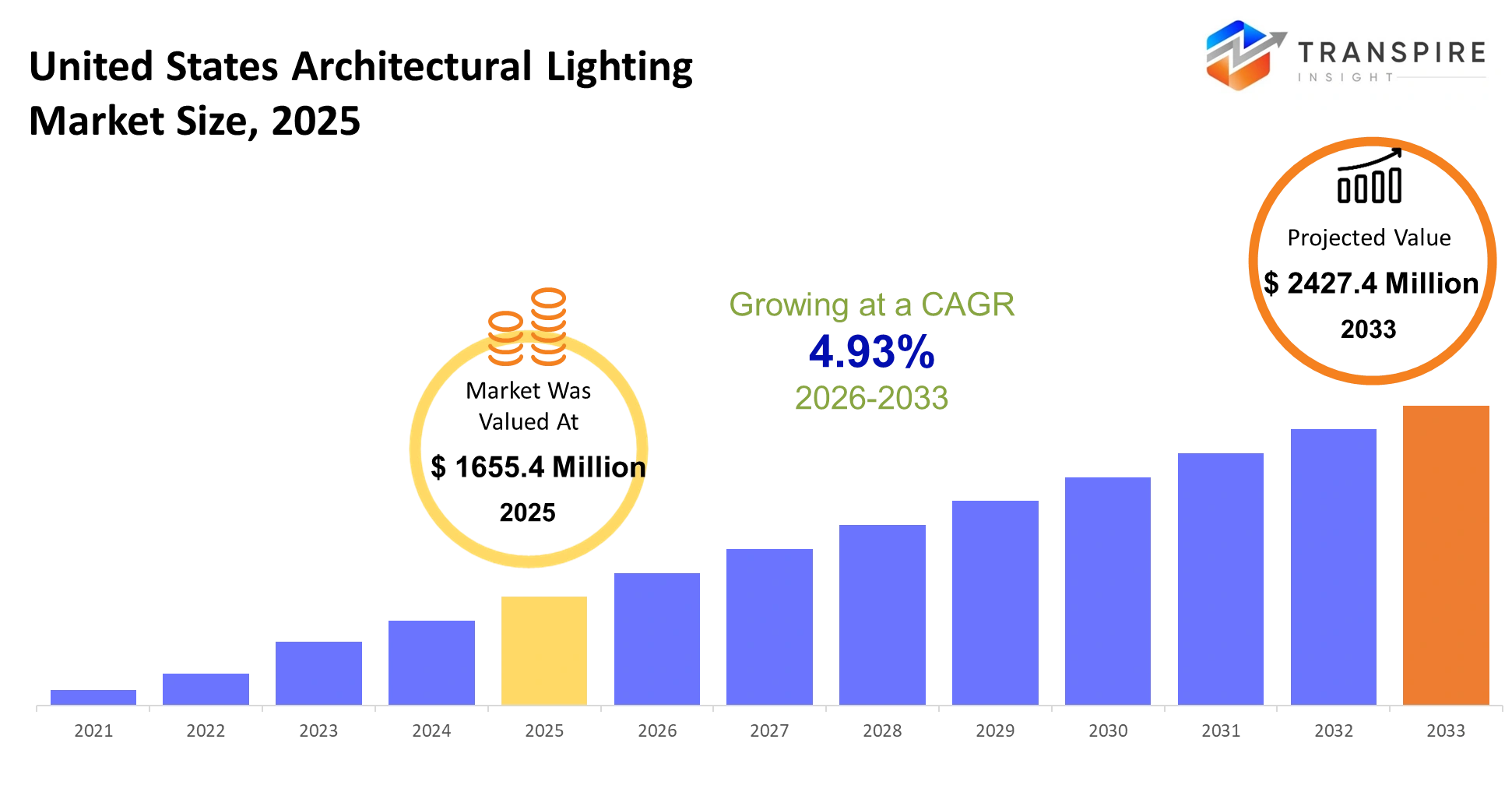
- United States Architectural Lighting Market Size 2025: USD 1655.4 Million
- United States Architectural Lighting Market Size 2033: USD 2427.4 Million
- United States Architectural Lighting Market CAGR: 4.93%
- United States Architectural Lighting Market Segments: By Product Type (LED Lighting, Fluorescent Lighting, HID Lighting, OLED Lighting, Smart Lighting, Decorative Lighting, Emergency Lighting), By Application (Indoor Lighting, Outdoor Lighting, Landscape Lighting, Commercial Lighting, Residential Lighting, Industrial Lighting, Hospitality Lighting), By Installation Type (New Installation, Retrofit Installation, Smart Integrated Systems, Wireless Lighting Systems, Sensor-based Systems, Automated Lighting).
To learn more about this report,  Download Free Sample Report
United States Architectural Lighting Market Summary:
The United States Architectural Lighting Market size is estimated at USD 1655.4 Million in 2025 and is anticipated to reach USD 2427.4 Million by 2033, growing at a CAGR of 4.93% from 2026 to 2033. In the United States the architectural lighting market kind of sets the tone for how commercial towers, hospitals, airports, stadiums, hotels, and public infrastructure end up working and feeling day to day. Not just about illumination either, these systems help with energy control occupant comfort, visual branding, workplace output, and meeting newer building rules. Lighting has turned into this wider smart building layer where fixtures talk with sensors , automation platforms and energy management systems, more or less in real time.
Over the last 3–5 years the whole market shifted, more like structurally away from simple conventional LED replacement efforts and toward connected, adaptive lighting ecosystems. Building owners now tend to favor tunable, sensor-driven, and software integrated solutions, mainly because they reduce operating costs while also lining up with sustainability goals and hybrid office redesigns. The momentum really kicked in after pandemic-era changes to office utilization, plus tougher state level energy efficiency regulations, especially in big urban construction hotspots like California and New York. Supply chain disruptions slowed down initial installs, yet somehow they also nudged buyers toward higher value, longer life lighting approaches. That increased project complexity, and it opened up stronger recurring service revenue chances for manufacturers and integrators.
Key Market Insights
- In 2025 the Western United States really dominated the United States Architectural Lighting Market, with close to 34% market share, mostly because California has strict energy codes, and well, that kind of thing pushes adoption faster.
- Meanwhile, the Southern region looks like the fastest-growing market through 2030, largely fueled by rapid commercial construction, expansion of hospitality, and mixed-use infrastructure buildouts, kind of all at once.
- Big city hubs like New York Los Angeles Dallas, and Miami are stepping up architectural lighting usage across smart commercial properties, not just the traditional way either.
- Also, ongoing urban redevelopment efforts plus public infrastructure modernization keep adding momentum, which supports both current industry scale and long-term architectural lighting market forecast chances.
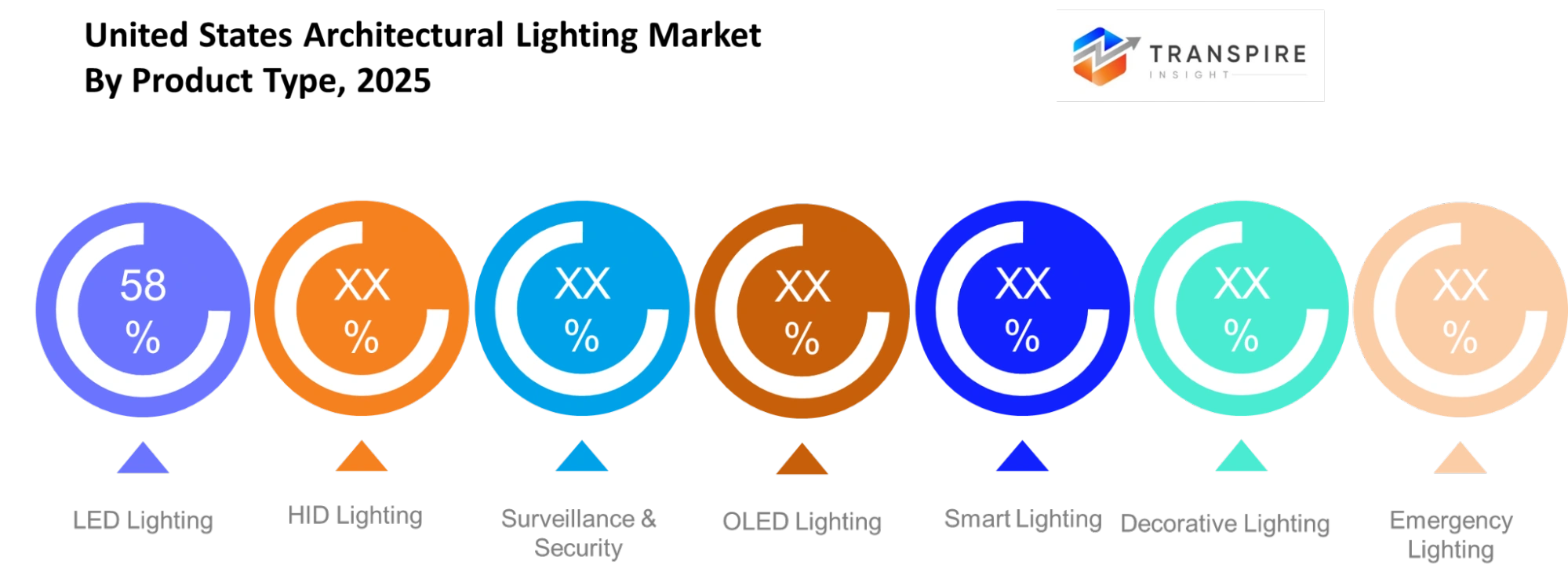
- LED architectural luminaires held more than 48% share in 2025, and they stayed in the driver’s seat through superior energy efficiency and lifecycle cost savings, which is usually the deciding factor.
- Smart lighting controls became the second-largest segment too, and it’s backed by IoT integration, occupancy sensors, and the growing push for centralized building automation, yes that.
- Wireless lighting management platforms are also quietly taking more share as facility managers lean toward predictive maintenance and real-time energy monitoring, that practical angle matters.
- For end-use, commercial office buildings were around 38% market share in 2025, leading lighting installations across retrofit programs, and premium workspace upgrades.
- And for applications, hospitality and entertainment venues are the fastest-growing, supported by experiential lighting design plus luxury renovation spending, making the whole setup feel more intentional.
What are the Key Drivers, Restraints, and Opportunities in the United States Architectural Lighting Market?
The most powerful driver moving the United States Architectural Lighting Market forward is really sort of the meeting point of stricter commercial energy rules, plus the steadily cheaper life cycle cost of intelligent LED setups. You can see it in how regulations like California Title 24, and ASHRAE building standards pushed developers and facility owners away from plain fixtures, and toward networked lighting systems. Those systems cut electricity use and also handle, in an almost self guided way, building performance. Meanwhile, LED component prices cooled down, and at the same time control software got better, so more advanced lighting became financially practical for offices, airports, hospitals, and also mixed-use developments. This transition makes more revenue chances for manufacturers and integrators, because projects now tend to include not only hardware but software controls, sensors, commissioning, and even recurring maintenance agreements. It’s less “swap the lamp” and more “deliver the whole managed layer”, if you know what I mean.
Even with all that momentum, retrofit complexity still feels like the biggest structural wall in the market. A lot of commercial buildings in major cities are still running on older electrical infrastructure, and it simply can’t support connected lighting architectures without major work. To make it function, teams must upgrade wiring, control networks, and ceiling interfaces, and that raises the total project costs, plus it stretches the installation timeline by quite a bit. Fixing this quickly is hard too, because older building stock across urban business areas usually needs phased modernization, and that requires large upfront capital. So, property owners often delay full scale upgrades, which limits adoption pace, and it also postpones revenue timing for suppliers.
Smart city infrastructure investment is kinda the next big growth chance. A lot of municipal projects in places like Chicago, Dallas ,and Los Angeles are starting to blend architectural façade lighting with IoT based stuff for traffic orchestration, surveillance monitoring and energy management. So the need is for programmable exterior lighting that can do real-time checking and adaptive glow, you know, based on what’s happening in the area. And when the whole connected city infrastructure keeps growing, there are long term windows for lighting firms that bring more than fixtures—they also provide bundled software, data insight, and cloud based control ecosystems.
What Has the Impact of Artificial Intelligence Been on the United States Architectural Lighting Market?
Artificial intelligence plus advanced digital technologies are kind of reshaping the United States Architectural Lighting Market by turning lighting systems into data driven building management assets, more or less. Commercial property owners now more often roll out AI enabled lighting platforms, that can automatically dial in brightness , color temperature and even occupancy settings by watching real time building usage patterns. Usually these platforms link up with HVAC tools and energy management software to cut electricity use and improve day to day operational efficiency across offices, airports, hospitals, and retail complexes.
At the same time, machine learning is pushing predictive maintenance further along, as in it can see patterns. Smart luminaires, with IoT sensors in them, keep gathering performance signals, including voltage variations, heat generation, and so on operating hours too. Then AI algorithms work through that stream of information to spot fixture degradation early before failures show up. This can help facility managers lower maintenance downtime, and it can extend lighting asset life cycles, pretty directly. On big commercial campuses, predictive lighting management has been known to bring maintenance costs down and also reduce wasteful energy consumption, mostly through automated scheduling and adaptive illumination control logic.
Beyond that, advanced analytics platforms help with regulatory compliance too, since they monitor energy performance against state level building efficiency guidelines. Still, the whole thing has a drawback— integration costs can be high. Plenty of older commercial buildings don’t yet have compatible digital infrastructure, so AI based lighting upgrades end up being expensive and technically complicated. On top of that, fragmented building management systems and inconsistent data quality can mess with the accuracy of real time optimization models in legacy environments.
Key Market Trends
- Since 2020, commercial developers keep leaning into sensor-driven lighting , swapping out static fixtures more often, and letting the system sort brightness automatically from occupancy cues and daylight conditions.
- California Title 24 updates also nudged manufacturers to reshuffle product lines around networked controls, which in turn sped up adoption of compliant smart lighting platforms after 2022 , not just “incremental” upgrades.
- In hospitality, from about 2021 to 2025, projects started moving toward programmable architectural façade lighting , mostly to craft a more distinct guest mood and reinforce premium branding—at least that is how many teams described it in meetings, and sure enough it shows in the installs.
- Big names, like Signify and Acuity Brands , expanded software-based lighting management options while they still sold conventional fixtures at the same time , kind of a both approach.
- During the supply chain disruptions in 2021 and 2022, contractors leaned toward longer-life luminaires and components sourced domestically, aiming to lower replacement risk plus cut down on schedule slips.
- Smart office retrofits really picked up after hybrid work spread, with building owners putting money into tunable white lighting so spaces feel more flexible , and occupants stay comfortable in a more consistent way.
- Meanwhile, municipal infrastructure work increasingly merged architectural lighting with surveillance, traffic monitoring, and smart city platforms across cities like Dallas , and also Los Angeles.
- Between 2022 and 2025, wireless lighting controls gained serious traction because installers could avoid some of the labor-heavy rewiring steps, especially in older commercial buildings that already had complicated wiring histories.
- Lastly, AI-enabled predictive maintenance platforms showed up across major commercial campuses, and those tools help facility managers notice fixture problems earlier , so unplanned maintenance interruptions drop , and downtime is less of a surprise.
United States Architectural Lighting Market Segmentation
By Product Type
LED lighting basically has the strongest position across most product categories because commercial developers and facility owners keep pushing for lower energy use, a longer operating life, and less upkeep cost, it’s kinda the whole package. At the same time, smart lighting systems keep taking more share as building operators adopt connected controls, occupancy sensors, and that adaptive illumination approach which tends to squeeze out better operational efficiency. Decorative lighting still matters a lot especially in hospitality, luxury retail, and mixed-use developments, because the visual differentiation ends up shaping how customers feel, and even how the property value is perceived. Emergency lighting systems also keep their demand fairly steady, due to strict safety codes , plus compliance requirements in healthcare, airports, and educational facilities .
Meanwhile, fluorescent and HID lighting segments are still drifting downward as replacement cycles start accelerating toward advanced LED alternatives. OLED lighting stays comparatively limited , mainly because production costs are higher, though premium architectural projects are increasingly trialing flexible, and design oriented uses. Going forward the market direction looks like it is pointing toward integrated digital lighting ecosystems, where manufacturers compete via software compatibility, energy analytics and AI enabled control platforms, not just by the fixture performance all by itself.
To learn more about this report, Download Free Sample Report
By Application
Commercial lighting kinda dominates application demand, because office towers retail complexes airports hospitals, and entertainment venues all still need high-performance illumination systems that help with energy management plus that whole occupant experience thing. You know, indoor lighting applications end up being the biggest slice as well, mainly due to lots of retrofit work happening across aging commercial infrastructure in big metropolitan areas. Hospitality lighting is one of the quickest moving segments too, since hotels and entertainment operators are steadily putting money into programmable ambiance and façade illumination to really reinforce brand identity and also keep customer engagement up.
Outdoor and landscape lighting are also seeing consistent growth, driven by urban redevelopment projects, smart city infrastructure funding, and public safety modernization programs. Residential lighting adoption keeps shifting toward connected and voice-enabled systems, though the price sensitivity part slows down how much the higher-end—premium—stuff gets into mid-market housing categories.
Industrial lighting demand is leaning more toward high-bay LED systems that are automation friendly. Going forward, growth will likely favor application-specific solutions that are shaped around user behavior, environmental controls, and integrated building management requirements, rather than one-size-fits-all deployments.
By Installation Type
Retrofit installation is still kind of the main category, mostly because a big share of commercial buildings in urban business areas are running on pretty outdated lighting infrastructure, like it never really got updated. At the same time property owners are more and more swapping the conventional fixtures for sensor based and wireless lighting setups, so they can cut operational costs without doing heavy structural reconstruction. Smart integrated systems keep picking up steam in premium office developments, healthcare campuses, and even airports, where centralized control and real-time monitoring help with energy optimization, plus they make maintenance planning feel more predictable. Wireless lighting systems specifically draw a lot of attention because installers can dial down the labor intensive rewiring costs and also limit operational disruption during modernization efforts, which is kinda a big deal on occupied sites.
Automated lighting installations also keep rising, driven by occupancy based controls and daylight harvesting technologies that help meet the changing energy regulations. New installation activity still tracks closely with commercial construction cycles, and also with mixed use infrastructure development. Looking ahead, market momentum will likely lean toward scalable digital installations, the ones that blend software analytics, predictive maintenance, and cloud based controls, and that can lead to recurring revenue for tech focused lighting providers and system integrators, so everyone stays busy.
What are the Key Use Cases Driving the United States Architectural Lighting Market?
Commercial office buildings kind of sit at the center of the whole architectural lighting story, because developers and property managers tend to push hard on energy optimization workplace comfort, plus whatever compliance is required by the state level efficiency standards. Smart LED installs and adaptive control behavior really are a big driver right now especially across corporate campuses, airports, and healthcare facilities where lighting essentially feeds into day to day operational performance.
Meanwhile hospitality and entertainment spaces are starting to lean into programmable façade lighting and more dynamic interior illumination to build stronger customer engagement, and also to support that premium branding vibe. On top of that, municipal infrastructure projects keep growing too, with connected outdoor lighting rolled out along smart city corridors, public plazas, and transportation hubs, pretty regularly.
For the newer angles, people are looking at human-centric lighting in healthcare and educational campuses where tunable illumination is used to back occupant wellness, and productivity targets. Mixed use smart districts are also experimenting with AI-enabled lighting platforms that get tied together with traffic monitoring, surveillance systems, and cloud based energy management applications.
|
Report Metrics |
Details |
|
Market size value in 2025 |
USD 1655.4 Million |
|
Market size value in 2026 |
USD 1733.2 Million |
|
Revenue forecast in 2033 |
USD 2427.4 Million |
|
Growth rate |
CAGR of 4.93% from 2026 to 2033 |
|
Base year |
2025 |
|
Historical data |
2021 - 2024 |
|
Forecast period |
2026 - 2033 |
|
Report coverage |
Revenue forecast, competitive landscape, growth factors, and trends |
|
Geographic scope |
United States of America |
|
Key company profiled |
Acuity Brands, Signify, Cree Lighting, Hubbell Lighting, Lutron Electronics, GE Lighting, Zumtobel Group |
|
Customization scope |
Free report customization (country, regional & segment scope). Avail customized purchase options to meet your exact research needs. |
|
Report Segmentation |
By Product Type (LED Lighting, Fluorescent Lighting, HID Lighting, OLED Lighting, Smart Lighting, Decorative Lighting, Emergency Lighting), By Application (Indoor Lighting, Outdoor Lighting, Landscape Lighting, Commercial Lighting, Residential Lighting, Industrial Lighting, Hospitality Lighting), By Installation Type (New Installation, Retrofit Installation, Smart Integrated Systems, Wireless Lighting Systems, Sensor-based Systems, Automated Lighting) |
Which Regions are Driving the United States Architectural Lighting Market Growth?
The Western United States kind of leads the architectural lighting market , because places like California enforce some of the country’s strictest commercial energy efficiency rules. Building standards such as Title 24 helped push adoption of connected LED systems, occupancy sensors, and automated lighting controls across offices, airports , healthcare campuses and public infrastructure projects. Big metropolitan areas—Los Angeles, San Francisco, and Seattle—also help, you know, with a solid ecosystem of lighting manufacturers, smart building integrators, software firms and sustainability focused developers. Plus high levels of commercial construction activity and aggressive carbon reduction targets keep reinforcing that regional advantage for advanced architectural lighting deployments.
The Northeastern United States stays a steady contributor, largely because older commercial real estate markets consistently put money into retrofit modernization instead of betting everything on big new construction expansion. Cities like New York and Boston tend to prioritize lighting upgrades in aging office towers, transportation hubs, educational institutions, and mixed-use developments , to improve day to day operational efficiency and tenant retention. Compared with the western region, growth up here depends less on fast policy changes and more on long term infrastructure renewal plus premium building repositioning strategies. Also financial resilience among institutional property owners supports steady spending on intelligent lighting controls and energy management systems.
The Southern United States seems to be showing the quickest growth momentum, mostly because population migration is speeding up, plus commercial construction activity, and then this smart city infrastructure investment. Some states like Texas and Florida have recently pushed forward with mixed use developments, hospitality projects, logistics facilities, and even entertainment venues, all of which need lighting systems that can scale without a big headache. Rapid urban expansion in places like Dallas, Austin, Miami, and Nashville has really built up a strong demand for programmable facade lighting, outdoor illumination, and wireless lighting controls too. So overall, this regional uptick creates genuinely attractive opportunities for manufacturers, integrators and software providers who want higher installation volumes and longer term infrastructure partnerships somewhere between 2026 and 2033.
Who are the Key Players in the United States Architectural Lighting Market and How Do They Compete?
The United States architectural lighting market still looks moderately fragmented, mostly because global lighting manufacturers show up alongside regional integrators, controls specialists, and design focused firms, and that makes the landscape kind of uneven in practice. Lately the competition is leaning more toward software integration, energy analytics, and smart building compatibility, instead of thinking fixture pricing is the only thing that matters. The longer established companies keep defending their market share using long standing contractor relationships, certified control platforms and bundled service offerings, while newer entrants try to stand out with wireless systems and AI enabled building automation tools.Commercial developers and municipal buyers now kind a tend to judge the vendors by lifecycle efficiency, interoperability with smart building infrastructure, and what kind of support they can actually provide after install, even if things get complicated later.
Signify kind of differentiates by leaning into connected lighting ecosystems that merge luminaires, sensors, cloud-based controls, and energy monitoring software together into one platform, not just a bunch of separate parts. They also build strategic partnerships with smart city operators and commercial developers, which helps them get deeper in urban infrastructure programs and hospitality related projects. Acuity Brands goes hard on intelligent building management integration, with occupancy analytics, indoor positioning technologies, and wireless control systems aimed at big commercial campuses. On top of that, its distribution network across North America tends to make deployment and retrofit execution move faster.
Lutron Electronics kinda competes by leaning on advanced lighting controls plus automated shading systems, which are used to boost energy optimization, and occupant comfort, especially inside premium commercial properties. They also keep a real edge in retrofit work, since the wireless installation options mean less infrastructure change in older buildings. Zumtobel Group on the other hand leans hard into architectural customization and that high-end design integration for places like airports, museums, and luxury retail locations, where the visual experience ends up steering a lot of the project value. Cree Lighting keeps pushing forward too, through high performance LED systems that focus on durability, energy efficiency, and industrial scale uses, especially across logistics facilities and municipal outdoor infrastructure projects.
Company List
- Acuity Brands
- Signify
- Cree Lighting
- Hubbell Lighting
- Lutron Electronics
- GE Lighting
- Zumtobel Group
Recent Development News
In April 2026, Signify Reports Q1 2026 Sales Decline Due to U.S. Professional Lighting Slowdown: Signify reported lower quarterly sales in April 2026, citing reduced activity in U.S. commercial and public infrastructure lighting projects. The update highlighted continued pressure on the professional architectural lighting segment, despite ongoing connected-lighting investments.
Source: https://www.reuters.com
In January 2026, Signify Launches Cost-Cutting Review After Weak U.S. Lighting Demand: Global lighting leader Signify announced a strategic business review and restructuring initiative after softer commercial lighting demand in the United States impacted margins. The company also introduced additional efficiency measures aimed at stabilizing its professional architectural lighting business during 2026.
Source: https://www.reuters.com
What Strategic Insights Define the Future of the United States Architectural Lighting Market?
In the United States, the architectural lighting market is kinda shifting, structurally speaking, toward software-defined lighting ecosystems. In that view, fixtures are less like “just hardware” and more like data collection and building optimization assets, even though people still call them luminaires, and so on. Over the next 5–7 years, growth should come more and more from intelligent control platforms, AI-enabled automation, and also from tighter integration with the wider smart building infrastructure. Underneath it all, the move is being pushed by commercial real estate operators who want measurable operational efficiency, occupancy analytics, and energy compliance, all inside one connected, coordinated environment.
There’s also a bit of a hidden risk, where the whole setup gets more and more dependent on semiconductor supply chains and proprietary software ecosystems. If the market bunches around a small number of control platform providers, integration costs could climb, and interoperability across commercial buildings might get worse, especially if construction cycles slow down, or if the technology standards start to fragment further, for whatever reason.
At the same time, there’s an emerging opportunity that looks pretty interesting. It’s centered on human-centric lighting systems in healthcare, education, and senior living facilities, where adaptive illumination supports wellness goals and productivity outcomes. Market participants should really lean into open-platform interoperability, plus recurring software service models. Long-term competitive advantage is likely to depend less on fixture manufacturing scale alone, and more on data integration capabilities, because, honestly, that’s where the real differentiation ends up living.
United States Architectural Lighting Market Report Segmentation
By Product Type
- LED Lighting
- Fluorescent Lighting
- HID Lighting
- OLED Lighting
- Smart Lighting
- Decorative Lighting
- Emergency Lighting
By Application
- Indoor Lighting
- Outdoor Lighting
- Landscape Lighting
- Commercial Lighting
- Residential Lighting
- Industrial Lighting
- Hospitality Lighting
By Installation Type
- New Installation
- Retrofit Installation
- Smart Integrated Systems
- Wireless Lighting Systems
- Sensor-based Systems
- Automated Lighting
Frequently Asked Questions
Find quick answers to common questions.
The approximate United States Architectural Lighting Market size for the market will be USD 2427.4 Million in 2033.
The key segments of the United States Architectural Lighting Market are By Product Type (LED Lighting, Fluorescent Lighting, HID Lighting, OLED Lighting, Smart Lighting, Decorative Lighting, Emergency Lighting), By Application (Indoor Lighting, Outdoor Lighting, Landscape Lighting, Commercial Lighting, Residential Lighting, Industrial Lighting, Hospitality Lighting), By Installation Type (New Installation, Retrofit Installation, Smart Integrated Systems, Wireless Lighting Systems, Sensor-based Systems, Automated Lighting).
Major players in the United States Architectural Lighting Market are Acuity Brands, Signify, Cree Lighting, Hubbell Lighting, Lutron Electronics, GE Lighting, Zumtobel Group.
The current market size of the United States Architectural Lighting Market is USD 1655.4 Million in 2025.
The United States Architectural Lighting Market CAGR is 4.93%.
- Acuity Brands
- Signify
- Cree Lighting
- Hubbell Lighting
- Lutron Electronics
- GE Lighting
- Zumtobel Group
Recently Published Reports
-
Apr 2026
Bottled Water Market
Bottled Water Market Size, Share & Analysis Report By Product Type (Still Bottled Water, Carbonated Bottled Water, Functional Bottled Water, and Others), By Packaging (PET, Cans, and Others), By Sales Channel (Supermarkets/Hypermarkets, Convenience Stores/Drug Stores, Grocery Stores/Club Stores, Foodservice, and Others) and Geography (North America, Europe, Asia-Pacific, Middle East and Africa, South and Central America), 2021 - 2032
-
Apr 2026
Color Cosmetic Packaging Market
Color Cosmetic Packaging Market Size, Share & Analysis Report By Application (Mascara Packaging, Liquid Packaging, and Liquid Face), By Type (Tubes & Bottles, Pens & Markers, Compacts & Containers, and Droppers & Pumps), and Geography (North America, Europe, Asia-Pacific, Middle East and Africa, South and Central America), 2021 - 2031
-
Apr 2026
External Microphone For Camera Market
External Microphone For Camera Market Size, Share & Analysis Report By Type (Shotgun Microphone, Lavalier Microphone, and Others), By Application (Digital Camera, Professional Video Camera, and Others), and Geography (North America, Europe, Asia-Pacific, Middle East and Africa, South and Central America), 2021 - 2031
-
Apr 2026
Foot Orthotic Insoles Market
Foot Orthotic Insoles Market Size, Share & Analysis Report By Type (Pre-fabricated, and Custom-made), By Material (Thermoplastic, Composite Carbon Fiber, and Others), By Distribution Channel (Drug Stores, Hospitals & Clinics, and Others), and Geography (North America, Europe, Asia-Pacific, Middle East and Africa, South and Central America), 2021 - 2031