

Europe HVAC System Market Size & Forecast:
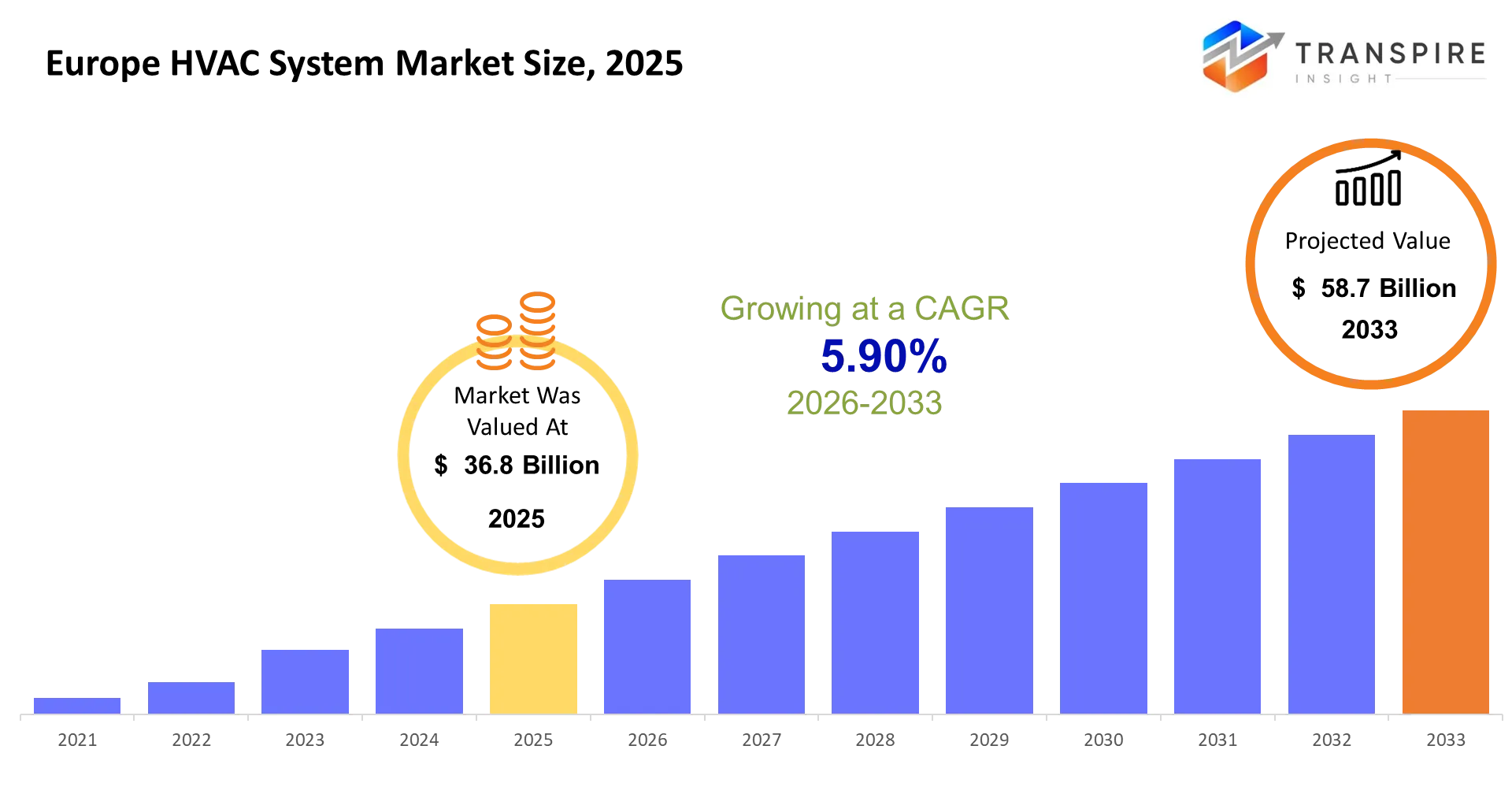
- Europe HVAC System Market Size 2025: USD 36.8 Billion
- Europe HVAC System Market Size 2033: USD 58.7 Billion
- Europe HVAC System Market CAGR: 5.90%
- Europe HVAC System Market Segments: By Type (Heating Systems, Ventilation Systems, Air Conditioning Systems, Hybrid Systems, Smart HVAC, Others), By Application (Residential, Commercial, Industrial, Healthcare, Others), By End-User (Households, Commercial Buildings, Industries, Others), By Technology (Conventional HVAC, Smart HVAC, Energy-efficient HVAC, Others).
To learn more about this report,  Download Free Sample Report
Europe HVAC System Market Summary:
The Europe HVAC System Market size is estimated at USD 36.8 Billion in 2025 and is anticipated to reach USD 58.7 Billion by 2033, growing at a CAGR of 5.90% from 2026 to 2033. The Europe HVAC System Market still feels like a central spine for keeping commercial buildings, factories, hospitals, data centers, and transport infrastructure up and running, efficient, and aligned with indoor air quality standards. basically, HVAC systems manage temperature, airflow , moisture, and filtration in spaces where equipment reliability, worker output, and occupant well-being directly shape operating costs, and also business continuity, kind of in a chain reaction.
Over the past five years, the market has been veering away from standard climate control toward smarter low-emission solutions, which get tied into building automation tools and energy management platforms. This shift really gathered speed after the European energy crisis connected to the Russia-Ukraine conflict, because it made the financial exposure of energy-hungry infrastructure pretty obvious. Governments and enterprises then pushed harder on efficiency retrofits, not just because of policy, but because the budgets were getting squeezed.
At the same time, tighter EU carbon reduction rules and refrigerant constraints pressured manufacturers to refit their designs around heat pumps, digital controls , and low-GWP refrigerants. With electricity prices moving and sustainability goals becoming non negotiable, buyers are leaning toward lifecycle cost optimization rather than thinking only about the first purchase price. That’s what keeps expanding long-term service income, retrofit activity, and digital monitoring revenue across the whole market.
Key Market Insights
- Germany is pretty much leading the Europe HVAC System market with something like 24% market share in 2025 , mostly from solid industrial infrastructure, plus the retrofit activity that never really slows down.
- France and the United Kingdom still keep a big footprint, because commercial construction modernization and energy-transition investments stay high, and those projects kind of stack year after year.
- Eastern Europe looks like the fastest-growing regional area during 2026–2032, helped by smart city initiatives and upgrades inside industrial sites.
- The Nordic countries show rising demand for high efficiency heat pumps, basically tied to strict carbon neutrality policies, and also the steady push toward heating electrification.
- Heat pumps are taking the lead in the Europe HVAC System market with above 38% market share in 2025, driven by EU decarbonization measures and programs meant to swap out fossil-fuel based solutions.
- Ventilation systems stay as the second-largest segment , mainly because indoor air quality requirements are getting tighter across hospitals, offices, and manufacturing plants.
- Smart HVAC controls are expected to grow the quickest through 2032, as digital building management systems keep spreading faster than before.
- Variable Refrigerant Flow systems are gaining momentum in commercial buildings too, since they cut operating expenses while supporting better energy optimization overall.
- When it comes to applications, commercial buildings lead with nearly 41% revenue share in 2025, supported by office retrofits, retail modernization, and hospitality expansion.
- Data centers are the fastest-growing application segment, as Europe continues expanding hyperscale cloud infrastructure and AI computing capacity.
- Industrial manufacturing facilities keep putting money into more advanced HVAC solutions, to boost equipment reliability, and also to meet workforce safety expectations without compromise.
What are the Key Drivers, Restraints, and Opportunities in the Europe HVAC System Market?
The strongest force pushing the Europe HVAC System Market forward, is basically the EU tightening its energy efficiency and carbon emission rules, especially with the EU Green Deal plus the updated Energy Performance of Buildings Directive. Because of that, commercial property owners and industrial operators started swapping older gas based heating setups, for more efficient heat pump based systems smart ventilation,and automated climate control. Then the 2022 energy price shock just made it even faster, since it showed in a real way how risky the long term running costs can be when HVAC is inefficient. Once electricity optimization became financially critical, the market shifted toward connected HVAC systems that can cut energy usage in real time. That shift didn’t only open up new revenue for equipment manufacturers, but also for software integration, prescriptive maintenance services, and retrofit support providers.
Still, the market’s most stubborn structural issue is the high retrofit complexity tied to Europe’s older building stock. A lot of residential and commercial buildings were basically not built for modern low-temperature heating systems, nor for digital HVAC integration. Updating them often means electrical redesign, insulation upgrades, and ventilation restructuring, and that’s what makes installation costs and project schedules jump , quite a bit. So adoption slows in cost-sensitive segments and the big replacement cycles get delayed, particularly across Southern and Eastern Europe.
A big growth chance is kind of bubbling up from the data center expansion across Europe, and you can feel it. In places like Ireland Germany and the Netherlands, they are putting serious money into hyperscale digital infrastructure, so suddenly there is more need for precision cooling systems with AI-enabled thermal management. Liquid cooling, plus energy recovery HVAC technologies are moving from “maybe later” into actual commercial readiness, because operators are really pushing for better energy efficiency, along with stronger uptime reliability.
What Has the Impact of Artificial Intelligence Been on the Europe HVAC System Market?
Artificial intelligence and advanced digital technologies are gradually changing the Europe HVAC System Market , from what looks like a reactive maintenance industry into this more data-driven building performance ecosystem, kinda like a living loop. HVAC operators now more often put AI-enabled building management systems in charge, to handle airflow balancing, temperature regulation, cooling based on occupancy signals, and energy load optimization across offices, retail spaces, and industrial plants. The smart control platforms keep taking in sensor inputs from compressors, chillers, air handlers, and ventilation units, then they fine-tune operating parameters in real time, so energy use can drop especially when occupancy is low, or nobody is around.
Also, machine learning models are pushing predictive maintenance a lot further. HVAC manufacturers plus facility operators rely on algorithms that spot vibration irregularities, refrigerant pressure swings, and weird power consumption behavior before a component failure shows up. That kind of predictive workflow supports fewer surprise shutdowns, longer service life, and overall maintenance expenses that feel more controlled. In big commercial buildings, and especially data centers, AI-assisted optimization can cut HVAC energy consumption by about 15% to 25%, while at the same time supporting higher system availability and steadier indoor thermal conditions.
Beyond that, digital twins and cloud-based analytics platforms are helping with emissions forecasting and lifecycle performance monitoring, not just for dashboards but for actual planning. Still, AI adoption runs into a key obstacle in Europe, mainly because the building stock is aging. A lot of older HVAC setups simply do not have compatible sensing devices, or they use control architectures that do not “talk” well with modern tools, and there is often no usable history in the first place. Because of that, rolling out AI on a large scale ends up being costly, and also operationally complicated, even when the idea sounds straightforward.
Key Market Trends
- Since 2022, commercial property owners kind of increasingly replaced gas boilers with electric heat pumps to reduce their long term exposure to volatile energy prices , or at least that is what many reports say.
- EU F-Gas rules pushed manufacturers like Daikin Industries and Mitsubishi Electric toward low-GWP refrigerant systems, and also they redesigned compressor technologies in the process, kinda.
- Between 2021 and 2025, AI enabled HVAC monitoring platforms gained traction , because facility managers prioritized predictive maintenance and energy optimization capabilities, more or less.
- Data center expansion across Germany and Ireland accelerated adoption of liquid cooling and precision ventilation systems with advanced thermal management controls, which made operators feel more in control.
- Residential buyers more and more shifted toward connected HVAC systems after electricity costs surged across Europe following the Russia-Ukraine energy crisis.
- Since 2020 hospitals and pharmaceutical facilities expanded investment in high filtration ventilation systems to meet stricter indoor air quality standards , without much room for compromise.
- HVAC manufacturers increasingly localized their European production networks after pandemic era supply chain disruptions exposed dependence on Asian component sourcing, and this became a talking point everywhere.
- Smart building retrofits became a major revenue driver as aging commercial infrastructure needed digital controls, occupancy based automation , and integrated energy management systems all together.
- Companies such as Johnson Controls and Trane Technologies expanded subscription based predictive maintenance services alongside equipment sales after 2023, which seems to be the new normal.
- Industrial facilities increasingly adopted variable refrigerant flow systems, because operators wanted lower energy consumption , without disrupting continuous manufacturing operations, at least not noticeably.
Europe HVAC System Market Segmentation
By Type
Heating systems still seem to keep the best market position inside their segment, mainly because European climate conditions, and decarbonization policies, put heating efficiency right at the heart of infrastructure investment. Heat pumps, plus hybrid heating setups, got real momentum once energy price volatility made operating costs for gas based equipment feel a lot higher. Ventilation systems keep showing up strongly across healthcare facilities, offices and industrial plants, largely because tougher indoor air quality standards were introduced right after the pandemic period.
Air conditioning systems are also growing, especially in Southern and Central Europe, as hotter summers raise cooling demand for both residential, and commercial buildings. Smart HVAC systems are the fastest moving category because property owners more and more value automated energy optimization, along with predictive maintenance functions. Manufacturers meanwhile are redirecting resources toward modular designs and digitally connected systems, that help sustain long term service contracts. What happens next in competition will likely hinge on energy efficiency results, software integration skill, and how well the solutions match low carbon building infrastructure.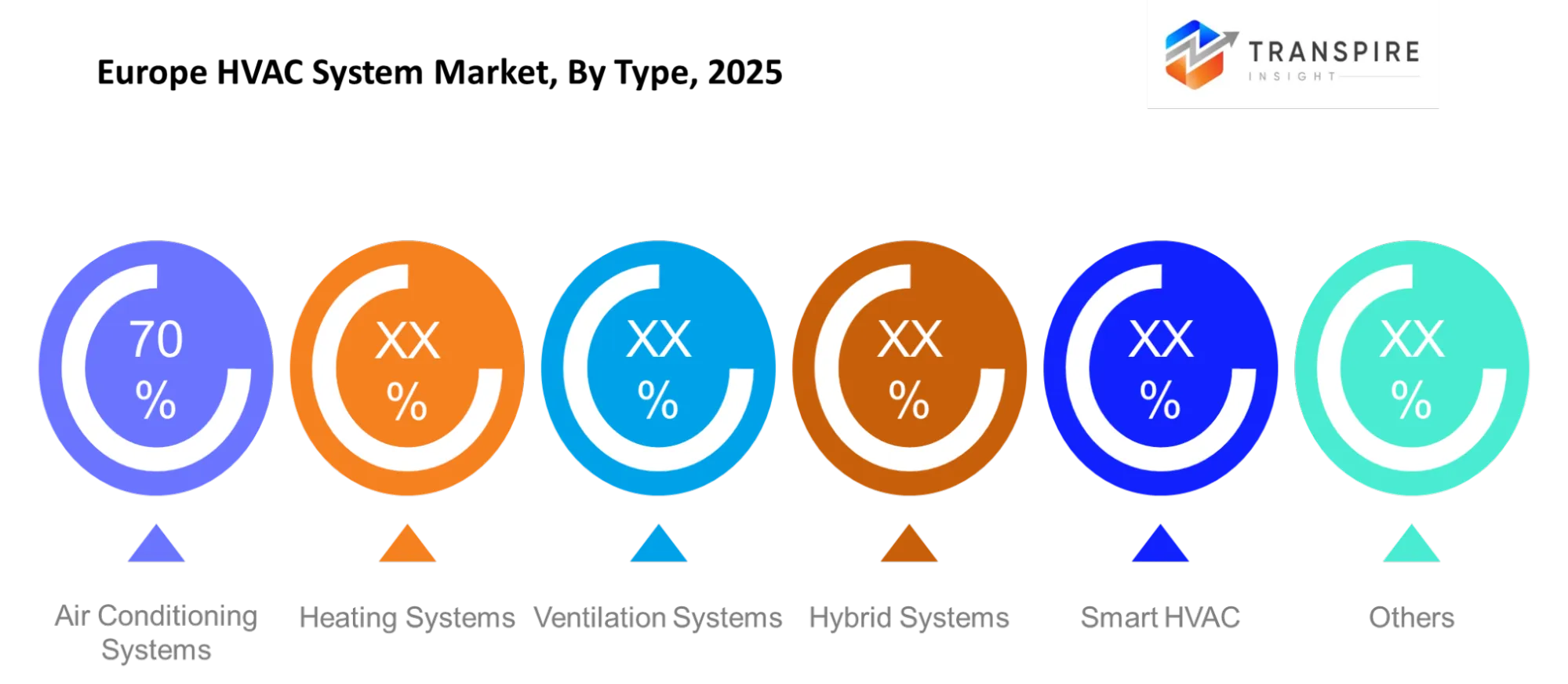
To learn more about this report, Download Free Sample Report
By Application
Commercial applications do seem to dominate the overall deployment picture because offices, retail centers, hospitality locations, and public infrastructure keep needing continuous climate control along with ventilation management, and energy optimization. On top of that, the large-scale retrofit work across older commercial properties still brings in strong replacement demand for advanced HVAC systems with smart controls, plus energy monitoring features that are a bit more nuanced. Residential applications are also growing fast, not just because heat pumps are getting more common, but because households are adopting connected climate control systems to squeeze down electricity and heating expenses.
Industrial applications keep a pretty steady pace, since factories and plants need temperature stability , air filtration, and equipment cooling that holds up operational continuity. Healthcare applications are gaining strategic importance too, mostly due to rising investment in precision ventilation and infection-control infrastructure across hospitals, labs and related sites . Looking ahead the market direction will likely tilt toward application specific system customization, rather than one-size-fits-all. Equipment suppliers and investors are expected to put even more focus on integrated solutions for data centers, pharmaceutical facilities, and energy efficient residential complexes.
By End-User
Commercial buildings are still sort of the main end-user slice, mainly because big property operators keep feeling this rising pressure to cut energy use, and to meet those European carbon reduction targets. Retail chains, office complexes, airports, and hospitality venues are investing more and more in intelligent HVAC setups, with centralized monitoring basically, and automated climate fine tuning. Industrial customers remain pretty influential too, since process cooling, dehumidification control, and worker safety compliance really matter in manufacturing operations.
At home, adoption has sped up lately, because residential people want smaller running costs and better indoor well being, often via connected heating and cooling. Public bodies, transport hubs, and schools also keep upgrading old HVAC infrastructure, usually driven by government-backed modernization schemes. Looking ahead, demand patterns hint at a stronger movement toward long-term service agreements and lifecycle performance management. Suppliers that offer remote diagnostics, energy analytics, and maintenance automation will likely boost their competitive stance across larger institutional and commercial groups.
By Technology
Conventional HVAC techs still make up a big installed base, mostly because lots of industrial and housing sites keep running old infrastructure with sort of limited ability to be retrofitted. Still, more energy-smart HVAC options are changing what people buy, as tougher emission rules and electricity price pressure start to shift investment priorities across Europe. High efficiency heat pumps, variable refrigerant flow setups, and low-GWP refrigerant solutions are getting more widely used, since they show clear payback via lower operating expenses and less carbon output.
Smart HVAC is the most lively lane of technological progress, it sort of happens because digital building management systems increasingly depend on AI-style automation, people presence detection, and preemptive upkeep routines. Adoption is most visible in commercial buildings and data centers, where day to day efficiency really links to margins and energy usage. What comes next in the tech race will likely focus on interoperability, cloud connectivity, and lifecycle optimization. Equipment makers are expected to put more money into software based platforms that blend climate regulation, energy analytics, and automated maintenance tasks into one operating environment, rather than separate pieces that don’t quite talk.
What are the Key Use Cases Driving the Europe HVAC System Market?
Commercial building climate management is still basically the main use case that drives HVAC adoption all over Europe. You know, office complexes, retail centers, airports, and hospitality facilities really need nonstop temperature regulation and also ventilation control, plus energy optimization, so they can stick to carbon reduction targets and hit day-to-day operational efficiency goals.
Healthcare buildings and industrial manufacturing plants are showing up as those high-value secondary applications. Hospitals are increasingly putting money into advanced air filtration, and pressure-controlled ventilation systems too, but pharmaceutical and electronics manufacturers are usually after precision cooling and humidity regulation, to keep sensitive production environments safe and stable.
Also, data centers and smart residential complexes are getting more attention, they’re kind of important emerging use cases with real long term potential. Hyperscale cloud operators across Germany, Ireland, and the Netherlands are deploying liquid cooling as well as AI driven thermal management, mainly to cut power consumption, while smart apartment developments are often adding connected HVAC platforms for automated energy management and predictive maintenance, which sounds simple but it works well.
|
Report Metrics |
Details |
|
Market size value in 2025 |
USD 36.8 Billion |
|
Market size value in 2026 |
USD 39.3 Billion |
|
Revenue forecast in 2033 |
USD 58.7 Billion |
|
Growth rate |
CAGR of 5.90% from 2026 to 2033 |
|
Base year |
2025 |
|
Historical data |
2021 - 2024 |
|
Forecast period |
2026 - 2033 |
|
Report coverage |
Revenue forecast, competitive landscape, growth factors, and trends |
|
Regional scope |
Europe (Germany, United Kingdom, France, Italy, Spain and Rest of Europe) |
|
Key company profiled |
Daikin, Carrier, Trane Technologies, Johnson Controls, Lennox, Mitsubishi Electric, LG Electronics, Samsung, Bosch, Hitachi, Panasonic, Honeywell, Siemens, Fujitsu, Toshiba |
|
Customization scope |
Free report customization (country, regional & segment scope). Avail customized purchase options to meet your exact research needs. |
|
Report Segmentation |
By Type (Heating Systems, Ventilation Systems, Air Conditioning Systems, Hybrid Systems, Smart HVAC, Others), By Application (Residential, Commercial, Industrial, Healthcare, Others), By End-User (Households, Commercial Buildings, Industries, Others), By Technology (Conventional HVAC, Smart HVAC, Energy-efficient HVAC, Others) |
Which Regions are Driving the Europe HVAC System Market Growth?
Western Europe keeps leading the Europe HVAC System Market, because the region sort of meshes strict energy efficiency rules with well-developed commercial infrastructure and also solid retrofit financing frameworks. In places like Germany, France, and the Netherlands, the building decarbonization push is pretty aggressive, and that tends to speed up the swap of older heating along with ventilation systems. Big commercial property portfolios, dense city networks, and active manufacturing activity keep feeding ongoing needs for smart climate regulation tools, plus high-efficiency heat pumps. On top of that, the region has a long-running, reliable ecosystem of HVAC makers, energy service providers, automation companies, and digital building management specialists. They help sustain modernization programs over the long haul , so demand doesn’t really fade.
Northern Europe shows up next as the second biggest regional contributor, although the whole growth story kind of looks different from Western Europe . It feels more tied to climate resilience and electrification priorities , not so much the bigger commercial retrofit waves. The Nordic countries keep channeling funding into district heating tie ins, low temperature heating infrastructure, and heat pump systems that run on renewables, all to reduce fossil fuel dependence. Government incentives there tend to be stable, and infrastructure planning stays consistent, so demand cycles look predictable which helps long term manufacturer commitments and smoother technology rollouts. In addition, there is strong household acceptance of energy saving residential heating solutions , which gives suppliers a dependable revenue base while they operate across Sweden, Denmark, Finland, and Norway.
Eastern Europe is kind of emerging as the fastest-growing regional market, mostly because after 2022 infrastructure modernization and industrial expansion picked up speed. In recent years governments in Poland, Romania, and the Czech Republic ramped up spending on commercial construction, logistics sites, and energy-efficient public infrastructure, mainly through EU recovery and sustainability support programs ,that are meant to steer spending toward greener outcomes. Meanwhile rapid city growth and a steady rise in industrial activity are driving demand for more sophisticated ventilation, cooling, and automated building management systems. Those solutions, until not long ago ,were adopted only in limited ways across the region. This overall momentum should bring promising room for growth for HVAC manufacturers, software providers, and service operators who want to tap higher-growth lanes between 2026 and 2033.
Who are the Key Players in the Europe HVAC System Market and How Do They Compete?
The Europe HVAC System Market has some moderate consolidation up at the top tier, where big multinational manufacturers basically steer many large commercial and industrial deals by bundling product portfolios together with long-term service networks, you know, the usual approach. Lately the real competition seems to shift more toward technology capability , not just equipment pricing by itself. Buyers increasingly care about lifecycle energy savings, plus digital monitoring and predictive maintenance, and also compliance with European refrigerant rules when they pick a supplier. The well established names keep defending their share through software integration, localized manufacturing, and constant energy-efficiency upgrades, but at the same time regional specialists and automation firms are creeping in too, usually through smart building and retrofit oriented solutions.
Daikin Industries stands out with a pretty aggressive push on low-GWP refrigerants and heat pump technology that is shaped for Europe’s decarbonization expectations. It also grew manufacturing capacity and expanded R&D across Europe so it can limit supply chain exposure , and react faster when policies change locally. Mitsubishi Electric, on the other hand, leans into variable refrigerant flow systems, designed to run efficiently inside dense commercial spaces where occupancy can swing a lot. Their strength in inverter driven compressor technology lets them frame energy optimization as an actual, measurable day to day operational payoff rather than just some extra “premium” add on.
Johnson Controls concentrates a lot on integrated building automation and AI enabled HVAC analytics, making differentiation happen through centralized energy management platforms for large institutional sites. The company keeps adding service based income via predictive maintenance agreements, plus partnerships tied to smart infrastructure.
Company List
- Daikin
- Carrier
- Trane Technologies
- Johnson Controls
- Lennox
- Mitsubishi Electric
- LG Electronics
- Samsung
- Bosch
- Hitachi
- Panasonic
- Honeywell
- Siemens
- Fujitsu
- Toshiba
Recent Development News
In May 2026, ABB Expands European Electrification Capacity to Support HVAC and Cooling Demand: Swiss engineering company ABB announced a $200 million investment to expand medium-voltage equipment manufacturing across Europe, including Italy, Germany, Norway, and Poland. The expansion is aimed at supporting rising electricity demand from heat pumps, data centers, and commercial cooling infrastructure tied to the HVAC sector. The company also confirmed major factory upgrades and new job creation across the region.
Source: https://www.reuters.com
In February 2026, Johnson Controls Raises 2026 Outlook on Data-Center Cooling Equipment Demand: Building solutions provider Johnson Controls raised its 2026 profit forecast after reporting stronger demand for thermal management and cooling technologies used in AI-driven data centers. The company highlighted sustained growth in advanced cooling systems and energy-efficient HVAC infrastructure, particularly across Europe and North America. Investor response pushed the company’s shares significantly higher following the announcement.
Source: https://www.reuters.com
What Strategic Insights Define the Future of the Europe HVAC System Market?
The Europe HVAC System Market is kinda moving structurally toward fully electrified, software-managed climate infrastructure where energy optimization becomes as commercially important as temperature control itself, it’s like the two are tied together more and more. The main push behind this is the convergence of carbon reduction mandates, grid modernization, and long term energy cost volatility. so building owners are starting to choose intelligent HVAC ecosystems rather than just buying standalone equipment. Over the next five to seven years, competitive advantage will depend less on manufacturing scale alone and more on data integration, predictive automation, and lifecycle service capability.
There is also this sneaky risk that people gloss over, the growing dependence on critical raw materials and semiconductor components used in heat pumps, smart sensors, and inverter-driven systems. If supply gets disrupted or if trade restrictions tighten up, deployment timelines could get delayed and even squeeze manufacturer margins, even while demand stays strong. On the other hand, there’s an opportunity that’s getting more visible in Eastern Europe, where EU-backed infrastructure modernization and smart city funding are driving demand for digitally integrated HVAC retrofits. Companies that move early into localized service networks, retrofit engineering know how, and AI-enabled building management platforms are likely to lock in more durable positioning than firms focused mainly on equipment sales.
Europe HVAC System Market Report Segmentation
By Type
- Heating Systems
- Ventilation Systems
- Air Conditioning Systems
- Hybrid Systems
- Smart HVAC
- Others
By Application
- Residential
- Commercial
- Industrial
- Healthcare
- Others
By End-User
- Households
- Commercial Buildings
- Industries
- Others
By Technology
- Conventional HVAC
- Smart HVAC
- Energy-efficient HVAC
- Others
Frequently Asked Questions
Find quick answers to common questions.
The Approximate Europe HVAC System Market size for the Market will be USD 58.7 Billion in 2033.
The key Segments of the Europe HVAC System Market are By Type (Heating Systems, Ventilation Systems, Air Conditioning Systems, Hybrid Systems, Smart HVAC, Others), By Application (Residential, Commercial, Industrial, Healthcare, Others), By End-User (Households, Commercial Buildings, Industries, Others), By Technology (Conventional HVAC, Smart HVAC, Energy-efficient HVAC, Others).
Major Players in the Europe HVAC System Market are Daikin, Carrier, Trane Technologies, Johnson Controls, Lennox, Mitsubishi Electric, LG Electronics, Samsung, Bosch, Hitachi, Panasonic, Honeywell, Siemens, Fujitsu, Toshiba.
The Current Market size of the Europe HVAC System Market is USD 36.8 Billion in 2025.
The Europe HVAC System Market CAGR is 5.90%.
- Daikin
- Carrier
- Trane Technologies
- Johnson Controls
- Lennox
- Mitsubishi Electric
- LG Electronics
- Samsung
- Bosch
- Hitachi
- Panasonic
- Honeywell
- Siemens
- Fujitsu
- Toshiba
Recently Published Reports
-
Apr 2026
Handling and Lifting Equipment Market
Handling and Lifting Equipment Market Size, Share & Analysis Report By Product (Cranes and Hoists, Forklifts, Conveyor Systems, Aerial Work Platforms, Others), By Application (E-Commerce, Automotive and Railway, Food and Beverages, Aviation, Others), and Geography (North America, Europe, Asia-Pacific, Middle East and Africa, South and Central America), 2021 - 2031
-
Apr 2026
HVAC Equipment Market
HVAC Equipment Market Size, Share & Analysis Report By Heating Equipment Type (Boilers and Furnaces, Heat Pumps, and Unitary Heaters), By Ventilation Equipment (Air Handling Units, Humidifiers and Dehumidifiers, Air Filters, and Fan Coiling Units), By Air Conditioning Equipment (Unitary Air Conditioners, Room Air Conditioners, Packaged Terminal Air Conditioners, and Chillers), By End User (Commercial, Residential, Industrial, and others), and Geography (North America, Europe, Asia-Pacific, Middle East and Africa, South and Central America), 2021 – 2031
-
Apr 2026
Refrigeration Valves Market
Refrigeration Valves Market Size, Share & Analysis Report By Type (Solenoid Valves, Expansion Valves, Check Valves, Service Valves, Others), By Application (Commercial Refrigeration, Industrial Refrigeration, Transport Refrigeration, Residential Refrigeration, Air Conditioning Systems), By End User (Food and Beverage Industry, Pharmaceutical Industry, HVAC Industry, Chemical Industry, Others), and Geography (North America, Europe, Asia-Pacific, Middle East and Africa, South and Central America), 2021 – 2031
-
Apr 2026
E-Commerce Packaging Materials Market
E-Commerce Packaging Materials Market By Material Type (Corrugated Boxes, Paper & Paperboard, Foam & Cushioning Materials, Plastic Packaging, Flexible Packaging, Protective Packaging, Others), By Product(Primary Packaging, Secondary Packaging, Tertiary Packaging), By Packaging Function (Protective Packaging, Branding & Presentation Packaging, Transit & Logistic Packaging, Sustainable Packaging, Tamper Evidence Packaging), By End-User (Retail & Consumer Goods, Electronic Appliances, Food & Beverages, Healthcare & Pharmaceutical, Fashion & Apparel, Home & Furnishing, Others); By Industry Analysis, Size, Share, Growth, Trends, and Forecasts 2021-2033