Asia Pacific Automotive Smart Cockpit Domain Controller Market Size & Forecast:
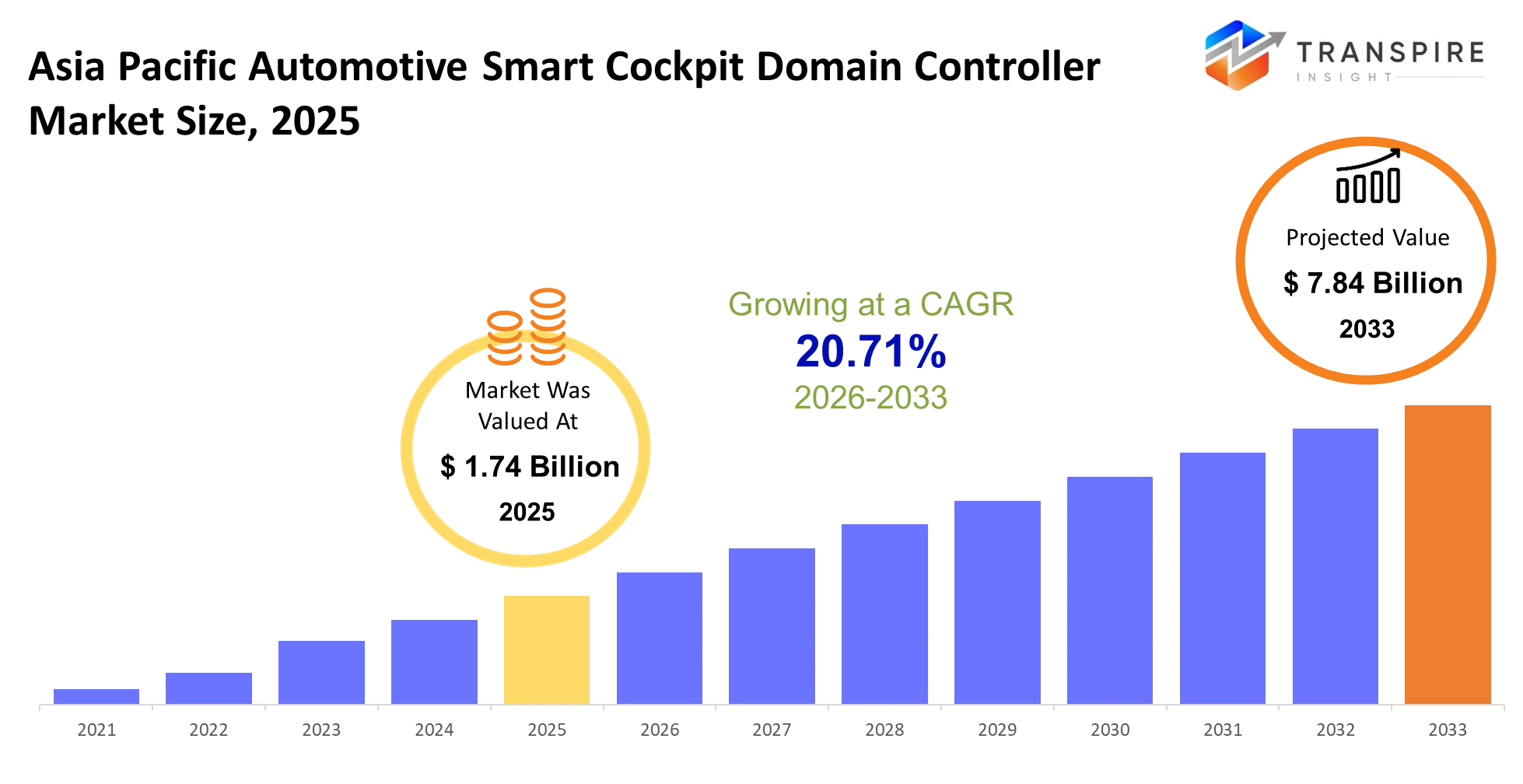
- Asia Pacific Automotive Smart Cockpit Domain Controller Market Size 2025: USD 1.74 Billion
- Asia Pacific Automotive Smart Cockpit Domain Controller Market Size 2033: USD 7.84 Billion
- Asia Pacific Automotive Smart Cockpit Domain Controller Market CAGR: 20.71%
- Asia Pacific Automotive Smart Cockpit Domain Controller Market Segments: By Type (Centralized Controllers, Distributed Controllers, Others); By Application (Infotainment Systems, Instrument Clusters, ADAS Integration, Connectivity Solutions, Others); By End-User (Automakers, Tier 1 Suppliers, Electronics Firms, Others); By Technology (AI-based Systems, Embedded Systems, High-performance Computing, Others).
To learn more about this report,  Download Free Sample Report
Asia Pacific Automotive Smart Cockpit Domain Controller Market Summary
The Asia Pacific Automotive Smart Cockpit Domain Controller Market was valued at USD 1.74 Billion in 2025. It is forecast to reach USD 7.84 Billion by 2033. That is a CAGR of 20.71% over the period.
The Asia Pacific market for automotive smart cockpit domain controllers focuses on creating a unified platform that delivers high-performance capabilities to handle multiple in-vehicle computing tasks including infotainment and digital instrument clusters and advanced driver interfaces and connectivity and human-machine interaction functions. The controllers function by solving the increasing complexity challenges that modern vehicle electronics present through their ability to unify all electronic control units into one system architecture that decreases both production costs and material requirements and operational delays.
The market experienced a fundamental change during the last five years as it shifted from using distributed electronic systems to adopting zonal and centralized computing architectures which followed the industry transition towards software-defined vehicles. The transition accelerated because the global chip shortage created semiconductor supply disruptions which demonstrated the problems with using numerous different components and pushed original equipment manufacturers to build simpler electronic systems. The demand for integrated cockpit computing platforms has increased among regional automakers in China and Japan and South Korea because premium electric vehicle production requires centralized controllers that provide faster software updates and better digital experiences and lower development costs for vehicle differentiation and ongoing software revenue generation.
Key Market Insights
- China controls the Asia Pacific Automotive Smart Cockpit Domain Controller Market because it will have almost 48% market share in 2025 through its aggressive expansion of electric vehicle production.
- Japan maintains a major market presence because its automotive electronics research and development capabilities and their original equipment manufacturers' investments in future cockpit system technologies.
- The Indian market will experience its fastest growth until 2030 because people are adopting connected vehicles and the country develops its automotive software engineering capacity.
- The hardware-integrated cockpit domain controllers will dominate the industry because they will achieve approximately 57% market share through their widespread adoption by original equipment manufacturers in 2025.
- The second-largest market sector consists of middleware and embedded operating software because vehicle software systems are becoming more complex.
- The segment which utilizes AI-powered cockpit processing platforms will experience its highest growth rate between 2026 and 2030 because automotive manufacturers concentrate their efforts on developing predictive in-cabin intelligence systems.
- The passenger vehicle segment leads the market with approximately 72% market share because it offers high-quality infotainment systems and integrated digital dashboard features.
- The demand for electric vehicle cockpit systems shows the most rapid growth because companies develop unique digital user experience methods.
- The OEM manufacturers control more than 68% of the Asia Pacific Automotive Smart Cockpit Domain Controller Market because they connect their products directly to existing architectural systems.
- Tier-1 suppliers create new market opportunities through their software-hardware co-development partnerships which they establish with strategic partners.
What are the Key Drivers, Restraints, and Opportunities in the Asia Pacific Automotive Smart Cockpit Domain Controller Market?
The primary factor driving the Asia Pacific Automotive Smart Cockpit Domain Controller Market expansion happens because automakers require unified computing systems to replace their current divided electronic control setups. The transition towards electric vehicle technology accelerated when Chinese and Japanese and South Korean electric vehicle makers started using advanced processors which provided their infotainment and digital cluster and driver interface systems with centralized control. The direct commercial impact is significant because centralized cockpit architectures reduce hardware complexity, which shortens development cycles, and enables recurring software monetization through over-the-air feature upgrades. This approach generates additional revenue per vehicle throughout its operational lifespan.
The most significant structural barrier remains semiconductor dependency and advanced chip integration complexity. Smart cockpit domain controllers require high-end automotive-grade processors, memory modules, and thermal management systems that depend on specialized fabrication capacity concentrated among a limited number of suppliers. The semiconductor manufacturing industry needs multiple years of both capital investments and qualification procedures before completing its foundry expansion projects. The result is delayed vehicle production schedules, higher component costs, and postponed smart cockpit deployments which suppress revenue realization across regional OEM programs.
India's developing automotive software and electronics ecosystem present major business expansion opportunities for companies. The government-backed semiconductor manufacturing initiatives together with growing investments in connected mobility platforms have established optimal conditions for developing cockpit controllers within the country. The partnership between regional original equipment manufacturers and software engineering companies to develop artificial intelligence-based in-cabin systems will position India as a key center for developing advanced cockpit technologies.
What Has the Impact of Artificial Intelligence Been on the Asia Pacific Automotive Smart Cockpit Domain Controller Market?
AI and advanced digital technologies are transforming cockpit domain controller development across Asia Pacific because they enable vehicles to handle in-cabin functions through new methods of processing and monitoring and optimization. AI-powered controllers now manage workload distribution for infotainment and digital instrument clusters and voice assistants and driver monitoring systems through automatic system processing which adapts to real-time driving conditions and user behavior. The automation system enhances operational efficiency because it maintains system performance at higher speeds while minimizing delays during operation of multiple cockpit displays.
Machine learning models are also strengthening predictive capabilities. Automakers are integrating algorithms that analyze driver behavior, cabin sensor data, processor thermal performance, and software usage patterns to predict component stress, optimize processor efficiency, and identify potential system failures before they disrupt vehicle operation. Predictive diagnostics enable organizations to decrease unplanned electronic device breakdowns while increasing controller operational lifespan and decreasing frequency of maintenance activities. In premium electric vehicles, intelligent energy optimization within cockpit systems has shown measurable reductions in auxiliary power consumption which leads to enhanced battery efficiency and longer driving distance.
The technologies enable organizations to perform quicker software updates through over-the-air transmission while their cybersecurity systems become more effective and they achieve better compliance with new vehicle safety regulations. The main constraint for businesses exists because they must pay expensive fees to implement AI-compatible semiconductor systems and to develop machine learning algorithms using local driving patterns and driving behavior data. The automotive market faces this problem because its validation systems for software and its collection of connected vehicle data still need to develop.
Key Market Trends
- Chinese automakers which include BYD and NIO have increased their use of centralized cockpit computing systems for their premium electric vehicle launches since 2022.
- The semiconductor shortages which delayed production throughout 2021 forced original equipment manufacturers to merge up to 40 percent of cockpit functions into fewer controllers which they planned to achieve by 2025.
- Since 2023 purchasers have started choosing vehicles that provide AI voice assistants together with multi-screen dashboard systems which has impacted cockpit platform design requirements throughout Asia Pacific.
- Japanese suppliers established software-hardware platform partnerships with Qualcomm and NVIDIA to replace their previous standalone ECU production methods which began after 2022.
- The ability to perform over-the-air software updates transformed from a special feature that distinguished products in 2020 into a common feature that new electric vehicle cockpit systems now must include.
- The regulatory body increased its focus on driver monitoring systems after 2023 which led manufacturers to include vision-processing features in their centralized cockpit control systems.
- South Korean original equipment manufacturers raised their spending on AI-driven in-cabin customization systems by almost 30 percent from 2022 until 2025 because they wanted to boost customer loyalty.
- The Tier-1 supplier companies Bosch and Continental AG now use modular domain controller systems to achieve quicker product adaptation for different regional markets.
- India established a fully developed connected mobility ecosystem after 2024 which created a need for local cockpit software development that relied on domestic resources instead of using foreign middleware solutions.
Asia Pacific Automotive Smart Cockpit Domain Controller Market Segmentation
By Type :
Centralized vehicle controllers operate multiple functions through one processing unit which enables automotive smart cockpit systems to process data together while using less hardware. This structure will improve coordination between digital cockpit functions and overall system performance, supporting smoother in-vehicle experiences.
Distributed controllers separate processing across different units, which results in better operational flexibility and system redundancy. This configuration enables vehicles to operate their functions independently while enhancing vehicle fault detection and management capabilities. Hybrid systems utilize both centralized and distributed methods to deliver different performance levels which can be adjusted to meet specific automotive needs.
By Application :
Smart cockpits use infotainment systems to deliver multimedia content and navigation services while enabling user interface operations which enhance both driver and passenger experiences. Instrument clusters present vehicle data through digital displays which show speed and fuel level information together with alert signals to enable drivers to monitor their vehicles in real time. ADAS systems use real-time processing to implement safety functions which include lane assistance and collision alerts.
Vehicle connectivity solutions enable communication between all vehicle elements while providing access to cloud services that allow ongoing data transmission and system updates. The system includes applications for controlling comfort, for using voice commands, and for creating personalized cockpit designs which enhance the usability of in-vehicle features.
To learn more about this report, Download Free Sample Report
By End-User :
Automakers use smart cockpit domain controllers for their vehicle platforms because these controllers enhance digital experiences and safety features and operational efficiency across multiple vehicle models. The present development work concentrates on creating advanced cockpit designs which meet both current vehicle requirements and user needs.
Cockpit systems receive advanced hardware and software solutions from Tier 1 suppliers who serve as primary market providers. Electronics firms supply semiconductor components and sensors and computing modules which enhance system performance. Technology developers and system integrators who work on specialized automotive computing solutions and cockpit innovation development represent one group of end-users.
By Technology :
Smart cockpit systems use AI-based technology to enhance their functions through voice recognition and predictive analysis and adaptive user interfaces which create better user experiences and driving support systems. The systems will enable vehicles to make better decisions for their operational environment.
Embedded systems provide stable computing architecture which enables real-time processing and dependable performance to support essential vehicle functions within automotive cockpit systems. High-performance computing enables quick data processing which supports advanced applications that include autonomous functions and high-resolution displays and integrated vehicle control systems.
What are the Key Use Cases Driving the Asia Pacific Automotive Smart Cockpit Domain Controller Market?
The primary application of smart cockpit domain controllers throughout the Asia Pacific region involves their use in passenger vehicles which are especially found in premium electric and hybrid models. Automakers prioritize this application because centralized cockpit computing supports seamless integration of digital clusters, infotainment systems, navigation, and driver assistance interfaces while lowering wiring complexity and development costs.
The adoption of secondary systems has reached its peak among mid-range passenger cars and between commercial fleet vehicles. Regional ride-hailing operators and logistics fleet owners are increasingly adopting these platforms to support real-time navigation, connected telematics, and driver monitoring systems that improve operational visibility and vehicle utilization.
New applications are developing through autonomous mobility pilots and next-generation shared transportation platforms. The development of robotaxi systems in China and the advanced mobility programs in Japan are field testing AI-powered cockpit controllers which operate interactive human-machine systems along with customizable cabin environments and adjustable display systems that are made for fully automated driving situations.
|
Report Metrics |
Details |
|
Market size value in 2025 |
USD 1.74 Billion |
|
Market size value in 2026 |
USD 2.1 Billion |
|
Revenue forecast in 2033 |
USD 7.84 Billion |
|
Growth rate |
CAGR of 20.71% from 2026 to 2033 |
|
Base year |
2025 |
|
Historical data |
2021 - 2024 |
|
Forecast period |
2026 - 2033 |
|
Report coverage |
Revenue forecast, competitive landscape, growth factors, and trends |
|
Regional scope |
Asia Pacific (China, India, Japan, South Korea, Australia, Rest of Asia Pacific) |
|
Key company profiled |
Bosch, Continental, Denso, Visteon, Harman, Panasonic, LG Electronics, Samsung, Aptiv, Valeo, Nvidia, Qualcomm, Intel, Renesas, NXP. |
|
Customization scope |
Free report customization (country, regional & segment scope). Avail customized purchase options to meet your exact research needs. |
|
Report Segmentation |
By Type (Centralized Controllers, Distributed Controllers, Others); By Application (Infotainment Systems, Instrument Clusters, ADAS Integration, Connectivity Solutions, Others); By End-User (Automakers, Tier 1 Suppliers, Electronics Firms, Others); By Technology (AI-based Systems, Embedded Systems, High-performance Computing, Others). |
Which Regions are Driving the Asia Pacific Automotive Smart Cockpit Domain Controller Market Growth?
The electric vehicle production capacity of China combined with its strong industrial policies for intelligent connected vehicles establishes China as the dominant force in the Asia Pacific automotive smart cockpit domain controller market. The implementation of national and provincial incentives has prompted automakers to speed up their software-defined vehicle development work which leads to high demand for centralized cockpit computing systems. The region benefits from an integrated semiconductor manufacturing network that produces display technology and automotive electronics components which enables shorter supply chains and lower deployment expenses. The ongoing partnership between domestic EV manufacturers and chip developers and software platform providers strengthens China's position as the leading market player.
Japan serves as the second largest regional contributor but its industrial power stems from its engineering accuracy and ability to maintain stable platforms over extended periods. Japanese automakers concentrate on implementing cockpit domain controllers into their existing vehicle frameworks whereas China develops vehicle innovation through its rapid innovation cycles. The approach receives backing from ongoing research and development funding together with established automotive electronics standards and strong ties to Tier-1 component suppliers who operate internationally. Japan maintains structural advantages which establish itself as a reliable market revenue generator that develops technological progress.
The connected vehicle market in India is growing at the fastest pace among regional markets because of rising connected vehicle adoption and expanding automotive digitalization initiatives. Recent investments in semiconductor manufacturing and vehicle software development and smart mobility infrastructure have created a better environment for deploying cockpit controllers. Domestic automakers are increasingly introducing feature-rich digital cockpits to meet changing consumer expectations in the mid-range vehicle segment. The current market momentum provides entry companies and investors with important chances to form partnerships and develop localized software and achieve initial business growth until 2033.
Who are the Key Players in the Asia Pacific Automotive Smart Cockpit Domain Controller Market and How Do They Compete?
The Asia Pacific automotive smart cockpit domain controller market shows moderate consolidation because established semiconductor companies and automotive electronics manufacturers control most valuable design contracts. The market situation becomes more dynamic because regional technology companies and electric vehicle startups introduce fast software development capabilities which create competition for traditional industrial suppliers. The main competitive factor has shifted from hardware cost effectiveness to computing power and artificial intelligence processing strength and software compatibility and over-the-air update system support. Existing companies expand their market presence by strengthening original equipment manufacturer partnerships while new companies succeed by providing adaptable platform development options.
The company Qualcomm uses its advanced cockpit processors which contain artificial intelligence and connectivity capabilities on one system to provide automotive manufacturers with simpler design processes. The company's Snapdragon Cockpit platforms achieved significant market success through partnerships with Chinese electric vehicle manufacturers who wanted to implement new features more quickly. NVIDIA establishes its market position through GPU-based cockpit computing systems which provide high-end digital cockpit systems and self-driving vehicle frameworks with advanced visualization functions.
Bosch develops complete hardware and software systems which meet the needs of original equipment manufacturers transitioning to centralized computing. The company possesses deep automotive validation skills which it uses to maintain strong partnerships with Japanese and South Korean automotive manufacturers. Huawei expands its business through smart vehicle software partnerships with Chinese car manufacturers while using its HarmonyOS platform to develop integrated cockpit systems which function across multiple devices. Continental AG develops modular domain controller systems which enable automotive manufacturers to customize their products according to specific regional requirements thus providing faster market entry for different vehicle types.
Company List
- Bosch
- Continental
- Denso
- Visteon
- Harman
- Panasonic
- LG Electronics
- Samsung
- Aptiv
- Valeo
- Nvidia
- Qualcomm
- Intel
- Renesas
- NXP
Recent Development News
In April 2026, Neusoft Smart Go entered a strategic partnership with Tencent Cloud to co-develop AI-powered intelligent cockpit solutions. The collaboration focuses on integrating on-device AI large models, in-vehicle cybersecurity, and cloud services to enhance cockpit interactivity and ecosystem connectivity in next-generation smart vehicles.
Source: https://www.prnewswire.com/
In April 2026, Bosch reported that its smart cockpit solution—built on Qualcomm Snapdragon platforms—surpassed 10 million cumulative global deliveries, reflecting large-scale commercialization across connected vehicle programs. The milestone highlights accelerating OEM adoption of centralized cockpit domain controller architectures in software-defined vehicles.
Source: https://autonews.gasgoo.com/
What Strategic Insights Define the Future of the Asia Pacific Automotive Smart Cockpit Domain Controller Market?
The Asia Pacific automotive smart cockpit domain controller market will develop its complete vehicle computing system during the coming five to seven years which will combine all cockpit functions with driver assistance systems through a single unified system. The current path leads to software-defined vehicles which require software updates and digital services for their long-term operational value instead of relying on hardware sales. The need for platform standardization will become essential when automotive manufacturers look for computing systems that can grow with their operations.
The automotive semiconductor market displays a hidden danger because it relies on only a small number of advanced semiconductor manufacturers. When processor roadmaps rely on specific global vendors for their development, automotive manufacturers will experience pricing problems and reduced ability to innovate and they will also face supply chain problems during times of geopolitical conflict. The development of edge AI-powered contextual cockpit systems in India and Southeast Asia creates a new opportunity for businesses as connected vehicle systems continue to progress.
Market participants should invest now in open, modular software architectures that allow rapid integration across multiple chipsets. This approach will help companies to depend less on suppliers while they adopt new technologies and it will enable businesses to gain upcoming software-based revenue streams.
Asia Pacific Automotive Smart Cockpit Domain Controller Market Report Segmentation
By Type
- Centralized Controllers
- Distributed Controllers
By Application
- Infotainment Systems
- Instrument Clusters
- ADAS Integration
- Connectivity Solutions
By End-User
- Automakers
- Tier 1 Suppliers
- Electronics Firms
By Technology
- AI-based Systems
- Embedded Systems
- High-performance Computing
Frequently Asked Questions
Find quick answers to common questions.
The Asia Pacific Automotive Smart Cockpit Domain Controller Market size is USD 7.84 Billion in 2033.
Key segments for the Asia Pacific Automotive Smart Cockpit Domain Controller Market are By Type (Centralized Controllers, Distributed Controllers, Others); By Application (Infotainment Systems, Instrument Clusters, ADAS Integration, Connectivity Solutions, Others); By End-User (Automakers, Tier 1 Suppliers, Electronics Firms, Others); By Technology (AI-based Systems, Embedded Systems, High-performance Computing, Others).
Major Asia Pacific Automotive Smart Cockpit Domain Controller Market players are Bosch, Continental, Denso, Visteon, Harman, Panasonic, LG Electronics, Samsung, Aptiv, Valeo, Nvidia, Qualcomm, Intel, Renesas, NXP.
The Asia Pacific Automotive Smart Cockpit Domain Controller Market size is USD 1.74 Billion in 2025.
The Asia Pacific Automotive Smart Cockpit Domain Controller Market CAGR is 20.71% from 2026 to 2033.
- Bosch
- Continental
- Denso
- Visteon
- Harman
- Panasonic
- LG Electronics
- Samsung
- Aptiv
- Valeo
- Nvidia
- Qualcomm
- Intel
- Renesas
- NXP
Recently Published Reports
-
Apr 2026
ATV & UTV Market
ATV & UTV Market Size, Share & Analysis Report By Type (ATV, and UTV), By Variants (Less Than 400 CC, 400 CC To 800 CC, and More Than 800 CC), and Geography (North America, Europe, Asia-Pacific, Middle East and Africa, South and Central America), 2021 - 2031
-
Apr 2026
Automotive Central Gateway Module Market
Automotive Central Gateway Module Market Size, Share & Analysis Report By Type (Ethernet Central Gateway Module, CAN Central Gateway Module, LIN Central Gateway Module, and FlexRay), By Application (Powertrain Control, Body Control, Infotainment System, Advanced Driver Assistance Systems (ADAS), and Others), By End User (Passenger Vehicles, and Commercial Vehicles), and Geography (North America, Europe, Asia-Pacific, Middle East and Africa, South and Central America), 2021 - 2031
-
Apr 2026
Automotive Engine Oil Filter Market
Automotive Engine Oil Filter Market Size, Share & Analysis Report By Filter Type (Fuel Filter, Engine Oil Filter, Hydraulic Oil Filter, and Others), By Filter Media (Cellulose, Synthetic, and Micro), By Sales Channel (OEMs, and Aftermarket), By Vehicle Type (Passenger Cars, Light Commercial Vehicles, Heavy Duty Trucks, Buses and Coaches, and Off-road Vehicles), and Geography (North America, Europe, Asia-Pacific, Middle East and Africa, South and Central America), 2021 - 2031
-
Apr 2026
Automotive Parts Aluminium Die Casting Market
Automotive Parts Aluminium Die Casting Market Size, Share & Analysis Report By Production Process (Pressure Die Casting, Vacuum Die Casting, Squeeze Die Casting, Gravity Die Casting), By Application (Body Parts, Engine Parts, Transmission Parts, Battery And Related Components, Other Application Types), and Geography (North America, Europe, Asia-Pacific, Middle East and Africa, South and Central America), 2021 - 2031
Our Clients