
Asia Pacific Consumer Electronics Market Size & Forecast:
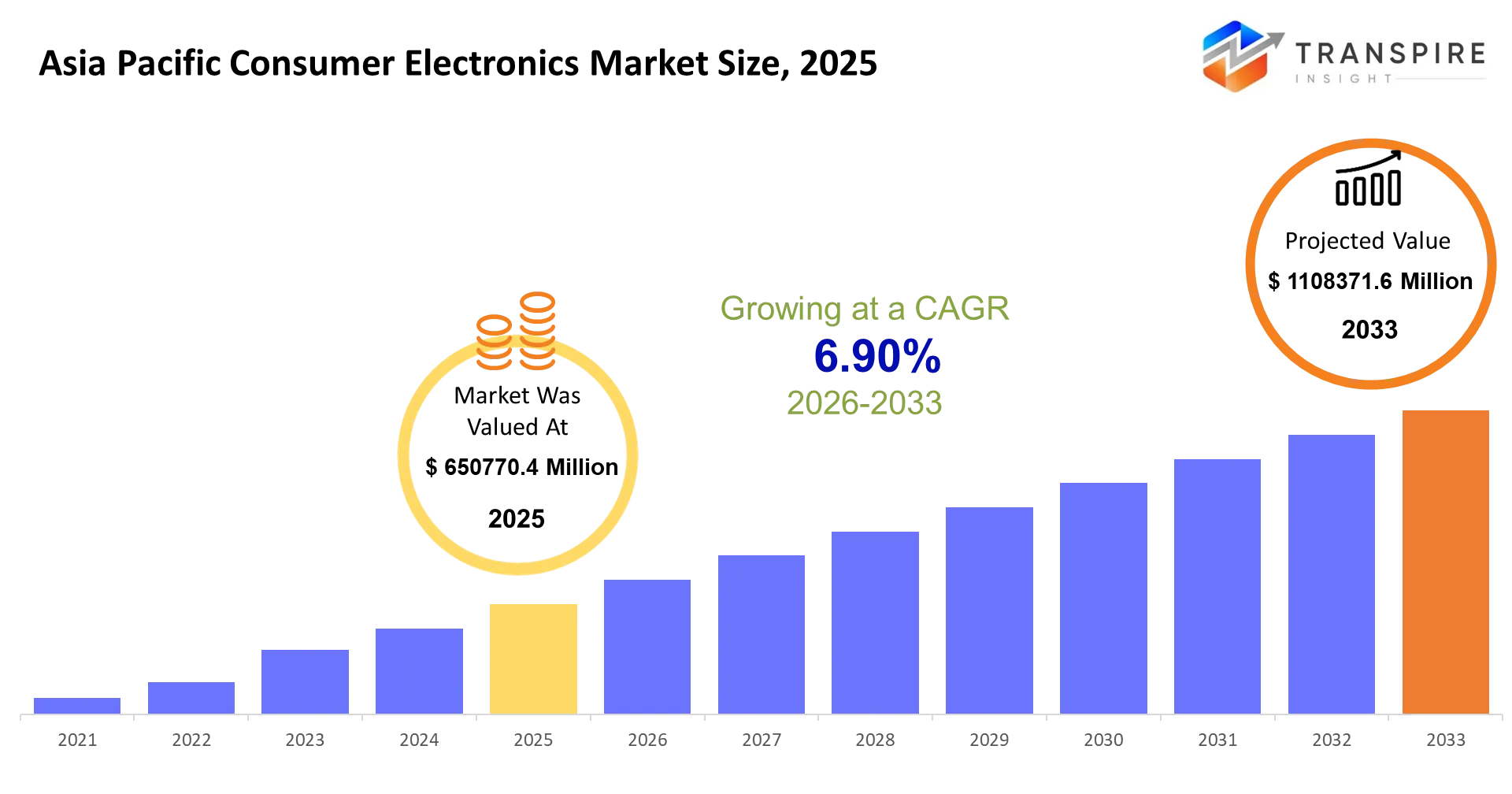
- Asia Pacific Consumer Electronics Market Size 2025: USD 650770.4 Million
- Asia Pacific Consumer Electronics Market Size 2033: USD 1108371.6 Million
- Asia Pacific Consumer Electronics Market CAGR: 6.90%
- Asia Pacific Consumer Electronics Market Segments: By Type (Smartphones, TVs, Laptops, Wearables, Home Appliances, Others); By Application (Personal Use, Professional Use, Gaming, Entertainment, Smart Homes, Others); By End-User (Consumers, Enterprises, Gamers, Professionals, Households, Others); By Distribution (Online, Retail Stores, Brand Outlets, Others)
To learn more about this report,  Download Free Sample Report
Asia Pacific Consumer Electronics Market Summary
The Asia Pacific Consumer Electronics Market was valued at USD 650770.4 Million in 2025. It is forecast to reach USD 1108371.6 Million by 2033. That is a CAGR of 6.90% over the period.
The Asia Pacific consumer electronics market powers the devices that shape daily digital activity across homes, workplaces, and connected public spaces. The market provides solutions through its product range which includes smartphones, laptops, smart televisions, wearables, and home automation systems to meet the requirements of modern technology-oriented economies which demand quicker communication and mobile work capabilities and digital entertainment and uninterrupted connectivity. The organization functions as an essential connection between three key industry sectors which include semiconductor production and software development and retailing throughout the entire region.
The market has transformed during the last five years because it has shifted from basic hardware to advanced digital systems that incorporate connected devices and artificial intelligence technology. The deployment of 5G networks throughout China and South Korea and India has made it possible for users to access advanced device capabilities while using applications that require minimal delay. The supply chain issues which emerged during the pandemic period compelled manufacturers to establish multiple sourcing options while they built production facilities in different regions. Regional manufacturing networks now have better capacity to recover from disruptions while they produce products at a faster rate and introduce high-end items to the market which helps businesses achieve revenue growth from quicker product turnover and greater demand for premium products.
Key Market Insights
- China maintains control over the Asia Pacific Consumer Electronics Market through its 2026 market share which reaches almost 42% and its manufacturing capabilities and domestic technology usage.
- The Indian market experiences its most rapid growth until 2031 because of domestic electronics production incentives and the ongoing replacement of smartphones.
- South Korea preserves its market position because of its semiconductor-driven innovations and the high demand from urban consumers for premium devices.
- Smartphones dominate the Asia Pacific Consumer Electronics Market as they account for approximately 38% of revenue in 2026 through their ongoing flagship product releases.
- 4K and OLED technology adoption through middle-income households enables smart televisions to achieve their second-largest market share.
- The growth of wearable electronics shows its highest rate for the upcoming period until 2031 because health-monitoring systems combine with AI-based personalized services.
- The market research shows that personal communication and entertainment devices control approximately 47% of market share because consumers prefer to use complete digital ecosystems.
- Smart home automation has become the fastest expanding application because IoT infrastructure development improves throughout urban areas.
- The Asia Pacific Consumer Electronics Market experiences its highest demand from individual household consumers who account for more than 68% of total market demand because they frequently replace and upgrade their products.
- Enterprise and institutional users demonstrate their highest demand for both connected displays and workplace collaboration products.
What are the Key Drivers, Restraints, and Opportunities in the Asia Pacific Consumer Electronics Market?
The rapid development of 5G networks together with artificial intelligence (AI) functions in devices creates the most powerful market growth force for the Asia Pacific consumer electronics industry. Telecom companies have invested in building large-scale infrastructure throughout China, India, and South Korea to establish sufficient bandwidth for supporting real-time cloud gaming, edge computing, and intelligent connected devices. The technological shift has resulted in shorter product replacement periods because consumers now prefer premium smartphones and wearables and smart home systems over traditional devices. The direct revenue effect shows itself through increased average selling prices and higher sales of products that belong to the ecosystem.
The most significant structural barrier remains semiconductor supply concentration and component dependency on a limited number of advanced fabrication hubs. High-end chip production requires capital-intensive foundries, specialized engineering expertise, and multi-year infrastructure development. The current situation remains unsolvable because political conflicts and export restrictions keep interrupting supply routes. The market experiences financial losses through product delays which lead to limited stock and decreased price competitiveness which altogether decrease revenue from replacements.
Smart ecosystems will become the next major growth area for businesses which plan to operate throughout Southeast Asia, especially in Indonesia and Vietnam. The expansion of digital payment systems, the growth of middle-income people in urban areas, and businesses moving their operations to new locations will establish optimal conditions for affordable AI-integrated televisions and connected appliances and wearable devices to reach mainstream acceptance.
What Has the Impact of Artificial Intelligence Been on the Asia Pacific Consumer Electronics Market?
Artificial intelligence transforms consumer electronics manufacturing throughout Asia Pacific by utilizing automated systems for semiconductor inspection and assembly line calibration and quality control. Samsung Electronics and Xiaomi Corporation now use computer vision technology to detect tiny defects in their display panels and circuit boards which achieves higher accuracy than standard manual inspection methods. The process leads to decreased production mistakes and faster production times and enhanced product dependability.
Machine learning models enhance predictive accuracy for all internet-connected devices. Smart appliances and wearable platforms now analyze user behavior to forecast component stress, optimize battery management, and improve thermal efficiency. The implementation of predictive maintenance systems in smartphone manufacturing leads to a 20 to 30 percent decrease in equipment downtime because of unexpected failures, while AI-based power optimization solutions enhance battery life and decrease maintenance expenses.
The implementation of these technologies leads to operational gains which enhance production efficiency and decrease warranty claims while enabling faster delivery of high-quality products to the market. AI-based supply chain forecasting tools enable manufacturers to quickly adapt their operations according to changing regional customer needs.
The primary obstacle exists because organizations must spend significant resources to achieve complete system integration while their data remains distributed across multiple platforms. The mid-tier manufacturer sector lacks proper infrastructure which prevents them from developing precise AI models, because their production facilities use different data formats that hinder algorithm development and execution.
Key Market Trends
- The AI integration efforts of Samsung Electronics and Xiaomi Corporation have enabled their flagship smartphones to achieve over 30% adoption of on-device processing since 2022.
- Global electronics manufacturers reduced their reliance on Chinese assembly hubs by developing production facilities in India and Vietnam between 2021 and 2026.
The upgraded premium features of products have decreased replacement cycles in urban Asia from 36 months to 28 months. - After the 2021 5G rollout started in different areas, smart televisions together with connected home devices began using cloud software systems instead of relying on their basic hardware functions.
- The Asia Pacific region experienced a twofold increase in foldable smartphone shipments between 2023 and 2025 because durability improvements made displays more reliable for consumers.
- The semiconductor industry witnessed a rise in localized component sourcing by manufacturers who used the pandemic as an opportunity to identify vulnerabilities in their cross-border semiconductor logistics operations.
- Brands used software update longevity as a competitive advantage because they extended device support to five years which helped them maintain customer loyalty to their ecosystems.
- The mid-range device market now features AI imaging processors that match flagship performance standards because consumers today expect premium results from products that cost less than their previous price range.
- The partnership between Sony Group Corporation and local semiconductor companies created more intense collaboration after 2023, which enabled faster product development and better inventory management.
Asia Pacific Consumer Electronics Market Segmentation
By Type:
The Asia Pacific Consumer Electronics Market considers the smartphone segment to be essential because new products keep entering the market and manufacturers create faster processors and customers increasingly demand digital products that connect together. The urban market maintains steady sales through replacement cycles but better mid-range product prices enable more people in developing countries to access products.
The demand for televisions has shifted toward smart TVs and ultra-high-definition models because streaming services have become more popular. People continue to adopt laptops because they need them for remote work and education, while wearables gain popularity through their health-monitoring capabilities. Home appliances now use smart technologies that include automated operations and energy-saving capabilities, while the other category contains accessories and new connected devices which help to increase market variety.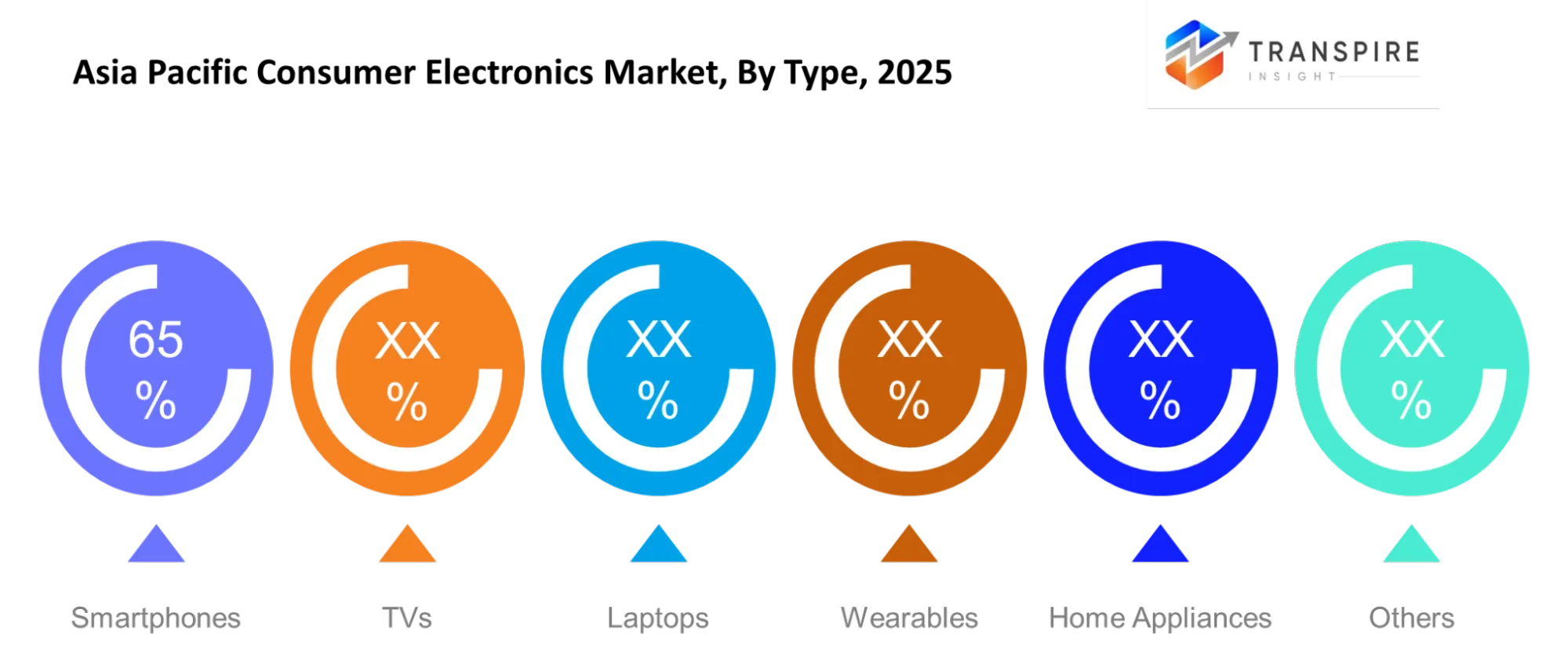
To learn more about this report, Download Free Sample Report
By Application:
Electronic devices have become essential for personal use because they enable people to communicate, learn, and enjoy entertainment during their daily activities. Growing internet access and rising use of digital platforms lead to higher dependence on consumer electronics which people need for their everyday activities. This pattern encourages consumers to buy new products and upgrade their existing devices across all categories.
Businesses are increasing their investment in digital tools which help to improve productivity and operational efficiency through their professional use. The development of gaming as a leading application area results from enhanced processor capabilities and the increasing number of esports fans. People want entertainment through streaming services and immersive content, while smart home applications are growing in popularity because connected systems now offer better installation and household integration.
By End-User:
The Asia Pacific Consumer Electronics Market sees its largest consumer group through consumers who have increased disposable income and altered their buying habits. Consumers show increased buying activity because they understand advanced product features and can access products through financing options and because multiple brands compete with one another in both premium and budget product segments.
Organizations make ongoing investments into modern equipment systems which help them achieve better results through improved workplace efficiency and effective communication technologies. The gamer market is expanding rapidly because more people join online gaming communities and seek advanced gaming equipment. People who work in offices need to use effective tools for their work tasks while people in homes use various smart devices to gain protection and better control of their home spaces.
By Distribution:
The online distribution channel has grown quickly because it provides customers with easy access to affordable products and extensive product options. E-commerce platforms enable customers to compare products easily through customer reviews and promotional discounts which lead to increased online shopping in both large cities and small towns throughout Asia Pacific.
Retail stores remain vital because they allow customers to test products physically which helps them decide whether to buy expensive electronic items. Brand outlets draw customers through exclusive product launches which provide direct service and show products more effectively. The current distribution system enables manufacturers to reach more customers while they adapt to changes in how consumers buy products through digital platforms and physical stores.
What are the Key Use Cases Driving the Asia Pacific Consumer Electronics Market?
The Asia Pacific consumer electronics market focuses mainly on personal mobile connectivity which uses smartphones as the main device for accessing communication and digital payment methods and entertainment streaming and productivity applications. Urban consumers require their single device to maintain work functions and commercial activities and social interactions as they navigate rapid digital system changes which create the greatest demand for this product category.
The use of connected home entertainment systems and enterprise collaboration tools enables expansion of adjacent applications. High-speed broadband access drives residential markets to adopt smart televisions and integrated audio systems while commercial displays and hybrid workplace devices receive wider adoption across corporate offices and educational institutions and coworking spaces.
The field of emerging applications includes AI-powered wearable health monitoring and connected household automation systems. Health-conscious consumers are starting to adopt smart rings and advanced fitness trackers and predictive wellness devices. The development of 5G networks in regional areas together with the widespread adoption of software interoperability standards enables voice-controlled appliances to operate within home ecosystems which work together.
|
Report Metrics |
Details |
|
Market size value in 2025 |
USD 650770.4 Million |
|
Market size value in 2026 |
USD 694995.2 Million |
|
Revenue forecast in 2033 |
USD 1108371.6 Million |
|
Growth rate |
CAGR of 6.90% from 2026 to 2033 |
|
Base year |
2025 |
|
Historical data |
2021 - 2024 |
|
Forecast period |
2026 - 2033 |
|
Report coverage |
Revenue forecast, competitive landscape, growth factors, and trends |
|
Regional scope |
Asia Pacific (China, India, Japan, South Korea, Australia, Rest of Asia Pacific) |
|
Key company profiled |
Apple, Samsung, Sony, LG, Panasonic, Xiaomi, Huawei, Dell, HP, Lenovo, Philips, Bosch, Whirlpool, Haier, Sharp |
|
Customization scope |
Free report customization (country, regional & segment scope). Avail customized purchase options to meet your exact research needs. |
|
Report Segmentation |
By Type (Smartphones, TVs, Laptops, Wearables, Home Appliances, Others); By Application (Personal Use, Professional Use, Gaming, Entertainment, Smart Homes, Others); By End-User (Consumers, Enterprises, Gamers, Professionals, Households, Others); By Distribution (Online, Retail Stores, Brand Outlets, Others) |
Which Regions are Driving the Asia Pacific Consumer Electronics Market Growth?
China holds the top position in the Asia Pacific consumer electronics market because its production capabilities exceed all competitors and its government-supported industrial policies and semiconductor ecosystem advanced development capabilities. The national electronics self-sufficiency programs together with the extensive component sourcing networks enable both domestic and international companies to expand their production operations. The region uses its comprehensive logistics network to achieve fast distribution of products between its domestic territories and its global shipping paths. The company holds the top market position through its complete business system, which includes chip production and manufacturing contracts and software creation and product delivery through retail channels.
Japan stands as the second most significant regional force, but its power exists through its ability to maintain consistent technological development instead of its manufacturing capacity. Japan’s system operates through precision engineering and premium product development and established consumer trust in its electronics brands, while China depends on volume-based production methods. The combination of stable household purchasing power and consistent corporate investment patterns enables organizations to maintain operational strength during periods of regional supply chain interruptions. The revenue base established through this mechanism secures reliable income streams for high-value consumer electronics, which include imaging devices and premium home entertainment systems and advanced component technologies.
India has become the fastest-growing market because of its strong electronics manufacturing incentives and its fast development of digital infrastructure. The Production Linked Incentive scheme together with the improved 5G deployment and increasing disposable income in urban areas has transformed regional development patterns during the last three years. Multinational manufacturers are increasing assembly investments to diversify supply chains and capture local consumption growth. The current momentum of the market creates an important chance for new market players and investors to build their manufacturing plants and distribution facilities and software integration operations throughout the period from 2026 to 2033.
Who are the Key Players in the Asia Pacific Consumer Electronics Market and How Do They Compete?
The Asia Pacific consumer electronics market currently faces intense rivalry which has reached a point of moderate industry consolidation because international brands dominate high-end market sales while domestic firms compete for customers in the middle and lower budget segments. Companies now compete through a combination of ecosystem integration and software optimization and product innovation speed which has replaced their previous focus on hardware pricing. The existing market players protect their existing market territory through increased control over their production processes and development of proprietary chips, while new market players create market disruption with their affordable products which offer multiple advanced features. Companies which operate production facilities in multiple locations have developed better protection against supply chain interruptions and changes in trade regulations.
Through its ability to control all aspects of production Samsung Electronics creates special products which enable the company to accelerate its product development process while protecting its profit margins. The company intends to expand its operations by developing new foldable products and AI-based home automation systems. Apple Inc. establishes its competitive position through the development of unified hardware and software systems which enable users to switch between devices without difficulty, thereby maintaining customer loyalty. The company expands its production operations to India which helps it achieve greater flexibility in its supply chain while providing access to the growing Indian market.
Xiaomi Corporation uses its high-value product pricing strategy together with its quick software updates to attract younger customers in emerging Asia Pacific markets. The company uses its network of connected smart home devices to create stronger customer engagement with its products. Sony Group Corporation uses its advanced imaging systems together with its entertainment hardware links to create unique product offerings, while its semiconductor partnerships enable the company to develop cutting-edge consumer technologies.
Company List
Recent Development News
"In March 2026, Sony Corporation formed a strategic partnership with TCL Electronics. The two companies established a joint venture through their signed definitive agreements which will operate Sony's worldwide home entertainment business by combining Sony's high-end television and audio product design expertise with TCL's production capabilities to strengthen their market position in the Asia Pacific television and smart home entertainment business. Source https://www.sony.co.jp/en/
In May 2025, Xiaomi launched mass production of its self-developed Xring O1 mobile chip. The chip’s deployment in flagship smartphones and tablets marked a major vertical integration milestone, strengthening Asia Pacific semiconductor self-reliance and increasing competitive pressure on regional consumer electronics manufacturers dependent on third-party processors. Source https://www.reuters.com/
What Strategic Insights Define the Future of the Asia Pacific Consumer Electronics Market?
The Asia Pacific consumer electronics market will develop AI-native software-defined device ecosystems that use hardware as the basic infrastructure for delivering subscription-based digital services during the upcoming five to seven years. The basic reason for this change occurs because edge AI processing and 5G infrastructure and consumer preference for interconnected multi-device experiences reach a state of maturity. The companies that succeed in creating a complete ecosystem through the combination of semiconductors and software platforms and cloud-based personalized services will achieve better results than their rivals who focus only on their hardware specifications.
The semiconductor industry currently faces a hidden danger because it relies too much on advanced semiconductor nodes that come from a small number of suppliers. The region will experience product cycle restrictions and a decline in premium device profitability because export control policies and fabrication capacity outages will affect operational capacity.
Affordable AI-enabled devices developed for secondary urban markets in India and Indonesia who experience rapid digital infrastructure development create a new market opportunity. The market participants need to develop regional manufacturing alliances and software ecosystems for specific areas because their competitive advantage will depend on their ability to adapt to specific regions instead of relying on global operations.
Asia Pacific Consumer Electronics Market Report Segmentation
By Type
- Smartphones
- TVs
- Laptops
- Wearables
- Home Appliances
By Application
- Personal Use
- Professional Use
- Gaming
- Entertainment
- Smart Homes
By End-User
- Consumers
- Enterprises
- Gamers
- Professionals
- Households
By Distribution
- Online
- Retail Stores
- Brand Outlets
Frequently Asked Questions
Find quick answers to common questions.
The Asia Pacific Consumer Electronics Market size is USD 1108371.6 Million in 2033.
Key Segments for the Asia Pacific Consumer Electronics Market are By Type (Smartphones, TVs, Laptops, Wearables, Home Appliances, Others); By Application (Personal Use, Professional Use, Gaming, Entertainment, Smart Homes, Others); By End-User (Consumers, Enterprises, Gamers, Professionals, Households, Others); By Distribution (Online, Retail Stores, Brand Outlets, Others).
Major Asia Pacific Consumer Electronics Market players are Apple, Samsung, Sony, LG, Panasonic, Xiaomi, Huawei, Dell, HP, Lenovo, Philips, Bosch, Whirlpool, Haier, Sharp.
The Asia Pacific Consumer Electronics Market size is USD 650770.4 Million in 2025.
The current Asia Pacific Consumer Electronics Market CAGR is 6.90% from 2026 to 2033.
- Apple
- Samsung
- Sony
- LG
- Panasonic
- Xiaomi
- Huawei
- Dell
- HP
- Lenovo
- Philips
- Bosch
- Whirlpool
- Haier
- Sharp
Recently Published Reports
-
Apr 2026
Fiber Optic Faceplates Market
Fiber Optic Faceplates Market Size, Share & Analysis Report By Type (< 300 mm2, 300-350 mm2, and > 350 mm2, By Application (Night Vision, Holographic Imaging, Medical, and Others), and Geography (North America, Europe, Asia-Pacific, Middle East and Africa, South and Central America), 2021 - 2031
-
Apr 2026
High Temperature Superconductors Market
High Temperature Superconductors Market Size, Share & Analysis Report By Type (1G HTS, and 2G HTS), By Application (Power Cable, Fault Current Limiter, and Transformer), and Geography (North America, Europe, Asia-Pacific, Middle East and Africa, South and Central America), 2021 - 2031
-
Apr 2026
Industrial Plugs and Socket Market
Industrial Plugs and Socket Market Size, Share & Analysis Report By Type (Industrial Plugs, Industrial Sockets), By Current (Up to 32 A, 32 to 125 A, Above 125 A), By Protection (Dustproof and Splash Proof, Waterproof, Explosion Proof), By End User (Heavy Industries, Oil and Gas, Chemicals and Pharmaceuticals, Power Generation, Others), and Geography (North America, Europe, Asia-Pacific, Middle East and Africa, South and Central America), 2021 - 2031
-
Apr 2026
InGaAs Avalanche Photodiodes Market
InGaAs Avalanche Photodiodes Market Size, Share & Analysis Report By Type (1100 - 1700 nm, and 1000 - 1600 nm), By Application (Missile Warning System, Muzzle Flash Detection, Wafer Defect Inspection, Laser Rangefinders, and Others), and Geography (North America, Europe, Asia-Pacific, Middle East and Africa, South and Central America), 2021 - 2031