

Global Gaming Merchandise Market Size & Forecast
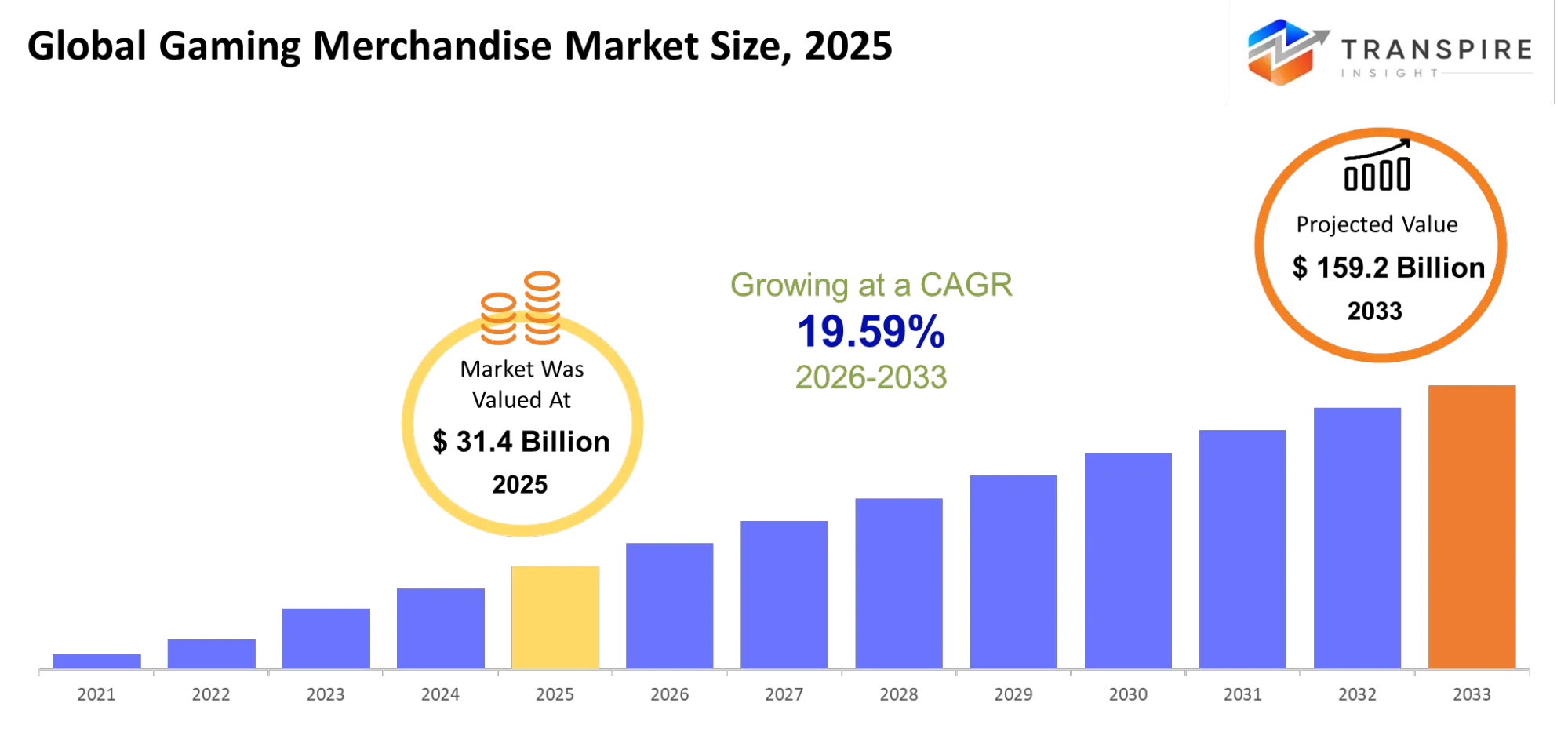
- Global Gaming Merchandise Market Size 2025: USD 31.4 Billion
- Global Gaming Merchandise Market Size 2033: USD 159.2 Billion
- Global Gaming Merchandise Market CAGR: 19.59%
- Global Gaming Merchandise Market Segments: By Product Type (Apparel, Collectibles, Accessories, Toys & Figurines), By Distribution Channel (Online Retail, Specialty Stores, Supermarkets & Hypermarkets), By End-User (Men, Women, Kids)
To learn more about this report,  Download Free Sample Report
Global Gaming Merchandise Market Summary
The global gaming merchandise market was valued at USD 31.4 billion in 2025 and is projected to reach USD 159.2 billion by 2033, growing at a CAGR of 19.59%. Gaming merchandise actually brings out the emotional investment that gamers put into virtual worlds in the form of physical products - from licensed clothing and limited-edition collectibles to branded accessories and character figurines. Its purpose is quite straightforward: it lets fans keep hold of their identity beyond the screen itself - while also giving publishers, studios, and hardware manufacturers a whole other source of income - one that doesn't even involve in-game monetization at all.
The structural change that really characterized the last four years or so was the transformation of gaming from a subculture into a mainstream form of entertainment. Esports viewership crossed 500 million annually, gaming-themed collaborations became a thing in luxury fashion, and platform holders started seeing merchandise as a much more important tool for building their brand - rather than just an afterthought. The real-world trigger that really sped this shift up was the pandemic: with live entertainment put on hold, gaming audiences really surged, and a whole generation that had previously spent money on concerts and sports events redirected their discretionary income towards gaming culture. That consumption habit actually stuck around post-pandemic - really expanding the addressable market for gaming merchandise well beyond the traditional core gamer demographic into casual players, collectors, and even gift-buyers.
Key Global Gaming Merchandise Market Insights
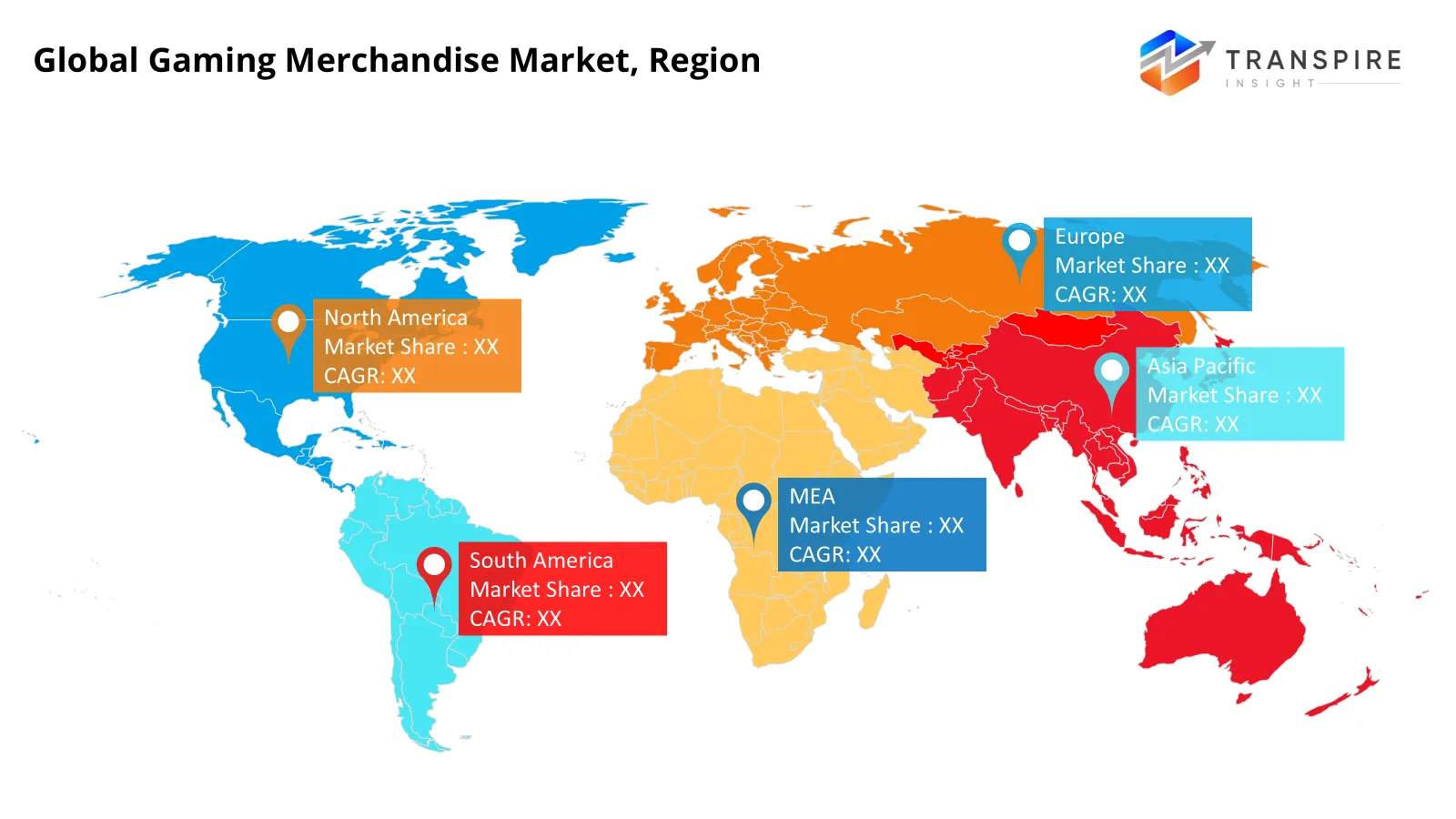
- North America dominates the gaming merchandise industry with the largest revenue share, accounting for approximately 38% in 2024, supported by a mature esports ecosystem, high per-capita gaming spend, and the strong licensing infrastructure of publishers such as Nintendo, Activision Blizzard, and Electronic Arts.
- Asia Pacific is the fastest-growing regional market, with China, Japan, and South Korea driving demand through dedicated gaming culture, robust anime-game crossover merchandise, and the expansion of platforms such as Bilibili Goods and Animate.
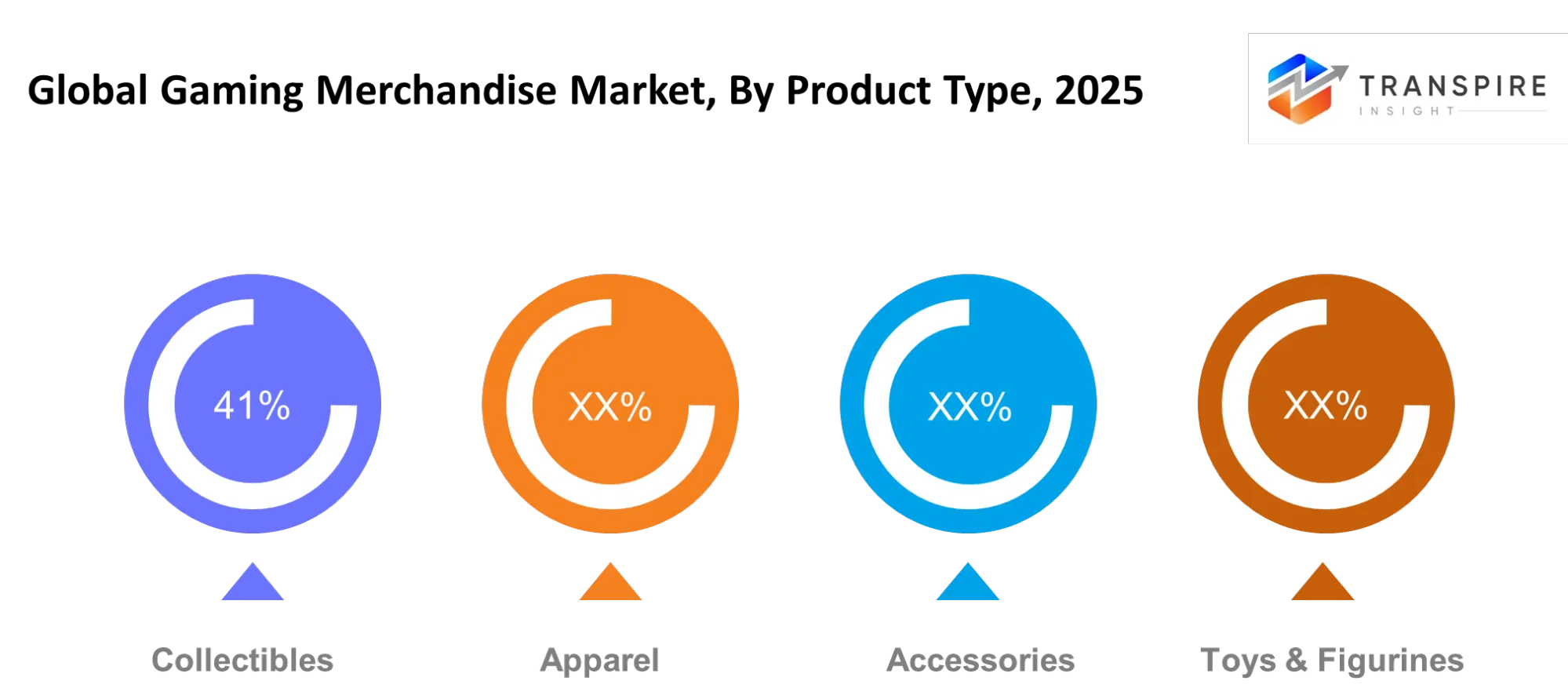
- Collectibles lead the product landscape in the gaming merchandise market, commanding an approximately 41% revenue share in 2024, driven by limited-edition figurines, premium statues, and franchise-specific items tied to franchises such as Pokémon, The Legend of Zelda, and Dark Souls.
- Apparel is the second-largest product segment, with licensed gaming T-shirts, hoodies, and streetwear collaborations expanding into mainstream retail channels including H&M, Uniqlo, and ZARA.
- Accessories represent the fastest-growing product segment, with branded peripherals, bags, and lifestyle accessories growing at above-market rates as gaming identity crosses into everyday consumer behavior.
- Online retail is the dominant distribution channel in the global gaming merchandise industry, accounting for over 55% of sales in 2024, driven by direct-to-consumer storefronts operated by publishers and third-party marketplaces including Amazon and Crunchyroll Store.
- Men represent the leading end-user segment with approximately 52% share in 2024, though female gamer merchandise consumption is growing at a faster rate, reflecting the expanding diversity of gaming audiences across franchises.
- Kids represent the fastest-growing end-user segment, fueled by Roblox, Minecraft, and Pokémon merchandise, with parents increasingly treating gaming IP as a legitimate category for toys, apparel, and gifts alongside traditional entertainment brands.
- Nintendo Co. Ltd. and Funko Inc. lead the competitive landscape, with Nintendo's official merchandise ecosystem spanning global flagship stores and pop-up shops, while Funko's Pop! vinyl figures have become the category-defining collectible format across gaming, film, and animation.
- Bandai Namco Holdings and Good Smile Company anchor the premium collectibles segment, leveraging Japanese manufacturing craftsmanship and anime-adjacent fanbases to command price premiums of 300–800% over mass-market equivalents.
What are the Key Drivers, Restraints, and Opportunities in the Global Gaming Merchandise Market?
The primary driving force behind the growth of the market is the structural maturity of gaming IPs into a recognized cultural asset class - similar to film and television franchises. When publishers such as Nintendo and Sony started thinking of merchandise not just as a royalty-licensing income source but as part of their brand infrastructure - setting up flagship retail stores, establishing quality standards, and releasing exclusive items around game launches - the market really responded. Revenue from officially licensed merchandise associated with major franchise releases is now generating quite a lot of pre-launch hype and post-launch engagement that actually prolongs a game's commercial lifespan. The direct result is that publishers have created a whole separate marketable group for each game title, one that operates quite independently of gameplay transactions and reaches consumers who may never buy the game itself.
The biggest structural limitation is the concentration of market value within a really tiny group of massive franchises. The top ten gaming IPs by merchandise revenue - Pokémon, Minecraft, Mario, Call of Duty, Fortnite, League of Legends, The Legend of Zelda, Dark Souls, FIFA, and Halo - collectively hold a significantly bigger share of licensed merchandise sales. Mid-tier studios with excellent game sales but limited franchise recognition really struggle to get sustained merchandise demand beyond a relatively short period around launch time. For distributors, this creates a portfolio concentration issue: way too much of our supply chain infrastructure is focused on serving franchise peaks rather than steady mid-catalog demand, making the economics of smaller licensing programs really tough to justify financially.
The clearest forward-looking opportunity is the combination of physical merchandise with digital authentication and limited-edition release mechanisms. A few publishers are now incorporating NFC chips and QR-linked digital content into physical collectibles, creating a whole new category that serves as both a product and a digital access key. Square Enix and Good Smile Company have even piloted this model with limited releases linked to in-game items. The potential addressable market for authenticated, digitally-linked physical gaming merchandise is still quite early stages, but the collector premium commanded by verifiably rare items - already quite apparent in trading card markets - suggests really significant revenue upside when this technology becomes widespread across major franchise releases.
What Has the Impact of Artificial Intelligence Been on the Global Gaming Merchandise Market?
Generative AI tools have very really shook up merchandise design and production workflows - allowing publishers and licensed manufacturers to cut their concept-to-prototype timelines from weeks to just days. Studios like Ubisoft and Electronic Arts use AI-assisted design platforms to create the first pieces of artwork for clothing and collectible packaging directly from the in-game asset libraries, reducing our reliance on outside design agencies for less high-priority SKUs. Demand forecasting algorithms trained on historical sales data, search trends, and social media engagement signals are being used by major online retailers and our direct-to-consumer storefronts to optimise inventory positioning right before franchise launch windows, reducing overstock on slow-moving items and improving our margin capture on highly demanded releases.
Machine learning is really changing how manufacturers spot collector demand patterns. Predictive models built on secondary market data — resale prices on StockX, eBay, and Mercari — can now signal which limited-edition releases will probably develop sustained secondary market premiums, informing both production volume decisions and special partnership negotiations. Funko Inc. and Jakks Pacific have publicly mentioned data analytics capabilities as part of their product selection process, though neither has actually disclosed the specific model architecture. Operational gains are quite measurable: several direct-to-consumer gaming merchandise platforms report 20-30% reductions in return rates after implementing AI-driven sizing recommendation tools for clothing.
The very real limitation of current AI adoption in this market is content authenticity risk. Fan communities place an extremely high value on design fidelity - a collectible that deviates from the canonical character design by even small details is rejected with very intense backlash. AI-generated product designs need quite a lot of human review before release to prevent the reputational damage that comes from a widely-shared comparison between a fan's expectation and a poorly-executed product. That review bottleneck currently prevents AI from fully automating any design stage beyond initial concept generation.
Key Market Trends
- Pokémon merchandise surpassed USD 15 billion in annual retail sales by 2023, establishing gaming IP as a larger consumer goods category than most traditional toy franchises.
- Nintendo's expansion of its Nintendo Store retail footprint between 2021 and 2024, including major openings in New York, London, and Tokyo, shifted the brand's merchandise model from pure third-party licensing toward direct retail control.
- Funko Inc. repositioned from a novelty collectible manufacturer toward a franchise-aligned entertainment merchandise partner, securing direct licensing agreements with major publishers rather than aggregating licenses through distributors.
- Esports team merchandise emerged as a distinct sub-category between 2020 and 2023, with teams such as Team Liquid, Cloud9, and T1 generating seven-figure merchandise revenues independent of game publisher licensing frameworks.
- Limited-edition collectible drops tied to game launches began commanding pre-order sell-outs within minutes by 2022, establishing scarcity mechanics as the primary value driver in the premium collectibles segment.
- Streetwear collaborations between gaming publishers and fashion brands — including Louis Vuitton x League of Legends and Uniqlo x Nintendo — moved gaming merchandise from specialty retail into department store and fashion retail channels by 2023.
- Chinese domestic gaming merchandise platforms including Bilibili Goods and NetEase's official stores expanded rapidly between 2021 and 2024, creating a parallel supply chain that operates largely independently of Western licensing and distribution networks.
- Second-hand and resale gaming merchandise platforms grew significantly after 2021, with platforms such as StockX adding gaming collectible categories that now compete directly with primary retail for price-sensitive collector segments.
Global Gaming Merchandise Market Segmentation
By Product Type
Collectibles account for the biggest product segment share at approximately 41% in 2024 - and the logic supporting this position is structural rather than cyclical. Gamers have a rather different relationship with scarcity than consumers of general merchandise. A limited-edition statue of a beloved character holds both deep emotional significance and a secondary market value, making purchase decisions less sensitive to price and more resistant to substitution. This dynamic attracts high-end investments from both publishers - who use exclusive collectibles to reward pre-orders and celebrate franchise milestones - and specialist manufacturers such as Good Smile Company and Kotobukiya, whose niche production capabilities command licensing deals that mass manufacturers cannot match.
The collectibles segment isn't growing uniformly. The highest-growth sub-category is resin and die-cast premium figures priced over USD 150, where buyers are treating purchases as investments as much as display items. Lower-priced vinyl figures, led by Funko Pop!, have plateaued as the format has become saturated, but premium alternatives continue to expand. Over the forecast period, collectibles will shift further toward authenticated scarcity products - numbered editions, artist-signed items, and digital certificate-linked physical objects - as the segment's collector base matures and prioritizes uniqueness over breadth.
To learn more about this report, Download Free Sample Report
By Distribution Channel
Online retail takes out over 55% of the world's gaming merchandise sales in 2024 - and the real reason is the very nature of the product category itself. Gaming merchandise is an extremely specific purchase - customers are looking for a certain character, franchise, or edition - and this really favors the search and discovery features of e-commerce websites more than the carefully curated floor space of physical retail stores. Publisher-operated direct storefronts, like Nintendo's online store, PlayStation Gear, and the Blizzard Gear Store, have converted what used to be royalty money from other retailers into the whole margin of direct sales themselves. Third-party platforms like Amazon, Crunchyroll Store, and Hot Topic's online channel bring together demand across many different franchises and make a lot of sales from buyers who wouldn't have visited a special physical location.
Specialty stores represent the second-biggest channel - with their main selling point being curation, discovery, and actually getting to touch and see products in person. Retailers like GameStop, GAME, and Animate in Japan serve a highly involved buyer who gets part of the value from the experience of shopping around. Limited-edition items found only in stores create a lot of foot traffic that online channels can't exactly replicate. The specialty channel is relatively stable, rather than decreasing, but its share of the total revenue is getting smaller because of online growth.
Supermarkets and hypermarkets cater to the big volume of the gaming merchandise market, mainly through toy and clothing categories aimed at kids and people buying gifts. The growth driver here is really just how widely these stores are spread out rather than enthusiasm: a Walmart shopper who happens upon a Minecraft action figure while doing their grocery shopping is someone the specialty and online channels would never have gotten their hands on. This channel will keep growing in proportion as gaming merchandise becomes even more of a regular, everyday consumer category.
By End-User
Men account for around 52% of the global gaming merchandise market by 2024, reflecting the traditional gender divide in the gaming audience. The male consumer really gravitates towards high-end collectibles, hardware accessories, and clothing tied to competitive gaming franchises like Call of Duty, Halo, and League of Legends. This sector sees the highest average transaction value and has the longest purchase history - it's been the main target for licensed gaming merchandise ever since the market started commercializing itself in the 1990s.
Women are the fastest-growing group of customers among adults, and the real driver of growth is franchise expansion into categories that appeal more to females - especially narrative RPGs, life simulation games, and gaming-related anime properties. Nintendo franchises such as Animal Crossing and Pokémon, as well as Final Fantasy and Persona, boast strong female fan communities supporting significant collectible and clothing spend. It's clear for product developers: merchandise lines created exclusively around competitive or action franchise styles really leave the female buyer under-served, and those companies that can successfully bridge this gap with quality execution will build really durable brand loyalty very quickly.
Kids are the fastest-growing group across the market altogether. Roblox, Minecraft, and Pokémon serve as the entertainment foundation for a generation of players aged 6-14, and their merchandise spending is driven not only by personal preference but also by gift-giving cycles - birthdays, holidays, and rewards. This creates rather predictable seasonal demand patterns, making the kids segment very attractive for mass-market retail positioning. The forecast implication is that franchise health for the top kids gaming IPs will be the single most important factor in this segment's trajectory all the way through 2033.
What are the Key Use Cases Driving the Global Gaming Merchandise Market?
The main use case is really fan expression connected with the large launches of franchises. Whenever a major title gets released - whether it's a new Pokémon generation, a Zelda sequel, or a Call of Duty season - publishers create matching merchandise lines that let players keep their engagement going even after the game is over. This use case drives the biggest concentration of demand in the market because franchise launch periods concentrate buyer intent: the very moment that generates game purchases also generates merchandise purchases. Publishers have really figured out how to exploit this by designing exclusive merchandise bundles, collector editions, and limited-run items timed to launch periods, building a concentrated revenue peak that didn't exist when merchandise was viewed as a continuous passive licensing stream all year round.
Esports viewership has brought about a second use case centered on team loyalty merchandise. Fans of professional esports organisations buy team jerseys, branded accessories, and player-affiliated collectibles just like traditional sports fans buy club merchandise - not because they play the game seriously, but because they really identify with a team. This use case is different from franchise merchandise since it runs continuously instead of being around game launch cycles, and its primary distribution channel is direct-to-consumer through team-operated storefronts and event sales at live tournament venues. Electronic Arts' FIFA esports leagues, Riot Games' League of Legends World Championship, and Valve's Dota 2 International have all shown that esports events produce merchandise revenue on a massive scale.
The emerging use case is gifting by non-gaming buyers - parents, partners, and friends who purchase gaming merchandise as gifts for people they think of as gamers. This buyer doesn't have direct franchise knowledge itself and really relies on brand recognition, packaging quality, and retail availability to make purchasing decisions. The expansion of gaming merchandise into supermarkets, department stores, and general e-commerce platforms is pretty much aimed at this buyer. As gaming IP becomes just as recognizable outside of gaming social contexts as film and television IP, gifting will really become a structural demand driver instead of an occasional one, particularly in the toys and apparel categories.
Report Overview Table
|
Report Metrics |
Details |
|
Market size value in 2025 |
USD 31.4 Billion |
|
Market size value in 2026 |
USD 45.5 Billion |
|
Revenue forecast in 2033 |
USD 159.2 Billion |
|
Growth rate |
CAGR of 19.59% from 2026 to 2033 |
|
Base year |
2025 |
|
Historical data |
2021 – 2024 |
|
Forecast period |
2026 – 2033 |
|
Report coverage |
Revenue forecast, competitive landscape, growth factors, and trends |
|
Regional scope |
United States; Canada; Mexico; United Kingdom; Germany; France; Italy; Spain; China; Japan; India; Australia; South Korea; Brazil; Argentina; South Africa; Saudi Arabia; United Arab Emirates |
|
Key companies profiled |
Nintendo Co. Ltd., Sony Group Corporation, Microsoft Corporation, Bandai Namco Holdings Inc., Funko Inc., Hasbro Inc., Mattel Inc., Ubisoft Entertainment SA, Electronic Arts Inc., Blizzard Entertainment Inc., Sega Sammy Holdings Inc., Capcom Co. Ltd., Square Enix Holdings Co. Ltd., Jakks Pacific Inc., Good Smile Company Inc. |
|
Customization scope |
Free report customization (country, regional & segment scope). Avail customized purchase options to meet your exact research needs. |
|
Report Segmentation |
By Product Type (Apparel, Collectibles, Accessories, Toys & Figurines), By Distribution Channel (Online Retail, Specialty Stores, Supermarkets & Hypermarkets), By End-User (Men, Women, Kids) |
Which Regions are Driving the Global Gaming Merchandise Market Growth?
North America really stands out as leader in the global gaming merchandise market, and it's due to some structural factors rather than just coincidence. It has the world's highest penetration of gaming households, a very well-developed licensing and royalty infrastructure that's been built over three decades, and the presence of big-name publishers like Nintendo of America, Activision Blizzard, Electronic Arts, and Riot Games - all of which create a very self-sustaining ecosystem. It has the highest output of content, the deepest fan base, and the best retail distribution capabilities all at once. Some notable retail locations - including Nintendo New York, the Microsoft Store, and large comic and gaming convention retail footprints at events such as PAX and San Diego Comic-Con - give publishers some very real touchpoints for merchandise at premium price points. The regional "equivalents" of port state enforcement in this market are the major e-commerce platforms: Amazon's gaming merchandise category and direct-to-consumer publisher storefronts both operate at scale and with the kind of data infrastructure that makes conversion extremely efficient.
Europe gives a very reliable and growing revenue share - different from North America in one really key aspect: the strength of tabletop games, trading cards, and collector culture creates a merchandise buyer profile that's less reliant on digital game franchise launches and much more focused on sustained, multi-category collecting behavior. Germany, the United Kingdom, and France are the three largest European markets, and each supports a large specialty retail infrastructure through chains such as GameStop Europe, GAME, and small, independent collector stores. The European market is also shaped by the strength of anime and manga-related gaming properties - like From Software's Dark Souls and Elden Ring franchises, for instance, generate a disproportionately high amount of European merchandise sales compared to their global player base, driven by a quite deep collector community across the entire continent.
Asia Pacific is the fastest-growing region overall, and the movement is driven by several converging factors that didn't really align before 2021. China's domestic gaming merchandise ecosystem really took off between 2021 and 2024, with platform operators like Bilibili and NetEase setting up licensed merchandise infrastructure that caters to a domestic audience of over 700 million gamers. Japan remains our deepest single country market for premium collectibles, with Good Smile Company, Kotobukiya, and Aniplex generating merchandise revenues that simply can't be directly compared to anything else in Western markets. South Korea's strong esports culture constantly demands team-related merchandise. For market entrants and investors, Asia Pacific offers the greatest potential growth volume of all regions up to 2033, even though regulatory complexity around licensing in China and the extreme fragmentation of distribution channels across the region mean that market-specific strategies will be required instead of a unified approach.
To learn more about this report, Download Free Sample Report
Who are the Key Players in the Global Gaming Merchandise Market and How Do They Compete?
The gaming merchandise market is somewhat consolidated around major publisher-licensors and a handful of specialist manufacturers - but there's still lots of room for new entrants. Publishers such as Nintendo, Sony, and Microsoft hold onto the upstream licensing rights for the most valuable gaming IP - meaning they hold all the cards. This makes them the structural gatekeepers of the market. Nevertheless the downstream manufacturing, distribution, and retail landscape is pretty disperse - with many licensed manufacturers competing intensely for shelf space and consumer attention all over product categories. The main basis of competition has actually changed from product quality mainly towards franchise exclusivity, getting things to market really quickly around launch windows, and the ability to pull off limited-edition release strategies that create a lot of collector demand without overloading secondary markets.
Nintendo has a very special competitive position - the company controls both the IP and increasingly the retail channel itself. Nintendo's brick-and-mortar flagship stores and online direct-to-consumer store let the company capture every single margin on premium merchandise - while using exclusive products - limited-edition Amiibo figures, launch-window collector sets - to get more customers into the stores. The strategic implication is that Nintendo merchandise buyers quite often can't get hold of certain items through any other channel, creating captive demand. Funko Inc. differentiates itself by securing a wide range of licenses - rather than going deep into just a few. Its Pop! vinyl figure format has been applied to thousands of gaming characters across dozens of franchises - making it the most recognizable format in the entry-level collectibles segment. The problem Funko has is format saturation - the Pop! figure's ubiquity is both its market advantage and its long-term vulnerability to higher-end alternatives.
Good Smile Company and Bandai Namco compete in the premium collectibles segment through manufacturing quality and very limited production runs. Good Smile's Nendoroid and figma formats command prices of USD 60–200 per unit and have active secondary market premiums - which validates the collector positioning and creates authentic scarcity. Bandai Namco exploits its dual role as both publisher and manufacturer - Gundam model kits, Dragon Ball figures, and Tekken merchandise benefit from full vertical control - eliminating the margin sharing inherent in third-party licensing. Hasbro and Mattel operate at the mass-market end - where scale and retail relationships determine profitability instead of exclusivity or premium positioning - and where gaming IP competes directly with traditional toy franchises for category floor space.
Global Gaming Merchandise Market Companies
- Nintendo Co. Ltd.
- Sony Group Corporation
- Microsoft Corporation
- Bandai Namco Holdings Inc.
- Funko Inc.
- Hasbro Inc.
- Mattel Inc.
- Ubisoft Entertainment SA
- Electronic Arts Inc.
- Blizzard Entertainment Inc.
- Sega Sammy Holdings Inc.
- Capcom Co. Ltd.
- Square Enix Holdings Co. Ltd.
- Jakks Pacific Inc.
- Good Smile Company Inc.
Recent Developments
In April 2026, Alpha Compute Corp. announced acquisition progress. The company confirmed an update on its planned acquisition of a 60% stake in GAMEE, a mobile gaming platform, with the deal timeline extended pending audit completion.https://www.stocktitan.net
In April 2026, GameStop announced acquisition proposal. The company made a $56 billion bid to acquire eBay, aiming to expand its gaming commerce and merchandise ecosystem into a broader digital marketplace.https://en.wikipedia.org
What Strategic Insights Define the Future of the Global Gaming Merchandise Market?
Over the next five to seven years, the gaming merchandise market will be shaped less by franchise growth rates and more by the infrastructure that publishers build around direct consumer relationships. The market is heading toward a model in which the most valuable merchandise revenue is generated not through retail intermediaries but through publisher-controlled storefronts, exclusive drops, and authenticated collector ecosystems. The underlying force is margin capture: a publisher that sells a USD 120 limited-edition figure directly to a fan retains the full margin; a publisher that licenses the same design to a third-party manufacturer and sells through a retailer captures a fraction of that value. As publishers recognize this arithmetic, direct-to-consumer infrastructure investment will accelerate.
The risk that headline growth figures obscure is platform dependency. A significant share of gaming merchandise demand is concentrated within a small number of IP platforms — primarily Nintendo, PlayStation, and a handful of live-service games including Fortnite and League of Legends. If any of these franchises experiences a material audience decline, which is possible given the competitive intensity of the gaming market, the downstream merchandise revenue impact will be disproportionate. Investors who price gaming merchandise as a steady-state royalty stream are underweighting the franchise risk embedded in that revenue.
The opportunity that most market analyses are not fully pricing in is the expansion of merchandise into gaming-adjacent lifestyle categories: home goods, fitness accessories, and premium stationery tied to gaming IP. Several publishers have already launched experimental lines in these categories. The first manufacturer to build a credible gaming-themed lifestyle brand — not merchandise, but a branded consumer goods line that happens to carry gaming IP — will access a TAM that is multiples larger than the current collectibles and apparel market. The strategic recommendation for market participants is to invest in authentication and scarcity infrastructure now. The premium collectibles sub-segment will experience the highest margin expansion of any category through 2033, but capturing that margin requires the ability to credibly limit supply, verify authenticity, and connect physical products to digital ownership records in ways that secondary market arbitrage cannot undermine.
Global Gaming Merchandise Market Report Segmentation
By Product Type
- Apparel
- Collectibles
- Accessories
- Toys & Figurines
By Distribution Channel
- Online Retail
- Specialty Stores
- Supermarkets & Hypermarkets
By End-User
- Men
- Women
- Kids
Frequently Asked Questions
Find quick answers to common questions.
The Global Gaming Merchandise Market size is expected to reach USD 159.2 Billion by 2033.
The key segments of the Global Gaming Merchandise Market are By Product Type (Apparel, Collectibles, Accessories, Toys & Figurines), By Distribution Channel (Online Retail, Specialty Stores, Supermarkets & Hypermarkets), By End-User (Men, Women, Kids).
Major players in the Global Gaming Merchandise Market include Nintendo Co. Ltd., Sony Group Corporation, Microsoft Corporation, Bandai Namco Holdings Inc., Funko Inc., Hasbro Inc., Mattel Inc., Ubisoft Entertainment SA, Electronic Arts Inc., Blizzard Entertainment Inc., Sega Sammy Holdings Inc., Capcom Co. Ltd., Square Enix Holdings Co. Ltd., Jakks Pacific Inc., and Good Smile Company Inc.
The Global Gaming Merchandise Market size is USD 31.4 Billion in 2025.
The Global Gaming Merchandise Market CAGR is 19.59% from 2026 to 2033.
- Nintendo Co. Ltd.
- Sony Group Corporation
- Microsoft Corporation
- Bandai Namco Holdings Inc.
- Funko Inc.
- Hasbro Inc.
- Mattel Inc.
- Ubisoft Entertainment SA
- Electronic Arts Inc.
- Blizzard Entertainment Inc.
- Sega Sammy Holdings Inc.
- Capcom Co. Ltd.
- Square Enix Holdings Co. Ltd.
- Jakks Pacific Inc.
- Good Smile Company Inc.
Recently Published Reports
-
Apr 2026
Bottled Water Market
Bottled Water Market Size, Share & Analysis Report By Product Type (Still Bottled Water, Carbonated Bottled Water, Functional Bottled Water, and Others), By Packaging (PET, Cans, and Others), By Sales Channel (Supermarkets/Hypermarkets, Convenience Stores/Drug Stores, Grocery Stores/Club Stores, Foodservice, and Others) and Geography (North America, Europe, Asia-Pacific, Middle East and Africa, South and Central America), 2021 - 2032
-
Apr 2026
Color Cosmetic Packaging Market
Color Cosmetic Packaging Market Size, Share & Analysis Report By Application (Mascara Packaging, Liquid Packaging, and Liquid Face), By Type (Tubes & Bottles, Pens & Markers, Compacts & Containers, and Droppers & Pumps), and Geography (North America, Europe, Asia-Pacific, Middle East and Africa, South and Central America), 2021 - 2031
-
Apr 2026
External Microphone For Camera Market
External Microphone For Camera Market Size, Share & Analysis Report By Type (Shotgun Microphone, Lavalier Microphone, and Others), By Application (Digital Camera, Professional Video Camera, and Others), and Geography (North America, Europe, Asia-Pacific, Middle East and Africa, South and Central America), 2021 - 2031
-
Apr 2026
Foot Orthotic Insoles Market
Foot Orthotic Insoles Market Size, Share & Analysis Report By Type (Pre-fabricated, and Custom-made), By Material (Thermoplastic, Composite Carbon Fiber, and Others), By Distribution Channel (Drug Stores, Hospitals & Clinics, and Others), and Geography (North America, Europe, Asia-Pacific, Middle East and Africa, South and Central America), 2021 - 2031