
North America Smart Kitchen Appliances Market Size & Forecast:
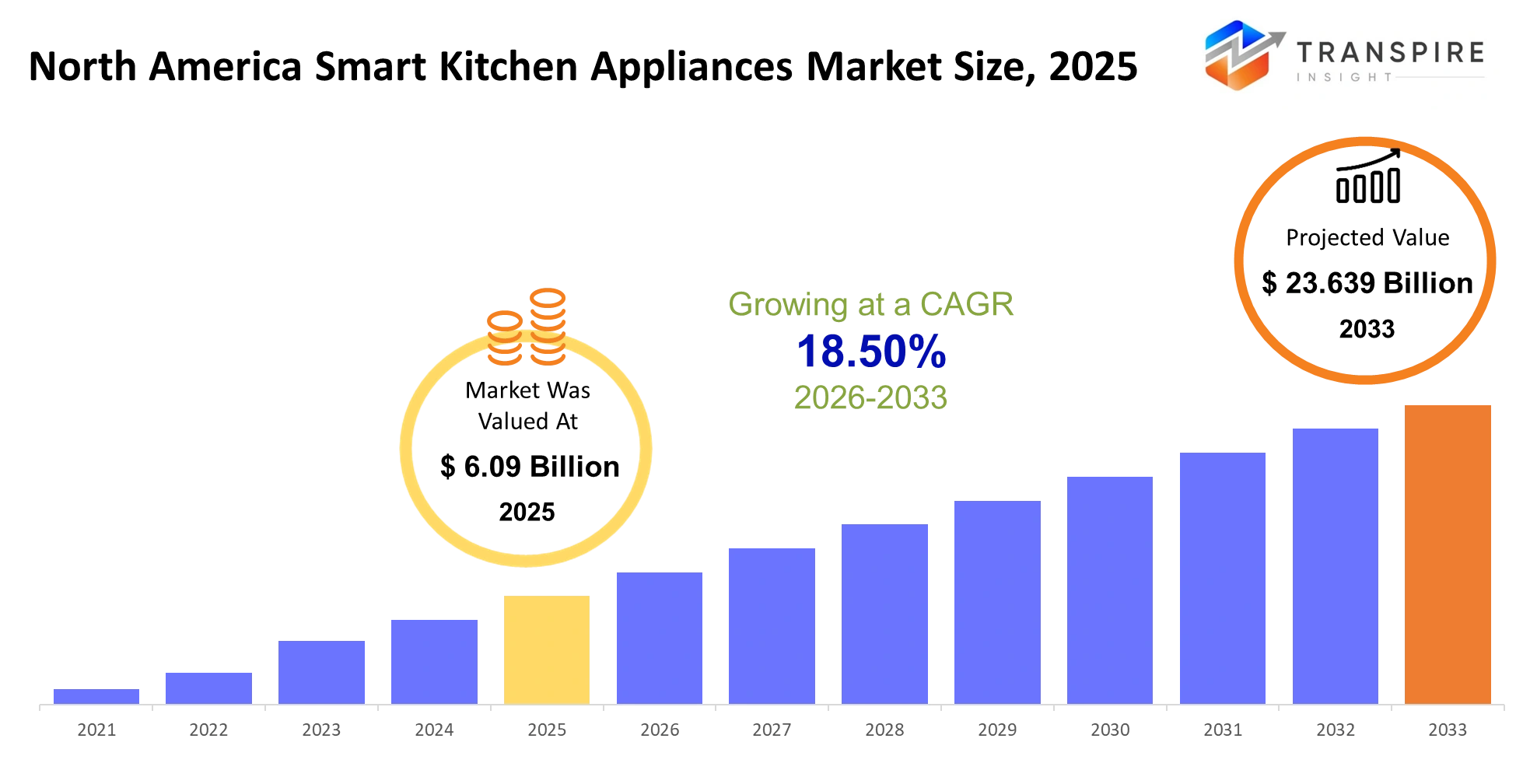
- North America Smart Kitchen Appliances Market Size 2025: USD 6.09 Billion
- North America Smart Kitchen Appliances Market Size 2033: USD 23.639 Billion
- North America Smart Kitchen Appliances Market CAGR: 18.50%
- North America Smart Kitchen Appliances Market Segments: By Product (Smart Ovens, Refrigerators, Dishwashers, Coffee Makers, Cooktops, Microwaves, Blenders), By Technology (IoT, AI, Voice Control, Sensors, Connectivity, Automation, Smart Apps), By Application (Residential, Commercial, Restaurants, Hotels, Cafes, Catering, Institutions), By Distribution (Online, Retail, Brand Stores, E-commerce, Specialty Stores, Wholesale, Direct), By End-User (Households, Chefs, Hotels, Restaurants, Cafes, Institutions, Corporates).
To learn more about this report,  Download Free Sample Report
North America Smart Kitchen Appliances Market Summary:
The North America Smart Kitchen Appliances Market size is estimated at USD 6.09 Billion in 2025 and is anticipated to reach USD 23.639 Billion by 2033, growing at a CAGR of 18.50% from 2026 to 2033. The North America Smart Kitchen Appliances Market is currently experiencing rapid growth because consumers increasingly demand products which provide convenience and connectivity and energy-efficient solutions. Smart refrigerators and ovens and dishwashers, which combine IoT technology with voice assistant functionality, enable users to cook without interruption by their advanced technological systems.
The rise of urban areas together with the demands of modern life leads home users to select appliances which provide time savings and greater control through mobile applications. The North America Smart Kitchen Appliances Market maintains its growth pattern because of continuous product development which drives the market forward.
The North America Smart Kitchen Appliances Market experiences expansion from two primary factors which drive its growth. The demand for energy-saving appliances which help customers lower their electricity expenses has increased because customers now prefer products that support their environmentally sustainable lifestyle choices. The product attractiveness increases through the development of AI-based cooking functions and customized user interaction technologies. The North America Smart Kitchen Appliances Market will experience continuous growth because top manufacturers maintain strong investment levels while introducing new products to both residential and high-end housing markets.
What Has the Impact of Artificial Intelligence Been on the North America Smart Kitchen Appliances Market?
Artificial intelligence is changing the North America Smart Kitchen Appliances Market because it enables manufacturers to analyze consumer behavior data for their market research activities. AI technology in North America Smart Kitchen Appliances Market provides organizations with advanced market research capabilities that conduct real-time data analysis to generate detailed insights about customer behavior and their purchasing habits.
The combination of machine learning with predictive analytics provides companies with tools to forecast future demand while they track new market developments and refine their product development processes. The data-driven method enables better decision-making for the North America Smart Kitchen Appliances Market which needs to meet changing consumer demands.
Artificial intelligence technology improves production efficiency and automated smart systems throughout manufacturing facilities and distribution networks within the North America Smart Kitchen Appliances Market. AI-powered systems enhance operational efficiency through their ability to decrease operational interruptions while maintaining system performance and product quality standards.
AI technology for supply chain optimization helps businesses cut expenses while achieving better inventory control which ensures that products reach customers at the right time. AI technology enables brands to create innovative cooking solutions that include personalized cooking experiences and voice control systems and adaptive learning capabilities which give them a competitive edge in the North America Smart Kitchen Appliances Market.
Key Market Trends & Insights:
- The United States dominates the north america smart kitchen appliances market which will reach 75% market share by 2025 because of increased smart home usage.
- The Canadian region experiences the highest growth rate because it will achieve more than 16% CAGR expansion between 2025 and 2030 based on increasing adoption of technology.
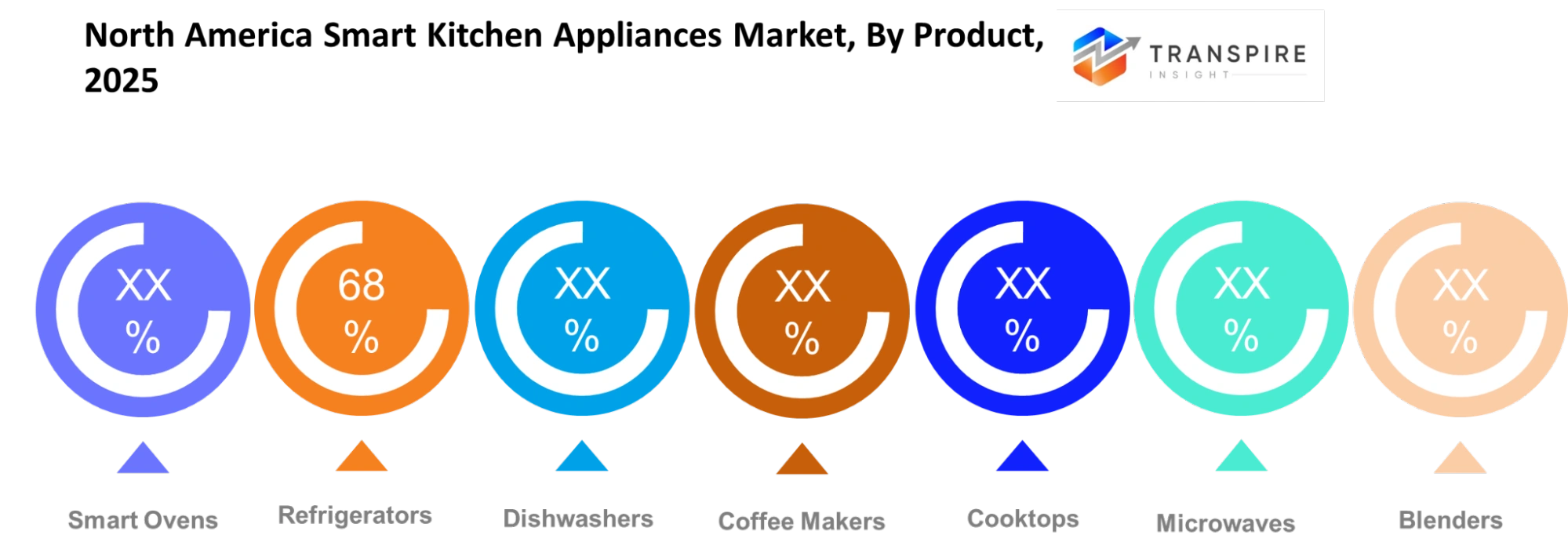
- Smart refrigerators lead the north america smart kitchen appliances market with about 30% market share because consumers want systems that enable them to manage their food inventory through internet connectivity.
- Smart ovens represent the second-largest segment because people show more interest in advanced cooking methods that combine automation and precise temperature control.
- Smart dishwashers will become the fastest expanding segment which will experience substantial growth until 2030 because of its ability to save water and conserve energy.
- The north america smart kitchen appliances market reaches over 80% residential use because smart home devices become more popular among consumers.
- The foodservice industry shows rapid expansion in commercial kitchens because businesses need greater operational efficiency through automated solutions.
- Urban households lead the market with significant share because they have more money to spend and prefer high-end smart appliances.
- Tech-savvy millennials represent the fastest-growing end-user segment which drives demand for kitchen solutions that feature AI capabilities and app-based control.
North America Smart Kitchen Appliances Market Segmentation
By Product
Smart ovens will provide automatic cooking functions which users can control from remote locations while they also include features to reduce energy consumption which helps users cook more efficiently throughout their daily activities. Refrigerators will include inventory tracking, temperature control, and connectivity with mobile apps for better food management.
Commercial dishwashers will achieve water conservation through their silent operation while their smart sensors determine appropriate washing methods depending on the size of the dishwashing load. Coffee makers and cooktops will provide precise operational control whereas microwave ovens and blender machines will enable users to prepare meals rapidly through their built-in cooking programs.
Product demand will rise because of the convenience which time-saving features and kitchen efficiency improvements bring to both residential and commercial environments. Innovative products that feature advanced design elements and functional capabilities will enable appliance manufacturers to create products which meet the evolving demands of current consumer lifestyles. The integration of smart systems with products will increase both their operational value and their user experience. Products will achieve higher market penetration when manufacturers provide continuous improvements to product performance and energy efficiency.
To learn more about this report, Download Free Sample Report
By Technology
The Internet of Things will create direct contact between devices which will let users handle their devices through their networked systems. Artificial intelligence will enable educational processes through its ability to provide customized cooking recommendations and generate predictive maintenance notifications. Users can interact with digital assistants through voice control because this feature enables them to operate devices without using their hands. The system will achieve better results because its sensors and connectivity elements will modify operations according to current conditions.
The combination of automated systems with intelligent applications will enable kitchen staff to complete their tasks faster while using remote kitchen operation and time-based kitchen management capabilities. Organizations that implement technological advancements will achieve better energy efficiency and resource management across multiple operational areas. Users will experience better system performance through ongoing software and connectivity improvements. The development of smart systems will create new possibilities for appliance development.
By Application
The residential sector will become the largest market segment because more people will start to use smart home technology while they search for easier methods to prepare their daily meals. Restaurants and hotels and cafes will use their facilities to achieve better performance results while maintaining product quality and lowering their expenses. Automation technology will provide kitchen operators with systems that enable them to prepare large quantities of food for catering purposes. High-demand situations will benefit from smart appliances that maintain product quality while delivering quick service.
Enhanced kitchen management systems and energy efficiency knowledge will create new application possibilities. Restaurants and hotels will adopt smart systems to improve service quality and reduce waste.Connected appliances will enable institutions to operate their facilities. The market demand will rise because different sectors will start using this technology.
By Distribution
The online and e-commerce channels will receive increased popularity because they provide convenient shopping options and access to a larger product selection and offer better pricing than other channels. The retail and brand stores will maintain their ability to draw customers through their physical store experience and product demonstration activities. Specialty stores will provide expert product recommendations and high-quality products to meet the needs of specific customers. Wholesale and direct channels will support bulk purchasing for commercial clients.
The distribution strategies aim to enhance accessibility while increasing customer interaction through various platforms. Digital channels will help businesses reach more customers while guiding them toward making purchase decisions. Businesses need offline channels to establish customer trust while offering practical product experience. Companies can achieve consistent revenue growth through the use of balanced distribution networks.
By End-User
The primary end-user segment will be occupied by households which show increasing demand for smart home systems and convenient living solutions and connected home technologies. Professional chefs and other users will depend on advanced cooking tools which provide exact measurements and uniform results. Smart appliances will be implemented by hotels and restaurants and cafes to enhance their operational efficiency and customer service standards. These solutions will be used by organizations and institutions to handle their extensive operations while controlling expenses.
People will demand more products because they want solutions which save time and use less energy. The adoption of smart technologies will increase because more people become aware of these systems. User groups will request specific features which meet their unique operational requirements. Ongoing product development will create permanent demand which will extend to all user segments.
What are the Main Challenges for the North America Smart Kitchen Appliances Market Growth?
The North America smart kitchen appliances market encounters three major technical and operational problems. The system requires components from three different technologies which include IoT systems and AI systems and connectivity systems. The system needs internet access to function correctly which results in problems when users attempt to use the system without an internet connection. The North American smart kitchen appliances market faces two challenges which include supply chain disruptions and semiconductor shortages that extend production cycles.
The North American smart kitchen appliances market faces two main challenges which include manufacturing restrictions and commercialization limitations. Advanced appliance production needs businesses to invest substantial amounts of capital while they deal with complex component sourcing and strict safety and energy regulations. These factors increase production costs and delay product launches. The companies in the North American smart kitchen appliances market need to handle pricing pressures which forces them to pursue innovation because their need for innovation creates extra difficulties.
The market faces major challenges because price-sensitive consumers and areas with insufficient smart infrastructure still need to adopt more solutions. High initial costs and lack of technical awareness restrict widespread adoption of connected appliances. The market penetration process faces delays because there is a lack of skilled workers who can handle installation and maintenance tasks. The market expansion process in North America for smart kitchen appliances faces limitations, which decrease the speed at which the market can reach more consumer groups.
Region Insights
Regional insights highlight strong growth across the United States and Canada which occurs because people widely adopt smart home technologies and connected devices. The demand will increase from urban centers because people there earn more income and understand the benefits of energy-efficient appliances. The combination of ongoing product development and digital system implementation will establish continuous growth throughout residential areas and commercial spaces.
The United States will lead because it possesses advanced infrastructure and well-established retail networks and people there have started using smart technologies. The Canadian market will experience steady growth because more consumers show interest in automation and sustainable living solutions. The regional demand will increase because of better internet connectivity and higher technology awareness, and more people will have access to smart kitchen products.
Recent Development News
In April 2026, smart multifunction ovens gain traction in U.S. kitchens: a new wave of compact, multifunction smart appliances is shaping product innovation across the North American smart kitchen appliances market. The focus remains on space-saving and high-performance features tailored for modern households.
Source: https://nypost.com
In April 2026, Martha Stewart launches a new kitchen appliance line on Amazon: expansion of branded appliance portfolios highlights strong commercialisation activity in the North America Smart Kitchen Appliances Market. The launch includes multiple connected and design-focused appliances aimed at U.S. consumers.
Source: https://www.goodhousekeeping.com
|
Report Metrics |
Details |
|
Market size value in 2025 |
USD 6.09 Billion |
|
Market size value in 2026 |
USD 7.204 Billion |
|
Revenue forecast in 2033 |
USD 23.639 Billion |
|
Growth rate |
CAGR of 18.50% from 2026 to 2033 |
|
Base year |
2025 |
|
Historical data |
2021 – 2024 |
|
Forecast period |
2026 – 2033 |
|
Report coverage |
Revenue forecast, competitive landscape, growth factors, and trends |
|
Regional scope |
North America (Canada, The United States, and Mexico) |
|
Key company profiled |
Samsung, LG, Whirlpool, Bosch, GE Appliances, Haier, Electrolux, Panasonic, Sharp, Miele, Siemens, Kenwood, Breville, KitchenAid, Sub-Zero. |
|
Customization scope |
Free report customization (country, regional & segment scope). Avail customized purchase options to meet your exact research needs. |
|
Report Segmentation |
By Product (Smart Ovens, Refrigerators, Dishwashers, Coffee Makers, Cooktops, Microwaves, Blenders), By Technology (IoT, AI, Voice Control, Sensors, Connectivity, Automation, Smart Apps), By Application (Residential, Commercial, Restaurants, Hotels, Cafes, Catering, Institutions), By Distribution (Online, Retail, Brand Stores, E-commerce, Specialty Stores, Wholesale, Direct), By End-User (Households, Chefs, Hotels, Restaurants, Cafes, Institutions, Corporates). |
How Can New Companies Establish a Strong Foothold in the North America Smart Kitchen Appliances Market?
New companies can build a strong presence in the north america smart kitchen appliances market by focusing on niche segments and unmet consumer needs. New market entrants will achieve their goals by selecting specific use cases which include compact urban kitchens and energy-efficient appliances and premium connected devices. The company needs to establish its market presence through distinctive innovation methods and custom solutions which match current market expansion patterns. The focused entry method enables new companies to compete successfully against established market players.
The smart kitchen appliances market in North America requires businesses to develop unique products through their technological advancements and innovative research methods. Startups that create AI-enabled appliances with machine learning capabilities and smart automation features will solve three main issues in their products which include energy management and predictive maintenance and personalized cooking.
Brava has developed smart ovens which use advanced light-based cooking technology while June produces intelligent countertop ovens which contain built-in sensors. User experience improvements through these innovations create stronger competitive advantages for companies.
The north america smart kitchen appliances market will experience growth through strategic partnerships and collaborations which boost both market entry and business expansion. The company should partner with IoT platform providers and smart home ecosystem companies and retail distributors to enhance its product distribution and increase brand recognition.
The company can create new application areas through its partnerships with real estate developers and hospitality sector organizations. The partnerships enable companies to achieve rapid growth while they face fewer obstacles in their operational and distribution processes.
Key North America Smart Kitchen Appliances Market Company Insights
The competitive analysis reveals that worldwide brands which emphasise innovation and connectivity and energy efficiency have established a strong market presence. The companies will spend their budget on developing better product features which will include AI capabilities and smart automated systems. The ongoing product development process together with technological advancements will create competitive advantages that endure through time.
The top companies will use partnership agreements and the introduction of new products and market development into new regions as their main methods for increasing market share. Customers will base their purchase choices on three main factors, which include the simple product operation, the affordable product price, and the customer support offered after the sale. The market will force businesses to create unique products which stand out through their performance and reliability and their ability to work with smart, connected systems.
Company List
- Samsung
- LG
- Whirlpool
- Bosch
- GE Appliances
- Haier
- Electrolux
- Panasonic
- Sharp
- Miele
- Siemens
- Kenwood
- Breville
- KitchenAid
- Sub-Zero
What are the Key Use-Cases Driving the Growth of the North America Smart Kitchen Appliances Market?
The North American market for smart kitchen appliances is experiencing growth because residential customers are selecting these devices which provide better heating and cooking functionalities. Common daily tasks become easier for users through the application of smart refrigerators which offer inventory tracking features and AI-powered ovens that provide automated cooking functionalities. The use cases directly support market growth by enhancing the user experience and reducing the time users spend on meal preparation, leading to increased consumer adoption among urban households.
The North American market for smart kitchen appliances in commercial environments operates through restaurant, hotel and cloud kitchen applications which prioritise efficient operations. Smart dishwashers, automated cooktops and connected kitchen systems provide benefits which include decreased labor expenses improved product consistency and quicker service times. These applications serve as essential tools which enable businesses to achieve maximum operational efficiency while they uphold their established quality benchmarks thus driving market growth.
The North American smart kitchen appliances market is experiencing growth through department kitchens and healthcare facilities which need systematic food handling and complete hygienic food processing systems. Smart appliances maintain safety standards by minimizing waste and establishing regulated cooking environments. Such applications demonstrate how automation combined with data analysis can create beneficial results in essential service environments.
North America Smart Kitchen Appliances Market Report Segmentation
By Product
- Smart Ovens
- Refrigerators
- Dishwashers
- Coffee Makers
- Cooktops
- Microwaves
- Blenders
By Technology
- IoT
- AI
- Voice Control
- Sensors
- Connectivity
- Automation
- Smart Apps
By Application
- Residential
- Commercial
- Restaurants
- Hotels
- Cafes
- Catering
- Institutions
By Distribution
- Online
- Retail
- Brand Stores
- E-commerce
- Specialty Stores
- Wholesale
- Direct
By End-User
- Households
- Chefs
- Hotels
- Restaurants
- Cafes
- Institutions
- Corporates
Frequently Asked Questions
Find quick answers to common questions.
The approximate North America Smart Kitchen Appliances Market size for the market will be USD 23.639 Billion in 2033.
The key segments of the North America Smart Kitchen Appliances Market are By Product (Smart Ovens, Refrigerators, Dishwashers, Coffee Makers, Cooktops, Microwaves, Blenders), By Technology (IoT, AI, Voice Control, Sensors, Connectivity, Automation, Smart Apps), By Application (Residential, Commercial, Restaurants, Hotels, Cafes, Catering, Institutions), By Distribution (Online, Retail, Brand Stores, E-commerce, Specialty Stores, Wholesale, Direct), By End-User (Households, Chefs, Hotels, Restaurants, Cafes, Institutions, Corporates).
Major players in the North America Smart Kitchen Appliances Market are Samsung, LG, Whirlpool, Bosch, GE Appliances, Haier, Electrolux, Panasonic, Sharp, Miele, Siemens, Kenwood, Breville, KitchenAid, Sub-Zero.
The current market size of the North America Smart Kitchen Appliances Market is USD 6.09 Billion in 2025.
The North America Smart Kitchen Appliances Market CAGR is 18.50%.
- Samsung
- LG
- Whirlpool
- Bosch
- GE Appliances
- Haier
- Electrolux
- Panasonic
- Sharp
- Miele
- Siemens
- Kenwood
- Breville
- KitchenAid
- Sub-Zero
Recently Published Reports
-
Dec 2024
Bottled Water Market
Bottled Water Market Size, Share & Analysis Report By Product Type (Still Bottled Water, Carbonated Bottled Water, Functional Bottled Water, and Others), By Packaging (PET, Cans, and Others), By Sales Channel (Supermarkets/Hypermarkets, Convenience Stores/Drug Stores, Grocery Stores/Club Stores, Foodservice, and Others) and Geography (North America, Europe, Asia-Pacific, Middle East and Africa, South and Central America), 2021 - 2032
-
Dec 2024
Color Cosmetic Packaging Market
Color Cosmetic Packaging Market Size, Share & Analysis Report By Application (Mascara Packaging, Liquid Packaging, and Liquid Face), By Type (Tubes & Bottles, Pens & Markers, Compacts & Containers, and Droppers & Pumps), and Geography (North America, Europe, Asia-Pacific, Middle East and Africa, South and Central America), 2021 - 2031
-
Dec 2024
External Microphone For Camera Market
External Microphone For Camera Market Size, Share & Analysis Report By Type (Shotgun Microphone, Lavalier Microphone, and Others), By Application (Digital Camera, Professional Video Camera, and Others), and Geography (North America, Europe, Asia-Pacific, Middle East and Africa, South and Central America), 2021 - 2031
-
Dec 2024
Foot Orthotic Insoles Market
Foot Orthotic Insoles Market Size, Share & Analysis Report By Type (Pre-fabricated, and Custom-made), By Material (Thermoplastic, Composite Carbon Fiber, and Others), By Distribution Channel (Drug Stores, Hospitals & Clinics, and Others), and Geography (North America, Europe, Asia-Pacific, Middle East and Africa, South and Central America), 2021 - 2031