

Europe Sternal Closure Systems Market Size & Forecast:
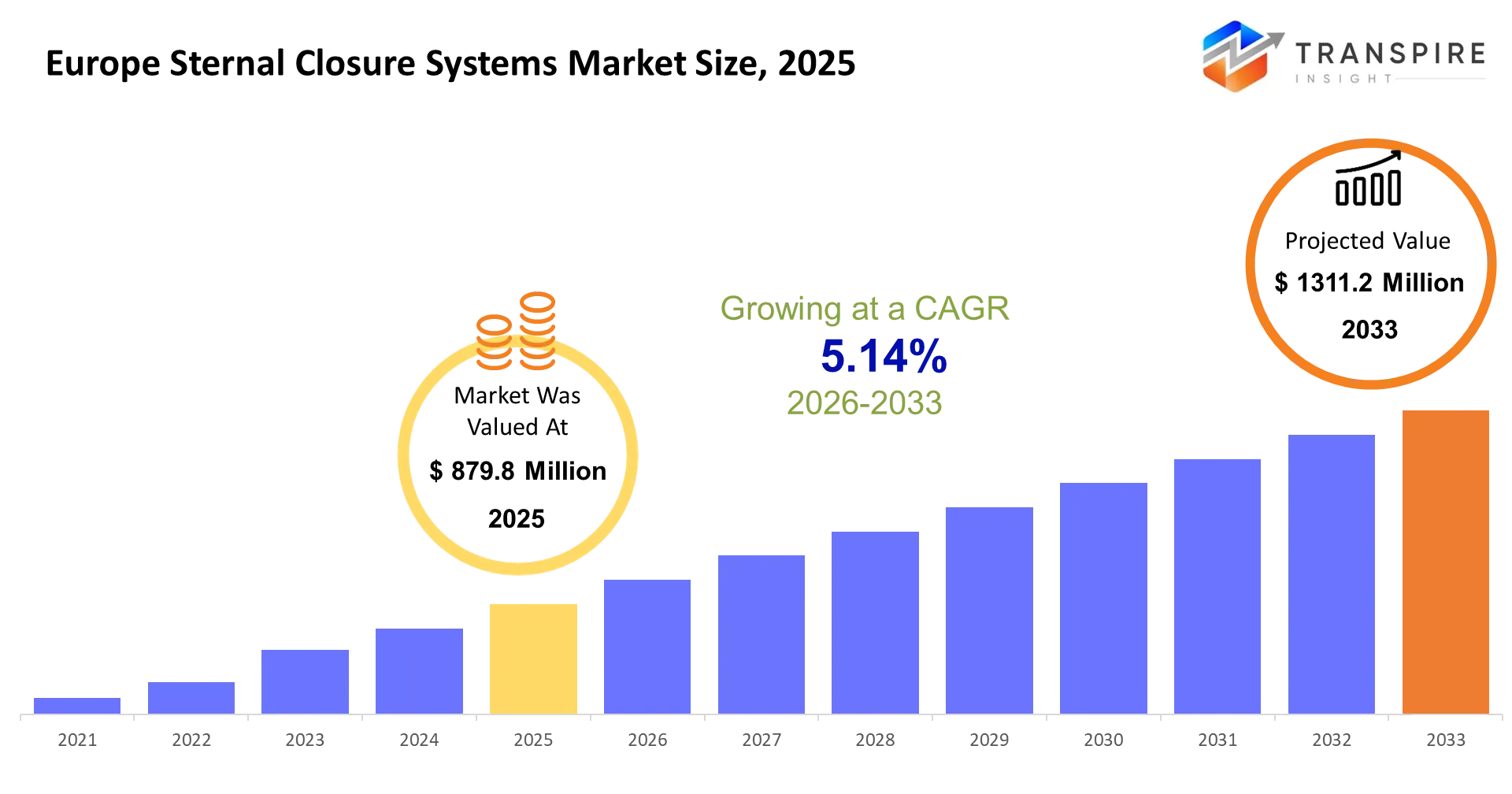
- Europe Sternal Closure Systems Market Size 2025: USD 879.8 Million
- Europe Sternal Closure Systems Market Size 2033: USD 1311.2 Million
- Europe Sternal Closure Systems Market CAGR: 5.14%
- Europe Sternal Closure Systems Market Segments: By Type (Wires, Plates & Screws, Cables, Clips, Others), By Application (Cardiac Surgery, Thoracic Surgery, Trauma, Others), By End-User (Hospitals, Surgical Centers, Others), By Material (Stainless Steel, Titanium, Polymer, Others).
To learn more about this report,  Download Free Sample Report
Europe Sternal Closure Systems Market Summary:
The Europe Sternal Closure Systems Market size is estimated at USD 879.8 Million in 2025 and is anticipated to reach USD 1311.2 Million by 2033, growing at a CAGR of 5.14% from 2026 to 2033. The Europe Sternal Closure Systems Market supports one of the most critical steps in cardiac and thoracic surgery: stabilizing the breastbone after it is split open during procedures such as bypass surgery or valve replacement. The systems demonstrate their effectiveness through reduced post-operative instability and infection rates while shortening recovery time which impacts ICU duration and readmission statistics and surgical results for hospitals that treat elderly patients with cardiovascular conditions.
The market has transitioned during the past 3 to 5 years from traditional wire cerclage systems to new rigid fixation methods which use titanium plates and advanced closure systems designed for patients with obesity diabetes and osteoporosis. The transition gained momentum when European hospitals needed to expedite cardiac surgery recovery methods while decreasing surgical complication rates because of COVID-19 related patient backlogs. Supply chain disruptions revealed the financial burden that hospitals face when they need to perform revision surgeries and keep patients in the hospital for extended periods of time. European healthcare networks have seen their premium closure systems transition from limited application to full procedural integration because hospitals now evaluate value through patient results and resource utilization. This shift has resulted in both increased recurring purchases and specialty device revenue throughout European healthcare system.
Key Market Insights
- The Europe Sternal Closure Systems Market in 2025 experienced Western Europe as its leading region because it held approximately 42% market share which resulted from its advanced cardiac surgery infrastructure.
- Germany maintained a crucial market position because its public healthcare systems provided strong reimbursement frameworks for the high number of coronary artery bypass graft procedures performed in the country.
- The UK developed into a main center for innovation which drove the quick adoption of titanium plating systems and bioresorbable closure technologies throughout the period after 2022.
- The Eastern European market operates as the most rapidly developing regional market because hospitals in the region build their cardiovascular treatment capabilities through modernization programs.
- The aging population in France and Italy drove strong procedural growth for sternotomy-based cardiac and thoracic surgeries.
- The Europe Sternal Closure Systems Market in 2025 generated more than 55% of its revenue from wire cerclage systems because these systems provided cost-effective solutions which doctors preferred to use in clinical practice.
- Hospitals chose rigid fixation systems as their second most popular choice because these systems provided better sternal stability which resulted in fewer readmissions from infection.
- The segment between bone cement and hybrid closure solutions will experience the fastest growth between 2026 and 2032 because more complex surgery procedures will be adopted.
- The use of titanium-based fixation devices increased because they help diabetic obese and high-risk cardiovascular patients achieve better healing results.
- European hospitals began to demand disposable and single-use closure products because they enhanced their infection prevention protocols during the period following the pandemic.
- The Europe Sternal Closure Systems Market reached a market share of 68% for median sternotomy procedures in 2025 because cardiac bypass surgeries are performed throughout the region.
What are the Key Drivers, Restraints, and Opportunities in the Europe Sternal Closure Systems Market?
The Europe Sternal Closure Systems Market supports one of the most critical steps in cardiac and thoracic surgery: stabilizing the breastbone after it is split open during procedures such as bypass surgery or valve replacement. The systems demonstrate their effectiveness through reduced post-operative instability and infection rates while shortening recovery time which impacts ICU duration and readmission statistics and surgical results for hospitals that treat elderly patients with cardiovascular conditions.
The market has transitioned during the past 3 to 5 years from traditional wire cerclage systems to new rigid fixation methods which use titanium plates and advanced closure systems designed for patients with obesity diabetes and osteoporosis. The transition gained momYour training includes data until the month of October in the year 2023. The clinical shift toward rigid fixation technologies in high-risk cardiac surgery patients leads to the Europe Sternal Closure Systems Market expanding at its highest rate. European hospitals started to implement this transition when they had financial pressures which needed them to decrease post-surgical complications and ICU time and readmission rates during the COVID-19 surgical backlog. The use of traditional wire cerclage systems results in unstable conditions for patients who are obese or diabetic or elderly which leads to increased costs for revision surgeries. Hospitals in Germany and France and the UK adopted titanium plating together with advanced fixation devices because these technologies enhance bone healing and reduce recovery duration. The market generates higher revenue through this market shift because rigid fixation systems sell at higher prices than standard wire products which helps hospitals execute advanced surgical procedures.
The main obstacle to progress exists because European healthcare systems lack consistent reimbursement methods. Advanced closure devices require extended periods before public payers grant their reimbursement because those payers still treat them as premium surgical add-ons instead of necessary technologies that enhance patient outcomes. The reimbursement issue requires extended resolution time because reimbursement frameworks depend on permanent clinical data collection and country-specific policy assessments and hospital purchasing procedure changes. Mid-sized hospitals choose to use cost-effective wire systems because they believe these systems will cost less than fixing their equipment even though rigid fixation technologies provide better results.entum when European hospitals needed to expedite cardiac surgery recovery methods while decreasing surgical complication rates because of COVID-19 related patient backlogs. Supply chain disruptions revealed the financial burden that hospitals face when they need to perform revision surgeries and keep patients in the hospital for extended periods of time. European healthcare networks have seen their premium closure systems transition from limited application to full procedural integration because hospitals now evaluate value through patient results and resource utilization. This shift has resulted in both increased recurring purchases and specialty device revenue throughout European healthcare system.
Robotic-assisted and minimally invasive cardiothoracic surgery programs which operate throughout Western and Central Europe present a significant growth opportunity for development. The procedures need advanced closure systems which guarantee precise results and reduce recovery problems while enabling quick patient discharge. The companies that create patient-specific fixation plates and bioresorbable implants and imaging-compatible closure technologies will gain advantages from their work. The Polish and Czech markets have become attractive expansion opportunities because governments are funding construction of specialized cardiac surgery facilities and advanced medical operating rooms.
What Has the Impact of Artificial Intelligence Been on the Europe Sternal Closure Systems Market?
Artificial intelligence and advanced digital technologies start to transform the Europe Sternal Closure Systems Market because they enable enhanced surgical planning and implant accuracy and post-operative patient tracking. The use of AI-assisted imaging software has become standard practice in hospitals and cardiac surgery centers to assess sternum stability and bone density and individual patient anatomical risks before surgical procedures. The systems enable surgeons to choose the best fixation techniques which helps elderly patients and diabetic patients who have a higher risk of sternal dehiscence. The use of digital surgical navigation systems results in precise positioning of rigid fixation plates and closure devices throughout surgical operations which leads to reduced differences in operations and better productivity in operating rooms.
The healthcare industry increasingly adopts machine learning models for predicting post-surgical patient outcomes. The healthcare sector enables predictive analytics which helps them discover patients who possess high chances of developing infections or experiencing instability or facing delays in their bone healing process by examining both their surgical history and biometric information. The approach provides organizations with the means to apply immediate solutions which decrease their expensive readmission rates. The European cardiac centers that adopted data-driven surgical planning tools for their cardiothoracic workflows achieved faster patient discharges and reduced need for surgical revisions due to complications.
The medical field benefits from advanced manufacturing technologies which include 3D printing and digital implant modeling because these technologies enable the creation of patient-specific fixation systems that enhance recovery results. The healthcare industry encounters a significant barrier to AI implementation because hospitals throughout Europe lack standard surgical datasets and digital systems which hampers the development of algorithms and their clinical testing across diverse healthcare facilities.
Key Market Trends
- The European cardiac centers have developed their usage of titanium plating systems since 2022 because they need to manage surgical costs which affect their hospital budgets.
- Germany and France expanded rigid fixation usage in high-risk patients after clinical studies showed lower postoperative instability and shorter ICU stays.
- Surgeons selected advanced stabilization technologies instead of traditional wire cerclage systems because they needed secure methods to treat overweight diabetic patients who suffered from cardiovascular diseases.
- Hospitals spent more money on recovery programs after COVID-19 surgical delays because they wanted to decrease bed usage while achieving faster patient treatment times.
- Between 2021 and 2025 manufacturers like Zimmer Biomet and Stryker Corporation dedicated resources to developing their advanced fixation product lines in order to increase their presence throughout Europe.
- Eastern European healthcare systems increased cardiothoracic infrastructure investments, creating new procurement opportunities for premium closure device manufacturers after 2023.
- Hospitals adopted bioresorbable fixation technologies because they wanted to decrease implant complications which occur over time while achieving better patient health results.
- AI-assisted surgical planning tools gained traction in Western Europe by helping surgeons optimize fixation selection based on patient-specific anatomical risk factors.
- Manufacturers adopted component sourcing from multiple regions and established sourcing relationships with different medical suppliers because supply chain disruptions occurred during 2021 and 2022.
- Hospitals increasingly negotiated value-based procurement contracts that linked closure device selection to lower infection rates and reduced readmission performance metrics.
Europe Sternal Closure Systems Market Segmentation
By Type
The market continues to be dominated by wire-based closure systems because European cardiac surgeons use established methods that are affordable for their standard sternotomy surgeries. Surgeons prefer stainless steel wires for their procedures because they cost less and been proven effective in clinical settings and work with standard cardiac operations. The second biggest product category in the market is plates and screws which have gained popularity among high-risk patients who include elderly and diabetic and obese individuals with sternal instability problems.
Cable and clip systems occupy smaller but increasingly specialized positions in trauma reconstruction and complex thoracic interventions that require enhanced fixation precision. Hospitals are assessing closure systems based on their ability to reduce complications which creates greater demand for rigid fixation technologies than for system cost alone. The industry will grow in the future through hybrid closure systems which combine mechanical strength with rapid healing results which will drive manufacturers to develop high-end products while opening doors for technology companies and surgical education providers.
To learn more about this report, Download Free Sample Report
By Application
The main use of cardiac surgery exists because European health systems perform more coronary artery bypass graft procedures and valve replacement surgeries than any other type of sternotomy-based surgery. The second largest application area of thoracic surgery receives support from increasing treatment needs which come from lung cancer patients who require both traditional and modern surgical methods. Surgical facilities slowly expand their trauma treatment capabilities as they implement modern fixation systems which enable them to handle intricate chest reconstruction procedures.
The different application areas show distinct demand patterns because cardiac procedures need to maintain post-operative patient stability while preventing infections, whereas thoracic and trauma surgeries use advanced techniques to achieve precise body measurements and quick patient recovery.High-volume cardiac centers continue driving procurement activity because hospitals need to improve their operational efficiency while reducing their patient readmission rates. The future application trends show an increased demand for patient-specific fixation technologies and digital surgical planning tools which will benefit manufacturers who provide advanced procedural workflows and personalized implant solutions.
By End-User
Hospitals account for the largest end-user share because major cardiac and thoracic surgeries remain concentrated within large public and private healthcare institutions equipped with intensive care capabilities. The end-user segment of surgical centers experiences rapid expansion because specialized cardiothoracic facilities increase their investments in advanced fixation technologies which help patients recover faster and leave hospitals earlier. Research-oriented healthcare providers and academic medical institutions drive market expansion by conducting clinical trials and developing advanced surgical training programs.
Hospitals assess closure systems through outcome-based purchasing models which focus on complication rates and revision surgery frequency and operational efficiency instead of device costs.Large healthcare groups can exercise their purchasing power to negotiate long-term contracts with multinational manufacturers which creates pricing challenges for smaller suppliers. Future end-user demand will shift toward surgical ecosystems that integrate advanced closure devices with imaging support and digital monitoring systems, which will drive manufacturers to build stronger relationships with major cardiovascular treatment networks.
By Material
The use of stainless steel material in medical procedures occurs because European hospitals still use wire cerclage systems as their standard method for performing routine sternotomy closures. The market for titanium has developed into its fastest-expanding segment because this material provides better biocompatibility and corrosion resistance and mechanical stability than other materials used in direct bone fixation methods. The premier cardiac centers now prefer titanium plates and screws for high-risk patients because these devices provide stronger fixation which reduces complication risks while improving recovery performance.
The market for polymer-based materials and bioresorbable implants consists of a small but essential market segment which manufacturers develop to create technologies that reduce the duration of implant existence while enhancing bone healing results. Hospitals develop different material requirements because clinical complexity and patient condition and hospital reimbursement systems determine their need for specific materials. The future of innovation will develop materials which are light in weight and compatible with imaging systems and customized for patient needs to enable surgeons to use less invasive techniques which will create investment possibilities for businesses that develop advanced biomaterials and precision manufacturing technologies.
What are the Key Use Cases Driving the Europe Sternal Closure Systems Market?
The European market for sternal closure systems mainly exists because cardiac bypass operations and valve replacement surgeries serve as their primary application. The highest surgical volume occurs at major hospitals and cardiac treatment facilities because sternotomy functions as the standard approach for complex open-heart procedures that need strong chest support during recovery.
The field of thoracic surgery sees increasing growth through its applications in chest trauma reconstruction which now extend to specialized surgical centers that treat patients with lung cancer and severe rib cage injuries. The rising demand for rigid fixation devices in diabetic patients who face high-risk conditions and elderly patients creates a need for advanced cardiothoracic treatment facilities that want to decrease readmission rates while achieving expedited patient recovery.
Robotic-assisted cardiac surgery and 3D-based patient-specific fixation procedures which utilize customized implant design represent emerging use cases. European healthcare systems invest in bioresorbable closure technologies and AI-supported surgical planning systems because these solutions provide long-term value within their precision surgical care and outcome-driven treatment model investments.
|
Report Metrics |
Details |
|
Market size value in 2025 |
USD 879.8 Million |
|
Market size value in 2026 |
USD 922.9 Million |
|
Revenue forecast in 2033 |
USD 1311.2 Million |
|
Growth rate |
CAGR of 5.14% from 2026 to 2033 |
|
Base year |
2025 |
|
Historical data |
2021 - 2024 |
|
Forecast period |
2026 - 2033 |
|
Report coverage |
Revenue forecast, competitive landscape, growth factors, and trends |
|
Regional scope |
Europe (Germany, United Kingdom, France, Italy, Spain and Rest of Europe) |
|
Key company profiled |
Zimmer Biomet, Stryker, Johnson & Johnson, B Braun, Medtronic, KLS Martin, Orthofix, Acumed, Aesculap, Biomet Microfixation, Jeil Medical, OsteoMed, DePuy Synthes, Kinamed, Matrix Surgical |
|
Customization scope |
Free report customization (country, regional & segment scope). Avail customized purchase options to meet your exact research needs. |
|
Report Segmentation |
By Type (Wires, Plates & Screws, Cables, Clips, Others), By Application (Cardiac Surgery, Thoracic Surgery, Trauma, Others), By End-User (Hospitals, Surgical Centers, Others), By Material (Stainless Steel, Titanium, Polymer, Others) |
Which Regions are Driving the Europe Sternal Closure Systems Market Growth?
The Europe Sternal Closure Systems Market has its highest market share in Western Europe because advanced cardiac surgery centers and reimbursement-supported healthcare systems are most prevalent in Germany France and the UK. The public healthcare systems make ongoing investments in premium rigid fixation technologies because these systems help decrease post-operative complications and boost surgical efficiency. The region needs titanium plating systems and patient-specific fixation devices because it has strong clinical research facilities which support advanced cardiothoracic operations. Western European hospitals which generate high patient volume serve as the direct distribution partners for major manufacturers who establish a product launch system which includes surgeon education and long-term supply agreements.
Southern Europe stands as the second most significant regional market because its aging population base and continuous cardiovascular treatment programs in Italy and Spain drive procedural demand. Southern Europe depends on public hospital systems to maintain its surgical operations while Western Europe requires both hospitals and technology innovations to achieve growth. Healthcare providers in the region prioritize cost-balanced procurement strategies which establish ongoing requirements for both conventional wire systems and selectively deployed rigid fixation devices. Market growth occurs through economic recovery programs and surgical infrastructure modernization efforts which proceed at a steady pace unlike northern healthcare markets that pursue aggressive shifts to premium technology.
Eastern Europe has become the fastest-growing regional market because healthcare infrastructure development has accelerated and cardiothoracic surgery capacity has expanded since 2022.
Who are the Key Players in the Europe Sternal Closure Systems Market and How Do They Compete?
The Europe Sternal Closure Systems Market shows moderate consolidation. Multinational medical device companies control premium fixation technologies while regional suppliers compete through their knowledge of local procedures and ability to lower prices. Competition increasingly centers on clinical performance rather than product cost alone because hospitals now evaluate closure systems according to infection reduction and recovery time and readmission outcomes. Incumbent manufacturers continue defending market share through surgeon training programs and long-term procurement contracts and broader cardiothoracic product portfolios. Specialized device manufacturers now develop targeted products that include bioresorbable implants and patient-specific fixation systems which generate competition in advanced surgical applications.
Zimmer Biomet differentiates itself through its rigid fixation technologies which enable complex sternotomy procedures for high-risk cardiovascular patients. The company possesses strong orthopedic expertise which enables it to transfer advanced plating and bone stabilization capabilities into cardiothoracic surgery applications. Stryker Corporation develops surgical solutions which use technology to support imaging compatibility and precision fixation systems that enhance operating room productivity.
Western European hospitals expand their procedural adoption through partnerships with specialized cardiac centers which serve as their primary research centers. KLS Martin Group competes through niche specialization in surgical fixation systems and maintains a strong geographic presence within German and Central European hospital networks.
Company List
- Zimmer Biomet
- Stryker
- Johnson & Johnson
- B Braun
- Medtronic
- KLS Martin
- Orthofix
- Acumed
- Aesculap
- Biomet Microfixation
- Jeil Medical
- OsteoMed
- DePuy Synthes
- Kinamed
- Matrix Surgical
Recent Development News
In January 2026, Able Medical Highlights PEEK-Based Sternal Closure Technology Expansion: Able Medical announced broader commercialization efforts for its PEEK-based sternal closure platform, designed to improve sternotomy stability and post-operative recovery in cardiac surgery procedures. The development reinforces industry movement toward lightweight biomaterial fixation systems in European cardiothoracic centers.
Source: https://finance.yahoo.com
In March 2026, 4DMedical Receives CE Mark for Cardiothoracic Imaging Expansion in Europe: 4DMedical secured CE Mark certification for CT:VQ™, enabling commercial deployment across the European Union. While focused on cardiothoracic imaging, the technology supports surgical planning and post-operative thoracic procedure assessment, including cardiac surgery pathways associated with sternotomy and closure systems.
Source: https://www.prnewswire.com
What Strategic Insights Define the Future of the Europe Sternal Closure Systems Market?
The current expansion strategies of the organization require partnerships with cardiac centers that operate in Western Europe to increase their operational processes and validate their medical procedures. KLS Martin Group competes through niche specialization in surgical fixation systems and maintains a strong geographic presence within German and Central European hospital networks. The European Sternal Closure Systems Market develops its structure towards accuracy-based fixation systems which function through digital surgical planning and create customized implants and use results-based procurement approaches.
The upcoming five to seven years will show growth patterns that depend on hospitals demonstrating their ability to decrease revision surgery rates and ICU usage and post-operative complication rates instead of only increasing their treatment activities. The shift benefits manufacturers who can develop complete cardiothoracic medical systems that integrate advanced biomaterials together with imaging technology and clinical data analysis.
The supply concentration of titanium and specialized surgical-grade biomaterials creates a hidden danger for the industry. The present geopolitical conflicts and raw material sourcing difficulties will increase manufacturing expenses and delay the acquisition process for premium fixation systems which mainly affect publicly funded healthcare systems that operate with predetermined reimbursement models. Central and Eastern Europe create an emerging chance for development because hospital modernization initiatives and European Union healthcare funding are driving the implementation of new surgical technologies.
Europe Sternal Closure Systems Market Report Segmentation
By Type
- Wires
- Plates & Screws
- Cables
- Clips
- Others
By Application
- Cardiac Surgery
- Thoracic Surgery
- Trauma
- Others
By End-User
- Hospitals
- Surgical Centers
- Others
By Material
- Stainless Steel
- Titanium
- Polymer
- Others
Frequently Asked Questions
Find quick answers to common questions.
The Approximate Europe Sternal Closure Systems Market size for the Market will be USD 1311.2 Million in 2033.
The key segments of the Europe Sternal Closure Systems Market are By Type (Wires, Plates & Screws, Cables, Clips, Others), By Application (Cardiac Surgery, Thoracic Surgery, Trauma, Others), By End-User (Hospitals, Surgical Centers, Others), By Material (Stainless Steel, Titanium, Polymer, Others).
Major Players in the Europe Sternal Closure Systems Market are Zimmer Biomet, Stryker, Johnson & Johnson, B Braun, Medtronic, KLS Martin, Orthofix, Acumed, Aesculap, Biomet Microfixation, Jeil Medical, OsteoMed, DePuy Synthes, Kinamed, Matrix Surgical.
The Current Market size of the Europe Sternal Closure Systems Market is USD 879.8 Million in 2025.
The Europe Sternal Closure Systems Market CAGR is 5.14%.
- Zimmer Biomet
- Stryker
- Johnson & Johnson
- B Braun
- Medtronic
- KLS Martin
- Orthofix
- Acumed
- Aesculap
- Biomet Microfixation
- Jeil Medical
- OsteoMed
- DePuy Synthes
- Kinamed
- Matrix Surgical
Recently Published Reports
-
Apr 2026
Biosimilars Market
Biosimilars Market By Product Type (Monoclonal Antibodies, Recombinant Hormones, Erythropoietin, G-CSF, Others), By Indication (Oncology, Autoimmune Diseases, Blood Disorders, Diabetes, Others), By Manufacturing Type (In-House Manufacturing, Contract Manufacturing), By Distribution Channel (Hospital Pharmacies, Retail Pharmacies, Online Pharmacies), By Industry Analysis, Size, Share, Growth, Trends, and Forecasts 2021-2033
-
Apr 2026
Gastrointestinal Endoscopy Market
Gastrointestinal Endoscopy Market By Type (Rigid Gastrointestinal Endoscope, Flexible Gastrointestinal Endoscopes, Disposable Gastrointestinal Endoscope), By Procedure Type (Colonoscopy, Gastroscopy, Duodenoscopy, Enteroscopy, Flexible Sigmoidoscopy, Others), By Application (Diagnosis, Treatment), By End-Users (Hospitals, Ambulatory Surgical Centers, Specialty Clinics, Laboratories, Others), By Industry Analysis, Size, Share, Growth, Trends, and Forecasts 2021-2033
-
Apr 2026
Rare Inherited Metabolic Disorder Drug Market
Rare Inherited Metabolic Disorder Drug Market By Drug Class (Enzyme Replacement Drugs, Gene Therapy Drugs, Substrate Reduction Drugs, Small Module Drugs, Protein Drugs), By Route of Administration(Parenteral, Oral, Intrathecal), By Clinical Development (Marketed Drugs, Late Stage Clinical Phase III, Early Stage Clinical Phase I-II, Preclinical Candidates), By Indication (Lysosomal Storage Disorders, Urea Cycle Disorders, Amino Acid Metabolic Disorders, organic Acidemias, Peroximal Disorders), By Industry Analysis, Size, Share, Growth, Trends, and Forecasts 2021-2033
-
Jan 2026
Pharmaceutical Cleanroom Technology Market
Pharmaceutical Cleanroom Technology Market By Product (Equipment, Consumables, Services); By Cleanroom Type (Standard Cleanrooms, Modular Cleanrooms); By End Use (Pharmaceutical Companies, Biotechnology Companies), By Industry Analysis, Size, Share, Growth, Trends, and Forecasts 2021-2033