
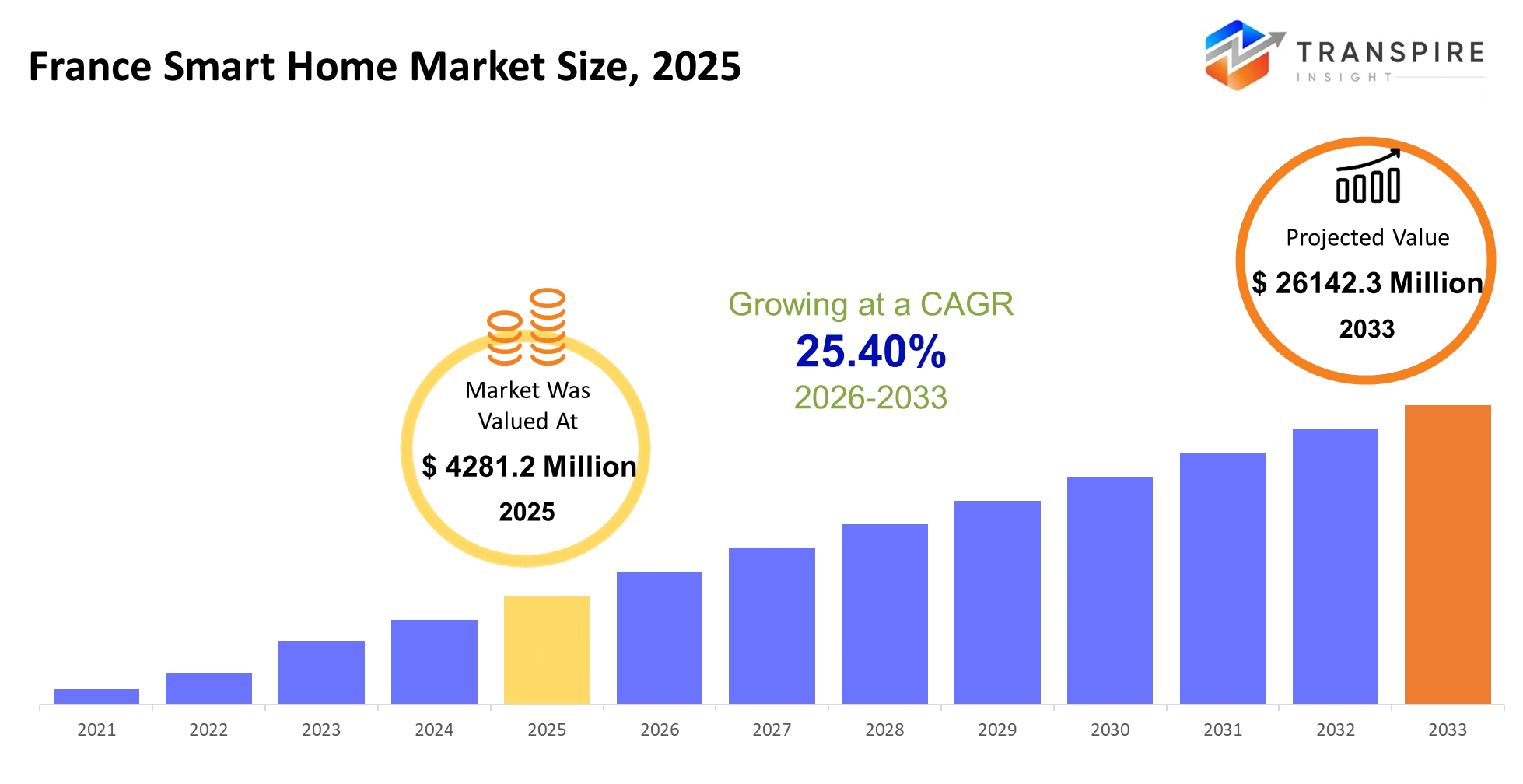
France Smart Home Market Size & Forecast:
- France Smart Home Market Size 2025: USD 4281.2 Million
- France Smart Home Market Size 2033: USD 26142.3 Million
- France Smart Home Market CAGR: 25.40%
- France Smart Home Market Segments: By Type (Smart Lighting, Smart Security, Smart Appliances, Others); By Application (Energy Management, Security, Entertainment, Home Automation, Others); By End-User (Homeowners, Tenants, Real Estate Developers, Others); By Technology (IoT, AI, Voice Assistants, Others).
To learn more about this report,  Download Free Sample Report
France Smart Home Market Summary
The France Smart Home Market was valued at USD 4281.2 Million in 2025. It is forecast to reach USD 26142.3 Million by 2033. That is a CAGR of 25.40% over the period.
The France Smart Home Market is changing how people use energy systems and security measures and comfort technologies and connected home systems through its complete digital home systems. Smart thermostats and intelligent lighting and connected surveillance systems and voice-controlled appliances enable homeowners to decrease their electricity expenses while protecting their homes and streamlining their everyday activities. Urban consumers in France use these technologies to achieve their energy-saving goals which form part of the country's overall residential energy transition.
The market has developed during the past five years starting from standalone smart devices to complete home automation systems which utilize IoT and AI technology. The combination of France's energy-efficiency guidelines and its smart building programs resulted in increased adoption across both newly constructed homes and existing home renovations. The European energy crisis led to energy price fluctuations which changed how consumers used power, resulting in increased demand for systems that monitor energy usage and heating systems. Subscription-based monitoring and cloud services and predictive home management solutions create stronger recurring revenues for vendors as device interoperability improves and telecom infrastructure expands.
Key Market Insights
- Western France held the largest market share in the France Smart Home Market which reached 38% during 2025 because the region possessed advanced broadband systems and made investments in smart housing development.
- The Southern France region presented the highest growth rate among regional markets between 2025 and 2033 because home retrofitting initiatives and fiber optic network expansion projects advanced throughout the area.
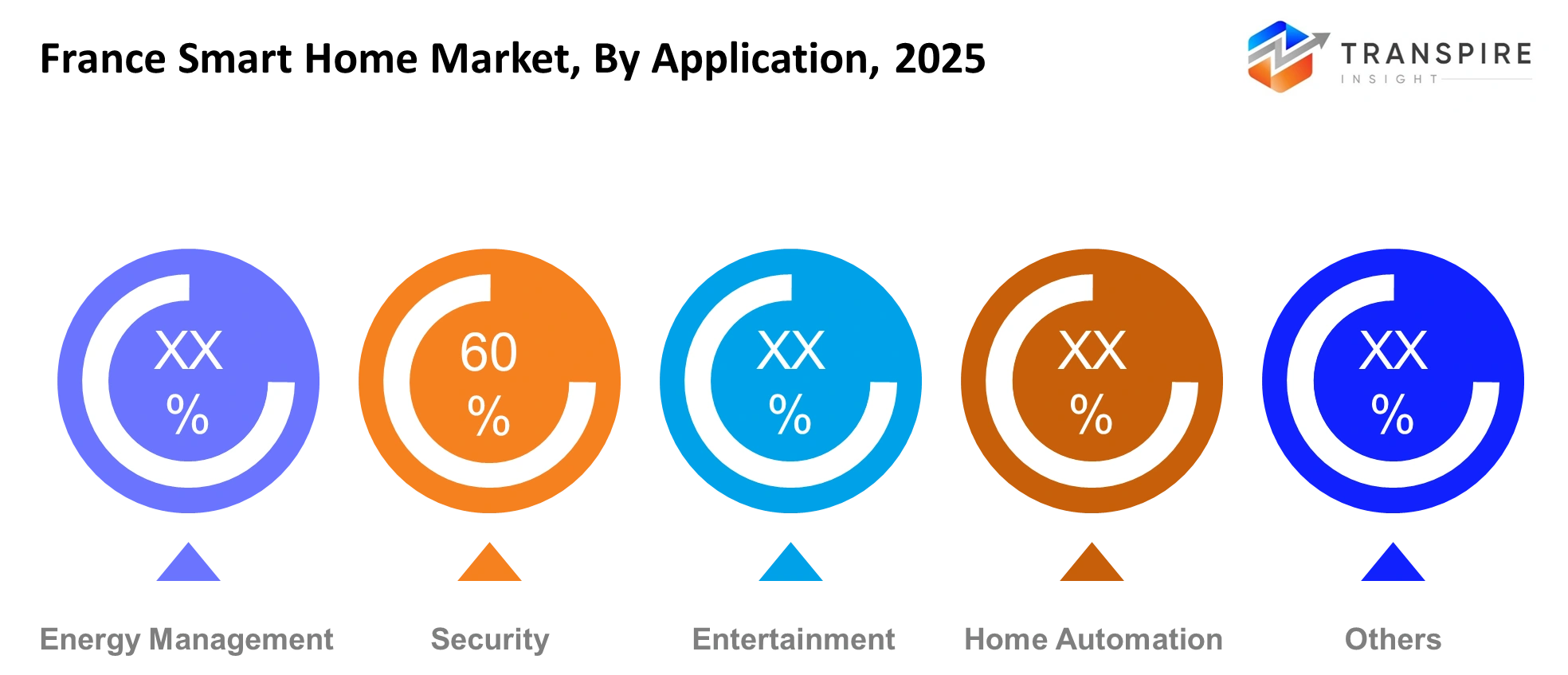
- The market for smart security systems achieved a 32% share during 2025 because the installation of connected cameras and motion sensors and remote surveillance systems increased throughout the country.
- Smart lighting served as the second largest market segment because more households started using automated energy-saving systems that work with mobile control apps.
- Smart thermostats will become the most rapidly expanding product category which will continue until 2033 because people will change their home energy use patterns to save electricity expenses.
- Energy management applications generated almost 35% of France smart living solutions revenue because smart meters became available and efficiency standards were implemented.
- After 2023 consumers showed the highest interest in remote home monitoring solutions because they could use their smartphones for surveillance and receive alerts through AI-powered systems.
- Homeowners represented the primary customer base for residential connected technology products which included automation systems in 2025 because they wanted to upgrade their homes.
- Intelligent building technology adoption became the main growth driver for real estate developers and premium housing projects which started to use these systems after 2022.
What are the Key Drivers, Restraints, and Opportunities in the France Smart Home Market?
The France Smart Home Market growth rate currently experiences its highest acceleration because energy efficiency regulations and affordable connected devices have reached their present state of development. Homeowners in France adopted smart heating systems and smart lighting systems and energy monitoring tools because of the combined impact of the country's residential energy transition policies and rising electricity rates that began after the European energy crisis. Smart thermostats with their automated HVAC systems enable households to decrease their electricity usage during active periods which results in direct financial savings that boost product usage. The implementation of telecom infrastructure improvements together with extended fiber broadband coverage developed better functionality for cloud-operated home systems which created new recurring revenue streams for platform providers.
The most significant restraint remains interoperability fragmentation across smart home ecosystems. Many households still face compatibility issues between devices operating on different communication standards, operating systems, or proprietary platforms. This structural limitation increases installation complexity and discourages large-scale adoption in older residential buildings. The presence of connected devices increases home network vulnerabilities which create additional cybersecurity challenges. The combined effect of these barriers results in delayed purchase decisions while they reduce revenue potential especially among middle-income consumers who need to see long-lasting performance before they will spend money on complete home automation systems.
Artificial intelligence-based energy management systems create a significant opportunity for residential users through their capacity to work with smart grid technology and renewable energy sources. France's growing solar energy infrastructure creates ideal conditions for developing intelligent home energy optimization systems.
What Has the Impact of Artificial Intelligence Been on the France Smart Home Market?
The Smart Home Market in France undergoes transformation because artificial intelligence enables connected devices to become smart home systems that learn user habits and perform home tasks through automated processes. AI-based home automation systems control various functions such as heating and lighting and ventilation and appliance operation through analysis of occupancy patterns and weather data and current electricity rates. Smart thermostats equipped with machine learning algorithms can reduce unnecessary energy consumption by adjusting indoor temperatures dynamically, which leads to enhanced energy efficiency for households and reduced monthly utility costs.
The use of predictive analytics has become essential for security monitoring systems that track machine status and residential security and appliance maintenance functions. AI-based monitoring systems can detect unusual equipment patterns which helps to identify upcoming device failures and enables them to generate advance warnings before systems stop working. Voice assistants and centralized smart home hubs are also using natural language processing to improve device coordination and user interaction across multi-device ecosystems. The system capabilities enable users to operate their devices easily while the system operates continuously without needing manual intervention.
Advanced digital technologies are further improving residential security through AI-driven facial recognition, motion analysis, and intelligent surveillance filtering that minimizes false alarms. The adoption of AI technologies encounters a major challenge because organizations must address complex integration processes while protecting user information. Many older residential properties require expensive infrastructure upgrades to support fully connected automation systems, while fragmented device standards reduce interoperability efficiency. The inconsistency of data-sharing standards between platforms creates challenges for accurate data verification.
Key Market Trends
- French households began to replace their individual smart devices with complete smart home systems which allowed them to manage their devices through smartphones and voice commands between 2021 and 2025.
- Homeowners started to adopt smart thermostats after the 2022 European energy crisis forced them to track their power usage and heating performance.
- Since 2023, all builders in urban France have started to use connected lighting and HVAC systems as standard features in their high-end residential building projects.
- Home automation systems with artificial intelligence capabilities developed rapidly after 2024 because they could use user data to predict energy needs and control home appliances.
- French consumers began to prefer subscription monitoring services between 2022 and 2025 which generated ongoing revenue streams for home automation companies that offered monitoring solutions.
- Schneider Electric and Legrand made interoperability investments to solve compatibility issues that occurred when multiple devices needed to work together.
- After 2023, voice assistant technology entered more markets because customers wanted to use voice commands to operate their lighting and security and entertainment and climate control systems.
- The adoption of connected surveillance systems and smart locks for French homes turned cybersecurity into an essential factor that customers use to evaluate products.
- The period from 2021 to 2025 saw a major rise in residential retrofitting work because older homes started to use connected heating systems and smart meters and automated lighting systems.
- The expansion of fiber broadband services throughout France led telecom companies and IoT platform developers to form more strategic alliances which improved the performance of cloud-based smart home services.
France Smart Home Market Segmentation
By Type
The market for home security solutions has Smart security as its top product because its connected surveillance cameras, smart locks and motion detection systems provide immediate protection for residential areas. Urban households and premium housing projects continue investing in remote monitoring solutions that support smartphone-based access and real-time alerts. The segment gains market share through insurance-linked security incentives and the increasing adoption of AI-enabled monitoring systems.
People embrace smart lighting technology because it enables them to control their energy usage while providing operational benefits. Automated lighting systems integrated with occupancy sensors and voice assistants support energy optimization across residential properties. The market for smart appliances keeps growing because connected refrigerators, washing machines and kitchen systems now work with centralized automation systems. The market for smart blinds and air quality monitors exists as a small segment which is beginning to grow because luxury homes are adopting these products. The type segment will develop into complete interoperable systems during the forecast period which will enable multiple devices to function through a single AI system.
By Application
You have received training on data which extends until October of 2023. The application field centers on energy management since connected thermostats and smart meters together with automated HVAC systems bring down electricity expenses for homes. Households need to implement intelligent energy optimization systems because rising utility costs and tougher residential efficiency requirements drive this necessity. The smart meter system shows strong implementation throughout urban areas of France which helps maintain this market segment as its primary competitive advantage.
Residential buildings now use AI-based surveillance systems combined with remote monitoring technologies for security purposes which make these systems more efficient throughout their operations. Home automation is gaining momentum as consumers seek centralized control over lighting, climate, and appliance management through mobile applications and voice-enabled platforms. Smart homes maintain their appeal through entertainment applications which work with connected audio systems and integrated streaming environments. The category of "others" which contains elderly care monitoring and wellness automation technology is growing steadily because aging populations need assisted living technologies. The future of application development will focus on platforms which unite energy management with security controls and lifestyle systems into one unified system.
To learn more about this report, Download Free Sample Report
By End-User
The main market segment for automation upgrades which boost energy efficiency and security and comfort needs of residential properties belongs to homeowners because they make long-term investments in these upgrades. Urban and suburban households maintain their buying behavior because people are developing more interest in smart home technology and their disposable income has increased. Integrated automation systems become easier to install through homeownership because residents can install these systems without facing rental restrictions.
The real estate development industry experiences substantial growth through premium residential projects which now use connected infrastructure as their basic construction component. Smart-ready apartments and intelligent housing projects help developers differentiate properties within competitive urban markets. Tenants are gradually adopting portable and subscription-based smart home products that do not require permanent infrastructure modifications. Remote monitoring and automated access management solutions have enabled the “others” category, which includes hospitality-linked residential properties and vacation rentals, to expand its market presence. The end-user demand will transition away from hardware ownership toward subscription-based service models for smart living solutions.
By Technology
The market leads IoT technology because residential automation systems require three elements which include connected sensors and cloud platforms and device interoperability. IoT networks provide essential support for smart lighting systems and connected appliances and remote surveillance systems because they enable instant communication and unified system management. Improved wireless connectivity together with expanded fiber broadband networks creates better conditions for residential IoT systems to operate in residential areas. AI technology develops swiftly because it enables users to create their own automated systems while it helps organizations reduce energy consumption and enhance their forecasting abilities. Machine learning algorithms increasingly support adaptive heating, intelligent surveillance analytics, and occupancy-based automation functions.
People continue to use voice assistants because they enable users to manage devices through natural language and control entire systems from one place. The "others" category which encompasses edge computing and advanced wireless protocols creates a small market segment that enables future system expansion and accelerates data transmission. The forecast period will see technology competition evolve to emphasize three critical areas which include interoperability and cybersecurity integration and AI-powered predictive automation systems.
What are the Key Use Cases Driving the France Smart Home Market?
The primary use cases which drive adoption of the France Smart Home Market both include connected security systems and energy management systems. Households are increasingly installing AI-enabled cameras, smart locks, motion sensors, and intelligent thermostats to reduce energy costs and improve residential security. The combination of rising electricity prices together with stricter building efficiency requirements resulted in increased use of automated heating and lighting systems within urban residential developments and retrofitted housing projects.
Home monitoring systems which use remote technology together with voice-activated home automation systems drive expansion into new application areas. Premium apartment developers and residential real estate firms are integrating centralized smart living platforms that manage lighting, entertainment, air quality, and appliance control from mobile applications. Elderly care monitoring systems have become popular among aging households because they provide remote assistance and emergency alert capabilities.
The new use cases which have emerged involve AI-based systems that forecast energy requirements together with systems that help households manage their renewable energy sources. The period from 2026 to 2033 will bring new business possibilities for smart homes which use rooftop solar systems, battery storage, and grid-responsive energy platforms. The connected housing industry in France will experience long-term growth through advanced occupancy analytics and adaptive automation systems.
|
Report Metrics |
Details |
|
Market size value in 2025 |
USD 4281.2 Million |
|
Market size value in 2026 |
USD 5359.9 Million |
|
Revenue forecast in 2033 |
USD 26142.3 Million |
|
Growth rate |
CAGR of 25.40%from 2026 to 2033 |
|
Base year |
2025 |
|
Historical data |
2021 - 2024 |
|
Forecast period |
2026 - 2033 |
|
Report coverage |
Revenue forecast, competitive landscape, growth factors, and trends |
|
Regional scope |
United States; Canada; Mexico; United Kingdom; Germany; France; Italy; Spain; Denmark; Sweden; Norway; China; Japan; India; Australia; South Korea; Thailand; Brazil; Argentina; South Africa; Saudi Arabia; United Arab Emirates |
|
Key company profiled |
Amazon, Google, Apple, Samsung, Schneider Electric, Siemens, Bosch, Philips Hue, Honeywell, LG, Sony, Panasonic, Xiaomi, Haier, ABB. |
|
Customization scope |
Free report customization (country, regional & segment scope). Avail customized purchase options to meet your exact research needs. |
|
Report Segmentation |
By Type (Smart Lighting, Smart Security, Smart Appliances, Others); By Application (Energy Management, Security, Entertainment, Home Automation, Others); By End-User (Homeowners, Tenants, Real Estate Developers, Others); By Technology (IoT, AI, Voice Assistants, Others). |
Which Regions are Driving the France Smart Home Market Growth?
The Smart Home Market in France maintains its dominance through Western and urban France because these areas possess superior digital systems and their residents have higher income and they make extensive investments in smart home technology. The cities of Paris and Lyon and Bordeaux experience advantages from their extensive broadband networks and their current connected home development efforts. The energy efficiency standards together with the government-supported building renovation initiatives, which involve installing smart thermostats and automated lighting systems and connected security cameras throughout metropolitan residential areas, resulted in a faster implementation of these technologies. The area possesses a developed ecosystem that includes telecom companies and IoT solution providers and home automation system vendors who promote ongoing customer adoption of their products.
Northern and central France contribute stable market revenue through consistent residential renovation activity and structured smart building deployment. The growth of these regions depends on long-term energy optimization initiatives instead of premium housing demand, which drives their expansion. Homeowners increasingly adopt connected heating systems and energy-monitoring technologies to manage electricity consumption in older residential buildings. The combination of stable economic conditions and slow infrastructure development maintains a constant need for smart integrated living systems in mid-sized cities and suburban residential areas.
The Southern France region establishes itself as the fastest-growing area through its rapid development of smart housing projects together with its efforts to improve fiber optic connectivity. The latest investments in energy-efficient residential projects and sustainable construction standards created better conditions for project implementation after 2023.
Who are the Key Players in the France Smart Home Market and How Do They Compete?
The France Smart Home Market shows moderate market fragmentation because both global technology companies and automation experts and energy management firms compete in the market. The market now prefers businesses which can create unified systems that combine AI and cybersecurity and cloud services and multiple device compatibility. The market now evaluates products based on their ability to provide continuous access through their platforms and subscription plans and their capacity to deliver an effortless experience to users. Established companies expand their ecosystems to protect their market position while new companies develop AI-driven customization tools and systems for connected energy management.
Google Nest uses Gemini-based voice automation and AI security analysis and Android system connection to create its unique market position. The company developed its connected home product line through advanced Nest cameras and smart speakers which enable users to automate their homes based on predictive analytics and real-time information about their devices. Schneider Electric operates as a competitor in the market through its energy management expertise which merges smart electrical systems with home automation technologies that promote energy conservation and efficient grid operations. The company builds its business model around establishing partnerships and developing smart energy management systems.
Samsung SmartThings develops its competitive advantage through its ability to connect different devices and its alliances with appliance producers and telecommunications companies. Honeywell focuses on developing AI-powered climate management systems and residential energy optimization solutions which serve high-end residential development projects. Bosch uses its European engineering network to build connected security systems and heating solutions and home appliance systems which offer enduring product performance and secure data handling capabilities. These companies develop connected systems which enable their users to acquire complete control over their home energy usage.
Company List
- Amazon
- Apple
- Samsung
- Schneider Electric
- Siemens
- Bosch
- Philips Hue
- Honeywell
- LG
- Sony
- Panasonic
- Xiaomi
- Haier
- ABB
Recent Development News
In October 2025, Google launched Gemini-powered Nest Cams, Nest Doorbell devices, and a new Google Home Speaker. The launch strengthened AI-driven home automation, advanced video analytics, and conversational smart home control capabilities across connected residential ecosystems.
Source: https://blog.google
In October 2025, Google Home & Nest introduced the “Gemini for Home” AI platform and Google Home Premium subscription service. The rollout enhanced natural language automation, predictive smart home management, and recurring subscription revenue opportunities within the smart home technology sector.
Source: https://blog.google/products-and-platforms
What Strategic Insights Define the Future of the France Smart Home Market?
The French Smart Home Market is developing toward residential systems which use artificial intelligence to manage their energy consumption and control their automated processes and maintain their device connections. The market will develop toward greater alignment with digital home services which use subscription models and renewable energy systems and smart grid infrastructure during the upcoming five to seven years. The primary force which drives this transformation stems from France's national energy transition plan which consumers now implement to achieve energy savings and control their smart building systems.
Ecosystem providers who control platform operations create an unrecognized danger because they establish greater market control through their business partnerships. Vendors and developers face permanent vendor lock-in difficulties because their systems depend on exclusive operating systems which restrict system interoperability. The residential solar system and battery storage market creates an important emerging business opportunity which yet remains untapped in the present day.
Market participants need to establish open-platform interoperability while investing in cybersecurity and building relationships with telecommunications companies in order to achieve sustainable competitive advantage because connected living ecosystems will become more interconnected and focused on delivering services.
France Smart Home Market Report Segmentation
By Type
- Smart Lighting
- Smart Security
- Smart Appliances
- Others
By Application
- Energy Management
- Security
- Entertainment
- Home Automation
- Others
By End-User
- Homeowners
- Tenants
- Real Estate Developers
- Others
By Technology
- IoT
- AI
- Voice Assistants
- Others
Frequently Asked Questions
Find quick answers to common questions.
The confirmed 2033 market size figure in USD 26142.3 Million.
Key segments for the France Smart Home Market are By Type (Smart Lighting, Smart Security, Smart Appliances, Others); By Application (Energy Management, Security, Entertainment, Home Automation, Others); By End-User (Homeowners, Tenants, Real Estate Developers, Others); By Technology (IoT, AI, Voice Assistants, Others).
Major France Smart Home Market players are Amazon, Google, Apple, Samsung, Schneider Electric, Siemens, Bosch, Philips Hue, Honeywell, LG, Sony, Panasonic, Xiaomi, Haier, ABB.
The France Smart Home Market size is USD 4281.2 Million in 2025.
The France Smart Home Market CAGR is 25.40% from 2026 to 2033.
- Amazon
- Apple
- Samsung
- Schneider Electric
- Siemens
- Bosch
- Philips Hue
- Honeywell
- LG
- Sony
- Panasonic
- Xiaomi
- Haier
- ABB
Recently Published Reports
-
Apr 2026
Fiber Optic Faceplates Market
Fiber Optic Faceplates Market Size, Share & Analysis Report By Type (< 300 mm2, 300-350 mm2, and > 350 mm2, By Application (Night Vision, Holographic Imaging, Medical, and Others), and Geography (North America, Europe, Asia-Pacific, Middle East and Africa, South and Central America), 2021 - 2031
-
Apr 2026
High Temperature Superconductors Market
High Temperature Superconductors Market Size, Share & Analysis Report By Type (1G HTS, and 2G HTS), By Application (Power Cable, Fault Current Limiter, and Transformer), and Geography (North America, Europe, Asia-Pacific, Middle East and Africa, South and Central America), 2021 - 2031
-
Apr 2026
Industrial Plugs and Socket Market
Industrial Plugs and Socket Market Size, Share & Analysis Report By Type (Industrial Plugs, Industrial Sockets), By Current (Up to 32 A, 32 to 125 A, Above 125 A), By Protection (Dustproof and Splash Proof, Waterproof, Explosion Proof), By End User (Heavy Industries, Oil and Gas, Chemicals and Pharmaceuticals, Power Generation, Others), and Geography (North America, Europe, Asia-Pacific, Middle East and Africa, South and Central America), 2021 - 2031
-
Apr 2026
InGaAs Avalanche Photodiodes Market
InGaAs Avalanche Photodiodes Market Size, Share & Analysis Report By Type (1100 - 1700 nm, and 1000 - 1600 nm), By Application (Missile Warning System, Muzzle Flash Detection, Wafer Defect Inspection, Laser Rangefinders, and Others), and Geography (North America, Europe, Asia-Pacific, Middle East and Africa, South and Central America), 2021 - 2031