

Urinary Catheters Market Summary:
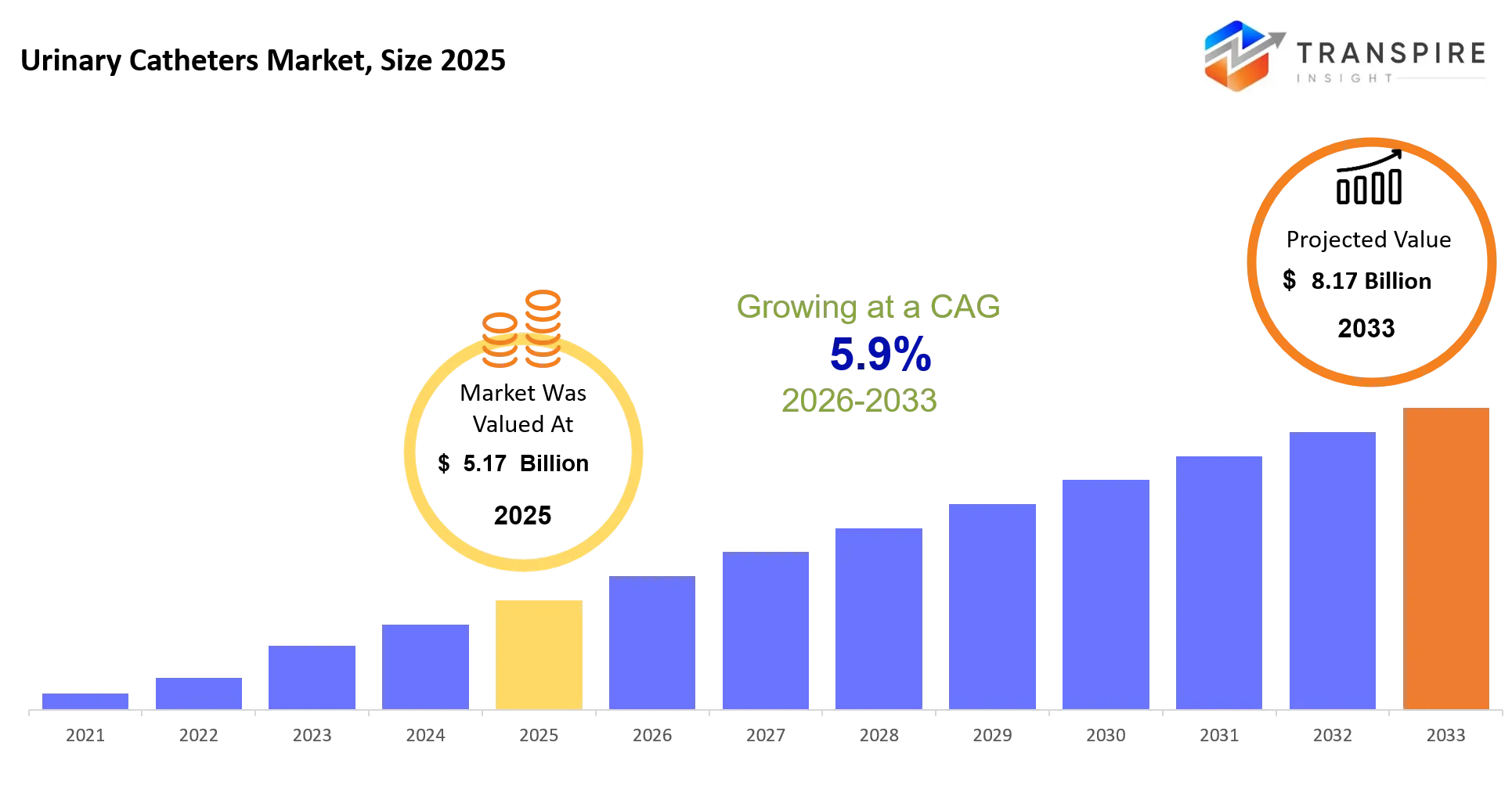
As per Transpire Insight Analysis, the Urinary Catheters Market size is estimated at USD 5.17 billion in 2025 and is anticipated to reach USD 8.17 billion by 2033, growing at a CAGR of 5.9% from 2026 to 2033. The growth of the market is driven by ageing demographics, increased hospitalisations, and higher demand for safe and comfortable urine care products.
The Urinary Catheters Market is being transformed due to the desire to improve the safety and comfort of urinary management among patients. Urinary catheters are commonly used in hospitals, clinics and even in patients' homes as a means to assist patients when they have issues with draining their bladder.
In recent years, the urinary catheters market has become interested in developing such products which minimize the risks of infection and are easy to use to improve the outcomes for patients. One trend is that there is an increased interest in materials used in the production of urinary catheters and in coatings used to increase the comfort of insertion of such catheters. There is a demand for urinary care products suitable both for use in hospitals and at home. Many factors are driving the market growth, including an increased number of hospital admissions, an ageing population and increased use of urinary catheters for managing some chronic conditions and recovering after operations. All these factors prompt hospitals and manufacturers to develop catheter products that are centred around patients' needs. The importance of urinary catheters is rising.
Urinary Catheters Market Size & Forecast:
- Global Market Size 2025: USD 5.17 Billion
- Expected Market Value (2033): USD 8.17 Billion
- Forecast CAGR (2026–2033): 5.9%
- Leading Region in 2025: North America
- Fastest Growing Region: Asia Pacific
- Key Company Profiles: Coloplast, B. Braun, BD, Teleflex, Hollister Incorporated, Convatec, Medline Industries, Cardinal Health, Cook Medical, Well Lead Medical, Boston Scientific, Romsons, Amsino International, Advin Health Care, Flexicare Medical
Key Market Insights:
The global market for urinary catheters is now heading towards those which provide enhanced comfort, easy handling and infection control. Foley catheters continue to dominate the product segment, while the demand for hydrophilic products is increasing due to their convenience.
- The Foley catheters constitute 39% of the total share of the market since hospitals continue to use them for continual urinary drainage.
- Intermittent catheters account for 28%, as the home use of bladder management increases in chronic users.
- External catheters make up 14%, with producers improving applicability and avoiding irritation of the skin by these catheters.
- Hydrophilic catheters account for 11% of the market and grow with a CAGR of 8.8% due to better coating technology.
- The suprapubic catheters constitute 5%, and their importance remains for patients with the need for long-term urinary management.
- Other catheter types account for 3% and satisfy some clinical needs.
- Producers develop new coatings and materials in order to increase comfort and safety in catheter usage.
- Healthcare specialists take into consideration the design and features of infection prevention while choosing catheter systems.
- Home care increases the need for such catheter systems, which could be used without medical intervention.
What are the Key Drivers, Restraints, and Opportunities in the Urinary Catheters Market?
Drivers
The market for global urinary catheters is experiencing growth due to the increasing demand for catheterisation services both in hospitals and homes. The rising number of surgeries performed and the increased demand for catheterisation from patients suffering from chronic bladder disorders are some of the factors contributing to product demand. The development of improved catheter materials and hydrophilic coatings is encouraging healthcare professionals to adopt products that offer ease and comfort during their application.
Restraints
One of the most significant challenges will be the ongoing problem of catheter-related infections. This problem cannot be easily solved since prolonged use of the catheters may cause infections and requires special attention. Thus, healthcare organisations have to develop effective infection control measures, which may lead to higher costs for treatment and restrictions on the use of some products.
Opportunities
An opportunity that presents itself will be catheters with modern coatings and user-friendly design. Manufacturers will also be able to develop in the home care market and the growing Asian market, which is developing healthcare infrastructure. Development of hydrophilic products can become a source of additional income for manufacturers. The expansion of the company could be done by targeting the market for home-care, as well as the emerging market in Asia. This is an investment that has the potential to generate income.
What Has the Impact of Artificial Intelligence Been on the Urinary Catheters Market?
Artificial intelligence is increasingly starting to contribute to the process of urinary catheters' maintenance through the identification of risk factors and better patient monitoring. With the help of the analysis of patient records and clinical data, artificial intelligence-based systems can identify certain trends that increase the likelihood of urinary complications. In hospitals, the process can be supported through connected monitoring technologies that will provide an opportunity to monitor catheter-related information without having to perform repeated assessments. The use of predictive analytics can also help healthcare professionals recognise patients who might be at a higher risk of complications and provide appropriate monitoring. Automation can help in the process of documentation and improvement of the catheter care process in busy healthcare organisations.
On the side of the manufacturers, artificial intelligence and connected technologies can also be helpful in the development of the products through identifying the needs and preferences of patients. Adoption of these technologies is still limited because of the costs of the digital system and integration with existing hospital infrastructure. In June 2025, Becton Dickinson and Company incorporated digital and AI-enabled technology in the healthcare solutions offered in order to aid clinical decision-making and enhance the patient experience. In the realm of urinary catheters, AI and other data-enabled technologies have opened up possibilities in terms of smart monitoring of patients who have been catheterised, as well as the early detection of any complications like catheter-associated UTIs.
Key Market Trends:
The trend in the urinary catheters market involves increased safety, improved comfort, and better handling of the devices. There is a shift towards more advanced materials and urinary catheter designs that meet modern requirements.
- Hydrophilic catheter use is growing due to the improved comfort during the procedure associated with the coating used.
- Infection control becomes more popular as medical professionals try to prevent the risks that can be caused by catheter use.
- There is an increase in the number of people receiving at-home care as they have urinary issues.
- More catheter manufacturers produce products that are designed to make handling simpler.
- There is an increased interest in advanced catheter materials.
- Medical facilities pay more attention to the efficiency of catheter management and try to avoid clinical interventions.
- Connected healthcare opens up new opportunities in gathering the patient data associated with catheters.
- The demand for intermittent catheters changes as self-catheterisation is getting easier for the right candidates.
Urinary Catheters Market Segmentation
By product type
Foley catheters are the largest, accounting for 39% of the market, as they are extensively used for providing continuous drainage of urine in hospitals and other healthcare facilities. Interim catheters constitute 28%, and external catheters are 14%. Hydrophilic catheters are 11% and forecast to register the highest growth at a CAGR of 8.8%. Suprapubic catheters constitute 5%, while others are 3%.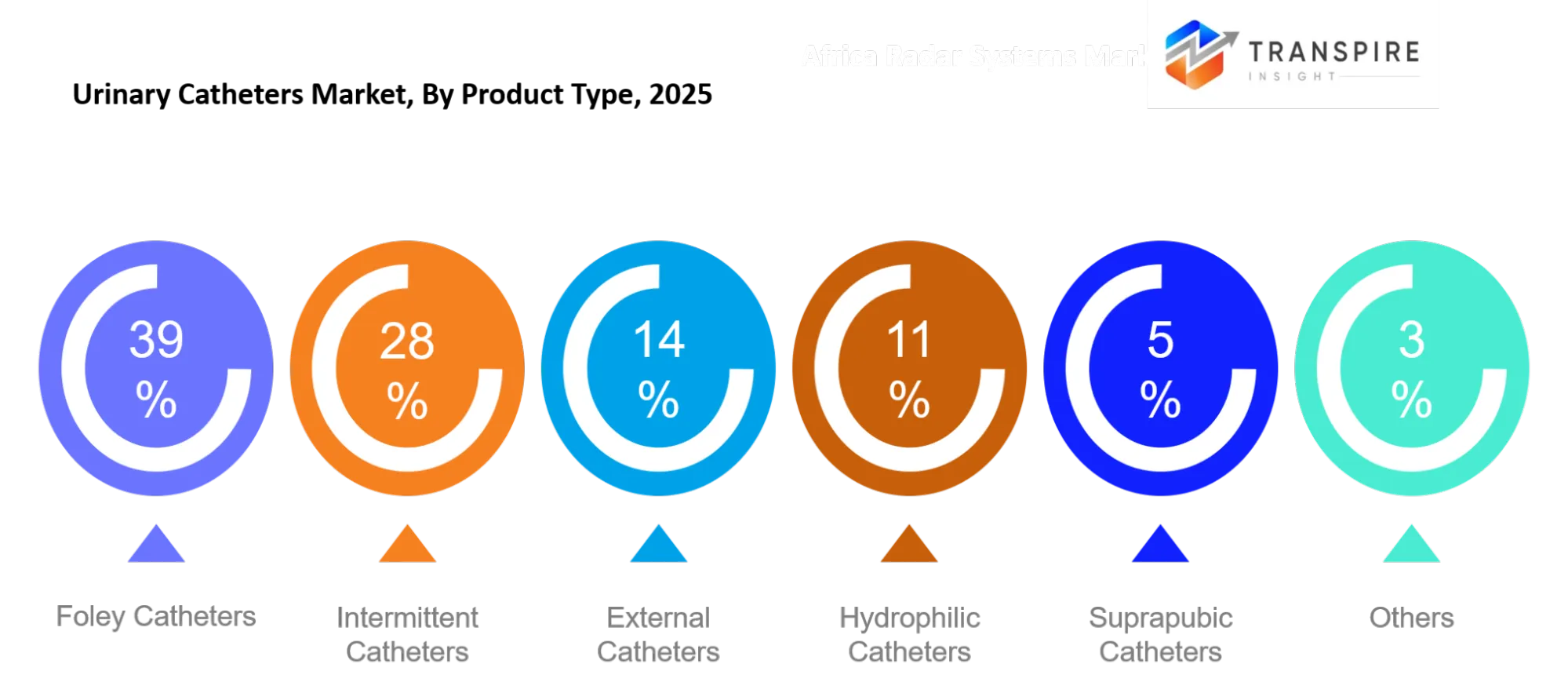
By Material
Silicone, latex, PVC, polyurethane, and hydrogel-coated materials are being used for specific clinical uses. Silicone catheters are better for long-term use, while hydrogel-coated and other advanced materials are becoming more prominent.
By Indication
Indication-wise, urinary incontinence continues to be one of the major applications along with benign prostatic hyperplasia, spinal cord injury, post-operative care and neurogenic bladder. The needs of urinary management under these indications are different from each other.
By End-user
Hospitals continue to be a significant market segment due to surgeries and patients’ stays at the hospitals. Clinics, home care, ambulatory surgery centres, and long-term care institutions are other segments of end users who expand the usage of products for urinary management, which is gradually moving out of hospital settings.
By Distribution Channel
Distributor-wise, hospital pharmacies and medical distributors are important channels for procurement by institutions. In addition, retail pharmacies and online pharmacies have become significant channels, especially in the case of recurrent catheter requirements in home care settings.
What are the Key Use Cases Driving the Urinary Catheters Market?
Use case in a hospital is one of the major applications for Foley catheters, which offer constant urine drainage in postoperative conditions and patients under clinical surveillance. The market is a consequence of the numerous applications in inpatient treatment and postoperative care. Increasing application of intermittent catheterisation is associated with an increased need for patients with neurogenic bladder urinary incontinence and spinal cord injury to drain their bladder regularly. Home care facilities assist with this application as well, catering to the needs of applicable patients and caregivers in managing recurring catheterisation at home. Hydrophilic catheters are forming another emerging use case due to their smooth surface coating for enhanced insertion ease and higher patient comfort.
|
Report Metrics |
Details |
|
Market size value in 2025 |
USD 5.17 Billion |
|
Market size value in 2026 |
USD 5.47 Billion |
|
Revenue forecast in 2033 |
USD 8.17 Billion |
|
Growth rate |
CAGR of 5.9% from 2026 to 2033 |
|
Base year |
2025 |
|
Historical data |
2021 - 2024 |
|
Forecast period |
2026 - 2033 |
|
Report coverage |
Revenue forecast, competitive landscape, growth factors, and trends |
|
Regional scope |
United States; Canada; Mexico; United Kingdom; Germany; France; Italy; Spain; Denmark; Sweden; Norway; China; Japan; India; Australia; South Korea; Thailand; Brazil; Argentina; South Africa; Saudi Arabia; United Arab Emirates |
|
Key company profiled |
Coloplast, B. Braun, BD, Teleflex, Hollister Incorporated, Convatec, Medline Industries, Cardinal Health, Cook Medical, Well Lead Medical, Boston Scientific, Romsons, Amsino International, Advin Health Care, Flexicare Medical |
|
Customization scope |
Free report customization (country, regional & segment scope). Avail customized purchase options to meet your exact research needs. |
|
Report Segmentation |
By Product Type (Intermittent Catheters, Foley Catheters, External Catheters, Suprapubic Catheters, Hydrophilic Catheters, Others); By Material (Silicone, Latex, PVC, Polyurethane, Hydrogel-coated, Others); By Indication (Urinary Incontinence, Benign Prostatic Hyperplasia, Spinal Cord Injury, Post-operative Care, Neurogenic Bladder, Others); By End User (Hospitals, Clinics, Home Care, Ambulatory Surgical Centers, Long-term Care Facilities, Others); By Distribution Channel (Hospital Pharmacies, Retail Pharmacies, Online Pharmacies, Medical Distributors, Others) |
Which Regions are Driving the Urinary Catheters Market Growth?
North America
North America is the leading regional market for urinary catheters, with a market share of 37%, backed up by well-developed healthcare infrastructure and availability of quality catheter products. Well-developed hospital networks and clinical practice are contributing toward the sustained usage of urinary catheters in the region. In March 2025, FLUME Catheter Company launched its FLUME urinary catheter in the United States market. It was reported that the product would be distributed from the company's warehouse in the US, with deliveries set to start in April 2025. The FLUME urinary catheter was cleared by the FDA under the 510(k) process and was indicated for use for both urethral and suprapubic applications. The company emphasised the expansion of innovative urinary catheter solutions in the North American market.
Europe
The European region holds 29% of the global market and is a consistent regional market owing to its developed healthcare system and consistent need for urinary catheters in the market. Well-developed clinical infrastructure and usage within hospitals and long-term care centres make the region a strong contender.
Asia Pacific
Asia Pacific holds 25% of the global market and is the fastest-growing region with a CAGR of 9.5%. Growing healthcare infrastructure and growing access to medical products are helping catheter manufacturers capture the market. Growing investments in the healthcare sector might help in capturing more market share.In November 2025, Coloplast extended the availability of Luja male intermittent catheter in Australia. The catheter utilises the unique Micro-hole Zone Technology with more than 80 micro-holes instead of common eyelets and is meant to provide complete bladder emptying without the risks of UTIs.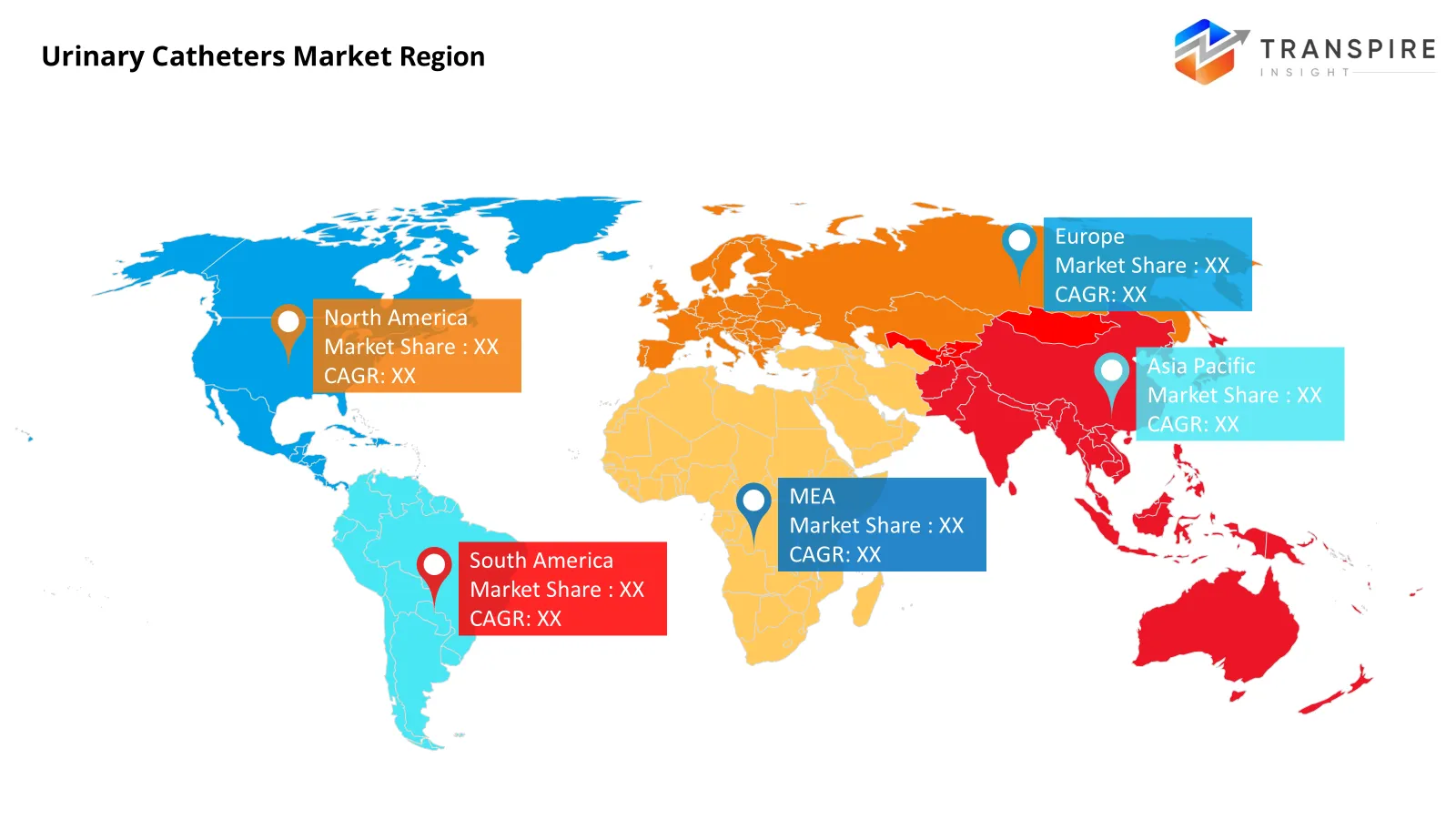
Who are the Key Players in the Urinary Catheters Marketand how do they Compete?
In the Urinary Catheters Market, there are various medical device companies with competition based on product innovation, strong distribution and urinary products. The key players in this market are Coloplast, B. Braun, Hollister, Teleflex, BD, ConvaTec, Boston Scientific and Medtronic. However, competition is now focusing on patient comfort, infection control, catheter material and product design meant for at-home care.
Coloplast competes with its focus on patient-oriented urinary care and specialised catheters. The company also benefits from its established distribution channels. The company, B. Braun, has been competing through having a diversified urology portfolio and constant investments in product development and production. The company, Hollister, competes with its user-friendly urinary care products and patient-oriented products. Teleflex competes with a diversified catheter portfolio and clinical application and distribution internationally. BD competes by leveraging its large medical device portfolio and infection control. ConvaTec competes with a focus on continence care and product development. Boston Scientific and Medtronic compete with medical technology portfolios.
Urinary Catheters Market companies
- Coloplast
- B. Braun
- BD
- Teleflex
- Hollister Incorporated
- Convatec
- Medline Industries
- Cardinal Health
- Cook Medica
- Well Lead Medical
- Boston Scientific
- Romsons
- Amsino International
- Advin Health Care
- Flexicare Medical
Recent Development News
In February 2026, BD introduced its new PureWick Flex Female External Catheter and PureWick Male External Catheter in Japan. The introduction is intended to widen the scope of non-invasive alternatives in urinary care and to minimise risks of catheter infections while decreasing the burden on health care personnel.
In November 2025, Hollister made an important announcement about its policy decision, which included Medicare coverage of closed system intermittent catheters for spinal cord injury patients. The development helps to increase the availability of the product used to reduce the risk of urinary tract infections.
What Strategic Insights Define the Future of the Urinary Catheters Market?
The Urinary Catheters Market trends towards urinary devices that provide both user comfort and safe and convenient urinary management. The innovations in coatings, materials, and design are expected to shape future developments due to healthcare's movement towards personalisation. There is a latent threat of infections caused by catheters, as they may raise the cost of treatment and increase health professionals' awareness of health professionals regarding catheter utilisation. On the other hand, hydrophilic catheters seem to be an emerging opportunity for the market players, as their faster growth compared to that of other product types indicates. Another opportunity for market development is the introduction of catheters' infection control capabilities along with the improvements in catheter usability and materials. Finally, expansion into the Asia Pacific region provides great market potential due to the development of healthcare infrastructure and increasing availability of medical equipment.
By Product Type
- Intermittent Catheters
- Foley Catheters
- External Catheters
- Suprapubic Catheters
- Hydrophilic Catheter
By Material
- Silicone
- Latex
- PVC
- Polyurethane
- Hydrogel-coated
By Indication
- Urinary Incontinence
- Benign Prostatic Hyperplasia
- Spinal Cord Injury
- Post-operative Car
- Neurogenic Bladder
By End User
- Hospitals
- Clinics
- Home Care
- Ambulatory Surgical Centres
- Long-term Care Facilities
By Distribution Channel
- Hospital Pharmacies
- Retail Pharmacies
- Online Pharmacies
- Medical Distributors
Regional Outlook
North America
- United States
- Canada
- Mexico
Europe
- Germany
- United Kingdom
- France
- Spain
- Italy
- Rest of Europe
Asia Pacific
- Japan
- China
- Australia & New Zealand
- South Korea
- India
- Rest of Asia Pacific
South America
- Brazil
- Argentina
- Rest of South America
Middle East & Africa
- Saudi Arabia
- United Arab Emirates
- South Africa
- Rest of the Middle East & Africa
Frequently Asked Questions
Find quick answers to common questions.
The Urinary Catheters Market size was valued at USD 5.17 Billion in 2025 and is poised to reach USD 8.17 Billion by 2033, expanding at a 5.9% CAGR.
Key segments for the Urinary Catheters Market are By Product Type (Intermittent Catheters, Foley Catheters, External Catheters, Suprapubic Catheters, Hydrophilic Catheters, Others); By Material (Silicone, Latex, PVC, Polyurethane, Hydrogel-coated, Others); By Indication (Urinary Incontinence, Benign Prostatic Hyperplasia, Spinal Cord Injury, Post-operative Care, Neurogenic Bladder, Others); By End User (Hospitals, Clinics, Home Care, Ambulatory Surgical Centers, Long-term Care Facilities, Others); By Distribution Channel (Hospital Pharmacies, Retail Pharmacies, Online Pharmacies, Medical Distributors, Others).
Growth is primarily driven by increased cases of urinary problems, a rise in the ageing population, an increase in urological procedures, increased healthcare costs, and increased use of advanced and minimally invasive urinary catheters.
The global market is led by major manufacturers including Coloplast, B. Braun, BD, Teleflex, Hollister Incorporated, Convatec, Medline Industries, Cardinal Health, Cook Medical, Well Lead Medical, Boston Scientific, Romsons, Amsino International, Advin Health Care, Flexicare Medical.
North America constitutes about 37% of the world’s market for urinary catheters. The leadership of North America is attributed to its superior health care infrastructure, increased adoption of urinary care products, growing number of older population and increased use of minimally invasive devices.
The Urinary Catheters Market provides growth potential due to the creation of innovative anti-microbial and hydrophilic catheters, increased consumer demand for at-home urinary catheterisation, and usage of disposable and minimally invasive catheters. Increased healthcare expenditures in emerging economies are another avenue for expansion of this Market.
- Coloplast
- B. Braun
- BD
- Teleflex
- Hollister Incorporated
- Convatec
- Medline Industries
- Cardinal Health
- Cook Medica
- Well Lead Medical
- Boston Scientific
- Romsons
- Amsino International
- Advin Health Care
- Flexicare Medical
About the Authors

Pankaj Ghogare Patil
I am Pankaj Ghogare Patil, a Senior Research Analyst at Transpire Insight, specializing in the Pharmaceutical, Chemicals & Materials, Healthcare IT, and Biotechnology industry. My expertise lies in conducting comprehensive market research, analyzing industry trends, evaluating competitive landscapes, and translating complex data into actionable insights. At Transpire Insight, I closely follow emerging technologies, regulatory developments, and market innovations to create accurate, well-researched, and informative content that helps businesses and professionals make informed decisions. I am committed to producing credible, evidence-based articles that reflect industry best practices while making technical topics accessible and valuable for a broad audience.

Chakradhar Khansole
Chakradhar serves as the Research Director at Transpire Insight, bringing over 8 years of experience in technology, innovation, and strategic market intelligence. He specializes in transforming complex market data into actionable business insights that enable organizations to make informed, growth-oriented decisions. Recognized for his strategic vision and analytical expertise, Chakradhar leads high-impact research initiatives, delivering comprehensive market assessments, competitive intelligence, and forward-looking industry analysis.
Recently Published Reports
-
Jul 2026
Alopecia Treatment Market
Alopecia Treatment Market Size, Share & Analysis Report By Disease Type (Alopecia Areata, Cicatricial Alopecia, Traction Alopecia, Alopecia Totalis, Androgenetic Alopecia, Alopecia Universalis, and Other Disease Types), By Treatment Type (Topical Treatments, Oral Medications, Injectable Therapies, and Hair Transplantation), By Gender (Male, and Female), By Distribution Channel (Hospitals and Clinics, Retail Pharmacies, and Online Retailers), and Geography (North America, Europe, Asia-Pacific, Middle East and Africa, South and Central America), 2021 - 2031
-
Jul 2026
Medical Ultrasound Probe Market
Medical Ultrasound Probe Market Size, Share & Analysis Report By Type (Linear Type, Convex Type, Endocavitary Probe, Phased Array/Cardiac Probe, Transesophageal (TEE) Probe, and Others), By Application (Ophthalmology, Cardiology, Musculoskeletal, Oncology, Obstetrics & Gynecology, General Imaging, and Others), By End User (Hospitals & Clinics, Diagnostic Centers, Ambulatory Surgical Centers, and Others), and Geography (North America, Europe, Asia-Pacific, Middle East and Africa, South and Central America), 2021 – 2031
-
May 2026
Biosimilars Market
Biosimilars Market By Product Type (Monoclonal Antibodies, Recombinant Hormones, Erythropoietin, G-CSF, Others), By Indication (Oncology, Autoimmune Diseases, Blood Disorders, Diabetes, Others), By Manufacturing Type (In-House Manufacturing, Contract Manufacturing), By Distribution Channel (Hospital Pharmacies, Retail Pharmacies, Online Pharmacies), By Industry Analysis, Size, Share, Growth, Trends, and Forecasts 2021-2033
-
Apr 2026
Gastrointestinal Endoscopy Market
Gastrointestinal Endoscopy Market By Type (Rigid Gastrointestinal Endoscope, Flexible Gastrointestinal Endoscopes, Disposable Gastrointestinal Endoscope), By Procedure Type (Colonoscopy, Gastroscopy, Duodenoscopy, Enteroscopy, Flexible Sigmoidoscopy, Others), By Application (Diagnosis, Treatment), By End-Users (Hospitals, Ambulatory Surgical Centers, Specialty Clinics, Laboratories, Others), By Industry Analysis, Size, Share, Growth, Trends, and Forecasts 2021-2033