

France Antimicrobial Catheters Market Size & Forecast:
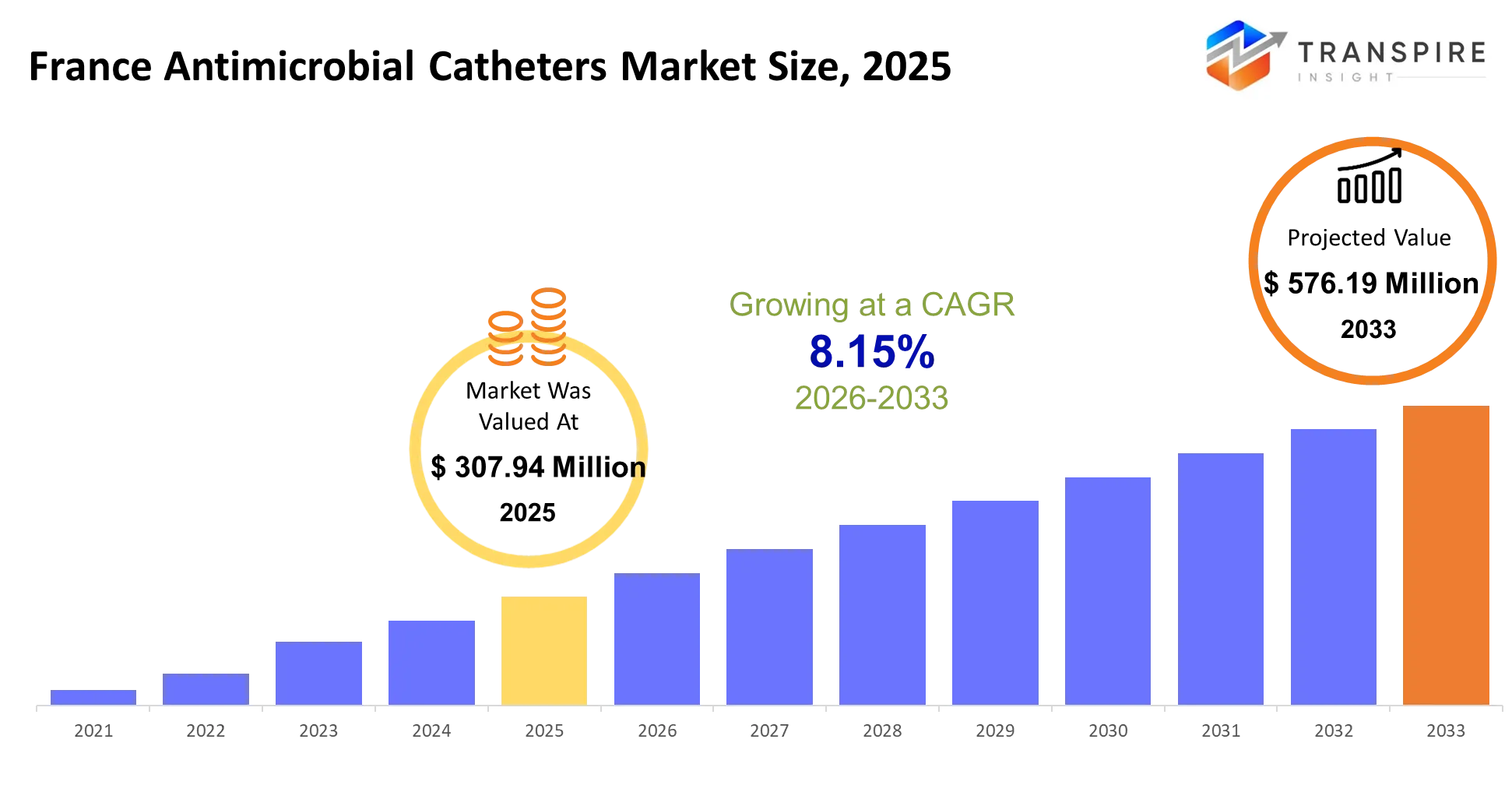
- France Antimicrobial Catheters Market Size 2025: USD 307.94 Million
- France Antimicrobial Catheters Market Size 2033: USD 576.19 Million
- France Antimicrobial Catheters Market CAGR: 8.15%
- France Antimicrobial Catheters Market Segments: By Type (Silver-coated, Antibiotic-coated, Others); By Application (Urinary Catheters, Central Venous Catheters, Others); By End-User (Hospitals, Clinics, Homecare, Others); By Material (Latex, Silicone, Others)
To learn more about this report,  Download Free Sample Report
France Antimicrobial Catheters Market Summary
The France Antimicrobial Catheters Market was valued at USD 307.94 Million in 2025. It is forecast to reach USD 576.19 Million by 2033. That is a CAGR of 8.15% over the period.
The France Antimicrobial Catheters Market kinda plays a key role in cutting down hospital-acquired infections tied to urinary, central venous, and cardiovascular catheter procedures. These catheters are built to help limit bacterial colonization during long-term patient support, especially in intensive care units, after surgery, and even for chronic disease care. In the last five years, the market sort of moved away from basic coated catheters toward more advanced silver-ion and antibiotic-impregnated options plus hydrophilic antimicrobial technologies, mainly because French healthcare providers tightened infection control benchmarks, and also put more attention on reimbursement compliance.
One big trigger came during the post-COVID hospital restructuring phase. That period made the financial weight of catheter-associated infections more visible, and it pushed hospitals to invest more in infection prevention infrastructure . Because of that, procurement of premium antimicrobial devices has sped up even if the sticker price is higher up front. Hospitals, now, lean more heavily on reduced readmission rates, faster discharge timelines, and lower antibiotic usage. And as healthcare systems continue moving toward outcome based care models, manufacturers that can show clinically validated infection-reduction performance are winning stronger contract volumes, plus more long-term institutional agreements.
Key Market Insights
- After 2021, the France antimicrobial catheters market kind of shifted toward silver alloy and antibiotic coated devices, following those infection control reforms in public hospitals, which you know.
- Northern and urban healthcare clusters seem to lead the way with about 45% market share, since procedural volumes are higher there and the tertiary care infrastructure is more advanced.
- Western France is turning out to be the fastest-growing regional market through 2033, because regional hospitals have put more money into ICU modernization programs over the last few years.
- Central venous catheters keep the largest industry share, especially since oncology, dialysis, and critical care procedures keep growing across French healthcare networks.
- Urinary antimicrobial catheters stay in the second-largest slot because catheter associated urinary tract infection management is still required a lot, particularly in long term care facilities.
- Antimicrobial coated PICC lines are growing fastest, driven by outpatient chemotherapy and home based infusion therapies that expanded after 2022.
- Intensive care use dominates at over 35% share, mostly because infection prevention protocols became stricter after pandemic-era hospital audits, and the review cycles got tighter.
- Home healthcare plus ambulatory surgical centers show the strongest adoption growth too, as France decentralizes chronic disease treatment pathways.
- And manufacturers are building competitive momentum via AI assisted infection monitoring, antimicrobial polymer innovation, and long term procurement partnerships with French hospital groups.
What are the Key Drivers, Restraints, and Opportunities in the France Antimicrobial Catheters Market?
The main thing, sort of, that accelerates market expansion is the ongoing tightening of infection-prevention protocols across French hospitals plus long-term care institutions. In practice, healthcare authorities placed extra pressure on hospitals to bring down catheter-associated bloodstream infections and urinary tract infections, after post-pandemic clinical audits showed treatment costs that were… kinda high, and mostly linked to longer stays. That change, in turn, directly pushed more procurement of antimicrobial-coated catheters, because hospitals now basically compare device choices with readmission performance, antibiotic use, and reimbursement efficiency. So, premium antimicrobial products are seeing stronger entry in intensive care, oncology, and dialysis environments where infection risk keeps staying relatively high, all the time.
The biggest drag is the structural cost burden tied to advanced antimicrobial catheter systems. Silver-alloy coatings, antibiotic impregnation setups, and multi-layer antimicrobial polymers make manufacturing more complex and raise procurement spending. A lot of smaller hospitals and regional care centers still run on limited healthcare budgets, so they can’t swap out standard catheter inventories quickly enough. On top of that, clinical validation needs, and long approval periods, make adoption slower, because providers want solid evidence of infection-reduction outcomes before they expand procurement arrangements.
A notable opportunity is the integration of smart catheter technologies together with infection surveillance ecosystems. In France, healthcare networks are gradually investing in connected patient monitoring infrastructure, which makes it easier for antimicrobial catheters with embedded biosensors or digital tracking features to move ahead.
What Has the Impact of Artificial Intelligence Been on the France Antimicrobial Catheters Market?
In recent years Artificial intelligence ,and advanced digital health technologies are kinda reshaping the way infection management works, especially when it comes to antimicrobial catheter usage across hospitals in France. You see more AI based monitoring platforms being brought in to follow catheter dwell time, spot early infection signals, and even automate the compliance paperwork that usually piles up in intensive care and surgical departments. Some hospitals that connect electronic patient monitoring tools with catheter management software say they’ve gotten steadier procedural habits and also less time spent on manual documentation for the clinical team.
Then there are the machine learning models, which add predictive infection analytics by looking at patient history, catheter duration, immune status, and how treatment response patterns behave over time. In practice these systems tend to help clinicians detect high risk situations earlier and decide on catheter replacement timing before complications appear. A number of healthcare providers also mentioned a more “directional” improvement in how hospital resources are used, with fewer infection related readmissions and shorter ICU stays after they combined predictive surveillance with antimicrobial device protocols.
On top of that, advanced analytics platforms can support procurement strategy too, by forecasting catheter utilization patterns and flagging departments where infection exposure is higher. But AI adoption has a big snag. The main issue is fragmented hospital data infrastructure, plus gaps in interoperability between older, legacy clinical systems. Many regional facilities still don’t have standardized digital integration frameworks, which ends up limiting both the accuracy and the scalability of predictive infection management models when they’re used in real world clinical settings.
Key Market Trends
- After the 2021 infection surveillance updates, more than 65% of major French hospitals ended up increasing the purchase of antimicrobial coated catheter systems for critical care use, in a noticeable way.
- Procurement teams sort of moved away from low cost standard catheters from 2022 to 2025, while they started prioritizing clinically validated infection reduction performance… not just price, basically.
- ICU adoption of antimicrobial central venous catheters climbed quite a lot after 2023, as hospitals intensified how closely they monitored bloodstream infection rates, tied to that pandemic related scrutiny.
- Starting in 2022, manufacturers rolled out upgraded hydrophilic antimicrobial coatings to help with patient comfort and to reduce catheter related tissue irritation during long periods of use.
- After 2024, demand for antimicrobial PICC lines rose steadily, partly because home based infusion therapy and outpatient oncology treatment programs expanded across France, more than before.
- By 2025, more than 40% of large hospitals had integrated digital catheter tracking platforms to improve compliance reporting, and to lighten the manual infection monitoring workload.
- Regional hospital networks increasingly consolidated supplier agreements after 2023, and they leaned toward vendors that provide bundled infection management support, plus longer term clinical service partnerships.
- Antibiotic impregnated catheter use grew strongly in dialysis and oncology care, since chronic disease patients often needed catheterization for longer durations, in practice.
- By 2025, outcome based procurement models gained wider traction across the French healthcare systems, with supplier selection linked directly to infection reduction results and patient recovery performance.
France Antimicrobial Catheters Market Segmentation
By Type
Silver-coated catheters are still kind of leading the France Antimicrobial Catheters Market, mainly because they get broad clinical buy in and they do well against bacterial colonization during long-term catheterization. Hospitals lean toward silver-coated items, since silver ions keep working as a kind of continuous antimicrobial shield, and they don’t depend as much on antibiotic compounds. That said, antibiotic-coated catheters hold a meaningful portion too, especially in intensive care and central venous access procedures, where preventing bloodstream infection is basically the whole point. Then there are other antimicrobial solutions, they stay more niche, supporting specialized use cases where customized coatings or hybrid materials are needed, not so much for general adoption.
The growth in the silver-coated segment seems fueled by tougher infection-control rules and less patience for hospital-acquired infections across French healthcare facilities. Antibiotic-coated products are gaining traction with high-risk patient groups, but some institutions keep adoption moderate because of worries around antimicrobial resistance , and those concerns can slow decisions. Alternative antimicrobial technologies keep moving forward through material innovation and these smaller targeted clinical settings. Over the forecast window, silver-coated devices are expected to keep their volume lead, while antibiotic-coated options may trend toward more specialized high-risk scenarios, backed by focused clinical evidence and newer, advanced coating technologies.
By Application
Urinary catheters kind of dominate the application structure, mostly because procedural volume is high in hospitals, elderly care centers, and rehabilitation facilities. Long term catheterization among aging patients keeps a steady demand going for infection-resistant urinary management solutions, which feels almost just predictable now. Central venous catheters show up as a strong secondary segment too since oncology, dialysis, and intensive care therapies need extended vascular access, with tight infection prevention requirements. Other catheter use cases stay smaller but remain fairly stable, they still contribute through surgical drainage, cardiovascular procedures, and some specialty care moments.
The upswing in urinary catheter applications is backed by rising pressure to lower catheter-associated urinary tract infections and also prevent hospital readmissions. Central venous catheter demand keeps moving upward, helped by growth in chronic disease treatment and outpatient infusion programs. Specialty use benefits from procedural innovation, and from stricter infection-control expectations, especially in critical surgical environments. During the forecast period, central venous catheters are expected to get more strategic value, as hospitals invest more in bloodstream infection reduction technologies and long-duration vascular access systems, even when planning gets intense.

To learn more about this report, Download Free Sample Report
By End-User
Hospitals, in a way, hold the dominant share in the France Antimicrobial Catheters Market. This is mostly because intensive care units, surgical departments and oncology centers generate the highest catheter utilization volumes. Also, bigger healthcare institutions tend to have better procurement muscle, and they can more easily adopt premium antimicrobial technologies that are backed by clinical outcome data, not just claims. Clinics form a sort of stable secondary segment, supported by outpatient procedures and chronic disease management services that still need short-term catheter use. And yes, homecare services keep expanding steadily, because decentralized healthcare delivery gets more traction all across France.
On the growth side, the hospital segment is moving ahead , mostly driven by stricter infection-control regulations, centralized procurement systems, and reimbursement structures that are built around outcomes. Clinics meanwhile see steadier gains, as outpatient treatment volumes rise, and their procedural costs usually stay lower than inpatient care. For homecare , adoption keeps accelerating kinda, thanks to stronger appetite for long term infusion therapy, plus the need to manage elderly patients beyond the classic hospital walls. Over the forecast period homecare is expected to turn into one of the faster growing end user categories, so manufacturers will probably keep pushing portable antimicrobial catheter solutions that feel more patient friendly, and tuned for decentralized treatment environments.
By Material
Silicone catheters tend to take the largest market share because of strong biocompatibility, lower irritation risk, and they’re a good fit for long-duration catheterization procedures, kind of. In day to day practice healthcare providers are increasingly choosing silicone materials for urinary and vascular uses, where patient comfort and fewer allergic reactions are key clinical priorities. Latex catheters are still quite relevant, mainly because of lower manufacturing costs and the flexibility benefits they offer in short-term applications. And other materials keep showing up in specialized medical environments, especially when teams need extra durability, antimicrobial integration, or tailored procedural compatibility.
The silicone portion is growing because there’s a rising preference for hypoallergenic materials and longer dwell times during chronic care treatment. Latex demand looks steadier in cost-sensitive healthcare settings, though allergy-related worries still put a lid on wider expansion. Meanwhile, alternative materials keep moving forward thanks to research investments aimed at advanced polymers and biofilm-resistant surfaces. Over the forecast period silicone is expected to further strengthen its value lead, as clinicians continue prioritizing patient safety, durability and compatibility with next generation antimicrobial coating technologies.
What are the Key Use Cases Driving the France Antimicrobial Catheters Market?
The main use case kinda starts in intensive care and critical care settings, where antimicrobial central venous catheters help cut bloodstream infection risk especially during long hospital days. In high dependency units , oncology departments, and dialysis centers the device demand tends to be the biggest because patients usually need extended vascular access and steady infusion therapy ongoing.
There are also expanding applications in elderly care, like urinary catheterization, and in post operative recovery units where keeping infection in check changes how long someone stays and the overall treatment costs. Ambulatory surgical centers and home infusion therapy providers are using antimicrobial PICC lines more often too, for outpatient chemotherapy as well as chronic condition management programs.
More emerging use cases point toward smart antimicrobial catheters that are integrated with biosensors, so they can monitor bacterial colonization and catheter performance in real time. Research institutions and more advanced hospital networks are looking at AI linked infection surveillance systems as well, combining predictive analytics with antimicrobial vascular access solutions to push preventive patient care outcomes further.
|
Report Metrics |
Details |
|
Market size value in 2025 |
USD 307.94 Million |
|
Market size value in 2026 |
USD 333.03 Million |
|
Revenue forecast in 2033 |
USD 576.19 Million |
|
Growth rate |
CAGR of 8.15% from 2026 to 2033 |
|
Base year |
2025 |
|
Historical data |
2021 - 2024 |
|
Forecast period |
2026 - 2033 |
|
Report coverage |
Revenue forecast, competitive landscape, growth factors, and trends |
|
Regional scope |
France |
|
Key company profiled |
Becton Dickinson, Teleflex, B Braun, Coloplast, Medtronic, Cook Medical, Boston Scientific, ConvaTec, Hollister, Cardinal Health, Smiths Medical, Terumo, Edwards Lifesciences, AngioDynamics, Vygon |
|
Customization scope |
Free report customization (country, regional & segment scope). Avail customized purchase options to meet your exact research needs. |
|
Report Segmentation |
By Type (Silver-coated, Antibiotic-coated, Others); By Application (Urinary Catheters, Central Venous Catheters, Others); By End-User (Hospitals, Clinics, Homecare, Others); By Material (Latex, Silicone, Others) |
Which Regions are Driving the France Antimicrobial Catheters Market Growth?
The Île-de-France region still stays the biggest contributor to antimicrobial catheter revenue, mainly because Paris-based university hospitals and large public healthcare networks handle the country’s densest pack of complex surgical and critical care work. There is also strong regulatory oversight , along with more centralized procurement systems, plus advanced infection-control protocols, all of which makes premium antimicrobial-coated devices get adopted quicker in intensive care and oncology wards. On top of that the area benefits from ongoing partnership between academic medical centers, clinical research institutions, and multinational medical device manufacturers, this speeds up clinical validation, and then moves the products into real deployment.
Auvergne-Rhône-Alpes comes in as the second-largest regional contributor, but the growth tempo looks a bit different than Île-de-France because here the market leans more on industrial healthcare steadiness and regional hospital modernization, rather than on a heavily centralized medical “cluster” alone. Big hospitals around Lyon and Grenoble keep putting money into infection-prevention capability, and this is supported by durable healthcare financing and strong chronic disease care capacity. Also, the region has a stable layer of elderly care facilities and rehabilitation centers , which tends to keep demand recurring for antimicrobial urinary catheters.
Provence-Alpes-Côte d’Azur is, meanwhile, starting to look like the fastest-growing regional market, driven by quicker healthcare infrastructure investments and higher patient inflows tied to aging demographics and seasonal population waves. Regional authorities expanded modernization initiatives after 2023 , with the aim to strengthen ICU readiness and lower hospital-acquired infection burdens across coastal healthcare sites.
Who are the Key Players in the France Antimicrobial Catheters Market and How Do They Compete?
Competition in the France antimicrobial catheter sector stays fairly consolidated, but not totally, with multinational medical device manufacturers taking up a big chunk of hospital procurement contracts via long-standing clinical ties and wide vascular access portfolios. In practice, the push and pull is mostly on infection reduction results, coating technology endurance, and clinical validation, not just price. Bigger suppliers tend to hang on by locking in long-term procurement arrangements with hospital networks , while smaller or more specialized companies try to win through very specific improvements—antimicrobial material tweaks, catheter comfort upgrades, and outpatient friendliness. Also, regulatory compliance and properly documented drops in catheter associated infections are increasingly what actually steers buying decisions across French healthcare.
Becton Dickinson kind of stands out because it is built around an integrated vascular access ecosystem , where catheter technologies are linked with connected care and AI-supported hospital workflow tools. The company improved its competitive stance in 2026 , after releasing the BD CentroVena One insertion platform, and it also extended its European digital care infrastructure. Teleflex is leaning hard into chlorhexidine impregnated catheter solutions through its Arrow brand, and it leans on solid clinical data for infection reduction to secure institutional contracts. Teleflex also grew its interventional presence through the 2025 acquisition of BIOTRONIK’s vascular intervention business, which in turn helps cross-selling in critical care and catheterization labs, and yes, it makes the whole offer feel more joined up overall.
Company List
- Becton Dickinson
- Teleflex
- B. Braun
- Coloplast
- Medtronic
- Cook Medical
- Boston Scientific
- ConvaTec
- Hollister
- Cardinal Health
- Smiths Medical
- Terumo
- Edwards Lifesciences
- AngioDynamics
- Vygon
Recent Development News
"In May 2026, Bactiguard entered a strengthened global partnership with Becton Dickinson for Bactiguard-coated Foley catheters. The agreement expanded worldwide commercialization access for antimicrobial urinary catheter technologies and reinforced long-term infection-prevention market expansion.https://ir.bactiguard.com
In July 2025, Teleflex completed the acquisition of BIOTRONIK’s Vascular Intervention business. The acquisition expanded Teleflex’s interventional catheter portfolio and strengthened its cardiovascular access and vascular intervention capabilities across global hospital markets.https://investors.teleflex.com
What Strategic Insights Define the Future of the France Antimicrobial Catheters Market?
The France Antimicrobial Catheters Market is kind of moving, toward integrated infection management ecosystems where antimicrobial coatings, digital monitoring,and predictive clinical analytics run together, not really as separate device add ons. This shift is mostly pushed by hospital reimbursement models that are getting tighter and that increasingly seem to pay for fewer complications and faster inpatient recovery timelines. There’s also this less visible risk around depending too much on specific antimicrobial coating materials, plus there being limited supplier concentration, which could end up making pricing swing, and causing supply disruptions during healthcare procurement cycles.
At the same time, outpatient vascular access and home based infusion therapy feel like an underexplored chance, that may subtly reshape long-term catheter demand in chronic disease care paths. Firms that start early with lightweight, digitally compatible antimicrobial catheter systems tailored for decentralized healthcare settings, may end up with a clear competitive edge. And honestly, strategic partnerships with hospital networks plus connected care platform providers will matter more over time, not just for awareness but for keeping procurement stability, and market share.
France Antimicrobial Catheters Market Report Segmentation
By Type
- Silver-coated
- Antibiotic-coated
- Others
By Application
- Urinary Catheters
- Central Venous Catheters
- Others
By End-User
- Hospitals
- Clinics
- Homecare
- Others
By Material
- Latex
- Silicone
- Others
Frequently Asked Questions
Find quick answers to common questions.
The expected France Antimicrobial Catheters Market size for the market will be USD 576.19 Million in 2033.
Key segments for the France Antimicrobial Catheters Market are By Type (Silver-coated, Antibiotic-coated, Others); By Application (Urinary Catheters, Central Venous Catheters, Others); By End-User (Hospitals, Clinics, Homecare, Others); By Material (Latex, Silicone, Others).
Major France Antimicrobial Catheters Market players are Becton Dickinson, Teleflex, B Braun, Coloplast, Medtronic, Cook Medical, Boston Scientific, ConvaTec, Hollister, Cardinal Health, Smiths Medical, Terumo, Edwards Lifesciences, AngioDynamics, Vygon.
The France Antimicrobial Catheters Market size is USD 307.94 Million in 2025.
The France Antimicrobial Catheters Market CAGR is 8.15% from 2026 to 2033.
- Becton Dickinson
- Teleflex
- B. Braun
- Coloplast
- Medtronic
- Cook Medical
- Boston Scientific
- ConvaTec
- Hollister
- Cardinal Health
- Smiths Medical
- Terumo
- Edwards Lifesciences
- AngioDynamics
- Vygon
Recently Published Reports
-
May 2026
Biosimilars Market
Biosimilars Market By Product Type (Monoclonal Antibodies, Recombinant Hormones, Erythropoietin, G-CSF, Others), By Indication (Oncology, Autoimmune Diseases, Blood Disorders, Diabetes, Others), By Manufacturing Type (In-House Manufacturing, Contract Manufacturing), By Distribution Channel (Hospital Pharmacies, Retail Pharmacies, Online Pharmacies), By Industry Analysis, Size, Share, Growth, Trends, and Forecasts 2021-2033
-
Apr 2026
Gastrointestinal Endoscopy Market
Gastrointestinal Endoscopy Market By Type (Rigid Gastrointestinal Endoscope, Flexible Gastrointestinal Endoscopes, Disposable Gastrointestinal Endoscope), By Procedure Type (Colonoscopy, Gastroscopy, Duodenoscopy, Enteroscopy, Flexible Sigmoidoscopy, Others), By Application (Diagnosis, Treatment), By End-Users (Hospitals, Ambulatory Surgical Centers, Specialty Clinics, Laboratories, Others), By Industry Analysis, Size, Share, Growth, Trends, and Forecasts 2021-2033
-
Apr 2026
Rare Inherited Metabolic Disorder Drug Market
Rare Inherited Metabolic Disorder Drug Market By Drug Class (Enzyme Replacement Drugs, Gene Therapy Drugs, Substrate Reduction Drugs, Small Module Drugs, Protein Drugs), By Route of Administration(Parenteral, Oral, Intrathecal), By Clinical Development (Marketed Drugs, Late Stage Clinical Phase III, Early Stage Clinical Phase I-II, Preclinical Candidates), By Indication (Lysosomal Storage Disorders, Urea Cycle Disorders, Amino Acid Metabolic Disorders, organic Acidemias, Peroximal Disorders), By Industry Analysis, Size, Share, Growth, Trends, and Forecasts 2021-2033
-
Jan 2026
Pharmaceutical Cleanroom Technology Market
Pharmaceutical Cleanroom Technology Market By Product (Equipment, Consumables, Services); By Cleanroom Type (Standard Cleanrooms, Modular Cleanrooms); By End Use (Pharmaceutical Companies, Biotechnology Companies), By Industry Analysis, Size, Share, Growth, Trends, and Forecasts 2021-2033