

United Kingdom Hydrophilic Catheters Market Size & Forecast:
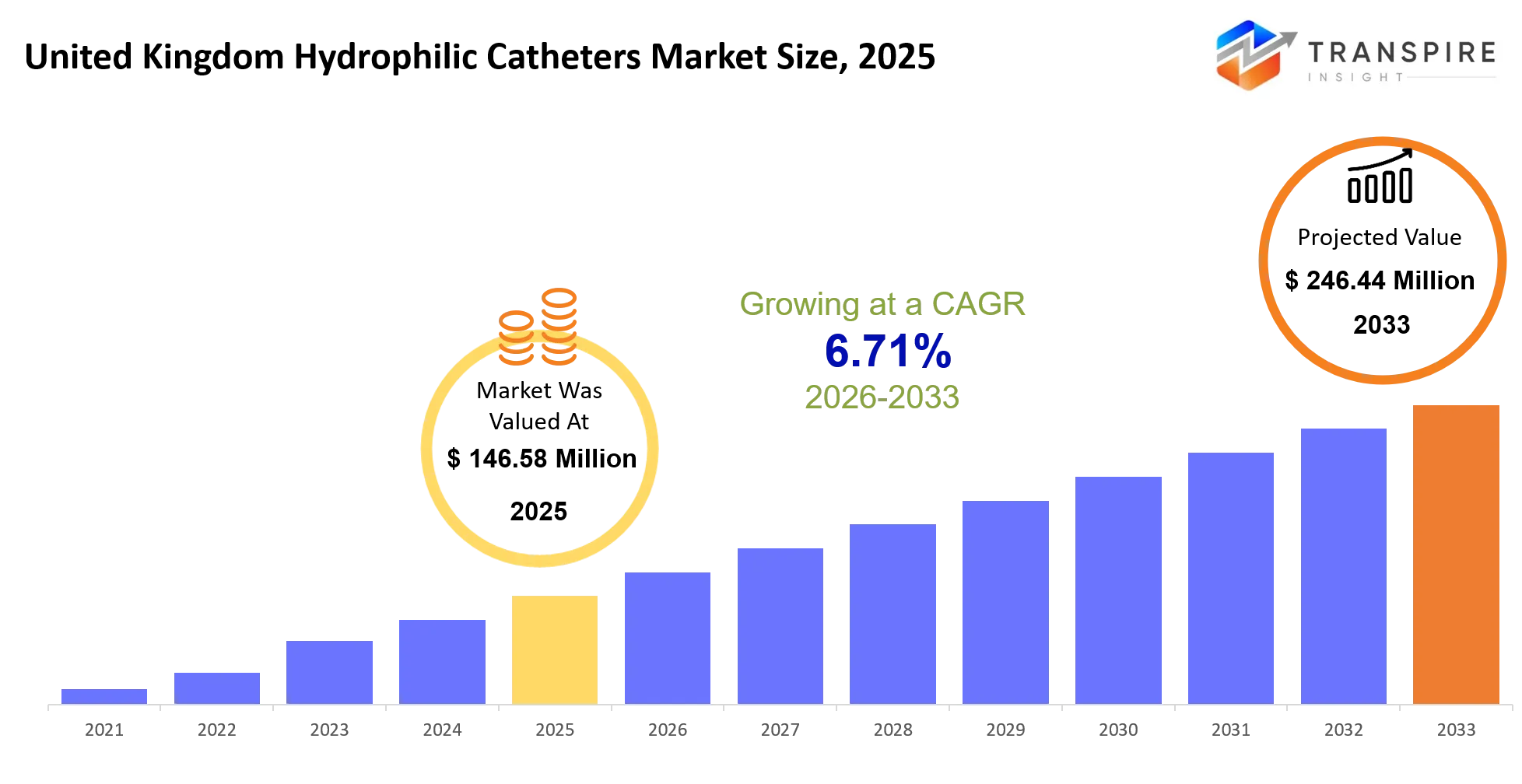
- United Kingdom Hydrophilic Catheters Market Size 2025: USD 146.58 Million
- United Kingdom Hydrophilic Catheters Market Size 2033: USD 246.44 Million
- United Kingdom Hydrophilic Catheters Market CAGR: 6.71%
- United Kingdom Hydrophilic Catheters Market Segments: By Product Type (Intermittent Catheters, Foley Catheters, External Catheters, Closed System Catheters, Pediatric Catheters, Coude Catheters, Others); By Application (Urinary Incontinence, Spinal Cord Injuries, Post-surgical Care, Benign Prostatic Hyperplasia, Neurogenic Bladder, Others); By End User (Hospitals, Home Care Settings, Ambulatory Surgical Centers, Specialty Clinics, Others); By Material (Silicone Catheters, Latex Catheters, PVC Catheters, Others)
To learn more about this report,  Download Free Sample Report
United Kingdom Hydrophilic Catheters Market Summary
The United Kingdom Hydrophilic Catheters Market was valued at USD 146.58 Million in 2025. It is forecast to reach USD 246.44 Million by 2033. That is a CAGR of 6.71% over the period.
The United Kingdom hydrophilic catheters market kinda plays a critical role in helping patients manage urinary retention, neurogenic bladder disorders, spinal cord injuries, and also post surgical urinary management, with catheterization that feels more comfortable, and with a lower chance of urethral trauma, in general. In everyday practice these devices kind of support long-term self-care , they also help reduce complications and ease the burden on hospital based care pathways.
Over the last three to five years, the whole market has shifted in a structural way toward patient centric intermittent catheterization, driven by broader adoption of home care models and a more noticeable clinical push on cutting catheter associated complications. This change has been reinforced by procurement policies that increasingly focus on outcomes, infection prevention, and quality of life measures, not only device cost, you know. A real world catalyst showed up after the COVID-19 pandemic, when the healthcare system was reconfigured, which sped up remote patient oversight and self care adoption. As more patients get training for independent catheter use and clinicians lean toward hydrophilic coated options to improve adherence and comfort, usage rates are climbing. That shift is gradually translating into stronger product penetration, more recurring consumption, and better revenue possibilities across community and home healthcare settings.
Key Market Insights
- England basically dominates the Hydrophilic Catheters Market across the United Kingdom, bringing in around 80% of the total market revenue , mostly because it has a big patient population and really solid healthcare infrastructure. It’s sort of like everyone else is catching up from there.
- Scotland on the other hand is expected to be the fastest mover during the forecast period, and this is being pushed by more expansive community healthcare services plus chronic disease management initiatives that keep expanding week by week.
- Wales and Northern Ireland are also showing emerging demand , especially since access to home-based continence care is getting better and more organized over time.
- When you look at product type, intermittent hydrophilic catheters pretty much take the lead, representing almost 60% of industry size due to a fairly strong clinical preference for a lower infection risk.
- After that, hydrophilic-coated Foley catheters sit in the second spot, supported by long-term urinary management requirements that do not really slow down.
- In terms of form, ready-to-use hydrophilic catheters are projected to grow the quickest through 2030. This growth leans on convenience, portability, and better patient compliance , even when lifestyles are busy.
- Single-use catheter products continue to gain traction too, because many healthcare providers are focusing on hygiene first and trying to reduce complications as much as possible.
- For applications, urinary incontinence and bladder dysfunction management accounts for more than 45% of market share , so it remains the dominant application segment.
- For applications, urinary incontinence and bladder dysfunction management is accounting for more than 45% of the market share, so it just keeps being the dominant application segment.
- Neurogenic bladder treatment also stays a major demand driver , mostly because there’s a rising prevalence of spinal cord injuries and other neurological disorders.
- Post surgical urinary care seems to be the fastest-growing application segment too , it lines up with increasing volumes of surgical procedures and stuff like that.
What are the Key Drivers, Restraints, and Opportunities in the United Kingdom Hydrophilic Catheters Market?
In the United Kingdom hydrophilic catheters market the strongest growth driver is a kind of move, where the healthcare system keeps shifting toward intermittent self-catheterization and more community based care. After the pandemic this change sort of sped up, because providers were trying to cut down on unnecessary hospital visits, while also supporting long term patient management at home. Hydrophilic catheters give lower friction, better comfort, and they tend to come with fewer catheter related complications than conventional options, so clinicians are leaning toward them more and more. And as more patients go down these self management routes, catheter utilization becomes more recurring, kind of steadier, and easier to forecast, which then builds a bigger base for repeat purchases and helps strengthen overall market revenues.
Still, the biggest barrier basically stays the higher acquisition cost of hydrophilic catheters compared with standard uncoated products. This is not just a small issue either, it feels structural, because in the UK healthcare procurement decisions are still strongly shaped by budget limits and cost effectiveness assessments across NHS trusts and other care providers. Clinical benefits are understood, of course, but reimbursement and buying frameworks often want extensive evidence before widespread adoption. So in practice, some facilities keep choosing lower cost alternatives, which can slow the conversion to hydrophilic products, and it also limits revenue growth for certain patient groups.
A big future opportunity is in the growth of digitally enabled continence care programs that kind of combine next level catheter products with remote patient monitoring and virtual clinical help. Money going into home healthcare infrastructure is setting up favorable conditions for these integrated care models, you know. Manufacturers that blend hydrophilic catheter technologies with patient adherence platforms and telehealth services can help improve outcomes, increase patient retention, and open up new growth avenues across community healthcare settings too.
What Has the Impact of Artificial Intelligence Been on the United Kingdom Hydrophilic Catheters Market?
Artificial intelligence and advanced digital technologies are starting to nudge, and kinda re-shape, the United Kingdom hydrophilic catheters market, mostly by improving patient management, clinical decision-making, and that supply chain side too. Healthcare providers are now leaning more toward AI-enabled continence care platforms that can automate patient monitoring, spot adherence risks early, and even smooth out follow up scheduling for people who use intermittent catheterization. In practice these platforms look at patient-reported outcomes , catheter usage behavior and complication histories, so clinicians can step in before things snowball into larger trouble.
At the same time, machine learning models are being used to estimate the probability of urinary tract infections, catheter-related complications, and hospital readmissions. These methods crunch large clinical datasets and help clinicians support a more personalized catheter selection, plus more tailored treatment planning. Alongside that, digital inventory management systems bring in predictive analytics to forecast product demand. That way hospitals and community care providers can cut down on stock shortages , and also keep procurement costs under tighter control.
The day-to-day operational benefits are becoming pretty obvious. Providers can push better care continuity, lower the number of avoidable clinic visits, boost adherence rates , and spread healthcare resources in a more efficient way. Manufacturers meanwhile get clearer visibility into product utilization trends, which helps with production planning and distribution strategies that are more “on target” and less guesswork.
Still, there is a major catch. A lot of healthcare data is fragmented. Patient records are often scattered across multiple systems, so AI integration becomes complicated, and model performance can drop. On top of that, data privacy rules, plus the costs of implementation, can delay adoption, especially in smaller healthcare organizations.
Key Market Trends
- Since 2020, NHS care pathways have, kinda more and more, pushed patients toward self-catheterization which in turn lowers hospital reliance and also drives repeat, recurring use of hydrophilic devices.
- From 2021 through 2025, procurement choices started to weight clinical outcomes and complication reduction above the cheapest upfront product price.
- Ready-to-use hydrophilic catheters gained real share, because patients were looking for something easier, more portable , and that supports day-to-day independent management, pretty plainly.
- Big manufacturers like Coloplast, Hollister, and Convatec did expand patient support initiatives too, kind of aiming to nudge adherence and at the same time reinforce long-term brand loyalty.
- After the pandemic, community healthcare services seemed to take on a larger role in continence management, so catheter distribution gradually moved away from hospital-centric systems, it was less centered there.
- Digital monitoring platforms also cropped up across urology care networks, which let clinicians watch adherence more carefully and spot complications earlier compared with those older routine check-ins, you know the usual kind.
- Meanwhile product development, shifted away from only basic functionality, toward upgraded lubrication technologies made to reduce urethral trauma and discomfort, less soreness overall.
- Supply chain approaches changed after 2020 as well, with manufacturers trying to build more inventory resilience and diversify sourcing in order to reduce disruption risks.
- Healthcare providers began to judge catheter products more often using quality-of-life metrics, which matches a wider move toward patient-centered treatment structures.
- And after 2022, partnerships between catheter manufacturers and home healthcare providers expanded, improving access to training, education, and ongoing clinical backing.
United Kingdom Hydrophilic Catheters Market Segmentation
By Product Type :
Intermittent catheters are often used so a person can empty the bladder, kind of in intervals, and they help someone maintain an independent urinary routine. Foley catheters are more made for continuous drainage, and in practice they show up for longer care spells, when everything is steady and it feels ongoing. External catheters give a non-invasive route to collect urine but only in the right context, based on what the patient needs.
Closed system catheters try to cut down contamination risks by using an integrated collection setup. Pediatric catheters are made for children and they support age specific clinical expectations. Coude catheters have a curved tip, which helps with navigation when catheterization is tricky. There are also other product types that cover specialized medical needs and patient conditions across various healthcare environments.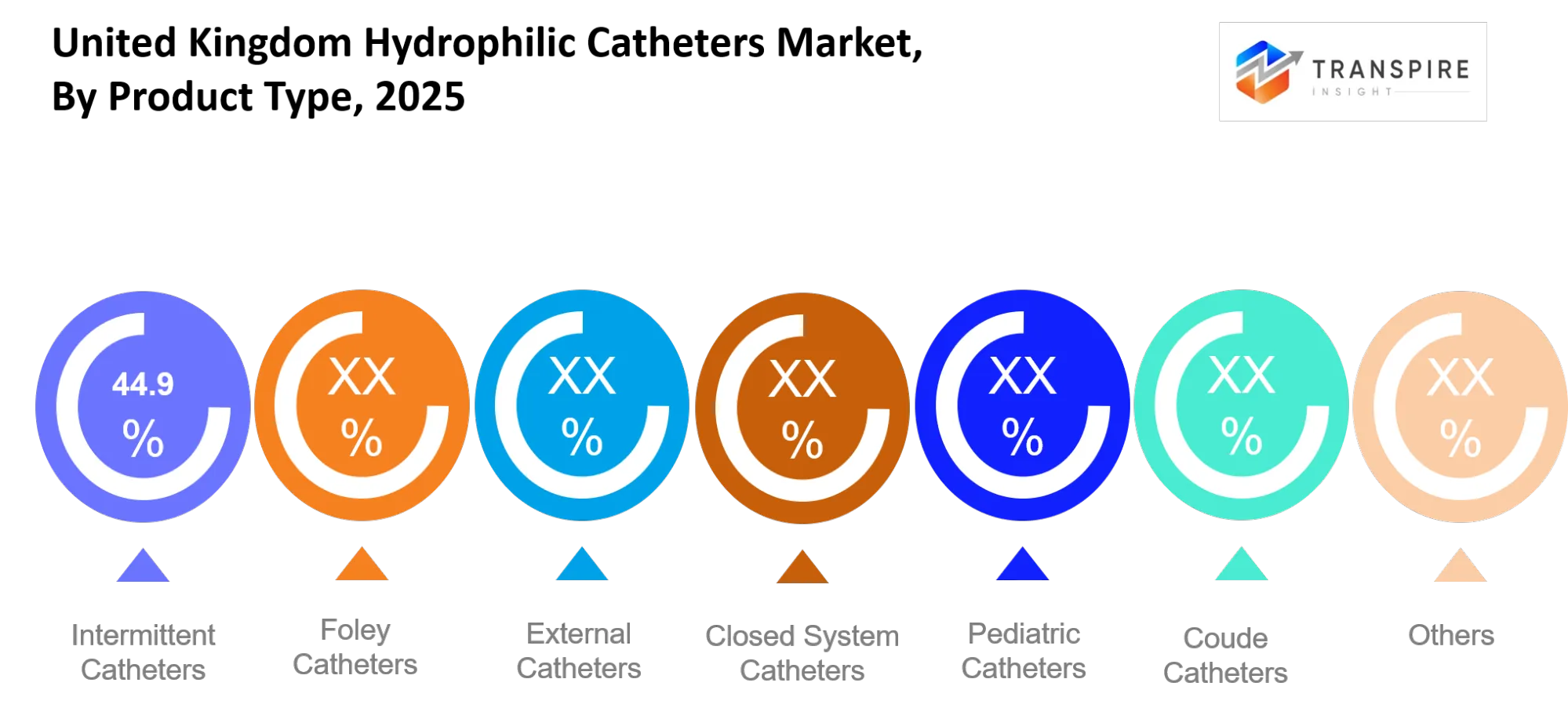
To learn more about this report, Download Free Sample Report
By Application
Urinary incontinence is a major application area, and it supports people who are dealing with a loss of bladder control, like, more frequent accidents than before. In the care of spinal cord injury, catheterization solutions are usually needed to enable efficient urinary drainage, so it doesn't get stuck or build up. After surgery, catheter use may assist in keeping bladder function steady and it can help recovery following those procedures, at least in many cases.
Benign prostatic hyperplasia cases may need catheter use when urinary obstruction slows normal urine flow. Neurogenic bladder management relies on catheterization to support regular emptying, and to help lower complication chances. Other uses include a range of urological and neurological conditions where temporary or long term urinary management becomes necessary.
By End User :
Hospitals stay as key end users , since catheterization is often needed during inpatient care, surgery, and emergency situations. Clinical teams typically pick different catheter models based on what the patient needs in that moment and how long treatment is expected to last. Even so , steady procedural volumes keep supporting steady utilization in hospital settings.
Home care environments are gaining more weight , especially as self-catheterization habits grow and long term care oversight becomes more common. In addition, ambulatory surgical centers rely on catheters during outpatient procedures, while specialty clinics provide a more narrow focus for urology and continence support. Beyond that, rehabilitation facilities and other healthcare providers also act as end users, mainly when they care for specialized patient groups.
By Material :
Silicone catheters remain popular because they tend to stay flexible, they have strong biocompatibility, and they work well for longer use cycles. Those material traits help with patient comfort and can lower irritation during catheterization. Because of that, healthcare providers frequently steer patients toward silicone choices when longer urinary management is required.
Latex catheters are still used in some cases where cost considerations matter , and PVC catheters offer durability, so they are often found in intermittent catheterization products. Meanwhile, other materials are being developed to meet specific performance expectations, handle patient sensitivity concerns, and reflect changing clinical preferences within the United Kingdom Hydrophilic Catheters Market.
What are the Key Use Cases Driving the United Kingdom Hydrophilic Catheters Market?
In the UK, a lot of folks are adopting hydrophilic catheters for a pretty direct, long term sort of bladder management, especially for people living with urinary incontinence or neurogenic bladder problems. For some of these patients, ongoing catheterization is basically required, and that hydrophilic coating helps, easing discomfort, cutting down urethral irritation, and limiting catheter related issues. So they kind of become a go to option in hospital care and community support too, depending on the situation and what’s going on.
On top of that, there’s more momentum coming from post surgical recovery and spinal cord injury management. More hospitals, specialty clinics, and rehab centers are choosing hydrophilic catheters to enable safer urinary drainage and to help improve patient results while someone is recovering. There’s also a stronger focus on cutting down hospital readmissions, which has pushed adoption in these kinds of settings.
Meanwhile, new opportunities are starting to show up alongside digitally supported home healthcare programs and more personalized continence services. Remote patient monitoring, virtual check-ins with clinicians, and tools that track or support adherence are opening up catheter use outside the usual clinical environments. It’s still early, in a way, but these approaches are expected to matter more during the forecast period as healthcare delivery keeps shifting toward home based care.
|
Report Metrics |
Details |
|
Market size value in 2025 |
USD 146.58 Million |
|
Market size value in 2026 |
USD 156.42 Million |
|
Revenue forecast in 2033 |
USD 246.44 Million |
|
Growth rate |
CAGR of 6.71% from 2026 to 2033 |
|
Base year |
2025 |
|
Historical data |
2021 - 2024 |
|
Forecast period |
2026 - 2033 |
|
Report coverage |
Revenue forecast, competitive landscape, growth factors, and trends |
|
Regional scope |
Middle East and Africa (Saudi Arabia, United Arab Emirates, South Africa, Rest of Middle East and Africa) |
|
Key company profiled |
Coloplast, Hollister, Becton Dickinson, Teleflex, Convatec, B. Braun, Cardinal Health, Wellspect Healthcare, Medtronic, Cure Medical, CompactCath, Adapta Medical, Pennine Healthcare, Romsons, Cook Medical |
|
Customization scope |
Free report customization (country, regional & segment scope). Avail customized purchase options to meet your exact research needs. |
|
Report Segmentation |
By Product Type (Intermittent Catheters, Foley Catheters, External Catheters, Closed System Catheters, Pediatric Catheters, Coude Catheters, Others); By Application (Urinary Incontinence, Spinal Cord Injuries, Post-surgical Care, Benign Prostatic Hyperplasia, Neurogenic Bladder, Others); By End User (Hospitals, Home Care Settings, Ambulatory Surgical Centers, Specialty Clinics, Others); By Material (Silicone Catheters, Latex Catheters, PVC Catheters, Others) |
Which Regions are Driving the United Kingdom Hydrophilic Catheters Market Growth?
England still comes out as the leading region in the United Kingdom Hydrophilic Catheters Market , mostly because it has such a huge patient base, a really broad hospital network and a clear concentration of specialist urology services. A lot of major NHS trusts and teaching hospitals back early uptake of newer catheter technologies and they also help push standardized continence care pathways,so it kind of keeps everything moving. Add in strong procurement muscles,plus distribution networks that already work well, and you get wide product availability across both acute and community care environments. So overall, the mix of clinical know-how, healthcare funding, and patient reach keeps England in that dominant slot.
Scotland follows as the second-largest regional market, but the pace is influenced by another sort of logic. In comparison with England, Scotland benefits from a more centralized healthcare setup, which makes it easier to roll out continence management programs across the various health boards in a consistent way. There’s also long term investment aimed at chronic disease handling and community healthcare offerings, and that tends to lock in steady demand for hydrophilic catheter products. With dependable public healthcare funding, and an emphasis on patient outcomes, Scotland stays a reliable contributor to market revenue.
Wales, though, is starting to look like the fastest-growing region, as care delivery keeps shifting toward home-led and community-driven models. Some recent initiatives meant to ease pressure on hospitals have encouraged broader adoption of self-catheterization programs, and remote patient support services are being used more often. Healthcare providers are also widening access to continence care resources, and that opens up fresh chances for advanced catheter uptake. For the 2026–2033 period , this momentum should draw more attention from manufacturers, and it will likely back additional investment in patient-centered care solutions.
Who are the Key Players in the United Kingdom Hydrophilic Catheters Market and How Do They Compete?
The competitive landscape of the United Kingdom Hydrophilic Catheters Market seems moderately consolidated, like a small set of multinational manufacturers do most of the heavy lifting in product sales. What counts here is not so much price, but the overall product feel and performance, patient comfort, clinical results, and even the support services around it. Existing suppliers keep trying to hold their ground via solid NHS relationships, clinician engagement initiatives, and wide-ranging portfolios. Meanwhile, new developments in catheter coatings, ready to use formats, and home care support solutions are quietly opening up space for differentiation, or at least that’s how it feels from the outside.
Coloplast shows up with continuous product innovation and a clear emphasis on the user experience. Their hydrophilic catheter line aims to make catheterization more comfortable and lower friction, which ends up supporting both clinician trust and patient preference. Coloplast also puts money into educational materials and patient support programs, these are meant to help people stick with the plan over time. Hollister, on the other hand, differentiates via more integrated continence care solutions, plus personalized support services that don’t stop at product delivery. That strategy helps create stronger patient persistence and also reinforces the connections with healthcare providers.
Convatec seems to blend catheter technology with wider continence care know-how, so they can sort of handle a few different patient needs at once, using a linked product portfolio, not just one thing. B. Braun, on the other hand, leans hard into clinical dependability and a large number of healthcare connections, using those solid relationships across hospitals and more specialist care contexts. Teleflex pushes further with focused urology offerings and keeps working on product improvements, so things feel easier to use, and procedures can move more efficiently. Taken together, these moves help each company strengthen its presence in the market while dealing with the fact that care is shifting more toward community- based and home centered models.
Company List
- Coloplast
- Hollister
- Becton Dickinson
- Teleflex
- Convatec
- B. Braun
- Cardinal Health
- Wellspect Healthcare
- Medtronic
- Cure Medical
- CompactCath
- Adapta Medical
- Pennine Healthcare
- Romsons
- Cook Medical
Recent Development News
In March 2026, Wellspect HealthCare launched LoFric® Elle™ Pro, a new hydrophilic ready-to-use intermittent catheter for women. The product incorporates twelve Pro eyelets designed to support complete bladder emptying in one flow without repositioning, strengthening Wellspect’s continence-care portfolio and advancing innovation in the hydrophilic catheter segment. Source https://mb.cision.com/
In January 2026, Wellspect HealthCare launched the Surity™ Female External Catheter for women with severe urinary incontinence. The launch expanded the company’s urinary management offering and addressed unmet continence-care needs, supporting broader adoption of advanced catheter-based solutions. Source https://ayondo.com/
What Strategic Insights Define the Future of the United Kingdom Hydrophilic Catheters Market?
Over the next five to seven years, the United Kingdom Hydrophilic Catheters Market is expected to drift further toward integrated, patient led continence care rather than staying only with product supply. The push underneath this shift is basically the healthcare system’s longer term intention to lower the burden on hospitals while also lifting outcomes through community based and home centered care models. So yeah, in practice, value will increasingly show up in service ecosystems, digital enablement tools, and patient adherence programs , alongside the catheter products themselves.
There is also a quieter risk, kinda less obvious , tied to how concentrated the market can become within the more premium hydrophilic catheter categories. If a small number of large suppliers dominate , procurement becomes more fragile , especially when manufacturing disruptions happen, when regulatory requirements change, or when supply chain constraints tighten up. This concern might not appear immediately in the current growth indicators , but it could still steer purchasing strategies later on.
On the opportunity side, there’s the rise of digitally enabled continence management platforms, those that blend remote monitoring with telehealth guidance, plus individualized patient education. Market players should therefore build integrated care partnerships with healthcare providers and community care networks , since these connections are likely to turn into a real differentiator in future procurement and adoption choices.
United Kingdom Hydrophilic Catheters Market Report Segmentation
By Product Type
- Intermittent Catheters
- Foley Catheters
- External Catheters
- Closed System Catheters
- Pediatric Catheters
- Coude Catheters
By Application
- Urinary Incontinence
- Spinal Cord Injuries
- Post-surgical Care
- Benign Prostatic Hyperplasia
- Neurogenic Bladder
By End User
- Hospitals
- Home Care Settings
- Ambulatory Surgical Centers
- Specialty Clinics
By Material
- Silicone Catheters
- Latex Catheters
- PVC Catheters
Frequently Asked Questions
Find quick answers to common questions.
The United Kingdom Hydrophilic Catheters Market size is USD 246.44 Million in 2033.
Key Segments for the United Kingdom Hydrophilic Catheters Market are By Product Type (Intermittent Catheters, Foley Catheters, External Catheters, Closed System Catheters, Pediatric Catheters, Coude Catheters, Others); By Application (Urinary Incontinence, Spinal Cord Injuries, Post-surgical Care, Benign Prostatic Hyperplasia, Neurogenic Bladder, Others); By End User (Hospitals, Home Care Settings, Ambulatory Surgical Centers, Specialty Clinics, Others); By Material (Silicone Catheters, Latex Catheters, PVC Catheters, Others).
Major United Kingdom Hydrophilic Catheters Market Players are Coloplast, Hollister, Becton Dickinson, Teleflex, Convatec, B. Braun, Cardinal Health, Wellspect Healthcare, Medtronic, Cure Medical, CompactCath, Adapta Medical, Pennine Healthcare, Romsons, Cook Medical.
The Current United Kingdom Hydrophilic Catheters Market size is USD 146.58 Million in 2025.
The United Kingdom Hydrophilic Catheters Market CAGR is 6.71% from 2026 to 2033.
- Coloplast
- Hollister
- Becton Dickinson
- Teleflex
- Convatec
- B. Braun
- Cardinal Health
- Wellspect Healthcare
- Medtronic
- Cure Medical
- CompactCath
- Adapta Medical
- Pennine Healthcare
- Romsons
- Cook Medical
About the Authors

Pankaj Ghogare Patil
I am Pankaj Ghogare Patil, a Senior Research Analyst at Transpire Insight, specializing in the Pharmaceutical, Chemicals & Materials, Healthcare IT, and Biotechnology industry. My expertise lies in conducting comprehensive market research, analyzing industry trends, evaluating competitive landscapes, and translating complex data into actionable insights. At Transpire Insight, I closely follow emerging technologies, regulatory developments, and market innovations to create accurate, well-researched, and informative content that helps businesses and professionals make informed decisions. I am committed to producing credible, evidence-based articles that reflect industry best practices while making technical topics accessible and valuable for a broad audience.

Chakradhar Khansole
Chakradhar serves as the Research Director at Transpire Insight, bringing over 8 years of experience in technology, innovation, and strategic market intelligence. He specializes in transforming complex market data into actionable business insights that enable organizations to make informed, growth-oriented decisions. Recognized for his strategic vision and analytical expertise, Chakradhar leads high-impact research initiatives, delivering comprehensive market assessments, competitive intelligence, and forward-looking industry analysis.
Recently Published Reports
-
Jul 2026
Alopecia Treatment Market
Alopecia Treatment Market Size, Share & Analysis Report By Disease Type (Alopecia Areata, Cicatricial Alopecia, Traction Alopecia, Alopecia Totalis, Androgenetic Alopecia, Alopecia Universalis, and Other Disease Types), By Treatment Type (Topical Treatments, Oral Medications, Injectable Therapies, and Hair Transplantation), By Gender (Male, and Female), By Distribution Channel (Hospitals and Clinics, Retail Pharmacies, and Online Retailers), and Geography (North America, Europe, Asia-Pacific, Middle East and Africa, South and Central America), 2021 - 2031
-
Jul 2026
Medical Ultrasound Probe Market
Medical Ultrasound Probe Market Size, Share & Analysis Report By Type (Linear Type, Convex Type, Endocavitary Probe, Phased Array/Cardiac Probe, Transesophageal (TEE) Probe, and Others), By Application (Ophthalmology, Cardiology, Musculoskeletal, Oncology, Obstetrics & Gynecology, General Imaging, and Others), By End User (Hospitals & Clinics, Diagnostic Centers, Ambulatory Surgical Centers, and Others), and Geography (North America, Europe, Asia-Pacific, Middle East and Africa, South and Central America), 2021 – 2031
-
May 2026
Biosimilars Market
Biosimilars Market By Product Type (Monoclonal Antibodies, Recombinant Hormones, Erythropoietin, G-CSF, Others), By Indication (Oncology, Autoimmune Diseases, Blood Disorders, Diabetes, Others), By Manufacturing Type (In-House Manufacturing, Contract Manufacturing), By Distribution Channel (Hospital Pharmacies, Retail Pharmacies, Online Pharmacies), By Industry Analysis, Size, Share, Growth, Trends, and Forecasts 2021-2033
-
Apr 2026
Gastrointestinal Endoscopy Market
Gastrointestinal Endoscopy Market By Type (Rigid Gastrointestinal Endoscope, Flexible Gastrointestinal Endoscopes, Disposable Gastrointestinal Endoscope), By Procedure Type (Colonoscopy, Gastroscopy, Duodenoscopy, Enteroscopy, Flexible Sigmoidoscopy, Others), By Application (Diagnosis, Treatment), By End-Users (Hospitals, Ambulatory Surgical Centers, Specialty Clinics, Laboratories, Others), By Industry Analysis, Size, Share, Growth, Trends, and Forecasts 2021-2033