
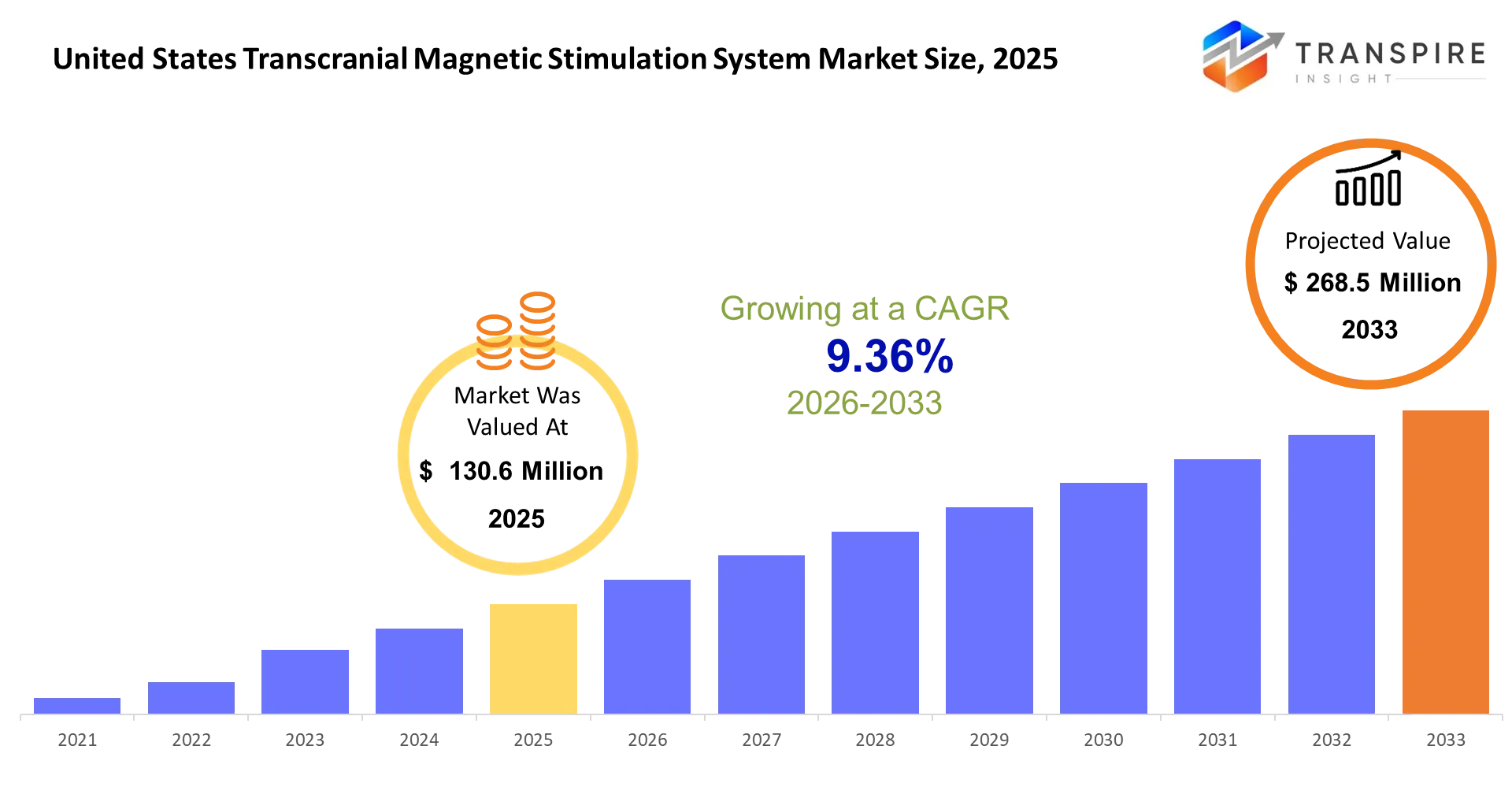
United States Transcranial Magnetic Stimulation System Market Size & Forecast:
- United States Transcranial Magnetic Stimulation System Market Size 2025: USD 130.6 Million
- United States Transcranial Magnetic Stimulation System Market Size 2033: USD 268.5 Million
- United States Transcranial Magnetic Stimulation System Market CAGR: 9.36%
- United States Transcranial Magnetic Stimulation System Market Segments: By Product Type (Deep TMS Systems, Repetitive TMS Systems, Single Pulse TMS Systems, Portable TMS Systems, Navigated TMS Systems, Others), By Application (Depression Treatment, Anxiety Disorders, Neurological Disorders, Schizophrenia, Pain Management, Others), By End User (Hospitals, Psychiatric Clinics, Neurology Centers, Rehabilitation Centers, Research Institutes, Others), By Technology (Electromagnetic Coil Systems, Figure-8 Coil Systems, Circular Coil Systems, H-coil Systems, Others).
To learn more about this report,  Download Free Sample Report
United States Transcranial Magnetic Stimulation System Market Summary:
The United States Transcranial Magnetic Stimulation System Market size is estimated at USD 130.6 Million in 2025 and is anticipated to reach USD 268.5 Million by 2033, growing at a CAGR of 9.36% from 2026 to 2033.The United States Transcranial Magnetic Stimulation System Market kind of sits right at the crossroads of psychiatry, neurology, and day to day outpatient care delivery, so it feels like one of those overlapping spaces. Practically speaking these systems help clinicians manage patients with major depressive disorder , obsessive-compulsive disorder , and several other neuropsychiatric issues that haven’t really improved with standard medication. Hospitals, specialty mental health clinics and even private psychiatric practices are using transcranial magnetic stimulation (TMS) more and more , aiming to lessen the need for long term pharmacological treatment, while also helping patient adherence and functional rehabilitation outcomes.
In the last 3–5 years the market has moved from something more niche into a more common neurostimulation option. This shift seems to be backed by wider reimbursement acceptance and a gradual expansion of clinical indications.The COVID-19 pandemic, well it kind of acted like a big catalyst , because it brought into focus weak points in mental health infrastructure and it also bumped the need for care up for anxiety , depression , and trauma related disorders. That kind of strain kind of pushed hospitals and clinics toward more mild, less invasive options, with fewer system wide side effects. Then, when insurers widened coverage a bit , and providers leaned into models that are outpatient centered, the use of TMS systems also rose, and it sorta helps sustain repeating income via device refreshes, required consumables and those multi session care pathways.
Key Market Insights
- The Northeast United States basically led the United States Transcranial Magnetic Stimulation System Market, taking almost 34% of the market share in 2025 , mainly because there is stronger psychiatric infrastructure there.
- Meanwhile the Western United States shows the fastest growth momentum through 2032, backed by more behavioral health spending and a rise in private neurostimulation clinics.
- Urban healthcare centers keep pulling in major revenue too, largely from broader use of outpatient neurotherapy tools and specialized mental health services, you know for many people it’s easier to access.
- In 2025 , Repetitive Transcranial Magnetic Stimulation systems had the biggest presence, grabbing over 58% share, driven by real clinical effectiveness.
- Deep Transcranial Magnetic Stimulation systems were in the second place, helped along by more FDA-cleared uses, especially for severe depression and obsessive-compulsive disorder treatment.
- Portable plus AI-assisted TMS platforms are also starting to move quicker than other options during the forecast period, mostly due to workflow refinement and more tailored treatment planning.
- Advanced neuronavigation enabled systems are gaining noticeable traction as clinicians look for better targeting accuracy and more consistent patient response outcomes.
- For applications, Major Depressive Disorder was close to 61% of overall industry demand in 2025, so it stays the dominant segment across the whole neurostimulation market.
- Obsessive-Compulsive Disorder, together with anxiety-related therapies, is turning out to be the fastest-moving application area as clinical proof for TMS keeps growing and being repeated.
- Neurological rehabilitation applications are starting to open up new demand pockets, especially within stroke recovery pathways and chronic pain management programs.
What are the Key Drivers, Restraints, and Opportunities in the United States Transcranial Magnetic Stimulation System Market?
The strongest growth driver in the United States Transcranial Magnetic Stimulation System market is sort of the ongoing expansion of reimbursement coverage for treatment resistant depression , and other neuropsychiatric conditions. Over the last five years , commercial insurers and public healthcare programs have widened their coverage rules, after several clinical studies showed measurable improvement rates and a reduced relapse risk compared with medication only approaches. That policy plus evidence change, it directly helped clinic economics because multi-session TMS therapy became financially reachable for a bigger patient population. And as reimbursement became more steady, psychiatric practices started moving faster on purchases of high-throughput stimulation systems, which in turn generates recurring revenue tied to treatment cycles, software upgrades, as well as upkeep and service contracts.
Meanwhile, the biggest structural restraint is the high day-to-day operational cost of delivering TMS therapy. Clinics need specialized equipment trained operators, dedicated treatment rooms and repeated patient sessions over a span of weeks. The combo of infrastructure and staffing needs makes this a capital-intensive business approach that smaller behavioral health providers just cannot scale quickly enough. In rural areas and other underserved regions provider shortages add extra delays to adoption, so nationwide penetration stays suppressed and many patients remain untreated, especially outside major city healthcare networks.
One big, future possibility is AI-guided personalized neurostimulation platformS , and honestly it feels like this is where a lot of people are going. A growing number of companies are putting resources into systems that take patient brain mapping data along with treatment-response analytics, then use that input to fine tune coil positioning and stimulation intensity, kind of in real time. If this really works at scale, it could help raise remission rates while shortening the overall therapy duration , and that means clinics can see more people per one device. On top of that, moving into veterans healthcare networks and outpatient neurology centers creates a more expandable route, for next generation deployments too.
What Has the Impact of Artificial Intelligence Been on the United States Transcranial Magnetic Stimulation System Market?
Artificial intelligence and newer digital technologies are increasingly, kinda quietly, reshaping the United States Transcranial Magnetic Stimulation System Market by boosting treatment precision, making workflows more automatic, and helping track patient outcomes more reliably. Today’s TMS setups often include AI-assisted targeting software so coil positioning and stimulation mapping are handled with less manual effort, using patient-specific neuroimaging plus behavioral response history. In practice this kind of approach lowers setup variability between different operators, and it also supports steadier sessions across high-volume psychiatric clinics, even when staffing changes. On top of that, cloud-connected treatment management tools automate scheduling, ongoing therapy monitoring, and compliance documentation. That lets providers manage more patients, while keeping the administrative load down, though it still feels like work for some teams.
vEarly rollouts have shown improvements in remission outcomes, plus fewer wasted sessions and better equipment utilization overall. Some outpatient networks even mention smoother throughput, and reduced discontinuation rates, once AI-supported workflow systems became part of their routine.
Still, AI adoption has a big obstacle because clinical data is fragmented and treatmeant protocols aren’t consistent across providers. A lot of psychiatric practices don’t have standardized datasets that are large enough to train predictive models with high accuracy. As a result, it becomes harder to scale these solutions, and it slows the wider commercial introduction of advanced neurostimulation analytics.
Key Market Trends
- Since 2021 , big insurers have broadened reimbursement eligibility, so psychiatric clinics could more easily scale multi-session TMS programs, which gives them better recurring revenue visibility, than before.
- Between 2020 and 2024 , outpatient mental health centers kept increasing their TMS installations too as hospitals kind of redirected psychiatric care toward cheaper ambulatory models, more like walk-in / outpatient style.
- Neuronetics and BrainsWay sorta leaned into rivalry by releasing shorter-session protocol options, improving clinic throughput, and also making patient scheduling feel more controlled.
- After 2022 , AI-assisted neuronavigation systems started getting real traction, because providers wanted tighter coil positioning and more standardized treatment outcomes across multi-site networks, not just one facility.
- Since the COVID-19 pandemic, behavioral health providers have been steering capital spending toward non-pharmaceutical therapies that show fewer systemic side effects , and also tend to support better long term adherence.
- Veterans’ healthcare programs increased neurostimulation adoption between 2021 and 2025, and that opened up new procurement opportunities for FDA-cleared depression and PTSD treatment systems, in practice.
- After 2023 , manufacturers increasingly moved into cloud-connected treatment analytics, aiming to automate compliance documentation , patient monitoring, and multi-location therapy management workflows, with less manual effort.
- Deep transcranial magnetic stimulation technologies also grabbed more clinical attention as research widened into obsessive-compulsive disorder, anxiety, and neurological rehabilitation use cases.
- Smaller psychiatric practices did however delay adoption , even with reimbursement improvements, because system installation costs , technician training, and the dedicated treatment room requirements stayed pretty capital intensive.
United States Transcranial Magnetic Stimulation System Market Segmentation
By Product Type
Repetitive TMS systems still kinda keep the strongest market hold, mainly because psychiatric clinics and hospitals, mostly, lean toward clinically validated platforms with already established reimbursement routes. Deep TMS platforms grab the second-largest slice, not surprisingly, as clinicians keep widening usage for severe depression along with obsessive compulsive disorder care. Navigated TMS is getting more attention as providers want better targeting detail and steadier patient outcomes, you know, in day to day practice.
Portable TMS feels more like an early commercial phase, because regulatory green lights and reimbursement support are still, somewhat limited for home based usage. Single pulse TMS keeps showing up in smaller specialist pockets, especially for migraine treatment. Overall product demand is starting to look more like a reflection of operational efficiency instead of plain device possession, so clinics favor setups that can manage high patient throughput without too much fuss. What comes next in competition will probably revolve around AI assisted workflow integration, shorter treatment cycles, and cloud connected therapy management platforms too, pushing manufacturers to stand apart using software strengths, alongside hardware advances, which matters.
By Application
Depression treatment kind of dominates the application demand since insurers generally recognize transcranial magnetic stimulation as an effective approach for treatment-resistant depressive disorders, it’s not always perfect but it’s broadly acknowledged. Meanwhile anxiety disorders and obsessive-compulsive disorder applications are expanding fast, mostly because the clinical evidence, and the regulatory permissions are widening at the same time . For neurological disorder treatment, like stroke rehabilitation and chronic pain management it stays smaller, but still strategic in a way, supported by research funding and neuroscience collaborations. Schizophrenia-related applications continue to roll out more slowly, partly because outcomes aren’t as standardized among different patient groups, and that makes adoption a bit cautious.
Demand is increasingly leaning toward multi-indication systems, so they can handle varied neuropsychiatric protocols in one clinic or same treatment area . Healthcare providers are also drawn to applications that deliver recurring reimbursement across longer treatment schedules, not just short episodes. Looking ahead, the market direction points toward broader neurostimulation integration into outpatient behavioral healthcare networks, so device suppliers have a chance to back tailored therapy pathways and data-driven adjustment of treatment across several neurological conditions.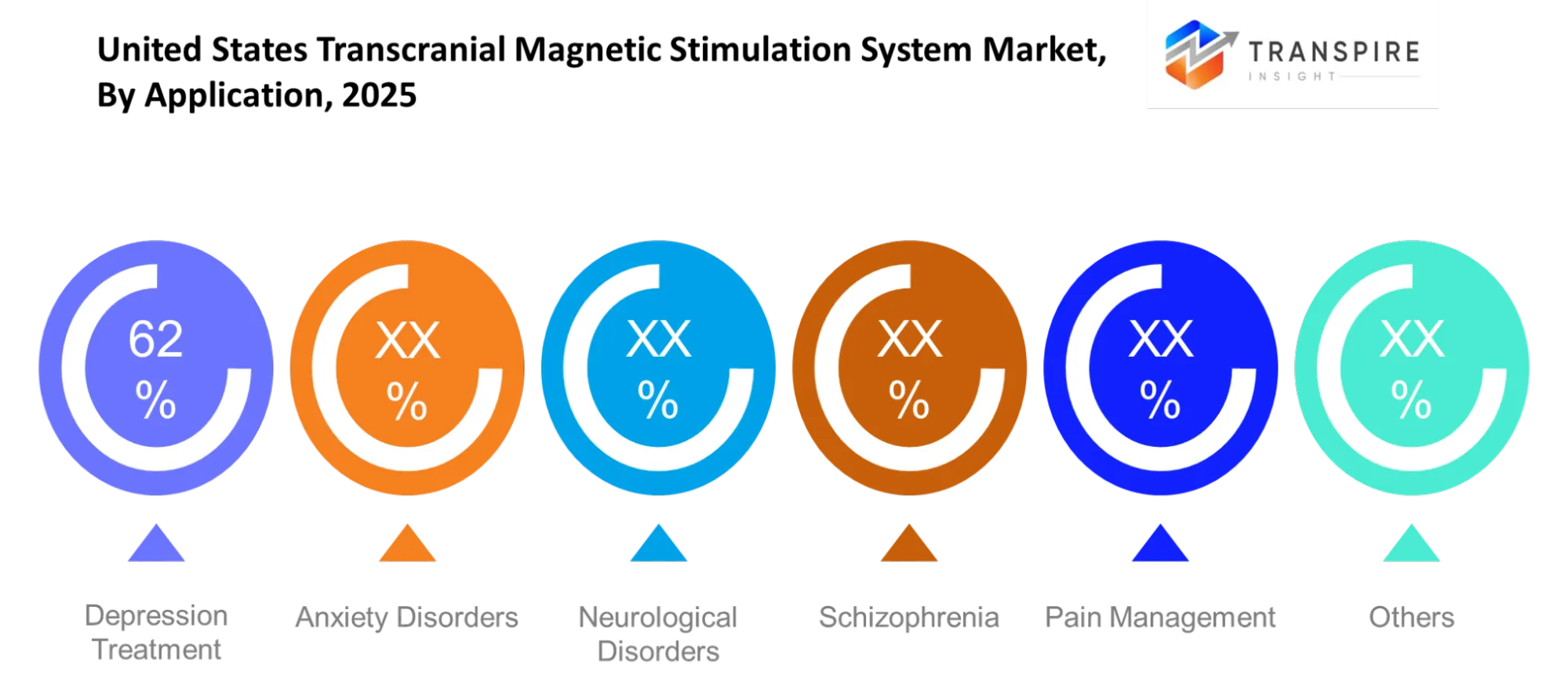
To learn more about this report, Download Free Sample Report
By End-User
Psychiatric clinics hold that top end-user standing kinda easily, since specialized mental health providers push high treatment volumes and run their own dedicated neurostimulation initiatives, almost like a full program. Hospitals still matter a lot though, mainly because they have integrated neuroscience departments and better reach to capital heavy medical technologies, so the whole setup stays smoother. Neurology centers are also on a steady upswing with adoption, because clinical uses are moving past depression, and now they’re used for neurological rehabilitation as well as chronic pain care, which makes more sense in practice. Rehabilitation centers feel like a newer opening, especially for post-stroke cognitive recovery, and this is backed by academic research partnerships.
Research institutes keep shaping technology progress mostly via clinical trials and protocol validation, not because they directly bring in revenue. End-user purchasing now leans more toward operational expandability, patient throughput, plus reimbursement consistency, instead of just basic availability. Meanwhile smaller behavioral healthcare facilities still hit obstacles, like staffing expectations, treatment room allocation issues, and system acquisition costs that add up. Looking ahead, growth will probably favor outpatient-focused providers who can weave neurostimulation into broader behavioral health management, with digital monitoring and predictive treatment analytics doing the extra work in the background.
By Technology
Figure 8 coil systems kind of dominate adoption because healthcare providers care about targeted stimulation accuracy, and they also want solid clinical evidence across different depressive disorder treatment pathways. H-coil systems are expanding fast , mainly because they support deeper brain stimulation abilities and they’re increasingly used for obsessive-compulsive disorder along with other resistant psychiatric conditions. Electromagnetic coil systems still help the wider market keep moving thanks to flexible platform compatibility and well known manufacturing ecosystems. Circular coil systems see a narrower but steady demand in research and neurological testing spaces where broader stimulation coverage stays useful.
Competition is shifting more toward precision targeting, patient comfort, and overall treatment efficiency, not just higher stimulation intensity. Providers are now basically judging systems by software integration, neuronavigation support, and whether the setup works with AI-assisted treatment planning tools. Looking ahead, investment behavior indicates more interest in adaptive stimulation technologies that can tune therapy parameters in real time. Manufacturers that merge improved coil engineering with predictive analytics, plus cloud connected treatment management platforms, will likely end up with stronger long term positioning.
What are the Key Use Cases Driving the United States Transcranial Magnetic Stimulation System Market?
Treatment resistant depression is still basically the main reason clinics and outpatient behavioral health centers adopt the system. A lot of providers are now leaning on transcranial magnetic stimulation in order to lessen the long-term medication reliance and to push remission results, especially for patients who are not improving with antidepressants .
On a parallel track , anxiety disorders plus obsessive-compulsive disorder care is getting more traction inside hospital neuroscience departments and specialty mental health networks. Veterans’ healthcare systems and neurology centers are also widening their use for post-traumatic stress disorder , and chronic pain management, mainly since reimbursement pathways keep getting better .
New or emerging uses are starting to show up too , like stroke rehabilitation and cognitive recovery therapy, which are being backed by academic medical centers and rehabilitation institutes. Early stage research is also looking at Alzheimer’s disease, substance abuse disorders, and neurodegenerative conditions , and it makes it feel like there could be future commercial upside as AI-guided stimulation technologies get better at targeting precision and more personalized treatment planning .
|
Report Metrics |
Details |
|
Market size value in 2025 |
USD 130.6 Million |
|
Market size value in 2026 |
USD 143.3 Million |
|
Revenue forecast in 2033 |
USD 268.5 Million |
|
Growth rate |
CAGR of 9.36% from 2026 to 2033 |
|
Base year |
2025 |
|
Historical data |
2021 - 2024 |
|
Forecast period |
2026 - 2033 |
|
Report coverage |
Revenue forecast, competitive landscape, growth factors, and trends |
|
Geographic scope |
United States of America |
|
Key company profiled |
BrainsWay, MagVenture, NeuroStar, Nexstim, eNeura, Magstim, Neuronetics, Yiruide Medical, Remed, Sebers Medical, Rogue Research, Axilum Robotics, Deymed Diagnostic, Sooma Medical, Neurosoft |
|
Customization scope |
Free report customization (country, regional & segment scope). Avail customized purchase options to meet your exact research needs. |
|
Report Segmentation |
By Product Type (Deep TMS Systems, Repetitive TMS Systems, Single Pulse TMS Systems, Portable TMS Systems, Navigated TMS Systems, Others), By Application (Depression Treatment, Anxiety Disorders, Neurological Disorders, Schizophrenia, Pain Management, Others), By End User (Hospitals, Psychiatric Clinics, Neurology Centers, Rehabilitation Centers, Research Institutes, Others), By Technology (Electromagnetic Coil Systems, Figure-8 Coil Systems, Circular Coil Systems, H-coil Systems, Others) |
Which Regions are Driving the United States Transcranial Magnetic Stimulation System Market Growth?
The Northeast United States is still kinda the leading regional market , because big metropolitan healthcare systems keep investing pretty heavily in outpatient psychiatric infrastructure and advanced neurostimulation programs. In many of the states across the region, insurance reimbursement coverage for treatment-resistant depression stays stronger, so that helps push higher procedure volumes plus quicker equipment replacement cycles , not always but often. Academic medical centers, neuroscience research institutions and specialty behavioral health networks form an established ecosystem for clinical validation and physician coaching. Also large urban patient populations keep long term demand alive for repetitive deep transcranial magnetic stimulation therapies , both in hospitals and in private clinic environments.
The Western United States is the second-largest regional contributor , but the growth pattern is a bit different from the Northeast because adoption is tightly linked to private behavioral healthcare expansion and those technology-driven care delivery models. Healthcare providers in states like California increasingly fold AI-assisted neurostimulation platforms into multi-site outpatient mental health networks. Venture-backed psychiatric service providers and telehealth-anchored behavioral clinics keep supporting steady purchasing activity even while overall healthcare cost pressures are pretty broad. And the steady investment in digital health infrastructure together with precision medicine programs makes the region a dependable contributor to national market revenue.
The Southern United States seems to be coming up fast as the fastest-growing regional market, mostly because access to outpatient mental healthcare is expanding quickly and there’s been major healthcare infrastructure investment at scale. In the last couple years, several hospital groups and psychiatric care chains pushed ahead with facility modernization programs after 2022 , partly to handle the rising treatment volumes for depression anxiety ,and post-traumatic stress disorder. There’s also the expanding Medicaid coverage in some states, plus increasing veterans’ healthcare demand which together generated more reimbursement-supported opportunities for neurostimulation providers. All that regional momentum should pull in device manufacturers, service operators, and even private equity investors looking for scalable expansion chances between 2026 and 2033.
Who are the Key Players in the United States Transcranial Magnetic Stimulation System Market and How Do They Compete?
In the United States, the competitive landscape for Transcranial Magnetic Stimulation System is still fairly consolidated, with just a few neurotechnology manufacturers really managing to hold a big slice of the installed clinical setups. In real-world terms, the rivalry is shifting toward treatment throughput , FDA-cleared uses, software integration, and reimbursement compatibility , rather than only chasing down device pricing. Most incumbents stay on offense to keep their position by leaning on proprietary stimulation methods and long-term provider relationships. Meanwhile newer companies seem to lean into portable systems, AI-assisted targeting, and workflow automation, like kind of a faster operational angle. Psychiatric clinic networks also now compare vendors using treatment throughput , data analytics capability, and post-installation support. They do this even when the conversation starts from hardware specifications, which is a bit different than before.
Neuronetics differentiates itself by pushing high-volume outpatient treatment optimization plus cloud-connected practice management tools that are integrated inside the NeuroStar platform. The company expanded its commercial presence by deepening partnerships with behavioral health clinic operators, and by improving reimbursement support services for clinicians. BrainsWay competes with its proprietary H-coil technology , built for deeper brain stimulation across several psychiatric indications. The broader FDA clearances for obsessive-compulsive disorder and smoking addiction helped BrainsWay move beyond the older depression-first therapy circles.
MagVenture concentrates on adaptable stimulation platforms where providers can change, sort of freely, the treatment protocols across neurological and psychiatric uses. The company also really pushed its United States footprint via partnerships with academic neuroscience centers plus research-forward clinical programs. Nexstim, meanwhile, is built around precision neuronavigation tech where brain imaging joins up with real-time stimulation aiming. This kind of method is quite attractive for neurology centers and research hospitals that want better treatment accuracy for difficult neurological disorders. Magstim keeps stressing research-grade stimulation systems and clinician training efforts, which helps it hold on to solid ties with university hospitals and neuroscience institutes.
Company List
- BrainsWay
- MagVenture
- NeuroStar
- Nexstim
- eNeura
- Magstim
- Neuronetics
- Yiruide Medical
- Remed
- Sebers Medical
- Rogue Research
- Axilum Robotics
- Deymed Diagnostic
- Sooma Medical
- Neurosoft
Recent Development News
In March 2026, BrainsWay Expands Investment After FDA Approval of Proliv™Rx System: BrainsWay announced an additional $6 million milestone-based investment in Neurolief following U.S. FDA approval of the Proliv™Rx system for major depressive disorder (MDD). The move strengthens BrainsWay’s position in advanced neurostimulation and expands its at-home depression treatment portfolio in the U.S. market.
Source: https://www.brainsway.com
In May 2026, Neuronetics Reports Growth in NeuroStar TMS System Revenue: Neuronetics reported first-quarter financial results showing a 13% increase in U.S. NeuroStar Advanced Therapy System revenue. The company also shipped 34 TMS systems during the quarter, reflecting continued adoption of TMS therapy solutions across U.S. clinics and mental health centers.
Source: https://ir.neuronetics.com
What Strategic Insights Define the Future of the United States Transcranial Magnetic Stimulation System Market?
The United States Transcranial Magnetic Stimulation System Market seems to be quietly moving, like toward a more integrated, data driven neuropsychiatric care model that’s delivered through scalable outpatient networks instead of just stand alone specialty clinics. What’s really pushing this shift is the convergence of reimbursement expansion , AI assisted treatment refinement and also the steady pressure on healthcare systems to chip away at long term reliance on pharmaceuticals for chronic mental health management. Over the next five to seven years, the edge will likely start belonging more to firms that stitch neurostimulation hardware together with predictive analytics, cloud based progress monitoring, and multi site workflow coordination.
One less obvious risk is reimbursement concentration. A meaningful slice of today’s revenue momentum depends on favorable insurance coverage for treatment resistant depression. So if payer eligibility gets tightened or if there’s more scrutiny about long term clinical durability, utilization rates could soften , and provider investments might get delayed. At the same time, a pretty clear opportunity is emerging inside veterans’ healthcare systems and neurological rehabilitation programs, where demand for non-invasive cognitive recovery interventions is speeding up. Market players should lean into collaborations with major outpatient behavioral health operators and also get in early on AI enabled personalization tools that can raise measurable treatment results.
United States Transcranial Magnetic Stimulation System Market Report Segmentation
By Product Type
- Deep TMS Systems
- Repetitive TMS Systems
- Single Pulse TMS Systems
- Portable TMS Systems
- Navigated TMS Systems
- Others
By Application
- Depression Treatment
- Anxiety Disorders
- Neurological Disorders
- Schizophrenia
- Pain Management
- Others
By End User
- Hospitals
- Psychiatric Clinics
- Neurology Centers
- Rehabilitation Centers
- Research Institutes
- Others
By Technology
- Electromagnetic Coil Systems
- Figure-8 Coil Systems
- Circular Coil Systems
- H-coil Systems
- Others
Frequently Asked Questions
Find quick answers to common questions.
The Approximate United States Transcranial Magnetic Stimulation System Market size for the Market will be USD 268.5 Million in 2033.
The key Segments of the United States Transcranial Magnetic Stimulation System Market are By Product Type (Deep TMS Systems, Repetitive TMS Systems, Single Pulse TMS Systems, Portable TMS Systems, Navigated TMS Systems, Others), By Application (Depression Treatment, Anxiety Disorders, Neurological Disorders, Schizophrenia, Pain Management, Others), By End User (Hospitals, Psychiatric Clinics, Neurology Centers, Rehabilitation Centers, Research Institutes, Others), By Technology (Electromagnetic Coil Systems, Figure-8 Coil Systems, Circular Coil Systems, H-coil Systems, Others).
Major Players in the United States Transcranial Magnetic Stimulation System Market are BrainsWay, MagVenture, NeuroStar, Nexstim, eNeura, Magstim, Neuronetics, Yiruide Medical, Remed, Sebers Medical, Rogue Research, Axilum Robotics, Deymed Diagnostic, Sooma Medical, Neurosoft.
The Current Market size of the United States Transcranial Magnetic Stimulation System Market is USD 130.6 Million in 2025.
The United States Transcranial Magnetic Stimulation System Market CAGR is 9.36%.
- BrainsWay
- MagVenture
- NeuroStar
- Nexstim
- eNeura
- Magstim
- Neuronetics
- Yiruide Medical
- Remed
- Sebers Medical
- Rogue Research
- Axilum Robotics
- Deymed Diagnostic
- Sooma Medical
- Neurosoft
Recently Published Reports
-
May 2026
Biosimilars Market
Biosimilars Market By Product Type (Monoclonal Antibodies, Recombinant Hormones, Erythropoietin, G-CSF, Others), By Indication (Oncology, Autoimmune Diseases, Blood Disorders, Diabetes, Others), By Manufacturing Type (In-House Manufacturing, Contract Manufacturing), By Distribution Channel (Hospital Pharmacies, Retail Pharmacies, Online Pharmacies), By Industry Analysis, Size, Share, Growth, Trends, and Forecasts 2021-2033
-
Apr 2026
Gastrointestinal Endoscopy Market
Gastrointestinal Endoscopy Market By Type (Rigid Gastrointestinal Endoscope, Flexible Gastrointestinal Endoscopes, Disposable Gastrointestinal Endoscope), By Procedure Type (Colonoscopy, Gastroscopy, Duodenoscopy, Enteroscopy, Flexible Sigmoidoscopy, Others), By Application (Diagnosis, Treatment), By End-Users (Hospitals, Ambulatory Surgical Centers, Specialty Clinics, Laboratories, Others), By Industry Analysis, Size, Share, Growth, Trends, and Forecasts 2021-2033
-
Apr 2026
Rare Inherited Metabolic Disorder Drug Market
Rare Inherited Metabolic Disorder Drug Market By Drug Class (Enzyme Replacement Drugs, Gene Therapy Drugs, Substrate Reduction Drugs, Small Module Drugs, Protein Drugs), By Route of Administration(Parenteral, Oral, Intrathecal), By Clinical Development (Marketed Drugs, Late Stage Clinical Phase III, Early Stage Clinical Phase I-II, Preclinical Candidates), By Indication (Lysosomal Storage Disorders, Urea Cycle Disorders, Amino Acid Metabolic Disorders, organic Acidemias, Peroximal Disorders), By Industry Analysis, Size, Share, Growth, Trends, and Forecasts 2021-2033
-
Jan 2026
Pharmaceutical Cleanroom Technology Market
Pharmaceutical Cleanroom Technology Market By Product (Equipment, Consumables, Services); By Cleanroom Type (Standard Cleanrooms, Modular Cleanrooms); By End Use (Pharmaceutical Companies, Biotechnology Companies), By Industry Analysis, Size, Share, Growth, Trends, and Forecasts 2021-2033