

United States Exterior Wall Systems Market Size & Forecast:
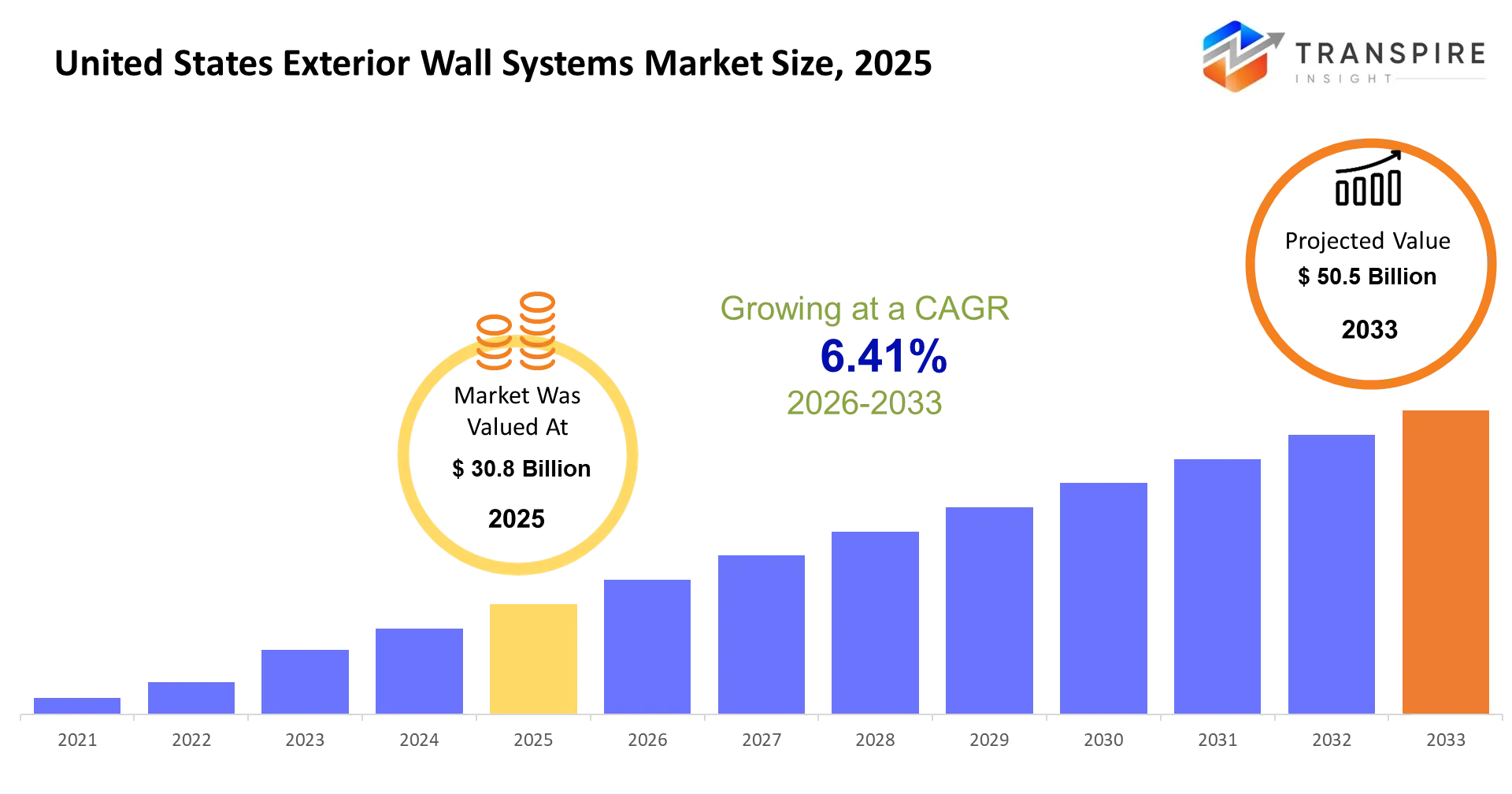
- United States Exterior Wall Systems Market Size 2025: USD 30.8 Billion
- United States Exterior Wall Systems Market Size 2033: USD 50.5 Billion
- United States Exterior Wall Systems Market CAGR: 6.41%
- United States Exterior Wall Systems Market Segments: By Material (Glass, Metal, Concrete, Wood, Vinyl, Composite Panels, Others); By System Type (Ventilated Facades, Curtain Walls, Cladding Systems, EIFS, Precast Panels, Insulated Panels, Others); By Application (Commercial Buildings, Residential Buildings, Industrial Buildings, Institutional Buildings, Healthcare Facilities, Hospitality Buildings, Others); By End User (Construction Companies, Real Estate Developers, Government Projects, Industrial Sector, Infrastructure Sector, Others)
To learn more about this report,  Download Free Sample Report
United States Exterior Wall Systems Market Summary
The United States Exterior Wall Systems Market was valued at USD 30.8 Billion in 2025. It is forecast to reach USD 50.5 Billion by 2033. That is a CAGR of 6.41% over the period.
Exterior wall systems are these engineered outer layers, that sort of guard U.S. buildings from weather exposure, air leakage, moisture intrusion, and sudden temperature fluctuation while still shaping energy performance and long term structural durability. Basically, in real life they help commercial towers, healthcare facilities, data centers, and institutional buildings, lower operating costs, hit insulation targets, and also reduce the day to day maintenance burdens. Over the last five years the market has tilted away from conventional cladding and more toward integrated high performance assemblies. These newer setups combine insulation, moisture barriers, and prefabricated façade components which sounds straightforward but changes a lot.
The momentum kinda picked up after stricter state level energy codes, plus federal decarbonization incentives, nudged developers to push for better building-envelope efficiency. And then during the pandemic, supply chain disruptions showed everyone the price of delayed material sourcing, so contractors started favoring modular, factory-fabricated systems that can shorten installation timelines. This is directly feeding revenue growth because developers now treat advanced wall systems like a financial performance instrument, not just something “required”. Better thermal control reduces lifecycle expenses, helps with compliance, and makes premium assemblies easier to justify for both new construction and retrofit work.
Key Market Insights
- The Northeast is sort of dominating the United States Exterior Wall Systems Market , with almost 31% market share in 2025, helped along by a very dense commercial retrofit vibe.
- Meanwhile, the Southern U.S. seems like the fastest-growing region, expected to keep growing through 2032 because of large scale data center builds and mixed-use construction, basically going at it.
- Western states are also seeing meaningful share gains. California, Washington, and a few neighbors, are pushing energy efficiency requirements that basically speed up exterior envelope modernization.
- Insulated wall panels take the lead here , grabbing about 36% of the United States Exterior Wall Systems Market revenue in 2025 due to better thermal performance.
- Curtain wall systems sit in the second spot, holding the second-largest market share, and that’s mostly driven by ongoing adoption across premium commercial plus institutional infrastructure projects.
- The prefabricated modular facade systems thing is kind of the fastest growing segment , and it is expected to expand pretty fast through 2030. Builders keep focusing on installation speed, so it makes sense.
- Commercial construction basically dominates here, holding close to 42% share, with office retrofits in the mix, plus healthcare expansions , and also energy code compliance improvements.
- For the application side, data centers are the fastest growing, mostly because digital infrastructure spending is rising , and everyone wants thermally efficient building envelope solutions.
- Institutional retrofitting is showing newer demand too, like when universities and public facilities start modernizing older exteriors , you know, the older skin of buildings.
- As for end users, the large commercial developers stay on top, and they are responsible for more than 38% of market demand in 2025.
What are the Key Drivers, Restraints, and Opportunities in the United States Exterior Wall Systems Market?
The strongest force behind the United States Exterior Wall Systems Market, is the tightening of building energy performance rules, especially the newer state level energy codes that are being pulled closer to stricter thermal envelope standards. You can already see this in states like California, New York, and Massachusetts, where commercial buildings are now held to higher expectations for insulation levels and air leakage control. So developers end up needing advanced exterior wall assemblies, not just the usual straightforward options. And honestly, this regulatory shift has helped open up more revenue lanes for manufacturers making insulated panel systems, rainscreen components, and prefabricated façade solutions. Developers are also putting a bigger share of the overall project budget toward how the wall performs, because not meeting the requirements now leads to real and countable money impacts , including redesign work, slower approvals, and lower building valuation.
Still, the biggest structural snag is the split, fragmented installation ecosystem combined with a shortage of specialized façade labor. High performance wall systems need careful engineering, detailed, precise detailing, and teams that understand moisture management, thermal bridge prevention, and airtightness checks. But the U.S. construction workforce hasn’t grown fast enough to match this demand. And it’s not something that gets fixed overnight, because contractor certification pathways, plus workforce development efforts, take years before they really settle in. The practical outcome is, delayed project start times, higher installation costs, and weaker uptake in mid sized commercial projects where budgets don’t really have much wiggle room.
The next big phase of growth sort of sits in data center construction and those prefabricated exterior envelope systems. Big money is flowing into AI infrastructure across Texas , Virginia and Arizona, and it is pulling demand toward thermally efficient but also quickly deployed façades. In practice, factory built modular wall systems can reduce the installation time line quite a lot, so they’re becoming more and more appealing for hyperscale campuses where getting the project done faster directly ties to operational revenue earning.
What Has the Impact of Artificial Intelligence Been on the United States Exterior Wall Systems Market?
Artificial intelligence and advanced digital technologies are kind of reshaping the exterior wall system design and deployment across the United States, basically by making façade engineering more precise, faster, and a lot more predictable. With AI-driven building information modeling platforms now automating clash detection , thermal bridge analysis, and envelope performance simulations during the early planning phase. That helps contractors and architects spot structural inefficiencies before anything gets fabricated, so it reduces design revisions and, in many cases, it shortens the project delivery timeline too. On the manufacturing side, quality-control systems with computer vision check insulated panels and cladding components for subtle dimensional inconsistencies. The result is better production accuracy and less material waste which is, honestly, a big deal.
Machine learning models are also adding stronger predictive power. In practice, advanced digital twins can study weather exposure, moisture migration, and thermal cycling to forecast façade degradation patterns years ahead. Then facility operators can plan targeted maintenance before sealant failure or insulation breakdown starts hurting building performance. Some smart façade monitoring systems have shown double digit decreases in unplanned maintenance, while also improving energy performance through continuous envelope optimization.
Day to day, these tools improve installation sequencing, lower rework expenses, and help teams hit tighter building code compliance requirements. Contractors who use AI-assisted project coordination platforms often report quicker installation cycles , and better labor efficiency, even when project conditions get messy.
Still, there is a major hangup, the cost to fully integrate legacy construction workflows with smarter monitoring systems. A lot of mid-sized contractors don't actually have the digital setup and the earlier performance archives needed in order to train predictive models reliably, and at scale.
Key Market Trends
- Since 2022, more than 20 U.S. states have updated their commercial energy codes , and it’s been nudging developers toward advanced insulated wall systems with tighter air leakage margins , you know, that whole “control infiltration” thing.
- Prefabricated façade adoption has been rising fairly steady since 2021 , and contractors have been shaving installation timelines by around 25% on bigger commercial jobs, sometimes even more if the site is cooperative.
- Manufacturers like Saint-Gobain and Kingspan Group expanded their North American production capacity between 2023 and 2025 , partly to reduce supply-chain exposure that was kind of hanging over everyone’s heads .
- Buyers have increasingly stepped away from pure lowest-cost procurement after those pandemic-era material shortages . They’re prioritizing delivery certainty , plus lifecycle performance , over just staring at the upfront panel pricing, even if the numbers look tempting at first.
- Since 2023, digital twin modeling and AI-based façade simulations have moved from premium projects into more mainstream institutional construction workflows , which is kind of surprising how fast it happened.
- Retrofitting picked up speed after federal building decarbonization funding expanded in 2022 , pushing public sector owners to replace older exterior envelopes that were basically aging out .
- Curtain wall specification rates dipped a bit in mid-rise developments, mostly because composite insulated panels started getting traction , mainly for lower labor dependency rather than some single miracle product.
- Labor shortages pushed façade contractors toward modular assemblies , and in some regions installers have reported 15% less onsite crew requirement by 2025, so yeah, less people on ladders.
- Competitive behavior has also shifted , with firms including Owens Corning and Carlisle Companies expanding integrated system offerings, not just standalone material sales, which feels more like bundling than competing.
United States Exterior Wall Systems Market Segmentation
By Material:
Material picking keeps shaping the United States Exterior Wall Systems Market, even as builders push harder toward long-term building results, energy savings, and design flexibility, you know. Glass is still showing up a lot in newer commercial projects, mostly because it brings natural light inside and it looks clean on the outside. Because of that, advanced insulated glass solutions should keep growing in demand, especially as energy rules get tighter across most city development efforts.
Metal systems are also getting more attention these days, mainly for their durability and the fact that maintenance is lower, which helps in industrial settings and in big commercial facilities. Concrete is still a key choice for jobs that demand structural strength, while wood shows up in some residential uses, particularly when people want that more natural kind of finish.Vinyl and composite panels are expanding too, largely tied to cost efficiency and quick installation. This gives builders more workable choices for different construction needs, and honestly it makes the whole selection process feel a bit less rigid.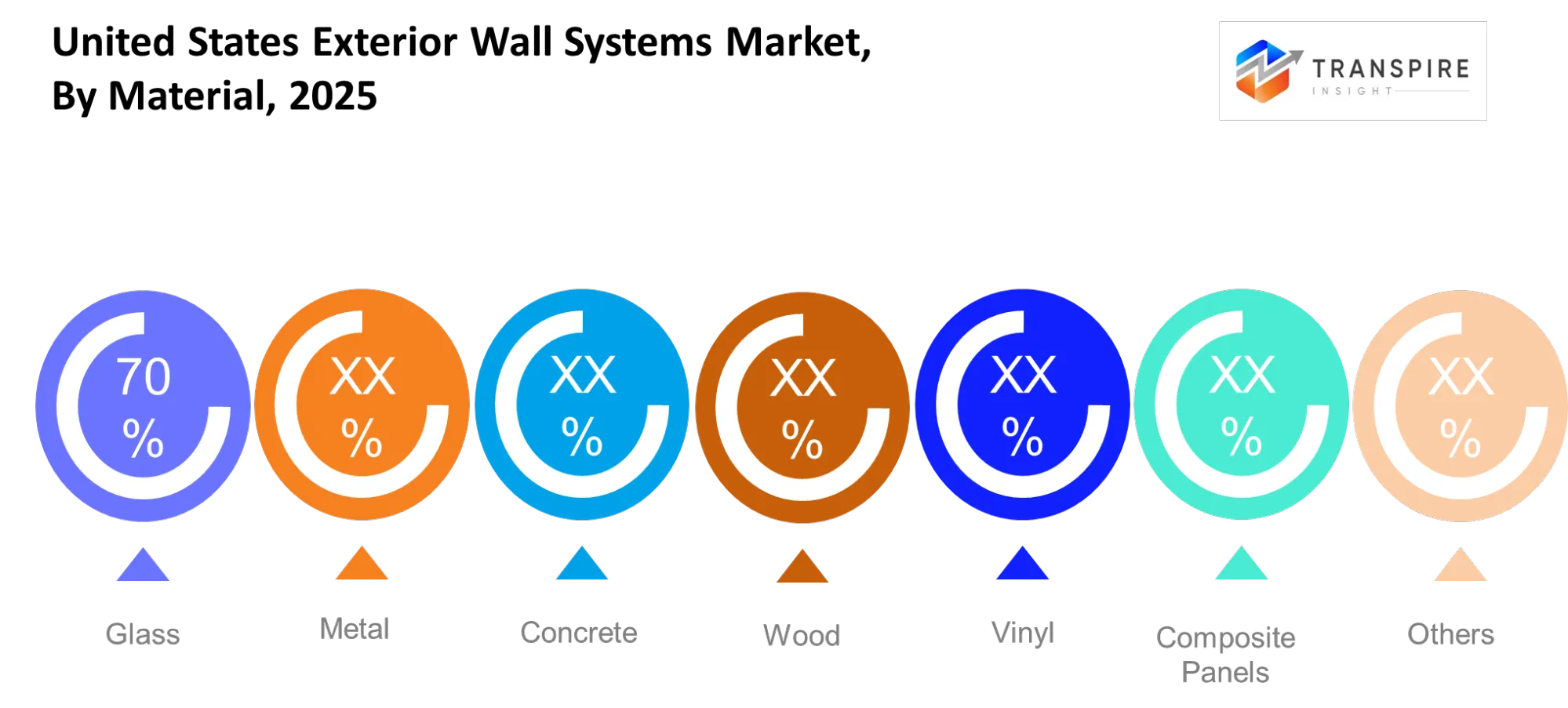
To learn more about this report, Download Free Sample Report
By System Type:
The system type demand in the United States Exterior Wall Systems Market is shifting as building requirements change, and ventilated facade assemblies are getting more common, mostly because they help with moisture control plus thermal performance. In other words, these exterior setups encourage better air movement and lower heat transmission, so they work well in locations that face harsh weather, and also where there’s growing attention on sustainable build standards.
Meanwhile, curtain wall systems still keep a solid place in high-rise commercial construction, largely due to their visual impact and the way they can be adapted structurally. For renovations, cladding solutions are still important, while EIFS is usually picked for insulation-related gains. Also, precast together with insulated panels are being adopted more often, because quicker project delivery is now a big deal for contractors dealing with strict timelines, so it’s not just a preference it’s kind of a necessity.
By Application:
Commercial buildings make up a big share of demand in the United States Exterior Wall Systems Market, like office complexes, retail developments, and mixed use projects. These places need exterior systems that do more than look good they also have to perform. In this slice the exterior wall systems will keep changing , mostly to hit higher insulation requirements while still fitting the modern architectural vibe people expect.
Residential construction is keeping things moving too, because homeowners and developers want exterior options that are durable and energy smart. For industrial buildings the priorities tend to shift toward resilience and weather resistance. Institutional sites and healthcare facilities usually care most about safety, thermal control , and getting long service life out of the materials. Hospitality projects often lean even harder on outward look, since appearance helps protect property value and improves the overall guest experience.
By End User:
Construction companies are still the biggest end users across the United States Exterior Wall Systems Market, since active building work basically pushes both material purchasing and system installation. These companies are choosing wall solutions that cut down on labor time, and at the same time help them stay in line with changing building efficiency rules across federal and state level standards.
Real estate developers also add meaningful demand, especially when competitive property markets encourage people to invest in higher performance building facades. Government work supports wider adoption through public infrastructure improvements and institutional development. Meanwhile, industrial and infrastructure participants keep contributing in a steady way, particularly when the project really depends on strong outside protection, reduced upkeep, and long term structural dependability.
What are the Key Use Cases Driving the United States Exterior Wall Systems Market?
The main, sort of biggest, use case for exterior wall systems is still commercial office towers, healthcare campuses, and different kinds of institutional buildings where thermal performance, and well, code compliance really hits operating costs. These projects tend to pull in the highest demand because developers have to satisfy strict envelope efficiency rules while also keeping long-term structural durability in place.
Nearby applications are growing fast in hyperscale data centers and advanced manufacturing facilities. People running these sites increasingly ask for high-performance insulated façades to manage internal climate loads, boost energy efficiency and, frankly, support uptime expectations. Education and municipal retrofits are also picking up momentum as public infrastructure modernization programs move ahead.
Newer use cases show up too, like exterior envelope systems for cold-storage logistics hubs, and modular life sciences facilities. Those projects need precision-controlled thermal barriers, plus faster assembly methods, because schedule matters. And as factory-built construction becomes more accepted across specialized industrial developments, demand for digitally engineered prefabricated façade systems is expected to strengthen during the forecast period.
|
Report Metrics |
Details |
|
Market size value in 2025 |
USD 30.8 Billion |
|
Market size value in 2026 |
USD 32.7 Billion |
|
Revenue forecast in 2033 |
USD 50.5 Billion |
|
Growth rate |
CAGR of 6.41% from 2026 to 2033 |
|
Base year |
2025 |
|
Historical data |
2021 - 2024 |
|
Forecast period |
2026 - 2033 |
|
Report coverage |
Revenue forecast, competitive landscape, growth factors, and trends |
|
Geographic scope |
United States of America |
|
Key company profiled |
Saint-Gobain, Kingspan Group, BASF, STO SE, Dryvit Systems, Owens Corning, Rockwool, Sika AG, Etex Group, Nichiha Corporation, Boral Limited, Alcoa Corporation, James Hardie, USG Corporation, Georgia-Pacific |
|
Customization scope |
Free report customization (country, regional & segment scope). Avail customized purchase options to meet your exact research needs. |
|
Report Segmentation |
By Material (Glass, Metal, Concrete, Wood, Vinyl, Composite Panels, Others); By System Type (Ventilated Facades, Curtain Walls, Cladding Systems, EIFS, Precast Panels, Insulated Panels, Others); By Application (Commercial Buildings, Residential Buildings, Industrial Buildings, Institutional Buildings, Healthcare Facilities, Hospitality Buildings, Others); By End User (Construction Companies, Real Estate Developers, Government Projects, Industrial Sector, Infrastructure Sector, Others) |
Which Regions are Driving the United States Exterior Wall Systems Market Growth?
The Northeast still, stays pretty much the dominant piece of the United States Exterior Wall Systems Market, mostly because the building energy codes there are really strict, plus there’s this dense cluster of older commercial buildings , and then the whole aggressive decarbonization push that's happening too. Places like New York and Massachusetts are still leaning in on tough envelope performance rules, so developers feel sort of compelled to choose high-efficiency façade systems. Also the region has a fairly mature setup—specialized façade consultants, certified installers, and material distributors are all pretty established. With all that in place it becomes easier to move fast on specification, get regulatory approvals through with fewer surprises, and keep projects running smoothly for both new construction and retrofit jobs, which matters a lot.
The Midwest shows up as the second-largest contributor, but it’s not so much driven by regulation, more by industrial steadiness. Compared to the Northeast, the Midwest is more about consistent investment across manufacturing, healthcare , and higher education infrastructure, rather than those intense, dense urban retrofit cycles. Big institutional owners across Illinois, Ohio , and Michigan keep putting money toward modernization programs, and they tend to focus on life cycle durability and weather resilience. That overall pattern gives exterior wall system suppliers a more dependable revenue foundation, even when the wider construction market starts moving around a bit.
Over, like, the Southern United States is showing this fastest growth momentum thing, kinda pushed by hyperscale data center expansion plus population- led commercial development , you know. In the last while, new investment across Texas, Virginia and Arizona has really sped up the need for thermally efficient wall systems that can take on large scale digital infrastructure. Also, looser construction schedules in those markets is making it easier for companies to lean into prefabricated façade assemblies, which reduces how much onsite labor they need. So for market entrants and investors , this shift looks like a strong opening between 2026 and 2033, because the regional construction pipeline keeps expanding.
Who are the Key Players in the United States Exterior Wall Systems Market and How Do They Compete?
The United States Exterior Wall Systems Market still looks pretty fragmented, like not one single player really owns it, and the fight is less about plain price pressure, more about how well the stuff works in real life, plus code compliance expertise, and installation support that actually matters. Bigger multinational manufacturers keep defending their share via vertically integrated product lines, but at the same time regional specialists jump in by moving quicker on customization, and by leaning harder into project-specific engineering services. Lately, there’s also this disruption vibe from prefabrication focused entrants they talk about shorter construction timelines, and digitally integrated façade solutions, which feels like it’s changing expectations. And across all tiers, winning more often comes down to thermal efficiency benchmarks , fire safety certifications, and whether a company can back complex retrofit projects without stumbling.
Saint-Gobain is competing mostly through technology-led system integration, so they bundle insulation, weather barriers and façade materials into one unified building-envelope package. Their edge is in the testing infrastructure, and the code-certification capacity, which helps architects specify the system on high-compliance jobs without as much back and forth. They’re also still pushing expansion through manufacturing investments, and partnerships with digital design platforms, that in turn strengthen their BIM driven façade planning role. Meanwhile Kingspan Group differentiates with advanced insulated panel technology, built for tougher thermal targets, and faster installation cycles. Their North American push is centered on localized production and distribution, which is supposed to cut lead times for commercial, as well as industrial clients.
Owens Corning leans on material science innovation, specially high-performance insulation systems made for moisture resistance and long haul durability. That kind of thing gives it a pretty strong standing in retrofit heavy institutional work, where lifecycle performance ends up mattering more than the initial price tag. Carlisle Companies sort of builds its edge by going service first , meaning they provide integrated technical consultation and installation support, so contractors don’t get stuck in execution surprises. And then there’s Nichiha USA , they’ve sort of carved out a niche using architectural fiber cement panels, which can be attractive for premium commercial developments that want both look and code certified resilience.
Company List
- Saint-Gobain
- Kingspan Group
- BASF
- STO SE
- Dryvit Systems
- Owens Corning
- Rockwool
- Sika AG
- Etex Group
- Nichiha Corporation
- Boral Limited
- Alcoa Corporation
- James Hardie
- USG Corporation
- Georgia-Pacific
Recent Development News
In February 2026, Cemex announced acquisition of Omega Products International. The transaction expands Cemex’s western U.S. stucco and façade materials footprint, strengthening its position in high-performance exterior wall systems for residential and commercial construction. Source https://www.cemex.com/
In October 2025, Holcim announced the acquisition of Xella. This €1.85 billion transaction enhances Holcim’s walling systems portfolio and supports its strategic shift toward sustainable building envelope solutions, including exterior wall systems. Source https://www.reuters.com/
What Strategic Insights Define the Future of the United States Exterior Wall Systems Market?
Over the next five to seven years, the United States Exterior Wall Systems Market is kind of moving, sort of, toward fully integrated prefabricated envelope assemblies engineered around performance data rather than the standalone material specs people used to treat as the main thing. And well, this shift seems pulled by tighter building decarbonization mandates , persistent construction labor constraints, and also that constant pressure to shave down delivery timelines without dropping thermal efficiency. So the market should likely reward suppliers who can blend advanced materials with digital design integration and offsite manufacturing capabilities , because that combination is what works in practice.
There’s also a risk that is less obvious on the surface: a growing reliance on a pretty narrow pool of specialized raw material suppliers, especially for high performance insulation cores and composite façade components. If anything happens in those supply chains, even a temporary disruption could cause delays, and then costs climb, particularly as adoption accelerates. Meanwhile, an opportunity is showing up more clearly: adaptive façade systems that come with embedded monitoring sensors, mainly in fast-growing Southern data center corridors where real time thermal performance optimization is starting to look commercially valuable, not just experimental.
For both incumbents and new entrants, the most effective approach is to invest now in regional prefabrication capacity and digital engineering partnerships. Firms that localize production while also integrating BIM-driven specification support will probably be the ones that snag premium projects, since procurement criteria keep shifting toward lifecycle performance and execution certainty.
United States Exterior Wall Systems Market Report Segmentation
By Material
- Glass
- Metal
- Concrete
- Wood
- Vinyl
- Composite Panels
By System Type
- Ventilated Facades
- Curtain Walls
- Cladding Systems
- EIFS
- Precast Panels
- Insulated Panels
By Application
- Commercial Buildings
- Residential Buildings
- Industrial Buildings
- Institutional Buildings
- Healthcare Facilities
- Hospitality Buildings
By End User
- Construction Companies
- Real Estate Developers
- Government Projects
- Industrial Sector
- Infrastructure Sector
Frequently Asked Questions
Find quick answers to common questions.
The United States Exterior Wall Systems Market size is USD 50.5 Billion in 2033.
Key Segments for the United States Exterior Wall Systems Market are By Material (Glass, Metal, Concrete, Wood, Vinyl, Composite Panels, Others); By System Type (Ventilated Facades, Curtain Walls, Cladding Systems, EIFS, Precast Panels, Insulated Panels, Others); By Application (Commercial Buildings, Residential Buildings, Industrial Buildings, Institutional Buildings, Healthcare Facilities, Hospitality Buildings, Others); By End User (Construction Companies, Real Estate Developers, Government Projects, Industrial Sector, Infrastructure Sector, Others).
Major United States Exterior Wall Systems Market players are Saint-Gobain, Kingspan Group, BASF, STO SE, Dryvit Systems, Owens Corning, Rockwool, Sika AG, Etex Group, Nichiha Corporation, Boral Limited, Alcoa Corporation, James Hardie, USG Corporation, Georgia-Pacific.
The current United States Exterior Wall Systems Market size is USD 30.8 Billion in 2025.
The United States Exterior Wall Systems Market CAGR is 6.41% from 2026 to 2033.
- Saint-Gobain
- Kingspan Group
- BASF
- STO SE
- Dryvit Systems
- Owens Corning
- Rockwool
- Sika AG
- Etex Group
- Nichiha Corporation
- Boral Limited
- Alcoa Corporation
- James Hardie
- USG Corporation
- Georgia-Pacific
Recently Published Reports
-
Apr 2026
Handling and Lifting Equipment Market
Handling and Lifting Equipment Market Size, Share & Analysis Report By Product (Cranes and Hoists, Forklifts, Conveyor Systems, Aerial Work Platforms, Others), By Application (E-Commerce, Automotive and Railway, Food and Beverages, Aviation, Others), and Geography (North America, Europe, Asia-Pacific, Middle East and Africa, South and Central America), 2021 - 2031
-
Apr 2026
HVAC Equipment Market
HVAC Equipment Market Size, Share & Analysis Report By Heating Equipment Type (Boilers and Furnaces, Heat Pumps, and Unitary Heaters), By Ventilation Equipment (Air Handling Units, Humidifiers and Dehumidifiers, Air Filters, and Fan Coiling Units), By Air Conditioning Equipment (Unitary Air Conditioners, Room Air Conditioners, Packaged Terminal Air Conditioners, and Chillers), By End User (Commercial, Residential, Industrial, and others), and Geography (North America, Europe, Asia-Pacific, Middle East and Africa, South and Central America), 2021 – 2031
-
Apr 2026
Refrigeration Valves Market
Refrigeration Valves Market Size, Share & Analysis Report By Type (Solenoid Valves, Expansion Valves, Check Valves, Service Valves, Others), By Application (Commercial Refrigeration, Industrial Refrigeration, Transport Refrigeration, Residential Refrigeration, Air Conditioning Systems), By End User (Food and Beverage Industry, Pharmaceutical Industry, HVAC Industry, Chemical Industry, Others), and Geography (North America, Europe, Asia-Pacific, Middle East and Africa, South and Central America), 2021 – 2031
-
Apr 2026
E-Commerce Packaging Materials Market
E-Commerce Packaging Materials Market By Material Type (Corrugated Boxes, Paper & Paperboard, Foam & Cushioning Materials, Plastic Packaging, Flexible Packaging, Protective Packaging, Others), By Product(Primary Packaging, Secondary Packaging, Tertiary Packaging), By Packaging Function (Protective Packaging, Branding & Presentation Packaging, Transit & Logistic Packaging, Sustainable Packaging, Tamper Evidence Packaging), By End-User (Retail & Consumer Goods, Electronic Appliances, Food & Beverages, Healthcare & Pharmaceutical, Fashion & Apparel, Home & Furnishing, Others); By Industry Analysis, Size, Share, Growth, Trends, and Forecasts 2021-2033