

United States Optical Communication Systems and Networking Market Size & Forecast:
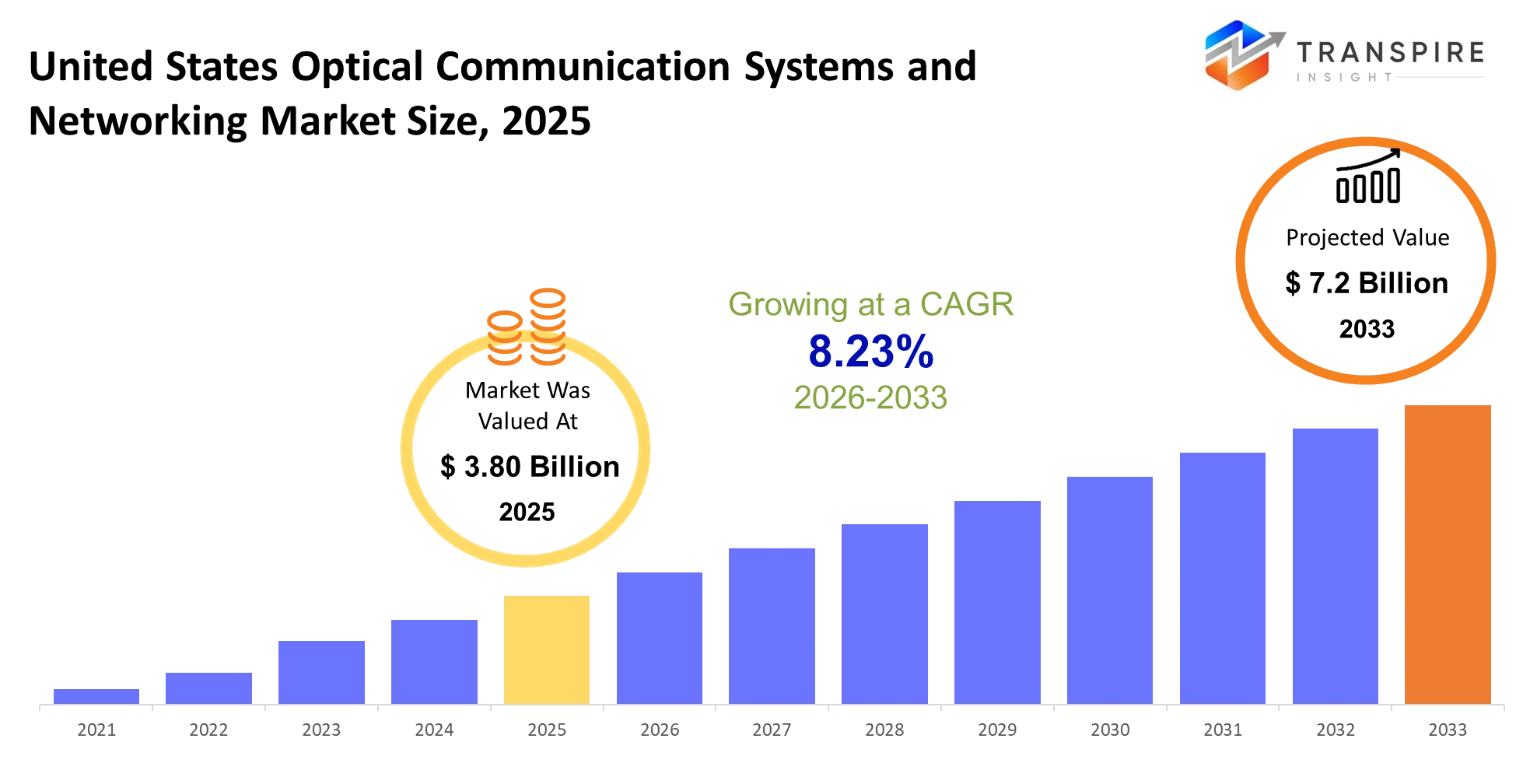
- United States Optical Communication Systems and Networking Market Size 2025: USD 3.80 Billion
- United States Optical Communication Systems and Networking Market Size 2033: USD 7.2 Billion
- United States Optical Communication Systems and Networking Market CAGR: 8.23%
- United States Optical Communication Systems and Networking Market Segments: By Component (Optical Fibers, Optical Switches, Optical Amplifiers, Transceivers, Routers, Multiplexers, Others), By Technology (WDM, SONET/SDH, Fiber Channel, Optical Ethernet, DWDM, CWDM, Others), By Application (Telecommunications, Data Centers, Enterprise Networks, Cable Television, Military Communications, Others), By End User (Telecom Operators, IT Companies, Government Sector, Enterprises, Cloud Providers, Others).
To learn more about this report,  Download Free Sample Report
United States Optical Communication Systems and Networking Market Summary:
The United States Optical Communication Systems and Networking Market size is estimated at USD 3.80 Billion in 2025 and is anticipated to reach USD 7.2 Billion by 2033, growing at a CAGR of 8.23% from 2026 to 2033. The United States Optical Communication Systems and Networking Market, kind of underpins the digital infrastructure that shuffles massive volumes of data between hyperscale data centers telecom backbones, defense networks, industrial facilities, and cloud platforms with minimal delay. In real usage these systems handle a key operational headache: moving bandwidth-heavy traffic reliably over distance while also keeping power draw down and reducing network congestion. That role has practically become the backbone of AI computing, edge workloads, 5G rollouts, and real time industrial automation .
Over the last 3–5 years, the market has shifted in a more structural way , away from plain hardware-focused transport networks toward software defined, high capacity optical setups tuned for cloud and AI activity. The quick growth of generative AI training cluster setups, plus the hyperscale data center interconnects, basically sped up fiber modernization and helped push wider adoption of coherent optical in a more stable way. At the same time, semiconductor constraints and geopolitical frictions showed up like weak spots in telecom supply chains, so operators started diversifying the vendor mix and also trying to localize procurement more than before. For enterprises handling larger datasets, and for carriers modernizing backbone capacity, the revenue picture increasingly depends on network densification, low latency performance needs, and recurring infrastructure upgrades—not just “more connectivity” in a basic sense.
Key Market Insights
- Western United States, basically led the United States Optical Communication Systems and Networking Market with almost 38% of the market share in 2025, mainly because hyperscale data center concentration. It’s kind of a clear pattern really.
- Meanwhile the Southern United States is showing the quickest momentum through 2030, propelled by large fiber scale deployment plus cloud infrastructure investments, you know the usual story.
- Texas and Virginia came up as key optical networking hubs because telecom operators extended low-latency backbone connectivity for AI tasks and enterprise workloads. That expansion, it mattered.
- Optical transceivers sat at the top in the United States Optical Communication Systems and Networking Market, taking more than 34% revenue share in 2025, driven by bandwidth needs that kept rising without much pause.
- Wavelength Division Multiplexing systems also captured the second-largest market share, as carriers upgraded long-haul and metro optical transport networks, step by step.
- Coherent optical networking solutions are expected to post the most rapid growth rate through 2030, since AI clusters are essentially hungry for high-capacity data transmission efficiency.
- Also 800G optical modules got notable commercial traction in 2025, as cloud providers pushed harder on next-generation network modernization plans.
- For applications, data center interconnect took nearly 41% of the United States Optical Communication Systems and Networking Market share in 2025, so that segment is really strong.
- The 5G transport and edge computing side is projected to be the fastest-growing segment, mostly due to ultra-low latency plus high-throughput connectivity demands, no surprise there.
- Enterprise cloud networking demand grew fast, especially as financial services, healthcare, and manufacturing expanded their digital infrastructure investments.
- And telecom service providers dominated the overall industry size picture, holding around 46% market share in 2025 thanks to nationwide fiber capacity expansion.
What are the Key Drivers, Restraints, and Opportunities in the United States Optical Communication Systems and Networking Market?
The strongest force that’s kind of pushing the United States Optical Communication Systems and Networking Market forward is the fast roll-out of AI computing infrastructure, plus hyperscale cloud data centers. When generative AI training models are getting built, they really do need ultra-high bandwidth with low-latency interconnects, so many operators are moving toward coherent optics, 400G, and then more and more 800G transmission methods. This momentum really got more obvious after major cloud providers increased their capital spending on AI infrastructure quite sharply, during 2023-2025. Once data traffic started climbing, telecom carriers and data center operators expanded their fiber backbone capacity so they wouldn’t hit network bottlenecks. In practice this means higher equipment sales, quicker deployment cycles, and a rise in steady, recurring revenue tied to network modernization contracts.
The biggest structural issue, though, is the awkward level of complexity and the cost tied to semiconductor and photonic component manufacturing. Those advanced optical modules rely on specialized chips, precision packaging, and supply chains that are spread out globally, and it’s not something you can localize quickly at all. On top of that, geopolitical tensions along with export controls affecting semiconductor technologies, have made the whole procurement process feel riskier, while also lengthening the lead times for vendors of network equipment. So overall it slows down carrier expansion programs, drags out hyperscale rollout schedules, and ends up reducing short term revenue visibility across the broader optical networking ecosystem.
Edge AI infrastructure is kind of the next big growth window, not just a trend. Telecom operators are, more and more, putting capital into metro fiber and nearby edge data centers, to enable real-time AI inference, autonomous systems, and industrial automation, in that same loop. Places like Texas and Virginia are showing up as high-investment corridors too where cloud providers plus carriers are stacking up dense optical interconnect networks so they can run distributed computing architectures more effectively.
What Has the Impact of Artificial Intelligence Been on the United States Optical Communication Systems and Networking Market?
Artificial intelligence, and advanced digital technologies, are quietly reshaping the United States Optical Communication Systems and Networking Market. It is happening because network management gets automated and traffic efficiency improves across hyperscale data centers as well as telecom backbones, kinda at the same time. Network operators now lean on AI driven control systems more often, to automate bandwidth allocation, spot faults quicker, and optimize optical routes in real time. And it isn’t just one trick , software-defined networking platforms that are tied to machine learning can spot congestion trends and then reroute traffic on their own. In practice this tends to reduce latency and also cuts down on packet loss when demand spikes.
Alongside that, predictive analytics has turned into a really important tool for optical infrastructure providers. Machine learning models dig through signal degradation records, track temperature swings, and read component performance measures to foresee fiber failures, or transceiver issues before the outage even begins. This method supports carriers in cutting unplanned downtime, stretching the usable life of equipment, and dialing down maintenance expenses. Several U.S. telecom operators say they are seeing clear gains in network uptime, plus faster fault resolution once AI-assisted monitoring gets rolled out across metro links and long haul fiber networks.
On top of those gains, AI enabled automation is also boosting energy efficiency in optical transport systems. The power usage can be adjusted dynamically based on how the network is behaving, rather than using fixed settings. Even so, adoption is still limited. The big reasons are the high integration costs, and the fact that training AI models can become messy when legacy network architectures are fragmented. Many of those older systems also lack standardized operational data, so the whole process is harder than it should be.
Key Market Trends
- Since 2022, hyperscale cloud providers went up on 800G optical module deployments, mostly because AI training clusters started chewing through a lot more interconnect bandwidth capacity, like really a lot.
- At the same time, telecom operators shifted their capital spending from older long haul infrastructure toward metro fiber densification, to better fit edge computing and near real time analytics use cases, and yes with less lag.
- Between 2021 and 2025, coherent optics adoption also sped up, because carriers kept pushing for lower power draw, and stronger spectral efficiency across the backbone.
- Cisco Systems and Ciena then broadened their AI driven network automation platforms to cut down outage response times , and also reduce operational overhead that was piling up.
- In 2022 and 2023, semiconductor supply disruptions happened, and network equipment vendors responded by diversifying photonic component sourcing. Not just relying on one single region’s manufacturing anymore, which turned out to be a pretty big deal.
- Meanwhile, large enterprises moved more often from copper based infrastructure to fiber heavy campus networking, after hybrid cloud traffic volumes jumped sharply post 2020, it was kind of inevitable.
- Data center operators also reduced manual network provisioning by using software defined optical networking platforms. Those tools can automate bandwidth allocation and do predictive fault management, instead of waiting for problems to show up.
- Federal broadband infrastructure funding sped up rural fiber deployment projects, which then created new demand for scalable optical transport systems across underserved regions of the U.S.
- Since 2023, telecom carriers have increasingly partnered with cloud providers, building dedicated low latency fiber corridors between AI focused data center campuses, and in a more coordinated way.
- Finally, optical networking vendors intensified acquisitions and strategic alliances, to reinforce vertically integrated photonics capabilities, and to lock in long term semiconductor supply resilience.
United States Optical Communication Systems and Networking Market Segmentation
By Component
Optical fiber strands and the transceivers they connect with currently hold the strongest position in the overall component scene, since hyperscale data centers as well as telecom operators keep pushing forward with higher capacity fiber builds. Optical fibers make up a big chunk because backbone rollouts at scale continue across both metro and long haul networks , while transceivers are getting a lift as teams migrate toward the 400G , and then 800G, style connectivity norms. Routers plus multiplexers still see fairly steady uptake too , mainly because network operators need careful traffic orchestration and bandwidth optimization inside ever more crowded digital ecosystems.
Optical amplifiers have also gained weight as carriers stretched transmission spans farther without creating even more physical infrastructure duplication. At the same time , demand is tilting toward energy efficient and space saving hardware layouts, which help cut operating costs, and also fit automated network management. Component makers are leaning hard into silicon photonics, and also integrated optical systems, so they can push scalability up and reduce latency. Looking ahead, the market trajectory seems to favor vertically integrated offerings that blend advanced optics, software control, and AI- enabled monitoring features, so suppliers can stay competitive over the long run.
By Technology
Wavelength Division Multiplexing tech is basically leading in the technology space, mainly because telecom carriers and cloud providers need smarter ways to boost fiber capacity without doing a ton of extra physical network expansion. Dense Wavelength Division Multiplexing solutions keep a strong market hold, mostly for their superior spectral efficiency and their reliable long-haul transmission abilities over backbone links. Coarse Wavelength Division Multiplexing is still getting attention too, especially from mid sized enterprises and regional operators that want lower deployment costs for metro use cases, a bit like a pragmatic choice.
Optical Ethernet has also been growing fast in recent years, partly since enterprise cloud adoption picked up and edge computing traffic started rising faster than before, so the need for scalable networking with low latency basically spiked. SONET/SDH systems are slowly losing ground, because those older transport setups don’t play well with AI driven data traffic growth, not efficiently enough. Fiber Channel stays relevant in high performance storage networking environments, especially within financial services and healthcare, where throughput and stability really matter.
More and more technology suppliers are focusing on programmable optical platforms and software defined transport systems. The goal is to handle changing bandwidth requirements and improve operational agility across distributed computing networks, rather than being stuck with rigid configurations.
By Application
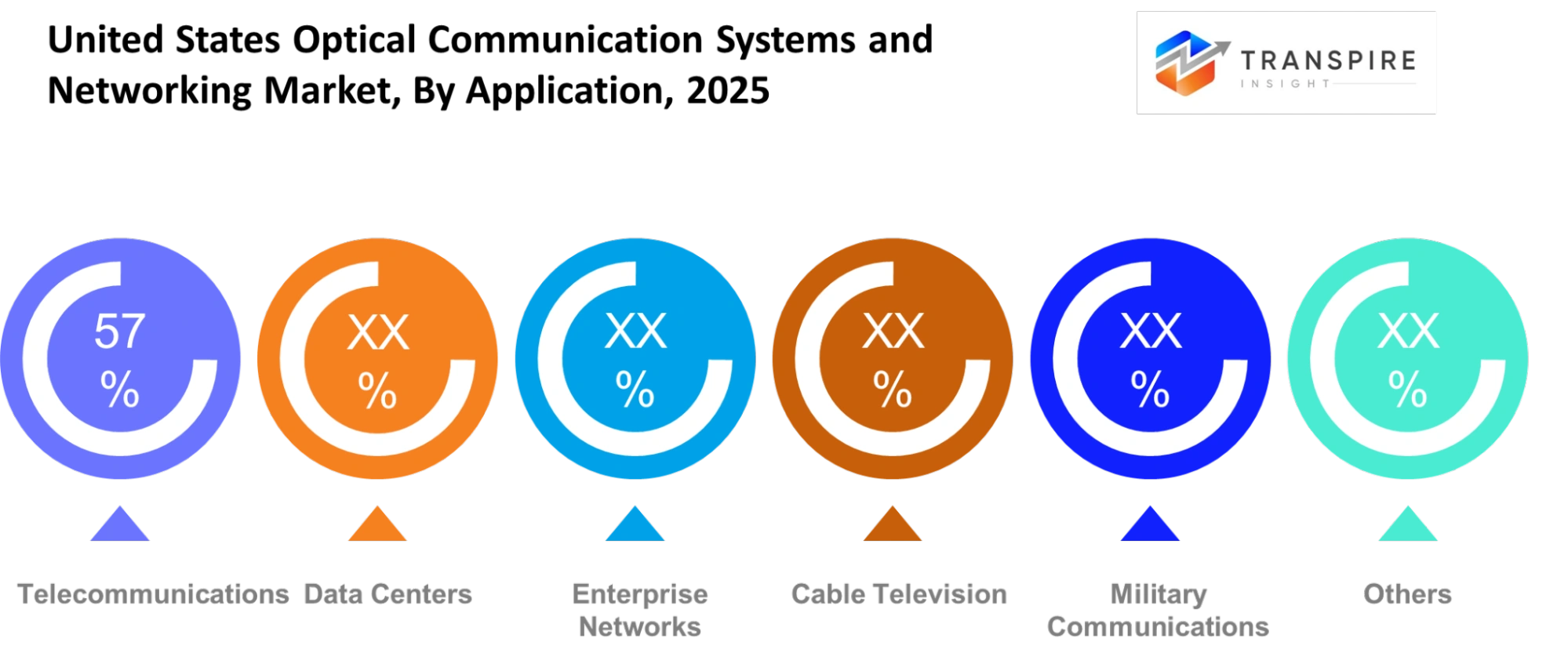
Telecommunications still counts as the biggest application segment, mostly because the nationwide fiber modernization efforts and the 5G rollouts keeps pushing ongoing investment into optical transport infrastructure. Telecom operators want very large backbone links, so they can handle the surge in mobile data, the cloud workloads, and the low latency digital services that everyone suddenly needs. Data centers look like the quickest expanding area, largely from the fast growth in AI training clusters, hyperscale cloud sites, and those inter-data-center connectivity projects.
For enterprise networks, advanced optical systems are getting more and more common too, as hybrid cloud operations become normal and cybersecurity expectations reshape how companies organize their IT plans. On the defense side, military communications stays steady, since agencies keep focusing on secure and high speed data transfer for intel, plus surveillance type activity. Meanwhile cable television is slowly shifting into fiber-friendly architectures, to carry higher streaming bandwidth and the kind of broadband convergence services that blend together better. What comes next in applications will likely hinge on edge computing rollouts, AI enabled traffic handling, and real time analytics infrastructure, so vendors that can deliver optical networking that is scalable, and also automated, should find plenty of openings.
To learn more about this report, Download Free Sample Report
By End-User
Telecom operators basically rule the end user landscape, because nationwide network expansion and fiber densification projects need ongoing investment in optical transport systems. Big carriers put a lot of capital into coherent optics, metro fiber upgrades, and automated traffic management platforms, to improve resilience maybe bandwidth efficiency too. Cloud providers are showing up as the fastest-growing end user group, since hyperscale companies ramp up AI infrastructure spend and roll out distributed data center networks across key U.S. regions.
Meanwhile IT companies and big enterprises are leaning harder toward advanced optical networking tech for hybrid work setups, cloud migration, and real time data processing needs. Government agencies keep steady procurement momentum, driven by cybersecurity modernization efforts and defense communications upgrades. Even so, budget limits and complicated legacy infrastructure keep slowing things for smaller enterprises and regional operators. Going forward, end user demand will lean more toward suppliers who can offer energy efficient systems, AI assisted network automation, and integrated photonic technologies that cut operational fuss and reduce long term infrastructure costs.
What are the Key Use Cases Driving the United States Optical Communication Systems and Networking Market?
Data center interconnect still seems to be the main use case, honestly, because hyperscale cloud operators need ultra-fast optical paths between AI training clusters and distributed computing locations. Big fiber capacity helps keep things moving in near-real-time , and it also enables low delay plus scalable bandwidth governance for both cloud and enterprise workloads.
More and more telecom carriers are rolling out advanced optical networking systems. This is mainly to move 5G transport networks and edge computing infrastructure across metropolitan areas, all while maintaining consistent throughput. At the same time , enterprise IT organizations are leaning on optical Ethernet platforms to reinforce cybersecurity, boost hybrid cloud reach, and improve high-volume application flow, especially in financial services as well as in healthcare settings.
There are also emerging uses like optical networking tailored for autonomous industrial systems, and AI-enabled defense communications platforms. Smart manufacturing plants, along with military agencies, are experimenting with low-latency fiber architectures, trying to support machine vision, predictive analytics, and secured real-time coordination. They’re doing this over the forecast period, in a way that feels very targeted toward operational responsiveness.
|
Report Metrics |
Details |
|
Market size value in 2025 |
USD 3.80 Billion |
|
Market size value in 2026 |
USD 4.14 Billion |
|
Revenue forecast in 2033 |
USD 7.2 Billion |
|
Growth rate |
CAGR of 8.23% from 2026 to 2033 |
|
Base year |
2025 |
|
Historical data |
2021 - 2024 |
|
Forecast period |
2026 - 2033 |
|
Report coverage |
Revenue forecast, competitive landscape, growth factors, and trends |
|
Geographic scope |
United States of America |
|
Key company profiled |
Cisco Systems, Ciena Corporation, Nokia, Huawei, Juniper Networks, Infinera, Fujitsu, Corning, NEC Corporation, ADVA Optical Networking, ZTE Corporation, Lumentum, Broadcom, Intel, Arista Networks. |
|
Customization scope |
Free report customization (country, regional & segment scope). Avail customized purchase options to meet your exact research needs. |
|
Report Segmentation |
By Component (Optical Fibers, Optical Switches, Optical Amplifiers, Transceivers, Routers, Multiplexers, Others), By Technology (WDM, SONET/SDH, Fiber Channel, Optical Ethernet, DWDM, CWDM, Others), By Application (Telecommunications, Data Centers, Enterprise Networks, Cable Television, Military Communications, Others), By End User (Telecom Operators, IT Companies, Government Sector, Enterprises, Cloud Providers, Others). |
Which Regions are Driving the United States Optical Communication Systems and Networking Market Growth?
The Western United States pretty much leads the optical communication systems and networking landscape , because the region hosts the country’s largest cluster of hyperscale data centers and cloud infrastructure operators. California, Oregon, and Washington keep pulling network investment , due to solid digital infrastructure policies , lots of subsea cable connectivity, and being close to major technology companies . Over the last couple years , big AI computing clusters and the constant inter-data-center traffic needs have pushed coherent optics , metro fiber networks and high-capacity transceivers into faster deployment across the area. There’s also a pretty mature mix of semiconductor suppliers, cloud providers, colocation firms , and telecom carriers which keeps the whole thing sustained. That whole ecosystem supports rapid commercialization of the next generation optical technologies and doesn’t really slow down.
The Northeastern United States stays a steady contributor, mostly because financial institutions, healthcare networks, and enterprise cloud operators consistently put money into resilient, high-speed connectivity infrastructure. And unlike the Western region, the Northeast growth depends less on hyperscale expansion and more on improving and upgrading older enterprise and telecom networks . States like Virginia and New York benefit from dense carrier-neutral facilities, established fiber corridors, and strong demand for low-latency financial data movement. With stable enterprise spending patterns and long-term infrastructure contracts , networking vendors and optical equipment manufacturers have predictable revenue streams , which helps them plan better .
The Southern United States seems to be the fastest-growing regional market, even though it’s kind of complicated, because telecom operators and cloud providers are rapidly expanding their fiber infrastructure across Texas, Georgia and North Carolina. This momentum really picked up after big AI infrastructure projects started to roll out, plus edge computing investments that raised the need for distributed data center capacity, away from the usual technology hubs. Lower energy costs, more friendly tax incentives, and access to big land parcels helped hyperscale companies move forward with new optical networking facilities across the region, after 2023. All of this, in practice, opens up major opportunities for equipment suppliers, fiber manufacturers, and infrastructure investors who want longer-term exposure to AI-driven network expansion from 2026 through 2033.
Who are the Key Players in the United States Optical Communication Systems and Networking Market and How Do They Compete?
The competitive environment in the United States optical communication systems and networking industry stays sort of moderately consolidated , where big infrastructure vendors still control many telecom and hyperscale contracts , while smaller photonics companies try to win in those high performance niche lanes. Lately the rivalry feels more about transmission speed, power efficiency , AI driven automation and the whole thing about scaling cloud focused network architectures quickly , like faster than before. The older players keep defending their market share using vertically integrated product ecosystems , and by leaning on long term carrier relationships , but the newer photonics and semiconductor firms are quietly disrupting parts of the supply chain with compact and lower power optical solutions. Buyers too , seem to care less about only buying standalone optical components , and more about suppliers that can deliver integrated hardware plus software , plus network management services in a kind of one stop approach.
Cisco Systems stands out mainly because of its software-defined networking integration , and AI enabled traffic optimization features that help drive automated bandwidth management across enterprise and cloud infrastructure. It has also broadened partnerships with hyperscale cloud providers , aiming to improve data center interconnect options , and to get high capacity optical routing platforms deployed faster . Ciena , meanwhile , leans heavily into coherent optics and programmable photonic systems , the kind tuned for metro and long haul fiber networks. Its know-how in adaptive optical transport technology helps it lock in contracts with telecom operators looking for scalable modernization of backbone networks , not just incremental upgrades.
Infinera gets an edge by doing vertically integrated photonic integrated circuit manufacturing, which helps with transmission efficiency yet also shrinks the equipment footprint , and lowers energy use too. With this kind of approach, the company has more direct control over where components come from , especially during semiconductor supply disruptions. Nokia on the other hand strengthens its competitive positioning via end-to-end telecom infrastructure offerings that bundle optical transport , 5G networking and automation software in one unified platform, pretty streamlined. Meanwhile Juniper Networks has been pushing into AI driven network operations plus cloud managed optical infrastructure services , to pull in enterprise and edge computing customers who want simpler network orchestration and more predictive maintenance functions.
Company List
- Cisco Systems
- Ciena Corporation
- Nokia
- Huawei
- Juniper Networks
- Infinera
- Fujitsu
- Corning
- NEC Corporation
- ADVA Optical Networking
- ZTE Corporation
- Lumentum
- Broadcom
- Intel
- Arista Networks
Recent Development News
In May 2026, Nvidia Invests $300M in Corning for U.S. Optical Fiber Expansion: NVIDIA has invested $300 million in Corning Incorporated to build three new U.S. optical fiber manufacturing plants in North Carolina and Texas. This move aims to strengthen domestic optical connectivity supply chains for AI data centers and significantly expand high-bandwidth fiber production capacity in the U.S.
Source: https://www.tomshardware.com
In May 2026, Lumentum Surges After Nasdaq 100 Inclusion: Lumentum Holdings stock surged after confirmation it will be added to the Nasdaq 100 index, replacing CoStar. The company continues to benefit from strong AI-driven demand for optical networking components used in hyperscale data centers across the U.S.
Source: https://www.barrons.com
What Strategic Insights Define the Future of the United States Optical Communication Systems and Networking Market?
Over the next 5–7 years, the United States Optical Communication Systems and Networking Market is kind of moving, structurally, toward AI-native, software-controlled optical infrastructure instead of just doing simple bandwidth expansion. The underlying drive is not only higher data traffic, but there’s also this deeper shift in how the computing architecture is actually built. AI inference, distributed cloud systems and edge processing are pushing networks to dynamically allocate capacity, shrink delay, and fold automation right into the transport layers. So the winners will likely be vendors who can blend photonics with software intelligence , plus power-efficient system design that does not spike energy usage.
There’s a risk that’s less obvious though, and it’s more about market concentration and semiconductor dependency. Big hyperscale cloud providers are increasingly shaping procurement rules and infrastructure investment timing, which exposes suppliers that depend on a small set of customers , or that rely heavily on specialized chip supply chains. If advanced photonic component availability gets disrupted, or if hyperscaler spending changes, revenue forecasts could get hit fast and in a way that’s hard to smooth out.
One more thing, an emerging opportunity is optical networking tailored for edge AI infrastructure along Southern U.S. growth corridors, especially in Texas and Georgia. Market participants should line up partnerships across the semiconductor side, cloud operators, and fiber deployment ecosystems now, rather than trying to win mainly through component pricing or just transmission speed.
United States Optical Communication Systems and Networking Market Report Segmentation
By Component
- Optical Fibers
- Optical Switches
- Optical Amplifiers
- Transceivers
- Routers
- Multiplexers
- Others
By Technology
- WDM
- SONET/SDH
- Fiber Channel
- Optical Ethernet
- DWDM
- CWDM
- Others
By Application
- Telecommunications
- Data Centers
- Enterprise Networks
- Cable Television
- Military Communications
- Others
By End User
- Telecom Operators
- IT Companies
- Government Sector
- Enterprises
- Cloud Providers
- Others
Frequently Asked Questions
Find quick answers to common questions.
The approximate United States Optical Communication Systems and Networking Market size for the market will be USD 7.2 Billion in 2033.
The key segments of the United States Optical Communication Systems and Networking Market are By Component (Optical Fibers, Optical Switches, Optical Amplifiers, Transceivers, Routers, Multiplexers, Others), By Technology (WDM, SONET/SDH, Fiber Channel, Optical Ethernet, DWDM, CWDM, Others), By Application (Telecommunications, Data Centers, Enterprise Networks, Cable Television, Military Communications, Others), By End User (Telecom Operators, IT Companies, Government Sector, Enterprises, Cloud Providers, Others).
Major players in the United States Optical Communication Systems and Networking Market are Cisco Systems, Ciena Corporation, Nokia, Huawei, Juniper Networks, Infinera, Fujitsu, Corning, NEC Corporation, ADVA Optical Networking, ZTE Corporation, Lumentum, Broadcom, Intel, Arista Networks.
The current market size of the United States Optical Communication Systems and Networking Market is USD 3.80 Billion in 2025.
The United States Optical Communication Systems and Networking Market CAGR is 8.23%.
- Cisco Systems
- Ciena Corporation
- Nokia
- Huawei
- Juniper Networks
- Infinera
- Fujitsu
- Corning
- NEC Corporation
- ADVA Optical Networking
- ZTE Corporation
- Lumentum
- Broadcom
- Intel
- Arista Networks
Recently Published Reports
-
Apr 2026
Fiber Optic Faceplates Market
Fiber Optic Faceplates Market Size, Share & Analysis Report By Type (< 300 mm2, 300-350 mm2, and > 350 mm2, By Application (Night Vision, Holographic Imaging, Medical, and Others), and Geography (North America, Europe, Asia-Pacific, Middle East and Africa, South and Central America), 2021 - 2031
-
Apr 2026
High Temperature Superconductors Market
High Temperature Superconductors Market Size, Share & Analysis Report By Type (1G HTS, and 2G HTS), By Application (Power Cable, Fault Current Limiter, and Transformer), and Geography (North America, Europe, Asia-Pacific, Middle East and Africa, South and Central America), 2021 - 2031
-
Apr 2026
Industrial Plugs and Socket Market
Industrial Plugs and Socket Market Size, Share & Analysis Report By Type (Industrial Plugs, Industrial Sockets), By Current (Up to 32 A, 32 to 125 A, Above 125 A), By Protection (Dustproof and Splash Proof, Waterproof, Explosion Proof), By End User (Heavy Industries, Oil and Gas, Chemicals and Pharmaceuticals, Power Generation, Others), and Geography (North America, Europe, Asia-Pacific, Middle East and Africa, South and Central America), 2021 - 2031
-
Apr 2026
InGaAs Avalanche Photodiodes Market
InGaAs Avalanche Photodiodes Market Size, Share & Analysis Report By Type (1100 - 1700 nm, and 1000 - 1600 nm), By Application (Missile Warning System, Muzzle Flash Detection, Wafer Defect Inspection, Laser Rangefinders, and Others), and Geography (North America, Europe, Asia-Pacific, Middle East and Africa, South and Central America), 2021 - 2031