

United States Dental Lab Market Size & Forecast:
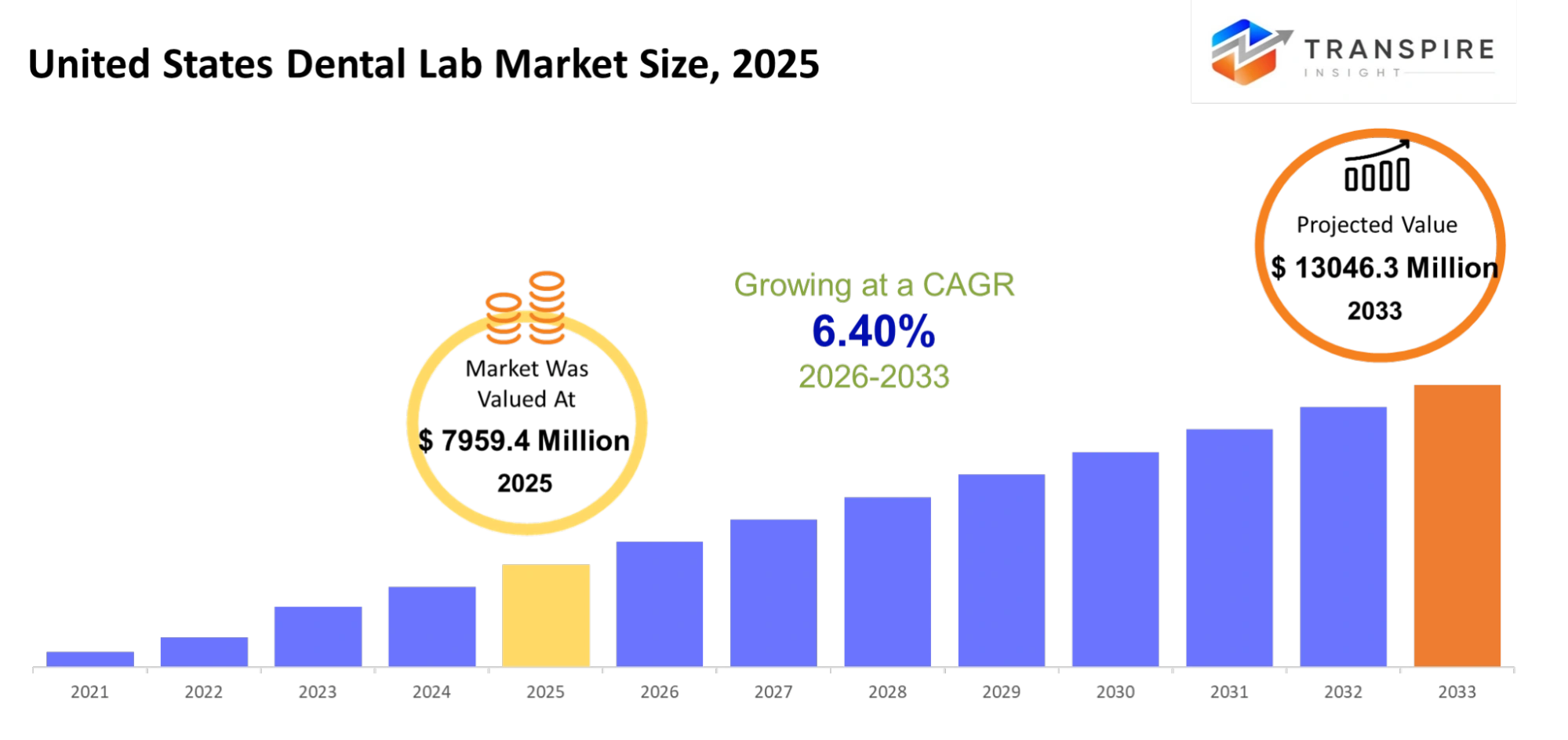
- United States Dental Lab Market Size 2025: USD 7959.4 Million
- United States Dental Lab Market Size 2033: USD 13046.3 Million
- United States Dental Lab Market CAGR: 6.40%
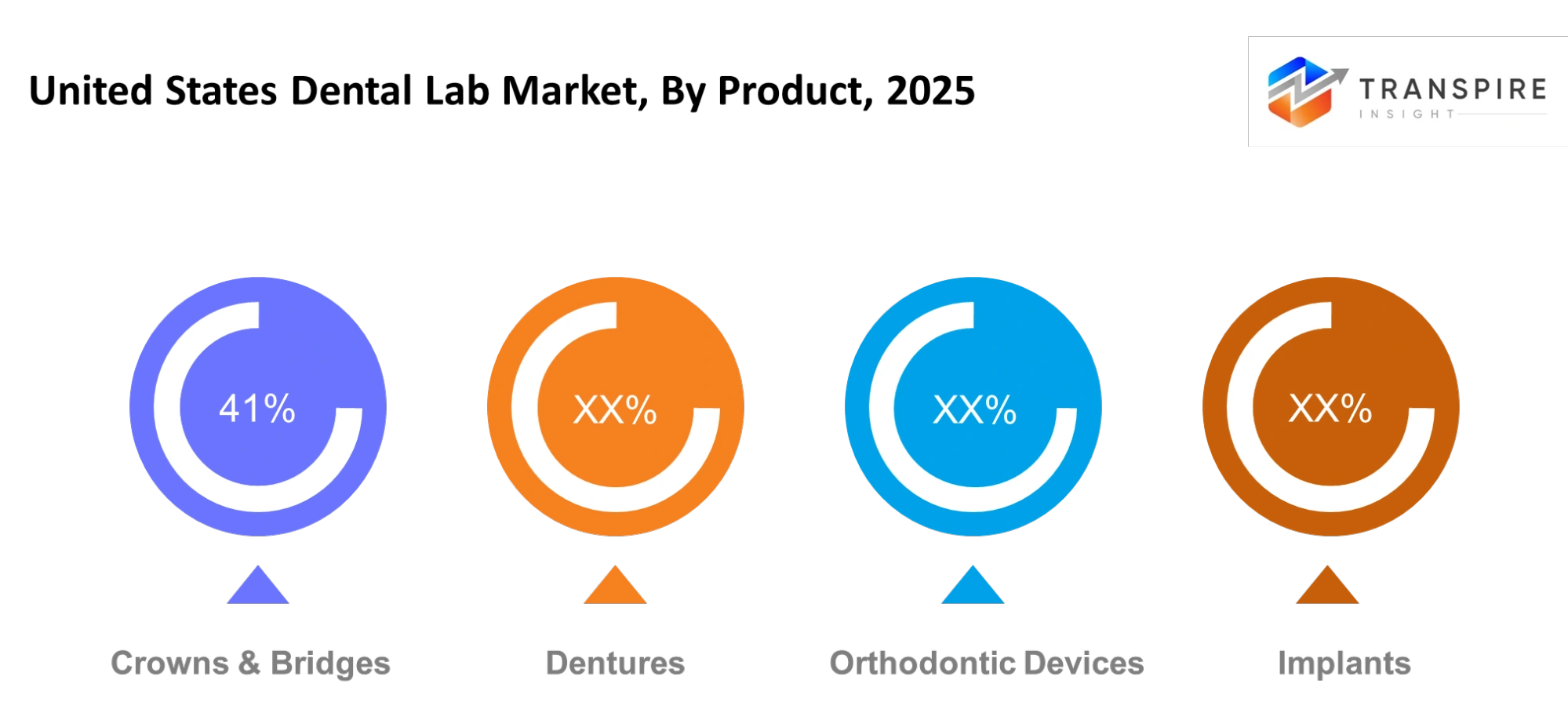
- United States Dental Lab Market Segments:By Product (Crowns & Bridges, Dentures, Orthodontic Devices, Implants), By Material (Ceramics, Metals, Polymers), By End User (Hospitals, Dental Clinics).
To learn more about this report,  Download Free Sample Report
United States Dental Lab Market Summary:
The United States dental lab market size is estimated at USD 7959.4 million in 2025 and is anticipated to reach USD 13046.3 million by 2033, growing at a CAGR of 6.40% from 2026 to 2033. The United States dental lab market maintains its continuous development because of increasing demand for cosmetic dental procedures and advanced restorative treatments. The growing use of digital technologies, which include CAD/CAM and 3D printing, has revolutionised laboratory operations by delivering greater accuracy and faster processing times. The market experiences expansion because of two factors which include the increasing number of elderly people and their improved understanding of dental health. The partnership between dental professionals and laboratory technicians shows positive effects on patient results. The industry faces challenges from rising expenses and shortages of qualified workers, but companies maintain their rapid development because they focus on new products and personalized services.
Key Market Trends & Insights:
- Dental labs are rapidly adopting digital tools like CAD/CAM systems and 3D printing. The technologies provide precise results which help labs operate faster while producing restorations that maintain a constant high standard.
- The U.S. population of elderly citizens is growing, which creates a higher need for dentures and implants and bridges. Dental labs are essential for providing the necessary long-term restorative solutions.
- Dental practitioners prefer zirconia and lithium disilicate materials because these substances show excellent durability and aesthetic properties. Labs choose these materials because they enable dentists to create better dental products which resemble real teeth.
- Dentists and labs achieve better treatment results through improved digital tools and enhanced communication systems. This partnership produces prosthetics that fit better, which results in improved patient contentment.
- Dental labs face technician shortages because many skilled dental technicians are in short supply, which affects their production abilities. The current situation forces laboratories to implement process automation while they develop educational programmes for their employees.
- Dental labs are using outsourcing to save expenses while other labs are merging their operations to create better resources. This trend is reshaping the competitive landscape of the market.
United States Dental Lab Market Segmentation
By Product
- Crowns & Bridges: The dental lab market shows its primary strength through crowns and bridges which dentists use to perform restorative treatments. The demand for dental services increases because more patients develop tooth decay and dental damage. Patients increasingly choose dental solutions which offer both durability and aesthetic appeal, so dental labs need to develop precise solutions through custom products and cutting-edge manufacturing methods.
- Dentures: Dentures remain essential, especially among the ageing population facing tooth loss. The latest denture designs provide patients with improved comfort and natural appearance, which leads to higher patient acceptance. Dental laboratories use advanced materials together with digital technologies to create better-fitting and more durable products, which they customise according to the specific requirements of each patient.
- Orthodontic Devices: The demand for orthodontic devices, which include aligners and retainers, is increasing among younger patients and adults who want to minimise their treatment visibility. The growing use of clear aligners has encouraged laboratories to adopt digital scanning and modelling technologies for developing precise and comfortable orthodontic products.
- Implants: Dental implants have become the leading long-term tooth replacement solution because they provide patients with a permanent option. The product offers high value to consumers because it combines long-lasting performance with a realistic look. Laboratories use precision engineering and premium materials to create implant systems which improve surgical outcomes by enabling better performance and user satisfaction.
To learn more about this report, Download Free Sample Report
By Material
- Ceramics: The aesthetic qualities of ceramics, together with their biocompatibility, make them attractive for widespread use. Zirconia serves as a dental material which delivers both strength and a natural resemblance to human teeth. Dental labs select ceramics to create crowns and veneers because these materials fulfil both the functional requirements and aesthetic needs of contemporary dental procedures.
- Metals: Metals maintain their importance in dental restorations because they provide exceptional strength and extended product lifespan. Dental professionals commonly use alloys to construct crowns and bridges together with partial dentures. Dental aesthetic requirements now favour tooth-coloured materials, yet metals still serve essential functions in situations that demand both exceptional durability and structural integrity.
- Polymers: Polymers have become popular materials because they offer flexible design options while remaining affordable and simple to handle. Dentists use them to create dentures and temporary dental restorations and orthodontic equipment. The development of polymer technology has enhanced the material's strength and visual appeal, which makes it suitable for different dental treatment methods.
By End User
- Hospitals: Hospitals use dental lab services for their surgical dental work, which requires advanced dental solutions. They need precise, high-quality restorations because their work demands dental labs to follow their established quality requirements. The dental work process becomes more effective because hospital dentists and labs work together to develop treatment plans which benefit patients.
- Dental Clinics: Dental clinics represent the largest end-user segment because they perform both standard dental procedures and specialised dental treatments. Clinics depend on laboratories to create personalised dental restorations and dental appliances. The partnership between clinics and labs, which uses digital communication, enables them to provide dental solutions that advantage patients through faster delivery and higher accuracy.
Country Insights
The dental laboratory industry in the United States shows a developed market which continues to progress through technological advances and shifting patient needs and its robust healthcare system. The industry requires more cosmetic dental services because older people need restorative dental work. Dental laboratories throughout the United States adopt digital workflows which include CAD/CAM systems and 3D printing technologies to achieve better accuracy and operational speed.
The larger cities lead in using new technological systems while the small laboratories work to update their operations for market survival. The existence of established dental service organisations helps shape market trends by promoting operational efficiency through standard practices. The public now understands oral health better, which leads to increased demand because people gain better access to dental insurance. The U.S. dental lab market continues to grow because dental labs establish partnerships with other companies and develop innovative solutions which focus on patient needs, even though the industry faces obstacles from labour deficits and rising business expenses.
Recent Development News
Dental Labs See Growth with Digital Dentistry Adoption: Digital workflows and CAD/CAM integration are transforming U.S. dental labs, improving precision and turnaround times. Labs are increasingly investing in automation to stay competitive.
Rising Tooth Loss Driving Demand for Dental Lab Services: Increasing cases of tooth loss in the U.S. are boosting demand for dentures, implants, and lab-based restorations. Labs are scaling capabilities to meet this need.
|
Report Metrics |
Details |
|
Market size value in 2025 |
USD 7959.4 Million |
|
Market size value in 2026 |
USD 8452.9 Million |
|
Revenue forecast in 2033 |
USD 13046.3 Million |
|
Growth rate |
CAGR of 6.40% from 2026 to 2033 |
|
Base year |
2025 |
|
Historical data |
2021 – 2024 |
|
Forecast period |
2026 – 2033 |
|
Report coverage |
Revenue forecast, competitive landscape, growth factors, and trends |
|
Country scope |
United States |
|
Key company profiled |
Dentsply Sirona Inc., Danaher Corporation, Straumann Group, Ivoclar Vivadent AG, Zimmer Biomet Holdings Inc., 3M Company, GC Corporation, Planmeca Oy, Kulzer GmbH, Mitsui Chemicals Inc., VITA Zahnfabrik H. Rauter GmbH, Shofu Inc., Ultradent Products Inc., Glidewell Laboratories, Nobel Biocare Services AG. |
|
Customization scope |
Free report customization (country, regional & segment scope). Avail customized purchase options to meet your exact research needs. |
|
Report Segmentation |
By Product (Crowns & Bridges, Dentures, Orthodontic Devices, Implants), By Material (Ceramics, Metals, Polymers), By End User (Hospitals, Dental Clinics). |
Key United States Dental Lab Company Insights
The United States dental lab market exists because established businesses compete with specialised laboratories which provide specialised dental services. Companies use their resources to develop digital technologies through CAD/CAM systems and 3D printing systems, which help them achieve greater operational efficiency and precise results. The companies are extending their service offerings to include both cosmetic procedures and dental implant treatments. Dental laboratories use strategic partnerships with dental clinics and dental service organisations to expand their business operations while delivering consistent quality results. The business atmosphere today enables companies to succeed through their dedication to product development and customer relationship building.
Company List
- Dentsply Sirona Inc.
- Danaher Corporation
- Straumann Group
- Ivoclar Vivadent AG
- Zimmer Biomet Holdings Inc.
- 3M Company
- GC Corporation
- Planmeca Oy
- Kulzer GmbH
- Mitsui Chemicals Inc.
- VITA Zahnfabrik H. Rauter GmbH
- Shofu Inc.
- Ultradent Products Inc.
- Glidewell Laboratories
- Nobel Biocare Services AG.
United States Dental Lab Market Report Segmentation
By Product
- Crowns & Bridges
- Dentures
- Orthodontic Devices
- Implants
By Material
- Ceramics
- Metals
- Polymers
By End User
- Hospitals
- Dental Clinics
Frequently Asked Questions
Find quick answers to common questions.
The Approximate United States Dental Lab Market size for the Market will be USD 13046.3 Million in 2033.
The key Segments of the United States Dental Lab Market are By Product (Crowns & Bridges, Dentures, Orthodontic Devices, Implants), By Material (Ceramics, Metals, Polymers), By End User (Hospitals, Dental Clinics).
Major Players in the United States Dental Lab Market are Dentsply Sirona Inc., Danaher Corporation, Straumann Group, Ivoclar Vivadent AG, Zimmer Biomet Holdings Inc., 3M Company, GC Corporation, Planmeca Oy, Kulzer GmbH, Mitsui Chemicals Inc., VITA Zahnfabrik H. Rauter GmbH, Shofu Inc., Ultradent Products Inc., Glidewell Laboratories, Nobel Biocare Services AG.
The Current Market size of the United States Dental Lab Market is USD 7959.4 million in 2025.
The United States Dental Lab Market CAGR is 6.40%.
- Dentsply Sirona Inc.
- Danaher Corporation
- Straumann Group
- Ivoclar Vivadent AG
- Zimmer Biomet Holdings Inc.
- 3M Company
- GC Corporation
- Planmeca Oy
- Kulzer GmbH
- Mitsui Chemicals Inc.
- VITA Zahnfabrik H. Rauter GmbH
- Shofu Inc.
- Ultradent Products Inc.
- Glidewell Laboratories
- Nobel Biocare Services AG.
Recently Published Reports
-
May 2026
Biosimilars Market
Biosimilars Market By Product Type (Monoclonal Antibodies, Recombinant Hormones, Erythropoietin, G-CSF, Others), By Indication (Oncology, Autoimmune Diseases, Blood Disorders, Diabetes, Others), By Manufacturing Type (In-House Manufacturing, Contract Manufacturing), By Distribution Channel (Hospital Pharmacies, Retail Pharmacies, Online Pharmacies), By Industry Analysis, Size, Share, Growth, Trends, and Forecasts 2021-2033
-
Apr 2026
Gastrointestinal Endoscopy Market
Gastrointestinal Endoscopy Market By Type (Rigid Gastrointestinal Endoscope, Flexible Gastrointestinal Endoscopes, Disposable Gastrointestinal Endoscope), By Procedure Type (Colonoscopy, Gastroscopy, Duodenoscopy, Enteroscopy, Flexible Sigmoidoscopy, Others), By Application (Diagnosis, Treatment), By End-Users (Hospitals, Ambulatory Surgical Centers, Specialty Clinics, Laboratories, Others), By Industry Analysis, Size, Share, Growth, Trends, and Forecasts 2021-2033
-
Apr 2026
Rare Inherited Metabolic Disorder Drug Market
Rare Inherited Metabolic Disorder Drug Market By Drug Class (Enzyme Replacement Drugs, Gene Therapy Drugs, Substrate Reduction Drugs, Small Module Drugs, Protein Drugs), By Route of Administration(Parenteral, Oral, Intrathecal), By Clinical Development (Marketed Drugs, Late Stage Clinical Phase III, Early Stage Clinical Phase I-II, Preclinical Candidates), By Indication (Lysosomal Storage Disorders, Urea Cycle Disorders, Amino Acid Metabolic Disorders, organic Acidemias, Peroximal Disorders), By Industry Analysis, Size, Share, Growth, Trends, and Forecasts 2021-2033
-
Jan 2026
Pharmaceutical Cleanroom Technology Market
Pharmaceutical Cleanroom Technology Market By Product (Equipment, Consumables, Services); By Cleanroom Type (Standard Cleanrooms, Modular Cleanrooms); By End Use (Pharmaceutical Companies, Biotechnology Companies), By Industry Analysis, Size, Share, Growth, Trends, and Forecasts 2021-2033