
Germany Platinum Group Metals Market Size & Forecast:
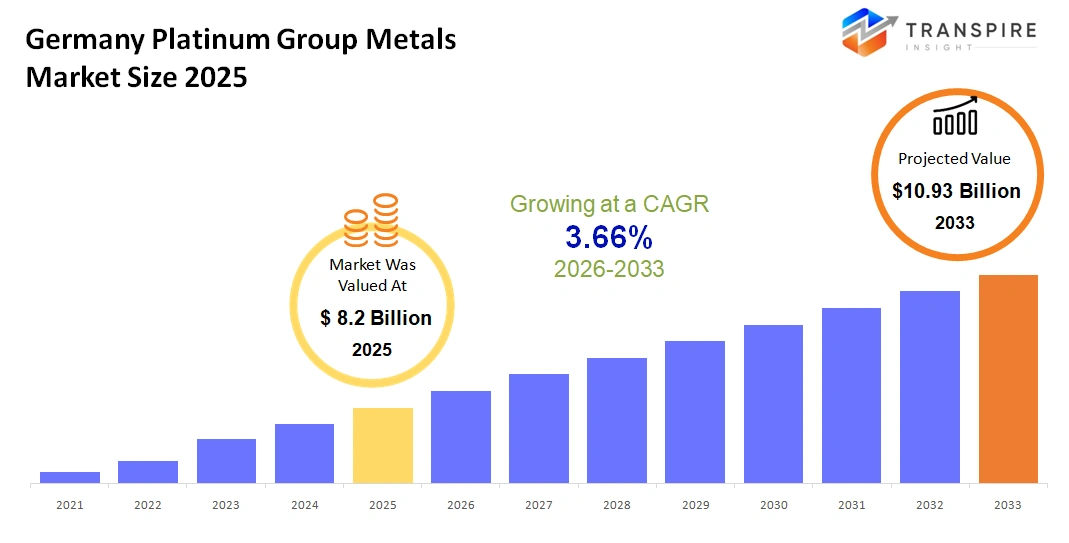
- Germany Platinum Group Metals Market Size 2025: USD 8.2 Billion
- Germany Platinum Group Metals Market Size 2033: USD 10.93 Billion
- Germany Platinum Group Metals Market CAGR: 3.66%
- Germany Platinum Group Metals Market Segments: by Metal Type (Platinum, Palladium, Rhodium, Others), Application (Automotive Catalysts, Electronics, Jewelry, Chemical Catalysts, Others), End User (Automotive, Industrial, Jewelry)
To learn more about this report,  Download Free Sample Report
Germany Platinum Group Metals Market Summary:
The Germany Platinum Group Metals Market size is estimated at USD 8.2 Billion in 2025 and is anticipated to reach USD 10.93 Billion by 2033, growing at a CAGR of 3.66% from 2026 to 2033. The precious metals sector of Europe operates this segment of its business which develops through customer requirements for its automotive products and industrial offerings and clean-tech solutions. The platinum group metals which include platinum and palladium and rhodium and ruthenium and iridium and osmium serve vital functions in catalytic converters and electronics and chemical processes and hydrogen production because of their outstanding catalytic and durability characteristics.
Key Market Trends & Insights:
- Germany's automotive industry serves as the primary driving force behind the platinum group metals market. The automotive industry uses platinum, palladium, and rhodium in catalytic converters to decrease dangerous emissions from vehicles. The European automotive industry uses PGMs to comply with environmental regulations which creates a steady demand for these materials in the German market.
- The global supply of platinum group metals is heavily concentrated in a few countries, particularly South Africa and Russia. The restricted availability of these resources leads to unpredictable price changes while creating supply chain uncertainties. German industries that depend on PGMs must handle price variations and international political risks which affect their buying decisions and future investment strategies.
- PGMs extended their applications to electronic devices and chemical processing and glass production and medical equipment because of their catalytic and corrosion-resistant properties. The industrial applications of these materials continue to grow through ongoing technological developments. The advanced manufacturing sector requires high-performance materials which will drive up platinum group metal consumption in Germany.
- Platinum group metals play a critical role in hydrogen fuel cells and electrolysis technologies used for green hydrogen production. The demand for platinum and iridium will increase because Germany is making substantial investments in its energy transition and hydrogen economy. These metals function as vital components which enhance fuel cell efficiency while enabling the construction of sustainable energy systems.
- The German government prioritizes the recycling of platinum group metals from used catalytic converters and electronic waste and industrial equipment. Recycling activities help reduce the need for imported raw materials while they assist in achieving environmental sustainability targets. The implementation of strict environmental regulations together with new recycling technologies will make secondary sources of PGMs essential to the entire market supply chain.
Germany Platinum Group Metals Market Segmentation
By Product
Platinum – Its superior catalytic capabilities and corrosion resistance make it the main component used in hydrogen fuel cells and chemical catalysts and catalytic converters.
Palladium – The metal serves as an essential component in both automotive catalytic converters and electronics production.
Rhodium – The metal functions primarily in vehicle emission control systems because of its powerful oxidation capacity.
Others (Ruthenium, Iridium, Osmium) – The materials find use in electronics production and chemical processing and advanced industrial equipment manufacturing.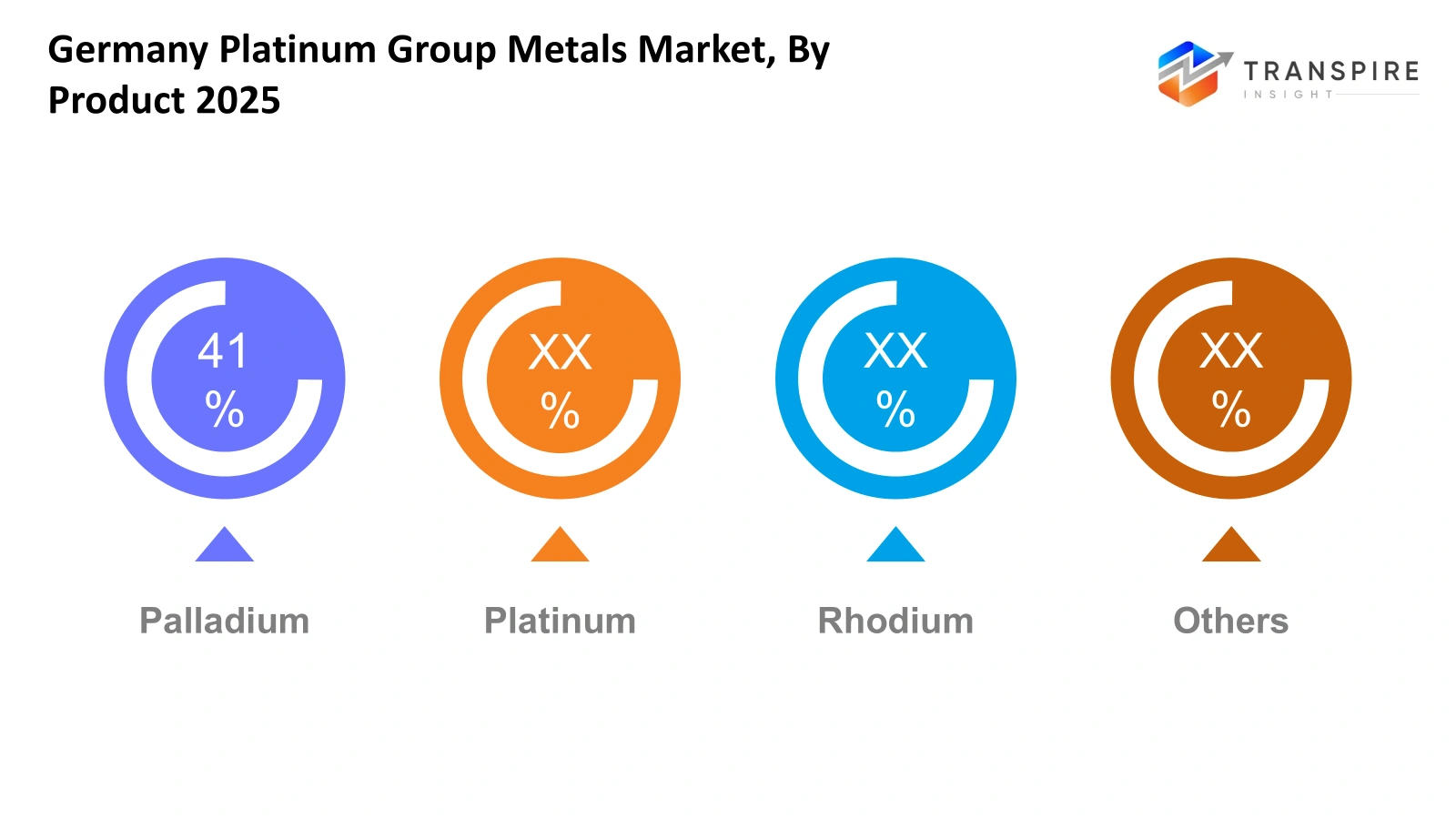
To learn more about this report, Download Free Sample Report
By End User
Automotive Industry – The automotive industry stands as the primary user of PGMs because it employs these metals in catalytic converters to lessen emissions.
Chemical Industry – Chemical industry businesses use these substances as catalysts to drive chemical reactions and petroleum refining operations.
Electronics Industry – The electronics industry uses these materials in semiconductor production and sensor development and the creation of circuit components because they offer electrical conductivity and long-lasting strength.
Energy Sector – The energy sector relies on these technologies for hydrogen fuel cells and systems that generate renewable energy.
By Technology
Catalytic Technology – Catalytic Technology functions as the main component of automotive catalytic converters and industrial catalysts.
Fuel Cell Technology – Fuel Cell Technology requires platinum and iridium as essential materials for hydrogen fuel cells which produce clean energy.
Chemical Catalysis – Chemical Catalysis Technology uses PGMs as catalytic agents for petrochemical and chemical production operations.
Recycling Technology – Recycling Technology uses advanced recovery methods to extract PGMs from spent catalytic converters and electronic waste..
Country Insights
The automotive industry in Germany functions as the main platinum group metals consumer because the country hosts leading automobile manufacturers. Cars use platinum and palladium and rhodium as crucial components in their catalytic converters which control vehicle emissions. Automotive manufacturing requires these metals because the country enforces strict environmental regulations.
Germany is making hydrogen energy a key element of its climate neutrality plans through its dedicated funding efforts. Green hydrogen production depends on platinum and iridium, which serve as essential components for both hydrogen fuel cells and electrolyzers. The expanding hydrogen infrastructure throughout the country will create increasing demand for platinum group metals, which the energy sector requires.
Germany operates one of Europe’s largest chemical industries. Chemical processing and petroleum refining and specialty chemical production use platinum group metals as common catalytic materials. The materials maintain their value for industrial applications because they offer both high catalytic efficiency and protection against corrosion.
Germany has developed a sophisticated recycling ecosystem for precious metals. PGMs are recovered from used catalytic converters, electronic waste, and industrial equipment. The recycling system enables the country to decrease its need for foreign raw materials while advancing its circular economy and sustainability objectives.
Germany possesses strong industrial requirements for platinum group metals, yet the country produces these metals through its mining operations. The country depends on imports from South Africa and other major producing countries for its platinum group metals needs.
Recent Development News
Platinum prices surged to record highs above $2,400/oz, driven by supply shortages and policy changes around internal-combustion engines in Europe.
Germany’s BASF and several financial institutions agreed to pay $20 million to settle a U.S. antitrust lawsuit alleging manipulation of platinum and palladium prices.
|
Report Metrics |
Details |
|
Market size value in 2025 |
USD 8.2 Billion |
|
Market size value in 2026 |
USD 8.5 Billion |
|
Revenue forecast in 2033 |
USD 10.93 Billion |
|
Growth rate |
CAGR of 3.66% from 2026 to 2033 |
|
Base year |
2025 |
|
Historical data |
2021 – 2024 |
|
Forecast period |
2026 – 2033 |
|
Report coverage |
Revenue forecast, competitive landscape, growth factors, and trends |
|
Country scope |
Germany |
|
Key company profiled |
Anglo American Platinum, Impala Platinum Holdings, Sibanye-Stillwater, Norilsk Nickel, Johnson Matthey, Heraeus Group, BASF SE, Umicore SA, Glencore PLC, Vale SA, Northam Platinum, Royal Bafokeng Platinum, African Rainbow Minerals, Sumitomo Metal Mining, Tanaka Holdings. |
|
Customization scope |
Free report customization (country, regional & segment scope). Avail customized purchase options to meet your exact research needs. |
|
Report Segmentation |
By Product- (Platinum, Palladium, Rhodium, Others (Ruthenium, Iridium, Osmium)) By End User- (Automotive Industry, Chemical Industry, Electronics Industry, Energy Sector) By technology- (Catalytic Technology, Fuel Cell Technology, Chemical Catalysis, Recycling Technology) |
Key Germany Platinum Group Metals Market Insights
The Germany platinum group metals market is expected to witness moderate but stable growth over the forecast period. The market size is projected to increase from USD 8.2 billion in 2025 to around USD 10.93 billion by 2033, reflecting a CAGR of approximately 3.66%. The growth of the market occurs because industrial demand and environmental regulations and technological advancements drive market development.
The precious metal recycling industry in Germany operates developed systems which recover platinum group metals from three sources: catalytic converters, electronic waste, and industrial equipment. Recycling operations decrease the need for imported materials while they create stable material availability and help achieve environmental sustainability objectives. The industrial ecosystem in Germany now relies more on secondary sources of PGMs.
Company List
- Heraeus Precious Metals GmbH & Co. KG
- Umicore AG & Co. KG
- SAXONIA Edelmetalle GmbH
- WIELAND Edelmetalle GmbH
- ESG Edelmetall-Service GmbH & Co. KG
- METAKEM GmbH
- abcr GmbH
- C. HAFNER GmbH + Co. KG
- Thermo Fisher (Kandel) GmbH
- Tricat GmbH
Germany Platinum Group Metals Market Report Segmentation
By Product
- Platinum
- Palladium
- Rhodium
- Others (Ruthenium, Iridium, Osmium)
By End User
- Automotive Industry
- Chemical Industry
- Electronics Industry
- Energy Sector
By technology
- Catalytic Technology
- Fuel Cell Technology
- Chemical Catalysis
Frequently Asked Questions
Find quick answers to common questions.
The Approximate Germany Platinum Group Metals Market size for the Market will be USD 10.93 Billion in 2033.
Key Segments for the Germany Platinum Group Metals Market are By Product- Platinum ,Palladium, Rhodium, Others (Ruthenium, Iridium, Osmium) By End User-Automotive Industry, Chemical Industry, Electronics Industry, Energy Sector By technology-Catalytic Technology, Fuel Cell Technology, Chemical Catalysis.
Major Germany Platinum Group Metals Market Players are Anglo American Platinum, Impala Platinum Holdings, Sibanye-Stillwater, Norilsk Nickel, Johnson Matthey, Heraeus Group, BASF SE, Umicore SA, Glencore PLC, Vale SA, Northam Platinum, Royal Bafokeng Platinum, African Rainbow Minerals, Sumitomo Metal Mining, Tanaka Holdings.
The current Germany Platinum Group Metals Market size is USD 8.2 Billion in 2025.
The Germany Platinum Group Metals Market CAGR is 3.66%.
- Heraeus Precious Metals GmbH & Co. KG
- Umicore AG & Co. KG
- SAXONIA Edelmetalle GmbH
- WIELAND Edelmetalle GmbH
- ESG Edelmetall-Service GmbH & Co. KG
- METAKEM GmbH
- abcr GmbH
- C. HAFNER GmbH + Co. KG
- Thermo Fisher (Kandel) GmbH
- Tricat GmbH
Recently Published Reports
-
Apr 2026
Healthcare Polymer Packaging Market
Healthcare Polymer Packaging Market Size, Share & Analysis Report By Packaging Type (Syringes, IV Bottles and Pouches, Clamshells, Blisters, Bottles & Jars, Containers, Tubes, IV Parental Packaging, Others), By Type (Regulated, Non-regulated), By Polymer Type (LDPE (Low-Density Polyethylene), HDPE (High-Density Polyethylene), Homo-polymer (Homo), Random Copolymer (Random), Block Copolymer (Block), PET, Polystyrene, Polyvinyl Chloride, Polyamide/EVOH, Others), and Geography (North America, Europe, Asia-Pacific, Middle East and Africa, South and Central America), 2021 - 2031
-
Apr 2026
Hydrophilic Tape (Waterstop) Market
Hydrophilic Tape (Waterstop) Market Size, Share & Analysis Report By Type (Bentonite-Based Hydrophilic Tape, Rubber-Based Hydrophilic Tape), By Application (Residential Buildings, Commercial Buildings, Infrastructure Projects), and Geography (North America, Europe, Asia-Pacific, Middle East and Africa, South and Central America), 2021 - 2031
-
Apr 2026
Metalens Market
Metalens Market Size, Share & Analysis Report By Type (Visible Light Metalens, and Infrared Metalens), By Application (Consumer Electronics, Automotive Electronics, Industrial, Medical, and Others), and Geography (North America, Europe, Asia-Pacific, Middle East and Africa, South and Central America), 2021 - 2031
-
Apr 2026
PBT Resin Market
PBT Resin Market Size, Share & Analysis Report By Type (Reinforced PBT Resin, Unreinforced PBT Resin), By Processing Method (Injection Molding, Extrusion, Blow Molding, Others), By End-User (Automotive, Electrical & Electronics, Consumer Appliances, Industrial Machinery, Medical Devices, Packaging, Others), and Geography (North America, Europe, Asia-Pacific, Middle East and Africa, South and Central America), 2021 - 2031