
United States Dental Intraoral Scanners Market Size & Forecast:
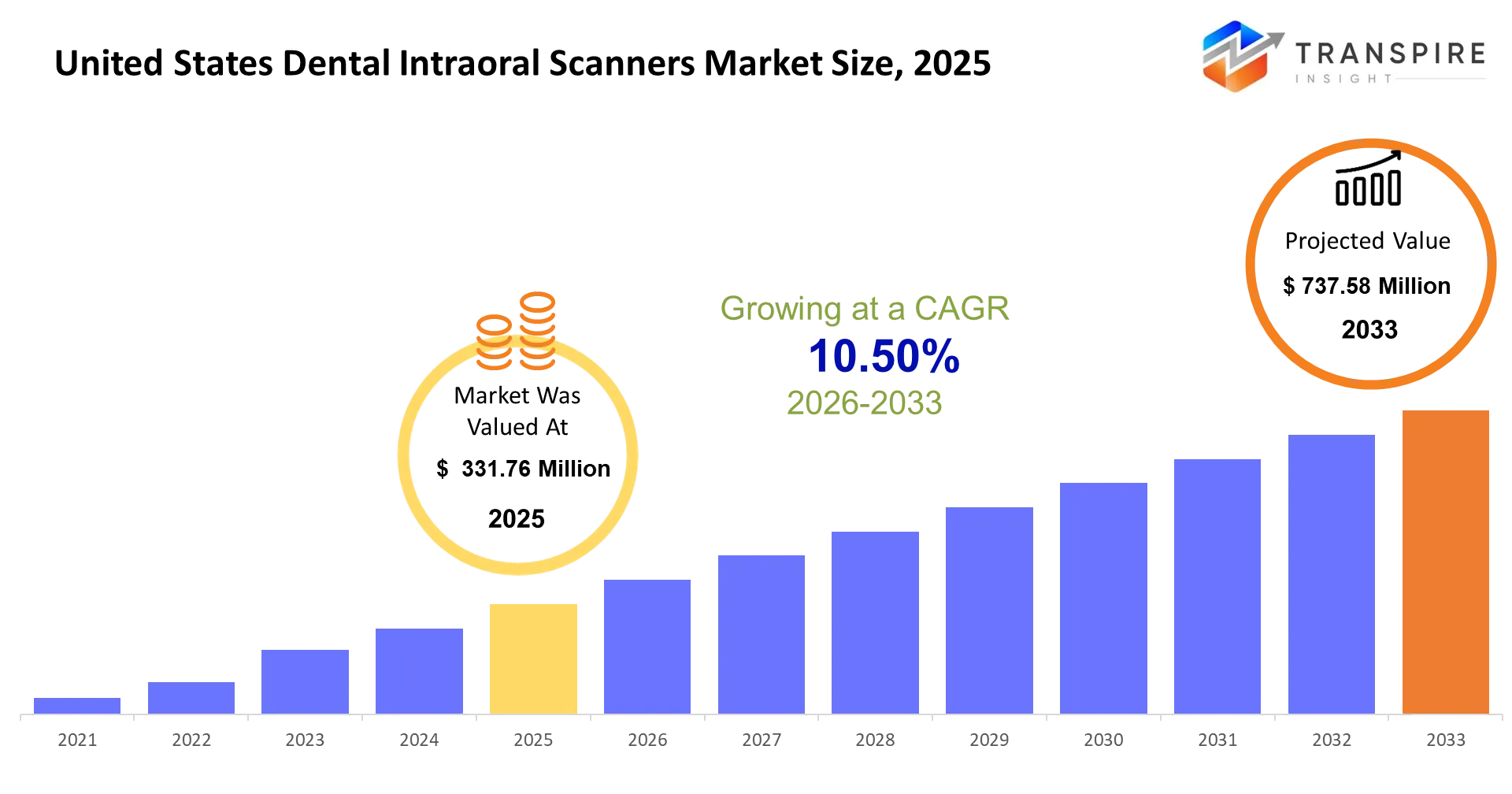
- United States Dental Intraoral Scanners Market Size 2025: USD 331.76 Million
- United States Dental Intraoral Scanners Market Size 2033: USD 737.58 Million
- United States Dental Intraoral Scanners Market CAGR: 10.50%
- United States Dental Intraoral Scanners Market Segments: By Type (Confocal Microscopy, Optical Wand, Triangulation, Laser Scanners, Video-based, Others); By Application (Orthodontics, Prosthodontics, Implantology, Diagnostics, Cosmetic Dentistry, Others); By End-User (Dental Clinics, Hospitals, Labs, Research Institutes, Others); By Technology (3D Imaging, CAD/CAM, Digital Impression, AI-based, Cloud-based, Others)
To learn more about this report,  Download Free Sample Report
United States Dental Intraoral Scanners Market Summary
The United States Dental Intraoral Scanners Market was valued at USD 331.76 Million in 2025. It is forecast to reach USD 737.58 Million by 2033. That is a CAGR of 10.50% over the period.
In the United States Dental Intraoral Scanners Market, clinicians often use handheld scanning devices to capture sharp digital images of a patient’s teeth and other oral tissues, while replacing the usual impression trays and those plaster models. In practice, it helps with faster making of crowns, aligners, and implants, plus it cuts down on redoes and those annoying coordination lags between clinics and dental laboratories.
Over the past five years, the market kind of drifted away from standalone scanning tools toward a more complete digital dentistry routine, meaning the scan data can flow straight into CAD/CAM systems and cloud-based design platforms. At the same time there’s more use of AI-assisted image correction, so small distortions get handled without so much manual tweaking.And then, the COVID-19 pandemic really acted as a strong trigger, it sped up adoption because many practices wanted to reduce chair time, strengthen infection control, and rely less on physical impression materials that got disrupted by supply chain shortages. So, providers are increasingly putting money into scanners, aiming to boost patient throughput, enhance procedural precision, and grow higher-margin restorative and orthodontic offerings.
Key Market Insights
- Northeast dominates the United States Dental Intraoral Scanners Market with over 30% installation share due to high dental practice density and early technology adoption.
- The West region is the fastest-growing, supported by advanced cosmetic dentistry demand and strong digital workflow integration in urban clinics.
- The South region shows rising penetration driven by expanding dental service organizations and improving healthcare infrastructure investments.
- Standalone intraoral scanners dominate the United States Dental Intraoral Scanners Market with significant share due to widespread clinic-level adoption.
- Chairside integrated scanner systems rank second, supported by CAD/CAM ecosystem expansion and same-day dentistry workflows.
- Wireless AI-enabled scanners represent the fastest-growing segment through 2025–2032 due to improved mobility and faster imaging accuracy.
- Restorative dentistry dominates with over 40% share, driven by crowns, bridges, and implant procedures requiring high-precision digital impressions.
- Orthodontics is the fastest-growing application, fueled by clear aligner treatment demand and digital treatment planning adoption.
- Dental clinics end up leading the United States Dental Intraoral Scanners Market with more than 60% share, mostly because there is huge patient volume and fast workflow digitization, it is kinda consistent.
- Meanwhile, dental hospitals and academic institutes are growing quite fast, they’re picking up scanners for training, diagnostic work, and also advanced oral surgery planning, so basically the adoption is spreading.
What are the Key Drivers, Restraints, and Opportunities in the United States Dental Intraoral Scanners Market?
The main driver is the rapid shift toward more fully digital dentistry workflows, kind of pushed along by CAD/CAM integration and chairside restorative solutions. This change started building speed after scanner accuracy got good enough to substitute conventional impression materials in everyday clinical use. So, in practice dental clinics now cut the turnaround time for crowns, bridges, and aligners from days into hours. That does, in turn, raise patient throughput and adds to procedural revenue per chair. On top of that, better alignment between insurance rules and reimbursement for digital restorative procedures has basically reinforced adoption, so clinics are now more willing to treat intraoral scanning systems as core diagnostic infrastructure.
The key constraint really is the high initial capital spend, plus those ongoing software subscription charges, and maintenance costs. It keeps getting sort of structurally restraining, because a lot of small plus mid-sized practices run with pretty tight cash flow cycles, and they can’t really make the ROI case right away, even if the whole approach sounds good.Also, staff training is not instant, and workflow redesign takes time, which postpones broad deployment. Because of that, installed systems can end up underused, and revenue conversion can become slower across the parts of the United States Dental Intraoral Scanners Market.
A notable opportunity is forming through AI-enhanced, cloud-based scanning ecosystems that improve precision and streamline design workflows. Firms like Align Technology and 3Shape are putting money into platforms that connect scanners directly to orthodontic treatment planning systems. Early uptake in large dental service organizations in places such as California and Texas shows how scalable digital networks can enable higher volume, subscription-led growth in the next stage of the market.
What Has the Impact of Artificial Intelligence Been on the United States Dental Intraoral Scanners Market?
Artificial intelligence and cutting edge digital technologies are quietly nudging the United States Dental Intraoral Scanners Market along, while quietly also improving scanning precision, speeding up daily workflow, and adding more clinical decision support across most dental practices. In real world terms, AI powered image processing now tends to do scan stitching automatically, sweeps away annoying artifacts, and also identifies the margins during intraoral capture, so there is less need for dental technicians to adjust things by hand. It’s kind of like the system just… takes care of it, more or less.That translates into more chairside efficiency and a quicker pace for restorative and orthodontic work, which helps clinics see more patients per day, without it feeling chaotic.
Then there are the predictive features showing up too, through machine learning models that are built into the scanner software. These tools look at historical scan data to fine tune calibration cycles, foresee device wear, and suggest maintenance ahead of performance slipping. Some systems even lean on cloud linked analytics to raise prosthetic design accuracy, because they learn from thousands of prior restorations. The result is better fit rates, and fewer remakes that nobody really wants.
Operationally, clinics that use AI-assisted scanning workflows often see faster case turnaround, plus fewer follow up adjustment appointments. Indirectly this means less material waste and lower labor costs, while patient satisfaction tends to rise too, along with more consistent procedures across the United States Dental Intraoral Scanners Market
Still, one major stumbling block stays the integration cost of AI-enabled ecosystems, especially when you are talking about smaller dental practices. Also, the training datasets are not evenly balanced across diverse patient anatomies. That can matter, because it may reduce algorithm accuracy when cases get complex, in full-scale automation adoption it may slow down adoption altogether or keep it partial.
Key Market Trends
- Since about 2020, many dental clinics kinda moved off analog impressions and went into digital scanning, which cut down the time at the chair by close to 40% in high volume practices .
- Align Technology meanwhile pushed deeper ecosystem integration between intraoral scanners and clear aligner platforms, and it sort of reshaped orthodontic planning routines starting 2022 and beyond.
- After 2021 , cloud-connected scanner use jumped sharply, letting U.S. clinics collaborate in real time with offshore dental laboratories.
- In 2023 , 3Shape added AI assisted margin detection upgrades, which helped with crown seating accuracy, and also lowered the odds of remakes in restorative dentistry cases.
- Post 2022, dental service organizations did more bulk procurement of scanners, so digital workflows became more standardized across multi location clinic groups nationwide.
- Also, wireless intraoral scanners got a lot more attention after 2021, since they replaced tethered units, and that happened because of better mobility plus quicker intraoperative scanning.
- Carestream Dental shifted toward subscription based software in 2023, so the revenue story changed from hardware purchases toward recurring digital services.
- And regulatory attention on infection control after COVID 19, really kept demand elevated for non contact digital impressions in U.S. practices.
- Training uptake improved a lot after 2022 , because dental schools folded intraoral scanning into main coursework, which sped up how fast trained operators became available.
- Finally, AI driven scan correction tools cut manual post processing time by as much as 30%, boosting overall workflow efficiency across more advanced U.S. clinics.
United States Dental Intraoral Scanners Market Segmentation
By Type :
In the United States dental market, intraoral scanners show up with several imaging flavors, sort of. Confocal microscopy is used for detailed surface capture, with high clarity that looks very crisp. Optical wand systems let clinicians move the device smoothly while scanning, which helps overall handling, in clinics, day to day.
Triangulation along with laser scanners can boost measurement accuracy, especially when dental structures are more complex than usual. Video based scanners enable continuous image capture, so there is less stopping and restarting during procedures. Meanwhile, other scanner types show up for very specific needs, where specialized imaging support actually matters in everyday clinical practice.
By Application :
In orthodontics, intraoral scanners support alignment checks and treatment planning, using clear digital models. In prosthodontics, they help with crown and bridge design, supporting better fit and function, too. Implantology relies on scanning for precise implant positioning and planning support.
For diagnostics, these systems assist early detection of dental problems through clear imaging. Cosmetic dentistry uses them for smile design and aesthetic planning. Other uses include general dental procedures, where digital impressions improve workflow and also reduce those manual impression slip-ups, that happen more than people admit.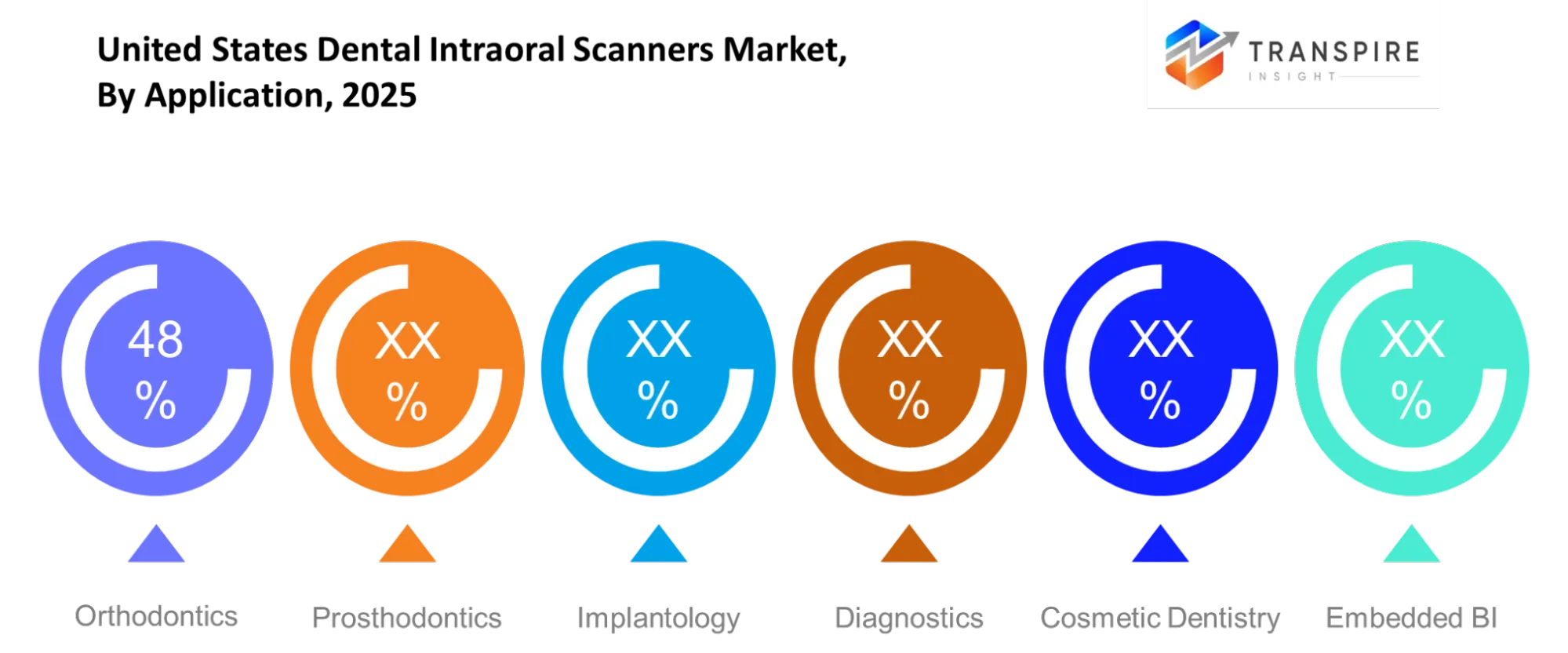
To learn more about this report, Download Free Sample Report
By End-User :
Dental clinics are still the main people using intraoral scanners, mostly because there is everyday patient flow and people want fast digital impressions, no wait. Hospitals also take them up for tricky dental cases, and for integrated planning across departments, kind of all in one place. Dental labs depend on the scanned results to produce prosthetic work and restorative pieces, even more often than clinics do.
Research institutes use intraoral scanners for clinical studies and for trying to improve dental imaging methods, step by step. Other end users include training centers and specialized dental facilities, where scanning systems get used to boost education, smooth out workflow efficiency, and support procedural accuracy .
By Technology :
In general, 3D imaging tech helps you see oral structures in a really detailed way, which backs up diagnosis and supports more accurate treatment planning . CAD/CAM systems let teams design and then manufacture dental restorations directly from the scanned data, it’s practical like that . Digital impression tech basically swaps traditional molds for a quicker , and cleaner workflow with less hassle.
AI based tools help raise scan quality by cutting down mistakes and making the image interpretation more reliable. Cloud solutions also matter because they allow easy data storage and sharing of dental files between clinics and labs, which helps coordination and lowers the time delays during treatment planning as well as during execution.
What are the Key Use Cases Driving the United States Dental Intraoral Scanners Market?
In the United States Dental Intraoral Scanners Market, restorative dentistry is still the main thing, sort of the core use case where clinicians capture digital impressions for crowns bridges and implants, in place of the usual molds, and this helps with accuracy, faster turnaround, and it also smooths out chairside CAD/CAM workflow efficiency in clinics.
Orthodontics, plus implant planning, keeps growing as use cases, pushed by the visible rise in clear aligner treatment and by wider adoption among dental service organizations and hospitals. They tend to rely on multi-location, cloud-based scan sharing, plus coordinated treatment design workflows, so it all connects better.
On the emerging side, there are teledentistry-supported remote scanning kiosks and AI guided intraoral capture systems, and there are also early pilot programs for at-home scanning kits. These might support preliminary diagnostics eventually, and broaden access in under served areas over time, even if it takes a while.
|
Report Metrics |
Details |
|
Market size value in 2025 |
USD 331.76 Million |
|
Market size value in 2026 |
USD 366.61 Million |
|
Revenue forecast in 2033 |
USD 737.58 Million |
|
Growth rate |
CAGR of 10.50% from 2026 to 2033 |
|
Base year |
2025 |
|
Historical data |
2021 - 2024 |
|
Forecast period |
2026 - 2033 |
|
Report coverage |
Revenue forecast, competitive landscape, growth factors, and trends |
|
Geographic scope |
United States of America |
|
Key company profiled |
Dentsply Sirona, Align Technology, 3Shape, Planmeca, Carestream Dental, Straumann, Henry Schein, GC Corporation, Danaher, Envista, Midmark, Vatech, Nobel Biocare, Zimmer Biomet, Ivoclar Vivadent |
|
Customization scope |
Free report customization (country, regional & segment scope). Avail customized purchase options to meet your exact research needs. |
|
Report Segmentation |
By Type (Confocal Microscopy, Optical Wand, Triangulation, Laser Scanners, Video-based, Others); By Application (Orthodontics, Prosthodontics, Implantology, Diagnostics, Cosmetic Dentistry, Others); By End-User (Dental Clinics, Hospitals, Labs, Research Institutes, Others); By Technology (3D Imaging, CAD/CAM, Digital Impression, AI-based, Cloud-based, Others) |
Which Regions are Driving the United States Dental Intraoral Scanners Market Growth?
The Northeast region, kind of leads the United States Dental Intraoral Scanners Market, mostly because it has a dense cluster of dental schools specialty clinics, and a patient base with higher purchasing power in major cities. Places like New York and Massachusetts , keep pushing early adoption too through solid insurance reimbursement frameworks for digital restorative work. Also the large academic medical centers plus dental research institutes, help speed up clinical confirmation of intraoral scanning tools, which makes the whole thing feel smoother. On top of that there’s a pretty established ecosystem of CAD/CAM software providers and dental laboratories, and it kind of locks in the leadership position, even when competition shows up.
The Southern region shows up as a steady and high-volume market, driven by quick expansion of dental service organizations and those corporate clinic chains that keep multiplying. But unlike the Northeast, its growth is less about “first wave” tech adoption and more about raw population scale, plus affordability minded dental care. States such as Texas and Florida, typically maintain consistent investment in multi location practices, where intraoral scanning gets standardized across the network. Meanwhile expanding Medicaid dental benefits and rising demand for elective procedures keep sustaining regular equipment procurement, year after year, so purchases don’t really stall.
The Western region is, honestly, the fastest growing, largely due to strong uptake of cosmetic dentistry and digitally centered orthodontic solutions. California stands out, leading the rush with tech-enabled dental clinics that fold in AI assisted scanning and cloud based workflows. In addition venture capital funding in dental medtech startups has accelerated innovation and commercialization of upgraded scanning systems. This kind of momentum suggests strong opportunities for manufacturers who want to expand subscription led models and AI integrated scanner platforms over the 2026–2033 period.
Who are the Key Players in the United States Dental Intraoral Scanners Market and How Do They Compete?
In the United States Dental Intraoral Scanners Market, competition is pretty moderately consolidated, with a handful of global leaders running the premium digital dentistry universe while newer entrants are kinda pressuring pricing and software openness a lot more than before. Most firms now seem to compete on workflow integration not just hardware by itself, so they highlight scan speed, interoperability and cloud connectivity, plus subscription based software models that support longer term practitioner reliance and lock in.
Align Technology pairs iTero scanners with Invisalign planning, linking it together into a tighter orthodontic ecosystem that tends to raise recurring treatment volume and makes clinicians rely on the setup more often. Dentsply Sirona pushes chairside adoption through Primescan and CEREC integration, which supports same day restorations, also backed by their well known global training programs. 3Shape goes its own route with TRIOS scanners and an open software platform that integrates smoothly with multiple CAD/CAM systems, so adoption climbs in clinics as well as dental laboratories.
Medit competes with affordability and pretty high accuracy scanners, plus open architecture and honestly that whole mashup is speeding up adoption among smaller dental practices across the U.S. Planmeca is linking intraoral scanning into its broader imaging systems, and it helps that bundled approach sticks because a lot of customers already have diagnostic tools on hand. Carestream Dental leans hard on unified imaging along with software ecosystems, and they’re extending collaborations with dental service organizations that are after centralized patient data workflows, all in one place or more like “one ecosystem” .
Company List
- Dentsply Sirona
- Align Technology
- 3Shape
- Planmeca
- Carestream Dental
- Straumann
- Henry Schein
- GC Corporation
- Danaher
- Envista
- Midmark
- Vatech
- Nobel Biocare
- Zimmer Biomet
- Ivoclar Vivadent
Recent Development News
In October 2025, Dandy launched the Dandy Vision intraoral scanner in North America. The system integrates AI-powered scanning and real-time technician support within a fully digital dental workflow, strengthening lab–clinic connectivity and accelerating chairside adoption of intraoral scanning in U.S. practices. Source https://instituteofdigitaldentistry.com/
In 2025, Shining 3D expanded its intraoral scanner portfolio with the Aircalscan Elf introduction in the U.S. market. The launch emphasized cost-accessible premium scanning technology, intensifying price competition and accelerating adoption of digital impression systems among mid-sized American dental clinics. Sourcehttps://instituteofdigitaldentistry.com/
What Strategic Insights Define the Future of the United States Dental Intraoral Scanners Market?
Over the next 5–7 years, the United States Dental Intraoral Scanners Market is sort of structurally shifting toward fully integrated, AI-enabled digital dentistry ecosystems, where hardware becomes kinda secondary to software-driven clinical outcomes. Growth will be shaped by platform consolidation, and yeah, dental groups really focus on end-to-end workflows that connect scanning, design, and manufacturing in one digital pipeline. This shift is also pushed by the need for higher procedural efficiency and less chair time especially in high-volume restorative and orthodontic practices.
There’s a less obvious risk too, and it’s more like increasing platform concentration. In other words, a small number of ecosystem providers end up controlling both scanning hardware and treatment planning software. That can create dependency risk for clinics, and it may limit interoperability, which then slows innovation and can raise switching costs over time.
A key emerging opportunity, seems to be decentralized scanning models supported by cloud-based AI interpretation. That lets satellite clinics and mobile dental units run high-quality diagnostics without building full in-house CAD infrastructure. This is starting to gain traction in corporate dental networks in Texas and California. Market participants should prioritize open-architecture systems, and API-driven integration strategies so they don’t get locked in long term. At the same time expand compatibility across multi-vendor dental ecosystems, and keep options open.
United States Dental Intraoral Scanners Market Report Segmentation
By Type
- Confocal Microscopy
- Optical Wand
- Triangulation
- Laser Scanners
- Video-based
By Application
- Orthodontics
- Prosthodontics
- Implantology
- Diagnostics
- Cosmetic Dentistry
By End-User
- Dental Clinics
- Hospitals
- Labs
- Research Institutes
By Technology
- 3D Imaging
- CAD/CAM
- Digital Impression
- AI-based
- Cloud-based
Frequently Asked Questions
Find quick answers to common questions.
The United States Dental Intraoral Scanners Market size is USD 737.58 Million in 2033.
Key Segments for the United States Dental Intraoral Scanners Market are By Type (Confocal Microscopy, Optical Wand, Triangulation, Laser Scanners, Video-based, Others); By Application (Orthodontics, Prosthodontics, Implantology, Diagnostics, Cosmetic Dentistry, Others); By End-User (Dental Clinics, Hospitals, Labs, Research Institutes, Others); By Technology (3D Imaging, CAD/CAM, Digital Impression, AI-based, Cloud-based, Others).
Major United States Dental Intraoral Scanners Market Players are Dentsply Sirona, Align Technology, 3Shape, Planmeca, Carestream Dental, Straumann, Henry Schein, GC Corporation, Danaher, Envista, Midmark, Vatech, Nobel Biocare, Zimmer Biomet, Ivoclar Vivadent.
The Current United States Dental Intraoral Scanners Market size is USD 331.76 Million in 2025.
The United States Dental Intraoral Scanners Market CAGR is 10.50% from 2026 to 2033.
- Dentsply Sirona
- Align Technology
- 3Shape
- Planmeca
- Carestream Dental
- Straumann
- Henry Schein
- GC Corporation
- Danaher
- Envista
- Midmark
- Vatech
- Nobel Biocare
- Zimmer Biomet
- Ivoclar Vivadent
Recently Published Reports
-
May 2026
Biosimilars Market
Biosimilars Market By Product Type (Monoclonal Antibodies, Recombinant Hormones, Erythropoietin, G-CSF, Others), By Indication (Oncology, Autoimmune Diseases, Blood Disorders, Diabetes, Others), By Manufacturing Type (In-House Manufacturing, Contract Manufacturing), By Distribution Channel (Hospital Pharmacies, Retail Pharmacies, Online Pharmacies), By Industry Analysis, Size, Share, Growth, Trends, and Forecasts 2021-2033
-
Apr 2026
Gastrointestinal Endoscopy Market
Gastrointestinal Endoscopy Market By Type (Rigid Gastrointestinal Endoscope, Flexible Gastrointestinal Endoscopes, Disposable Gastrointestinal Endoscope), By Procedure Type (Colonoscopy, Gastroscopy, Duodenoscopy, Enteroscopy, Flexible Sigmoidoscopy, Others), By Application (Diagnosis, Treatment), By End-Users (Hospitals, Ambulatory Surgical Centers, Specialty Clinics, Laboratories, Others), By Industry Analysis, Size, Share, Growth, Trends, and Forecasts 2021-2033
-
Apr 2026
Rare Inherited Metabolic Disorder Drug Market
Rare Inherited Metabolic Disorder Drug Market By Drug Class (Enzyme Replacement Drugs, Gene Therapy Drugs, Substrate Reduction Drugs, Small Module Drugs, Protein Drugs), By Route of Administration(Parenteral, Oral, Intrathecal), By Clinical Development (Marketed Drugs, Late Stage Clinical Phase III, Early Stage Clinical Phase I-II, Preclinical Candidates), By Indication (Lysosomal Storage Disorders, Urea Cycle Disorders, Amino Acid Metabolic Disorders, organic Acidemias, Peroximal Disorders), By Industry Analysis, Size, Share, Growth, Trends, and Forecasts 2021-2033
-
Jan 2026
Pharmaceutical Cleanroom Technology Market
Pharmaceutical Cleanroom Technology Market By Product (Equipment, Consumables, Services); By Cleanroom Type (Standard Cleanrooms, Modular Cleanrooms); By End Use (Pharmaceutical Companies, Biotechnology Companies), By Industry Analysis, Size, Share, Growth, Trends, and Forecasts 2021-2033