
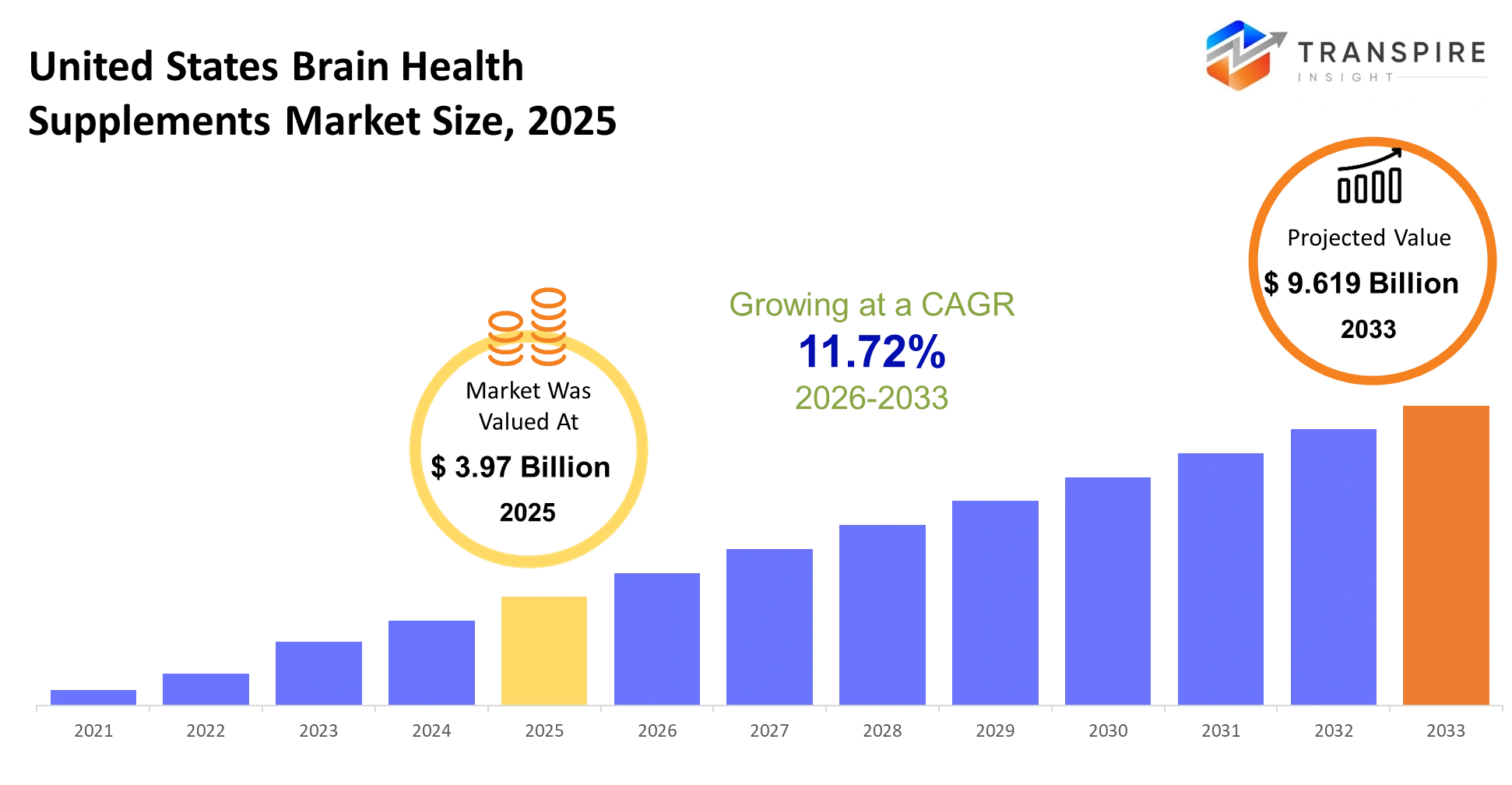
United States Brain Health Supplements Market Size & Forecast:
- United States Brain Health Supplements Market Size 2025: USD 3.97 Billion
- United States Brain Health Supplements Market Size 2033: USD 9.619 Billion
- United States Brain Health Supplements Market CAGR: 11.72%
- United States Brain Health Supplements Market Segments: By Ingredient Type (Omega-3, Vitamins, Herbal Extracts, Amino Acids, Probiotics, Others), By Form (Capsules, Tablets, Powders, Gummies, Liquid Supplements, Others), By Application (Memory Enhancement, Cognitive Support, Mood Support, Focus & Attention, Sleep Support, Others), By Distribution Channel (Online Stores, Pharmacies, Supermarkets, Specialty Stores, Others).
To learn more about this report,  Download Free Sample Report
United States Brain Health Supplements Market Summary:
The United States Brain Health Supplements Market size is estimated at USD 3.97 Billion in 2025 and is anticipated to reach USD 9.619 Billion by 2033, growing at a CAGR of 11.72% from 2026 to 2033.The United States brain health supplements market kind of helps consumers who are trying to keep focus , memory staying strong , cognitive stamina, and mood stability, even when life is high pressure work and also in aging situations. In practice these items are more and more used by professionals dealing with screen heavy days, older adults looking to delay cognitive decline, and students who want concentration support without using prescription medication. Over the past five years, the market has changed from a general “wellness” angle toward clinically backed formulations with nootropics , adaptogens, omega-3s, and gut brain ingredients, all with measurable cognitive claims that companies can point to.
A big turning point, honestly, came around the COVID-19 period, when stress related fatigue , sleep disruption, and remote work really pushed people to pay more attention to cognitive performance and mental resilience. That shift also changed how people buy things, from taking supplements once in a while to taking them more like a daily routine. Since healthcare costs connected to neurological conditions keep climbing, shoppers are starting preventive cognitive care sooner , and that makes supplement brands put more effort into personalized formulas, subscription models , and evidence based product differences that can support better long term revenue retention.
Key Market Insights
- The Northeast region kinda ruled the United States Brain Health Supplements Market, holding close to 34% market share in 2025, mostly because healthcare spending was higher over all.
- Meanwhile Western United States showed up as the fastest-growing regional market through 2032, with support from nutraceutical innovation that keeps moving plus wellness-leaning consumer habits.
- California is still leading brain supplement industry size expansion, driven by notable investments in functional nutrition startups and digital health ecosystems, too.
- The southern states started to pick up momentum in market growth rate after 2023, fueled by e-commerce penetration getting wider and preventive healthcare adoption growing in everyday life.
- Omega-3 and fish oil supplements were the top picks, they accounted for around 38% share in 2025 for the United States Brain Health Supplements Market.
- Herbal nootropics—like ginkgo biloba and ashwagandha formulations—came in as the second-largest segment, mainly because people broadly accept them.
- Adaptogenic cognitive support products are projected to grow the quickest between 2026 and 2032, with a double-digit revenue forecast potential, which sounds pretty strong.
- Capsule and softgel formats kept a meaningful market share because consumers like easy daily dosing solutions, without fuss.
- Personalized brain nutrition supplements picked up new demand as AI-based wellness platforms improved ingredient customization, and also helped keep subscription rates from slipping.
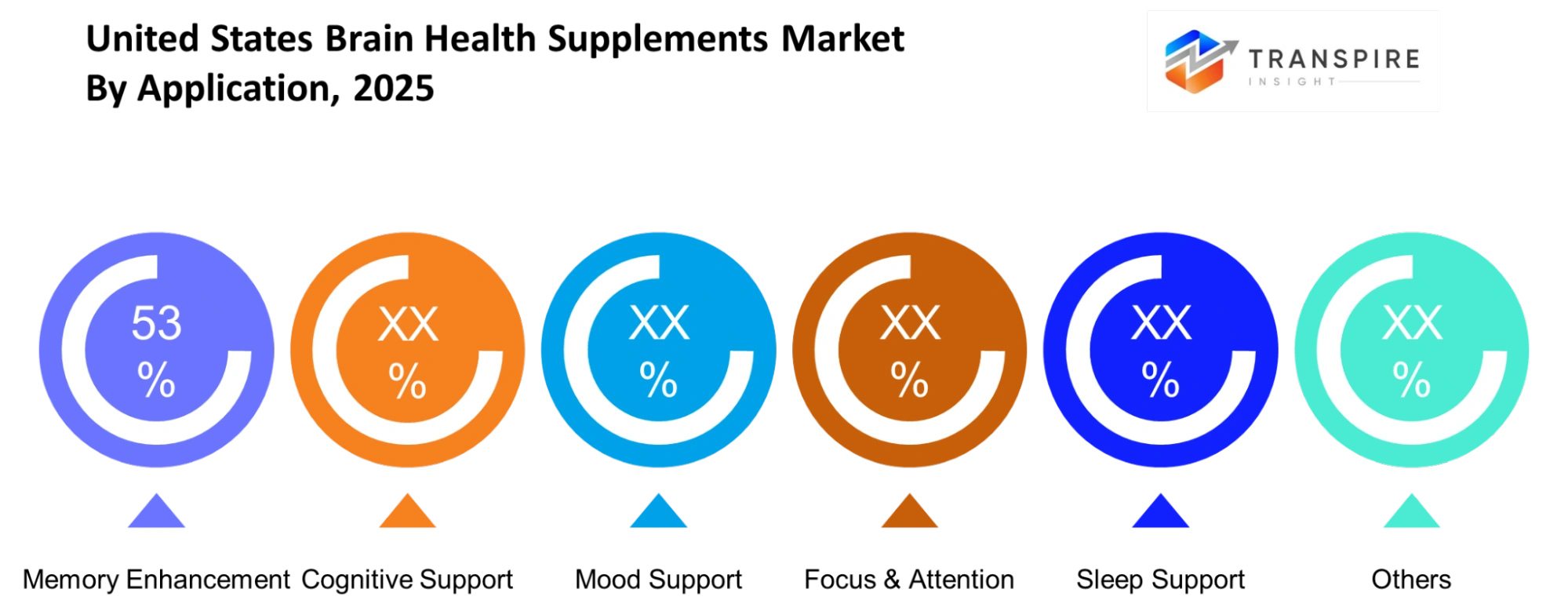
- Memory enhancement applications dominated the cognitive wellness supplements market, taking roughly 41% revenue share in 2025 among aging consumers.
- Stress management and mood support applications are forecast as the fastest-growing categories through 2032, as workplace burnout keeps rising and sleep disruption concerns don’t really slow down.
What are the Key Drivers, Restraints, and Opportunities in the United States Brain Health Supplements Market?
The strongest force driving the United States Brain Health Supplements Market is this kind of shift toward preventive cognitive care after COVID-19 , because that period showed the real economic cost of stress, fatigue, and the drop in mental performance. Employers, healthcare providers, and regular consumers started viewing cognitive resilience more like a work productivity matter, not just a small wellness thing. And then it kinda pulled more spending toward clinically supported nootropics, omega-3 blends , and adaptogenic supplements that are marketed around sharper focus, better sleep quality, and memory retention. Because brands also started growing subscription programs plus direct-to-consumer channels, revenue growth moved faster , repeat orders rose and customer lifetime value got stronger.
The biggest structural obstacle still sits in inconsistent clinical validation and a fragmented style of regulatory oversight across the dietary supplement industry. A lot of brain health products continue to lean on limited long-term efficacy evidence, so physicians remain a bit cautious about recommending them inside mainstream care. This is not something that can be fixed overnight either, since large-scale neurological studies take years of testing and a lot of money. So, the market ends up losing upside , especially from older customers and institutional healthcare channels that want stronger scientific proof before they back broad adoption.
Personalized brain nutrition is basically the next big growth shot, you know, kind of. Companies are more and more mixing AI based health evaluations, biomarker testing, and microbiome pattern analysis to build these customized mental performance supplement routines. And yeah, the whole thing is being positioned as a better fit for each person, not just a generic plan.
Startups in California and Massachusetts are bringing in attention and investment for platforms that blend wearable health information with tailored nutrition suggestions. That combo is giving them a better margins, and it’s also making the model more defensible overall, because it’s harder to copy.
What Has the Impact of Artificial Intelligence Been on the United States Brain Health Supplements Market?
Artificial intelligence and advanced digital technologies are kinda reshaping the United States Brain Health Supplements Market, mostly by boosting formulation accuracy, narrowing consumer targeting, and smoothing out supply chain efficiency. Now supplement makers are using AI driven analytics platforms to scan consumer biomarker data, track purchasing behavior, and spot cognitive health patterns in real time. With this setup they effectively automate product recommendation engines, and then they personalize supplement stacks based on sleep quality, stress levels, focus performance, and also those age related cognitive indicators. Some companies even combine wearable health data with machine learning models to foresee ingredient effectiveness, and then adjust dosage combinations in a way that can be more efficient than the older trial-and-error development cycle.
On top of that, predictive analytics kinda helps manufacturers estimate inventory demand earlier, reduce stock imbalances , and tighten production planning across e-commerce channels. AI supported formulation software cuts down research timelines too, because it can flag high potential nootropic compounds and check possible ingredient interactions before clinical testing even starts. In practice, these tools support better customer retention through subscription personalization, and they raise operational efficiency by lowering product development costs and decreasing the odds of failed product launches.
Still, AI adoption has a big snag, mainly because brain health outcomes are hard to standardize across different groups of people. A lot of cognitive performance datasets don’t have enough long-term clinical depth , so predictive models can end up less precise. This also limits regulatory confidence in AI generated supplement recommendations, no matter how well the dashboards look.
Key Market Trends
- Since 2020, subscription based supplement sales went up pretty a lot , because brands kinda moved away from retail reliance and leaned into direct-to-consumer cognitive wellness platforms, which is something everyone seemed to be doing.
- Companies like Nestlé Health Science and Onnit grew their clinically supported nootropic lineups after consumer doubt got louder in 2022 , and honestly that timing felt pretty aligned.
- From 2021 through 2025 , the appetite shifted away from plain multivitamins toward adaptogens, omega 3 mixtures, and stress oriented cognitive formulations, all while pushing measurable performance promises.
- AI powered personalization platforms really caught on after 2023, allowing supplement brands to point people toward individualized brain health routines, by pulling from wearable readings and biomarker signals, rather than guessing.
- By 2025, e commerce channels grabbed more than 45% of cognitive supplement purchases, as shoppers increasingly wanted recurring delivery and recommendations that felt more targeted , not just “one size fits all”.
- After 2022, regulatory attention tightened, so manufacturers had to improve ingredient openness, add third party testing, and show stronger clinical grounds for cognitive performance claims , even if it slowed some launches.
- Manufacturers also leaned less on overseas botanical suppliers after pandemic era disruptions showed weak spots in herbal sourcing , plus the whole inventory stability thing was exposed.
- Between 2022 and 2025, corporate wellness programs started adopting cognitive support supplements more often, partly to deal with employee burnout, reduced productivity , and that stress related fatigue that comes in waves.
- Younger consumers changed what they buy after 2021 by choosing clean label, vegan, and sugar free options , instead of the older style synthetic cognitive enhancers.
- Meanwhile investment sped up in California and Massachusetts, as startups blended microbiome studies, AI analytics, and personalized nutrition into premium brain health products, like they were building a system not just a supplement.
United States Brain Health Supplements Market Segmentation
By Ingredient Type
Ingredient type segmentation keeps, in a way or another, steering purchasing behavior and how products are framed across cognitive wellness categories. Omega 3 ingredients still carry the largest market share, mostly because clinical research connecting fatty acids with memory retention and neurological backing stays pretty mainstream among both healthcare professionals and consumers. Vitamins like B-complex and vitamin D are also strong, not just because they’re common, but because they fit into everyday preventive health routines, as if it’s already routine for many people. Herbal extracts, including ashwagandha ginkgo biloba and bacopa monnieri, are seeing quicker growth too—stress regulation and attention support got more commercial weight after remote work became normal, and that shift followed right after adoption.
Amino acids and probiotics are smaller segments overall, yet they pull investment anyway, since gut brain connection studies keep moving forward.On top of that, the supply chain instability for imported botanicals is still kinda generating pricing pressure for herbal formulations, which makes it feel like things are never fully steady. In the near future, competition will probably lean harder on scientific validation and ingredient traceability, plus more individualized blends, so manufacturers can stand apart with premium cognitive support products, even when retail shelves seem crowded.
By Form
Form based segmentation kinda shows how consumer preferences keep shifting, around convenience, compliance, and how well a product fits someone’s lifestyle, or not. Capsules still lead the overall sales numbers because people tend to link capsule formats with dosage precision portability, and that longer shelf life thing. Tablets stay pretty steady, partly from cheaper manufacturing and also because they’re already all over in mainstream pharmacy distribution, especially among older demographic groups. Gummies are the fastest growing segment, mainly because younger buyers are leaning harder toward flavored easy to consume supplements rather than the more traditional formats, it feels.
Powder formulations also got more traction with fitness focused consumers, who want multifunctional products, like cognitive support plus energy, or recovery benefits in one. Liquid supplements are still kind of niche though, since storage needs and shorter shelf stability make mass adoption harder. Manufacturers are now pouring money into flavor technology sugar free formulations and vegan delivery systems, trying to nudge repeat purchases, and keep things interesting. Going forward, growth should favor delivery formats that help absorption rates and daily adherence, while also making it easier to charge premium prices through convenience driven differentiation.
By Application
Application segmentation points to a kind of shift from basic wellness framing, toward more specific cognitive performance offerings. Memory enhancement apps, right now, bring in the biggest revenue slice because aging populations are actively shopping for products that back long term neurological health and also help delay cognitive decline. At the same time, cognitive support and focus enhancement areas expanded quickly too, after hybrid work models kicked in and screen exposure rose with it , along with mental fatigue across most professional settings. Mood support supplements got major momentum as stress management started getting tied very tightly to workplace productivity , and even to better sleep quality.
Sleep support formulas are now more and more mixing melatonin, magnesium, and adaptogenic herbs, aiming at recovery related cognitive performance concerns, not only rest. Broader preventive health positioning also ended up boosting secondary use cases around concentration and emotional equilibrium. Going forward, new product development will probably lean into multifunctional formulations that try to cover memory, stress, sleep, and attention inside one daily regimen. If that happens it could raise customer retention, while also letting brands secure higher value recurring subscription revenue.
To learn more about this report, Download Free Sample Report
By Distribution Channel
Distribution channel dynamics shifted pretty hard when digital commerce basically remade how supplements are bought across the United States. These days online stores show up first in market penetration, mostly because subscription services, somewhat personalized suggestions, and more direct consumer engagement make everything feel easy, and they also boost repeat orders ,again and again. Pharmacies still matter a lot too, mainly because people trust them, they often follow pharmacist recommendations, and older adults keep buying clinically framed products at a higher rate. Supermarkets keep backing volume sales since they are everywhere, yet price competition makes it tougher to stand out with premium brands in mass retail settings, so brands sort of blur together.
Specialty stores kind of hold onto their influence with fitness enthusiasts and wellness oriented buyers, mainly if they’re hunting down niche nootropic formulations, and also that human know-how, the one you get from real expert guidance. After 2021, digital ad algorithms and influencer driven campaigns sped up how quickly new brands pick up customers, so smaller companies had fewer obstacles when they entered cognitive wellness categories . Going forward, channel competition will probably lean harder into data based personalization, speedy fulfillment infrastructure, and omnichannel engagement, basically tying the trust you feel in physical retail with the convenience of digital purchasing .
What are the Key Use Cases Driving the United States Brain Health Supplements Market?
Memory enhancement is still the main use case that keeps supplement adoption going across the United States , more or less. Aging adults end up with the biggest purchasing volume because preventive cognitive care has turned into a long-running healthcare spending priority. In this space, products with omega-3s , B vitamins , and herbal nootropics are basically the top picks, mostly due to the clear connection people make with focus retention and neurological backing.
Alongside that, focus improvement and stress management uses grew pretty fast among working professionals students and remote employees, especially after hybrid work setups started causing more mental fatigue and screen exposure, kind of nonstop. Then mood support plus sleep recovery blends also caught momentum inside corporate wellness programs and among fitness-minded consumers who are looking for productivity along with recovery benefits.
Newer angles are showing up too, like personalized cognitive nutrition plans that tie into wearable health devices and microbiome-based brain health formulations. AI-supported supplement suggestions and biomarker-driven nootropic routines are still kind of early-stage but they look like they could do really well commercially as digital health keeps getting integrated into preventive wellness platforms .
|
Report Metrics |
Details |
|
Market size value in 2025 |
USD 3.97 Billion |
|
Market size value in 2026 |
USD 4.427 Billion |
|
Revenue forecast in 2033 |
USD 9.619 Billion |
|
Growth rate |
CAGR of 11.72% from 2026 to 2033 |
|
Base year |
2025 |
|
Historical data |
2021 - 2024 |
|
Forecast period |
2026 - 2033 |
|
Report coverage |
Revenue forecast, competitive landscape, growth factors, and trends |
|
Geographic scope |
United States of America |
|
Key company profiled |
Nature's Bounty, NOW Foods, Onnit Labs, Amway, Herbalife, Himalaya Wellness, Pure Encapsulations, Jarrow Formulas, Thorne HealthTech, Nestlé Health Science, Quincy Bioscience, Procera Health, Mind Lab Pro, Neurohacker Collective, GNC |
|
Customization scope |
Free report customization (country, regional & segment scope). Avail customized purchase options to meet your exact research needs. |
|
Report Segmentation |
By Ingredient Type (Omega-3, Vitamins, Herbal Extracts, Amino Acids, Probiotics, Others), By Form (Capsules, Tablets, Powders, Gummies, Liquid Supplements, Others), By Application (Memory Enhancement, Cognitive Support, Mood Support, Focus & Attention, Sleep Support, Others), By Distribution Channel (Online Stores, Pharmacies, Supermarkets, Specialty Stores, Others) |
Which Regions are Driving the United States Brain Health Supplements Market Growth?
The Northeast region sort of leads the United States brain health supplements market because healthcare spending levels, and aging population density , plus a kind of strong clinical wellness adoption, all stay higher than the national averages.States like New York and Massachusetts help shape a more grown-up ecosystem of nutraceutical companies, academic research bodies, and specialty healthcare retailers that just keep pushing premium supplement adoption faster, yeah. There are also higher concentrations of professionals working in finance, healthcare and tech, which means demand stays stronger for better focus and cognitive performance items. And beyond that, established pharmacy networks, wellness clinics, and direct-to-consumer subscription platforms keep reinforcing regional market dominance, mostly through easier product availability , and ongoing consumer touchpoints, which is kind of the whole point.
In contrast, the Western region delivers steadier market revenue more from innovation-minded consumer habits than from aging demographics alone. California, Washington, and Colorado keep spending pretty consistently on supplements because wellness culture, preventive healthcare practices, and functional nutrition adoption are basically baked into day to day lifestyles. At the same time venture capital activity and startup investment keep feeding a pipeline of personalized nutrition platforms, AI driven wellness tools, and clean-label cognitive products. Compared with the Northeast, the Western market tends to lean more toward technology integration, premium branding, and lifestyle framing, instead of relying as much on traditional healthcare distribution channels.
The Southern region shows the quickest growth momentum after major e-commerce expansion and healthcare access improvements, which then reshaped supplement purchasing behavior post 2021 in a ripple-like effect. Texas, Florida, and Georgia saw rising investment into fulfillment infrastructure, digital wellness platforms ,and also retail pharmacy expansion, so cognitive health products become more within reach across suburban and mid-sized city communities. Younger working professionals, and aging retirees that are moving into the region as well, have helped widen the customer base for stress control, memory boosting, and sleep support formulations. Overall, strong regional growth from 2026 through 2033 is expected to create attractive chances for emerging brands, digital health collaborations, and private-label manufacturers, all while they try to keep lower operating costs and extend consumer reach more broadly.
Who are the Key Players in the United States Brain Health Supplements Market and How Do They Compete?
The United States market for brain health supplements stays sort of moderately fragmented, and honestly the competitive pressure keeps building between multinational nutrition players, digital wellness startups, and smaller nootropic brands that stay more focused. The big incumbents keep trying to protect share by putting money into clinical research, leaning into huge retail distribution reach, and riding strong brand recognition, but meanwhile the newer entrants are disrupting the old ways of selling, using personalized subscriptions and AI powered wellness suggestions, like they’re trying to meet people where they already are. At this point competition tends to revolve around scientific validation, clean-label formulations, ingredient transparency, and direct consumer conversations, not just competing on price. Firms that link cognitive health messaging with technology enabled personalization are seeing better customer retention and more premium pricing across online sales channels too.
Nestlé Health Science keeps its attention on clinically backed cognitive nutrition and it differentiates through lots of research collaborations and medical nutrition know-how. It also tries to strengthen its edge by threading brain health supplements into wider preventive healthcare ecosystems , not only framing them as simple retail wellness items. Neuriva is more about targeted formulations for memory and focus, backed by familiar nootropic ingredients, plus pretty aggressive digital marketing aimed at working professionals and also aging consumers. Their expansion lately includes physician engagement initiatives and better e-commerce personalization tools.
Onnit competes by leaning into niche specialization around cognitive performance, and fitness integration, plus lifestyle branding directed toward younger consumers and athletes.
Company List
- Nature's Bounty
- NOW Foods
- Onnit Labs
- Amway
- Herbalife
- Himalaya Wellness
- Pure Encapsulations
- Jarrow Formulas
- Thorne HealthTech
- Nestlé Health Science
- Quincy Bioscience
- Procera Health
- Mind Lab Pro
- Neurohacker Collective
- GNC
Recent Development News
In May 2026, MOSH Raised $13 Million Series A to Scale Brain Health Nutrition Brand: U.S.-based brain wellness nutrition company MOSH secured $13 million in Series A funding to expand its cognitive health product portfolio and retail footprint. The company said the funding will also support new research initiatives focused on gut-brain biomarkers and cognitive performance, highlighting rising investor interest in the U.S. brain health supplements sector.
Source: https://www.nutraceuticalsworld.com
In February 2026, Big Health Secured Funding to Expand Digital Mental Health Treatments : California-based Big Health announced a new funding round aimed at accelerating adoption of its FDA-cleared mental health therapies, including SleepioRx and DaylightRx. The financing reflects growing commercialization activity in cognitive wellness and brain health management solutions across the United States healthcare ecosystem.
Source: https://www.businesswire.com
What Strategic Insights Define the Future of the United States Brain Health Supplements Market?
The United States brain health supplements market is sort of moving, structurally, toward personalized cognitive wellness platforms that bring together nutrition, biomarker testing wearable health tracking, and AI based recommendations in this weird kind of loop. Underneath it all, the main driver seems to be the growing connection of preventive healthcare with consumer technology ecosystems, so supplements aren’t really just “grab it sometimes” wellness items anymore but more like long-term subscription based health management services. In the next five to seven years, brands that can show measurable cognitive performance outcomes, and also offer clinically supported personalization, will probably pull in a bigger portion of the premium revenue streams.
Still, there is a less noticed risk involving raw material concentration and scientific credibility pressure. A lot of the high-demand nootropic ingredients depend on a limited global botanical supply chain, which can mean pricing swings and also quality inconsistencies that are hard to control. Meanwhile, a more intense look at cognitive wellness claims could end up nudging compliance expenses higher, and it might quietly push the lesser products out of big retail shelves, not instantly, but more like piece by piece, slowly.
One new chance, sort of, shows up in employer-backed cognitive wellness programs linked to digital health analytics. If firms want to get into this space, they should lean into clinical collaborations, proprietary data strengths, and clear ingredient sourcing, in other words, so they can shape a solid, defensible market stance before the regulatory hurdle rises again.
United States Brain Health Supplements Market Report Segmentation
By Ingredient Type
- Omega-3
- Vitamins
- Herbal Extracts
- Amino Acids
- Probiotics
- Others
By Form
- Capsules
- Tablets
- Powders
- Gummies
- Liquid Supplements
- Others
By Application
- Memory Enhancement
- Cognitive Support
- Mood Support
- Focus & Attention
- Sleep Support
- Others
By Distribution Channel
- Online Stores
- Pharmacies
- Supermarkets
- Specialty Stores
- Others
Frequently Asked Questions
Find quick answers to common questions.
The approximate United States Brain Health Supplements Market size for the market will be USD 9.619 Billion in 2033.
The key segments of the United States Brain Health Supplements Market are By Ingredient Type (Omega-3, Vitamins, Herbal Extracts, Amino Acids, Probiotics, Others), By Form (Capsules, Tablets, Powders, Gummies, Liquid Supplements, Others), By Application (Memory Enhancement, Cognitive Support, Mood Support, Focus & Attention, Sleep Support, Others), By Distribution Channel (Online Stores, Pharmacies, Supermarkets, Specialty Stores, Others).
Major players in the United States Brain Health Supplements Market are Nature's Bounty, NOW Foods, Onnit Labs, Amway, Herbalife, Himalaya Wellness, Pure Encapsulations, Jarrow Formulas, Thorne HealthTech, Nestlé Health Science, Quincy Bioscience, Procera Health, Mind Lab Pro, Neurohacker Collective, GNC.
The current market size of the United States Brain Health Supplements Market is USD 3.97 Billion in 2025.
The United States Brain Health Supplements Market CAGR is 11.72%.
- Nature's Bounty
- NOW Foods
- Onnit Labs
- Amway
- Herbalife
- Himalaya Wellness
- Pure Encapsulations
- Jarrow Formulas
- Thorne HealthTech
- Nestlé Health Science
- Quincy Bioscience
- Procera Health
- Mind Lab Pro
- Neurohacker Collective
- GNC
Recently Published Reports
-
May 2026
Biosimilars Market
Biosimilars Market By Product Type (Monoclonal Antibodies, Recombinant Hormones, Erythropoietin, G-CSF, Others), By Indication (Oncology, Autoimmune Diseases, Blood Disorders, Diabetes, Others), By Manufacturing Type (In-House Manufacturing, Contract Manufacturing), By Distribution Channel (Hospital Pharmacies, Retail Pharmacies, Online Pharmacies), By Industry Analysis, Size, Share, Growth, Trends, and Forecasts 2021-2033
-
Apr 2026
Gastrointestinal Endoscopy Market
Gastrointestinal Endoscopy Market By Type (Rigid Gastrointestinal Endoscope, Flexible Gastrointestinal Endoscopes, Disposable Gastrointestinal Endoscope), By Procedure Type (Colonoscopy, Gastroscopy, Duodenoscopy, Enteroscopy, Flexible Sigmoidoscopy, Others), By Application (Diagnosis, Treatment), By End-Users (Hospitals, Ambulatory Surgical Centers, Specialty Clinics, Laboratories, Others), By Industry Analysis, Size, Share, Growth, Trends, and Forecasts 2021-2033
-
Apr 2026
Rare Inherited Metabolic Disorder Drug Market
Rare Inherited Metabolic Disorder Drug Market By Drug Class (Enzyme Replacement Drugs, Gene Therapy Drugs, Substrate Reduction Drugs, Small Module Drugs, Protein Drugs), By Route of Administration(Parenteral, Oral, Intrathecal), By Clinical Development (Marketed Drugs, Late Stage Clinical Phase III, Early Stage Clinical Phase I-II, Preclinical Candidates), By Indication (Lysosomal Storage Disorders, Urea Cycle Disorders, Amino Acid Metabolic Disorders, organic Acidemias, Peroximal Disorders), By Industry Analysis, Size, Share, Growth, Trends, and Forecasts 2021-2033
-
Jan 2026
Pharmaceutical Cleanroom Technology Market
Pharmaceutical Cleanroom Technology Market By Product (Equipment, Consumables, Services); By Cleanroom Type (Standard Cleanrooms, Modular Cleanrooms); By End Use (Pharmaceutical Companies, Biotechnology Companies), By Industry Analysis, Size, Share, Growth, Trends, and Forecasts 2021-2033