
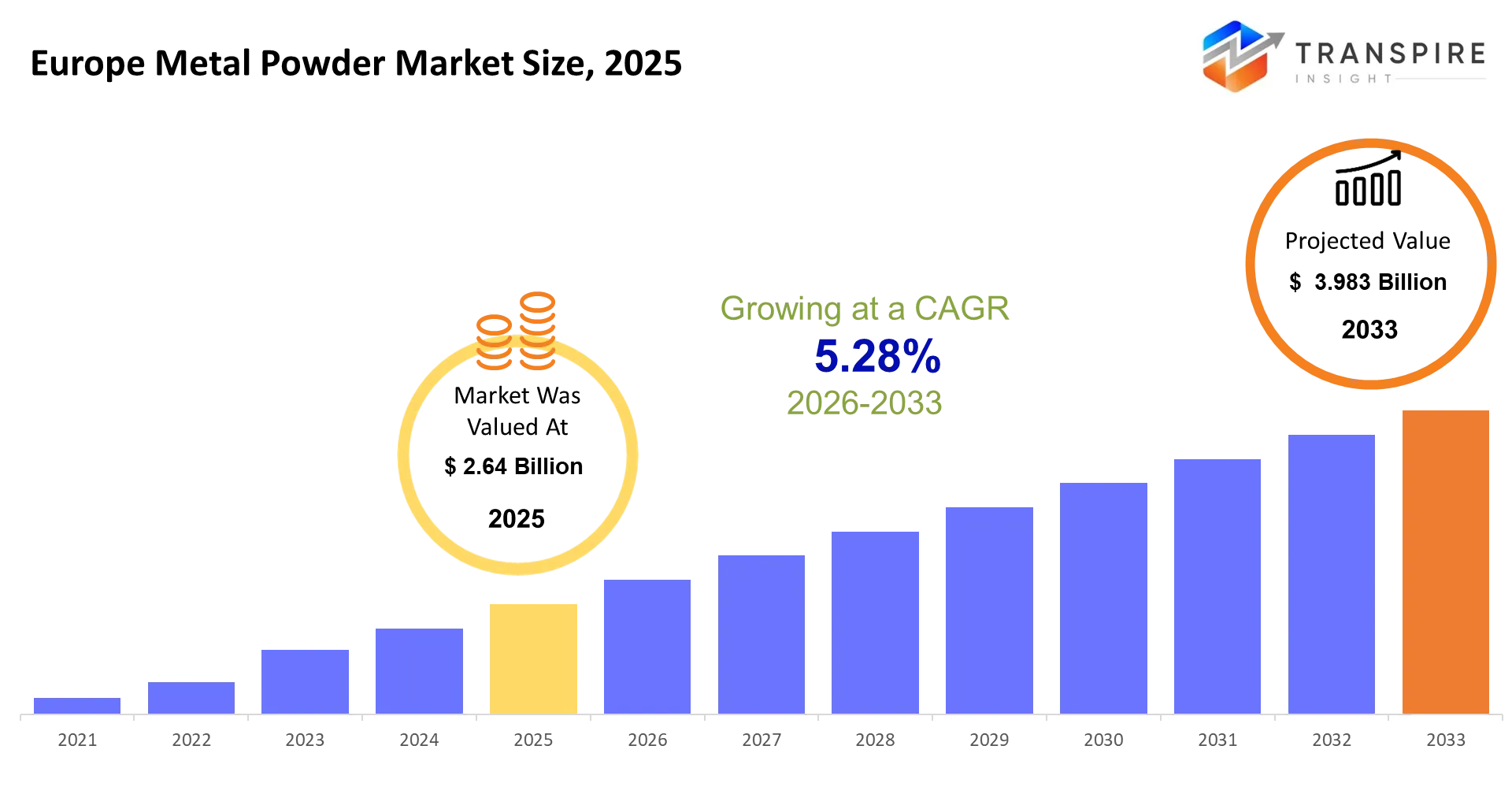
Europe Metal Powder Market Size & Forecast:
- Europe Metal Powder Market Size 2025: USD 2.64 Billion
- Europe Metal Powder Market Size 2033: USD 3.983 Billion
- Europe Metal Powder Market CAGR: 5.28%
- Europe Metal Powder Market Segments: By Type (Ferrous, Non-ferrous, Alloy Powder, Composite Powder, Others), By Application (Additive Manufacturing, Metallurgy, Automotive, Aerospace, Tooling, Others), By End-User (Industrial, Automotive, Aerospace, Defense, Others), By Form (Powder, Granules, Flakes, Others).
To learn more about this report,  Download Free Sample Report
Europe Metal Powder Market Summary:
The Europe Metal Powder Market size is estimated at USD 2.64 Billion in 2025 and is anticipated to reach USD 3.983 Billion by 2033, growing at a CAGR of 5.28% from 2026 to 2033. The Europe metal powder market serves as an essential resource for industries that require their manufacturing processes to generate components with superior performance and minimal material waste. Metal powders serve as the essential material for creating precise components used in automotive drivetrain systems aerospace turbine systems industrial machinery medical implant devices and additive manufacturing equipment which cannot be created through traditional machining methods due to their excessive time and expense requirements and material consumption. The market enables manufacturers to create lighter products which allows them to develop prototypes at a quicker pace while producing items at nearby facilities which decreases their need for international supply networks.
The market has undergone a transformation during the past five years as it has moved away from traditional powder metallurgy methods to focus on developing powders that meet specific needs of three-dimensional printing and cutting-edge energy technologies. The transition gained momentum after COVID-19 supply chain interruptions and the Russia-Ukraine conflict which caused an energy crisis that revealed European countries' industrial raw material dependency on external sources. Manufacturers responded by developing new production sites within their regions while implementing technologies that improve material usage capabilities. Metal powders gained increased value as their manufacturing process enabled production of near-net products which resulted in reduced waste during manufacturing when energy expenses and raw material prices increased. The operational advantage now leads to increased use throughout automotive electric vehicle development aerospace weight reduction efforts and industrial automation initiatives.
Key Market Insights
- Near-net-shape manufacturing processes in the Europe Metal Powder Market result in 30% less raw material waste when compared to traditional machining methods.
- Aerospace and medical component production drove more than 25% of total Europe metal powder industry demand in 2025 through its use of additive manufacturing applications.
- German and French and Italian sustainability regulations create conditions that drive industrial manufacturing operations to use recycled metal powder.
- Automotive electrification drives demand for aluminum and iron powders which automotive manufacturers use to produce lightweight EV components and battery systems.
- Advanced atomization technologies produce powder materials with better consistency which enables manufacturers to achieve higher accuracy standards in aerospace and medical applications.
- Germany captured approximately 32% of the Europe Metal Powder Market in 2025 because its automotive and industrial manufacturing sectors provided a strong foundation.
- France sustained its market presence through aerospace and defense expenditures which specifically targeted high-performance titanium powder usage.
- The developing market in Eastern Europe will expand through 2030 because manufacturers are establishing production sites in Poland and Hungary to achieve lower operating costs.
- Nordic countries are developing a new market for sustainable powder metallurgy solutions which support renewable energy projects and green hydrogen infrastructure development.
- The Europe metal powder industry generated almost 45% of its revenue from ferrous metal powders which served the automotive component manufacturing sector.
- Non-ferrous powders which include aluminum and copper variants became the second most popular market segment because their lightweight properties suit industrial applications.
What are the Key Drivers, Restraints, and Opportunities in the Europe Metal Powder Market?
The Europe Metal Powder Market experiences its highest growth because additive manufacturing industrialization develops rapidly across automotive aerospace and medical industries. European manufacturers shifted toward powder-based production after energy prices and raw material costs rose sharply following the Russia-Ukraine conflict. Industries discovered that conventional subtractive machining methods became less economically viable because these methods produced excessive scrap material and required more energy to create each finished part. Metal powder technologies solved this efficiency problem by enabling near-net-shape manufacturing with lower waste and shorter production cycles. The direct revenue boost from this transition benefited powder suppliers because it created new market opportunities for titanium and nickel and aluminum alloy powders which customers use in lightweight and high-performance products.
The market’s biggest structural barrier remains the high capital intensity of advanced powder production and processing infrastructure. Smaller manufacturers face challenges to absorb the required investments for gas atomization systems and particle-size control technologies and quality certification processes. Manufacturers face additional difficulties because Europe currently experiences unpredictable changes in industrial electricity prices which decrease their operating profit margins. The result is that large industrial groups maintain control over adoption which creates a barrier to mid-sized manufacturing ecosystems while halting total addressable market growth.
The upcoming European hydrogen and renewable energy infrastructure development will open significant business opportunities. Fuel cells and electrolyzers and advanced turbine systems need high-purity metal powders to produce their exact components. Speciality powder manufacturers will gain new downstream customers during the upcoming ten years because Germany and the Netherlands are increasing their investments in clean energy.
What Has the Impact of Artificial Intelligence Been on the Europe Metal Powder Market?
The European Metal Powder Market experiences transformation through artificial intelligence and advanced digital technologies which enhance process accuracy and operational productivity and product quality across powder production activities. Metal powder producers increasingly use AI-driven monitoring systems to automate atomization control, particle-size distribution analysis, and furnace temperature management. The production systems maintain continuous parameter adjustments which result in decreased material variations and reduced scrap production during high-value titanium and nickel powder manufacturing processes.
Machine learning models enhance predictive maintenance capabilities in powder metallurgy plants and additive manufacturing facilities through their implementation. The sensors which industrial operators install in atomizers and compressors and sieving systems, gather operational data that AI platforms use to predict equipment failures before unplanned shutdowns occur. The European manufacturers report measurable reductions in maintenance downtime and energy consumption after they establish predictive analytics systems on their production lines. Digital twin technology enables manufacturers to create simulations of powder flow behavior which they use to enhance additive manufacturing performance, resulting in improved component reliability and faster product development.
Advanced analytics tools assist organizations in their regulatory compliance efforts by monitoring emissions and energy consumption levels and raw material utilization rates across their production sites. The implementation of AI technology faces significant challenges because many existing metallurgy facilities do not have basic digital systems. The mid-sized industrial manufacturers throughout Eastern and Southern Europe experience deployment delays because of high costs associated with system integration and institutionalized challenges that arise from incomplete operational data.
Key Market Trends
- European automotive suppliers started using aluminum powder as their main material for lightweight drivetrain and battery housing components which electric vehicle manufacturers needed since 2021.
- Aerospace manufacturers adopted titanium and nickel powders after European commercial aviation production programs introduced stricter fuel efficiency requirements during 2022 and 2023.
- The manufacturing industry in Germany and Sweden increased its gas atomization investments because it needed to achieve better particle-size control for its 3D printing industrial operations.
- European producers decreased their need for imported industrial metals after the Russia-Ukraine conflict by building new powder manufacturing facilities within their territories.
- Höganäs AB and Sandvik AB increased their research and development budget for recyclable powder recovery technology after European energy prices reached higher levels.
- Cobalt-chrome and titanium powders received growing use from medical device manufacturers between 2020 and 2025 to create customized orthopedic implants.
- Aerospace and defense customers required aerospace-grade materials through their gas-atomized components which led to decreased usage of water-atomized powders for premium applications.
- Eastern Europe became a manufacturing center after 2022 because Western European companies chose to develop powder metallurgy projects there due to its lower operational expenses.
- Manufacturers adopted AI-based systems for process monitoring after 2023 to decrease production interruptions and achieve better powder quality maintenance.
- European regulators implemented stricter requirements for industrial emissions documentation which forced powder manufacturers to purchase energy-saving furnaces and systems for recycling production waste.
Europe Metal Powder Market Segmentation
By Type
The strongest type of powder material used in manufacturing processes remains Ferrous powders because automotive transmission parts and industrial machinery components and structural applications still require cost-effective and mechanically strong iron-based materials. Water-atomized ferrous powders achieve widespread usage because they require lower production expenses and they work well with processes that produce high volumes of products. The demand for non-ferrous powders has increased because electrification projects require manufacturers to use lightweight and conductive materials which include aluminum and copper.
The aerospace and medical manufacturing industries are experiencing rapid growth in alloy powders because advanced additive manufacturing systems require high-purity feedstock with consistent particle characteristics. Defense and high-performance tooling sectors show specific interest in composite powders which have smaller volumes. Manufacturers will direct their future investment resources toward developing specialty alloys and recycling technologies and advanced atomization methods as they compete in powder consistency and energy efficiency and material performance assessments that extend beyond production scale.
By Application
Additive manufacturing has become the most disruptive application sector because aerospace and medical and automotive industries now focus more on material efficiency and versatile production methods. The market for metal powders created for additive manufacturing requires higher prices because customers must meet both particle-size and purity standards. The total consumption of traditional metallurgy applications remains higher than other methods because powder metallurgy exists as the fundamental production method for automotive components throughout Germany and France and Italy.
The automotive industry maintains steady demand for ferrous and aluminum powders which manufacturers use to produce gears and bearings and electric vehicle components. The aerospace industry experiences faster growth than typical industrial applications because aircraft manufacturers require lightweight materials which enhance fuel efficiency and structural performance. Tooling applications are undergoing transformation because industrial buyers are implementing rapid prototyping together with low-volume precision manufacturing techniques. The future growth of all applications will require digital manufacturing systems and powder recyclability and material solutions which are designed for specific industry performance.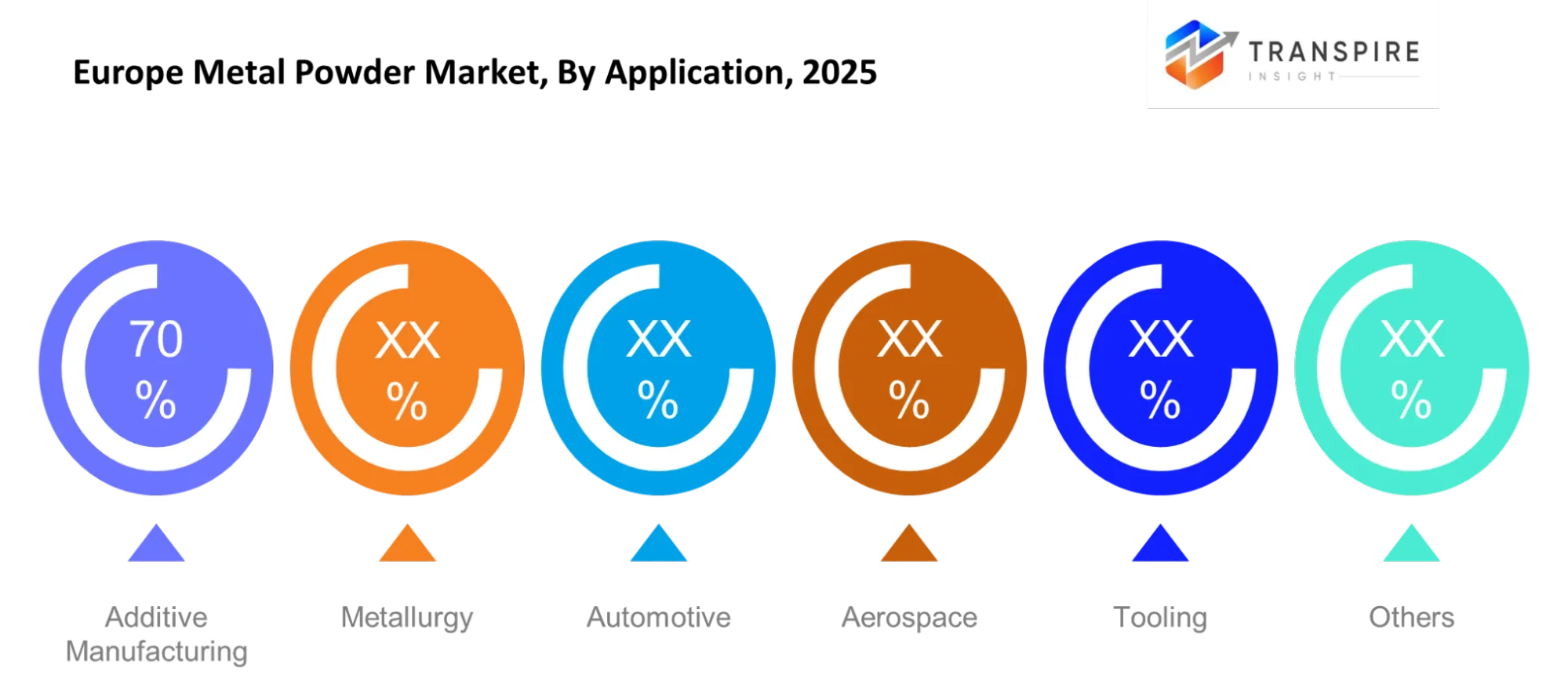
To learn more about this report, Download Free Sample Report
By End-User
The industrial manufacturing sector leads all other sectors because machinery manufacturers and equipment vendors and precision engineering companies use powder metallurgy as their primary method to produce cost-effective parts. The automotive industry holds the second largest market position because electrification programs create new demand for lightweight materials and compact drivetrain systems. The aerospace and defense industries are experiencing rapid growth because companies are increasing their investments in additive manufacturing and turbine technologies and mission-critical structural components.
Medical technology companies are increasing their use of titanium and cobalt-chrome powders to create customized implants and surgical devices. Demand patterns differ across end-user industries because industrial buyers prioritize scale and cost stability while aerospace and defense firms focus on maintaining powder purity and traceability. The end-user segments of the market will achieve greater specialization because suppliers develop specific material systems and certification programs to meet the needs of regulated industries. The transition will enable manufacturers who meet technical and compliance standards to establish stronger pricing control over their products.
By Form
The industry currently prefers powder materials because atomized powders provide both continuous flowability and they enable high-density sintering and they work with additive manufacturing equipment. Aerospace and medical production increasingly uses fine spherical powders because precision printing systems require uniform particle distribution for stable layer formation. Granules maintain their current importance in traditional metallurgy and thermal spraying because they provide both better handling efficiency and decreased dust emissions during operations. Flake-based materials serve niche applications in electronics, coatings, and conductive systems, particularly where surface area and conductivity performance matter more than structural strength.
The market for specialty forms, which include hybrid blends and coated particles, is currently expanding into advanced industrial applications that support energy storage and defense manufacturing operations. The future development of form categories will proceed through research on particle engineering and recycling processes and automated production methods. Buyers show a preference for materials that produce less waste while increasing printing accuracy and sustaining steady results in highly automated production settings.
What are the Key Use Cases Driving the Europe Metal Powder Market?
European automotive manufacturers consider metal powder usage to be their main production method. Powder metallurgy allows manufacturers to produce extensive quantities of gears and bearings and transmission components while their operating costs and energy consumption decrease during automobile manufacturing.
Aerospace and medical manufacturing have increasing needs for high-purity titanium and nickel powders. Aircraft suppliers use additive manufacturing to create lightweight turbine and structural parts while orthopedic implant manufacturers use customized metal printing to enhance production speed and manufacturing accuracy.
The hydrogen infrastructure together with advanced energy systems development creates new operational applications. Electrolyzer manufacturers are conducting tests on specialty alloy powders which protect against corrosion for use in fuel cell components. Defense contractors investigate hybrid powder materials to develop lightweight armor and advanced thermal management systems.
|
Report Metrics |
Details |
|
Market size value in 2025 |
USD 2.64 Billion |
|
Market size value in 2026 |
USD 2.779 Billion |
|
Revenue forecast in 2033 |
USD 3.983 Billion |
|
Growth rate |
CAGR of 5.28% from 2026 to 2033 |
|
Base year |
2025 |
|
Historical data |
2021 - 2024 |
|
Forecast period |
2026 - 2033 |
|
Report coverage |
Revenue forecast, competitive landscape, growth factors, and trends |
|
Regional scope |
Europe (Germany, United Kingdom, France, Italy, Spain and Rest of Europe) |
|
Key company profiled |
Hoganas, Rio Tinto, Sandvik, Carpenter Technology, GKN Powder Metallurgy, BASF, ATI Metals, Kennametal, Praxair, AMG Advanced Metallurgical, CNPC Powder, Daido Steel, JFE Steel, Kobe Steel, Erasteel |
|
Customization scope |
Free report customization (country, regional & segment scope). Avail customized purchase options to meet your exact research needs. |
|
Report Segmentation |
By Type (Ferrous, Non-ferrous, Alloy Powder, Composite Powder, Others), By Application (Additive Manufacturing, Metallurgy, Automotive, Aerospace, Tooling, Others), By End-User (Industrial, Automotive, Aerospace, Defense, Others), By Form (Powder, Granules, Flakes, Others) |
Which Regions are Driving the Europe Metal Powder Market Growth?
The market dominant position of Western Europe exists because Germany France and Italy operate extensive automotive and aerospace and industrial manufacturing systems which require significant amounts of precision metal powders. Manufacturers have turned to powder metallurgy and additive manufacturing technologies because of strong environmental regulations and energy-efficiency targets which created more demands for these technologies than other regions did. The region benefits from its established research institutions combined with its advanced atomization facilities and its industrial suppliers working together with engineering firms. The ecosystem enables continuous development of titanium nickel and aluminum powder materials while maintaining its capability to produce commercial products at a large scale.
Northern Europe establishes its unique contribution because its market stability relies on specific technology expertise and extended industrial development rather than both production capacity and manufacturing output. Sweden and Finland maintain strong positions in advanced metallurgy field which includes powder recycling and high-purity alloy production because both countries possess dependable industrial infrastructure and sustainable energy transition policies. Manufacturers in the region choose to spend money on digital manufacturing systems and automated powder production technologies despite the current economic uncertainty. Aerospace medical and industrial automation companies receive consistent income from their suppliers because the suppliers maintain ongoing investment in their services.
The fastest-growing regional market in Eastern Europe shows rapid growth because industrial companies increase their manufacturing operations since 2022. Western European production expenses increased which led automotive and industrial suppliers to establish powder metallurgy facilities in Poland and Hungary and the Czech Republic.
Who are the Key Players in the Europe Metal Powder Market and How Do They Compete?
The Europe Metal Powder Market shows moderate consolidation because a few advanced manufacturers control valuable alloy and additive manufacturing markets while local suppliers serve standard ferrous powder markets. The industry now competes over powder purity and particle-size distribution and recycling ability and customized solutions for specific uses instead of focusing on production output. Companies in the market use gas atomization technology and digital process control systems and long-term supply contracts with aerospace and automotive customers to maintain their market position. Companies that specialize in medical-grade powders and hydrogen infrastructure materials and industrial 3D printing additive manufacturing feedstock are entering the market to serve specific needs.
Höganäs AB uses its capabilities in powder metallurgy and recycling to provide automotive and industrial clients with solutions that cut material waste and production expenses. The company establishes its unique market position through its development of advanced powder products which include iron and stainless-steel powders for energy-efficient manufacturing processes. Sandvik AB develops premium gas-atomized powders which meet the additive manufacturing and aerospace markets' requirements for precise particle sizing and high-quality surface characteristics. Companies that develop expansion strategies now build partnerships with industrial 3D printing companies while they invest in developing specialized alloys for medical and energy sector clients.
Company List
- Hoganas
- Rio Tinto
- Sandvik
- Carpenter Technology
- GKN Powder Metallurgy
- BASF
- ATI Metals
- Kennametal
- Praxair\
- AMG Advanced Metallurgical
- CNPC Powder
- Daido Steel
- JFE Steel
- Kobe Steel
- Erasteel
Recent Development News
In April 2026, EOS Acquires Metalpine to Strengthen Titanium Metal Powder Supply: EOS GmbH expanded its industrial metal powder capabilities by acquiring Austrian powder specialist Metalpine GmbH. The deal strengthens EOS’s access to high-quality titanium powders used in aerospace and medical additive manufacturing.
Source: https://www.metal-am.com
In April 2026, EOS Completes Full Ownership Acquisition of Metalpine: EOS GmbH confirmed full integration of Metalpine into its materials division, aiming to scale patented gas atomisation-based metal powder production across Europe. The company stated this will improve consistency of titanium powder supply for high-performance manufacturing sectors including aerospace and defence.
Source: https://www.eos.info
What Strategic Insights Define the Future of the Europe Metal Powder Market?
The Europe Metal Powder Market is developing its structure to create high-value materials which meet specific requirements for additive manufacturing and electrification and energy-transition infrastructure. The industrial output increase results in a fundamental change which establishes localized manufacturing systems that produce minimal waste and use less energy while minimizing supply chain risks. Powder producers who can supply aerospace and medical and hydrogen industries with certified high-purity alloys that maintain stable particle dimensions will achieve superior market advantages.
Raw material concentration and energy dependency have created a hidden risk that is starting to become apparent. European manufacturers depend on imported nickel and cobalt and specialty alloy materials which makes them vulnerable to geopolitical events and electricity price fluctuations that can lead to sudden profit losses. Hydrogen infrastructure development represents a significant new opportunity because electrolyzers and fuel-cell systems need advanced corrosion-resistant powder materials. The market participants need to establish long-term raw material agreements while making early investments in powder recycling and digital quality-control technologies to create supply chain protection and maintain profitability during cost increases.
Europe Metal Powder Market Report Segmentation
By Type
- Ferrous
- Non-ferrous
- Alloy Powder
- Composite Powder
- Others
By Application
- Additive Manufacturing
- Metallurgy
- Automotive
- Aerospace
- Tooling
- Others
By End-User
- Industrial
- Automotive
- Aerospace
- Defense
- Others
By Form
- Powder
- Granules
- Flakes
- Others
Frequently Asked Questions
Find quick answers to common questions.
The Approximate Europe Metal Powder Market size for the Market will be USD 3.983 Billion in 2033.
The key Segments of the Europe Metal Powder Market are By Type (Ferrous, Non-ferrous, Alloy Powder, Composite Powder, Others), By Application (Additive Manufacturing, Metallurgy, Automotive, Aerospace, Tooling, Others), By End-User (Industrial, Automotive, Aerospace, Defense, Others), By Form (Powder, Granules, Flakes, Others).
Major Players in the Europe Metal Powder Market are Hoganas, Rio Tinto, Sandvik, Carpenter Technology, GKN Powder Metallurgy, BASF, ATI Metals, Kennametal, Praxair, AMG Advanced Metallurgical, CNPC Powder, Daido Steel, JFE Steel, Kobe Steel, Erasteel.
The Current Market size of the Europe Metal Powder Market is USD 2.64 Billion in 2025.
The Europe Metal Powder Market CAGR is 5.28%.
- Hoganas
- Rio Tinto
- Sandvik
- Carpenter Technology
- GKN Powder Metallurgy
- BASF
- ATI Metals
- Kennametal
- Praxair\
- AMG Advanced Metallurgical
- CNPC Powder
- Daido Steel
- JFE Steel
- Kobe Steel
- Erasteel
Recently Published Reports
-
Apr 2026
Healthcare Polymer Packaging Market
Healthcare Polymer Packaging Market Size, Share & Analysis Report By Packaging Type (Syringes, IV Bottles and Pouches, Clamshells, Blisters, Bottles & Jars, Containers, Tubes, IV Parental Packaging, Others), By Type (Regulated, Non-regulated), By Polymer Type (LDPE (Low-Density Polyethylene), HDPE (High-Density Polyethylene), Homo-polymer (Homo), Random Copolymer (Random), Block Copolymer (Block), PET, Polystyrene, Polyvinyl Chloride, Polyamide/EVOH, Others), and Geography (North America, Europe, Asia-Pacific, Middle East and Africa, South and Central America), 2021 - 2031
-
Apr 2026
Hydrophilic Tape (Waterstop) Market
Hydrophilic Tape (Waterstop) Market Size, Share & Analysis Report By Type (Bentonite-Based Hydrophilic Tape, Rubber-Based Hydrophilic Tape), By Application (Residential Buildings, Commercial Buildings, Infrastructure Projects), and Geography (North America, Europe, Asia-Pacific, Middle East and Africa, South and Central America), 2021 - 2031
-
Apr 2026
Metalens Market
Metalens Market Size, Share & Analysis Report By Type (Visible Light Metalens, and Infrared Metalens), By Application (Consumer Electronics, Automotive Electronics, Industrial, Medical, and Others), and Geography (North America, Europe, Asia-Pacific, Middle East and Africa, South and Central America), 2021 - 2031
-
Apr 2026
PBT Resin Market
PBT Resin Market Size, Share & Analysis Report By Type (Reinforced PBT Resin, Unreinforced PBT Resin), By Processing Method (Injection Molding, Extrusion, Blow Molding, Others), By End-User (Automotive, Electrical & Electronics, Consumer Appliances, Industrial Machinery, Medical Devices, Packaging, Others), and Geography (North America, Europe, Asia-Pacific, Middle East and Africa, South and Central America), 2021 - 2031