United Kingdom Wireless Cardiac Monitoring Market Size & Forecast:
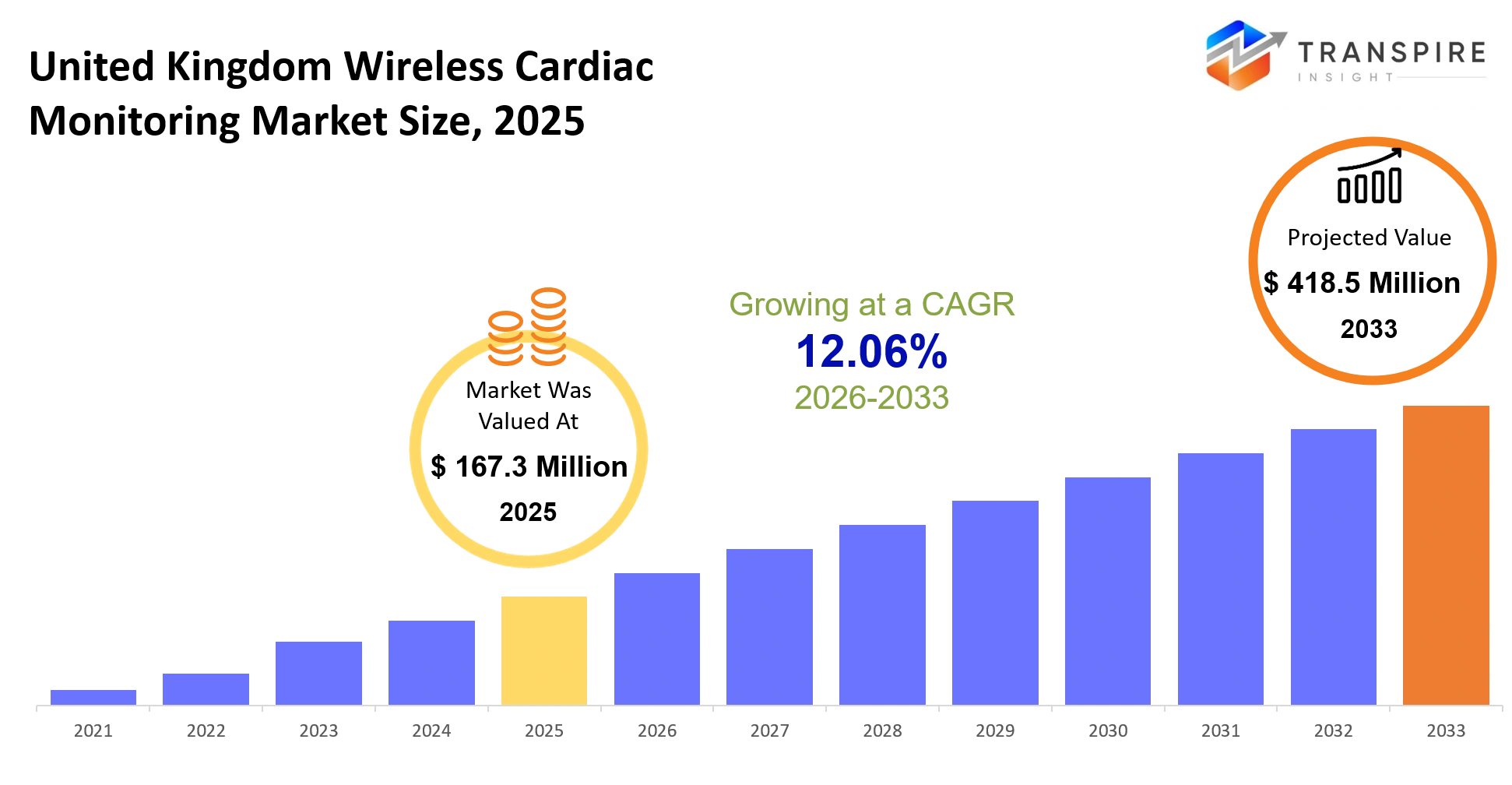
- United Kingdom Wireless Cardiac Monitoring Market Size 2025: USD 167.3 Million
- United Kingdom Wireless Cardiac Monitoring Market Size 2033: USD 418.5 Million
- United Kingdom Wireless Cardiac Monitoring Market CAGR: 12.06%
- United Kingdom Wireless Cardiac Monitoring Market Segments: By Device Type (Wearable Cardiac Monitors, Holter Monitors, Event Monitors, Mobile Cardiac Telemetry Devices, Implantable Loop Recorders, Others); By Technology (Bluetooth-enabled Monitoring, AI-based Monitoring, Cloud-connected Monitoring, Remote Patient Monitoring, Others); By Application (Arrhythmia Monitoring, Heart Failure Monitoring, Post-operative Monitoring, Preventive Cardiac Care, Others); By End User (Hospitals, Cardiology Clinics, Home Healthcare, Diagnostic Centers, Others)
To learn more about this report,  Download Free Sample Report
United Kingdom Wireless Cardiac Monitoring Market Summary
The United Kingdom Wireless Cardiac Monitoring Market was valued at USD 167.3 Million in 2025. It is forecast to reach USD 418.5 Million by 2033. That is a CAGR of 12.06% over the period.
The United Kingdom wireless cardiac monitoring market, sort of supports continuous heart rhythm tracking beyond the usual hospital settings, which lets clinicians notice arrhythmias earlier, help manage ongoing cardiac conditions, and cut down on those avoidable admissions. Hospitals, NHS trusts, and remote care providers are now using wireless ECG patches wearable monitors and connected telemetry systems more often. This is all done in real time, and it also eases the stress on acute care capacity, a bit like day-to-day pressure.
Over the last five years, the market has moved away from those episodic in-clinic diagnostics, and toward remote, and ambulatory monitoring that is tied in with digital health platforms. That shift really picked up during the COVID-19 pandemic, when healthcare providers leaned into virtual care pathways, and kept pushing remote patient management so they could limit unnecessary trips to hospital. In parallel, NHS investment in digital transformation and community-based care models has backed adoption across outpatient cardiology services.
Market growth today seems to come from a pretty practical operational need. Providers rely on wireless monitoring to compress diagnostic timelines, increase patient throughput, and enable earlier intervention for high-risk cardiac patients. And as reimbursement frameworks mature, along with growing clinical confidence, vendors are noticing more solid recurring revenue chances. That includes connected monitoring services, plus data-driven care platforms that keep generating value over time.
Key Market Insights
- In 2025, England seemed to dominate the United Kingdom Wireless Cardiac Monitoring Market, with roughly 72% market share . That mainly comes from advanced NHS infrastructure, plus a bit more cardiology procedure volumes. It feels like a nice combo where tech deployment and clinical throughput just go together, so England holds the lion share.
- Scotland is showing the fastest growing regional market through 2030, kind of pushed by more telehealth expansion programs and this trend toward increased rural, remote monitoring adoption too.
- Urban healthcare networks across London and Manchester keep on speeding up wireless ECG rollouts, in outpatient and community care kind of settings, not stop at all.
- Regional demand growth kind of mirrors this wider push in digital health care ecosystems, like connected diagnostics and those AI enabled patient monitoring platforms too. It’s not just one area, more like a networked, ongoing investment flow, making the whole thing feel more connected and efficient, over time.
- Wearable ECG monitors kind of dominated the market, with around 38% of the revenue share in 2025, mainly because long term ambulatory monitoring is more efficient, not to mention it just makes follow up feel better.
- Mobile cardiac telemtry systems basically held the second largest market share, while hospitals kept expanding real time arrhythmia detection abilities. It kind of tracked with the overall push for more immediate monitoring so, you know, the position stayed fairly strong in that period.
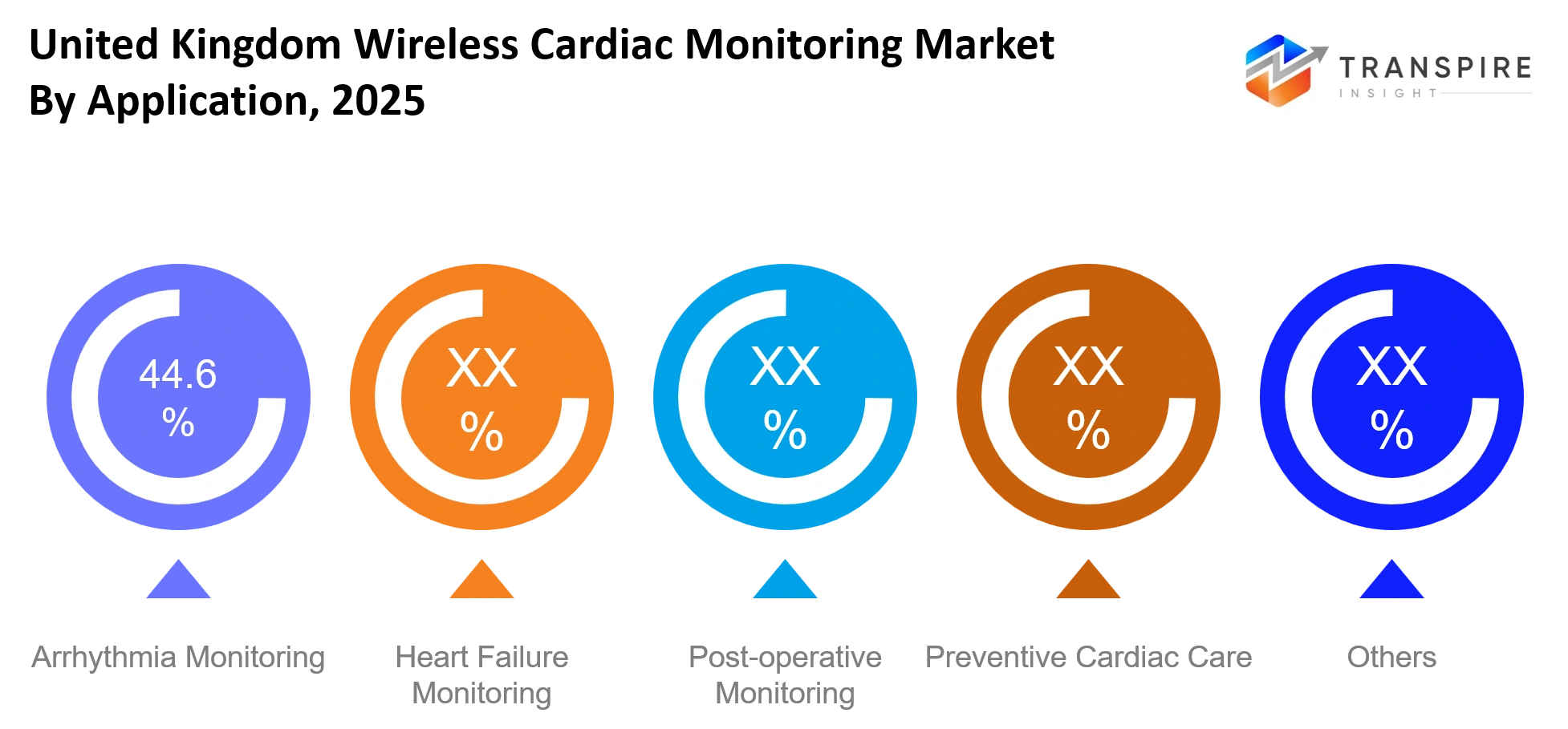
- In 2025 arrhythmia monitoring basically made up nearly 44% of the United Kingdom wireless cardiac monitoring industry size, because atrial fibrillation detection rates kept climbing. It kind of looks like that share came from stronger detection needs, and well, the whole market followed along, pretty closely.
- Remote post-operative cardiac monitoring kind of popped up as the fastest-growing application segment after 2021, especially once expanded virtual recovery programs started getting more traction. Not sure if it was just the timing but it really seemed to accelerate, and yeah, it fits in that direction.
- In 2025 Hospitals plus specialty cardiac centers, really ran the show with more than 55% market share mainly due to lots of diagnostic procedure volume and this integrated monitoring infrastructure, you know kind of all-in-one setup.
- In 2025 Hospitals plus specialty cardiac centers, really ran the show with more than 55% market share mainly due to lots of diagnostic procedure volume and this integrated monitoring infrastructure, you know kind of all-in-one setup.
What are the Key Drivers, Restraints, and Opportunities in the United Kingdom Wireless Cardiac Monitoring Market?
The strongest growth driver in the United Kingdom wireless cardiac monitoring market is, in a way, the NHS shift toward more remote and community based care delivery. This change kind of sped up after the COVID 19 pandemic, when capacity constraints showed up across hospitals and cardiology departments. NHS England then expanded funding for virtual wards, remote diagnostics, and digital patient monitoring programs. The purpose is to reduce avoidable admissions and also shorten waiting lists . Because of that, many healthcare providers began using wearable ECG patches, mobile telemetry systems, and cloud connected cardiac platforms so monitoring can happen outside acute care settings. This transition helps market revenue more directly than it seems, since providers now need both the hardware devices and long running monitoring services. So manufacturers and digital health vendors get recurring income streams, not just one off sales.
Still, data integration is the market’s biggest structural hurdle. A lot of NHS trusts keep fragmented IT systems that, honestly, do not connect wireless cardiac monitoring platforms well with electronic patient records. Fixing this requires several years of infrastructure modernization, cybersecurity upgrades, and interoperability standardization across regional healthcare networks. With these gaps, procurement cycles get slower, big deployments get pushed back, and overall implementation costs climb for providers. Smaller facilities often delay adoption too, because the integration costs feel too high compared with short term operational gains.
Artificial intelligence enabled cardiac analytics looks like the most obvious long term growth opening. Companies are building algorithms that can detect atrial fibrillation and early cardiac irregularities from continuous ECG data, with better diagnostic efficiency. Investment in AI assisted remot
What Has the Impact of Artificial Intelligence Been on the United Kingdom Wireless Cardiac Monitoring Market?
Artificial intelligence along with advanced digital technologies are kind of reshaping the United Kingdom wireless cardiac monitoring market, improving diagnostic speed, and automating clinical workflows while also expanding the ability for remote patient management. More and more healthcare providers are rolling out AI-enabled ECG analysis platforms that can automatically find arrhythmias, atrial fibrillation, and other unusual heart rhythms from continuous wearable monitoring data. This kind of automation cuts down the manual sift through work for cardiologists, and it lets hospitals handle much bigger patient volumes through remote monitoring programs, generally speaking.
Machine learning models are doing another thing too, they’re strengthening predictive cardiac care. Advanced analytics tools review ECG traces over time to spot early signals of cardiac worsening, which helps clinicians step in before acute events force hospitalization. Some NHS-affiliated remote monitoring programs now rely on cloud-connected telemetry systems to sort and prioritize higher-risk patients using AI-based risk scoring. In practice, these systems have helped shorten diagnostic timelines, reduce avoidable admissions, and make outpatient monitoring run more efficiently.
Digital cardiac monitoring platforms are also boosting operational performance by lowering repeat diagnostic appointments and improving clinician productivity, it all feels smoother. Even so, AI adoption still has a big drawback that keeps showing up, mainly around data interoperability. A lot of NHS trusts still run fragmented legacy IT systems, and they cannot seamlessly bring wearable monitoring data into the same environment, which blocks real-time analytics deployment and, in turn, slows broad implementation across regional healthcare networks.
Key Market Trends
- Since 2021, NHS trusts started to put more money into remote cardiac monitoring platformss to try to ease cardiology backlogs and also make outpatient diagnostic timelines shorter, kind of faster.
- After COVID-19, wearable ECG patch adoption really took off, and they began swapping out short-duration Holter monitors in a lot of longer-term ambulatory monitoring programs.
- Philips and GE HealthCare then pushed further with cloud-connected telemetry solutions, because providers were moving toward centralized remote monitoring hubs.
- AI-assisted arrhythmia detection tools helped cut down the manual ECG reading workload, so cardiology teams could move through more patients, without needing to add staffing at the same pace or scale.
- From 2022 through 2025, home-based cardiac monitoring expanded across Scotland and Northern England, mostly due to telehealth funding initiatives, which sounded good on paper too.
- More and more, healthcare providers leaned toward subscription-based monitoring services instead of standalone device purchases, so technology vendors got these recurring revenue patterns rather than one-off sales.
- In 2021, supply chain disruptions highlighted how dependent the sector was on imported semiconductor components, so manufacturers tried diversifying sourcing strategies across Europe.
- Also, mobile cardiac telemetry systems became more common in post-operative monitoring, since hospitals wanted earlier discharge and recovery that happens more in the community.
- Medtronic, Abbott, and iRhythm Technologies increased competition by using AI-enabled analytics, and lighter wearable monitoring technologies that feel less invasive.
- NHS digital transformation rules encouraged vendors to strengthen interoperability standards, but fragmented hospital IT infrastructure still causes delays, so large-scale deployment cycles tend to drag on, a bit too long.
United Kingdom Wireless Cardiac Monitoring Market Segmentation
By Device Type:
Holter Monitors: Holter monitors are used a lot for continuous heart activity recording, over longer stretches. A big reason is the need to find irregular heart rhythms, that often do not show up during a quick, routine check. People also keep adopting them because comfort keeps getting better and the data quality stays strong, in general.
Event Monitors: Event monitors are more like, for capturing heart issues that happen only sometimes, especially when symptoms show up. They give targeted monitoring, and that helps with effective diagnosis. Since they tend to be compact and easier to use, more clinics and patients are willing to take them up, which supports market growth.
Mobile Cardiac Telemetry Devices: Mobile cardiac telemetry devices allow heart data to be sent in real time, to healthcare providers. With ongoing monitoring there can be faster medical reaction when needed. And the rising push for remote care, is really the thing driving adoption at the moment.
Implantable Loop Recorders: Implantable loop recorders are designed for long-term monitoring, mainly for patients who get symptoms only rarely. When the monitoring timeline becomes longer, the diagnostic confidence also tends to improve. Plus, smaller and more miniaturized device designs are moving forward, so the market can keep expanding.
Others: Other monitoring devices cover particular needs for cardiac assessment in different healthcare environments. Product upgrades keep improving features and convenience, without being too complicated. There is also a growing interest in personalized healthcare, and that supports additional demand.
By Technology:
Bluetooth-enabled monitoring kinda lets you move data between devices and digital platforms pretty smoothly. The convenient linking of devices supports efficient cardiac tracking. And you know, the growing use of connected healthcare equipment is pushing adoption.
Wi‑Fi-based monitoring works in a similar way but leans on steady, near real‑time cardiac information transfer. Healthcare providers gain easier access to patient data, and as digital healthcare infrastructure keeps expanding, this approach keeps getting more momentum.
Cellular network monitoring is more like continuous data sending even when you’re not in one place. It’s especially valuable for remote patient monitoring programs . With better network capabilities showing up, adoption is getting stronger over time.
Others: Some other wireless options offer more tailored connectivity for cardiac monitoring. Innovation tends to focus on boosting data precision and operational efficiency, and broader digital healthcare integration helps the market move forward.
By Application:
Arrhythmia Monitoring: Arrhythmia monitoring is still a main application, even as heart rhythm disorders become more common. Keeping watch continuously helps with early detection and faster treatment . Also, more people are paying attention to cardiovascular health, so demand keeps going up.
Post-Surgical Monitoring: After surgery, post surgical monitoring helps track how the patient is bouncing back following cardiac procedures. With continuous observation, the safety improves and treatment outcomes look better. Wireless solutions also make day to day care a bit easier, for most patients.
Heart Failure Management: In heart failure management, ongoing monitoring matters a lot, because it flags shifts in a person’s condition before things get worse. When clinicians can get timely access to cardiac data it supports better treatment decisions. Remote monitoring adoption keeps rising across many care settings.
Others: There are also other uses like preventive care and routine cardiac assessments . More widespread use of monitoring technologies feeds market growth. And with continued innovation, new related opportunities keep showing up.
To learn more about this report, Download Free Sample Report
By End User:
Hospitals, as in most places, are a big driver for wireless cardiac monitoring systems, mostly for continuous patient observation that feels almost always on. With more advanced monitoring in place diagnosis and treatment become more precise, or at least that’s the goal. And since cardiovascular disease cases keep going up, the demand stays steady, sometimes even stronger.
Ambulatory Surgical Centers: These centers use wireless monitoring for patient assessment before and after the procedure. The tech helps overall workflow, and also supports patient safety, not just in theory. As outpatient procedures keep increasing, adoption tends to follow along.
Home Care Settings: Home care settings are seeing strong growth because more people want remote healthcare services. Wireless monitoring makes patient comfort better and also improves accessibility. At the same time, progress in digital health platforms helps these programs keep expanding, without quite so much friction.
Others: Other end users include diagnostic centers and specialized clinics, which means the same cardiac assessment needs appear in different kinds of facilities. Wireless monitoring improves those evaluations across many healthcare environments. Plus, the growing attention on preventive healthcare supports overall market growth.
What are the Key Use Cases Driving the United Kingdom Wireless Cardiac Monitoring Market?
Continuous arrhythmia surveillance is still the main reason people keep adopting it across hospitals and outpatient cardiology clinics . In practice, clinicians are more and more rolling out wearable ECG patches and mobile telemetry setups to catch those on and off episodes of atrial fibrillation, plus other irregular rhythms that a standard in clinic ECG test might not really catch, especially when symptoms come and go.
On another track, post operative heart observation and long term illness upkeep are growing fast, mostly through home healthcare services and those virtual ward arrangements. In the NHS supported remote monitoring pathways, clinicians can oversee patients while they recover at home, which means fewer avoidable readmissions, and generally less stress on acute care units.
More new ideas are also showing up, like AI assisted forecasting for cardiac risk monitoring, plus remote cardiovascular evaluation for elderly groups in rural areas. Tech providers are even trialing integrated monitoring platforms, basically tying wireless ECG signals together with blood pressure readings and oxygen saturation tracking, to back preventive cardiology programs across the forecast period.
|
Report Metrics |
Details |
|
Market size value in 2025 |
USD 167.3 Million |
|
Market size value in 2026 |
USD 188.6 Million |
|
Revenue forecast in 2033 |
USD 418.5 Million |
|
Growth rate |
CAGR of 12.06% from 2026 to 2033 |
|
Base year |
2025 |
|
Historical data |
2021 - 2024 |
|
Forecast period |
2026 - 2033 |
|
Report coverage |
Revenue forecast, competitive landscape, growth factors, and trends |
|
Regional scope |
United Kingdom |
|
Key company profiled |
Medtronic, Philips Healthcare, GE HealthCare, Boston Scientific, Abbott Laboratories, iRhythm Technologies, Biotronik, Nihon Kohden, Baxter, AliveCor, Hillrom, Honeywell, BioTelemetry, Cardiac Insight, Preventice Solutions |
|
Customization scope |
Free report customization (country, regional & segment scope). Avail customized purchase options to meet your exact research needs. |
|
Report Segmentation |
By Device Type (Wearable Cardiac Monitors, Holter Monitors, Event Monitors, Mobile Cardiac Telemetry Devices, Implantable Loop Recorders, Others); By Technology (Bluetooth-enabled Monitoring, AI-based Monitoring, Cloud-connected Monitoring, Remote Patient Monitoring, Others); By Application (Arrhythmia Monitoring, Heart Failure Monitoring, Post-operative Monitoring, Preventive Cardiac Care, Others); By End User (Hospitals, Cardiology Clinics, Home Healthcare, Diagnostic Centers, Others) |
Which Regions are Driving the United Kingdom Wireless Cardiac Monitoring Market Growth?
England is still kind of the dominant regional market because big NHS trusts and large metro hospital networks keep investing, pretty heavily in digital cardiology infrastructure. London, Birmingham and Manchester take a substantial slice of remote cardiac monitoring deployments, mainly because patient volumes are high and outpatient care capacity is more advanced. Then the national virtual ward expansion programs plus NHS digital transformation funding, sort of sped up adoption of wearable ECG monitoring and cloud-based telemetry systems across acute care environments. And there’s also this solid ecosystem of cardiology specialists, digital health startups, diagnostic labs, and technology vendors… which keeps backing big implementations and steady recurring demand for monitoring services.
Scotland is more like stable and strategically important, since healthcare providers emphasize remote monitoring to handle geographic access barriers across rural areas. And it’s a bit different than England, because Scotland’s growth leans less on hospital density and more on telehealth integration within community-based healthcare delivery. Public support for connected healthcare infrastructure plus long-term chronic disease management programs keeps enabling consistent rollout of wireless cardiac monitoring systems. Regional healthcare authorities also stick to ongoing procurement cycles for remote patient monitoring technologies, which gives device manufacturers and software providers pretty reliable revenue visibility.
Wales is emerging as the fastest growing regional market, mainly due to recent investment in digital healthcare modernization and expanded remote care pathways after 2022. Regional health boards are increasingly taking on home-based cardiac monitoring programs to ease hospital congestion and improve cardiovascular disease
Who are the Key Players in the United Kingdom Wireless Cardiac Monitoring Market and How Do They Compete?
Competition across the United Kingdom wireless cardiac monitoring market stays fairly consolidated, with multinational medical technology companies holding a meaningful portion of hospital based monitoring infrastructure. Still, digital health firms and specialized remote monitoring providers are starting to mess with the usual procurement ways, mainly via cloud analytics and subscription service platforms, that kind of thing. In other words, technology capability is now the main ground of competition, more than device pricing by itself. Vendors tend to win (or lose) on AI assisted diagnostics, interoperability with NHS digital systems, remote monitoring scalability, and the long-term service fit across outpatient cardiology programs.
Philips stands out by offering integrated patient monitoring ecosystems, where wireless telemetry plugs into cloud analytics and also links with hospital electronic records inside centralized clinical workflows. Their growth push is leaning more and more toward NHS partnerships and virtual care deployments, aimed at remote cardiac observation even outside acute care facilities. GE HealthCare competes with advanced telemetry infrastructure and AI enabled ECG interpretation platforms built for high volume hospital settings. They also get an edge from strong integration with existing diagnostic imaging plus hospital IT systems, which helps them operate at scale across big healthcare networks.
iRhythm Technologies keeps a tighter niche focus through wearable ECG patches combined with AI based arrhythmia detection algorithms. Their competitive strength comes from more straightforward ambulatory monitoring workflows, which support patient adherence during longer observation windows. Medtronic keeps expanding remote cardiac monitoring features through connected implantable monitoring system
Company List
- Medtronic
- Philips Healthcare
- GE HealthCare
- Boston Scientific
- Abbott Laboratories
- iRhythm Technologies
- Biotronik
- Nihon Kohden
- Baxter
- AliveCor
- Hillrom
- Honeywell
- BioTelemetry
- Cardiac Insight
- Preventice Solutions
Recent Development News
In February 2026, Abbott secured NHS adoption support for its CardioMEMS HF wireless heart failure sensor following NICE guidance. The approval expanded remote monitoring access for chronic heart failure patients and strengthened home-based cardiac care deployment across the UK healthcare system.https://pharmaphorum.com
In April 2026, iRhythm Technologies presented new clinical data at the Heart Rhythm Society 2026 meeting highlighting the effectiveness of extended ambulatory cardiac monitoring through its Zio platform. The findings reinforced clinical adoption of AI-powered wearable ECG monitoring and supported broader use of long-duration arrhythmia detection pathways.https://investors.irhythmtech.com
What Strategic Insights Define the Future of the United Kingdom Wireless Cardiac Monitoring Market?
The United Kingdom wireless cardiac monitoring market is kind of shifting, structurally, toward fully integrated remote cardiology ecosystems that blend wearable diagnostics, AI-assisted analytics, and ongoing patient oversight all within community based healthcare delivery models. The NHS pressure to ease hospital congestion and handle long term cardiovascular disease outside acute care settings will keep nudging this change along over the next five to seven years. That said, one risk that doesn’t get enough attention is data interoperability fragmentation across NHS trusts. If standardized integration frameworks aren’t there, then healthcare providers could end up postponing wider rollouts even with strong clinical demand, which then messes with scalability for monitoring platforms and slows the pace of recurring service revenue growth
An interesting and more recent opportunity is starting to form around predictive cardiac risk monitoring supported by AI enabled longitudinal ECG analysis. Early stage virtual ward efforts in Scotland and Northern England are making it easier for preventive cardiology models, these can spot patient worsening before hospitalization is really needed. Market participants should focus on interoperable cloud monitoring infrastructure and long horizon partnerships with the NHS,
not just chasing device hardware, because purchasing choices are increasingly leaning toward integrated digital care ecosystems that show concrete operational efficiency wins
United Kingdom Wireless Cardiac Monitoring Market Report Segmentation
-
By Device Type
- Wearable Cardiac Monitors
- Holter Monitors
- Event Monitors
- Mobile Cardiac Telemetry Devices
- Implantable Loop Recorders
- Others
-
By Technology
- Bluetooth-enabled Monitoring
- AI-based Monitoring
- Cloud-connected Monitoring
- Remote Patient Monitoring
- Others
-
By Application
- Arrhythmia Monitoring
- Heart Failure Monitoring
- Post-operative Monitoring
- Preventive Cardiac Care
- Others
-
By End User
- Hospitals
- Cardiology Clinics
- Home Healthcare
- Diagnostic Centers
- Others
Frequently Asked Questions
Find quick answers to common questions.
The expected United Kingdom Wireless Cardiac Monitoring Market size for the market will be USD 418.5 Million in 2033.
Key segments for the United Kingdom Wireless Cardiac Monitoring Market are By Device Type (Wearable Cardiac Monitors, Holter Monitors, Event Monitors, Mobile Cardiac Telemetry Devices, Implantable Loop Recorders, Others); By Technology (Bluetooth-enabled Monitoring, AI-based Monitoring, Cloud-connected Monitoring, Remote Patient Monitoring, Others); By Application (Arrhythmia Monitoring, Heart Failure Monitoring, Post-operative Monitoring, Preventive Cardiac Care, Others); By End User (Hospitals, Cardiology Clinics, Home Healthcare, Diagnostic Centers, Others).
Major United Kingdom Wireless Cardiac Monitoring Market players are Medtronic, Philips Healthcare, GE HealthCare, Boston Scientific, Abbott Laboratories, iRhythm Technologies, Biotronik, Nihon Kohden, Baxter, AliveCor, Hillrom, Honeywell, BioTelemetry, Cardiac Insight, Preventice Solutions.
The United Kingdom Wireless Cardiac Monitoring Market size is USD 167.3 Million in 2025.
The United Kingdom Wireless Cardiac Monitoring Market CAGR is 12.06% from 2026 to 2033.
- Medtronic
- Philips Healthcare
- GE HealthCare
- Boston Scientific
- Abbott Laboratories
- iRhythm Technologies
- Biotronik
- Nihon Kohden
- Baxter
- AliveCor
- Hillrom
- Honeywell
- BioTelemetry
- Cardiac Insight
- Preventice Solutions
About the Authors

Pankaj Ghogare Patil
I am Pankaj Ghogare Patil, a Senior Research Analyst at Transpire Insight, specializing in the Pharmaceutical, Chemicals & Materials, Healthcare IT, and Biotechnology industry. My expertise lies in conducting comprehensive market research, analyzing industry trends, evaluating competitive landscapes, and translating complex data into actionable insights. At Transpire Insight, I closely follow emerging technologies, regulatory developments, and market innovations to create accurate, well-researched, and informative content that helps businesses and professionals make informed decisions. I am committed to producing credible, evidence-based articles that reflect industry best practices while making technical topics accessible and valuable for a broad audience.

Chakradhar Khansole
Chakradhar serves as the Research Director at Transpire Insight, bringing over 8 years of experience in technology, innovation, and strategic market intelligence. He specializes in transforming complex market data into actionable business insights that enable organizations to make informed, growth-oriented decisions. Recognized for his strategic vision and analytical expertise, Chakradhar leads high-impact research initiatives, delivering comprehensive market assessments, competitive intelligence, and forward-looking industry analysis.
Recently Published Reports
-
Apr 2026
AI in Diabetic Retinopathy Market
AI in Diabetic Retinopathy Market Size, Share & Analysis Report By Type (Screening AI Systems, Diagnostic AI Systems, and Predictive AI Models), By Application Segment (Hospitals, Ophthalmology Clinics, Diagnostic Centers, and Research and Development), and Geography (North America, Europe, Asia-Pacific, Middle East and Africa, South and Central America), 2021 - 2031
-
Apr 2026
Psychometric Tests Market
Psychometric Tests Market Size, Share & Analysis Report By Type (Personality Tests, Ability/Aptitude Tests, Skill/Knowledge Tests, and Others), By Application (Talent Acquisition and Talent Management), and Geography (North America, Europe, Asia-Pacific, Middle East and Africa, South and Central America), 2021 – 2031
-
Apr 2026
Rare Biological Sample Collection Market
Rare Biological Sample Collection Market Size, Share & Analysis Report By Type (Isolation Kits & Reagent, Blood Collection Tubes, and Others), By Application (Oncology, Transcriptomics, Pharmacogenomics, and Others), and Geography (North America, Europe, Asia-Pacific, Middle East and Africa, South and Central America), 2021 – 2031
-
Jul 2026
Diabetic Retinopathy Market
Diabetic Retinopathy Market Size, Share & Analysis Report By Type (Proliferative Diabetic Retinopathy, and Diabetic Macular Edema (DME)), By Treatment Type (Anti VEGF Drug, Steroid Implants, Laser Surgeries, and Vitrectomy), and Geography (North America, Europe, Asia-Pacific, Middle East and Africa, South and Central America), 2021 – 2031
Our Clients