North America Cardiac AI Monitoring and Diagnostics Market Size & Forecast:
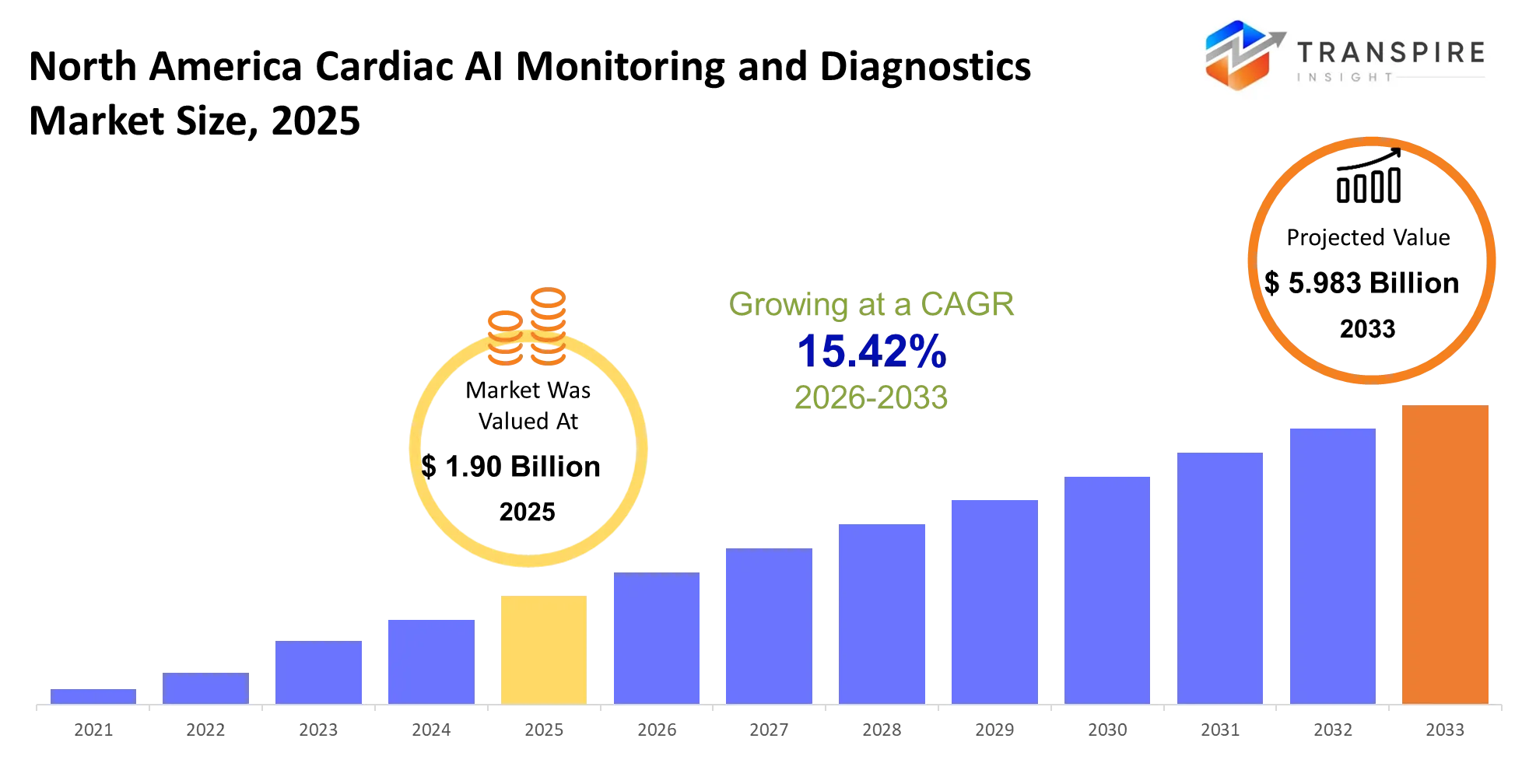
- North America Cardiac AI Monitoring and Diagnostics Market Size 2025: USD 1.90 Billion
- North America Cardiac AI Monitoring and Diagnostics Market Size 2033: USD 5.983 Billion
- North America Cardiac AI Monitoring and Diagnostics Market CAGR: 15.42%
- North America Cardiac AI Monitoring and Diagnostics Market Segments: By Type (ECG Monitoring, Remote Monitoring, Predictive Analytics, Imaging AI, Wearables, Others), By Application (Arrhythmia, Heart Failure, Ischemic Disease, Monitoring, Others), By End-User (Hospitals, Clinics, Homecare, Others), By Deployment (Cloud, On-premises, Hybrid, Others).
To learn more about this report,  Download Free Sample Report
North America Cardiac AI Monitoring and Diagnostics Market Summary:
The North America Cardiac AI Monitoring and Diagnostics Market size is estimated at USD 1.90 Billion in 2025 and is anticipated to reach USD 5.983 Billion by 2033, growing at a CAGR of 15.42% from 2026 to 2033.North America Cardiac AI Monitoring and Diagnostics Market is kind of reshaping, how hospitals , cardiology networks, and remote care providers detect and manage heart problems before they turn into acute medical events. These kinds of platforms work by looking at ECGs, imaging scans, wearable-device signals, and patient histories all together in real time, and that makes it easier for clinicians to spot arrhythmias, heart failure trends, and ischemic risk quicker than the older, slower review workflows. In real day to day practice , the tech helps cut diagnostic bottlenecks a bit, speeds up intervention timelines , and also backs care delivery beyond the hospital walls.
Over the last five years , the market has moved away from more standalone AI assisted imaging tools toward connected clinical decision ecosystems. Those are tied into cloud platforms, remote monitoring infrastructure, and electronic health records. The COVID-19 pandemic pushed this change forward pretty hard too, since providers had to grow virtual cardiac care and rely less on in person diagnostic work. So yeah, that shift basically changed purchasing behavior for good. Health systems now keep putting money into scalable AI platforms because they improve workflow efficiency and patient throughput . And there are pressures building from multiple angles , like cardiologist shortages, aging populations, and higher chronic disease load, all of which raise demand on care capacity and affect reimbursement results.
Key Market Insights
- North America Cardiac AI Monitoring and Diagnostics Market keeps going up, especially as hospitals start using AI powered ECG interpretation, and sort of real time cardiac risk assessment platforms, you know.
- In 2025, AI driven cardiac imaging solutions took close to 38% of the market share, mostly because scan interpretation is quicker, plus diagnostic turnaround times feel less slow than before.
- The United States still leads the North America Cardiac AI Monitoring and Diagnostics Market, holding more than 82% of the regional revenue share, which is backed by an advanced digital healthcare infrastructure.
- Canada looks like the fastest growing regional market through 2030 because provincial healthcare systems are moving faster on virtual cardiac care investments, in a fairly direct way.
- Cloud based cardiac monitoring platforms saw major adoption after 2021, since health systems expanded remote patient management, and also telecardiology services at scale.
- Wearable cardiac monitoring stuff also grew hard, mostly because AI algorithms started fitting together more tightly with consumer health tracking ecosystems.
- Now when it comes to technology, predictive analytics solutions will be the quickest expanding segment from 2025 to 2030, driven by preventive cardiology efforts, and also the general push to spot issues early before they get worse.
- Diagnostic software platforms make up nearly 42% of industry size, because providers often prioritize workflow automation, and clinical decision support features, all together.
- For applications, AI assisted arrhythmia detection stays the leader, with roughly 35% market share across healthcare networks in North America.
- Heart failure monitoring is projected to be the fastest growing application category, largely linked to more chronic disease management needs, and hospital readmission penalties that keep increasing.
- And finally, hospitals plus cardiac specialty centers lead end user demand with about 58% revenue share, supported by big enterprise level AI integration projects that take time but get traction.
What are the Key Drivers, Restraints, and Opportunities in the North America Cardiac AI Monitoring and Diagnostics Market?
The North America Cardiac AI Monitoring and Diagnostics Market is getting its biggest boost from the rapid, kind of uneven, integration of AI into remote cardiac care workflows after COVID-19. That period really showed the weak spots of hospital centric monitoring systems. Then healthcare providers ran into more readmission costs, clinician shortages, and later diagnosis timelines, so hospitals and insurers leaned harder on AI enabled monitoring platforms for continuous patient surveillance beyond the usual clinical walls. On top of that, expanded reimbursement for remote physiological monitoring in the United States made AI supported cardiac diagnostics more affordable and scalable, not just experimental. In practice, this shift is already lifting recurring software revenue, cloud monitoring subscriptions , and device integration contracts across health systems.
But honestly, data interoperability is still the market’s most stubborn structural obstacle. Cardiac AI platforms have to connect with fragmented hospital IT setups, older imaging infrastructure, and different electronic health record architectures. A lot of providers are still using dated systems that struggle to process real time cardiovascular data streams without major friction. Fixing it is not quick, it tends to mean multi year infrastructure modernization, regulatory coordination, and a sizable cybersecurity investment. So deployments can move slower at the enterprise level, procurement decisions get delayed, and adoption is often suppressed in mid-sized networks where digital budgets are tight.
Predictive cardiovascular analytics looks like the next real growth lane. AI models that can anticipate heart failure worsening and arrhythmia risk before acute events hit are bringing steady funding interest from both providers and insurers, and that momentum feels like it will keep building.
What Has the Impact of Artificial Intelligence Been on the North America Cardiac AI Monitoring and Diagnostics Market?
Artificial intelligence and newer digital technologies are, in a very real way, reshaping how cardiac conditions are monitored, diagnosed, and managed through North American healthcare systems. AI enabled cardiac monitoring platforms now do ECG interpretation mostly on their own, spotting arrhythmias and sorting patient risk levels, so the manual check work for cardiologists and other clinical staff gets lower, kind of lighter. Many hospitals are also linking these tools to cloud based electronic health records , plus remote monitoring networks , so high-risk cardiac patients can be watched continuously outside of usual clinic or ward settings. The result is smoother clinical workflow, and often faster diagnostic turnaround, especially in urgent care and outpatient settings where time matters.
On top of that, machine learning models are giving predictive cardiology more muscle.Clinicians are using AI methods to help them anticipate heart failure worsening, spot earlier atrial fibrillation signatures, and flag patients with higher cardiovascular risk before acute events show up . In day to day practice, these forecasting systems can reduce avoidable hospital readmissions , and they also help people remain on track with the suggested care pathways . Remote cardiac monitoring programs, tied to wearable biosensors, have shown clear improvements in care consistency and operational effectiveness, mostly because interventions can happen earlier and fewer unnecessary in person appointments are required.
Still, there’s the catch, and it’s not small. Integration remains a major stumbling block. A lot of healthcare organizations keep running on disconnected legacy IT systems that do not handle real time cardiovascular data very well. High setup expenses, heavy cybersecurity requirements, and variable data quality all keep large scale rollout from moving quickly across mid sized hospital networks.
Key Market Trends
- From 2021 to 2025, hospitals kind of shifted around 35% more cardiac monitoring workflows toward remote , and cloud connected diagnostic ecosystems , which honestly felt like a pretty big change.
- GE HealthCare and Philips expanded their AI driven ECG analytics portfolios after clinician shortages, which then pushed teams toward more automated , almost like workflow smoothing.
- AI assisted arrhythmia detection moved out of those pilot runs and into enterprise deployment once reimbursement support grew for remote physiological monitoring services in 2022.
- Wearable cardiac biosensors got noticeably better adoption after healthcare providers started caring about longitudinal monitoring rather than those single, isolated diagnostic encounters.
- Since 2020 , health systems have been reducing reliance on manual ECG interpretation because machine learning platforms improved triage speed , and also diagnostic consistency , at the same time.
- Canadian healthcare networks accelerated telecardiology investments after pandemic era virtual care rules permanently altered outpatient cardiac management strategies, and yes that change stuck.
- Medtronic and Abbott Laboratories increased their partnerships with AI software firms in order to strengthen predictive cardiac monitoring capabilities, in a more proactive direction.
- Cardiology providers increasingly favor subscription based AI monitoring platforms , since the recurring software approach helps lower the upfront infrastructure investment requirement, even if budgets are tight.
- Cybersecurity spending across cardiac diagnostics platforms rose a lot after connected medical devices became more integrated with hospital IT ecosystems, and that integration kept expanding.
- Between 2023 and 2026 , predictive heart failure analytics showed up as a strategic investment area because insurers focused on reducing avoidable readmission costs, and the numbers mattered.
North America Cardiac AI Monitoring and Diagnostics Market Segmentation
By Type
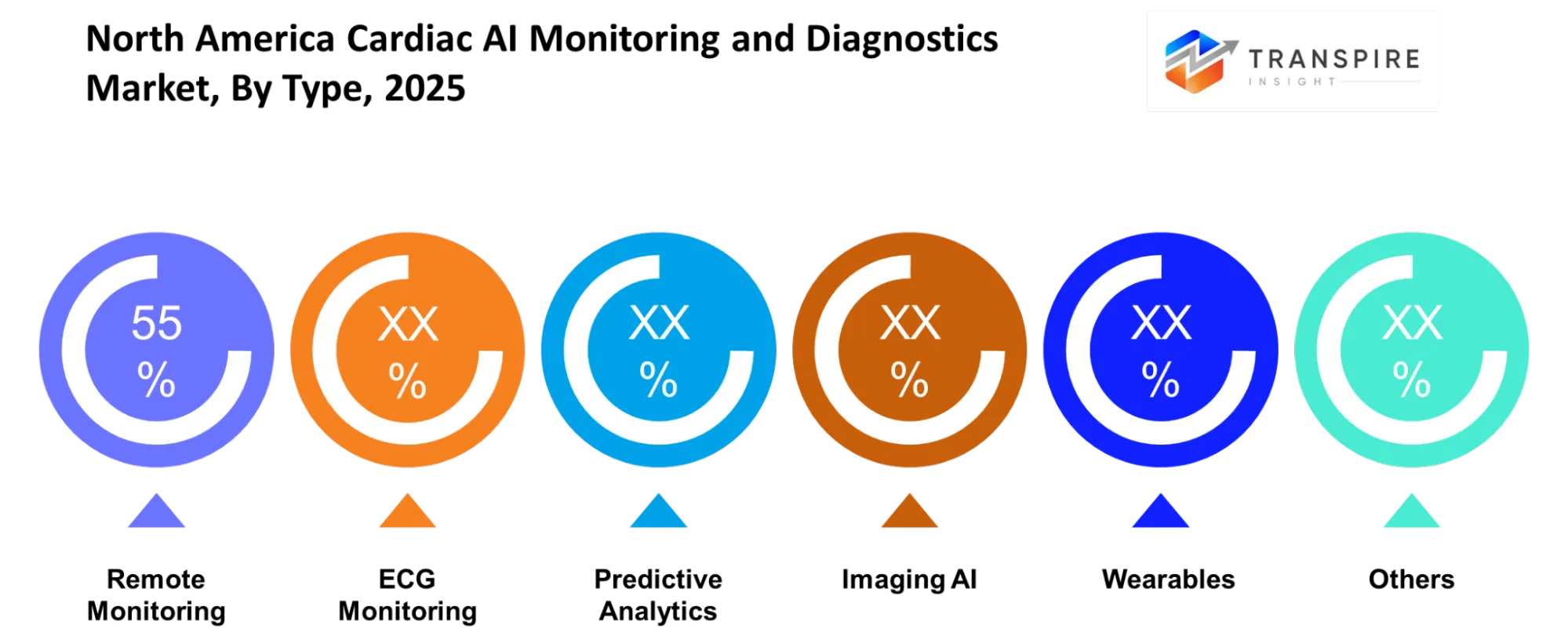
So, by type ECG monitoring solutions stay in the lead, in a kind of obvious way, since hospitals and cardiology networks depend a lot on automated rhythm interpretation and basically continuous electrocardiographic analysis. At the same time remote monitoring platforms have been picking up big momentum, because healthcare systems are pushing more virtual cardiac care and, you know, trying to lean less on in-person diagnostics. Imaging AI tools are also getting more traction in tertiary care centers due to swifter scan interpretation and some workflow streamlining advantages. Predictive analytics and wearable integrated monitoring solutions look like the fastest-growing segments, mostly because insurers and providers are putting extra emphasis on preventative cardiovascular management.
Wearable biosensors that plug into AI platforms now enable long horizon patient tracking even outside the clinic, which is kind of important. Meanwhile cost pressures and cardiologist shortages keep nudging more automation through diagnostic workflows, step by step but still pretty quickly. Looking ahead, future development will likely revolve around more integrated ecosystems that blend ECG monitoring, predictive risk scoring, imaging analytics, and wearable connectivity into one unified cardiovascular intelligence platform, and that should create recurring software income for tech providers, while giving healthcare buyers better long-term operational efficiency.
To learn more about this report, Download Free Sample Report
By Application
In terms of application , arrhythmia detection is still the big segment. atrial fibrillation and irregular heartbeat problems basically need continuous watchfulness and fast intervention. AI-supported ECG analysis has also made a noticeable difference, because in emergency departments it speeds up diagnostic work, and in outpatient cardiology settings it helps keep interpretation more consistent, sort of. Heart failure monitoring looks like it is growing the quickest as well, partly because readmission penalties keep rising and chronic disease burdens are getting heavier all across North America. Now, predictive monitoring platforms assist clinicians in spotting early decline patterns, before an acute hospitalization actually becomes unavoidable.
Ischemic disease diagnostics still hold solid adoption levels too, since imaging AI and clinical decision support tools raise interpretation precision, especially in high-volume cardiac centers. At the same time, remote patient monitoring applications are expanding in a steady way, as healthcare systems keep moving toward decentralized care delivery models. Going forward, application growth will likely lean hard on predictive cardiology algorithms that can blend imaging results, biosensor signals , and patient history into something truly actionable for clinical teams. Developers that focus on early intervention capabilities and real time risk stratification are expected to end up in a stronger competitive position over the next decade, overall.
By End-User
By end-user, hospitals kind of take the biggest share, mainly because big healthcare networks have the infrastructure, the budgets, and all the clinical data volume they need to roll out enterprise-style AI diagnostics systems. You see cardiac specialty centers and those larger integrated hospital groups keep pouring money into automated imaging interpretation, steady monitoring platforms, and cloud powered cardiovascular analytics. Meanwhile clinics are slowly ramping up adoption, subscription based software models make things easier to start with , and they also widen access to AI-supported diagnostic help. Homecare environments are the fastest-growing bit , largely driven by more widespread acceptance of wearable cardiac monitoring and remote patient management programs.
As populations age and chronic cardiovascular disease stays high, providers feel pushed to extend monitoring beyond the hospital walls. Even reimbursement backing for remote physiological monitoring services has gotten stronger, so ambulatory care and home-based models are adopting more. Looking ahead, the direction seems to lean toward tighter convergence between hospital systems and homecare monitoring networks, which opens up opportunities for vendors able to provide interoperable platforms that keep patients engaged continuously, while also fitting into multi setting clinical workflows.
By Development
By deployment, cloud based platforms kinda dominate the market because healthcare providers increasingly need scalable infrastructure that can deal with huge amounts of real time cardiovascular data. Cloud deployment also makes remote access easier , and it supports more centralized patient management, and it tends to fit nicely with wearable monitoring ecosystem integration. That said, on-premises solutions still keep a bit of relevance especially for large hospitals and research institutions that really care about internal data control, tighter cybersecurity management, and meeting regulatory compliance. However, the ongoing maintenance costs and those infrastructure limitations that never seem to go away are slowly pulling attention away from fully localized deployment models.
Hybrid deployment frameworks are now starting to show up as a notable growth area , mainly because many healthcare organizations want flexibility. They want cloud scalability on one side and protected local data storage on the other. Multi-site healthcare systems in particular often go hybrid, kind of balancing operational efficiency with compliance expectations that can’t just be brushed aside. Moving ahead, I guess future investment trends will lean more toward interoperable cloud native ecosystems, that sort of blend with electronic health records , predictive analytics engines and remote monitoring infrastructure . In other words, the providers who can roll out secure low latency deployment models , while also keeping in step with regulatory expectations, are probably going to lock in sturdier long term contracts across North American healthcare networks .
What are the Key Use Cases Driving the North America Cardiac AI Monitoring and Diagnostics Market?
AI assisted arrhythmia detection is still kind of the main reason hospitals and cardiac specialty centers are adopting these systems. With continuous ECG monitoring, clinicians can pick up atrial fibrillation and other uneven heart rhythms sooner , and that tends to cut down emergency admissions plus it shortens diagnostic delays.
At the same time remote heart failure monitoring, and follow-up cardiac surveillance after discharge is getting more attention with homecare providers and ambulatory care networks. Wearable biosensors that feed into cloud based analytics now help teams keep track of patients over longer periods, which can help reduce readmissions and support chronic disease management results.
Some emerging use cases are predictive cardiovascular risk modeling and AI guided preventive cardiology programs too. Health systems are already trialing machine learning platforms that mix imaging information with wearable measurements and patient history , to forecast acute cardiac deterioration before symptoms show up in a way clinicians can clearly see.
|
Report Metrics |
Details |
|
Market size value in 2025 |
USD 1.90 Billion |
|
Market size value in 2026 |
USD 2.193 Billion |
|
Revenue forecast in 2033 |
USD 5.983 Billion |
|
Growth rate |
CAGR of 15.42% from 2026 to 2033 |
|
Base year |
2025 |
|
Historical data |
2021 - 2024 |
|
Forecast period |
2026 - 2033 |
|
Report coverage |
Revenue forecast, competitive landscape, growth factors, and trends |
|
Country scope |
North America (Canada, The United States, and Mexico) |
|
Key company profiled |
Philips, GE Healthcare, Siemens Healthineers, Medtronic, Abbott, Boston Scientific, AliveCor, iRhythm, BioTelemetry, IBM, Microsoft, Google, Oracle, NVIDIA, Apple |
|
Customization scope |
Free report customization (country, regional & segment scope). Avail customized purchase options to meet your exact research needs. |
|
Report Segmentation |
By Type (ECG Monitoring, Remote Monitoring, Predictive Analytics, Imaging AI, Wearables, Others), By Application (Arrhythmia, Heart Failure, Ischemic Disease, Monitoring, Others), By End-User (Hospitals, Clinics, Homecare, Others), By Deployment (Cloud, On-premises, Hybrid, Others) |
Which Regions are Driving the North America Cardiac AI Monitoring and Diagnostics Market Growth?
The United States kind of leads the North America Cardiac AI Monitoring and Diagnostics Market because big healthcare systems still keep investing pretty aggressively in digital cardiology infrastructure, and AI‑supported clinical workflows . At the same time, reimbursement rules that are favorable for remote physiological monitoring plus telehealth services, helped push enterprise adoption across hospitals and outpatient networks faster than before. Also, major technology companies , academic medical centers and cardiovascular research institutions kind of build a broader innovation ecosystem that keeps supporting rapid commercialization of AI‑enabled diagnostics. On top of that, widespread electronic health record use and cloud-connected healthcare infrastructure further reinforces the country’s leadership in predictive cardiac analytics and remote monitoring platforms.
Canada sits as the second-largest regional contributor, though the growth patterns look different in practice . Canadian provincial healthcare systems seem to emphasize long-term care efficiency, fair patient access, and coordinated virtual healthcare expansion more than large-scale commercial rollouts. Their public healthcare funding models help maintain steady adoption of remote cardiac monitoring technologies, especially for underserved groups and people in geographically dispersed areas. Meanwhile, ongoing investments in telecardiology infrastructure and chronic disease management programs keep Canada a dependable generator of recurring market revenue , even though its healthcare technology ecosystem is comparatively smaller.
Mexico is starting to look like the fastest-growing regional market, mainly because healthcare digitization is still moving forward, and there is also bigger investment going into private cardiac care infrastructure. Lately the telemedicine programs have been expanding , and with urban specialty hospitals plus connected diagnostic platforms, people can access more AI-assisted cardiovascular services, mostly in the main metropolitan areas. Private healthcare providers are also modernizing their diagnostic capabilities more and more, partly to cope with the rising cardiovascular disease rates, and because patients and clinicians want quicker, almost instantaneous clinical decision-making tools. This whole momentum then makes room for interesting opportunities for technology vendors, cloud platform companies, and device manufacturers looking for early expansion momentum across the 2026–2033 stretch.
Who are the Key Players in the North America Cardiac AI Monitoring and Diagnostics Market and How Do They Compete?
The competitive landscape of the North America Cardiac AI Monitoring and Diagnostics Market is still somewhat consolidated, like, big medical technology companies run most hospital-scale deployments while specialized digital health players quietly poke at specific diagnostic niches. It feels like the fight is less about device pricing now, and more about how correct the algorithms are, how well things integrate, the cloud connectivity, and whether vendors can land long term service agreements. Even the older healthcare technology providers are holding their ground by adding artificial intelligence right into the imaging systems they already sell, plus monitoring platforms and clinical workflow software. Meanwhile new entrants are starting to show momentum with wearable diagnostics, analytics sold via subscriptions, and remote monitoring ecosystems meant for outpatient and homecare settings, basically in those smaller care environments.
GE HealthCare sets itself apart with integrated cardiovascular imaging and AI-enabled workflow automation platforms that plug directly into enterprise hospital systems. They also lean on long standing relationships with large healthcare networks, which helps a lot with multi-site deployment contracts and extended software integration work. Philips puts a lot of emphasis on connected patient monitoring and telecardiology infrastructure, so healthcare providers can pair bedside diagnostics with remote cardiac surveillance. Ongoing strategic partnerships with hospital systems and cloud technology providers keep reinforcing recurring service revenue models, and the whole long-term digital care integration angle too.
iRhythm Technologies kind of competes by focusing in a very niche spot for continuous ECG tracking plus AI aided arrhythmia detection. Their own analytics routines along with long duration wearable monitoring help set them apart, especially in outpatient cardiac diagnostics where timing matters. Medtronic then grows its positioning, they do it by mixing AI supported analytics right into implantable heart devices and the wider remote monitoring networks. Abbott Laboratories keeps boosting its presence too, mostly through connected cardiovascular platforms and cloud enabled patient management tools that aim for real time clinical decision making, across both hospital and ambulatory care settings.
Company List
- Philips
- GE Healthcare
- Siemens Healthineers
- Medtronic
- Abbott
- Boston Scientific
- AliveCor
- iRhythm
- BioTelemetry
- IBM
- Microsoft
- Oracle
- NVIDIA
- Apple
Recent Development News
In April 2026, HeartFlow Files AI Cardiology Patent Lawsuit Against Cleerly: California-based HeartFlow filed a lawsuit against rival Cleerly over alleged misuse of patented AI-driven cardiac imaging technologies. The dispute highlights increasing competition in AI-powered heart diagnostics and coronary disease analysis platforms in the U.S. cardiac AI market.
Source: https://www.reuters.com
In January 2026, Boston Scientific Expands Cardiovascular Portfolio with Penumbra Acquisition: Boston Scientific agreed to acquire Penumbra in a $14.5 billion transaction aimed at strengthening its cardiovascular and interventional device business. The acquisition supports Boston Scientific’s broader strategy around advanced cardiac treatment and AI-assisted monitoring technologies.
Source: https://www.reuters.com
What Strategic Insights Define the Future of the North America Cardiac AI Monitoring and Diagnostics Market?
The North America Cardiac AI Monitoring and Diagnostics Market is kinda moving, structure wise, toward predictive and continuously connected cardiovascular care models over the next five to seven years. The main reason is mounting financial pressure on healthcare systems to cut down emergency admissions, clinician workload, and also the long-haul costs tied to chronic disease, mostly by intervening earlier. AI platforms that can weave wearable biosensors, imaging information, and longitudinal patient records together will more and more swap out the older isolated diagnostic routines with real-time cardiovascular risk management ecosystems.
There’s also a less obvious risk, kind of like a quieter undercurrent, related to market concentration around a small set of healthcare technology vendors. These vendors control proprietary datasets and the hospital integration backbone. Smaller developers might find it difficult to scale, because algorithm validation, cybersecurity compliance, and interoperability needs are getting more capital intensive, than people expect. Meanwhile, preventive cardiology solutions that are connected to consumer wearables, and even insurer-supported remote monitoring initiatives, look like a rising opening , with solid long-term promise. Firms trying to step into this area should really lean hard on interoperable cloud architecture and payer partnerships early on, since reimbursement alignment and clinical embedding will shape the long-run competitive position more than standalone algorithm performance alone.
North America Cardiac AI Monitoring and Diagnostics Market Report Segmentation
By Type
- ECG Monitoring
- Remote Monitoring
- Predictive Analytics
- Imaging AI
- Wearables
- Others
By Application
- Arrhythmia
- Heart Failure
- Ischemic Disease
- Monitoring
- Others
By End-User
- Hospitals
- Clinics
- Homecare
- Others
By Deployment
- Cloud
- On-premises
- Hybrid
- Others
Frequently Asked Questions
Find quick answers to common questions.
The approximate North America Cardiac AI Monitoring and Diagnostics Market size for the market will be USD 5.983 Billion in 2033.
The key segments of the North America Cardiac AI Monitoring and Diagnostics Market are By Type (ECG Monitoring, Remote Monitoring, Predictive Analytics, Imaging AI, Wearables, Others), By Application (Arrhythmia, Heart Failure, Ischemic Disease, Monitoring, Others), By End-User (Hospitals, Clinics, Homecare, Others), By Deployment (Cloud, On-premises, Hybrid, Others).
Major players in the North America Cardiac AI Monitoring and Diagnostics Market are Philips, GE Healthcare, Siemens Healthineers, Medtronic, Abbott, Boston Scientific, AliveCor, iRhythm, BioTelemetry, IBM, Microsoft, Google, Oracle, NVIDIA, Apple.
The current market size of the North America Cardiac AI Monitoring and Diagnostics Market is USD 1.90 Billion in 2025.
The North America Cardiac AI Monitoring and Diagnostics Market CAGR is 15.42%.
- Philips
- GE Healthcare
- Siemens Healthineers
- Medtronic
- Abbott
- Boston Scientific
- AliveCor
- iRhythm
- BioTelemetry
- IBM
- Microsoft
- Oracle
- NVIDIA
- Apple
Recently Published Reports
-
Apr 2026
AI in Diabetic Retinopathy Market
AI in Diabetic Retinopathy Market Size, Share & Analysis Report By Type (Screening AI Systems, Diagnostic AI Systems, and Predictive AI Models), By Application Segment (Hospitals, Ophthalmology Clinics, Diagnostic Centers, and Research and Development), and Geography (North America, Europe, Asia-Pacific, Middle East and Africa, South and Central America), 2021 - 2031
-
Apr 2026
Psychometric Tests Market
Psychometric Tests Market Size, Share & Analysis Report By Type (Personality Tests, Ability/Aptitude Tests, Skill/Knowledge Tests, and Others), By Application (Talent Acquisition and Talent Management), and Geography (North America, Europe, Asia-Pacific, Middle East and Africa, South and Central America), 2021 – 2031
-
Apr 2026
Rare Biological Sample Collection Market
Rare Biological Sample Collection Market Size, Share & Analysis Report By Type (Isolation Kits & Reagent, Blood Collection Tubes, and Others), By Application (Oncology, Transcriptomics, Pharmacogenomics, and Others), and Geography (North America, Europe, Asia-Pacific, Middle East and Africa, South and Central America), 2021 – 2031
-
May 2026
Patient Lift Pendant Market
Patient Lift Pendant Market By Product Type (Wired Pendants, Wireless, Programmable), By Operation Type(Manual, Electric), By End-Users (Healthcare Professionals, Patients), By Application (Hospitals, Homecare, Rehabilitation Centers, Others), By Industry Analysis, Size, Share, Growth, Trends, and Forecasts 2021-2033
Our Clients
.jpg)